What's inside
- Key Takeaways
- Quick Picks
- How We Chose These Picks
- Why does backyard pizza taste different?
- Comparison Table
- Setting up a backyard pizza station that works
- How do you choose a backyard pizza oven?
- How do you cook great pizza outdoors?
- What Are the Most Common Mistakes?
- Final Recommendation
- Frequently Asked Questions
- Related Guides
As an Amazon Associate I earn from qualifying purchases. This post may contain affiliate links at no extra cost to you.
cottageverdict.com is reader-supported. When you buy through links on our site, we may earn an affiliate commission.
Backyard pizza is a different sport from its indoor cousin, and the best backyard pizza ovens play it at full intensity: stones at temperatures a kitchen oven cannot pronounce, real flame in two cases, and pizzas that cook in about the time it takes to tell someone you are making one. This guide covers the outdoor class on its own terms — gas, wood and multi-fuel machines for gardens, patios and gatherings.
The six divide by fuel and philosophy. Two Oonis offer gas simplicity at 18 inches and multi-fuel choice at 16; Solo Stove and Gozney bring professional heat in portable bodies; the Bertello rotates its stone and burns gas and wood together; and the Big Horn opens the wood-fired door at an honest price, with its gas burner sold separately — a fact its review states before praising anything else.
Before the reviews, a note on sourcing: each pick links to its Amazon listing, where you can check price on Amazon and confirm fuel fittings, included burners and accessories for your region. Outdoor ovens live hard lives, so also weigh covers, stands and storage while you shop — the oven is a system, and the system includes where it sleeps.
A safety frame for the whole guide: these are outdoor appliances, full stop. They belong on sturdy, level, heat-proof surfaces in open air, away from structures and overhangs, attended while lit. Every pleasure described below assumes that frame, and no crust is worth bending it.
Key Takeaways
- Fuel is the first decision: gas for ease (Koda 2 Pro, Pi Prime), wood for character (Big Horn), both for choice (Karu, Bertello, Roccbox).
- The Big Horn’s gas burner is sold separately — it is a complete wood oven in the box and a gas project later.
- The Bertello’s rotating stone removes the turning skill that defeats most beginners.
- Recovery between pizzas decides party quality; insulated and big-stoned ovens hold their heat across a run.
- Size runs 12 to 18 inches — personal-pizza flow or sharing-pie stage; buy for your gathering’s real shape.
- Every oven here is outdoor-only, on a sturdy surface, attended while lit. No exceptions for weather or enthusiasm.
Quick Picks
| Pick | Badge | Why it earns its place |
|---|---|---|
| Ooni Koda 2 Pro Gas Pizza Oven 18 Inch | Biggest gas-fired stage | An 18-inch gas oven with regulator and hose included — the largest pies and the easiest fuel in the backyard class. |
| Ooni Karu 2 Pro Multi-Fuel Pizza Oven | Wood or gas, your choice | A 16-inch multi-fuel oven with an integrated thermometer — burn wood for flavour and ceremony, or gas for ease, in one body. |
| Solo Stove Pi Prime Propane Pizza Oven | Fastest heat, demi-dome design | Propane-fired, heats to 950°F and cooks in about 90 seconds, with a demi-dome design and a wide 13-inch opening. |
| Gozney Roccbox Outdoor Pizza Oven | Restaurant-grade, portable body | A compact, low-profile oven heating to 950°F for 12-inch pizzas in about a minute — gas as standard, wood with its burner system. |
| Bertello SimulFIRE 16 Inch Rotating Outdoor Pizza Oven | Rotating stone, simultaneous fire | A 16-inch outdoor oven whose rotating stone turns the pizza for you, with SimulFIRE burning gas and wood together. |
| BIG HORN 16 Inch Multi-Fuel Outdoor Pizza Oven | Big heat, honest entry price | A 16-inch stainless multi-fuel oven reaching 1112°F on wood — with gas available via a burner sold separately, stated plainly. |
How We Chose These Picks
We selected outdoor ovens across the fuel spectrum and the honest price range, verifying each against its maker’s listing for size, fuel and included equipment. Where a listing separates the oven from its gas burner — the Big Horn — the assignment is stated in the review’s opening, its spec list and these notes, because an outdoor oven bought under a misapprehension about fuel is a garden ornament by August.
Judgement weighted the party reality: heat-up, recovery between pizzas, the forgiveness of the launch and turn, and the quality of the tenth pizza as much as the first. Portability claims were read sceptically — an oven is portable if a household actually carries it — and build was assessed as garden equipment, built to live outdoors and be cleaned outdoors.
We also kept one foot in the beginner’s garden. Several picks automate or forgive the skills that defeat first sessions, and the reviews say which help each oven actually gives, because the best backyard oven is the one still being fired in its second summer.
Why does backyard pizza taste different?
Heat, mostly — heat of a kind indoor appliances are not allowed to make. A stone at 900°F and beyond cooks a pizza from both worlds at once: the base crisps in a minute while flame rolls over the rim, puffing and spotting it before the toppings have time to dry. The result is a contrast — crackle, chew, char, freshness — that defines the style and cannot be simulated at 500°F by any technique yet invented.
Fire adds its signature where wood is involved. The smoke of real hardwood kisses the crust in the minute it cooks, a flavour gas cannot counterfeit and the reason multi-fuel ovens exist. Even gas-fired backyard ovens benefit from the format itself: an open, fierce, dedicated chamber, and a cook standing over the pizza with a peel, participating.
The third ingredient is the occasion. Backyard pizza is cooked in the open, in company, in a sequence — the oven becomes a hearth, the cook a host, and dinner a performance with edible results every two minutes. Indoor pizza feeds people; backyard pizza gathers them, and the machines in this guide are built for the gathering as much as for the crust.
None of this requires expertise to start. It requires heat, a little flour, and the willingness to sacrifice a first pizza to education — a tuition every owner in history has paid, and none has regretted at the price of the second pizza.
There is also a rhythm the backyard teaches: fire, launch, turn, retrieve, slice, repeat. It is closer to a craft than to cooking by timer, and households that take to it find their Fridays reorganised around the oven the way earlier generations organised them around a barbecue — which is, in the end, the category this guide belongs to.
And the leftovers question answers itself: there rarely are any. Pizzas cooked in ninety seconds, to order, in a garden, tend to be eaten at the pace they are made.
One more backyard truth deserves recording: the neighbours will know. The smell of wood smoke and baking crust is the least private cooking in the world, and pizza ovens have a documented tendency to enlarge their owners’ social circles whether the owners planned it or not. Buy a little extra flour from the first week. You will need it, and the reason will be standing at your fence with a plate.

Ooni Koda 2 Pro Gas Pizza Oven 18 Inch — Biggest gas-fired stage
Size is a social feature, and the Koda 2 Pro is built around that truth. Its 18-inch stone takes the pizzas that end arguments — the big sharing pies, the rectangular-ish family efforts, the two smaller pizzas juggled in sequence without a queue forming at the oven door. For households whose pizza night is a gathering rather than a meal, those extra inches are not a specification; they are the difference between hosting and catering in shifts.
Gas keeps the big stage easy to run. The included regulator and hose connect to a standard bottle, the oven climbs to full pizza heat in a preheat you can time a drink by, and the flame answers the dial when a delicate pizza needs mercy. Beginners fear big ovens less when the fuel behaves, and the Koda’s gas manners make its size welcoming rather than intimidating.
The crust at full heat is the Ooni signature this guide’s affordable chapter already praised: a base that crisps in about a minute, a rim that puffs and spots, toppings that stay vivid because their ordeal is brief. At 18 inches the same physics scales — the stone stores more heat, recovery between pizzas is swift, and a run of six pizzas for a garden full of people holds its quality from first to last.
Portability is relative at this size. The oven moves between a stand, a table and a car boot, but it is a two-hand carry and a deliberate setup, not a grab-and-go toy. Households should site it properly — a sturdy, level, heat-proof surface with the bottle placed as the manual directs — and treat the setup ritual as part of the occasion rather than a tax on it.
Running a big gas oven teaches economy quickly. Preheat fully once, cook the run of pizzas in a flowing sequence, and let the stone’s stored heat work; opening and idling between scattered single pizzas wastes the charge you paid gas to build. Hosts who organise toppings into an assembly line discover the oven’s real party trick: it is faster than the table can eat.
Against its 14-inch sibling in our affordable guide, the Pro’s case is purely scale and refinement — the same gas simplicity, a larger stage, a build aimed at enthusiasts who host. Readers cooking for two should save the difference; readers cooking for eight should not pretend the smaller stone will feel generous by July.
Storage and weather complete the ownership picture. The oven lives under a cover or indoors between sessions, the stone stays dry, and the hose connection gets a leak check at the season’s start. None of this is burdensome, but a backyard oven is garden equipment as much as kitchen equipment, and it rewards being kept like both.
There is also a confidence dividend in starting big. Cooks who learn on an 18-inch stone learn launching and turning with room for error, and their second pizza is visibly better than their first. Cramped ovens punish beginners; this one gives them a stage and lets them grow into it.
For the household that has decided pizza night is a fixture — weekly, outdoors, with an audience — the Koda 2 Pro is the guide’s expansive answer: the most room, the easiest fuel, and crusts that justify the gathering.
Choose it if your pizzas are large, your gatherings are larger, and your fuel preference is the clean simplicity of gas.
A note on the second pizza, because it is where big ovens prove themselves. The first pizza rides on stored heat and optimism; the second arrives while the stone is being asked to recover and the guests are forming opinions. The Koda 2 Pro’s gas output restores the stone briskly, so pizza two eats like pizza one — and by pizza six, when lesser ovens are fading, the big Ooni is simply in its working rhythm, which is what hosting actually requires.
- Fuel: propane gas, 28 mBar regulator and hose included
- Pizza size: up to 18 inch
- Use: outdoor, portable
- Brand: Ooni Koda line, second generation
- Style: low-profile tabletop oven
- Best for: large pizzas and gatherings
Strengths
- 18-inch stone hosts sharing pizzas
- Gas control is beginner-friendly
- Fast recovery across a run of pizzas
Trade-offs
- Needs a proper stand and storage
- Two-hand carry, deliberate setup
- Overkill for couples cooking for two
Best for: Hosts and families cooking pizza outdoors weekly.
Not suited for: Small households and first-time buyers testing the hobby.

Ooni Karu 2 Pro Multi-Fuel Pizza Oven — Wood or gas, your choice
The Karu 2 Pro is the romantic’s oven, engineered so the romance does not cost convenience. It burns wood — real flame, real smoke, the full ceremony of fire management — and it also runs on gas when Tuesday is not a night for ceremony. That dual citizenship is the design’s whole argument: the flavour and theatre of wood-fired cooking, kept honest by a gas alternative for the evenings when the cook’s heart is willing but the schedule is not.
Wood first, because that is why you are looking at it. A properly built fire in the Karu drives the stone to fierce heat and licks flame across the pizza’s rim, giving the crust a blistered, faintly smoky character that gas alone does not counterfeit. The integrated thermometer keeps the fire honest — no guessing whether the stone is ready — and the 16-inch chamber gives the pizza, and the cook’s turning peel, room to work.
Fire management is a skill, and this guide will not pretend otherwise. Small, dry hardwood pieces, added little and often, hold the temperature steadier than a bonfire approach; the first few sessions teach more than any manual. But the learning is the pleasure for the Karu’s buyer — this is cooking as participation, and the oven is built to reward the participant with visible, edible progress.
Gas mode, by contrast, is the oven’s weekday face: connect, preheat, cook, with the same stone and chamber delivering the same style of crust minus the smoke’s signature. Households divided between a purist and a pragmatist will find the Karu ends the argument by housing both religions under one chimney.
The build is Ooni’s enthusiast tier — substantial, well-finished, designed to live outdoors under a cover and travel to gatherings when required. It is not the lightest object in this guide, and its chimney silhouette needs a moment’s thought in storage, but the substance reads as quality every time the door opens.
Fuel costs split by mood: wood in small quantities is cheap and characterful, gas is predictable and clean. Either way the oven earns its keep across a season of Fridays, and the multi-fuel flexibility means a shortage of one fuel never cancels pizza night — a resilience single-fuel owners occasionally envy.
Against the Koda 2 Pro, the trade is character against simplicity. The Koda is easier, larger and gas-only; the Karu is the oven for cooks who want fire in the story. Neither answer is wrong, and the buyer’s honest answer to one question — do I want to tend a flame? — decides between them more reliably than any specification.
Technique notes for the wood path: let the stone, not the flame, be the judge of readiness, keep a turning peel moving, and accept that pizza three of your first session will shame pizza one. The Karu’s thermometer shortens that apprenticeship by telling the truth about the stone.
There is a gathering effect unique to fire ovens. Guests drift toward the flame the way they drift toward a hearth, and the cook becomes the evening’s quiet performer. If your pizza nights are partly theatre — and the best ones are — the Karu is the only pick here that supplies its own stage lighting.
Choose the Karu 2 Pro if you want the choice itself: wood when the night deserves it, gas when it does not, and a 16-inch stone that serves both faithfully.
Ownership settles into a pleasing duality: the Karu becomes two appliances in the household’s mind, the celebration oven and the Tuesday oven, and both get used because neither asks the other to compromise. Few purchases survive contact with real schedules as gracefully as a machine that can change its character with the evening’s mood, and that adaptability is the deepest sense in which this oven is well named.
- Fuel: multi-fuel — wood and gas (gas burner configuration per listing)
- Pizza size: 16 inch class
- Extras: integrated thermometer, pizza stone included
- Use: outdoor, portable
- Brand: Ooni Karu line
- Style: chimney multi-fuel design
Strengths
- Wood flavour with a gas fallback
- Integrated thermometer guides the fire
- 16-inch chamber suits turning and hosting
Trade-offs
- Fire management is a learned skill
- Chimney design needs storage thought
- Heavier than the gas-only portables
Best for: Cooks who want wood-fired character without commitment.
Not suited for: Anyone wanting the simplest possible oven.

Solo Stove Pi Prime Propane Pizza Oven — Fastest heat, demi-dome design
Solo Stove made its name with smokeless fire pits, and the Pi Prime applies the same instinct — manage the heat intelligently — to pizza. Its demi-dome design rolls heat over the pizza from above while the cordierite stone handles the base, and the numbers tell the story plainly: up to 950°F, pizzas cooked in about ninety seconds. For the cook whose gatherings run on momentum, that speed is not a statistic; it is the difference between a queue and a flow.
The 13-inch opening is the working detail. Wide enough to launch and turn without the knuckle-scraping anxiety of narrower mouths, it makes the Pi Prime a forgiving teacher for beginners despite its professional temperatures. The first pizza may still be tuition — it always is — but the oven’s geometry stops charging extra for the lesson.
Propane keeps the operation clean: no ash, no fire-tending, a dial between the cook and the temperature. Solo Stove’s stainless build, in 304 grade, is made for outdoor life and reads it — this is equipment designed to live in gardens and travel to campsites, with the finish and fasteners to survive both without cosseting.
Ninety-second pizzas demand a mise en place discipline the slower ovens forgive. Toppings laid out in order, dough stretched in a small queue, a confident launch and one turn — the Pi Prime rewards the organised cook with a production line, and gently exposes the disorganised one. Hosts who enjoy a system will find the oven makes them look very good.
Size honesty: the stone serves the 12-inch class of pizza, so this is a many-pizzas oven rather than a giant-pizza oven. For gatherings that rhythm suits the format — personal pizzas, topped to order, arriving every couple of minutes — and children in particular prefer their own pizza to a slice of a large one.
The brand’s fire-pit following matters for ownership: Solo Stove’s accessories, covers and support are built around outdoor products that live outside, and the Pi Prime slots into that world of stands and shelters. Buyers already running a Solo fire pit will find the family resemblance practical, not just visual.
Against the Oonis, the Pi Prime’s argument is speed and the dome. The Koda 2 Pro offers a bigger stage; the Karu offers wood; the Pi counters with the fastest cook in the guide and an opening that flatters beginners. Enthusiasts with strong opinions about heat roll will have theirs; newcomers can buy this oven on its friendliness at full temperature.
Running costs are the usual propane pennies per pizza, and the oven’s appetite is proportionate to its pace — short preheats, short cooks, little idle burning if the host keeps the sequence moving. Organisation, again, is the fuel economy.
There is a particular joy in an oven that keeps up with a party. The Pi Prime’s ninety-second rhythm turns pizza-making from a bottleneck into the entertainment itself, with the cook stationed at the warmest, happiest post in the garden.
Choose the Pi Prime if your pizza nights are gatherings that run on flow — many pizzas, made to order, at genuine high heat.
Solo Stove’s following brings a practical dividend: the Pi Prime lives in an ecosystem of stands, covers and shelters designed by people who think about outdoor equipment full-time. A pizza oven is only as usable as the station around it, and buying into a mature outdoor system shortens the distance between the box arriving and the first great Friday night.
- Fuel: propane gas
- Top heat: up to 950°F
- Cook time: around 90 seconds at full heat
- Stone: cordierite pizza stone
- Opening: 13 inch wide
- Build: 304 stainless steel, demi-dome heating
Strengths
- 950°F heat cooks in about 90 seconds
- Wide opening forgives beginners
- 304 stainless build for outdoor life
Trade-offs
- 12-inch class stone, not for giant pizzas
- Demands organised topping preparation
- No wood-fuel option for purists
Best for: Hosts making many personal pizzas at gatherings.
Not suited for: Giant-pizza households and wood-fire seekers.

Gozney Roccbox Outdoor Pizza Oven — Restaurant-grade, portable body
The Roccbox is the professional’s portable, and its design tells you so before the first pizza: thick insulation, a serious stone floor, and a compact body that holds restaurant heat without a restaurant’s bulk. It reaches 950°F and cooks a 12-inch pizza in about a minute, yet it is built to be carried — to the beach house, the campsite, the friend’s garden — which makes it the oven in this guide most likely to have adventures.
Insulation is its quiet genius. Where lesser portables leak heat and struggle to recover between pizzas, the Roccbox’s body holds its temperature like a much larger oven, so the fourth pizza cooks like the first. For gatherings, recovery is the specification that matters and the one brochures underplay; Gozney, coming from professional ovens, builds for it instinctively.
Gas is the standard fuel, with a wood-fired path through the brand’s burner system for cooks who want flame character on occasion. That optionality mirrors the Karu’s philosophy in a smaller body: convenience as the default, ceremony as the choice. The wood route is an accessory decision rather than a second oven, which keeps the Roccbox’s proposition tidy.
The 12-inch ceiling defines its household: couples, small families, and gatherings run as a sequence of personal pizzas. Within that ceiling, quality per pizza is arguably this guide’s peak — the crust a Roccbox produces at full heat is the one enthusiasts photograph. Hosts of eight should look at the Ooni Koda 2 Pro’s stage instead; artists of the individual pie should look nowhere else.
Build quality carries a professional price signal, and check price on Amazon will place the Roccbox in the premium tier of this guide. The justification is in the materials and the insulation — this is a small commercial oven adapted for home use, not a home oven pretending upward — and buyers who cook weekly will feel the difference in recovery and consistency long after the price is forgotten.
Portability deserves precision: it is portable the way a serious tool is portable — a planned carry, a proper surface at the destination, a cool-down before the return trip. Within those manners it travels beautifully, and its low profile sits happily on tables that would make taller ovens nervous.
The learning curve is the standard high-heat one, shortened by the oven’s consistency. Because the Roccbox repeats its temperatures faithfully, the cook’s notes from last Friday apply this Friday, and improvement compounds — a professional trait that home ovens with wandering heat cannot offer.
Accessories and covers from a professional brand complete the ownership: peels sized to the oven, covers that fit, support that understands heavy use. The ecosystem costs money and returns reliability, the usual Gozney bargain.
For the cook who wants one perfect pizza at a time, anywhere, at professional heat, the Roccbox is the guide’s connoisseur portable — small in size, entirely serious in intent.
Choose it if quality per pizza and true portability outrank pizza diameter in your backyard ambitions.
There is a discipline the Roccbox teaches that larger ovens let you postpone: because each pizza is small and the heat is fierce, the cook learns to read colour and blister with real attention. Owners describe their tenth Roccbox pizza as a different food from their first, made in the same oven — the machine’s consistency turns experience into skill at an unusual rate.
- Top heat: up to 950F
- Pizza size: 12 inch, cooked in about 60 seconds
- Fuel: gas, with wood-fired option via burner system
- Design: portable, compact low-profile
- Grade: restaurant-grade build
- Use: outdoor, home and away
Strengths
- Insulation gives superb heat recovery
- 950°F, minute-long cooks, pro build
- Travels to gatherings and campsites
Trade-offs
- 12-inch ceiling on pizza size
- Premium pricing for its class
- Wood firing needs the burner accessory
Best for: Connoisseurs cooking personal pizzas anywhere.
Not suited for: Hosts needing large pizzas in quantity.
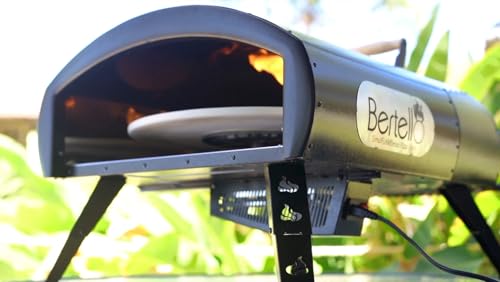
Bertello SimulFIRE 16 Inch Rotating Outdoor Pizza Oven — Rotating stone, simultaneous fire
Every high-heat oven in this guide asks the cook to turn the pizza; the Bertello asks the stone to do it. Its rotating base turns the pizza continuously through the heat, evening the rim’s colour without the turning peel, the opened door or the lost heat — and for beginners, that automation removes the single most intimidating skill in pizza making at exactly the moment they are least equipped to perform it.
The fuel system is the second idea in the name: SimulFIRE burns gas and wood simultaneously, so the oven holds gas’s dependable base temperature while real wood flame adds the character and top heat that purists chase. It is a genuinely different answer to the fuel argument — not either-or like the Karu’s modes, but both at once, with the wood contributing flavour while the gas guarantees the stone never sags mid-service.
Sixteen inches is a family-generous stage, and the rotation makes it a calm one: launch the pizza, watch it turn, retrieve it when the colour says so. The theatre of a rotating pizza is also real — guests watch it the way they watch a rotisserie — and hosts who have burned a rim while greeting arrivals will appreciate an oven that minds the turning for them.
Honesty about novelty is required. Rotating mechanisms add a moving part to an environment of fierce heat and flour dust, so the Bertello asks for the cleaning discipline its manual describes and a buyer comfortable with a younger brand’s support network. The idea is sound and the following is enthusiastic — the oven’s Shark Tank appearance built it a visible community — but it is the least conventional machine here, and conventional buyers should know themselves.
Results, when the system is used as designed, solve the classic backyard failure: the half-blistered, half-pale rim. Rotation averages the oven’s hot spots the way the Presto’s tray did indoors, and at 16 inches with simultaneous fire the average is taken at a much higher level of ambition. Fresh dough rewards the evenness most; frozen pizzas benefit too, though they are not the reason to buy this oven.
Setup and siting follow the class rules — sturdy surface, outdoor air, fuel connections checked — with the addition of the rotation’s power or mechanism arrangements per the manual. Plan the station before the first firing and the oven settles into the garden’s routine quickly.
Against the Karu, its multi-fuel rival, the Bertello trades the ritual of fire-tending for automation and simultaneity. The Karu’s cook participates; the Bertello’s cook supervises. Both produce wood-kissed pizza at 16 inches, and the choice between them is a choice about what the cook wants to do with their hands while dinner happens.
For households whose pizza nights failed on the turn — the burnt side, the pale side, the argument about whose fault — the rotating stone is not a gimmick but a targeted cure. Features that cure a specific, remembered failure earn their complexity.
It is also, quietly, the most forgiving oven here for teaching children and guests to launch a pizza, because the oven forgives the stillness that ruins a static-stone cook. A pizza night where everyone gets a turn is a better party than one where everyone watches the expert.
Choose the Bertello if you want wood-and-gas flavour at 16 inches without mastering the turn — the oven that does the skilled part for you.
Families report an unexpected social effect of the rotation: because the oven minds the turning, the cook can talk, pour drinks and supervise children’s toppings between launch and retrieval. The Bertello returns the host to the party, and for households whose pizza nights kept exiling their best conversationalist to the oven, that return is worth as much as the even crusts.
- Pizza size: 16 inch
- Stone: rotating for even cooking
- Fuel: SimulFIRE — gas and wood simultaneously
- Use: outdoor
- Recognition: as seen on Shark Tank
- Style: rotating outdoor pizza oven
Strengths
- Rotating stone evens the crust automatically
- Gas and wood burn simultaneously
- 16-inch stage suits families and guests
Trade-offs
- Moving parts need diligent cleaning
- Younger brand, smaller support network
- Less hands-on ritual for fire lovers
Best for: Beginners and hosts who fear the turning peel.
Not suited for: Purists who want full manual fire craft.

BIG HORN 16 Inch Multi-Fuel Outdoor Pizza Oven — Big heat, honest entry price
The Big Horn is the value play of the backyard class, and its review must handle one fact with total clarity, because the listing itself states it: this is a 16-inch wood-fired oven that is also gas compatible, with the gas burner sold separately. Bought as a wood oven, it is complete in the box. Bought as a future gas oven, it has an accessory in its future. Readers deserve that sentence before any praise, and the praise, once the sentence is absorbed, is considerable.
Considerable because the wood-fired core is serious: a stainless 16-inch oven rated to a fierce 1112°F, sized for family pizzas and party service, at the accessible end of this guide’s pricing — check price on Amazon and compare it with the premium names. For the buyer whose dream is a real wood-fired pizza and whose budget is not, the Big Horn is the door that is actually open.
Wood firing at this level is the full craft: building the fire, reading the stone, feeding small pieces to hold the heat. The Big Horn’s size helps the beginner — a 16-inch chamber forgives a wandering launch — while its heat punishes inattention the way all wood ovens do. Expect the apprenticeship every wood cook serves, and expect the oven to reward it with crusts that carry genuine fire character.
Portability is party-grade: the oven moves around the garden and travels to gatherings without a trailer, and its stainless construction shrugs at outdoor life. It is built to a price, and the finish will not be mistaken for the Gozney’s — but it is built for heat first, which is the correct priority at its level.
The gas option, when the burner is added, converts the oven into the dual-fuel pattern this guide knows well: wood for occasions, gas for Tuesdays. Budgeting that burner from the start — rather than discovering it at checkout — turns the Big Horn into a staged purchase: wood now, gas when the habit proves itself. Staged honestly, it is a sensible way to climb the category.
Against the Karu 2 Pro, the comparison is finish and furniture: the Ooni brings an integrated thermometer, a refined burner ecosystem and a premium build; the Big Horn brings the same 16-inch wood-fired idea at a friendlier entry, with more of the judgement left to the cook. Thermometer-free wood cooking teaches by flame and stone colour — the old way — and some cooks prefer their education unbugged by instruments.
Party service is its home fixture. Sixteen inches, fierce heat and a price that does not make the host nervous around enthusiastic guests — the Big Horn can be the garden’s workhorse without being its treasure. There is a freedom in an oven you are not precious about, and pizzas taste no worse for it.
Running costs are wood costs: small hardwood pieces, kindling, and the time to tend them. Households that enjoy the fire will count that time as part of the evening; households that will not should buy gas from the start and leave this oven to the fire-tenders, who will love it without reservation.
It closes the guide as its entry ticket to real wood-fired pizza — the oven that proves the hobby to a household before the household invests in its premium forms. Many enthusiasts’ stories begin with exactly such a machine.
Choose the Big Horn if you want genuine wood-fired heat at 16 inches on an honest budget — and buy the gas burner later only if Tuesdays demand it.
A word for the cook who will tend this fire: keep a small stock of dry hardwood pieces cut to size, a natural firelighter habit, and a brush for the stone, and the Big Horn’s rituals become five pleasurable minutes rather than a chore. Wood ovens reward households that organise their fuel the way good cooks organise a pantry — and gently punish those who go hunting for dry wood in the dark.
- Pizza size: 16 inch
- Top heat: up to 1112°F wood-fired
- Fuel: wood-fired, gas compatible (burner sold separately)
- Build: stainless steel, portable
- Use: outdoor, party-friendly size
- Format: 2-in-1 multi-fuel design
Strengths
- Real wood-fired heat up to 1112°F
- 16-inch stage at an accessible level
- Gas upgrade path when you are ready
Trade-offs
- Gas burner sold separately — not in the box
- No integrated thermometer to guide you
- Finish is functional over refined
Best for: Budget-minded wood-fire beginners and party hosts.
Not suited for: Buyers expecting gas cooking out of the box.
Comparison Table
| Pick | Headline trait | Watch out for |
|---|---|---|
| Ooni Koda 2 Pro | 18-inch stone hosts sharing pizzas | Needs a proper stand and storage |
| Ooni Karu 2 Pro | Wood flavour with a gas fallback | Fire management is a learned skill |
| Solo Stove Pi Prime | 950°F heat cooks in about 90 seconds | 12-inch class stone, not for giant pizzas |
| Gozney Roccbox | Insulation gives superb heat recovery | 12-inch ceiling on pizza size |
| Bertello SimulFIRE 16 | Rotating stone evens the crust automatically | Moving parts need diligent cleaning |
| BIG HORN 16 Inch | Real wood-fired heat up to 1112°F | Gas burner sold separately — not in the box |
Setting up a backyard pizza station that works
Arrange the station as a flow: dough and toppings on one side, the oven at the centre, a landing rack and board on the other. The cook should never cross the garden with a peel or carry a finished pizza through a crowd. A minute spent arranging the flow saves every session from the small chaos that burns rims and tempers.
Light and footing matter after dark. Pizza nights run into the evening, and the cook works with fire and blades; a lit station and a dry, level floor are safety equipment, not ambience. Put the oven where its light falls on the work, not in the cook’s eyes.
Finally, give the station a home for its tools — peels hung, brush and fuel at hand, cover within reach. Stations that reassemble themselves get used weekly; stations that must be rebuilt from the shed get used monthly, and the oven’s value lives entirely in that difference.
How do you choose a backyard pizza oven?
Fuel first, because it decides your evenings. Gas is pizza on a whim — light, preheat, cook, done — and suits households that fire the oven weekly without ceremony. Wood is pizza as an event, with fire-tending as part of the pleasure and smoke in the crust as the reward. Multi-fuel ovens refuse the choice at a premium; the Big Horn stages it, wood now and gas by accessory later. Be honest about which cook you are on a wet Friday, not which you are in June.
Size second. Twelve-inch ovens cook personal pizzas in a flowing sequence — ideal for gatherings where everyone tops their own. Sixteen and eighteen inches serve sharing pies and families who eat the same pizza together. Count your usual table, not your largest imaginable party, and remember that a sequence of small pizzas is often better theatre than one large one.
Forgiveness third. Beginners should weigh the ovens that help: the Bertello’s rotation, the Pi Prime’s wide opening, the Karu’s thermometer, the Koda’s dial-simple gas. Every owner improves, but the oven that forgives the first month is the one still in use in the second year, and use — not specification — is what a backyard oven is for.
Site and storage fourth. The oven needs a sturdy, level, heat-proof station with room for the peel’s swing and the bottle’s placement, plus a dry sleep under a cover or indoors. Measure the station before the oven arrives, and budget the stand and cover as part of the purchase rather than as afterthoughts.
Total cost last, honestly counted: oven, burner if separate, stand, cover, peels, fuel. The Big Horn’s accessible ticket grows by its burner if you want gas; the premium ovens arrive more complete. Compare systems, not headlines, and check price on Amazon for each element on the same day.
Finally, buy for the second summer. First-summer enthusiasm is universal; the right oven is the one whose fuel, size and temperament still suit you when pizza night is a habit rather than a novelty. Habits are built from ease and pleasure in equal measure — choose the machine that offers your household both.
How do you cook great pizza outdoors?
Heat the stone, not the air. Give the oven its full preheat and judge readiness by the stone — by thermometer where fitted, by the flour test where not: a pinch of flour on the stone should turn golden in seconds, not blacken instantly or sit pale. Launching onto an underheated stone is the one error no topping can survive, and patience at this step is the whole secret the professionals charge for.
Build on the peel, launch with confidence. Dust the peel with flour or semolina, assemble the pizza there, shake to confirm it slides, and deliver it to the stone in one committed motion. Turn once — or trust the Bertello to turn for you — when the rim’s colour tells you to, and retrieve onto a rack so the base stays crisp while the cheese settles.
Keep toppings dry and light. Outdoor heat is fierce but brief; wet toppings steam rather than roast in ninety seconds. Pat mushrooms and peppers, drain mozzarella, sauce thinly. The backyard style is about intensity of flavour per bite, not volume per slice, and restraint is its technique as much as its taste.
Run the session like a station. Dough balls resting, toppings in order, a landing zone for finished pizzas, a queue of guests with opinions. The ovens here cook faster than a table can deliberate, so organisation — not the oven — is the bottleneck at every good pizza party.
Mind the fire between pizzas. Wood ovens want small pieces added little and often to hold the stone’s heat; gas ovens want the door closed and the dial left alone. Recovery is a habit, and hosts who feed the oven while the table eats the last pizza never serve a pale one.
Clean when cool, store when dry. Brush the stone, empty ash cold, wipe the steel, cover or carry in. Five minutes of aftercare is the difference between an oven that is ready next Friday and one that needs a project before it is.
What Are the Most Common Mistakes?
Using an outdoor oven under a cover or indoors
These ovens are open-air appliances. Awnings, garages and conservatories trap heat and fumes; the garden, in open air, is the only venue, whatever the weather is doing.
Launching onto a cold stone
Impatience is the ruin of first sessions. The stone is the oven; when it is ready, everything else is easy, and when it is not, nothing else matters.
Buying gas expectations in a wood box
The Big Horn cooks on gas only with its separate burner. Read what is in the box before the first firing, and budget accessories as part of the oven.
Leaving the oven out uncovered all winter
Stones crack with trapped moisture and steel dulls under weather. A cover or a dry shed is not an accessory; it is the second half of the purchase.
Overloading a 90-second pizza
At backyard temperatures, heavy wet toppings cannot cook through before the base is done. The style rewards restraint; serve seconds instead of mountains.
Setting the oven on a wobbly table
A fierce oven, a swinging peel and a rickety stand are a bad committee. Sturdy, level and heat-proof, or do not light it.
Final Recommendation
Most households should start where their temperament points. Gas households will be happiest with the Koda 2 Pro’s big, easy stage or the Pi Prime’s rapid flow; fire households with the Karu’s choice of fuels or the Big Horn’s honest wood-fired entry; the Roccbox serves the travelling connoisseur, and the Bertello serves everyone whose pizzas used to burn on one side — which, if we are honest, is most of us at the beginning.
What unites the six is the transformation they offer a garden: a reason to gather, a skill to grow into, and dinner as an event rather than a delivery. Buy the fuel you will actually light, the size your table actually needs, and the forgiveness your first month requires — then fire it weekly, sacrifice the first pizza cheerfully, and let the second one explain why the whole neighbourhood suddenly prefers your garden on Fridays.
Start your shortlist with the Ooni Koda 2 Pro, weigh it against the Ooni Karu 2 Pro, and keep the Solo Stove Pi Prime in view before you decide.
Frequently Asked Questions
How long do backyard pizza ovens take to heat up?
Plan on a real preheat — roughly a quarter of an hour to half an hour depending on fuel and weather — for the stone to store cooking heat. Gas is the most predictable; wood rewards patience with character. The stone’s readiness, not the clock, is the true signal.
Can I leave a backyard pizza oven outside?
With a fitted cover, most can live outside in season; stones should stay dry, and winter storage indoors or under serious shelter extends every oven’s life. Ash must be cold and removed, and gas connections checked at the season’s start.
What fuel is cheapest to run?
All are modest per pizza. Gas is predictable and clean, wood is inexpensive where hardwood offcuts are available, and the real cost driver is how often you fire the oven — weekly cooks amortise any of these machines into pennies of fuel per pizza.
Do I need a stand for a backyard pizza oven?
A sturdy, level, heat-proof surface is essential; a dedicated stand is the easiest way to guarantee one, with working height that saves your back across a session. Wobbly garden furniture is not a surface, whatever its intentions.
How big a pizza should a family oven make?
Sixteen inches feeds a family as one shared pizza or two mediums in sequence; twelve-inch ovens serve gatherings as personal pizzas. Match the oven to your table’s habit rather than its maximum headcount.
Is wood-fired pizza really better than gas?
It is different: wood adds a smoky signature and the pleasure of fire craft, gas adds precision and ease. Most blind tasters argue happily for an hour, which tells you the honest answer — buy the fuel whose process you will enjoy weekly.
Related Guides
The outdoor chapter connects back to the kitchen in our neighbouring guides: Best 24 Inch Electric Ranges covers compact indoor cooking for the days the garden is rained off, Best Barista Machines equips the coffee end of a long evening outside, and Best Bean to Cup Coffee Machines for Home completes the drinks station for hosts whose gatherings run from espresso to pizza.


