What's inside
- Key Takeaways
- Quick Picks
- How We Chose These Picks
- The Best 30 Inch Electric Ranges Worth Your Money, Reviewed One by One
- How Do the Six Compare Side by Side?
- Why Has Electric Become the Default Range?
- How Much Oven Capacity Does a Household Need?
- What Is the Difference Between Steam Clean and Self Clean?
- Does Air Fry in a Full Oven Actually Work?
- How Do Radiant, Infrared and Standard Elements Differ?
- What Should You Check About the Electrical Supply?
- How Should You Care for a Glass-Ceramic Top?
- Which Control Layout Suits Your Household?
- How Do You Plan a Kitchen Around a Freestanding Range?
- What Does Ownership Cost Beyond the Purchase?
- Which Range Suits a Rental or a First Home?
- How Should You Break In a New Electric Range?
- What Happens at Holiday Scale on a 30-Inch Electric Range?
- How Do You Judge an Oven’s Evenness Before You Own It?
- Why Do Some Ranges Offer a Fifth Element?
- What Should You Do With the Old Range?
- How Does a New Range Change Weeknight Cooking?
- What Questions Should You Ask at the Point of Order?
- What Goes Wrong Most Often With a 30-Inch Electric Range Purchase?
- Final Recommendation
- Frequently Asked Questions
- Related Guides
As an Amazon Associate I earn from qualifying purchases. This post may contain affiliate links at no extra cost to you.
cottageverdict.com is reader-supported. When you buy through links on our site, we may earn an affiliate commission.
The 30-inch electric range is the default cooker of the modern kitchen: no gas line required, a smooth top that wipes clean, and an oven whose even heat made a generation of bakers. Choosing among the best 30 inch electric ranges is therefore not about whether the format works — it is about which version of it fits your household: the biggest oven, the gentlest cleaning, the keenest burners, or the plainest good sense. This guide separates those arguments so you can pick your own.
Where to buy: all six ranges are sold through Amazon, and the pick names in the Quick Picks table and the detailed reviews link to each listing so you can check price on Amazon and confirm the current specification before ordering. Every model here is a full range needing a proper range circuit — if your kitchen currently cooks on gas, read the installation notes in the sections below before assuming the swap is simple.
The six below divide the mainstream honestly: GE’s all-round benchmark, Frigidaire’s big gentle oven, Kenmore’s capacity with front controls, Midea’s plain value, Empava’s flexibility, and Rangaire’s infrared enthusiasm. Same width, same fuel, six different households — the reviews argue each case on the evidence of daily life rather than brochure arithmetic.
Key Takeaways
- All six are smooth-top electric ranges at the standard 30-inch width — the differences are oven size, cleaning style and burner character.
- Oven capacity runs from 4.8 to 5.6 cu. ft.; the Kenmore holds the most and puts its controls at the front.
- Steam cleaning (Frigidaire, Midea, Empava) is the gentle school; it handles routine soil, not years of neglect.
- Air fry now lives inside full ovens — GE even skips the preheat — but a crowded tray still crisps unevenly.
- Infrared burners on the Rangaire are the responsiveness pick for cooks who sear often.
- Service networks matter over a fifteen-year life: GE and Frigidaire are the easiest badges to get repaired widely.
Quick Picks
| Pick | Badge | Why it earns its place |
|---|---|---|
| GE 30 Inch Free-Standing Electric Convection Range | Best All-Round Family Range | Convection baking plus No Preheat Air Fry in a free-standing body from the most serviced badge in American kitchens. |
| Frigidaire Electric Convection Range 5.3 Cu Ft | Best Big Oven, Gentle Cleaning | A 5.3 cu. ft. convection oven with both air fry and steam cleaning — capacity for family roasts, cleaning without the blast furnace. |
| Kenmore 5.6 Cu Ft Front Control Electric Range | Best Capacity and Controls Up Front | The largest oven here at 5.6 cu. ft., true convection, five elements, and front controls that keep sleeves out of the steam. |
| Midea MER30S2AST 30 Inch Electric Range | Best Straightforward Value | A clean, standard 30-inch electric range with steam clean — the essentials done plainly by the world’s largest appliance maker. |
| Empava 30 Inch Electric Range 4.8 Cu Ft | Best Flexible Installation | A 4.8 cu. ft. oven under a radiant ceramic cooktop with four elements, designed to work freestanding or slid in. |
| Rangaire RRE303TS 30 Inch Electric Range | Best for Keen Cooks | Infrared burners, true convection and air fry with a timer — the enthusiast’s specification at the standard width. |
How We Chose These Picks
We kept the brief mainstream on purpose: freestanding or front-control electric ranges at 30 inches, smooth tops, full ovens — the appliances that the great majority of kitchens actually buy. Every pick had to come from a maker with genuine distribution, and the set had to span the real decision axes: capacity, cleaning philosophy, control position, burner technology and price philosophy from value to enthusiast.
We weighted oven behaviour over brochure modes. Air fry appears on several models here, and it is useful, but the daily verdict on a range is written by how evenly it bakes, how honestly its elements simmer, and how painless its cleaning is in month thirty. Those are the qualities the reviews below argue about, because they are the ones you will still be living with when the novelty modes are furniture.
We also read the cleaning fine print across the set, because ‘self-cleaning’ on a listing can mean a punishing high-heat cycle, a gentle steam routine or merely a coating. The reviews name which school each model belongs to, since the difference decides whether you clean monthly with pleasure or annually with dread — and an oven’s cleanliness, over fifteen years, is a cooking feature in itself.
The Best 30 Inch Electric Ranges Worth Your Money, Reviewed One by One

GE 30 Inch Free-Standing Electric Convection Range — Best All-Round Family Range
GE’s free-standing convection range is the sensible centre of this category, and its party trick is genuinely useful: No Preheat Air Fry. Air frying in a full oven, without waiting for a preheat cycle, turns a weeknight side dish into a twelve-minute decision instead of a project, and the convection system that powers it also delivers the even browning that makes electric ovens the baker’s default. This is family cooking engineered by people who clearly watch families cook.
The free-standing format matters for real kitchens. Finished sides mean it sits happily at the end of a counter run, the backguard keeps splashes off the wall, and the whole unit installs into the standard 30-inch slot with a standard range receptacle. GE’s service network is the other quiet argument: in most of the country, a GE range is the easiest appliance in the house to get repaired quickly, with parts stocked by every independent engineer. Boring advantages, compounded over fifteen years, are how categories get won.
What settles the GE into family life is the absence of friction: the oven light shows the food, the racks move without a fight, and the air fry shortcut gets used on Tuesdays rather than admired in the manual. Owners replacing an older GE often describe the swap as the kitchen equivalent of new tyres — nothing theatrical, everything slightly better. In a category where the appliance is used twice a day, that frictionless quality is the feature. Families with a pizza night should know the convection preheat is brisk enough that dough can be shaped after the oven is switched on, not before.
- Width: 30 inches, free-standing electric
- Oven: convection with No Preheat Air Fry
- Cooktop: smooth radiant surface
- Format: finished sides, backguard included
- Support: extensive national service network
Strengths
- Air fry without a preheat wait
- Convection evenness for everyday baking
- Easiest badge here to service almost anywhere
Trade-offs
- Free-standing look is traditional beside slide-ins
- Air fry results vary with how full the tray is
- Backguard style will not suit every renovation
Best for: Family kitchens that want one range to do everything without drama.
Not suited for: Design-led renovations chasing a flush slide-in silhouette.
Current availability and specification for the GE 30 Inch Free-Standing Electric Convection Range sit on its listing — check price on Amazon when you are ready to compare.

Frigidaire Electric Convection Range 5.3 Cu Ft — Best Big Oven, Gentle Cleaning
Frigidaire’s entry stakes its claim on volume and mercy: 5.3 cu. ft. of convection oven — room for the big roasting pan and the tray of potatoes beside it — paired with steam cleaning for the oven and air fry for the cook. Steam cleaning is the gentle school of oven care: water, moderate heat, and a wipe, instead of the hours-long high-heat cycle that fills the house with fumes and locks the oven away for an afternoon. For households that clean little and often, it is the right technology.
In daily service the range behaves like the experienced appliance it is. Frigidaire has built electric ranges for generations of American kitchens, and the controls, the oven light, the rack positions all feel considered rather than novel. The air fry mode earns its place for the usual suspects — wings, chips, anything breaded that benefits from moving air — while the convection bake handles the Sunday work. If your cooking is family-scale and your cleaning philosophy is humane, this is your range.
The Frigidaire’s steam cycle changes cleaning psychology: because it is painless, people actually run it, and an oven cleaned monthly never becomes the shameful archaeology project that high-heat cycles exist to rescue. Pair that with an oven big enough for the family roast and its retinue, and the range’s argument completes itself. It is the pick for households honest about their habits — and most households, honestly assessed, clean gently or not at all. Its oven also doubles as the household’s proofing drawer on the lowest settings — bread households discover this within the first month.
- Width: 30 inches, freestanding electric
- Oven: 5.3 cu. ft. convection capacity
- Modes: air fry built into the oven
- Cleaning: steam clean cycle
- Character: family volume with gentle upkeep
Strengths
- Generous oven for roasts and double trays
- Steam cleaning avoids harsh high-heat cycles
- Air fry covers the breaded-food repertoire
Trade-offs
- Steam clean tackles light soil, not archaeology
- Large cavity is slower to preheat for tiny meals
- Styling is mainstream rather than distinctive
Best for: Family cooks who clean gently and roast generously.
Not suited for: Singles who mostly cook one small tray at a time.
Current availability and specification for the Frigidaire Electric Convection Range 5.3 Cu Ft sit on its listing — check price on Amazon when you are ready to compare.
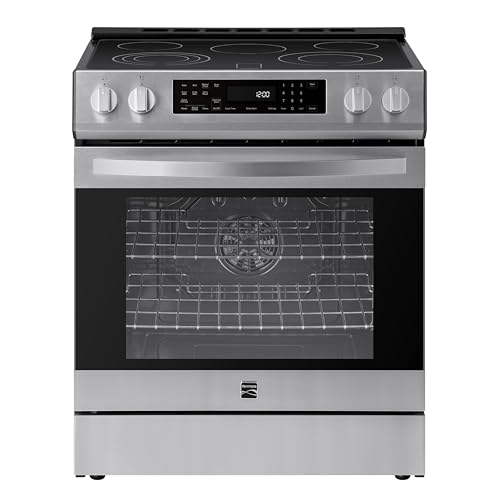
Kenmore 5.6 Cu Ft Front Control Electric Range — Best Capacity and Controls Up Front
Kenmore’s front-control range makes two arguments at once. The first is capacity: 5.6 cu. ft. is the biggest oven in this guide, a cavity that takes the holiday bird and the baker’s double batch without negotiation, served by true convection — a fan with its own heating element — that keeps the temperature honest when the door opens for basting. The second argument is the control panel’s address: at the front, where you can read and reach it without leaning across four hot elements.
Five elements across the top give the multi-pot household its positions, and the front-control format delivers most of the slide-in look — the range reads as built-in from across the room — while remaining a freestanding installation. Kenmore’s badge carries decades of American kitchen history, and this model wears it confidently: big, clear, unpretentious, and aimed squarely at the household that cooks in volume and wants the controls where hands actually are.
Living with 5.6 cu. ft. recalibrates what a home oven is for: two trays of scones, the bird and the bread, a batch-cooking Sunday that fills the freezer in one session. The Kenmore’s true convection keeps those loads honest, circulating heat so the second rack is a citizen rather than a compromise. Households that bake for sales, teams or extended family will feel the difference weekly; everyone else should admire it and buy the size they will actually fill. Batch bakers selling at markets will find the cavity pays for its size in a single Saturday of double trays.
- Width: 30 inches, front-control electric
- Oven: 5.6 cu. ft., largest in this guide
- Heating: true convection with fan element
- Elements: five across the cooktop
- Controls: front panel, no reaching over heat
Strengths
- Largest oven capacity of these six
- True convection holds heat through door openings
- Front controls are safer and easier to read
Trade-offs
- Front panel is reachable by small children
- Big oven is overkill for very small households
- Five elements crowd the largest pans
Best for: High-volume households that want capacity and front controls together.
Not suited for: Homes with toddlers and no appetite for control locks.
Current availability and specification for the Kenmore 5.6 Cu Ft Front Control Electric Range sit on its listing — check price on Amazon when you are ready to compare.

Midea MER30S2AST 30 Inch Electric Range — Best Straightforward Value
Midea is the largest appliance manufacturer on earth, a fact that surprises people only because the badge is newer on American ranges. The MER30S2AST is its straightforward proposition: a standard 30-inch electric range, a smooth cooktop, an honest oven, and steam clean for upkeep, without a garnish of features competing for your attention. For a great many kitchens — rentals being upgraded, first homes, a replacement bought under time pressure — straightforward is not a compromise; it is the brief.
The value of the proposition compounds in ownership. Steam cleaning keeps the oven presentable without punishing cycles, the controls ask nothing of a guest or a new tenant, and the whole machine concentrates its budget on the heating and the structure rather than on connectivity you may never open. If your decision process has circled through feature lists and come back to ‘we just need a good range’, this is the one the circling was looking for.
The Midea’s virtue compounds quietly in rented and first homes: a tenant cannot really misuse it, a guest can operate it without instruction, and its steam clean forgives the standard of care such kitchens honestly receive. Appliances that survive being treated ordinarily are a category of their own, and this range belongs to it. Buy it for a decade of unremarkable, reliable dinners — which is, most weeks, exactly what dinner is supposed to be. In a rental, its plain panel is a feature: nobody has ever needed a tutorial to boil an egg on it.
- Width: 30 inches, electric range
- Model: MER30S2AST
- Cleaning: steam clean function
- Cooktop: smooth electric surface
- Positioning: essentials-first value
Strengths
- Simple controls anyone can use immediately
- Steam clean keeps upkeep light
- Budget concentrated on core cooking hardware
Trade-offs
- Fewer headline modes than feature-led rivals
- Badge is newer in this category locally
- Styling is quiet to the point of plain
Best for: Rentals, first homes and anyone buying the essentials done well.
Not suited for: Feature collectors who want every mode in one panel.
Current availability and specification for the Midea MER30S2AST 30 Inch Electric Range sit on its listing — check price on Amazon when you are ready to compare.

Empava 30 Inch Electric Range 4.8 Cu Ft — Best Flexible Installation
Empava’s range is built around a practical flexibility: it is designed to serve as a freestanding unit or slid into a fitted run, which makes it a favourite of renovators whose plans evolve and landlords whose kitchens vary. The radiant ceramic cooktop carries four elements over a 4.8 cu. ft. oven — a mid-size cavity that matches the way most households actually cook, big enough for the Sunday roast, small enough to preheat without ceremony.
Steam clean handles the upkeep, and the overall design language is clean-lined and contemporary without chasing fashion. Empava has carved its place in the market by selling exactly this kind of considered, installation-friendly appliance, and the range shows the habit: nothing is over-specified, nothing essential is missing. Choose it when the kitchen plan has a question mark in it — the range that fits two futures is worth more than the one that fits only the first draft.
Renovators should note the Empava’s party trick in practice: when the plan changes — and plans change — a range that works freestanding today and slides in tomorrow saves a second purchase. Its 4.8 cu. ft. oven also hits the efficiency sweet spot for couples and small families, preheating quickly and cooking the weekly repertoire without heating a ballroom. Flexibility plus right-sizing is an unfashionable combination that ages extremely well. Its slide-in flexibility also helps in flipped houses, where the buyer pool’s kitchen plans are unknown by definition.
- Width: 30 inches, electric range
- Oven: 4.8 cu. ft. capacity
- Cooktop: radiant ceramic, four elements
- Cleaning: steam clean
- Install: freestanding or slide-in flexibility
Strengths
- Fits freestanding or fitted kitchen plans
- Ceramic top wipes down quickly
- Mid-size oven preheats without fuss
Trade-offs
- Four elements beside five-element rivals
- Mid-pack capacity for holiday-scale cooking
- Brand support network still growing
Best for: Renovators whose layout plans may still change.
Not suited for: Cooks who regularly need five simultaneous elements.
Current availability and specification for the Empava 30 Inch Electric Range 4.8 Cu Ft sit on its listing — check price on Amazon when you are ready to compare.

Rangaire RRE303TS 30 Inch Electric Range — Best for Keen Cooks
Rangaire’s 30-inch model brings the same technology-first attitude as its 24-inch sibling in our compact guide, scaled to the standard slot. The infrared burners are the headline: they drive heat into the pan base quickly and spread it evenly, which you feel as a skillet that sears across its whole surface instead of in a ring. In the oven, true convection — fan plus dedicated element — works alongside an air fry mode, giving one appliance three distinct heat personalities.
A timer anchors the package for real life, because keen cooking in a family kitchen is still cooking amid homework and doorbells. The stainless presentation is confident without being theatrical. This is the range for the cook who reads the manual, learns the infrared top’s responsiveness, and enjoys an appliance that rewards skill — the one in this guide most likely to be chosen by the household’s designated chef rather than by committee.
The Rangaire asks something of its cook and gives something back. Learn the infrared top’s pace — pans come to temperature faster than habit expects — and searing becomes a pleasure rather than a negotiation. The true convection oven rewards the same attentiveness with browning that looks deliberate. It is the range in this guide most likely to improve its owner’s cooking, because its responses are quick enough to teach with. Infrared owners quickly learn to pull pans a moment earlier than instinct suggests — the heat you feel is the heat you get.
- Width: 30 inches, electric range, stainless steel
- Burners: infrared stove burners
- Oven: true convection with air fry
- Controls: timer function included
- Character: technology-led enthusiast pick
Strengths
- Infrared burners heat pans fast and evenly
- True convection plus air fry in one oven
- Timer suits busy, multi-dish cooking
Trade-offs
- Infrared responsiveness asks for attention at a simmer
- Enthusiast specification may exceed casual needs
- Fewer service touchpoints than the biggest badges
Best for: Keen home chefs who enjoy responsive, modern heat.
Not suited for: Set-and-forget cooks who want the simplest panel possible.
Current availability and specification for the Rangaire RRE303TS 30 Inch Electric Range sit on its listing — check price on Amazon when you are ready to compare.
How Do the Six Compare Side by Side?
The comparison fixes the essentials: oven volume from 4.8 to 5.6 cu. ft., cleaning by steam across the middle of the range, and the two technology stories — GE’s no-preheat air fry and Rangaire’s infrared burners — that pull buyers off the mainstream path.
| Pick | Badge | Standout trait |
|---|---|---|
| GE 30 Inch Free-Standing Electric Convection Range | Best All-Round Family Range | Convection baking plus No Preheat Air Fry in a free-standing body from the most serviced badge in American kitchens. |
| Frigidaire Electric Convection Range 5.3 Cu Ft | Best Big Oven, Gentle Cleaning | A 5.3 cu. ft. convection oven with both air fry and steam cleaning — capacity for family roasts, cleaning without the blast furnace. |
| Kenmore 5.6 Cu Ft Front Control Electric Range | Best Capacity and Controls Up Front | The largest oven here at 5.6 cu. ft., true convection, five elements, and front controls that keep sleeves out of the steam. |
| Midea MER30S2AST 30 Inch Electric Range | Best Straightforward Value | A clean, standard 30-inch electric range with steam clean — the essentials done plainly by the world’s largest appliance maker. |
| Empava 30 Inch Electric Range 4.8 Cu Ft | Best Flexible Installation | A 4.8 cu. ft. oven under a radiant ceramic cooktop with four elements, designed to work freestanding or slid in. |
| Rangaire RRE303TS 30 Inch Electric Range | Best for Keen Cooks | Infrared burners, true convection and air fry with a timer — the enthusiast’s specification at the standard width. |
Why Has Electric Become the Default Range?
Three forces made the smooth-top electric range the standard. The first is installation: any kitchen with a range circuit can host one, with no gas line, no combustion ventilation demands and no flame to manage. The second is the oven — electric heat is even, dry and precise, and a generation raised on electric baking now cooks that way by instinct. The third is the top itself: a flat glass-ceramic surface that cooks, then becomes counter space, then wipes clean in a pass.
None of this makes gas or dual fuel wrong; it makes electric the path of least resistance for the most households. Induction is the rising rival within the electric family, but the radiant smooth-top remains the volume answer — compatible with every pan, understandable by every cook, and available at every level from the Midea’s plain value to the Rangaire’s infrared enthusiasm. This guide lives in that mainstream deliberately.
How Much Oven Capacity Does a Household Need?
Capacity figures in this guide run from the Empava’s 4.8 cu. ft. to the Kenmore’s 5.6, and the honest need depends on two questions: the largest single dish you cook, and how often two dishes share the oven. A family roast with its tray of potatoes wants the upper half of that range. A household of two cooking a casserole and a crumble will never feel the Empava’s limit. Measure your biggest roasting pan, including handles, against the cavity before paying for volume.
Oversized ovens carry a quiet cost: they preheat more air for a single small tray, which is why keen small households often prefer the mid-size cavity and a countertop oven for tiny jobs. The sweet spot for most families sits around five cubic feet — the Frigidaire’s 5.3 is the statistical answer — with the Kenmore reserved for households whose holidays and batch baking genuinely fill the extra space.
What Is the Difference Between Steam Clean and Self Clean?
Steam cleaning uses water and moderate heat to loosen light, recent soil so it wipes away. It is quick, gentle on the oven and the household — no fumes, no locked door for hours — and it appears here on the Frigidaire, Midea and Empava. Its limit is honesty: carbonised spills from a year of roasts will laugh at steam. Steam clean is a maintenance habit, not a rescue service, and it suits cooks who wipe monthly.
Traditional high-heat self-cleaning burns soil to ash at very high temperatures. It rescues neglected ovens, at the cost of heat, smell, energy and an oven out of service for hours — and it is hard on electronics over repeated cycles. Many modern electric ranges choose steam precisely because most owners clean more happily little and often. Decide which household you are: the monthly wiper should buy steam; the annual deep-cleaner should check the manual of any model for what its cycle can truly handle.
Does Air Fry in a Full Oven Actually Work?
Yes — with one condition the brochures understate: air needs to move. Oven air fry is convection with intent, using the fan and a high heat to crisp breaded and fatty foods. On a single, uncrowded tray it produces results a household will happily eat weekly; the GE’s no-preheat version removes the waiting that made people reach for a countertop basket instead. Wings, chips, frozen snacks and roasted vegetables all thrive in the mode.
Crowd the tray and the physics revolts: overlapping pieces steam each other and crisp nowhere. Use a low-sided tray or the air fry basket if supplied, cook in two honest batches rather than one soggy one, and remember the oven’s size is an advantage only when the air can circulate. Judged as a replacement for a deep fryer, oven air fry is excellent; judged as magic, it will disappoint exactly once.
A final practical note on trays: the oven’s own air fry basket or a simple wire rack over a sheet pan both work, and parchment is the air fry enemy — it blocks the very airflow the mode exists to create. Sauces and marinades should be patted dry before they meet the heat, because surface moisture is crispness leaving early. Small disciplines, repeated weekly, are the difference between a mode that delights and a mode that gets blamed.
How Do Radiant, Infrared and Standard Elements Differ?
A standard radiant element under glass-ceramic cycles on and off to hold its temperature, glowing in pulses. It is the technology under most of these six tops — predictable, pan-agnostic and kind to every budget. Infrared burners, the Rangaire’s speciality, push more of their energy directly into the pan base and respond faster across the surface, which searing cooks feel immediately as an even crust rather than a ring of colour.
In daily terms the difference shows at the extremes: infrared boils and sears with more urgency, standard radiant simmers with more patience. Both ask the glass-top disciplines — lift pans rather than dragging them, match base sizes to zones, wipe sugary spills before they bake into the surface. Choose infrared if your cooking lives at high heat; the standard element serves the full normal repertoire without complaint and usually at a gentler price of entry.
What Should You Check About the Electrical Supply?
A 30-inch electric range is the most power-hungry appliance in most kitchens, and it needs its own dedicated high-amperage circuit and the correct receptacle, positioned so the range sits flush to the wall. Homes switching from gas sometimes discover the slot has only an ordinary socket for the old range’s clock — the upgrade to a proper circuit is an electrician’s job and belongs in the budget from the first day of planning.
While the electrician is booked, confirm the receptacle’s exact position against the new range’s rear recess: a socket in the wrong place pushes the whole appliance proud of the counter line, a small daily ugliness that is free to avoid and annoying to fix. Photograph the existing arrangement, keep the old range’s details until the new one is cooking, and delivery day becomes a swap instead of a saga.
How Should You Care for a Glass-Ceramic Top?
The glass top’s rules are few and absolute. Clean it cool, with a dedicated cleaner and a soft pad; use a flat-held razor scraper for sugary spills before the next heating, because melted sugar is the one substance that can pit the surface permanently. Lift heavy pans — especially cast iron — rather than sliding them, and keep the pan bases clean, since a grain of grit under a hot pan is a scratch waiting for pressure.
Inside the oven, the glass top’s philosophy continues: little and often. A warm wipe after a roast, steam cycles used as maintenance rather than archaeology, and door seals kept clean so heat stays where it belongs. A smooth-top range rewards these small habits with a surface that still looks new at year five — which, in an open-plan kitchen where the range is furniture, is worth real money.
Seals deserve a sentence of their own: run a finger along the oven door gasket monthly and wipe away the crumbs and grease that collect there. A clean seal keeps the cavity’s heat honest, protects the surrounding cabinet faces from escaping steam, and costs nothing but attention. When a seal finally perishes after years of service, it is one of the cheapest professional repairs in the appliance world — another quiet dividend of the mainstream electric format.
Which Control Layout Suits Your Household?
Rear controls, on a backguard, keep the panel away from small hands and give the classic free-standing silhouette of the GE and Frigidaire. Front controls, the Kenmore’s arrangement, put everything within easy reach and sight — no leaning over steaming pans to adjust the oven — at the cost of being reachable by the household’s smallest members, which makes a control lock a feature to verify rather than assume.
Touch panels versus knobs divide households by temperament. Knobs are operable with wet or floury hands and give tactile certainty; touch panels wipe clean in one pass and read precisely. There is no correct answer, only your kitchen’s truth: bake with messy hands and you will vote knobs forever; keep a minimalist kitchen and the flat panel’s calm will please you daily. Try the gestures in your head before the range arrives.
How Do You Plan a Kitchen Around a Freestanding Range?
A freestanding range is the forgiving format: finished sides, its own backguard, and no demand that counters meet it with millimetre manners. It suits end-of-run positions, older kitchens with settled cabinets, and any household that values a swap-in replacement in fifteen years over a fitted look today. Leave the standard clearance, confirm the receptacle sits within the range’s rear recess, and the installation is the simplest in this guide.
Front-control models like the Kenmore blur the line, delivering the fitted look while keeping the freestanding installation. The planning difference is at the front, not the sides: nothing may overhang the control panel’s reach, and the floor beneath should be finished, because a front-control range shows more of it. Either way, measure the slot at floor level and the door swing of neighbouring cabinets before ordering — the range is the kitchen’s largest moving part.
What Does Ownership Cost Beyond the Purchase?
An electric range’s running costs are dominated by the oven, because the oven is a heated room you open rarely and heat for hours. Convection shortens cooking times enough to matter across a year; steam cleaning sips compared with the high-heat alternative; and a right-sized cavity — the Empava’s lesson — avoids paying to heat air. The cooktop’s share is smaller and mostly governed by pan matching: a base that meets its zone wastes nothing around the edges.
Repairs across a fifteen-year life typically involve an element, a fan motor or a control board, in ascending order of expense. This is where the big badges repay their premium quietly: GE and Frigidaire parts sit in every wholesaler’s stock, and independent engineers know the machines by heart. A range is cheap to own when its failures are ordinary — choose the appliance whose problems a local engineer has solved a hundred times.
Which Range Suits a Rental or a First Home?
The rental brief is durability under indifferent care, controls a stranger can read, and cleaning that forgives. On those criteria the Midea is the landlord’s pick in this guide, with the GE close behind on the strength of its service network. Both present smooth tops that wipe down between tenancies and ovens whose steam or standard cycles can restore respectability without heroics.
First homes argue slightly differently: the range may serve a decade, through changing household sizes and ambitions. There the Frigidaire’s capacity or the Kenmore’s front controls buy future-proofing, and the Empava’s installation flexibility insures against the renovation that always comes eventually. Buy for the household you are becoming, but weight the evidence of the household you are — most first ranges are replaced for size and features, never for failing to cook.
How Should You Break In a New Electric Range?
Run the empty oven through a full hot cycle before the first meal to burn off manufacturing residues, with the kitchen ventilated and no judgement passed on the smell — it is normal and brief. Then cook three familiar things in the first week: a roast you know, a bake you know, a tray of vegetables. Familiar food is the calibration instrument; its behaviour tells you where your oven runs hot, how its convection offset feels, and which rack position is honest.
Note what you learn somewhere durable — the inside of a cupboard door has served cooks for generations. Check the cooktop zones with a pan of water to see each element’s true ring, and confirm the range sits level so sauces stop pooling in the low corner. A week of attention at the start converts a new appliance into your appliance, and every dinner afterwards is cooked on the knowledge.
What Happens at Holiday Scale on a 30-Inch Electric Range?
Holiday cooking tests the two resources a range actually has: oven volume and surface positions. The Kenmore’s 5.6 cu. ft. earns its keep precisely here — the bird and a second dish can genuinely coexist under true convection — while smaller cavities ask for a written sequence: bird first, sides reheated in its resting heat, gravy and greens on the top in the final twenty minutes. Either approach feeds a table; only one of them improvises successfully.
The cooktop’s five-element models spread the side dishes wider, but pan discipline decides more than element count: lids on, the oven used as a holding cabinet at low heat, and anything make-ahead actually made ahead. Electric ranges forgive holiday ambition better than their reputation suggests, because the oven’s even heat does not punish a full load the way a temperamental cavity does. Plan on paper, and the standard width stops feeling standard.
How Do You Judge an Oven’s Evenness Before You Own It?
You cannot bake in a showroom, but you can interrogate the design. True convection — fan plus its own element — is the strongest structural promise of evenness, which is why the Kenmore and Rangaire specify it. Plain convection, fan alone, still moves air helpfully. Rack count and spacing tell you whether two trays can both sit in the fan’s honest airflow, and a visible, well-placed oven light tells you the maker expects you to look rather than open.
After purchase, the toast test remains the owner’s classic instrument: a rack of white bread slices, baked and compared, maps your oven’s hot and cool territories in one tray. Every oven has a map; good ones have a boring one. Learn yours in the first week and you will place trays by knowledge for fifteen years, which is worth more than any laboratory score printed in a brochure.
Why Do Some Ranges Offer a Fifth Element?
The fifth position on a 30-inch top is rarely a fifth cooking zone in honest use; it is a warming spot, a griddle bridge or a home for the kettle while four real elements work. Judged as a bonus rather than a headline, it is genuinely useful — sauces hold, plates warm, the finished dish waits without crowding. Judged as five simultaneous pans, it disappoints, because the width cannot give five vessels honest room.
Households should therefore read five-element tops as four-plus-flexibility. The Kenmore’s layout suits the cook who keeps a kettle resident and a sauce warm as a matter of routine. If your cooking is two pans and an oven, a four-element top like the Empava’s loses you nothing at all — and the money difference buys a great deal of cookware over a range’s lifetime.
What Should You Do With the Old Range?
A replaced range is bulky, heavy and full of recyclable metal, and the exit deserves the same planning as the entrance. Many retailers haul the old unit away at delivery for a fee that is worth every penny in a walk-up or a tight hallway; where that is not offered, appliance recyclers and scrap services collect for the metal value. Do not abandon it to the pavement lottery in a building with shared halls and strict rules.
Before it leaves, strip the value: the manual for the next owner’s sake if it is going to a new home, any unburned spare elements you bought and never fitted, and a photograph of its model plate for your records of the installation that was. If the old range still cooks and a local charity collects appliances, donation turns a disposal problem into somebody’s first working kitchen — the most honourable exit a faithful appliance can make.
How Does a New Range Change Weeknight Cooking?
The first month with a new electric range quietly rewrites weeknight habits. A reliable preheat makes roasting a tray of vegetables a default instead of a decision; a top whose zones you trust gets used for the quick pan sauce that lifts a plain chop; air fry turns the freezer’s breaded reserves into dinner without a phone call to a takeaway. None of this is dramatic, and all of it compounds — households consistently cook more, and eat better, in the season after a range replacement than the specifications alone would predict.
The effect fades into competence, which is the point. By the second season the range has disappeared into the cooking, its temperatures known, its quirks mapped, its oven the place where the household’s reliable dishes live. That disappearance is the true product being bought in this category — not stainless, not modes, but fifteen years of evenings in which the cooker is never the problem. Choose the model whose habits match yours and the disappearance happens fastest.
What Questions Should You Ask at the Point of Order?
Four questions prevent most regrets in this category. Is the listed model exactly the configuration in the review — width, control position, cleaning type? Does the delivery include placement in the kitchen, or only the doorstep, and who removes the old range? What does the warranty cover in-home, and who performs the service locally? And does the installation need an electrician’s visit first — a question whose honest answer, in a former gas kitchen, is usually yes.
Ask them in writing where possible, and keep the answers with the order confirmation. A range is too large to return casually and too important to live with wrongly, so the ten minutes of clerical care at ordering are the highest-value minutes in the whole purchase. The six ranges in this guide will all cook; the questions exist to make sure the one that arrives is the one you meant, in the kitchen you actually have.
What Goes Wrong Most Often With a 30-Inch Electric Range Purchase?
- Buying the largest oven for a household that cooks small, then paying to preheat empty air for a decade.
- Expecting steam clean to rescue a year of carbonised spills — it is maintenance, not archaeology.
- Piling an air fry tray two layers deep and concluding the mode does not work.
- Assuming a gas kitchen’s slot can host an electric range without an electrician’s visit first.
- Dragging cast iron across the glass top and blaming the surface for the scratches.
- Choosing front controls for a house with toddlers without checking for a control lock.
Final Recommendation
For the household that wants one answer, the GE is the centre of this category for a reason: convection that bakes evenly, air fry without the preheat wait, and a service network that makes fifteen years of ownership a calm prospect. It is the range we would hand to a family member moving into a new home, because nothing about it needs explaining after the first week.
Step off that centre deliberately, not accidentally. Take the Kenmore for capacity and front controls, the Frigidaire for the big oven with gentle cleaning, the Rangaire if searing is your love language. The Midea and the Empava serve the value and flexibility briefs with real dignity. A 30-inch electric range is a fifteen-year decision disguised as a shopping trip — choose the one whose daily habits match yours, and it will disappear into your cooking the way the best appliances do.
Before ordering, do the two unglamorous things: measure your largest pan against the oven you fancy, and photograph the receptacle behind your current range. Those ten minutes prevent the two classic disappointments of this category — the roasting pan that does not fit and the range that cannot sit flush — and leave only the pleasant decision of which of these six cooks your next fifteen years.
The three-listing shortcut: GE 30 Inch Free-Standing Electric Convection Range, Frigidaire Electric Convection Range 5.3 Cu Ft, Kenmore 5.6 Cu Ft Front Control Electric Range. Compare those first and most households will find their range among them.
Frequently Asked Questions
Is a smooth-top electric range hard to keep looking new?
It is easy to keep clean and possible to scratch — the distinction is technique. Wipe spills once the top cools, lift rather than slide heavy pans, and deal with sugary spills promptly. Households that adopt those three habits report tops that look new for years; the surface forgives cooking readily and carelessness slowly. The one unforgivable spill is sugared liquid left to bake — everything else is a cloth and a minute.
Can I use cast iron on a glass-ceramic cooktop?
Yes, with respect. Cast iron’s weight and rough base demand lifting rather than dragging, and a pan with a burr on its base should be smoothed or retired to oven duty. The heat itself is no problem — generations of cooks use cast iron on glass tops daily — but the pan must arrive and leave vertically. Keep one older, rougher pan for high-heat jobs if you want to be extra kind to the glass.
What size circuit does a 30-inch electric range need?
A dedicated high-amperage range circuit with the correct receptacle — the exact specification is in the model’s installation manual, and an electrician should verify or install it. Never run a full range from an ordinary socket, and have the receptacle position checked so the range can sit flush against the wall. If the home already had an electric range, the circuit is usually right and the swap is an hour’s work.
Is front control better than a backguard design?
Front controls win on reach and safety from steam; backguards win on keeping controls away from children and on price. Households with small children should verify a lock on any front-control model. Households with keen cooks and older children usually prefer never reaching over a boiling pan again. Knob conversions and child locks both exist in the aftermarket, but a verified factory lock is the safer answer.
How long should a modern electric range last?
Twelve to fifteen years is a fair expectation, with elements, igniters — where fitted — and fan motors as the usual mid-life repairs. Steam-clean models spare their electronics the thermal stress of repeated high-heat cycles, one reason the gentle school is gaining ground among makers and owners alike. Glass tops and steam cycles have quietly extended cosmetic life too — ranges simply look newer for longer now.
Does air fry mode replace a countertop air fryer?
For most households, yes: the oven version handles larger batches and one less appliance crowds the counter. Heavy air fry users cooking for one may still prefer the small basket’s speed for tiny portions. The honest test is your tray discipline — a single uncrowded layer in the oven crisps beautifully. Two smaller batches in the oven beat one crowded tray every time; the mode rewards patience with crispness.
Related Guides
A range decision usually arrives with a renovation in tow — these guides cover the purchases that share the project. Best 36 Gas Ranges Best Basic Top Loading Washing Machines Best 16 Quart Electric Roaster Ovens


