What's inside
- Key Takeaways
- Quick Picks
- How Did We Choose These Reading Chairs?
- How Do These Reading Picks Compare?
- What Makes a Chair Right for Hours of Reading?
- Where Should a Reading Chair Live?
- What Mistakes Do Readers Make Buying a Reading Chair?
- How Do You Care for a Chaise Across Years of Reading?
- How Should a Reading Chair Support the Book, Not Just the Reader?
- What Is the Right Back Angle for Reading?
- How Do Reading Chairs Serve Different Kinds of Readers?
- When Is a Reading Chair Too Big for Its Room?
- How Should Couples and Households Share One Great Reading Chair?
- What Should Arrive in the Room Before the Chair Does?
- Final Recommendation
- Frequently Asked Questions
- Related Guides
As an Amazon Associate I earn from qualifying purchases. This post may contain affiliate links at no extra cost to you.
cottageverdict.com is reader-supported. When you buy through links on our site, we may earn an affiliate commission.
Where to buy: each linked chaise and oversized reading chair below leads to its Amazon listing, where you can check price on Amazon and confirm the overall length, fabric, and whether assembly is needed for the current version before ordering. The sixth pick is discussed in prose only, because a traditional wingback and footstool are best bought where you can sit in the exact chair, and makers vary too much for one listing to represent the type fairly.
The best chairs for long reading sessions are built around a single, selfish, wonderful activity: one person, one book, and time that is allowed to disappear. A reading chair is not an accent chair that happens to be near a bookshelf. Its seat runs deep enough to tuck legs up, its back reclines the reader into the angle where pages turn themselves, and its arms — or its pillows, or its ottoman — arrange the whole body so completely that the only remaining effort is reading. This guide is about chairs for long-term reading in that full sense: novels finished in a sitting, winter afternoons surrendered to a trilogy, the chapter that becomes six.
Five of the six picks are chaises and oversized chairs, because that is the shape long reading actually takes. The modern boneless chaise — a deep, soft, frameless-feeling lounge filled and upholstered like a cloud that learned furniture — dominates current reading furniture for honest reasons: it accepts every reading posture a body invents, from upright with a hardback to sideways with a paperback held overhead. Around the boneless designs sit a framed oversized chaise with cup holders and storage pockets, a chair-and-a-half with its own ottoman, and finally the traditional answer, a wingback with a footstool, included in prose for readers who want their long sessions upright, structured, and fireside.
Keep the distinction from this batch’s living room guide in mind as you read. Accent chairs are social, upright, and decorative; they host a chapter politely. These reading chairs are private, deep, and indulgent; they host the whole book. A household with room for both should let each be itself. A household choosing one should be honest about which activity its evenings actually contain — and if the answer is a novel a week, this is the guide to spend from.
Key Takeaways
- Depth is the reading chair’s first specification: a seat must accept tucked legs, stretched legs, and the sideways curl.
- Four picks are boneless or softly built chaises that need no assembly; one is a framed chaise with storage and cup holders.
- Corduroy and chenille dominate these picks because long contact rewards soft, warm, textured fabrics over sleek ones.
- Measure the full length of a chaise against your room — a 64-inch piece is a commitment of floor, not a corner accent.
- Pillows included with a chaise are part of its posture system, supporting the neck, the book, and the elbow in turn.
- An ottoman pairing, as in the LUXSeatful pick, gives upright readers the leg support a chaise builds in.
Quick Picks
| Pick | Badge | Why it earns its place |
|---|---|---|
| Chorlenimi Chaise Lounge Reading Chair | Best Overall | A deep-seated boneless chaise with three pillows and no assembly, ready for a whole novel out of the box. |
| Boneless Cloud Chaise Lounge 54 Inch | Best Cloud Comfort | A 54-inch oversized cloud sofa in grey corduroy that swallows a reader and their blanket entirely. |
| Amsleekey Oversized Chaise Lounge 64 Inch | Best Framed and Equipped | A wood-framed 64-inch chaise with two cup holders and four storage pockets for the fully provisioned reader. |
| LUXSeatful Oversized Chair with Ottoman | Best Chair-and-Ottoman Pair | A 41-inch chenille chair and a half with a matching ottoman, for readers who sit up and stretch out in turns. |
| VINGLI Chaise Lounge Chair Indoor Corduroy | Best Sleeper Chaise | A 56-inch green corduroy chaise that doubles as a sleeper, for reading that ends in a nap or a guest. |
| A Classic Wingback Chair with a Separate Footstool | Best Traditional Prose-Only Pick | The upright, fireside arrangement for readers who want structure, posture, and a chair with a century of precedent. |
Check price on Amazon from any linked row or detailed section; a well-made wingback and footstool sit at a mid-to-premium tier in furniture shops.
How Did We Choose These Reading Chairs?
We read in them — in imagination disciplined by dimensions, which is the honest method for furniture. For each pick we walked through the postures a long session actually cycles through: upright for the first chapter while tea is hot, reclined as the book takes hold, sideways for the middle third, legs tucked, legs stretched, book raised, book resting on a raised knee at the end. A chair that serves only the first posture is an accent chair in disguise. The picks here serve the whole cycle, through depth, softness, pillows, or an ottoman, and their detailed sections say plainly where each one’s cycle is strongest.
Length and width were treated as the serious numbers they are. A chaise is the largest single seat most homes ever buy, and its listing dimensions decide whether it graces a room or annexes it. We favoured picks whose sizes were stated clearly and whose shapes suit real rooms — against a wall, in a bay, beside a bed — and we flag the largest, the 64-inch framed Amsleekey, as the purchase that most demands a tape measure before a decision. Oversized is a promise that must be checked against a doorway as well as a wall.
Fabric judgement for reading differs from fabric judgement anywhere else, because contact is total and prolonged. Corduroy’s ribs, chenille’s pile, and soft upholstery generally were favoured for warmth and grip — a reader shifts less on a fabric that holds them gently — while sleek, cold surfaces were marked down however handsome. Pillows were counted as equipment, not decoration: a chaise that arrives with its posture kit included starts its life a full step ahead of one that sends its owner cushion-shopping.
Finally, we considered the reader’s household. Reading chairs get borrowed — by partners with their own books, by children who treat them as islands, by cats with seniority. Builds that welcome a second species of occupant, covers that survive a household’s traffic, and designs that can serve as a guest’s sleeper or a film night’s best seat all earned their place. A reading chair is private, but it does not live alone.
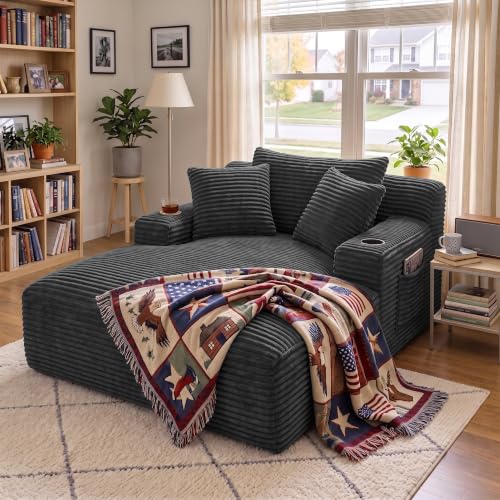
Chorlenimi Chaise Lounge Reading Chair — Best Overall
The Chorlenimi is the boneless idea executed with a reader’s priorities in order: a deep seat, an upholstered form that yields where a body presses and supports where it rests, and three pillows included, which the listing states plainly and which transform the chair from a shape into a system. One pillow takes the neck, one takes the book’s weight at the elbow, one fills whichever gap a particular reader’s posture invents. Long-session comfort is mostly the management of small gaps, and this chair arrives with its gap-management supplied.
No assembly is the second headline, and anyone who has built flat-pack furniture on the evening they wanted to read will feel its value. The chair arrives as a chair. For renters, for readers setting up a corner in a bedroom or a spare room, for anyone whose reading life happens in spaces that rearrange, a boneless chaise also moves like no framed furniture can — carried by one person, turned to chase the light, angled toward the fire in winter and the window in spring. The reading corner becomes a place you tune, not a monument you visit.
Its limits are the boneless family’s own. Without a frame, the silhouette is soft and informal; a formal sitting room may find it underdressed, and readers who rise often — the tea-makers, the page-fetchers — will find a deep soft seat slower to exit than a firm chair, a consideration that grows with the reader’s knees. Boneless filling also settles with months of devoted use and benefits from regular plumping and rotation, the small liturgy of soft furniture. Accept those terms and this is the most complete reading seat in the guide.
- Form: boneless chaise lounge, deep seat
- Pillows: three included per listing
- Assembly: none required
- Suggested rooms in listing: living room, bedroom
- Profile: soft silhouette, movable by one person
Strengths
- Three included pillows complete its posture system.
- No assembly and easy moving suit renters and rearrangers.
- Deep seat accepts every reading posture in the cycle.
Trade-offs
- Soft silhouette may underdress a formal room.
- Deep soft seat is slower to rise from.
- Filling wants regular plumping to keep its loft.
Best for: devoted readers building a flexible corner in a bedroom or relaxed living room. Not suited for: formal rooms or readers who need a firm, quick-rising seat.

Boneless Cloud Chaise Lounge 54 Inch — Best Cloud Comfort
Cloud is this chaise’s whole thesis, stated in its name and delivered in grey corduroy at 54 inches. The boneless cloud format takes the Chorlenimi’s softness further toward pure upholstery: a deep seat and a body of plush filling that receives a reader the way a snowdrift receives a falling child, completely and without negotiation. For the reader whose ideal session is a full surrender — blanket, book, nowhere to be until the light fails — this is the most complete disappearance available in the guide.
Corduroy deserves its own sentence of praise for reading furniture. Its ribbed texture grips gently, so a reader does not slowly submarine down the backrest across a chapter; it feels warm on contact in a cold room; and it wears its years softly, the ribs relaxing rather than the fabric failing. Grey keeps the large form calm in a room, which matters at this size: a 54-inch cloud is a landscape feature, and a quiet colour lets it be furniture instead of event. The listing’s suggested territory — reading nook, apartment, bedroom, even gaming and film nights — reflects how these pieces actually live: one great soft seat, used for everything restful.
Size is its caution, in both directions. A smaller reader may find the cloud’s generosity needs pillow engineering to become support rather than swallowing, and households should budget for extra cushions as part of the setup. A larger room is also genuinely required; in a small room this chaise is not an accent but the occupant. And like all boneless pieces, it will soften and settle across its first season — plan to plump and rotate it as you would any beloved soft thing, and it will keep its welcome for years.
- Form: boneless cloud chaise, 54-inch size
- Fabric: plush corduroy, grey
- Seat: deep, oversized
- Assembly: boneless format, minimal setup
- Suggested uses in listing: reading nook, living room, bedroom, film nights
Strengths
- Maximum sink-in comfort for full-surrender reading.
- Corduroy grips, warms, and ages gracefully.
- Grey keeps a very large seat visually calm.
Trade-offs
- Can swallow smaller readers without extra pillows.
- Needs a room that can give it real territory.
- Settles over its first season; wants plumping.
Best for: readers who read lying almost flat, in rooms with space to honour the gesture. Not suited for: small rooms or upright, desk-like reading habits.

Amsleekey Oversized Chaise Lounge 64 Inch — Best Framed and Equipped
At 64 inches deep with a wood frame, the Amsleekey is the chaise for readers who want structure with their sprawl. The frame gives the piece a defined shape that boneless rivals cannot hold: a seat that stays where furniture should stay, edges that read as designed, and a presence that suits a living room or a film room as readily as a private corner. The listing’s dimensions — 64 inches deep by 54 wide — describe a seat that can hold a reader, a blanket, a cat, and a hardback’s full apparatus without negotiation.
Its equipment list is the most practical in the guide: two cup holders and four storage pockets. Mock them gently and then consider the reading session they serve. The cup holders end the eternal negotiation between a mug and a side table that is always six inches too far. The pockets take the book’s companions — the next volume, the reading glasses, the phone that should be face-down and out of sight, the notebook for the lines worth copying. A reader fully provisioned without rising is a reader who finishes the chapter, and this chaise is provisioned like a small expedition.
The cautions scale with the chair. Sixty-four inches is a room-planning event: measure the wall, the door it enters by, and the path between them, because a framed chaise does not fold, squeeze, or apologise. Its plush corduroy wants the usual vacuuming, and its very completeness makes it the least movable pick here — choose its position as you would a sofa’s, with the light and the lamp decided in advance. For the reader building a permanent station, though, permanence is the point, and no other pick builds the station so completely.
- Form: framed oversized chaise
- Size: 64 inches deep, 54 wide per listing
- Equipment: two cup holders, four storage pockets
- Fabric: plush corduroy, grey
- Suggested rooms in listing: living room, film room, bedroom
Strengths
- Wood frame holds a defined, sofa-like shape.
- Cup holders and pockets provision a session completely.
- Generous dimensions fit readers of every size.
Trade-offs
- Largest footprint here; doors and paths need measuring.
- Effectively permanent once placed.
- Corduroy needs regular vacuuming at this scale.
Best for: a permanent reading station in a living room or film room. Not suited for: renters or rooms that rearrange with the seasons.

LUXSeatful Oversized Chair with Ottoman — Best Chair-and-Ottoman Pair
Not every long reader wants to recline into a chaise’s single long line. Some read upright and extend by degrees, and for them the chair-and-ottoman is the classic machine: sit properly for the first chapters, raise the legs onto the ottoman as the afternoon deepens, slide the ottoman aside when the session ends and the chair rejoins the room. The LUXSeatful is that machine in modern dress — a 41-inch oversized chair, a chair and a half in the trade’s lovely phrase, upholstered in khaki chenille with pillows included, and its ottoman matched and ready.
The chair-and-a-half width is the detail to savour. It fits a reader and a tucked-up pair of legs, a reader and a child hearing a story, a reader and the cat who owns the household — width that a standard armchair denies and a chaise provides only in one orientation. Chenille gives the pair a soft, light-catching surface that suits the living rooms and bedrooms the listing suggests, and the separate ottoman doubles as a spare seat, a side surface with a tray, or a footrest for the sofa’s end when guests rearrange the room’s politics.
Compare its posture honestly with the chaises before choosing. The ottoman supports legs at one height — the chair’s — and a reader who likes their knees bent at varied angles across a session gets more positions from a chaise’s long slope. Two pieces also claim their floor in two places, and the ottoman will migrate around the room in a way a chaise cannot, for better and worse. But for readers who sit up to read and want furniture that also behaves in company, this pair is the most sociable long-session seat in the guide.
- Form: oversized chair with matching ottoman
- Width: 41 inches per listing — a chair and a half
- Fabric: chenille, khaki
- Pillows: included per listing
- Suggested rooms in listing: living room, bedroom, apartment, home office
Strengths
- Ottoman flexibility serves reading and guests alike.
- Chair-and-a-half width fits readers plus children or cats.
- Upright posture suits readers who dislike reclining.
Trade-offs
- Leg support comes at one fixed height.
- Two pieces claim floor in two places.
- Less enveloping than a true chaise for lying readers.
Best for: upright readers in sociable rooms who want one pair to do everything. Not suited for: readers who read lying down and want a single long surface.

VINGLI Chaise Lounge Chair Indoor Corduroy — Best Sleeper Chaise
The VINGLI chaise in green corduroy is the guide’s double agent: a 56-inch oversized reading chair by day that the listing also presents as a sleeper sofa chair bed, and that second identity reorganises its value. Reading that ends in a nap needs no apology and no relocation. A guest in a small apartment gains a bed that spent the day as the home’s best seat. In a film room, it is the chair everyone hopes to be assigned. Green, meanwhile, is the colour choice with character in a category of greys and beiges — a reading corner in deep green corduroy looks like a place with intentions.
As a reader’s chair it follows the modern chaise pattern faithfully: oversized, upholstered deep, corduroy’s grip and warmth over a long session, a shape the listing pitches at living rooms and apartments where one piece must justify its floor completely. The chair-and-a-half generosity that serves a sprawled reader also serves the sleeper function, and households should read its dimensions with both occupants in mind — the reader it will hold weekly and the guest it will hold occasionally deserve the same tape measure.
Its cautions are the honest ones of any double-duty furniture. A sleeper is a compromise against a dedicated bed for a long stay, however welcome for a night or two. The green that charms in the listing’s photographs will steer a room’s palette, so be sure the room wants steering. And a piece bought for two jobs tends to be borrowed for both constantly — the reader may find their corner occupied by a napping guest with increasing regularity, which is either this chair’s triumph or its tragedy, depending on the household’s diplomacy.
- Form: oversized chaise, sleeper-capable
- Size: 56 inches per listing
- Fabric: corduroy, green
- Suggested rooms in listing: living room, film room, apartment
- Second life: occasional guest sleeping
Strengths
- Sleeper function doubles the piece’s household value.
- Deep green corduroy gives a corner real character.
- Oversized seat serves sprawled reading fully.
Trade-offs
- Sleeper comfort is for nights, not long guest stays.
- Strong colour steers the room’s palette.
- Double duty means the seat gets borrowed often.
Best for: apartments and film rooms where the reading chair must also host sleep. Not suited for: readers who guard their corner against all other uses.
A Classic Wingback Chair with a Separate Footstool — Best Traditional Prose-Only Pick
Before the chaise went boneless, the long reader’s throne was the wingback: high back, wings to rest a head against and to shut out the room’s draughts and distractions, a firm seat at proper chair height, and a footstool to complete the posture. We cover the type in prose because the difference between a wingback that serves for thirty years and one that disappoints in three is joinery and padding you must judge with your own body in the seat. Expect a mid tier for honest mass-made examples and a premium tier for the handmade and the leather-upholstered.
The wingback’s reading posture is upright and attentive, and a whole school of readers prefers it for exactly that reason. Nonfiction, poetry, anything read with a pencil — these sit naturally in a chair that holds its reader like a good listener rather than a hammock. The wings genuinely work: they cradle a resting head during the pause to think, they shade the page from a side lamp’s glare, and they give the reader the small, enclosed feeling of a room within the room. By a fire, with the footstool at the right distance, the arrangement has no equal in this guide for atmosphere.
Its demands are posture and space. A wingback will not accept the sideways curl or the tucked legs; readers who change shape hourly should choose the chaises and be happy. The pair also presents two pieces to place and to move, and the footstool’s correct distance is a personal geometry each reader sets nightly. Buy the wingback for the reader you are if you are the upright kind, in person, from a maker whose frames you can interrogate — and expect it to outlast every boneless rival here, still taking its place by the fire when their filling has long since been plumped for the last time.
- Form: high-back wingback chair plus footstool
- Posture: upright, structured, fireside
- Tier: mid to premium depending on maker
- Buying route: sit in it in person before deciding
- Service life: decades in honest construction
Strengths
- Upright support suits attentive, pencil-in-hand reading.
- Wings shelter the head and shade the page.
- Longest service life of any arrangement here.
Trade-offs
- No sideways curl or tucked-leg postures.
- Two pieces to place, move, and match.
- Firm seat will not suit surrender-style readers.
Best for: upright readers, firesides, and nonfiction with a pencil. Not suited for: sprawlers, curlers, and readers who read lying down.
How Do These Reading Picks Compare?
Notice, as the table lays them out, that no pick wins on every row: depth, structure, softness, and flexibility trade against one another, and the reader’s own habits must cast the deciding vote between them.
| Pick | Form | Fabric | Standout trait | Watch out for |
|---|---|---|---|---|
| Chorlenimi Chaise Lounge Reading Chair | Boneless chaise | Upholstered soft build | Three pillows, no assembly | Slow to rise from |
| Boneless Cloud Chaise Lounge 54 Inch | Boneless cloud | Corduroy, grey | Maximum sink-in comfort | Can swallow small readers |
| Amsleekey Oversized Chaise Lounge 64 Inch | Framed chaise | Corduroy, grey | Cup holders, four pockets | Largest footprint |
| LUXSeatful Oversized Chair with Ottoman | Chair plus ottoman | Chenille, khaki | Flexible two-piece posture | One ottoman height |
| VINGLI Chaise Lounge Chair Indoor Corduroy | Sleeper chaise | Corduroy, green | Doubles as a guest bed | Colour steers the room |
| A Classic Wingback Chair with a Separate Footstool | Wingback plus stool | Varies by maker | Upright fireside posture | No sprawling |
What Makes a Chair Right for Hours of Reading?
Three systems must agree. The first is support distributed widely enough that no single point — tailbone, shoulder blade, the back of one knee — files a complaint by chapter five; deep seats, long slopes, and pillows exist to spread a reader’s weight across the greatest possible area. The second is thermal: a reader in hour two is a warm, still body, and fabrics that breathe or at least do not seal, in a corner with a whisper of air movement, keep the session from ending in restlessness mistaken for boredom with the book. The third is the book’s own ergonomics — its weight carried by a pillow, an arm, or a raised knee, its page lit without glare — because arms tire before eyes do, and most abandoned reading sessions are abandoned by the shoulders.
Test any candidate against your real session, not your ideal one. If you read in forty-minute instalments, almost everything here is luxury; if Sunday means four hours inside a novel, the depth and pillow questions become decisive and the accent chair in the living room stops being a contender. Readers also differ in motion: still readers can take the deepest cloud, while chapter-break pacers — up for tea, for the window, for one look at the garden — should choose a seat they can leave and re-enter gracefully, which favours the framed chaise, the chair-and-ottoman, and the wingback over the great soft depths.
Where Should a Reading Chair Live?
Light decides, and the two kinds of light pull in opposite directions. Daylight readers want the window — but not the sun’s full afternoon force on the page or the fabric, so a corner at an angle to the glass, bright and shaded at once, is the classic solution. Evening readers want the lamp, positioned over the shoulder that the book is not on, warm in tone, and close enough that the page glows without the room becoming a stage. Place the chair for the light you read by most, and let the other kind be the compromise.
The room’s traffic decides the rest. A reading chair in a through-route becomes a obstacle everyone resents, including the reader interrupted by every passage; a chair in a genuine corner, a bay, the end of a bedroom, or the quiet side of a living room gathers the stillness reading feeds on. Keep a surface within reach — the Amsleekey builds its own, the others want a small table — and a throw within the same reach, and the corner is complete. Readers defend these corners ferociously once established, and households learn to route themselves around them, which is the surest sign the placement was right.
What Mistakes Do Readers Make Buying a Reading Chair?
The expensive mistake is buying the chair for the photograph’s posture — usually a model sitting upright and smiling — when your own reading body sprawls, curls, or lies nearly flat. Be honest about your shape in hour two and buy for that animal. The second mistake is measuring the wall and forgetting the door: oversized chaises have ended their journeys in hallways, and the framed 64-inch pick in particular deserves a measured path from the street to its station before it is ordered.
Third, readers under-buy the accessories and over-blame the chair: a chaise without a lamp in reach and a surface for tea will feel oddly unusable however deep its seat. Fourth, couples buy one magnificent reading chair for a two-reader household and discover the arithmetic of envy; a good chair-and-ottoman or a second, smaller seat is cheaper than the diplomacy. Finally, do not let a sleeper function or a storage pocket choose the chair for you — they are bonuses on a seat whose first duty is the book, and a chair that reads badly but sleeps adequately has its priorities exactly backwards for the purchase this guide is about.
How Do You Care for a Chaise Across Years of Reading?
Soft, large furniture ages where it is used most, so distribute the use. Plump boneless filling weekly — lift, shake, and turn the piece where its design allows — and rotate cushions and pillows so the favourite spot does not become a permanent hollow. Vacuum corduroy and chenille along their texture with an upholstery tool, because dust settles deep in ribbed and piled fabrics and dulls them from inside. Attend to spills at the moment of the session’s end rather than the week’s; a cover’s care guidance, photographed at purchase, is the manual you will actually consult at midnight.
Framed pieces ask for the furniture basics: feet and fixings checked seasonally, the chair lifted rather than dragged when it moves, direct sun managed with a throw or a curtain where the fabric faces the glass. A reading chair under this care does not merely last; it improves, moulding itself gently to its reader’s habits until the corner fits one person the way a good pair of shoes fits one foot. That personal fit, accumulated across a hundred books, is the real product being bought — and the reason a beloved reading chair is the last piece of furniture its owner would ever lend.
How Should a Reading Chair Support the Book, Not Just the Reader?
A hardback of any ambition weighs enough to become the session’s limiting factor, and a reading chair earns its keep by quietly taking that weight. Wide arms carry a book at elbow height for the upright reader. A firm pillow, angled against the chaise’s slope, builds a lectern for the reclined one. The chair-and-ottoman pair lets a book rest on raised knees, the oldest reading stand of all. When you assess any pick, mime your own reading in it: where does the book live, and what holds it there at page two hundred, when your arms have opinions?
E-readers and tablets lighten the load and complicate the light, since a screen wants dimming where a page wants a lamp. Readers who split their library between paper and glass should choose a corner with both: a lamp for paper, and a chair angle that keeps a screen out of the window’s reflection. The storage pockets on the framed Amsleekey and the pillows on the Chorlenimi serve both libraries impartially — devices rest face-down in a pocket as obediently as a paperback, and the household rule that the corner is for reading, not scrolling, is easier to keep when the chair itself seems to expect a book.
There is a small, serious point about necks hidden in all this. A book held low in the lap bends the head forward for hours; a book raised by pillows, arms, or knees lets the head rest back against the chair, and the session lasts longer in comfort. None of this is medical equipment and this guide makes no health claims — it is furniture geometry, observable in any reader by the second chapter. Arrange the book’s height when you arrange the chair, and the two will serve each other for years.
What Is the Right Back Angle for Reading?
Upright backs suit alert reading — morning papers, study, anything with a pencil — because the body’s posture keeps the mind in its working register. As the session lengthens and the book becomes a novel, most readers drift back by degrees, and the chaise’s long slope exists to meet that drift without a mechanism: you simply settle further into it. The ideal reading chair therefore is not one angle but a range, provided by a slope, a deep seat, or an ottoman’s partnership, through which a reader can travel as the evening changes them.
Fixed, very reclined positions have one honest cost: they are sleep’s antechamber. Readers who regularly wake at 2 a.m. under a finished lamp with a lost page should sit themselves slightly more upright — the wingback’s discipline, or a pillow behind the shoulders on a chaise — not because napping in a book is a failure, but because the last forty pages deserve to be read awake. Conversely, the reader kept awake by an over-upright chair is being failed in the opposite direction. The range is the answer, and every pick here provides it by shape rather than by lever, which is why none of them can break in the manner of recliner mechanisms.
Test the range before you commit, using the furniture you already own as the laboratory. Note the angle of the sofa corner where you read happily, the pillows you stack to achieve it, and the point where comfort turns to drowsiness in your own sessions. That personal map, honestly drawn, chooses between this guide’s picks more reliably than any specification: the cloud for the near-horizontal, the framed chaise for the supported slope, the chair-and-ottoman for the adjustable middle, the wingback for the vertical life.
How Do Reading Chairs Serve Different Kinds of Readers?
The novelist’s reader — one book, one sitting, a whole interior life — is this guide’s central figure, and the deep chaises are built for her. The grazing reader, who keeps four books in rotation across a week and reads in twenty-minute visits, needs a chair that welcomes briefly and releases easily: the chair-and-ottoman or the wingback, where sitting down and standing up carry no commitment. The rereader, returning to beloved books in a favourite season, often cares most about the corner’s ritual completeness — the same lamp, the same throw, the chair that has held every previous reading of the same pages.
Listeners are readers too, in the audiobook age, and their chair wants the same depth with the eyes free — many find the boneless picks ideal, since the posture can go fully horizontal while the story proceeds. Students and researchers, reading against deadlines with notebooks open, should look hardest at the framed Amsleekey, whose pockets and cup holders organise a working session, and whose defined shape keeps a study posture available inside the comfort. Parents reading aloud need width above all: the chair-and-a-half, or a chaise’s broad seat, because a picture book is read by two people, one of whom is mostly elbows.
None of these readers is better than another, and most households contain three of them in one person across a year. That is the final argument for the versatile middle picks — a chaise with pillows that can upright it, a pair that can split its ottoman — when the buyer cannot name a single reading self with confidence. Buy for the reader you are most often, forgive the chair its compromises with the reader you are occasionally, and the corner will serve every version of you that arrives with a book.
When Is a Reading Chair Too Big for Its Room?
A chaise crosses the line from furniture to landscape when the room’s other lives stop working around it: when the door’s swing is edited by it, when reaching the window requires a negotiation, when guests must process past it single file. The test is not the tape measure alone but the room’s choreography across a week — vacuuming, visitors, children with projects, the Christmas tree’s annual claim. A chair that the room resents will be resented back, and even the deepest comfort curdles when its owner must apologise for it daily.
Scale can be cheated honestly, though. A large chaise in a pale, quiet colour reads smaller than a small chair in a loud one; a boneless piece pushed fully into a corner claims less visual territory than a framed one standing proud; and a chair placed along a wall, length parallel to it, disturbs a room less than one angled into the middle, however photogenic the angle. The 54-inch cloud in grey will live peacefully in rooms where the 64-inch framed piece, for all its virtues, would govern. Choose the largest chair your room can host graciously — not the largest it can physically contain.
And if the honest answer is that the room cannot host a chaise at all, the guide’s own logic points to the dignified alternatives rather than a squeezed compromise: the chair-and-ottoman, whose pieces can separate around a room’s obstacles, or the wingback pair, whose footprint is a chair’s and whose reading pedigree is a century deep. A small room with the right upright chair will host more finished books than a small room at war with an oversized chaise. Fit is a feature; in reading furniture, it may be the first one.
How Should Couples and Households Share One Great Reading Chair?
They mostly do not, and the households that thrive admit it early. A reading chair moulds itself to its reader — pillows migrate to personal positions, the throw lives at a personal angle — and a second reader using it is a guest in someone else’s posture. The workable arrangements are rotation by schedule, which suits households of regular habits, or the quiet arms race in which a second chair appears within the year. Given the cost of domestic diplomacy, the second chair is usually the economical outcome; buy the first chair knowing its success may demand a companion, and let the LUXSeatful’s ottoman serve as the interim second seat, which it does with surprising grace.
Children complicate sharing in the happiest direction. A reading chair big enough for a parent and a picture book becomes the room where reading itself is taught — not the skill, which school handles, but the pleasure, which only a comfortable lap and an unhurried voice can teach. The oversized picks here were chosen partly with that scene in mind. A household that reads aloud should count the second, smaller occupant in its width calculations from the start, and expect the chair’s deepest associations, decades later, to be exactly those shared hours rather than the solitary novels it was bought for.
What Should Arrive in the Room Before the Chair Does?
The lamp, if you can manage it, because a reading chair delivered into a badly lit corner will be judged for the corner’s failures. Then the small surface, the throw, and one shelf or basket for the current books — a reading corner is a small ecosystem, and the chair is only its largest organism. Households that assemble the ecosystem first also measure better: with the lamp placed and the table set, the chair’s true available footprint reveals itself, and the 64-inch temptation can be assessed against reality rather than hope. Buy in that order and the delivery day feels like a completion instead of a beginning, which is how the best corners are born.
Final Recommendation
Choose by the reader you are at hour two. For most, that is the Chorlenimi Chaise Lounge Reading Chair: deep, pillow-complete, and ready without assembly for the next novel. Take the cloud chaise if your reading is a full surrender, the framed Amsleekey if your corner is permanent and your sessions fully provisioned, the LUXSeatful pair if you read upright in sociable rooms, and the green VINGLI if your reading chair must occasionally become a bed. Keep the wingback for the fireside traditionalist, and honour it. Whatever you choose, give it light, a surface, and a throw, and then defend its corner against the household’s other plans — because a reader with a true chair is a household treasure, quietly finishing books in the corner while the years and the chapters turn together, one long, comfortable session at a time.
Frequently Asked Questions
How do I keep a reading chair from becoming a clothes chair?
By giving the clothes a better offer and the chair a defended identity, renewed each evening by the simple act of sitting down in it with a book before the day’s garments can stake their claim upon its arms and back. A hook rail or a valet stand nearer the wardrobe than the chair wins most garments; a household rule that the reading chair holds only the current book, the throw, and the reader wins the rest. Readers who sit in the chair daily rarely lose it — occupation is the strongest defence — so the true protection is use. A chair read in every evening stays a reading chair; a chair read in monthly becomes furniture with a past, and the laundry moves in like weather.
Does a reading chair belong in the bedroom or the living room?
The bedroom offers privacy, the bed’s proximity for the final pages, and morning light for early readers; its risk is that the chair becomes a wardrobe for clothes in transition, a fate prevented only by a hook on the door and household discipline. The living room offers the lamp, the fire, and the company at the room’s edge; its risk is interruption, which some readers feed on and others flee. Follow your sessions: the reader who reads after everyone sleeps belongs in the bedroom, the reader whose book accompanies the household’s evening belongs in the living room, and the reader with both habits should choose the chair that moves — which is the boneless picks’ quiet superpower.
What cushion or pillow setup improves any reading chair?
Three pillows cover nearly every reader: one small and firm behind the lower back or under the neck, one under the book-bearing elbow, and one spare for the gap nobody predicts until hour two, when the body has settled into its true reading shape and announced exactly where it wants to be held. Natural fills hold an angle better; soft synthetic fills comfort better; the mixture of one firm and two soft serves most corners. Replace or re-plump them when they stop recovering overnight — pillows are the reading chair’s consumables, and a fresh set can make a three-year-old chaise feel newly bought for the price of a single hardback.
How long does a boneless chaise take to reach its full shape?
Boneless pieces commonly arrive compressed, and the listing usually advises an expansion period — often a day or two, helped by plumping and by working the filling toward the corners with your hands. Judge the chair’s comfort and size only after that settling, because a chaise assessed in its first hour is a compressed rumour of itself. Plan the purchase ahead of the reading weekend you are imagining, give the chair its days in a warm room, and the first full session will meet the furniture you actually bought.
Is a chaise better than an armchair for reading?
For long sessions, usually yes: the chaise supports legs along their length, so posture can change without the reader ever sitting unsupported, while an armchair needs an ottoman to reach the same completeness. For short sessions and upright reading, a good armchair with a footstool — the wingback arrangement — serves beautifully and takes less room. Match the furniture to your session length.
What does boneless actually mean in these chairs?
It means the chair has no rigid internal frame; its shape comes from its filling and upholstery, like a very structured, very large cushion. Boneless chairs arrive ready, move easily, and accept every posture, at the cost of a softer silhouette and a seat that is slower to rise from. Framed chaises hold crisper lines and suit formal rooms better.
How much space does a reading chaise really need?
Its full length, plus the space your feet and the occasional passing human need beyond it — in practice, treat a 56-to-64-inch chaise as you would a small sofa when planning the room. Measure the delivery path too: doors, turns, and stairs have ended more chaise purchases than walls ever have.
Can two people share a reading chaise?
The oversized picks can hold a reader and a child, or a reader and a determined cat, in genuine comfort, and couples do read side by side on the widest of them at an angle. Two adult readers each deep in their own book will still prefer two seats; the chair-and-ottoman pair splits most gracefully for sharing, since the ottoman can serve as the second person’s footrest or seat.
Do reading chairs work for laptop use and films?
Films, certainly — the chaises here are film-night aristocracy, and several listings say so. Laptops, briefly: a chaise’s recline fights a keyboard’s posture, so answer the email, then close the lid and return to the book the chair was bought for. A cushion behind the back can upright a reader for a short working stretch when the desk is occupied.
Related Guides
The reading corner rarely stands alone in a furnished life. Its sociable counterpart is compared in Best Chairs for a Marble Dining Table, where chairs are chosen for looks against stone rather than hours against a novel. Families will find the children’s end of the seating story in Best Chairs for a Classroom, and screen-centred comfort is covered by Best Gaming Chairs for Computer Gamers. To complete the reading corner itself — the layer every reader reaches for by chapter three — see Best Faux Mink Blankets before the cold evenings arrive.


