What's inside
- Key Takeaways
- Quick Picks
- How Did We Choose These Bottom Freezer Models?
- The Best 24 Cu Ft Bottom Freezer Refrigerators, Reviewed One by One
- How Do the Six Compare Side by Side?
- Why Do Cooks Prefer the Freezer at the Bottom?
- Drawer or Door: Which Bottom Freezer Style Works Better?
- How Should You Measure for a Bottom Freezer?
- What Should You Check About Ice and Water Before Buying?
- How Do You Keep a Bottom Freezer Organised?
- How Does This Layout Suit Different Kinds of Households?
- What Happens to Each Layout in a Power Cut?
- How Should You Clean and Maintain a Bottom Freezer?
- What Does the Freezer’s Share Mean for Batch Cooking?
- How Do the Finishes Here Behave in Real Kitchens?
- When Should You Repair the Old Fridge Instead of Replacing It?
- How Does a Bottom Freezer Change a Small Kitchen’s Feel?
- What Should Happen in the First Week of Ownership?
- How Much Does Delivery Day Really Decide?
- Why Does Door Swing Deserve Its Own Measurement?
- What Role Does Lighting Play Inside the Cabinet?
- How Should a Household Grow Into a Larger Cabinet?
- What Is the Sensible Order of Decisions?
- What Are the Most Common Mistakes When Buying a Bottom Freezer?
- Final Recommendation
- Frequently Asked Questions
- Related Guides
As an Amazon Associate I earn from qualifying purchases. This post may contain affiliate links at no extra cost to you.
cottageverdict.com is reader-supported. When you buy through links on our site, we may earn an affiliate commission.
The bottom freezer is the layout cooks defend at dinner parties: fresh food at eye level, frozen food in a drawer below, and no crouching for the milk. Shoppers searching the best 24 cu ft bottom freezer refrigerators usually want that layout at family size, and this guide is honest about what the class looks like in practice. Five of the six picks below cluster between 18.5 and 26 cu. ft., bracketing the headline figure from both sides. The sixth is a deliberate exception that has nothing to do with 24 cu. ft. at all: a Summit that is 24 inches wide and holds about 10.5 cu. ft., included for the small kitchens that search this class by width by mistake and deserve a real answer.
Where to buy: all six models are sold through Amazon, and the names in the Quick Picks table, the review headings and the comparison table link to each listing so you can check price on Amazon and confirm the current configuration. Bottom freezer models reward careful measuring, because the freezer drawer pulls out toward you: check not only the cabinet’s width and depth, but the floor space the open drawer will occupy and whether an island or a wall will argue with it.
Two of the six are Whirlpool twins separated only by finish, two are big modern boxes from Kenmore and LG with ice makers and smart touches, one is a GE in the classic mould, and one is the narrow Summit. That spread covers the honest range of the category — from family workhorse to apartment exception — and the reviews treat each on its own brief rather than pretending they are six versions of the same fridge.
Key Takeaways
- Five picks run from 18.5 to 26 cu. ft.; the Kenmore at 22.3 cu. ft. sits closest to the class figure.
- The Summit FFBF1031PL is a width pick, not a capacity pick: 24 inches wide, about 10.5 cu. ft. — read it as a compact.
- The two Whirlpools are the same 18.5 cu. ft. fridge in stainless or white; choose by finish, not by features.
- The LG is the step-up at 26 cu. ft. and 33 inches wide, with Door Cooling and ThinQ connectivity.
- Bottom freezer drawers present frozen food from above, but need clear floor space to open fully.
- Ice makers appear on the Kenmore; check each listing for the others before assuming.
Quick Picks
| Pick | Badge | Why it earns its place |
|---|---|---|
| Kenmore 22.3 Cu Ft Bottom Freezer Refrigerator | Closest to the Class — Best Overall | At 22.3 cu. ft. in a 31-inch cabinet, with a factory ice maker, glass shelving and fingerprint-resistant stainless, it is the class’s centre of gravity. |
| GE 21.0 Cu Ft Bottom Freezer Refrigerator | Best Standard-Depth Simplicity | A 21.0 cu. ft. GE in fingerprint-resistant stainless with a standard-depth cabinet and an uncomplicated, proven layout. |
| LG 26 Cu Ft Bottom Mount Refrigerator 33 Inch LRDCS2603S | Best Capacity Step-Up | The big answer at 26 cu. ft. and 33 inches wide, with Door Cooling to protect door-bin food and ThinQ connectivity for alerts. |
| Whirlpool 18.5 Cu Ft Bottom Freezer Refrigerator WRB329DMBM | Best Compact in Stainless | Whirlpool’s long-running 18.5 cu. ft. bottom freezer in stainless steel, sized for smaller households and tighter slots. |
| Whirlpool 18.5 Cu Ft Bottom Freezer Refrigerator White WRB329DMBW | Best White-Finish Classic | The identical 18.5 cu. ft. Whirlpool in white, for kitchens where stainless would clash with an otherwise pale scheme. |
| Summit 24 Inch Bottom Mount Refrigerator FFBF1031PL | Best 24-Inch-Wide Compact Exception — 10.5 Cu. Ft. | A bottom-mount fridge just 24 inches wide holding about 10.5 cu. ft., for studios and small flats; the 24 here is width, never capacity. |
How Did We Choose These Bottom Freezer Models?
We began with the layout itself: a fresh-food door on top and a freezer that lives below it, in drawer or door form. Models that were really French door or side-by-side designs in disguise were set aside, because the shopper typing this search wants the single wide fresh-food door and the low freezer, and a guide that blurs the category betrays the search. Within the layout, we favoured models whose listings state capacity and width plainly, because bottom freezer shoppers are often replacing a fridge in a fixed slot and cannot afford dimensional surprises.
Capacity honesty shaped the final six. The class figure of 24 cu. ft. is a neighbourhood, not an address: the Kenmore’s 22.3 and the LG’s 26 bracket it, the GE and the Whirlpools sit below it, and pretending otherwise would have meant excluding good fridges for the crime of arithmetic. We kept the Summit for a different honesty — search data shows many shoppers type this class while actually needing a 24-inch-wide cabinet, and a guide that ignores them sends them home with a fridge that cannot enter the kitchen.
Finish and equipment finished the selection. Every pick had to offer a finish a real kitchen would accept, and the spread — fingerprint-resistant stainless, plain stainless, white, and a stainless-look compact — reflects how these fridges are actually bought. Ice making, door cooling and connectivity were treated as differentiators to describe, not boxes to tick, because a household without a water line gains nothing from an ice maker it cannot plumb.
The Best 24 Cu Ft Bottom Freezer Refrigerators, Reviewed One by One

Kenmore 22.3 Cu Ft Bottom Freezer Refrigerator — Closest to the Class, Best Overall
The Kenmore is the pick that makes this guide’s title honest. At 22.3 cu. ft. it stands closest to the class figure, and it does so in a 31-inch-wide cabinet — noticeably narrower than the 36-inch boxes that dominate modern line-ups, which makes it a quiet gift for kitchens whose slot was framed a generation ago. A factory ice maker, adjustable glass shelving, crisper drawers and LED lighting fill out an equipment list that reads like the class definition.
The fingerprint-resistant stainless finish matters more on a bottom freezer than on most layouts, because the fresh-food door handle is the most-touched surface in the kitchen and it sits at exactly hand height all day. Kenmore’s treatment keeps that door presentable between cleans. Inside, the glass shelves wipe down without the wire-shelf drip-through that sends spills cascading onto the food below, and the crispers give salad and fruit a fighting chance of being eaten rather than discovered.
Living with it, the impression is of a fridge designed by people who measured real kitchens. The 31-inch width threads slots that reject wider models, the freezer drawer below takes the week’s frozen staples without ceremony, and the whole cabinet feels sized for a household rather than a showroom. If you buy one fridge from this guide on the strength of the numbers alone, this is the one the numbers point to.
One more consideration in its favour: single-door bottom freezers like this one tend to be the layout service technicians describe with the least sighing, because the refrigeration circuit is conventional and the parts are ordinary. A household that keeps appliances for fifteen years and repairs rather than replaces will find that conventionality worth as much as any feature on the badge.
- Capacity: 22.3 cu. ft. total
- Width: 31 inches
- Ice: factory ice maker included
- Shelving: adjustable glass shelves, crisper drawers
- Lighting: LED interior lighting
- Finish: fingerprint-resistant stainless steel, ENERGY STAR certified
Strengths
- Closest capacity to the class figure, in a slot-friendly 31-inch width.
- Ice maker fitted as standard rather than sold as an accessory.
- Glass shelving contains spills instead of raining them downward.
Trade-offs
- Freezer drawer space is family-adequate, not batch-cooker generous.
- Single finish choice; no white or black variant in this listing.
- 31-inch width means narrower shelves than 36-inch rivals offer.
Best for: families replacing an older fridge in a modest slot who want the class size without widening the opening.
Not suited for: households that freeze in bulk and need the deepest freezer section available.

GE 21.0 Cu Ft Bottom Freezer Refrigerator — Best Standard-Depth Simplicity
GE’s entry is the conservative heart of this guide: 21.0 cu. ft., standard depth, fingerprint-resistant stainless, and a layout that has been refined over so many model years that its compromises are all known quantities. Where the Kenmore wins on paper, the GE wins on familiarity — this is the fridge shape that installers, repairers and previous owners all understand, and there is a real comfort in buying the understood thing.
Standard depth is its quiet argument. A deeper cabinet than the counter-depth fashion allows means shelves that accept a roasting pan without a sideways shuffle and a freezer section with genuine stacking room. In a kitchen with the floor space to spare, giving back the few inches that counter-depth styling saves buys back storage you will use every week. The fingerprint-resistant finish then keeps the big door looking civilised between cleans.
Choose the GE if your household’s priorities run to the proven and the spacious rather than the newest. It will not connect to your phone or cool its door bins with a named technology, and it does not need to: it keeps a family’s food cold in a sensible order for a very long time, which is the entire job description written plainly.
There is also a resale-of-the-house argument that rarely gets voiced: a mainstream GE in a standard size is the fridge a future buyer of your home will look at with relief. Nothing about it requires explanation, matches nothing awkwardly, and asks for no special plumbing beyond the ordinary. Appliances are partly for the life you live and partly for the listing photos you may one day take, and this one serves both without trying.
- Capacity: 21.0 cu. ft. total
- Depth: standard depth cabinet
- Finish: fingerprint-resistant stainless steel
- Layout: single fresh-food door over a bottom freezer
- Brand position: GE’s mainstream bottom freezer offering
- Character: conventional layout, widely understood design
Strengths
- Standard depth restores the shelf room counter-depth models surrender.
- Fingerprint-resistant finish suits a much-handled single door.
- Conventional design means parts and knowledge are everywhere.
Trade-offs
- No connected features or app alerts for households that want them.
- Deeper cabinet will stand proud of a shallow counter run.
- Capacity sits below the class figure and below the Kenmore.
Best for: households with floor space to spare who value proven design and deep shelves over connectivity.
Not suited for: galley kitchens where a deep cabinet would narrow the walkway uncomfortably.
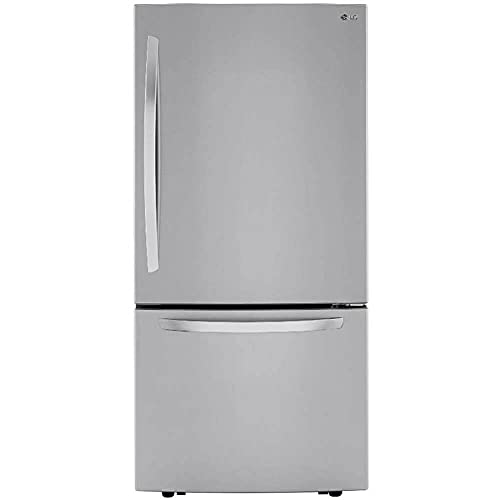
LG 26 Cu Ft Bottom Mount Refrigerator 33 Inch LRDCS2603S — Best Capacity Step-Up
When the class figure is simply not enough fridge, this LG is where the guide points. At 26 cu. ft. in a 33-inch-wide cabinet, the LRDCS2603S holds the largest weekly shop here while keeping the bottom-mount layout intact — fresh food behind one wide door at standing height, frozen food in the section below. It is the pick for households whose last fridge failed them at the holidays, every holiday, on schedule.
LG’s Door Cooling is the feature with a genuine daily mechanism behind it: vents direct cold air toward the door bins, the warmest and most-abused zone of any fridge, where the milk and condiments live. Food stored in doors suffers every opening; cooling aimed there is engineering pointed at a real problem rather than a brochure. ThinQ connectivity adds the modern layer — alerts and monitoring through LG’s app for households that run their appliances from the sofa.
The cautions are size and appetite. A 26 cu. ft. cabinet at 33 inches wide needs its opening measured with respect, and a household of two will cool a great deal of empty air inside it. But for the family of five, the multi-generational kitchen, or the household that shops the warehouse club monthly, this is the bottom freezer that ends the capacity argument, and it does so without abandoning the layout for a side-by-side.
It also carries the big-fridge advantage nobody lists: thermal mass. A well-filled large cabinet holds its temperature through a busy Sunday of door openings better than a small one, because the food itself is the ballast. For households that cook all day with the fridge in constant use, that steadiness is a quality-of-life feature disguised as physics.
- Capacity: 26 cu. ft. total — the largest in this guide
- Width: 33 inches
- Cooling: Door Cooling vents aimed at the door bins
- Connectivity: ThinQ app support
- Model: LRDCS2603S
- Layout: bottom mount freezer below a single fresh-food door
Strengths
- Class-leading capacity for big households and warehouse shoppers.
- Door Cooling protects the milk and condiments in the warmest zone.
- App alerts catch a door left open before the shop suffers.
Trade-offs
- Needs a true 33-inch opening; measure before falling for it.
- Oversized for couples, who will pay to cool empty shelves.
- Connected features assume a household happy to use an app.
Best for: large families and bulk shoppers who refuse to leave the bottom freezer layout behind.
Not suited for: small households or narrow slots, where its size becomes the problem it was bought to solve.
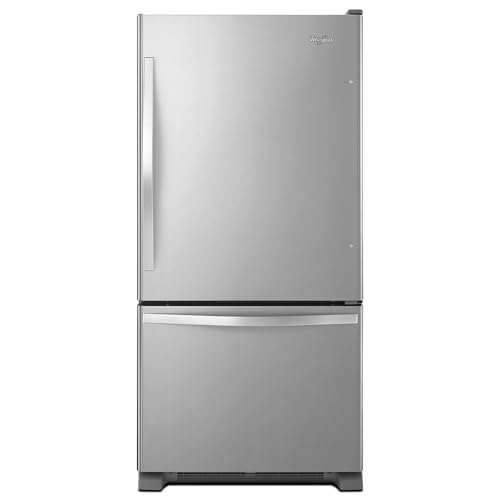
Whirlpool 18.5 Cu Ft Bottom Freezer Refrigerator WRB329DMBM — Best Compact in Stainless
The Whirlpool WRB329DMBM has been the default answer to a particular question for years: what bottom freezer should a smaller household buy when it wants the layout without the acreage? At 18.5 cu. ft. it sits well below this guide’s class figure, and it earns its place by being right-sized — a couple, a small family, or a downsized kitchen gets the eye-level fresh food and the low freezer in a cabinet that does not bully the room.
Its longevity in the market is itself evidence. Designs that survive this long do so because owners recommend them to neighbours, parts stay available, and the failure modes are known and mostly minor. The stainless finish keeps it current in a renovated kitchen, and the interior follows the sensible Whirlpool pattern of adjustable shelving and a freezer section arranged for ordinary frozen staples rather than catering fantasies.
Be clear-eyed about the freezer if you batch cook: 18.5 cu. ft. total means the frozen share is modest, and a household that freezes a garden’s worth of produce will fill it by September. For the household it suits, though, that modesty is the point — a fridge that matches the shop, in the layout that matches the cook, from a line that has forgotten more about bottom freezers than most brands have learned.
It is also the pick we would hand to someone furnishing a rental property with standards. Tenants understand it instantly, its size suits the smaller kitchens rentals usually have, and its long production run means a replacement part is a phone call rather than an archaeology project. Landlords and owners end up valuing the same virtues here: clarity, durability, and a layout nobody needs a manual to love.
- Capacity: 18.5 cu. ft. total
- Model: WRB329DMBM
- Finish: stainless steel
- Layout: single fresh-food door over a bottom freezer
- Position: compact end of this guide
- Pedigree: a long-running Whirlpool design
Strengths
- Right-sized bottom freezer for couples and small families.
- Long production history means parts and familiarity everywhere.
- Stainless finish keeps a modest fridge looking current.
Trade-offs
- Freezer share is small for batch cookers and garden freezers.
- Equipment is honest and basic; no smart features or door cooling.
- Well below the class capacity — buy it for fit, not for volume.
Best for: smaller households and quality rentals that want the bottom freezer layout at a sane size.
Not suited for: large families, whose weekly shop will defeat its shelves by Wednesday.
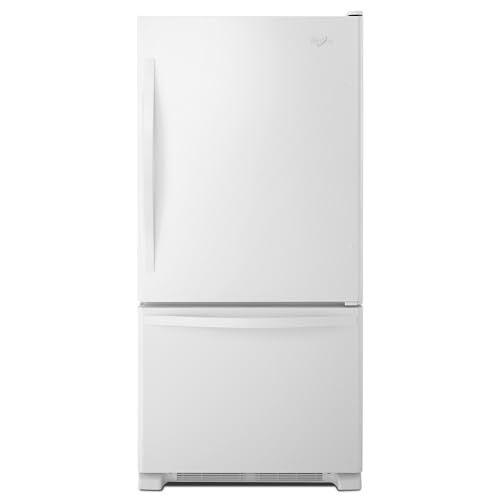
Whirlpool 18.5 Cu Ft Bottom Freezer Refrigerator White WRB329DMBW — Best White-Finish Classic
This is the same Whirlpool as the pick above — same 18.5 cu. ft., same layout, same long-running design — wearing white instead of stainless, and the guide lists it separately because finish is a legitimate reason to choose a fridge. In a pale kitchen, a farmhouse scheme, or a room where the other appliances are white and staying, a stainless box is not an upgrade; it is an interruption. The WRB329DMBW exists so that the bottom freezer layout does not force that interruption.
White has practical manners of its own. It hides the fine dust that stainless spotlights, it brightens a small or north-facing kitchen instead of absorbing its light, and it pairs with the painted cabinetry that dominates cottage and country styles. The trade is fashion’s wheel: white reads as classic in one decade and dated in another, and only you know which decade your kitchen intends to live in.
Everything said about its stainless twin applies here — the right-sizing, the production pedigree, the modest freezer — so the decision between the two is purely about the room. Stand in your kitchen, look at the slot, and choose the finish that disappears into it. A fridge you stop noticing is a fridge that is doing its design job perfectly.
One honest note for households torn between the twins: finishes also differ in how they meet the rest of a renovation timeline. If a full kitchen refit is two years away and the range will go stainless then, buy the stainless twin now and let the fridge lead the change. If the white appliances around it are young and staying, match them. The fridge will outlast several fashion cycles either way; buy for the kitchen you are actually building.
- Capacity: 18.5 cu. ft. total
- Model: WRB329DMBW
- Finish: white
- Layout: single fresh-food door over a bottom freezer
- Relationship: finish twin of the WRB329DMBM above
- Pedigree: the same long-running Whirlpool design
Strengths
- Blends into white and farmhouse kitchens where stainless would jar.
- Same proven design and sizing as its stainless twin.
- White surfaces forgive dust and brighten darker rooms.
Trade-offs
- Identical capacity limits to the twin — the freezer stays modest.
- White can read as dated if the kitchen later goes all-stainless.
- No feature advantage over the twin; the choice is purely the finish.
Best for: white-appliance kitchens and cottage styles that want the layout without the stainless interruption.
Not suited for: kitchens mid-transition to stainless, where the twin above is the better long-term match.

Summit 24 Inch Bottom Mount Refrigerator FFBF1031PL — Best 24-Inch-Wide Compact Exception, 10.5 Cu. Ft.
Read this pick’s badge twice, because it is the most important line in the guide: the 24 in this Summit’s story is its width in inches, not its capacity. The FFBF1031PL is a bottom-mount refrigerator-freezer just 24 inches wide, holding about 10.5 cu. ft., finished in a stainless steel look. It belongs in this guide because thousands of shoppers searching the class actually have a two-foot slot — in a studio, a small flat, an in-law suite or an office kitchen — and for them this is not the smallest pick on the list; it is the only pick that fits.
Within its brief, it is a remarkably complete fridge. The bottom-mount freezer keeps the fresh-food section at standing height, which in a compact is a genuine ergonomic gift: the food you use hourly sits where you can see it, and the frozen drawer below takes a modest, honest store. Summit specialises in exactly this territory — appliances for spaces the mainstream brands round down to zero — and the FFBF1031PL shows that specialisation in its proportions and its finish, which lets a small kitchen look deliberate rather than apologetic.
Do not buy it as a cheap way into the class. Its 10.5 cu. ft. will not feed a family, its shelves will not take a roasting pan, and its freezer is a drawer of essentials, not a store. Buy it because your slot is 24 inches wide and you want a real refrigerator — bottom freezer, proper finish, full-height fresh food — instead of a mini fridge pretending. For that household, it is not a compromise at all; it is the correct appliance, correctly sized.
It also makes a thoughtful second fridge for a household that has one: a drinks-and-produce cabinet in a utility room, a suite fridge for a long-stay guest, or the cold storage in a garden office. In those roles the bottom freezer layout still earns its keep, because even a second fridge is opened mostly for fresh things. Just let the record show, one final time, that you are buying width, not volume.
- Width: 24 inches — the figure in its name is width, not capacity
- Capacity: about 10.5 cu. ft. total
- Model: FFBF1031PL
- Finish: stainless steel look
- Layout: bottom-mount freezer below the fresh-food section
- Role: compact exception for narrow slots, studios and suites
Strengths
- Fits genuine 24-inch-wide slots no other pick here can enter.
- Bottom-mount layout keeps fresh food at standing height.
- Stainless-look finish lets a compact kitchen look finished.
Trade-offs
- About 10.5 cu. ft. is compact capacity — not a family fridge.
- Shelves will not accept wide pans or party platters.
- Freezer drawer holds essentials, not a bulk frozen store.
Best for: studios, small flats, in-law suites and second-fridge roles with a 24-inch-wide slot.
Not suited for: anyone shopping for 24 cu. ft. of capacity — the other five picks are your guide.
How Do the Six Compare Side by Side?
| Pick | Capacity | Width | Signature point |
|---|---|---|---|
| Kenmore Bottom Freezer | 22.3 cu. ft. | 31 in. | Ice maker, glass shelves, LED lighting |
| GE Bottom Freezer | 21.0 cu. ft. | Standard width | Standard depth, fingerprint-resistant finish |
| LG LRDCS2603S | 26 cu. ft. | 33 in. | Door Cooling and ThinQ connectivity |
| Whirlpool WRB329DMBM | 18.5 cu. ft. | Compact width | Long-running design in stainless |
| Whirlpool WRB329DMBW | 18.5 cu. ft. | Compact width | The same fridge in white |
| Summit FFBF1031PL | About 10.5 cu. ft. | 24 in. wide | Compact exception — width pick, not capacity |
The table tells the guide’s whole argument in six rows. Capacity climbs from the Summit’s compact exception through the Whirlpool twins and the GE to the Kenmore and the big LG, and the right row is the one whose width fits your slot and whose volume fits your shop. If two rows both fit, let the signature point decide: ice making, door cooling, finish, or sheer pedigree.
Why Do Cooks Prefer the Freezer at the Bottom?
Because of where the day is spent. A household opens its fresh-food section perhaps twenty times for every freezer visit, so putting the fresh food at standing height and the freezer at ankle height aligns the appliance with the body’s habits. No more kneeling for the milk, no more yoghurt hidden behind the frozen peas at eye level. The layout is ergonomics wearing an appliance’s clothes.
The freezer drawer’s presentation helps too. Frozen food viewed from above, in a drawer you pull toward you, is easier to inventory than food stacked behind a swinging door, and easier inventory means less food forgotten until it is freezer-burned archaeology. The honest cost is bending: every frozen retrieval is a stoop, and households with bad backs should weigh that against the fresh-food benefit with clear eyes.
Drawer or Door: Which Bottom Freezer Style Works Better?
Most modern bottom freezers, the picks here included, use a drawer, and the drawer’s virtues are presentation and containment: it pulls the whole frozen store out into the room’s light and keeps loose bags from avalanching onto the floor. Its vice is geometry — rigid, awkward shapes pack less efficiently into a drawer than into a shelved compartment behind a door.
Door-style bottom freezers survive in some compact and older designs, and they ask less floor space in front of the fridge, since a door swings rather than slides toward you. In a kitchen where an island sits close opposite the fridge slot, that difference can be the whole decision. Measure the open-drawer depth against your floor plan before you fall in love with any model in this guide.
How Should You Measure for a Bottom Freezer?
Start with the slot: width at three heights, depth to the counter’s edge, and height beneath any bridging cabinet. Then add the layout’s special measurement — the drawer’s travel. Mark on the floor how far the freezer drawer will extend when open and walk around it as you would with a pan in your hands; if the open drawer turns the kitchen into an obstacle course, the layout will annoy you daily no matter how good the fridge is.
Finish with the journey from kerb to kitchen, as with any large appliance: door widths, hallway turns, stair corners. Bottom freezers are single wide doors on top, so their boxed width is honest, but their height defeats more doorways than buyers expect. Ten minutes with a tape now is cheaper than a refused delivery later.
What Should You Check About Ice and Water Before Buying?
Whether the model makes ice, and whether your kitchen can feed it. The Kenmore in this guide carries a factory ice maker; for any pick, confirm the listing’s current configuration before ordering, and then confirm your own plumbing: a water line near the slot, a shut-off valve that actually shuts off, and a plan for the line’s route that does not involve it lying across a walkway in spirit if not in fact.
Households without a line have three honest options: plumb one, choose a model and accept the ice maker staying dormant, or make ice in trays like the twentieth century did without complaint. What you should not do is discover the question on delivery day, when the installers are standing in the kitchen and the old fridge is already on the truck.
How Do You Keep a Bottom Freezer Organised?
Treat the drawer as two climates of attention: the top layer for the week’s frozen regulars, the depths for the strategic reserve. Flat-freeze bags of soup, sauce and portions so they stack like books, label them on the spine that faces upward, and keep one small container as the drawer of lost things — the half-bag of peas, the single chicken breast — so strays gather in one auditable place instead of fossilising in four corners.
Up top, give the fresh-food door a weekly five-minute audit while the kettle boils. Bottom freezer households eat fresher because the food is visible; that advantage compounds when the visible food is also current. Move the oldest items forward, marry the duplicate mustards, and let the layout’s gift — everything at eye level — do the work it was designed for.
How Does This Layout Suit Different Kinds of Households?
For the daily cook, the bottom freezer is the layout that respects the work: ingredients at eye level, prep bowls sliding straight from shelf to counter, nothing important stored where knees are required. For the batch cook, the judgement is more mixed, because the freezer drawer — however well presented — is where the batch cook lives, and it is the smaller half of every cabinet here. A household that freezes Sunday’s cooking for the week should read the freezer share of each pick as carefully as the total.
For older households and anyone whose back files complaints, the split verdict continues: fresh food without stooping is a daily mercy, frozen food with stooping is a weekly tax. Many such households solve it by keeping the drawer’s top layer stocked with the frozen regulars and letting a small chest freezer in the garage carry the deep reserve. Judge the layout against your own spine and your own shopping rhythm, not against a showroom’s opinion.
What Happens to Each Layout in a Power Cut?
Outages test a fridge’s insulation and its owner’s discipline more than its layout, but the drawer earns a small honest credit here: a freezer drawer’s cold mass sits low and spills less cold air when cracked open than a door freezer does, and the fresh-food section above stays shut while the household thinks. The practical rules are the same for all six picks — keep doors closed, let a full cabinet’s thermal mass carry you, and know in advance which foods get eaten first when power returns.
Households in outage-prone areas should also note which picks give them information. A connected model like the LG can report a temperature excursion to a phone after the fact, which turns the anxious guesswork of “was it warm, and for how long” into a fact. It is not a reason to buy a fridge on its own, but in storm country it is a real line in the ledger.
How Should You Clean and Maintain a Bottom Freezer?
The drawer’s gift to maintenance is that it comes to you: pull it out and the whole frozen compartment can be wiped, audited and defrosted of its stray ice in minutes, without the kneeling archaeology a door freezer demands. Do it twice a year, moving the frozen stock to bags in the sink, and the drawer will never develop the glacier of spilt peas and frost that older freezers grow in their corners.
The fresh-food door’s seal is the other maintenance story, because a single wide door carries a long gasket that works hard at its corners. Wipe it monthly, check the banknote grip at all four sides, and keep the hinge side free of the crumbs that migrate there. The condenser area at the base wants an occasional brush or vacuum; a fridge that can shed heat easily is a fridge whose compressor lives long and runs quietly.
What Does the Freezer’s Share Mean for Batch Cooking?
Total capacity flatters; the split decides. In this class the freezer typically claims around a third of the cabinet, so a 22 cu. ft. fridge offers roughly seven cubic feet of frozen room — plenty for a household that freezes ingredients and a few prepared meals, tight for one that freezes whole weekends of cooking. Before buying, lay out your household’s honest frozen inventory on the counter: the bags, boxes and tubs that must live in the new drawer on an ordinary week, not a holiday week.
If the pile defeats every pick here, the answer is rarely a different fridge; it is a small supplementary freezer, which costs little to run and lets the kitchen fridge stay in the layout you love. Many bottom freezer households run exactly that pairing and consider it the best of both geometries: eye-level freshness in the kitchen, deep cold storage where the floor space is cheap.
How Do the Finishes Here Behave in Real Kitchens?
Three finishes divide this guide. The fingerprint-resistant stainless on the Kenmore and the GE hides the daily evidence of hands, which on a much-handled single door is worth more than any other cosmetic property. Plain stainless, on the Whirlpool MBM, shows more but polishes to a depth the treated finishes cannot quite match, and in a low-traffic household that trade can be worth making.
White, on the Whirlpool MBW, remains the forgiving finish: dust disappears into it, small marks read as patina rather than damage, and a bright kitchen stays bright. The Summit’s stainless look is a finish in the honest sense of the word — a surface that gives a compact the visual manners of stainless in rooms where a white box would announce itself as an appliance of last resort. Choose by traffic and by the room’s other surfaces, and remember the fridge will be touched more than it will be admired.
When Should You Repair the Old Fridge Instead of Replacing It?
If the existing fridge is under a decade old, cools evenly, and has failed in one ordinary way — a fan, a thermostat, a seal — repair usually wins, and this guide will happily wait for you. Replacement earns its place when the compressor is tired, when the cabinet’s size or layout fights the household daily, or when the old machine’s appetite for electricity has become a line item you can feel. Layout misery is a legitimate reason: a household that has stooped for the milk for ten years does not need a breakdown to justify a bottom freezer.
There is also the slot argument. Kitchens get renovated around appliances, and if a refit is coming within a year or two, buying the fridge for the future slot rather than the present one can save a second purchase. Measure the planned opening, not just today’s, and let the renovation’s tape measure co-author the decision.
How Does a Bottom Freezer Change a Small Kitchen’s Feel?
In a compact kitchen the single wide door reads as one calm surface, and the room feels less chopped than it does beside a side-by-side’s vertical seam or a French door pair. The trade is the door’s swing: one wide arc needs its space, and in the smallest galleys that arc is the room. This is where the Summit’s narrow cabinet and the Kenmore’s 31-inch width stop being specifications and become the difference between a kitchen that flows and one that negotiates.
Height plays its part too. A bottom freezer puts its visual weight low — the freezer drawer — and its working surface at the top, which tends to make a small room feel taller and less top-heavy than a top freezer’s looming frozen box. It is a subtle effect, noticed mostly in the first week, but first weeks are when a kitchen either settles into being loved or begins its long career of being apologised for.
What Should Happen in the First Week of Ownership?
Day one belongs to temperature: let the cabinet settle, confirm the fresh-food section holds its set point, and resist loading the freezer drawer to its brim while the machine finds its rhythm. Days two and three belong to arrangement — live with the shelves as they came, then move exactly one thing at a time as the household’s habits reveal themselves. The fridge you rearrange daily for a week becomes the fridge that fits; the one you rearrange once, grandly, fits the plan instead of the life.
By the end of the week, do the unglamorous paperwork: register the warranty, photograph the model plate, note the water filter’s part number if your model uses one, and file the manual where the household actually looks for manuals. Then cook something ambitious. A new fridge earns its place not on the delivery invoice but on the first Sunday when the shop, the prep and the leftovers all find their level without a thought — and a bottom freezer, honestly chosen, reaches that Sunday quickly.
How Much Does Delivery Day Really Decide?
More than the brochure admits. A bottom freezer is a tall, single cabinet, and its journey through the house — front door, hallway turn, kitchen doorway — defeats more purchases than any compressor ever has. Walk the route with a tape before ordering, note the tightest turn, and compare it with the boxed dimensions on the listing rather than the cabinet’s bare figures, because packaging adds the inches that matter at a banister.
On the day itself, small preparations compound: the old fridge emptied and its water line photographed, the route cleared, a decision made in advance about doors that may need lifting off their hinges. Crews who meet a prepared house install carefully and leave quickly; crews who meet improvisation leave a fridge standing in the hall and a household eating from bags. The appliance is identical either way — the experience is not, and the experience colours the first year of ownership more than any feature list.
Why Does Door Swing Deserve Its Own Measurement?
Because a bottom freezer’s fresh-food door is one wide panel, and its arc is the largest moving object in most kitchens. Open it fully in your mind’s eye: does it clear the island’s corner, the oven handle, the peninsula where someone will inevitably stand with a mug? A door that stops at ninety degrees still works, but a door that can open past it lets crisper drawers slide out fully, and a crisper that cannot fully open becomes a drawer of forgotten vegetables within a month.
Handedness follows from the same thinking. The hinge side decides which hand works the door while the other holds a pan, and which wall the open door rests against. Most models here allow the swing to be set or chosen at purchase; decide it by standing in the kitchen and miming the cooking, not by accepting the default the truck happens to carry.
What Role Does Lighting Play Inside the Cabinet?
A bottom freezer’s fresh-food section is a tall, single room, and its lighting decides whether the back corners participate in the household or secede from it. LED lighting, like the Kenmore’s here, spreads an even wash that makes the top shelf and the crisper equally legible, and legibility is what turns a fridge from storage into inventory. Food that can be seen gets eaten; food that hides gets bought twice.
Judge lighting the way you would judge a kitchen’s own: brightness matters less than evenness, and a single dim point at the top leaves the lower shelves in permanent dusk. When you read listings, treat a named lighting system as a small but real point in a pick’s favour, and when the fridge arrives, arrange the tallest items where they cast the least shadow over the shelves behind them.
How Should a Household Grow Into a Larger Cabinet?
Families eyeing the LG’s 26 cu. ft. often ask the wrong question — whether they can fill it — when the better question is whether their habits will change to deserve it. A big bottom freezer rewards the household that plans: a written inventory on the freezer drawer’s inside lid, a monthly rhythm of using the oldest stock, and a fresh-food section arranged by meal rather than by shopping trip. Without those habits, extra capacity simply delays the discovery of expired food by a fortnight.
With them, the large cabinet becomes the kitchen’s quiet advantage: the holiday bird fits without evicting the week, the garden’s August glut freezes in a single afternoon, and the weekly shop stops being a negotiation. Capacity is not a virtue in itself; it is an amplifier. It amplifies an organised household into a serene one and a chaotic household into a larger chaos, which is why this guide keeps pointing smaller households toward the Whirlpools without a trace of condescension.
What Is the Sensible Order of Decisions?
Slot, shop, finish, features — in that order, and the discipline matters because each step eliminates honestly. The slot’s width and the drawer’s travel decide which of these six can physically live in your kitchen. The shop’s size then decides among the survivors on capacity, and only then should finish be allowed a vote, because a fridge that fits the room’s scheme but not its slot is a photograph, not an appliance. Features come last and should be bought only when a household habit will actually use them: the ice maker for the household that entertains, the app for the household that travels, the door cooling for the household whose milk lives in the door.
Followed in that order, the decision usually makes itself, and the buyer’s remorse that haunts appliance purchases — the sense of having been sold rather than having chosen — never gets a foothold. That is the real service a guide can do: not to crown a winner, but to order the questions so that your own kitchen answers them.
What Are the Most Common Mistakes When Buying a Bottom Freezer?
The first is reading the Summit’s 24 as capacity — a mistake this guide has flagged repeatedly because search behaviour proves people make it. The second is forgetting the drawer’s travel and discovering that the island blocks it. The third is buying capacity by the badge while ignoring the freezer’s share, then finding the frozen drawer full by October. The fourth is assuming an ice maker exists because the layout looks like it should have one; check the listing, every time.
Fifth, shoppers forget that a single wide fresh-food door needs a full swing arc, and a wall or a peninsula can clip it forever. Sixth, they measure the slot and not the route, and meet their new fridge on the doorstep in defeat. None of these mistakes is about the fridges; all of them are about the ten minutes of measuring and reading that the purchase deserves.
Final Recommendation
Start where the class actually lives: the Kenmore 22.3 cu. ft. bottom freezer is the guide’s centre — nearest the headline capacity, sensibly narrow, properly equipped. Households with room and appetite step up to the LG LRDCS2603S, while those who value the proven over the new will be happy with the GE 21.0 cu. ft. model. The Whirlpool twins serve smaller households in whichever finish the kitchen wears, and the Summit serves the 24-inch-wide slot that nothing else here can enter. Choose by slot first, by shop second, and by finish last, and the bottom freezer layout will repay you every morning when the milk is exactly where your eyes already are — for a layout bought with open eyes and honest numbers is the one a household keeps, and keeps gladly, for years.
Frequently Asked Questions
Is the Summit really only about 10.5 cu. ft.?
Yes. The FFBF1031PL is 24 inches wide and holds about 10.5 cu. ft. It is a compact bottom-mount fridge for narrow slots, included here as an exception for small kitchens — not a 24 cu. ft. family model.
Which pick is closest to 24 cu. ft.?
The Kenmore at 22.3 cu. ft. is the closest below the figure, and the LG at 26 cu. ft. is the step above it. The class is a neighbourhood; those two are its nearest addresses on either side.
Are the two Whirlpools actually the same fridge?
In every way that affects food, yes — same 18.5 cu. ft. design, different finish. The MBM is stainless and the MBW is white. Choose between them by looking at your kitchen, not at the spec sheet.
Do bottom freezers use more energy than top freezers?
The layout itself is not the deciding factor; size, seals, insulation and how often the doors open matter far more. An ENERGY STAR certified model like the Kenmore here is the surer route to low running costs than layout folklore.
How much space does the freezer drawer need to open?
Enough clear floor in front of the fridge for the drawer’s full travel plus your own feet. Measure the drawer’s open depth from the listing’s dimensions and test it against islands and opposite counters before ordering.
Related Guides
Planning the rest of the cold-storage picture, or the laundry room beyond it? These companion guides continue the tour. Best 25 Cu Ft Refrigerators Best 33 Inch Wide French Door Refrigerators Best Agitator Top Loader Washers


