What's inside
- Key Takeaways
- Quick Picks
- How Did We Choose These Six for the 25 Cu Ft Class?
- The Best 25 Cu Ft Refrigerators, Reviewed One by One
- How Do the Six Compare Side by Side?
- Top Mount or Side-by-Side: Which Layout Earns the Space?
- How Much Freezer Space Does Each Layout Really Give?
- What Should You Measure Before Choosing in This Class?
- How Do Dispensers Change the Ownership Equation?
- How Should Each Layout Be Organised Once It Is Home?
- What Does This Size Class Mean for Running Costs?
- How Do You Choose Between the Two Exact-Class Finishes?
- What Should Delivery Day Look Like for a Fridge This Size?
- How Long Should a Fridge in This Class Last, and What Fails First?
- What Changes in the First Month of Ownership?
- Can One of These Serve as a Second Fridge Instead?
- Which Pick Suits a Household That Is Still Growing?
- How Does the Freezer’s Position Change a Cook’s Day?
- What Should You Do With the Old Fridge?
- How Do You Keep a Big Cabinet From Becoming a Big Mess?
- What Is the Right Order to Decide Everything In?
- How Should You Judge a Listing Before You Trust It?
- Why Do Two Identical Capacities Feel So Different?
- What About the Kitchen Around the Fridge?
- What Are the Most Common Mistakes When Buying at This Size?
- Final Recommendation
- Frequently Asked Questions
- Related Guides
As an Amazon Associate I earn from qualifying purchases. This post may contain affiliate links at no extra cost to you.
cottageverdict.com is reader-supported. When you buy through links on our site, we may earn an affiliate commission.
Twenty-five cubic feet is the crossroads size of the refrigerator world: big enough that layout becomes a real choice, small enough that every layout is still on the table. Shoppers looking for the best 25 cu ft refrigerators are not really shopping a number — they are deciding, at family scale, between a top freezer’s simplicity, a side-by-side’s organisation and a counter-depth cabinet’s manners. This guide leans into that decision. Two Kenmore top-mounts hit the class figure exactly, in stainless and in white; a Midea side-by-side sits a half-step below it in a counter-depth body; a big Kenmore side-by-side steps up to 29; and two simpler models — a BLACK+DECKER top mount at 24 and an Element side-by-side at 21.4 — serve households whose real size is a notch smaller than their search.
Where to buy: every model below is sold through Amazon, and the names in the Quick Picks table, the review headings and the comparison table link to the matching listing, where you can check price on Amazon and confirm the finish and configuration on offer. Because this class spans three layouts, measure more than the slot: note the door swing each layout needs, the freezer access your household prefers, and the route the cabinet must travel to reach the kitchen.
The honest headline is that at 25 cu. ft., cubic feet stop being the interesting variable. The six fridges here divide by philosophy: two doors stacked, two doors side by side, shallow cabinet or deep. The reviews argue each philosophy through the model that expresses it best, so that by the comparison table you are choosing a way of living with a fridge, not merely a volume of one.
Key Takeaways
- Only the two Kenmore top-mounts are exactly 25 cu. ft.; the class here honestly spans 21.4 to 29 cu. ft.
- At this size, layout is the decision: top mount for simplicity, side-by-side for organisation, counter depth for manners.
- The two exact-class Kenmores differ by finish and crisper detailing, not by size or shelf plan.
- The Midea is the counter-depth diplomat: 24.5 cu. ft. and an AutoFill pitcher in a shallower cabinet.
- The 29 cu. ft. Kenmore side-by-side is the step-up for warehouse shoppers, with through-door ice and water.
- The Element at 21.4 cu. ft. suits households whose real shop is smaller than the class they searched.
Quick Picks
| Pick | Badge | Why it earns its place |
|---|---|---|
| Kenmore 25 Cu Ft 33 Inch Top Mount Refrigerator Stainless | Best Exact-Class Top Mount | Exactly 25 cu. ft. at 33 inches wide, with glass shelving, gallon door bins and fingerprint-resistant stainless over a classic top freezer. |
| Kenmore 25 Cu Ft 33 Inch Top Mount Refrigerator White | Best Exact-Class in White | The same exact 25 cu. ft. Kenmore in white, with humidity-controlled crispers for kitchens that wear the paler finish. |
| Midea 24.5 Cu Ft Counter-Depth Side-by-Side Refrigerator MRS25I7BST | Best Counter-Depth Near-Class | A 24.5 cu. ft. side-by-side in a counter-depth stainless cabinet, organised around an AutoFill water pitcher instead of a through-door dispenser. |
| Kenmore 29 Cu Ft 36 Inch Side-by-Side Refrigerator | Best Step-Up for Big Shops | Twenty-nine cubic feet at 36 inches wide, with a space-saving ice and water dispenser and Accela Chill and Freeze for fast pull-down after loading. |
| BLACK+DECKER 24 Cu Ft Top Mount Refrigerator BR2400JW | Best Simple Top Mount | A 24 cu. ft. white top mount with adjustable temperature control and no feature the household did not ask for. |
| Element 21.4 Cu Ft Side-by-Side Refrigerator | Best Smaller Side-by-Side | A frost-free 21.4 cu. ft. side-by-side with tempered glass shelves and LED lighting for smaller households that still want the split layout. |
How Did We Choose These Six for the 25 Cu Ft Class?
We treated 25 cu. ft. as a crossroads and chose one strong expression of each road. The exact-class pair had to be genuinely exact — not 24.6 wearing a round number — and the two Kenmore top-mounts are, which is why they anchor the guide. Around them we placed the models a real shopper cross-shops in the same afternoon: the counter-depth side-by-side a half-step down in volume but a step up in manners, and the 36-inch side-by-side a full step up in both.
The two smaller picks survived a sterner test: they had to serve a household that would be worse off with the exact class size. The BLACK+DECKER does that with simplicity — a top mount that asks nothing of its owner — and the Element does it by keeping the side-by-side layout available to households whose shops never justified 25 cu. ft. in the first place. A guide that only lists the number on its cover would be tidier; it would also be less truthful about how fridges are actually chosen.
Listings had to state capacity, width and layout without fog, because at a crossroads size the cost of a misunderstood dimension is a returned appliance. Models that blurred counter depth with standard depth, or hid their width behind marketing, were passed over regardless of their other virtues.
The Best 25 Cu Ft Refrigerators, Reviewed One by One

Kenmore 25 Cu Ft 33 Inch Top Mount Refrigerator Stainless — Best Exact-Class Top Mount
Start with the fridge the title promises: exactly 25 cu. ft., 33 inches wide, top freezer, in fingerprint-resistant stainless. The Kenmore’s argument is that the classic layout, executed at full family size with modern details, remains hard to beat. Adjustable glass shelving contains spills instead of distributing them, crisper drawers guard the produce, gallon door bins swallow the milk and juice jugs that otherwise colonise the main shelves, and LED lighting makes the whole cabinet legible at a glance.
The top freezer deserves its defence at this size. A stacked freezer is a simple, wide, undivided space: the turkey fits, the pizza boxes fit, the batch cook’s trays fit, and none of them negotiate with a drawer or a narrow column. Households that freeze generously and organise loosely will always prefer this geometry, and at 25 cu. ft. the freezer’s share is generous enough to matter. The fresh-food section below it is equally undivided, with a full-width span that takes a sheet pan without tilting.
What lifts this Kenmore above nostalgia is the finish and the certification. Fingerprint-resistant stainless keeps a family fridge presentable, and ENERGY STAR certification means the big cabinet’s appetite is disciplined. For a household that wants the class size, the classic layout and no experiments, this is the guide’s anchor pick and the one against which the other five justify their deviations.
It also suits the way family kitchens actually age. Shelves adjust as children grow and shopping changes; the layout a teenager raids is the same one a toddler’s parent stocked, and nothing about the fridge needs relearning across those years. Appliances that survive a family’s whole arc are usually the simple ones bought at the right size — which is a fair one-line summary of this Kenmore.
- Capacity: exactly 25 cu. ft. total
- Width: 33 inches
- Layout: top mount freezer over fresh food
- Shelving: adjustable glass shelves, crisper drawers
- Door storage: gallon door bins
- Finish: fingerprint-resistant stainless steel, ENERGY STAR certified, LED lighting
Strengths
- The genuine class capacity in the classic, freezer-friendly layout.
- Full-width shelves accept sheet pans and party trays flat.
- Gallon bins free the main shelves from jug congestion.
Trade-offs
- Fresh food sits low; tall households will stoop for the bottom shelf.
- No through-door water or ice dispensing in this layout.
- Top freezer means frozen food lives above eye level for shorter cooks.
Best for: families who freeze generously and want the exact class size in its most proven form.
Not suited for: households set on door dispensing or eye-level fresh food as their first priority.
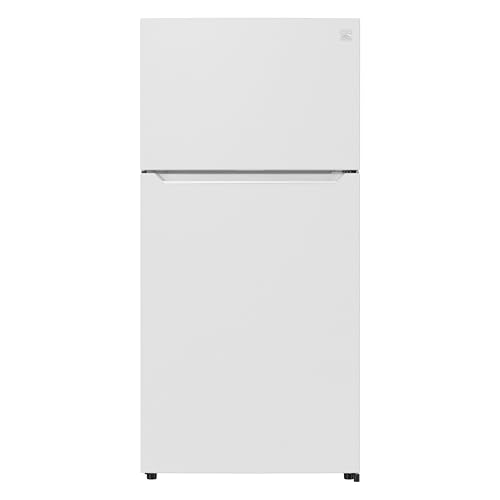
Kenmore 25 Cu Ft 33 Inch Top Mount Refrigerator White — Best Exact-Class in White
The white Kenmore is the stainless pick’s sibling, not its understudy: the same exact 25 cu. ft. at the same 33 inches, the same glass shelving, gallon bins and LED lighting, with humidity-controlled crispers specified on this variant and a white finish that changes the kitchen it belongs in. In a farmhouse scheme, a rental with white appliances, or a bright room where stainless would sit like a grey slab, this is the exact-class fridge that fits the picture.
Humidity-controlled crispers are worth the sentence they get. Leafy greens and herbs die of dryness while fruit suffers from damp; a crisper whose humidity the household can set acknowledges that produce is not one category. At 25 cu. ft., where the weekly shop includes a serious vegetable contingent, that control quietly reduces the amount of food bought twice.
Choose between the twins the way you would choose between two suits: the cut is identical, the cloth is the decision. If the kitchen’s other appliances are white and staying, match them and enjoy a fridge that disappears into the room’s scheme. If a stainless renovation is coming, buy the twin above. Either way you are getting the guide’s anchor fridge, and the finish argument should never be allowed to obscure that happy fact.
White also ages gracefully in a working family’s kitchen: it does not record every fingerprint for the evening’s inspection, and in a sunlit room it returns light instead of absorbing it. Owners of north-facing kitchens, where every appliance decision is also a lighting decision, tend to understand this pick instantly.
- Capacity: exactly 25 cu. ft. total
- Width: 33 inches
- Layout: top mount freezer over fresh food
- Crispers: humidity-controlled
- Door storage: gallon door bins, LED lighting
- Finish: white, ENERGY STAR certified
Strengths
- Exact class capacity in the finish white kitchens actually need.
- Humidity-controlled crispers treat greens and fruit differently, as they deserve.
- Same shelf plan and bins as the stainless anchor pick.
Trade-offs
- Shares the layout’s trade-offs: low fresh food, no door dispensing.
- White will clash if the kitchen later converts to stainless.
- No feature separates it from its twin beyond finish and crispers.
Best for: white-appliance and farmhouse kitchens that want the exact class size without a stainless interruption.
Not suited for: kitchens mid-renovation toward stainless, where the twin above is the safer long-term buy.

Midea 24.5 Cu Ft Counter-Depth Side-by-Side Refrigerator MRS25I7BST — Best Counter-Depth Near-Class
Read from the 25 cu. ft. angle, the Midea MRS25I7BST is the diplomat of this guide: a side-by-side that gives up only a half cubic foot to the class figure while changing almost everything else about the experience. The cabinet is counter-depth, so the doors sit close to the cabinet line and the kitchen keeps its walkway; the layout is a vertical split, so frozen and fresh food both stand at full height in their own columns; and the water lives in an AutoFill pitcher rather than a through-door dispenser, keeping the stainless front unbroken.
The pitcher changes the side-by-side’s usual bargain. Conventional models surrender a slab of freezer or fresh-food space to the dispenser machinery; the Midea’s pitcher docks in the door, refills itself, and lifts out for the table, so the columns stay columns. Households that pour water at meals rather than grazing at a paddle will find this arrangement more civilised, and the clean front flatters a renovated kitchen in the way counter-depth buyers are paying for.
Its honest cost is the side-by-side geometry itself: two narrower columns instead of one wide span, so the widest platters and the biggest pizza boxes need a plan B. At 24.5 cu. ft. there is room for that plan — a shelf adjusted, a box angled — but households whose cooking centres on sheet pans should weigh the Kenmore top-mounts’ full-width span carefully before choosing the diplomat’s manners over the anchor’s width.
For the household that entertains in an open-plan space, though, this is the pick that behaves like furniture: quiet lines, a shallow stance, water that travels to the table in a jug. It reframes the class question entirely — not how much fridge, but how the fridge comports itself in the room — and at a half-step below the headline number, that reframing costs almost nothing in volume.
- Capacity: 24.5 cu. ft. total
- Model: MRS25I7BST
- Depth: counter-depth cabinet
- Layout: side-by-side vertical split
- Water: AutoFill pitcher docked in the door
- Finish: stainless steel
Strengths
- Counter-depth stance preserves walkway and sightlines.
- Pitcher frees the columns from dispenser machinery and pours at the table.
- Side-by-side columns keep frozen and fresh food equally visible.
Trade-offs
- Narrower columns challenge the widest trays and boxes.
- No through-door dispensing for paddle-and-glass households.
- A half-step below the class figure in raw volume.
Best for: renovated, open-plan kitchens that want near-class volume with counter-depth manners and a pitcher habit.
Not suited for: sheet-pan households that need an undivided full-width fresh-food span.

Kenmore 29 Cu Ft 36 Inch Side-by-Side Refrigerator — Best Step-Up for Big Shops
Approached from the 25 cu. ft. crossroads, this Kenmore is the road marked “more”: 29 cu. ft. across a 36-inch frame, organised as a side-by-side with a space-saving ice and water dispenser in the door. The step-up is not subtle — four extra cubic feet is a shelf’s worth of food in each column — and it is aimed squarely at the household whose 25 cu. ft. trial ended with the door being persuaded shut. If your shop comes home in a warehouse club trolley, this is the guide’s honest answer.
Kenmore’s Accela Chill and Accela Freeze are the features that matter after exactly that kind of shop: fast pull-down modes that drag a cabinet full of room-temperature groceries back to safe cold without an overnight of compressor complaint. The space-saving dispenser design then protects the gain, tucking the ice and water hardware into the door so the freezer column keeps more of its width for food than older dispenser models managed.
The step-up’s costs are the usual ones, payable in advance: a 36-inch opening is required, the cabinet will fill a modest kitchen’s elevation, and a household of two will cool air. But judged from this class upward — as the answer to “25, but bigger” — it is the most complete big side-by-side here, with dispensing, fast cooling and a fingerprint-resistant finish forming a coherent whole rather than a list of options.
It also reframes the freezer question that haunts side-by-sides. The format’s freezer column is narrow by design, but at 29 cu. ft. total the column is a genuinely useful store, tall and fully visible, where frozen food stands in files instead of hiding in a drawer’s depths. Households that freeze flat and file upright will find this column easier to keep honest than any drawer.
- Capacity: 29 cu. ft. total — the step-up in this guide
- Width: 36 inches
- Layout: side-by-side vertical split
- Dispenser: space-saving ice and water in the door
- Cooling: Accela Chill and Accela Freeze fast modes
- Finish: fingerprint-resistant stainless steel
Strengths
- Four cubic feet above class absorbs warehouse-scale shops.
- Fast chill and freeze modes recover temperature after loading.
- Dispenser design protects the freezer column’s usable width.
Trade-offs
- Demands a 36-inch opening and a kitchen that can carry its scale.
- Side-by-side columns still refuse the widest trays.
- Oversized for small households, who pay to cool empty volume.
Best for: big families and warehouse shoppers who outgrew the class and want dispensing with their volume.
Not suited for: 33-inch slots or small households, for whom the exact-class Kenmores are the honest size.
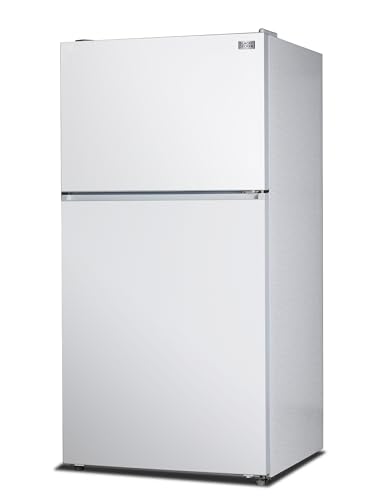
BLACK+DECKER 24 Cu Ft Top Mount Refrigerator BR2400JW — Best Simple Top Mount
The BR2400JW is the guide’s argument for restraint: a 24 cu. ft. top mount in white, with two doors, adjustable temperature control, and a refreshing absence of features competing for your attention. A cubic foot below the class figure, it suits the household that searched 25, measured its actual shop, and discovered its life runs a size smaller — a discovery this guide wishes on more buyers, because the right fridge is the one that matches the groceries, not the search history.
Simplicity here is not the same as cheapness of purpose. A top mount with a straightforward control and an undivided interior is a fridge a household can understand completely in an afternoon, maintain without a manual, and expect ordinary service from for years. BLACK+DECKER’s name in small appliances precedes it; in full-size refrigeration the proposition is the same — the essentials, done plainly, in a white finish that suits utility rooms, rentals and first homes as readily as family kitchens.
Its natural homes are legion: the first house, the in-law apartment, the rental that deserves better than a landlord special, the garage-adjacent kitchen feeding a big household’s overflow. In each, the absence of dispensing plumbing and smart electronics is not a lack but a list of things that cannot break, leak or demand an update. Buy it with that philosophy and it will not disappoint; buy it wanting a dispenser and it was never your fridge.
There is a budget logic to it that this guide will state qualitatively: money not spent on features a household never uses is money available for the rest of the kitchen, and a simple top mount at near-class size is where that logic bites hardest. The BR2400JW keeps the cold, keeps the size, and declines the theatre.
- Capacity: 24 cu. ft. total
- Model: BR2400JW
- Layout: top mount, two doors
- Control: adjustable temperature control
- Finish: white
- Character: full-size kitchen appliance without dispenser or smart extras
Strengths
- Near-class volume with the simplest possible brief.
- No plumbing or electronics beyond the essentials to maintain.
- White finish suits rentals, utility spaces and first homes.
Trade-offs
- No ice maker or dispenser; trays are the ice programme.
- Fresh food sits at the layout’s usual lower height.
- Plainer interior fittings than the Kenmore anchor picks.
Best for: first homes, rentals and overflow duty where near-class size and total simplicity are the brief.
Not suited for: households that consider through-door ice and water part of a fridge’s job description.

Element 21.4 Cu Ft Side-by-Side Refrigerator — Best Smaller Side-by-Side
From the 25 cu. ft. vantage point, the Element is the layout loyalist’s smaller option: a side-by-side for households that love the vertical split — everything at full height, frozen and fresh in parallel columns — but whose weekly shop never filled a class-size cabinet. At 21.4 cu. ft. it is the smallest pick here, and its presence makes the guide’s real point one final time: the layout you live with happily at 21 cu. ft. beats the layout you tolerate at 25.
Element equips it properly for its size: frost-free operation so the freezer never needs a defrosting weekend, tempered glass shelves that contain spills and carry heavy pots without flexing, and LED interior lighting that keeps both columns legible. The stainless finish gives a modest cabinet a finished face. Nothing here is experimental; it is the side-by-side idea distilled to the dimensions of a smaller household’s actual life.
The geometry’s known limits apply with smaller margins: the columns are narrower than the big Kenmore’s, so the widest trays need their plan B sooner, and the freezer column rewards flat, filed storage over bulky boxes. Households that cook from fresh ingredients and freeze in bags and tubs will feel none of this. Households that freeze whole pizzas in their boxes should look at the top-mounts and think again.
As a second-fridge candidate it also deserves a mention: a side-by-side in a utility room or a large pantry gives a big household an organised overflow with both temperatures at standing height, which is more gracious than the usual retired top mount wheeled into the garage. Bought new for that role, the Element’s size is not a compromise but a fit.
- Capacity: 21.4 cu. ft. total
- Layout: side-by-side vertical split
- Freezer: frost-free operation
- Shelving: tempered glass shelves
- Lighting: LED interior lighting
- Finish: stainless steel
Strengths
- Keeps the side-by-side layout available at a smaller household’s size.
- Frost-free freezer removes a whole maintenance ritual.
- Glass shelves and LED lighting match bigger models’ manners.
Trade-offs
- Narrowest columns here; wide items need early planning.
- Well below class volume — buy it for fit, not capacity.
- No dispenser features in this straightforward specification.
Best for: smaller households loyal to the side-by-side split, and organised overflow duty in a utility space.
Not suited for: bulk freezers and wide-tray cooks, who need the top-mounts’ undivided span.
How Do the Six Compare Side by Side?
| Pick | Capacity | Layout | Signature point |
|---|---|---|---|
| Kenmore Top Mount Stainless | 25 cu. ft. | Top mount | Exact class size, gallon bins, glass shelves |
| Kenmore Top Mount White | 25 cu. ft. | Top mount | Exact class size in white, humidity-controlled crispers |
| Midea MRS25I7BST | 24.5 cu. ft. | Side-by-side, counter depth | AutoFill pitcher, unbroken stainless front |
| Kenmore Side-by-Side 29 | 29 cu. ft. | Side-by-side | Door dispenser, Accela Chill and Freeze |
| BLACK+DECKER BR2400JW | 24 cu. ft. | Top mount | Near-class size, deliberately simple |
| Element Side-by-Side | 21.4 cu. ft. | Side-by-side | Frost-free, glass shelves, smaller footprint |
Read the table by layout first and capacity second — that is the order in which these fridges will affect your life. The two top-mount Kenmores and the BLACK+DECKER offer undivided width; the three side-by-sides offer full-height organisation in columns. Within your layout, the capacity column then sorts the household sizes honestly, from the Element’s smaller brief to the big Kenmore’s warehouse brief.
Top Mount or Side-by-Side: Which Layout Earns the Space?
The top mount’s case is width and simplicity: one undivided fresh-food span, one undivided freezer, the fewest doors and seals of any layout. Its cost is altitude — fresh food lives below the freezer, so the most-used shelf in the house is also one of the lowest. The side-by-side’s case is symmetry and visibility: both temperatures at full height, everything filed in columns, nothing buried. Its cost is narrowness, paid every time a wide tray meets a column.
Households rarely choose wrong by following their shopping. If the freezer holds whole birds, trays and boxes, the top mount’s geometry is your friend. If the household eats from both sections daily and organises by category, the columns will feel like a well-run pantry. The 25 cu. ft. class is where both answers are fully grown, which is exactly why it is the crossroads.
How Much Freezer Space Does Each Layout Really Give?
Gross capacity hides the split, and the split is where households feel a fridge. Top mounts at this size tend to give the freezer a generous, undivided share that swallows bulky items whole. Side-by-sides divide more evenly in feel, because the freezer column is tall and fully usable, but its width taxes every box. Counter-depth cabinets like the Midea’s trade a little depth everywhere for their stance in the room.
The practical test is a countertop rehearsal: gather the frozen inventory your household honestly keeps — not the holiday maximum, the ordinary Tuesday stock — and pace it against each layout’s promise. The fridge whose geometry accepts that pile without theatre is the fridge whose freezer you will still respect in year three.
What Should You Measure Before Choosing in This Class?
The slot, as always: width at three heights — these picks need 33 or 36 honest inches — depth against the counter’s edge, and height under any bridging cabinet. Then the layout measurements: a top mount’s door swing, a side-by-side’s pair of narrower arcs, and the floor space in front for loading. Counter-depth adds its own check: confirm the cabinet’s stated depth against your counter run, since the format’s whole promise lives in that comparison.
And the route, always the route. A 36-inch side-by-side is a large object in a hallway; a 33-inch top mount is a slightly smaller one. Boxed dimensions, the tightest turn, and the kitchen doorway decide whether delivery day is a pleasure. Measure them while the decision is still free to change.
How Do Dispensers Change the Ownership Equation?
This guide contains the full spectrum: the big Kenmore’s through-door ice and water, the Midea’s self-filling pitcher, and four models with no dispensing at all. Through-door service is the most convenient and the most demanding — it needs a water line, filters on a schedule, and it occupies door or column space. The pitcher needs the same water line but returns the space and travels to the table. The dispenser-free four need nothing, ever, and their owners make ice in trays and pour from a jug kept cold inside.
None of these is the correct answer in the abstract. The correct answer is the one matched to the household’s actual drinking habits and the kitchen’s actual plumbing. Decide it before the capacity decision seduces you, because a dispenser you cannot plumb is a feature you bought twice — once in money, once in disappointment.
How Should Each Layout Be Organised Once It Is Home?
A top mount rewards zoning by height: the freezer’s single span takes a labelled basket for the week’s frozen dinners and leaves the rest as open country for bulky arrivals, while the fresh-food door below works best with the daily shelf at its centre and the rarely opened jars exiled to the door bins. The Kenmores’ gallon bins exist precisely for that exile — milk and juice standing in the door free the main span for food that is actually cooked with.
A side-by-side rewards filing. Treat each column as a cabinet of narrow shelves and give every shelf a category that survives contact with a tired household: breakfast, sandwich makings, frozen vegetables, frozen proteins. The columns punish improvisation and reward routine, which is why organised households describe their side-by-side with affection and improvisers describe theirs with adjectives. Know which household you are before the layout is chosen for you by a photograph.
The counter-depth Midea asks for a third discipline: because its shelves are shallower, it rewards the household that stores in rows rather than in depth — newest at the back, oldest at the front, in the manner of a well-run shop. Households that adopt that single habit find the shallow cabinet wastes less food than the deep one it replaced, which is the counter-depth format’s quiet manifesto: visibility is a storage technology, and at this size it is the one most likely to change what a household actually eats.
What Does This Size Class Mean for Running Costs?
A fridge in the mid-twenties of cubic feet runs every hour of every day, so its efficiency is a subscription the household pays monthly for a decade. ENERGY STAR certification, carried by both exact-class Kenmores here, is the simplest signal that the subscription is a modest one. Beyond the badge, the household’s own behaviour writes the rest of the bill: seals kept clean, clearances respected, and a cabinet loaded in rhythm rather than stuffed in panic all cost less than any technology.
Size itself cuts both ways. A larger cabinet that is kept reasonably full holds its temperature through door openings better than a small one opened just as often, because the food is thermal ballast. A larger cabinet kept mostly empty is simply a bigger room to refrigerate. The cheapest 25 cu. ft. fridge to run is therefore the one whose size matches the shop closely enough that it lives three-quarters full — another argument for reading this guide’s smaller picks without embarrassment.
How Do You Choose Between the Two Exact-Class Finishes?
Beyond the obvious — match the room — the stainless and white Kenmores differ in how they will look in year seven. Fingerprint-resistant stainless hides the daily touching and suits a kitchen that trends modern, but it asks the rest of the room’s metals to harmonise with it. White forgives dust, brightens a dim room, and never argues with painted cabinetry, but it will date the kitchen to whichever decade white next falls out of fashion, and only the household can price that risk.
There is a practical tiebreaker hiding in the household’s composition. Kitchens with toddlers and dogs live closer to their appliances; the finish that shows less of that closeness wins, and reasonable people can argue it both ways — stainless hides the smear, white hides the dust. Stand in the kitchen at the hour it is busiest, look at the slot, and let the room cast the vote.
What Should Delivery Day Look Like for a Fridge This Size?
Rehearse it. The cabinet that arrives is bigger than the cabinet you imagined, because packaging, a pallet and two installers accompany it. Clear the route the day before, decide which doors come off their hinges, and empty the old fridge into cool boxes with the water line’s shut-off located and tested while there is still time to call a plumber in daylight. A 33-inch top mount threads most houses kindly; the 36-inch side-by-side should be walked through the route on paper twice.
Once installed, patience is the final fitting. Let the cabinet level, settle and pull down to temperature before the weekly shop goes in, and give the ice maker — where fitted — its first day to fill without judgement. Keep the packaging until the first week has passed cleanly. The households that enjoy their fridges most are, disproportionately, the ones whose delivery day was boring.
How Long Should a Fridge in This Class Last, and What Fails First?
Plan on a decade or more, with the middle years decided by seals, fans and the household’s cleaning habits rather than by the compressor, which is usually the last thing to die. Door gaskets harden and tear at their corners; a gasket that no longer grips is a slow leak of money disguised as a fridge that runs a lot. Dispenser models add their own small consumables — filters, and occasionally a valve — while the dispenser-free picks here simply have less to go wrong.
The layout plays a quiet role in longevity too. A top mount’s refrigeration is the industry’s most practised design, and parts for it will exist as long as fridges do. A side-by-side’s extra door and seals ask slightly more of the years. None of this should override the layout your groceries prefer; it should simply be priced into the decision with open eyes.
What Changes in the First Month of Ownership?
The household’s shopping changes first. A class-size fridge invites a weekly rhythm — one substantial shop, cooked from in order — and households arriving from a smaller cabinet often overbuy for a fortnight out of old habit before the new rhythm settles. Let it settle. The second change is spatial: the old fridge’s contents, transferred, reveal how much of it was condiment archaeology, and the new cabinet starts its life blessedly uncluttered.
The third change is social. A fridge with a dispenser becomes the kitchen’s water cooler; a fridge with a pitcher becomes the table’s servant; a simple top mount stays politely out of the conversation. None of these is a small thing across ten years of mornings, and noticing which social role your household wants is a legitimate part of choosing among these six.
Can One of These Serve as a Second Fridge Instead?
Several can, and the role deserves respect rather than the usual hand-me-down. A household that entertains, preserves, or shops monthly often needs a planned overflow: the BLACK+DECKER’s simplicity suits a utility room, the Element’s columns suit a pantry that wants both temperatures organised at standing height, and either exact-class Kenmore can anchor a serious garage setup where the climate allows. A second fridge bought deliberately, at the right size, outperforms a retired giant wheeled out in resentment.
Mind the environment if you go this route. Garages that swing between frost and heatwave ask more of a fridge than a kitchen does, and a model working against a hot garage all summer will show it in the running costs. Where the space is temperate — a basement, a utility room — any of these six will serve a long and useful second career.
Which Pick Suits a Household That Is Still Growing?
The honest answer is the step-up, bought once. A couple expecting the household to double within the fridge’s lifetime should look hard at the 29 cu. ft. Kenmore, because the cost of growing room is lowest on the day the fridge is bought, and the cost of replacing an undersized fridge in year three is a whole second fridge. The counter-argument belongs to households whose growth is speculative: a fridge bought for a hypothetical family cools real empty air in the meantime.
Between those poles sit the exact-class Kenmores, which are the size a family of four actually lives at, and the Midea, whose manners suit the renovated kitchen a growing household often builds around itself. Growth is a reason to buy capacity, not an excuse to skip the measuring tape — the slot, the route and the layout still vote first.
How Does the Freezer’s Position Change a Cook’s Day?
Altitude is destiny in a kitchen. A top mount places the freezer where a tall cook’s eyes already are and where a shorter cook needs a step and a strategy; its fresh food, used twenty times more often, sits lower than instinct would choose. A side-by-side abolishes the question by giving both sections the full height of the cabinet, which is why households with mixed heights often settle their layout argument there. Neither answer is wrong; they are answers for different bodies.
Think about the specific frozen items your household handles weekly. A whole frozen chicken retrieved from above head height is a small weekly hazard a step stool makes safe and a drawer would abolish; a tray of ice cubes at eye level in a column is a daily pleasure. The layout that treats your most-handled frozen item kindly is, more often than the brochures suggest, the layout you will praise at year five.
What Should You Do With the Old Fridge?
Decide before the new one is ordered, because a displaced refrigerator in a hallway has a way of becoming furniture. The honourable options are three: haul-away arranged at purchase, which is the cleanest; a planned second career in a temperate utility space, which suits a working machine with years left; or a prompt donation or sale while it still cools, which puts it to work in another household instead of a landfill’s queue. What does not belong on the list is the garage corner of indefinite postponement, where old fridges go to consume electricity and store three jars.
If the old machine is staying as overflow, move it before the new one arrives and give it its own honest audit — seals, temperature, appetite for power. A second fridge should be a decision, renewed annually, not an accident that happened during a delivery.
How Do You Keep a Big Cabinet From Becoming a Big Mess?
Capacity invites drift, and the defence is a small set of rituals scaled to the household. A five-minute Friday audit — oldest items forward, duplicates married, anything doubtful evicted — keeps a 25 cu. ft. cabinet as legible as a small one. Labels earn their keep in the freezer especially, where a bag of something frozen is a riddle by February. And one shelf, deliberately, should be the leftovers shelf, at eye level, because food with an assigned home gets eaten.
The layouts differ in how they help. Columns file naturally and punish strays visibly; undivided spans hide strays generously and need the audit more. Either way, the household that treats its fridge as inventory rather than storage will waste less food than the household with the cleverer appliance, which is the least glamorous and most repeatable finding in all of refrigeration.
What Is the Right Order to Decide Everything In?
Layout, slot, size, finish, features — and notice that size, the thing the search began with, sits third. Layout comes first because it governs every day of the decade; the slot second because it eliminates without appeal; size third, read exactly rather than by class; finish fourth, because it is the room’s decision more than the fridge’s; and features last, bought only where a habit exists to use them. Followed in that order, the six picks in this guide sort themselves, and the crossroads stops feeling like a dilemma.
Households that decide in the reverse order — features first, layout as an afterthought — are the ones writing the regretful reviews a year later. The fridge is the most-used appliance in the house and the least often reconsidered; the hour spent ordering these questions properly is the best-value hour in the whole purchase.
How Should You Judge a Listing Before You Trust It?
Read for the numbers a maker cannot fudge: exact capacity, cabinet width, depth with and without handles, and the layout stated in words. A listing that gives all four plainly, as the six here do, has earned the right to be compared; a listing that leads with lifestyle photography and buries its dimensions is telling you something about its priorities. Cross-check the model number against the maker’s own page where one exists, because marketplace titles compress and occasionally garble the very figures the decision turns on.
Then read the configuration, not the family. Finishes, dispenser fitment and ice making vary within a model line, and the fridge that arrives is the configuration on the listing, not the brochure’s flagship. Ten minutes of this reading, done before the order rather than after the delivery, is the cheapest insurance in the entire purchase — and it is the habit that separates households who love their fridges from households who merely own them.
Why Do Two Identical Capacities Feel So Different?
Because capacity is a volume and a kitchen is a geometry. Twenty-five cubic feet arranged as an undivided span accepts the sheet pan, the stockpot and the holiday bird; the same volume arranged as two columns accepts none of those gracefully and a hundred smaller things beautifully. Add door bins, crisper drawers and shelf adjustability, and two fridges with identical badges become different tools that happen to share a measurement.
This is why the guide refuses to rank these six by their numbers. The number tells you the size of the cold; the layout tells you its shape; and a household lives in the shape every day while consulting the size only when the holiday bird arrives. Choose the shape for the Tuesdays and check the size for the holidays, in that order, and the class will reward you.
What About the Kitchen Around the Fridge?
A fridge this size is a piece of architecture whether it wants to be or not, and the room’s other decisions bend around it: the counter run’s depth, the island’s distance, the swing of the door opposite, even the lighting, since a tall stainless cabinet returns light differently than a white one. The counter-depth Midea exists for rooms where that architecture is tightly composed; the standard-depth Kenmores suit rooms with depth to spare. Choosing the fridge is partly choosing which room you are building, and it is legitimate — wise, even — to let the room’s plan veto a fridge the groceries alone would have picked.
One more habit separates the households that thrive at this size: the door-bin treaty. Door bins are the warmest storage in the cabinet and the most fought over, because they are the easiest to reach. Reserve them by agreement — condiments and drinks in, eggs and delicate dairy out, whatever the packaging suggests — and the daily traffic of the fridge becomes calmer than any feature could make it.
What Are the Most Common Mistakes When Buying at This Size?
First, shopping the round number and never reading the exact capacity — this guide spans 21.4 to 29 cu. ft. under one search phrase, and the differences are a household’s whole weekly shop. Second, choosing the layout from a photograph instead of from the frozen inventory on your counter. Third, forgetting that a 36-inch step-up needs a 36-inch slot, and that slot widths in older kitchens are often nominal rather than true.
Fourth, ignoring the water line until the dispenser model is already in the kitchen. Fifth, measuring the slot and forgetting the hallway. Sixth — the quietest mistake — buying for the household you host twice a year instead of the one that eats every Tuesday, and spending a decade cooling empty air for the sake of two weekends.
Final Recommendation
For the household that wants exactly what the search promised, the answer is the anchor pair: the Kenmore 25 cu. ft. top mount in stainless for most kitchens, or its white twin where the room wears white. Renovated kitchens that value manners and a pitcher should take the Midea counter-depth side-by-side, while households that outgrew the class should step up to the 29 cu. ft. Kenmore without a backward glance. The BLACK+DECKER serves simplicity, the Element serves the smaller side-by-side loyalist, and all six serve better once the layout question is answered honestly. Pick the geometry your groceries would choose, at the size your Tuesdays actually need, and the crossroads class will feel less like a compromise than like the first fridge that was ever truly yours.
Frequently Asked Questions
Which picks are exactly 25 cu. ft.?
The two Kenmore top-mounts — stainless and white — are the exact-class models. The Midea sits just below at 24.5, the BLACK+DECKER at 24, the Element at 21.4, and the big Kenmore side-by-side steps up to 29.
Is a top mount or a side-by-side better at this size?
Neither in the abstract. Top mounts give undivided width for trays and bulky frozen goods; side-by-sides give full-height organisation in columns. Your frozen inventory and your widest pan should cast the deciding votes.
Does the Midea’s pitcher need a water line?
The AutoFill pitcher refills from the fridge’s water supply, so a plumbed line is needed to enjoy the automatic filling. Without one, the pitcher can still be filled at the tap and kept chilled in its dock.
Will the 29 cu. ft. Kenmore fit a 33-inch slot?
No — it is a 36-inch-wide model and needs a true 36-inch opening. The exact-class Kenmores and the BLACK+DECKER serve 33-inch and narrower plans; measure your slot’s real width at several heights before ordering any of them.
Are the two exact-class Kenmores identical apart from colour?
Nearly — same capacity, width, shelf plan and bins. The white variant specifies humidity-controlled crispers, and the stainless variant wears a fingerprint-resistant finish. Choose by the kitchen’s scheme and the produce you store.
Related Guides
If the size question is still open, or the project continues into the laundry room and the pet corner, these guides pick up the thread. Best 28 Cu Ft Refrigerators Best Carpet Washers for Pet Best American Made Washers



[…] the cold-storage picture, or the laundry room beyond it? These companion guides continue the tour. Best 25 Cu Ft Refrigerators Best 33 Inch Wide French Door Refrigerators Best Agitator Top Loader […]