What's inside
- Key Takeaways
- Quick Picks
- How We Chose These Picks
- The Best 2000psi Electric Power Washers, Reviewed Model by Model
- How Do the Six Compare Side by Side?
- PSI or GPM: Which Number Should Lead Your Decision?
- What Does a Turbo Nozzle Actually Do?
- How Should You Wash a Car With a 2,000 PSI Class Machine?
- What Surfaces Can This Class Damage, and How Do You Avoid It?
- How Do Cord, Hose and Outlet Decide What You Can Clean?
- Which Mistakes Do Pressure Washer Buyers Regret Most?
- How Should You Maintain an Electric Pressure Washer Between Seasons?
- What Does the Step From 1,600 PSI Feel Like in Practice?
- How Do You Clean a Whole Driveway Evenly, Without Stripes?
- What Should a Fence and Deck Owner Read in This Class?
- How Does Detergent Choice Change Results?
- What Is the Realistic Cleaning Calendar for a House?
- How Do You Choose Between the Two Westinghouse Machines?
- How Do the Two Greenworks Models Differ in Daily Use?
- What Should You Wear and Check Before Pulling the Trigger?
- How Does This Class Handle Boats, RVs and Outdoor Furniture?
- What Does Ownership Cost Beyond the Purchase?
- How Should a Beginner’s First Session Be Planned?
- How Do You Store the Machine So It Survives the Garage?
- Final Recommendation
- Frequently Asked Questions
- Related Guides
As an Amazon Associate I earn from qualifying purchases. This post may contain affiliate links at no extra cost to you.
cottageverdict.com is reader-supported. When you buy through links on our site, we may earn an affiliate commission.
Two thousand PSI is the pressure washer class where electric machines stop apologising. Below it, you rinse; at it, you clean — driveway film, fence algae, deck grey, the winter crust on a car’s underside all become negotiable. Shoppers hunting for the best 2000psi electric power washers should know the class is really a band rather than a point, and this guide treats it that way: the six machines below run from an honest 2,000 PSI at the floor to 2,500 max PSI at the ceiling, with the exact figure for every model stated in its review, its spec box and the comparison table, because a class named after a number owes its readers numbers.
Where to buy: every machine here is sold through Amazon, and the names in the Quick Picks table, the review headings and the comparison table link to the listings so you can check price on Amazon and confirm the included nozzles and hose lengths. The Greenworks at exactly 2,000 PSI is the class in its purest form, the Westinghouse ePX3100s trades a little pressure for a lot of water flow, and the Westinghouse ePX3500 shows what the top of the band can do.
One piece of physics before the reviews, because it governs every verdict below. Cleaning power is pressure multiplied by flow: PSI breaks the bond between dirt and surface, GPM carries the loosened dirt away. A 2,100 PSI machine flowing 1.76 GPM can out-clean a 2,200 PSI machine flowing 1.1 GPM on broad surfaces, while the higher-pressure machine wins on stubborn spots. Keep that trade in mind and the six personalities here will sort themselves by your driveway rather than by their badges.
Key Takeaways
- Real pressures in this set: 2,000, 2,100, 2,100, 2,200, 2,200 and 2,500 max PSI — each model is labelled with its own figure, not the class name.
- Flow separates the field as much as pressure: the Westinghouse pair run up to 1.76 GPM against 1.1–1.2 GPM for the Greenworks and Sun Joe models.
- Turbo nozzles appear on the Greenworks 2000 and both Sun Joe and Westinghouse kits, multiplying spot-cleaning power without more motor.
- Foam cannons come with the Westinghouse ePX3100s and the Sun Joe SPX7000-MAX for car and siding work.
- Every machine here is corded electric, so a GFCI-protected outdoor outlet and hose reach define your working radius.
- The Greenworks 2000 is the benchmark; the ePX3500 at 2,500 max PSI is the ceiling for owners with genuinely stubborn surfaces.
Quick Picks
| Pick | Badge | Why it earns its place |
|---|---|---|
| Greenworks 2000 PSI Electric Pressure Washer | Best True 2,000 PSI Benchmark | Exactly the class figure, 1.2 GPM, and a full tip set including a turbo nozzle — the reference machine. |
| Greenworks 2100 PSI Electric Pressure Washer | Best Modest Step Up | 2,100 PSI and 1.2 GPM in the same straightforward Greenworks formula, for a touch more bite. |
| Westinghouse ePX3100s Electric Pressure Washer 2100 Max PSI | Best Water Flow | 2,100 max PSI with up to 1.76 max GPM, a foam cannon and a turbo nozzle — rinsing power leads here. |
| Sun Joe XTREAM 2200 PSI Pressure Washer SPX3000-XT1 | Best Nozzle Kit | 2,200 PSI from a 14.9-amp motor with four quick-connect nozzles covering the realistic angle range. |
| Sun Joe 2200 PSI Electric Pressure Washer SPX7000-MAX | Best Foam and Reach | 2,200 PSI with a foam cannon, turbo nozzle and a 25-foot hose for cars, siding and patios. |
| Westinghouse ePX3500 Electric Pressure Washer 2500 Max PSI | Best Class Ceiling | 2,500 max PSI and 1.76 max GPM with anti-tipping design and a five-nozzle set for the heaviest home work. |
How We Chose These Picks
Performance claims were the first audit, because this category’s marketing inflates happily. We recorded each machine’s stated pressure exactly as its maker states it — noting where a figure is a maximum rating — and paired it with the stated flow, since the two numbers together predict cleaning behaviour and either alone misleads. Machines that could not support their place in the 2,000-to-2,500 band with a straight face were excluded, whatever their other charms.
The second pass weighed the working kit: nozzle selection, because the tip in the wand matters as much as the motor behind it; hose and cord length, because they draw the map of what you can reach; and stability and storage, because a machine that tips or sprawls will be hated by its second season. Detergent handling split the car-and-siding vote, with foam cannon models earning their places honestly. What survived is a band of six that lets a buyer choose a pressure-flow personality rather than a logo. Every pressure and flow figure quoted in this guide is the manufacturer’s own stated figure for that model, reproduced without rounding it into the class name.
The Best 2000psi Electric Power Washers, Reviewed Model by Model

Greenworks 2000 PSI Electric Pressure Washer — Best True 2,000 PSI Benchmark
The benchmark earns its title by being exactly what the class promises: 2,000 PSI max at 1.2 GPM max, delivered through a sensible kit. The included tips — 25-degree and 40-degree fan tips, a soap tip and a turbo nozzle — cover the domestic repertoire without a separate accessory order, and the 25-foot kink-resistant hose plus a 35-foot GFCI cord give the machine a working radius that suits most driveways from a single outlet. This is the machine against which the rest of the page is measured, because its specification is the class name with no asterisk worth arguing about.
In behaviour it is the balanced electric washer: enough pressure to strip algae film and driveway grime with the turbo tip, enough restraint with the 40-degree fan to wash a car or a fence without etching it. The detergent tank handles soap application at low pressure in the ordinary way. Owners stepping up from a 1,600 PSI machine will feel the difference most on concrete, where 2,000 PSI with a turbo nozzle changes an afternoon of scrubbing into an hour of sweeping passes. Owners with genuinely brutal surfaces should read to the end of the list, where the ceiling lives.
- Pressure: 2,000 PSI max, as stated
- Flow: 1.2 GPM max
- Kit: 25° and 40° tips, soap tip, turbo nozzle
- Hose and cord: 25-ft hose, 35-ft GFCI power cord
- Detergent: onboard tank
- Role here: the class benchmark
Strengths
- Honest class-figure pressure with a complete starter tip set.
- Turbo nozzle transforms concrete and paver cleaning.
- Long cord and hose reduce outlet-hopping on most homes.
Trade-offs
- Flow of 1.2 GPM rinses broad areas slower than the Westinghouse pair.
- No foam cannon included for car enthusiasts.
- Stubborn oil staining still needs detergent and patience.
Best for: the typical homeowner wanting the class’s reference machine.
Not suited for: owners prioritising maximum flow or maximum pressure.

Greenworks 2100 PSI Electric Pressure Washer — Best Modest Step Up
One hundred extra PSI will not rewrite a Saturday, and this Greenworks does not pretend otherwise. At 2,100 PSI and 1.2 GPM it is the benchmark’s close sibling, offering a shade more bite on ingrained grime in the same straightforward electric formula. Its place in this guide is for the buyer who compared the pair, decided the driveway’s concrete is old and porous enough to accept any extra pressure going, and prefers to stay inside one brand’s accessory and parts world while taking it.
Everything said about technique for the 2,000 applies here with the volume turned up slightly: fan tips for breadth, patience for rinsing, respect for soft surfaces, which do not care that your machine is only a hundred PSI stronger when the tip is too close. Treat the step-up as seasoning rather than as a course change, choose between the Greenworks pair on the day’s listing details and included kit, and either will serve a normal home’s cleaning calendar without drama.
- Pressure: 2,100 PSI, as stated
- Flow: 1.2 GPM
- Format: corded electric
- Kit: confirm included tips on the listing
- Role here: modest step up within the class
- Best surfaces: concrete, pavers, fencing, vehicles with care
Strengths
- A little more pressure for porous, weathered concrete.
- Same manageable electric formula as the benchmark.
- Stays in the class’s sweet spot for mixed home use.
Trade-offs
- The gain over 2,000 PSI is incremental, not transformational.
- Flow matches the benchmark, so rinsing speed is unchanged.
- Accessory kit varies by listing; verify before ordering.
Best for: Greenworks buyers wanting the slightly stronger sibling.
Not suited for: anyone expecting a category jump from 100 PSI.
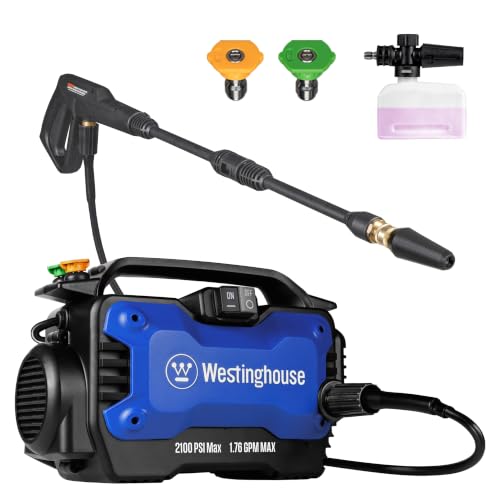
Westinghouse ePX3100s Electric Pressure Washer 2100 Max PSI — Best Water Flow
The ePX3100s is the machine that teaches the PSI-versus-GPM lesson by winning with it. Its pressure reads 2,100 max PSI, mid-band and unremarkable, but its flow runs to 1.76 max GPM — roughly half again the water of the 1.2 GPM machines — and on real cleaning that flow shows up as speed: loosened dirt leaves the surface instead of relocating, broad patio and siding passes finish sooner, and rinsing a washed car takes minutes rather than a second campaign. Pressure breaks the bond; this machine’s water carries the evidence away.
The kit supports the personality: a foam cannon for laying detergent on vehicles and siding, a turbo nozzle for the spots flow alone cannot bully, and Westinghouse’s compact, low-centred design language that keeps the unit planted while you work. Households whose cleaning list is long on area — big patios, long fences, two cars, a boat — will feel this machine’s advantage every session. Households whose list is short, stubborn spots on old concrete should keep reading toward pressure instead.
- Pressure: 2,100 max PSI, as stated
- Flow: 1.76 max GPM, the joint-highest here
- Kit: foam cannon and turbo nozzle included
- Surfaces named by maker: cars, fences, driveways, patios
- Format: corded electric, compact body
- Role here: the flow-first option
Strengths
- High flow rinses broad surfaces dramatically faster.
- Foam cannon suits vehicle and siding routines out of the box.
- Turbo nozzle covers the stubborn-spot work flow cannot.
Trade-offs
- Peak pressure is mid-band for set-in concrete stains.
- Higher flow empties detergent and patience at similar rates.
- Compact body stores less hose and cord than tower designs.
Best for: area cleaning — patios, siding, fences and multi-car households.
Not suited for: buyers whose main enemy is deep, old concrete staining.

Sun Joe XTREAM 2200 PSI Pressure Washer SPX3000-XT1 — Best Nozzle Kit
Sun Joe’s XTREAM variant of its long-running SPX3000 line pushes the platform to 2,200 PSI behind a 14.9-amp motor, and then makes its real argument at the end of the wand: four quick-connect nozzles spanning the angles domestic work actually uses. Nozzle discipline is the unglamorous skill that separates owners who clean from owners who damage, and a kit that puts the right fan angle one click away encourages the habit. The package adds a 35-foot power cord to the reach equation, keeping the machine’s working map generous for a corded unit.
As a cleaning tool it sits in the band’s upper-middle: more pressure than the Greenworks pair for set grime, less flow than the Westinghouse pair for broad rinsing, and a mature platform whose quirks and accessories are documented across years of owners. Buyers who enjoy having the exact tip for the exact job — and who will actually swap them rather than leaving the turbo on for everything — will get the most from this machine’s particular strengths.
- Pressure: 2,200 PSI, as stated
- Motor: 14.9-amp electric
- Kit: 4 quick-connect nozzles, garden hose adapter
- Cord: 35-foot power cord
- Lineage: XTREAM variant of the SPX3000 platform
- Role here: the nozzle-discipline pick
Strengths
- Four nozzles cover the realistic home angle range.
- 2,200 PSI handles set grime the class floor cannot.
- Established platform with a deep accessory ecosystem.
Trade-offs
- Flow is modest beside the Westinghouse machines.
- No foam cannon in the standard kit.
- Tip swapping only pays owners who actually swap tips.
Best for: methodical cleaners who work by nozzle and surface.
Not suited for: foam-first car washers or maximum-flow seekers.

Sun Joe 2200 PSI Electric Pressure Washer SPX7000-MAX — Best Foam and Reach
The SPX7000-MAX matches its XTREAM sibling at 2,200 PSI and then changes the subject to soap and distance. A foam cannon rides in the kit for the car-and-siding households, a turbo nozzle covers the concrete spots, flow reads 1.1 GPM, and the hose stretches to 25 feet with a 35-foot cord behind it — a reach combination that lets the machine body stay planted by the outlet while the wand tours a long driveway or a two-storey siding run. For owners whose properties are bigger than their patience for repositioning equipment, that geography is the feature.
The trade is flow: at 1.1 GPM this is the slowest rinser in the set, so broad dirty surfaces take more passes than the Westinghouse pair would need. What it returns is pressure, foam and reach in one box, which maps precisely onto the car-plus-house-plus-patio household. Judge it by your own map: if your cleaning happens within one hose length of one outlet and involves a vehicle most weekends, this Sun Joe’s priorities are probably yours.
- Pressure: 2,200 PSI, as stated
- Flow: 1.1 GPM
- Kit: foam cannon and turbo nozzle included
- Reach: 25-ft hose, 35-ft cord
- Motor: 13-amp electric
- Role here: foam plus reach at upper-band pressure
Strengths
- Foam cannon and turbo nozzle cover cars and concrete alike.
- Longest combined hose-and-cord working radius here.
- Upper-band pressure for set patio and driveway grime.
Trade-offs
- Lowest flow in the set slows broad-area rinsing.
- Foam cannon quality time adds setup to short jobs.
- Big reach tempts working at distances where control fades.
Best for: car-and-house households with long driveways and siding.
Not suited for: rapid broad-area rinsing as the main job.
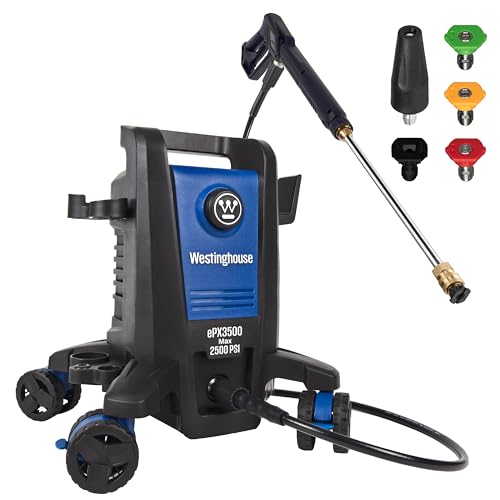
Westinghouse ePX3500 Electric Pressure Washer 2500 Max PSI — Best Class Ceiling
The ePX3500 closes the band at its ceiling: 2,500 max PSI with 1.76 max GPM, the only machine here that refuses to make you choose between pressure and flow. Around that pairing Westinghouse builds its anti-tipping design — a low, stable stance that stays planted when the hose tugs — an onboard soap tank, a pro-style steel wand and a five-nozzle set. This is the electric answer for properties whose cleaning list reads like a smallholding’s: long concrete, weathered decking, farm-adjacent mud, siding that has ignored several springs.
Ceiling machines demand ceiling discipline. At 2,500 max PSI the wrong tip at the wrong distance will etch soft concrete, strip tired paint and carve wood grain, so the five-nozzle set is not decoration; it is how the machine’s power gets governed down to each surface’s tolerance. Owners who learn that governance gain the strongest home electric cleaning in this guide. Owners who want a machine that cannot hurt anything should buy the benchmark and accept its limits instead — power and forgiveness trade against each other all the way down this page.
- Pressure: 2,500 max PSI, as stated
- Flow: 1.76 max GPM
- Design: anti-tipping body, onboard soap tank
- Wand and kit: pro-style steel wand, 5-nozzle set
- Surfaces named by maker: cars, fences, driveways, patios
- Role here: the band’s ceiling
Strengths
- Highest pressure and joint-highest flow in one machine.
- Anti-tipping design stays planted during real work.
- Five nozzles and a steel wand suit serious, varied cleaning.
Trade-offs
- Power will damage soft surfaces under careless technique.
- More machine than small, tidy properties will ever use.
- Onboard tank refills punctuate long detergent sessions.
Best for: large properties and the heaviest home cleaning lists.
Not suited for: beginners wanting a machine that forgives everything.
How Do the Six Compare Side by Side?
| Pick | Stated pressure | Stated flow | Defining trait |
|---|---|---|---|
| Greenworks 2000 | 2,000 PSI max | 1.2 GPM max | Benchmark kit with turbo nozzle |
| Greenworks 2100 | 2,100 PSI | 1.2 GPM | Modest step up |
| Westinghouse ePX3100s | 2,100 max PSI | 1.76 max GPM | Flow plus foam cannon |
| Sun Joe SPX3000-XT1 | 2,200 PSI | See listing | Four quick-connect nozzles |
| Sun Joe SPX7000-MAX | 2,200 PSI | 1.1 GPM | Foam cannon, 25-ft hose |
| Westinghouse ePX3500 | 2,500 max PSI | 1.76 max GPM | Class ceiling, anti-tipping |
Read the pressure column as a ladder and the flow column as a second, independent ladder, because the machines climb them in different orders. The Greenworks pair and the Sun Joes climb pressure; the Westinghouse pair climb both at once at the cost of the band’s higher shelf. Your surfaces decide which ladder matters: ingrained, porous, stained hard surfaces reward pressure, while large, moderately dirty areas reward flow every single time.
PSI or GPM: Which Number Should Lead Your Decision?
Pressure is the number in the class name, so it gets the attention, yet experienced owners shop the pair together. PSI describes the force at the nozzle that breaks dirt’s grip and lifts staining out of pores. GPM describes how much water per minute arrives to flush what pressure freed. A useful shorthand multiplies them into cleaning units, and by that arithmetic the 2,500 max PSI, 1.76 GPM Westinghouse towers over the band, while the 2,200 PSI, 1.1 GPM Sun Joe and the 2,000 PSI, 1.2 GPM Greenworks sit closer than their pressure figures alone suggest.
Surface type referees the contest. On hard, stained concrete, pressure dominates because the bond is the problem. On siding, fencing, vehicles and big patio areas, the dirt is mostly loose film and the flush is the problem, so flow dominates. Most homes own both problems in different postcodes of the property, which is why the middle machines exist and why the honest answer to which number leads is: the one matched to the surface you clean most often, not the one matched to the surface you clean most angrily.
What Does a Turbo Nozzle Actually Do?
A turbo nozzle spins a zero-degree jet in a tight cone, combining the cutting force of a pencil jet with the coverage of a small fan. On concrete and pavers it is transformative: the rotating jet scours a several-inch circle per pass, lifting algae, tyre marks and ingrained grey that fan tips polish rather than remove. Three of the kits here — the Greenworks 2000, the Sun Joe SPX7000-MAX and the Westinghouse ePX3100s — include one, and for driveway owners it may be the single most valuable accessory in any box on this page.
The same aggression sets its limits. Keep turbo tips off vehicles, wood, soft stone and anything painted you intend to keep painted, and maintain a working distance even on concrete, because the spinning jet at close range can etch a visible spiral into softer surfaces. Turbo is a specialist that rewards the owner who reaches for it deliberately and puts it back when the delicate work starts.
How Should You Wash a Car With a 2,000 PSI Class Machine?
Cars and pressure washers coexist happily under three rules. Use the widest fan tip or the foam cannon, never the turbo or a zero-degree jet. Keep a respectful distance — a foot or more — and let water flow and detergent do the work that pressure does on concrete. And work top-down in shade where possible, so soap dwells on the panels it is cleaning rather than drying on the ones waiting. The foam cannon machines here, the ePX3100s and the SPX7000-MAX, exist for this routine: foam first, dwell, rinse wide and gentle, and the paint never learns what the machine does to driveways.
Engine bays, wheel arches and badges deserve individual judgement rather than a system. Arches tolerate a closer fan; badges, trim seals and any stone-chipped panel want distance and angle, never a direct close blast that can lift edges and drive water where electrics live. A pressure washer in this class is entirely car-safe in governed hands, which is precisely why this guide keeps returning to governance: the machine provides force, the owner provides judgement, and the results are the product of both.
What Surfaces Can This Class Damage, and How Do You Avoid It?
Every machine in this band can damage something, and the honest list is short enough to memorise: soft or deteriorating concrete, sandstone and old mortar, wood decking washed against the grain at close range, tired paint, window seals, and any surface already delaminating. The avoidance system is equally short. Start with the widest tip at the greatest distance on an inconspicuous patch, then close distance gradually until dirt moves and the surface does not. That test-patch ritual takes ninety seconds and is the difference between a cleaning tool and a renovation bill.
Decking deserves its own sentence because it fills emergency forums every spring. Wood wants a fan tip, low effective pressure at the surface through distance, strokes along the grain, and absolutely no turbo nozzle. Siding wants upward angles avoided so water is not driven behind the boards. Brick wants its mortar inspected first, because 2,200 PSI finds weak mortar the way water finds a roof leak. Respect those three and the class is safe across a normal property.
How Do Cord, Hose and Outlet Decide What You Can Clean?
Corded electric machines draw a map before they clean anything. The working radius is the outlet’s location plus the cord, and then the hose extends the wand’s reach from wherever the machine body stops. The Sun Joe SPX7000-MAX’s 25-foot hose over a 35-foot cord draws the biggest map here; the Greenworks benchmark’s 25-foot hose and 35-foot GFCI cord draw a similar one. Properties whose outlets sit badly — one socket, far from the driveway — should measure the map before choosing, because an extension solution for a pressure washer is a heavy-duty, properly rated cord, never the household spare.
Water supply is the map’s other half. These machines want a standard garden tap delivering at least their stated flow with margin, and long, narrow or kinked supply hoses can starve a pump and shorten its life. Set the machine on level ground near the tap, feed it generously, and let the pressure hose do the travelling. Owners who plan the map once, on paper, stop fighting it every session thereafter.
Which Mistakes Do Pressure Washer Buyers Regret Most?
The standing regrets in this class are technique-shaped. Buying by PSI alone and discovering the low-flow machine rinses a big patio at a crawl. Using the turbo nozzle on a deck once. Washing siding upward and finding water inside the wall’s story a month later. Storing the machine wet and undrained into a frost. And choosing the ceiling machine for a small, delicate property whose surfaces all needed governing down anyway.
The purchase-shaped regret is subtler: ignoring the kit. Two machines with identical motors behave like different tools depending on the nozzles, cannon and hose in the box, and accessory purchases after the fact quietly erase a bargain. Read the kit column of the comparison table as seriously as the pressure column. In this class, the wand’s end decides at least half of what the motor’s number promises.
How Should You Maintain an Electric Pressure Washer Between Seasons?
Electric machines ask for less than petrol ones — no fuel to sour, no oil to change — and repay a short liturgy. Flush detergent from the system with clean water after foaming sessions so seals and the cannon stay honest. Drain the pump and hoses before any frost, because trapped water expanding is the class’s one reliable killer. Coil hoses loosely to protect their lining, store tips in their onboard places rather than in a pocket of the garage, and inspect the GFCI plug and cord before the first spring session.
Pump-saver treatments exist for owners in hard-frost country and earn their shelf space there. Everyone else can rely on drainage and dry storage. A machine maintained this way starts its fifth spring like its first, which matters in a category where the motor itself rarely gives owners any trouble at all.
What Does the Step From 1,600 PSI Feel Like in Practice?
Many buyers arrive here from a smaller machine, so the comparison deserves plain words. On vehicles and furniture, the step is pleasant but modest — the smaller machine was already adequate with the right tip. On concrete, pavers and weathered fencing, the step is the difference between improving a surface and restoring it: the turbo-equipped 2,000 PSI benchmark lifts in one pass what a 1,600 machine scrubs at repeatedly, and the 2,200–2,500 models extend that authority to older, rougher hard surfaces.
The step also changes the risk profile, which smaller-machine owners should respect in their first sessions. Distances that were safe habits at 1,600 PSI are working distances at 2,500. Relearn the machine on the driveway’s least visible corner, with the fan tip, before touring the property. An hour of calibration protects every surface the new power was bought to serve.
How Do You Clean a Whole Driveway Evenly, Without Stripes?
Striped concrete is a technique failure, not a machine failure, and the cure is method. Divide the driveway into lanes the width of a comfortable sweep, work from the house toward the street so loosened dirt exits rather than pools, and overlap each pass by a third while keeping the nozzle at a constant distance and angle. The turbo nozzle forgives more than a fan tip here because its rotating jet blends pass edges, which is one reason the kits that include one earn such loyalty from driveway owners. Where two concrete pours meet, expect the older, rougher slab to clean to a different brightness than its neighbour, and accept that as the surface’s biography rather than your error.
Detergent changes the arithmetic on genuinely dirty drives. A low-pressure soap pass, given ten minutes of dwell without drying, loosens the film so the pressure pass becomes rinsing rather than excavation, and total time falls even though a step was added. Work in sections small enough that the soap never dries on the surface, keep the runoff in mind where planting borders the concrete, and rinse plants before and after if detergent drifts their way. The machines with onboard tanks and cannons in this guide exist to make that two-stage rhythm convenient rather than theoretical.
Finishing is where patience pays visibly. A final broad rinse at distance, sweeping the whole area in the direction of drainage, carries off the grey slurry that otherwise dries back as a tide mark. Let the surface dry fully before judging it: wet concrete hides both remaining stains and false alarms, and many a driveway condemned mid-job has dried to a perfectly even finish by evening.
What Should a Fence and Deck Owner Read in This Class?
Wood responds to pressure washers like a language with dialects: species, age and previous treatment all change what a given PSI means at the surface. The governing technique is distance and fan width. A 40-degree tip held far enough that the spray feels like hard rain on a bare hand will lift algae and grey weathering from fence boards without raising the grain; halve the distance and the same machine furs the surface and writes lines into it that sanding must then remove. Every fence owner should rehearse on the inside of the least visible panel, because fences, unlike driveways, cannot be re-poured.
Composite decking tolerates the class more calmly but keeps its own rule: keep the wand moving and the pressure governed, because a stationary fan at close range can scar even synthetic boards and void the maker’s care guidance. Between boards, angle the spray to lift the black accumulation from the gaps without driving water under the deck structure. The flow-rich Westinghouse machines rinse a deck’s loosened film away satisfyingly, while the pressure-rich models demand the most discipline and repay it on the stairs and posts where grime concentrates.
After washing, wood needs time more than product. Let fences and decks dry for days of fair weather before any stain or sealant is discussed, because coatings over damp wood fail from beneath. The pressure washer’s job in the wood calendar is preparation, and owners who treat the wash and the coating as separate weekends get both jobs done properly.
How Does Detergent Choice Change Results?
Pressure does the mechanical work, yet chemistry decides several common battles before the wand is raised. Algae and mildew films yield to detergents formulated for them far faster than to pressure alone, and using the right one lets you clean siding and fencing at gentler effective pressures, which every surface prefers. Vehicle work wants a pH-balanced car shampoo through the foam cannon rather than a household cleaner whose alkalinity strips wax and dulls trim. Concrete oil stains want a degreaser and dwell time, because pressure mostly redistributes oil that chemistry has not broken.
The machines divide by how they serve that chemistry. Onboard tanks, like the ePX3500’s, meter detergent at low pressure in the ordinary electric-washer way. Foam cannons, on the ePX3100s and the SPX7000-MAX, lay a clinging blanket that dwells on vertical surfaces instead of sheeting off them, which is why car and siding households rate them so highly. Either system rewards restraint: more detergent than the label directs buys foam, not cleanliness, and complicates the rinse.
Environmental manners belong in this section too. What leaves the driveway enters the storm drain, so choose detergents labelled for outdoor use, keep them off planting where the label warns, and never pressure-wash engine oil or paint residue toward a watercourse. The class is powerful enough to move a problem downstream in minutes; a thoughtful owner declines to.
What Is the Realistic Cleaning Calendar for a House?
Pressure washing rewards rhythm over heroics. A sensible calendar for a temperate-climate house runs the driveway and paths once or twice a year, siding every year or two depending on shade and algae pressure, fences and decks as preparation for their coating cycles, and vehicles as often as their owner enjoys, at the gentle settings described earlier. Machines in this class make that calendar achievable in single sessions rather than in hired weekends, which is the economic heart of owning one: the purchase amortises across a decade of small, timely cleans instead of a few dramatic rescues.
Timing within the year matters more than frequency. Wash siding before it goes into winter damp, so algae does not overwinter in the film. Wash decks at the start of their season, when the coating decision can still follow. Wash driveways after pollen and leaf-fall have done their worst rather than before. And keep the machine’s own calendar: a drained, dry-stored washer in winter is next spring’s reliable washer, while a neglected one is a parts order.
Households in frost-free climates can ignore the storage liturgy and should still flush and inspect seasonally, because seals age and hoses perish in heat and sun as surely as pumps crack in frost. The calendar is the maintenance; everything else is commentary.
How Do You Choose Between the Two Westinghouse Machines?
Same surname, different briefs, and the comparison teaches the whole class in miniature. The ePX3100s pairs 2,100 max PSI with 1.76 max GPM and a foam cannon: a flow-and-foam machine for area, vehicles and siding. The ePX3500 pairs 2,500 max PSI with the same 1.76 max GPM, adds anti-tipping stability, an onboard tank and a steel wand: the ceiling machine for heavy work across big properties. If your sessions are measured in cars and patio squareage, the smaller machine’s kit serves you better out of the box. If they are measured in concrete age and acreage, the larger one’s governed power is the honest tool.
Between them sits the question of headroom. Machines bought at the exact size of today’s list get outgrown by properties that acquire a boat, a longer drive or a deck extension. Machines bought with headroom ask their owners for technique discipline from day one. Neither answer is wrong; the error is refusing to ask the question. This guide’s ordering — benchmark first, ceiling last — is designed so that a reader can stop at the first machine whose numbers honestly cover the property, and no sooner.
How Do the Two Greenworks Models Differ in Daily Use?
Siblings this close invite a fair question, and the answer is mostly temperament. The 2,000 PSI machine is the documented benchmark: its kit is fully specified, its behaviour is the class reference, and its specification sheet is the one other brands are compared against at this number. The 2,100 PSI model adds a margin of pressure for owners whose concrete is old and thirsty, in the same brand ecosystem of accessories and support. In daily use the difference appears in minutes saved on stubborn patches rather than in any job one can do and the other cannot, and buyers should let the day’s kit contents and listing details arbitrate between them without anxiety.
Brand continuity carries a small practical value of its own. Owners who later add a second Greenworks tool for the garden meet familiar fittings and a familiar manual style, and households standardise on one maker’s parts shelf. None of that should override the numbers — pressure, flow, kit — yet between two machines this evenly matched, continuity is a legitimate tiebreak rather than a superstition.
What Should You Wear and Check Before Pulling the Trigger?
A 2,000 PSI jet can cut skin, and the class’s safety routine is short enough to become reflex. Closed footwear, always; eye protection whenever ricochet is possible, which on concrete is always; and a rule that the wand is never pointed at any part of any person, including the operator’s own free hand steadying a ladder. Check every connection before pressurising, because a hose that parts at 2,200 PSI whips with real intent, and bleed the pressure through the trigger before disconnecting anything.
Ladders and pressure washers are a notorious pairing: the jet’s reaction can push an operator off balance at exactly the height where balance matters. Wash two-storey siding from the ground with reach, extension wands used carefully, or accept a professional for the high work. The machines in this guide clean houses impressively from the lawn; none of them was designed to be fired from a rung.
Children and pets leave the work area entirely, not as a courtesy but as a rule, and bystanders stay behind the operator. Ninety seconds of setup discipline is the entire safety programme of this class, and it has the merit of working every time it is used.
How Does This Class Handle Boats, RVs and Outdoor Furniture?
The miscellaneous fleet of outdoor life is where the middle machines shine. Boat hulls at haul-out want film and algae lifted without gouging gelcoat: fan tip, distance, and the flow machines’ rinsing generosity. RVs and trailers want their seals and decals respected, which means the car rules — wide fan, distance, foam first — applied at larger scale, where the SPX7000-MAX’s hose reach earns its keep around a long vehicle. Outdoor furniture splits by material: resin and metal forgive nearly anything in this class at sensible distance, while teak and wicker ask for the deck rules and a gentle hand.
Bicycles, mowers and garden tools collect around any pressure washer’s session like petitioners, and the class handles them well at fan distance, with care around bearings, chains and engine intakes where water should never be driven. The habit to build is a closing circuit: after the main job, walk the property once with the gentlest useful tip and evict the week’s grime from everything that has been waiting. Owners who build that circuit find the machine paying for its shelf space in a dozen small currencies.
What Does Ownership Cost Beyond the Purchase?
The running ledger of an electric pressure washer is mercifully short. Electricity per session is measured in small change. Water is the larger consumable, and the flow-rich machines spend more of it per session while finishing sooner, which roughly balances the account. Detergent is a household choice rather than a machine tax. The real costs arrive as wear items: hose linings that eventually weep, O-rings that flatten, tips that erode their orifices wider until the jet loses its shape. All are cheap, all are replaceable, and all reward the owner who inspects them each spring rather than discovering them mid-driveway.
Compare that ledger honestly with the alternatives and the class justifies itself. Hiring the work costs a session’s fee several times a year, forever. A petrol machine adds fuel, oil, plugs and carburettor moods to the same wear list. The electric band’s economy is precisely why it has become the default for houses: the machine asks for water, current and occasional rubber rings, and returns a property that looks maintained. Keep the tips and seals fresh and the performance you bought is the performance you keep.
How Should a Beginner’s First Session Be Planned?
Choose a small, forgiving, invisible first job: a concrete path behind the house, a section of fence’s inner face, a patio corner. Fit the widest fan tip, start at arm’s length plus a step, and shorten the distance slowly until the dirt’s behaviour changes. That single experiment teaches pressure, distance and angle more honestly than any manual, and it teaches them where mistakes are free. Only then graduate to the driveway, the car and the deck, in that order of forgiveness.
Plan the session’s logistics before the water is on: machine placed where its cord and hose reach the whole job, connections checked, detergent decided, plants rinsed if soap will drift, and an exit route for the dirty water that does not cross the cleaned area. Beginners who choreograph first and spray second finish faster and cleaner than veterans who improvise, because pressure washing is mostly choreography with a loud prop. By the third session the choreography is habit, and the machine has become what it was bought to be: the easiest way to make a house look cared for.
How Do You Store the Machine So It Survives the Garage?
Garages kill pressure washers slowly and politely. Hoses draped over sharp hooks develop kinks that become leaks; machines stored under paint cans collect dents and dust in their cooling vents; cords coiled tight for a winter take a permanent spiral that fights every future session. The storage discipline is simple enough to state in one breath: drain everything, coil the hose in wide loops, hang or shelve the machine where nothing will be stacked on it, and keep the nozzle set with the machine rather than in the general archaeology of the tool drawer.
Cold garages add the frost rule already described, and it bears repeating because it is the class’s principal cause of early death: water left in a pump expands as it freezes and cracks what it cannot stretch. Owners in borderline climates should treat the first forecast frost as the deadline, not the first hard freeze, and should run the drain routine even for a machine used the previous weekend. Pump-saver fluid is the belt to drainage’s braces for anyone whose garage regularly sits below freezing for weeks.
Hot garages levy the opposite tax in summer, perishing rubber seals and hose linings across years rather than nights. Shade, ventilation and keeping the machine out of the sun-struck corner by the door slow that clock considerably. None of this storage care is heroic; it is the same respect a household gives a good mower or a good bicycle, and it returns the same dividend of a machine that works when called upon.
Final Recommendation
Let your dominant surface choose. For the mixed suburban brief — driveway, patio, cars, fences — the Greenworks 2000 benchmark remains the class’s most honest starting point, with the 2100 sibling for a shade more bite. For area and vehicles, the Westinghouse ePX3100s converts flow into saved Saturdays. For nozzle craftsmen and foam-and-reach households, the two Sun Joes divide that vote at 2,200 PSI. And for the property whose cleaning list never gets shorter, the ePX3500’s 2,500 max PSI with real flow behind it is the ceiling this class can offer a careful owner. Whichever machine arrives, give it a drained, dry home between sessions and fresh seals when it asks for them, and it will repay the small courtesies for years. Buy the machine whose numbers match your surfaces, learn its gentlest effective distance on a hidden patch of concrete, and the whole band will feel less like a specification and more like what it is: the point where electric cleaning grows up.
Frequently Asked Questions
Is 2,000 PSI enough for a concrete driveway?
Yes, for typical driveway film, algae and tyre marking, especially with the turbo nozzle the Greenworks benchmark includes. Deeply oil-stained or very old porous concrete responds better to the 2,200–2,500 PSI models here, plus detergent dwell time and, for oil, a degreasing pre-treatment. Work in overlapping lanes from the house toward the street, keep the nozzle height constant, and let the surface dry fully before deciding whether a second pass is truly needed.
What does max PSI mean in these listings?
It is the manufacturer’s stated maximum pressure rating for the model. This guide reports each figure exactly as stated — 2,000, 2,100, 2,200 or 2,500 — and pairs it with flow, because working cleaning power depends on both numbers together rather than on the maximum alone. Treat any class label as a neighbourhood, never as a measurement.
Can these electric washers run from any outdoor outlet?
They need a properly grounded, GFCI-protected supply, and their cords should not be extended with light household extension leads. If an extension is unavoidable, it must be a heavy-duty outdoor cord rated for the machine’s draw, kept as short as the work allows. Test the GFCI before the season’s first session as a matter of routine.
Will a pressure washer remove paint?
At these pressures, yes — loose and tired paint is a surface this class strips readily, which is a feature for preparation work and a hazard everywhere else. Keep fan tips moving and at distance on any painted surface you intend to keep, and never use a turbo tip on paintwork. Sound paint in good condition tolerates a governed wash well; paint that is already lifting has given its verdict in advance.
How loud is a 2,000 PSI electric pressure washer?
Noticeably quieter than a petrol equivalent: the sound is pump and water noise rather than an engine, and conversation nearby remains possible. It is still a working machine outdoors, so early-morning sessions are a neighbour-relations decision rather than a technical one. Most owners find the water’s hiss on concrete louder than the machine itself, and both fade quickly with distance across a garden.
Related Guides
Outdoor power decisions travel together, and the guides below cover the neighbouring ones. If cords themselves are the obstacle, Best Battery Powered Pressure Washers explores the untethered alternative honestly, while the renovation’s indoor chapters continue in Best 21 Cu Ft French Door Refrigerators and Best 3.0 Small Refrigerators.



[…] on the washer decision; wash action is the other, and our companion guide argues it in full. Read Best 2000psi Electric Power Washers next if the utility work continues outdoors, and cover the cold-storage side of the same renovation […]