What's inside
- Key Takeaways
- Quick Picks
- How We Chose These Picks
- How Do the Six Washers Compare at a Glance?
- Why Do Cleaning Units Matter More Than PSI Alone?
- Which Nozzle Should You Reach for on Each Surface?
- How Does Detergent Change What a Washer Can Do?
- What Does a Sensible Cleaning Day Look Like, Start to Finish?
- How Should You Protect Wood, Paint, and Vehicles From 3,000 PSI?
- Which Mistakes Turn a Cleaning Day Into a Repair Bill?
- How Do You Maintain a Pump So It Survives a Decade?
- Which Surfaces Should You Keep Away From This Much Pressure?
- How Does Hose Reach Quietly Decide Your Whole Technique?
- What Should a First-Time Owner Practise Before the Real Job?
- How Loud Is Too Loud, and What About the Neighbours?
- What Separates a Spring Clean From a Restoration Project?
- How Should You Decide Between Renting Once and Owning for Years?
- Why Do Two Identical Ratings Feel Different in the Hand?
- Final Recommendation
- Frequently Asked Questions
- Related Guides
As an Amazon Associate I earn from qualifying purchases. This post may contain affiliate links at no extra cost to you.
cottageverdict.com is reader-supported. When you buy through links on our site, we may earn an affiliate commission.
Where to buy: the six machines reviewed here are all sold through Amazon, and each linked name in the Quick Picks table, the review headings, and the comparison chart leads to that model’s listing, where you can check price on Amazon and confirm its hose length, nozzle set, and warranty terms. Homeowners shopping for the best 3000 psi pressure washers are usually staring at a driveway that winter has tattooed with algae, a fence gone grey, or siding wearing a season of grime — jobs where a garden hose shrugs and a rental machine feels like overkill.
Three thousand PSI sits at an interesting border. Below it, electric machines handle cars and patio furniture politely; above it, gas machines start stripping paint whether you asked them to or not. At exactly this rating, both technologies compete honestly, and the six picks below split between them: four electrics led by an induction-motor Westinghouse and two brushless Greenworks designs, a high-flow value electric, and two Westinghouse gas machines for properties where extension cords go to die.
Pressure alone, however, is a half-truth, and this guide will keep returning to the other half: flow, measured in gallons per minute. Cleaning units — pressure multiplied by flow — predict how fast a surface actually comes clean, which is why a 2.6 GPM gas machine at 3,400 PSI can outwork a nominally similar rival across a long driveway. Nozzle angle matters just as much, since a 25-degree fan at a sensible distance cleans concrete that a 0-degree pinpoint would etch. Buy the combination, not the headline.
We also weighted the ownership details that separate a satisfying Saturday tool from a garage regret: whether the pump and motor are built for seasons rather than summers, how the hose behaves when it is cold, whether the soap system dilutes sensibly, and how the machine stores when the job ends. A pressure washer spends most of its life standing in a corner, and the good ones stand there compactly, hoses coiled, ready to be forgiven for their size.
Key Takeaways
- Flow rate decides real cleaning speed; multiply PSI by GPM before comparing any two machines in this class.
- Electric picks suit homes with outdoor outlets near the work; gas picks free you from cords on large properties.
- The Westinghouse WPX3000e’s induction motor is the durability headline among the electric models here.
- Greenworks fields two distinct 3,000 PSI electrics, one brushless with a fuller tip set, one simpler and lighter in spirit.
- Gas power peaks with the WPX3400 at 3,400 PSI and 2.6 GPM for the longest driveways and toughest concrete.
- A 25-degree nozzle at a foot or more of distance cleans most home surfaces without scarring them.
Quick Picks
| Pick | Badge | Why it earns its place |
|---|---|---|
| Westinghouse WPX3000e Electric Pressure Washer 3000 Max PSI | Best Electric All-Rounder | An induction motor, onboard soap tank, and 1.76 max GPM in Westinghouse’s most complete electric package. |
| Greenworks Brushless Electric Pressure Washer 3000 PSI | Best Brushless Electric | Brushless drive, 2.0 GPM max flow, and a three-tip set plus soap applicator for varied surfaces. |
| Greenworks 3000 PSI Electric Pressure Washer 2.0 GPM | Best Streamlined Electric | The same headline pressure and flow in a simpler Greenworks frame for buyers who skip extras. |
| Electric Pressure Washer 3000 Max PSI 2.5 GPM | Best High-Flow Value | A claimed 2.5 GPM flow and four nozzles aimed at buyers who rank rinsing speed first. |
| Westinghouse WPX3000 Gas Pressure Washer 3000 PSI | Best Gas at 3000 PSI | Gas freedom with 2.3 GPM and a four-nozzle set for fences, decks, and rural driveways. |
| Westinghouse WPX3400 Gas Pressure Washer 3400 PSI | Best Step-Up Gas Power | 3,400 PSI, 2.6 GPM, onboard soap, and five nozzles for the heaviest home cleaning brief. |
How We Chose These Picks
Every machine had to genuinely belong to the 3,000 PSI neighbourhood — close enough that a homeowner cross-shopping the class would consider it a peer — and publish both its pressure and its flow, since a washer that hides its GPM is asking to be judged on the flattering half of its arithmetic. Manufacturer-stated maximums are labelled as such in our spec lists, because the industry measures peak and rated output differently and honesty about that gap serves buyers better than pretending all numbers share one ruler.
Powertrain variety was the second filter. An electric-only guide would abandon acreage owners; a gas-only guide would abandon everyone with a townhouse patio and a conscience about storing fuel. The final six therefore span induction electric, brushless electric, conventional electric, and two sizes of gas, so the decision becomes a matching exercise — your property, your outlets, your tolerance for engine maintenance — rather than a compromise.
We also read the accessory lists as working documents. Nozzle sets reveal a machine’s intended surfaces: a kit with 15, 25, and 40-degree tips plus a soap applicator was designed by someone who cleans houses, while a lone turbo nozzle suggests a narrower brief. Soap delivery, hose reach, and onboard storage all counted, because a washer’s second hour of use is shaped by those details more than by its first five minutes.
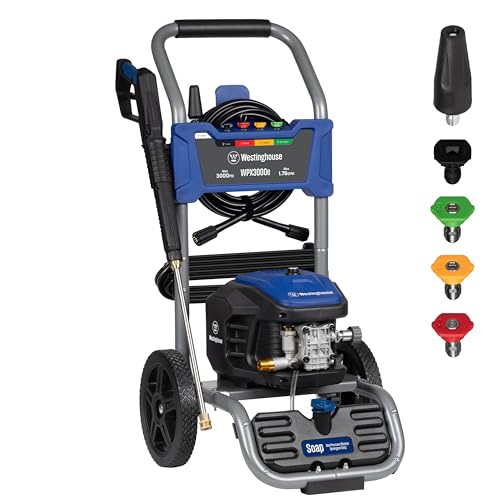
Westinghouse WPX3000e Electric Pressure Washer 3000 Max PSI — Best Electric All-Rounder
Induction motors are the quiet aristocracy of electric pressure washers. Unlike the universal motors in cheaper machines, an induction design has no brushes to wear, runs cooler under sustained load, and shrugs at the long driveway sessions that leave lesser electrics resting to cool. Westinghouse built the WPX3000e around that motor, and the result is the electric pick we would hand to a homeowner who intends to own one washer for many seasons rather than audition a new one each spring.
The supporting cast matches the motor’s ambition. A maximum of 1.76 gallons per minute gives rinsing real authority — loosened grime actually leaves the surface instead of relocating — and the onboard soap tank feeds detergent through the low-pressure nozzle without a separate bottle dangling from the wand. Around a typical suburban home, this machine covers the full circuit: driveway aprons, vinyl siding up to a sensible height, composite decking, brick steps, and the family cars on their gentler settings.
Electric limits remain electric limits. You will plan work around outlet locations and cord length, and multi-acre properties will test your patience with extension management. Within the suburban brief, though, the WPX3000e asks for almost nothing: no fuel to stale, no oil to change, no recoil starter to argue with on a cold morning. It starts with a switch, every time, which is a feature whose value compounds across years.
- Drive: induction motor, built for long service life
- Output: 3,000 max PSI with 1.76 max GPM flow
- Soap: onboard tank for detergent application
- Role: flagship electric for full suburban cleaning circuits
- Ownership: no fuel, no engine oil, switch-start convenience
Strengths
- Induction motor outlasts universal-motor rivals by design.
- Strong flow makes rinsing as effective as blasting.
- Onboard soap tank keeps detergent work tidy.
Trade-offs
- Cord range governs how far from the house you clean.
- Heavier than the lightest electrics when carried far.
- Maximum figures are peaks; working output sits below them.
Best for: suburban owners wanting one durable electric for every surface. Not suited for: large rural properties far from outdoor outlets.

Greenworks Brushless Electric Pressure Washer 3000 PSI — Best Brushless Electric
Greenworks answers Westinghouse’s induction flagship with brushless technology borrowed from its battery-tool empire. A brushless motor adjusts its effort to the load, wasting less energy as heat and promising a long service life without brush replacement. The headline numbers impress on paper — 3,000 PSI maximum with up to 2.0 GPM — and the pairing matters, because that flow figure is the strongest among this guide’s plug-in electrics with full accessory kits.
The included tips tell a thoughtful story: 15 degrees for stubborn concrete stains, 25 for general work, 40 for rinsing and delicate passes, plus a soap applicator for the detergent stage. A homeowner can walk from a mossy paver path to a dusty car without improvising, and the machine’s behaviour stays consistent enough that technique, once learned, transfers between surfaces. Greenworks also designs for storage, with the wand and hose finding homes on the frame rather than in a separate bin.
Shoppers already invested in Greenworks outdoor tools will find the brand’s ergonomics familiar, though this is a corded machine and shares no batteries with that ecosystem. Its real contest is with the WPX3000e above: brushless efficiency and higher stated flow against induction’s proven longevity and soap tank. Either wins a suburban garage honestly; choose by which motor philosophy and accessory layout you trust more.
- Drive: brushless electric motor with load-sensing efficiency
- Output: 3,000 PSI max paired with 2.0 GPM max
- Tips: 15, 25, and 40-degree nozzles plus soap applicator
- Role: high-flow electric for varied home surfaces
- Storage: onboard wand and hose organisation
Strengths
- Brushless drive runs efficiently without brush wear.
- Highest stated flow among the kitted electrics here.
- Three-angle tip set covers delicate through stubborn jobs.
Trade-offs
- Corded design still tethers you to the house.
- Soap comes via applicator rather than an onboard tank.
- Peak ratings flatter; judge it by cleaning units instead.
Best for: buyers wanting brushless efficiency and a complete tip wardrobe. Not suited for: anyone determined to avoid cords entirely.

Greenworks 3000 PSI Electric Pressure Washer 2.0 GPM — Best Streamlined Electric
Greenworks sells two roads to the same summit, and this second model is the plainer path: 3,000 PSI with 2.0 GPM maximum flow in a frame that skips some of its brushless sibling’s ceremony. For a buyer whose cleaning list is short and repetitive — the same driveway, the same siding, the same patio furniture each spring — simplicity is not a compromise but a correct reading of their own habits.
Performance on the core tasks is the point. Pressure and flow figures match the class standard, so concrete brightens, fences shed their grey, and rinsing moves at a satisfying pace. What you give up sits at the margins: fewer refinements in the accessory bundle and a less sophisticated motor story. What you keep is Greenworks’ dealer and parts presence, which matters in year four when a fitting cracks and you want the replacement to be a search rather than an archaeology project.
Position it honestly in your mind before ordering. If the price gap to the brushless model is small on the day you buy, the upgrade buys motor longevity and tips; if the gap is wide, this machine delivers the same class of clean for the surfaces most homes present. Either way, verify the exact tip assortment in the box on the listing, because bundles in this category shift between production runs more often than the machines themselves do.
- Drive: conventional electric motor, corded operation
- Output: 3,000 PSI with 2.0 GPM maximum flow
- Role: straightforward class-standard cleaning power
- Support: Greenworks parts and accessory availability
- Buyer fit: short, repetitive cleaning lists done yearly
Strengths
- Full class pressure and flow without flagship pricing logic.
- Simple operation suits once-a-season cleaning routines.
- Brand support network eases future parts hunting.
Trade-offs
- Motor lacks brushless or induction longevity claims.
- Accessory bundle is leaner than its sibling’s kit.
- Bundle contents can vary; confirm tips before buying.
Best for: pragmatists cleaning the same home surfaces each season. Not suited for: heavy weekly users who should buy motor longevity.

Electric Pressure Washer 3000 Max PSI 2.5 GPM — Best High-Flow Value
Flow is this unbranded machine’s entire argument, and it is not a foolish one. A stated 2.5 GPM at 3,000 max PSI would, if delivered as advertised, produce cleaning units beyond everything else in this guide, gas included, and rinsing speed is the quality homeowners feel most directly once the blasting stops. Four nozzles round out a package aimed squarely at buyers who comparison-shop by arithmetic.
Arithmetic deserves one caution, offered plainly. Maximum figures across this industry describe peaks under favourable conditions, and unbranded listings historically speak in the most generous dialect of that language. Treat the flow claim as a direction — this machine is tuned for volume — rather than as a lab certificate, and lean on Amazon’s return window if the delivered performance feels shy of the promise. That is not cynicism; it is how value-tier tools should be bought, eyes open.
There is a learning dividend to starting here, too. Technique acquired on a forgiving budget machine — standoff discipline, detergent timing, overlap rhythm — transfers intact to any flagship you buy later, while the reverse journey, learning on a 3,400 PSI gas unit, teaches the same lessons at higher stakes for every mistake. Instructors in every trade start students on the calmer equipment for a reason, and pressure washing obeys the same pedagogy whether the classroom is a driveway or a workshop.
What you can verify from the listing supports the brief: four distinct nozzles for pressure shaping, electric convenience with no fuel chores, and a format aimed at driveways, fences, and vehicles. For a first pressure washer bought to learn the craft — how distance changes impact, how detergent dwell time does half the work — a high-flow value machine is a rational teacher, and if it graduates you to a flagship later, it will have earned its tuition.
- Drive: electric motor, corded plug-in operation
- Output: 3,000 max PSI with a stated 2.5 GPM flow
- Nozzles: four pressure options included in the box
- Role: value-tier, flow-first cleaning for home surfaces
- Buying note: verify delivered performance within returns window
Strengths
- Highest stated flow figure anywhere in this guide.
- Four nozzles shape pressure for different surfaces.
- Electric simplicity suits first-time washer owners.
Trade-offs
- Unbranded support and parts trail the big names.
- Peak claims deserve sceptical, real-world verification.
- Long-term durability is unproven beside established brands.
Best for: value hunters who prioritise rinsing volume and versatility. Not suited for: buyers who want a decade-long brand relationship.

Westinghouse WPX3000 Gas Pressure Washer 3000 PSI — Best Gas at 3000 PSI
Cross a certain property size and the electric conversation ends, not with a failure of power but of geography. The WPX3000 gas machine exists for the barn side of the driveway, the far fence line, the equipment pad behind the workshop — places a cord reaches only in theory. Its 3,000 PSI arrives with 2.3 GPM, a flow figure no electric in this guide matches with a full kit, and that pairing chews through farmyard concrete and weather-beaten decking at a working pace.
Four nozzles cover the gas machine’s wider brief, from a fan for general washing to the tighter patterns that strip a trailer bed or a tractor’s mudguards. The spray gun and wand follow Westinghouse’s familiar layout, and the whole unit rolls on the kind of frame that tolerates gravel, thresholds, and being hauled across a yard by someone in a hurry. Gas ownership duties apply in full: fresh fuel, oil checks, and winter storage done properly.
Fuel logistics deserve a sentence of their own, because they shape rural ownership quietly. Keep fresh petrol in an approved container, rotate it through the mower or the machine itself so nothing stales in a corner, and treat the last session of autumn as a maintenance appointment rather than an afterthought. Owners who build those habits find gas ownership nearly as effortless as electric; owners who skip them meet the carburettor’s opinion in April, expressed as a refusal to start on the season’s first fine morning.
Choose it when the work map, not the spec sheet, demands it. A suburbanite with a forty-foot driveway gains nothing from the engine and inherits its chores, while a rural owner gains the entire property. Westinghouse’s gas line also offers the natural comparison in the next review: the same philosophy with more headroom, for those whose concrete is older, larger, or dirtier than average.
- Drive: gas engine, fully cordless working range
- Output: 3,000 PSI delivered with 2.3 GPM flow
- Nozzles: four-piece set with spray gun and wand
- Role: gas freedom for large or remote cleaning areas
- Ownership: fuel, oil, and seasonal storage care required
Strengths
- Works anywhere on the property, outlets irrelevant.
- Flow outruns the kitted electrics for fast rinsing.
- Rugged rolling frame suits gravel and yard terrain.
Trade-offs
- Engine maintenance joins your seasonal chore list.
- Noise and exhaust rule out enclosed-space use.
- Heavier to move despite the wheels and handle.
Best for: rural and large-lot owners cleaning far from the house. Not suited for: townhouse owners with a short driveway and neighbours close by.

Westinghouse WPX3400 Gas Pressure Washer 3400 PSI — Best Step-Up Gas Power
Some properties outgrow the class this guide is named for, and the WPX3400 is the honest acknowledgement. At 3,400 PSI and 2.6 GPM it posts the highest cleaning units here by a clear margin, aimed at long concrete runs stained by decades, second-storey siding reached from the ground with the right nozzle discipline, and the kind of pre-paint preparation where surface readiness decides whether a coating survives its first winter.
Five nozzles and an onboard soap tank complete a specification that reads like a checklist written by someone who cleans commercially-adjacent properties. The extra pressure demands respect rather than celebration: at close range this machine can scar wood, lift paint you meant to keep, and cut skin, so its owner should be the household member who reads manuals and wears the boots. Power in this category is a tool with a temperament, and the WPX3400’s temperament is serious.
It also closes the guide’s central argument. The step from the WPX3000 gas model is not about the number 400; it is about flow rising alongside pressure, so big jobs finish while the operator is still fresh enough to work carefully. If your cleaning map is measured in hours, buy the headroom. If it is measured in minutes, the electrics above will serve you with less noise, less weight, and no fuel can in the garage.
- Drive: gas engine, maximum-output configuration here
- Output: 3,400 PSI with 2.6 GPM, highest cleaning units listed
- Nozzles: five-piece set plus onboard soap tank
- Role: heavy-duty home and semi-rural cleaning flagship
- Safety note: pressure can damage wood, paint, and skin
Strengths
- Cleaning speed leads this entire comparison clearly.
- Onboard soap tank supports long detergent sessions.
- Five nozzles span delicate rinses to aggressive stripping.
Trade-offs
- Overpowered for cars and softwood in careless hands.
- Full gas-engine maintenance and storage obligations.
- Largest, loudest footprint of the six machines.
Best for: big properties and pre-paint preparation needing maximum pace. Not suited for: beginners or anyone whose jobs are small and near outlets.
How Do the Six Washers Compare at a Glance?
| Washer | Power | Output | Defining trait |
|---|---|---|---|
| Westinghouse WPX3000e Electric Pressure Washer 3000 Max PSI | Electric, induction | 3,000 max PSI, 1.76 max GPM | Onboard soap, durable motor |
| Greenworks Brushless Electric Pressure Washer 3000 PSI | Electric, brushless | 3,000 PSI max, 2.0 GPM max | Three-tip set plus soap applicator |
| Greenworks 3000 PSI Electric Pressure Washer 2.0 GPM | Electric, corded | 3,000 PSI, 2.0 GPM max | Streamlined class-standard package |
| Electric Pressure Washer 3000 Max PSI 2.5 GPM | Electric, corded | 3,000 max PSI, stated 2.5 GPM | Flow-first value proposition |
| Westinghouse WPX3000 Gas Pressure Washer 3000 PSI | Gas engine | 3,000 PSI, 2.3 GPM | Cordless range for big properties |
| Westinghouse WPX3400 Gas Pressure Washer 3400 PSI | Gas engine | 3,400 PSI, 2.6 GPM | Maximum pace, five nozzles |
Why Do Cleaning Units Matter More Than PSI Alone?
Imagine two hoses aimed at the same muddy patio. One delivers a needle of water at ferocious pressure but in a trickle; the other delivers a broad, forceful sheet. The needle etches a clean line slowly, while the sheet lifts dirt across a swath and carries it away. That difference is cleaning units at work: pressure loosens, flow transports, and the product of the two predicts how a Saturday afternoon actually goes.
Run the arithmetic across this guide and the ranking reshuffles in instructive ways. The gas WPX3400 multiplies out far ahead, the gas WPX3000 follows, and the high-flow value electric claims a paper position among them that its price would never suggest. The induction Westinghouse posts modest units yet wins owners through durability — a reminder that the formula measures pace, not lifespan, and a complete judgment needs both columns.
Practical shopping follows from that. Decide your largest recurring job, estimate its area honestly, and let cleaning units tell you whether it is a one-hour task or a three-hour sentence. Then check the motor and frame for the stamina to repeat that job for years. Pace without durability is a rental; durability without pace is a chore. The six machines here were chosen so that every property size can find both in one box.
Which Nozzle Should You Reach for on Each Surface?
Nozzle numbers describe the fan’s spread, and spread is how you tame a 3,000 PSI machine for civilised work. A 40-degree tip throws a wide, gentle sheet for rinsing cars, screens, and outdoor cushions. The 25-degree fan is the household default, strong enough for concrete and decking at a sensible standoff. Fifteen degrees concentrates force for rust spots, paint prep, and the algae line at a driveway’s edge, and it deserves a test patch before commitment.
The 0-degree pinpoint, where included, is a specialist that behaves like a water chisel. It strips, etches, and can inject water under siding or into wood grain, so its legitimate home uses are narrow: spot rust on metal, gum on concrete, tasks where damage to the immediate point is acceptable. Beginners should leave it in the holder until experience teaches what the wider fans cannot do, which turns out to be very little around a house.
Distance is the second dial nobody prints on the wand. Doubling your standoff dramatically softens impact while barely slowing a detergent-assisted clean, and starting far then walking closer is the professional’s habit worth copying. Work from the top of a wall downward, keep the fan moving, and never park a tight pattern on one spot while you admire the result — the surface keeps the memory of every pause.
How Does Detergent Change What a Washer Can Do?
Most household grime is not bonded to the surface so much as glued by biology and road film, and detergent attacks the glue. Applied at low pressure through a soap nozzle or tank, given several minutes to dwell without drying, a suitable cleaner loosens algae, mildew, and traffic film until plain water at moderate pressure can carry them away. Owners who skip this stage compensate with pressure, and their fences and decks pay for the substitution in scarred fibres.
Delivery systems differ across this guide in ways worth understanding. The onboard tanks on the two Westinghouse flagships meter detergent continuously and suit long siding runs, while applicator bottles and soap tips on the Greenworks pair and the value electric handle shorter sessions with more refills. Neither approach cleans better in principle; the tank simply interrupts a big job less often, which is a real but situational advantage.
Choose detergents for the surface and the garden around it. Plant-safe formulas exist for deck and siding work near beds you value, while concrete cleaners can be harsher where runoff reaches only more concrete. Rinse plants before and after, divert the first soapy runoff where you can, and never let detergent dry on hot siding — the streaks it leaves are harder to remove than the dirt it was meant to lift.
What Does a Sensible Cleaning Day Look Like, Start to Finish?
Walk the property first with the machine off. Note the outdoor outlet and tap positions, the delicate plantings to pre-rinse or cover, the windows whose seals look tired, and the electrical fixtures that should never meet a fan of water. This five-minute survey prevents the classic mid-job discoveries: the cord that ends six feet short, the nest behind the shutter, the cracked caulk that funnels water into a wall.
Sequence the work from chemistry to force. Apply detergent to the first zone, let it dwell while you set up the next, then wash top-down so gravity assists rather than redeposits. On concrete, overlap each pass by a third and maintain a metronome pace; zebra stripes on a driveway are simply a record of hurried, uneven passes, visible to the whole street until the surface weathers evenly again.
Finish like someone who will own the machine next year. Flush the soap system with clean water, relieve the line pressure, coil the hose in wide loops that will not kink-memory by spring, and wipe the wand’s fittings before storage. Gas owners add fuel discipline — stabiliser or a run-dry carburettor per the manual — while electric owners inspect the cord along its length. Fifteen unglamorous minutes protect the entire investment.
How Should You Protect Wood, Paint, and Vehicles From 3,000 PSI?
Wood fails first because its fibres separate under concentrated water, leaving a fuzzy, splintered surface that drinks stain unevenly forever after. Keep the fan wide, the distance generous, and the wand moving along the grain, and test in a hidden corner before committing to a full deck. If the surface furs under your test pass, the answer is more detergent and patience, not a braver technique.
Paint presents the opposite trap: a strong fan finds every chip edge and lifts flakes with enthusiasm, which is wonderful during deliberate preparation and ruinous during a casual wash. Treat any painted surface as pre-paint work unless you are using the widest fan at a respectful distance, and expect older coatings to vote on the matter regardless of your intentions. The WPX3400 in particular should meet painted surfaces only when removal is the actual agenda.
Vehicles sit at the gentle end of this class’s abilities. With a 40-degree tip, a long standoff, and detergent doing the heavy work, the electrics here wash cars safely, but the discipline is absolute: never the pinpoint tip, never close range on badges, seals, or stone chips, and never a gas flagship at working distance. Owners whose primary job is the car should read our gentler dedicated guide rather than borrowing this class’s muscle; the link sits at the foot of this page for exactly that reason.
Which Mistakes Turn a Cleaning Day Into a Repair Bill?
Pointing the wand at your own boots ranks first in injury statistics and embarrassment alike, because a 3,000 PSI jet treats leather and skin as surfaces to be cleaned. Wear closed footwear with real soles, keep the lance pointed at the work, and treat the trigger with the respect reserved for power tools — because that is precisely what it is. Children and pets belong indoors or behind you, never in the fan’s parish.
Water intrusion causes the expensive, invisible failures. Spraying upward under lap siding, into soffit vents, or against window seals drives water into assemblies designed to shed it downward, and the mould that follows bills you months later. Always work with gravity’s direction, keep fans off electrical fixtures and outlets entirely, and remember that a pressure washer can push water through barriers that stop weather.
The third mistake is chemical rather than hydraulic: letting detergent dry on glass or hot siding, mixing cleaners experimentally, or running bleach-heavy solutions through a pump not rated for them. Follow the machine’s stated detergent path, rinse the system afterward, and give chemistry its dwell time in the shade where it works instead of baking into evidence.
How Do You Maintain a Pump So It Survives a Decade?
The pump is the machine’s heart and its most replaceable-feeling component, yet most pump deaths are slow suicides by neglect. The leading cause is heat: a washer left idling with the trigger closed circulates the same water through the pump until it cooks the seals, so during any pause longer than a minute or two, squeeze the trigger to exchange the water or switch the machine off entirely. That single habit separates ten-year pumps from two-year pumps more reliably than any brand badge.
Water quality writes the second chapter. A clogged inlet screen starves the pump and invites cavitation, the tiny implosions that pit internal surfaces, so rinse that screen whenever flow feels shy and always feed the machine from a clean supply. Hard water districts should flush the system after detergent sessions and store the pump protected, because mineral crust narrows passages a fraction at a time until performance feels mysteriously tired.
Storage completes the discipline. Drain what the manual tells you to drain, protect against freezing with the approved fluid or a genuinely frost-free room, and keep hoses in wide coils so their liners do not set into kinks. Come spring, inspect fittings for the green blush of corrosion and replace washers that have flattened. None of this requires a workshop — only the decision that the machine you maintain is cheaper than the machine you replace.
Which Surfaces Should You Keep Away From This Much Pressure?
Asphalt shingles top the refusal list, because a strong fan strips the protective granules that give a roof its lifespan, trading a cleaner look for years of lost service. Roof work belongs to soft-wash chemistry and garden-hose pressures. Old mortar in brick and stone walls runs a close second: the joints erode long before the masonry does, and repointing costs dwarf whatever the cleaning saved.
Window screens, soft cedar, and ageing vinyl with chalked surfaces all suffer quietly under enthusiasm. Screens tear at pressures that feel gentle on concrete, cedar furs like decking only faster, and oxidised vinyl can streak permanently where a fan lingers. Each of these surfaces can be cleaned — with the widest fan, real distance, and detergent carrying the load — but none should meet the business end of a 15-degree tip in a beginner’s hand.
Finally, respect anything electrical or living. Outdoor outlets, light fixtures, doorbell cameras, and HVAC condensers with delicate fins were not designed for directed jets, and neither were the plantings you spent three seasons establishing. Pre-rinse foliage, cover what cannot move, and let the machine’s considerable talents stay on the surfaces that invited them: stone, concrete, metal, and sound hard surfaces.
How Does Hose Reach Quietly Decide Your Whole Technique?
A pressure hose is a leash with opinions. Too short, and you spend the job dragging the machine across wet concrete, repositioning around its own cord or fuel lines; too stiff, and it fights every turn, kinking at the same corner until flow stutters. When comparing listings, treat stated hose length as a working dimension of your property: measure from your tap and outlet to the farthest regular job, then buy the machine whose reach covers that route with slack to spare.
Working technique bends around the hose’s behaviour. Seasoned operators lay out the full length before starting, in loose S-curves that feed toward the work instead of tangling behind it, and they wash back toward the machine so the finished ground stays behind them. Walking a job in the wrong direction means crossing your own wet, dirty runoff with a live lance in hand — a small misery that planning erases completely.
Extensions exist, and they cost pressure. Every added length and coupling shaves a little delivery at the nozzle, which a 3,400 PSI gas machine absorbs without noticing and a marginal electric feels in its rinsing pace. If your property demands an extension, factor that appetite into the purchase: buy the headroom now, in the machine, rather than discovering the deficit across a half-cleaned driveway in June.
What Should a First-Time Owner Practise Before the Real Job?
Spend twenty minutes on an unimportant slab — the garage apron, a utility pad — learning the fan’s manners at different distances before any surface you love meets the water. Watch how the cleaning path widens as you step back, how overlap erases striping, and how the wand kicks when the trigger first opens. That kick surprises every beginner exactly once; let it happen where the only witness is a oil stain.
Practise the detergent rhythm too, because timing is a skill rather than a specification. Apply a test patch, start a mental clock, and observe the grime’s release at intervals until you know your cleaner’s working dwell on your climate’s dirt. Too short wastes chemistry, too long risks drying marks, and the correct window learned on a test patch transfers to every wall and driveway afterward.
Finally, rehearse the shutdown until it is muscle memory: trigger released, pressure relieved, water off before electrics, hoses drained. Emergencies during a job — a slipped footing, a child at the gate — are handled by hands that already know the sequence, and the calm that follows is the true mark of an owner rather than a borrower of powerful tools.
How Loud Is Too Loud, and What About the Neighbours?
Electric washers converse; gas washers announce. An induction electric running on a Saturday morning registers as appliance noise, easily tolerated across a fence, while a gas engine at working throttle carries the acoustic signature of a lawn tractor held at full song for an hour. In dense neighbourhoods that difference decides when you may work, how long sessions can run, and whether the household two doors down schedules its garden party around your driveway ambitions.
Timing is the courtesy that costs nothing. Mid-morning starts respect sleepers and still leave the day’s heat for drying, and warning the adjacent houses before a long session converts potential resentment into the occasional loan request. Several owners in every suburb discover that a well-kept gas machine makes them popular in spring, right up until the third consecutive weekend of dawn starts — a social budget worth spending wisely.
Storage noise matters too, in the quieter sense of garage diplomacy. A gas machine asks for ventilated space away from ignition sources and living areas, its fuel stored by the rules, while an electric hangs or stands wherever a corner exists. Households sharing tight garages with bicycles, freezers, and a workbench should count that footprint honestly, because a machine that is awkward to store becomes a machine that is awkward to use.
What Separates a Spring Clean From a Restoration Project?
Expectations, mostly. A seasonal clean removes the winter’s film — algae bloom on the north wall, tyre arcs on the apron, pollen cemented onto the patio — and any machine in this guide completes it in an afternoon with detergent’s help. A restoration confronts a decade: blackened concrete pores, paint failing in sheets, deck boards grey to the fibre. The same machines still do the work, but the calendar stretches, the nozzle discipline tightens, and the temptation to substitute pressure for patience grows dangerous.
Restoration pace is set by the surface’s recovery, not the operator’s stamina. Work in zones small enough to finish properly, photograph each stage so progress stays visible when fatigue argues otherwise, and accept that some stains — deep oil in porous concrete, rust blooming from within — will fade to a honourable ghost rather than vanish. Professionals charge for exactly this judgment, and a homeowner who develops it saves the fee and the surface simultaneously.
There is also a sequencing wisdom: restore before you seal, paint, or stain, and allow full drying days between the wash and any coating. A sealer laid over damp concrete traps moisture into a milky failure, and stain over pressure-furred wood drinks unevenly no matter its quality. The wash is the overture, not the opera, and treating it with that respect is what separates projects neighbours photograph from projects they politely ignore.
How Should You Decide Between Renting Once and Owning for Years?
Run the frequency test honestly. A household that pressure washes once, for a house sale or a single restoration, rents well: a commercial machine for a weekend, no storage, no maintenance, and power beyond this guide’s class. A household facing the annual rhythm — spring siding, summer deck, autumn driveway — crosses into ownership quickly, because rental queues in April are long, rental machines arrive with unknown histories, and the second year’s rental fee starts resembling a down payment.
Ownership also changes behaviour in your favour. When the machine stands in your garage, small jobs get done at the right moment: the slippery step before a guest slips, the algae line before it becomes a restoration. Rented power arrives on a schedule and tempts you to over-clean everything in sight to justify the day, which is how fences get scarred by enthusiasm. Owned power, paradoxically, tends to be used more gently.
The middle path some households choose is buying the electric class and renting gas muscle for the rare heavy project. That pairing maps neatly onto this guide: an induction or brushless electric for the ninety percent, a rental yard’s flagship for the exceptional weekend. It is a defensible strategy, and if your property’s heavy jobs truly are rare, it may beat owning the WPX3400 and feeding it through quiet years.
Why Do Two Identical Ratings Feel Different in the Hand?
Because the rating describes a peak the pump touches, while your hand feels the sustained delivery underneath it, shaped by the motor’s character and the pump’s design. An induction motor holds its pace through a long pass with an almost indifferent steadiness, a universal motor works harder and hotter as the session stretches, and a gas engine delivers its output with a mechanical abundance that includes vibration through the lance. None of these sensations appears in a specification table, yet all of them decide whether hour two of a driveway feels like progress or punishment.
Weight distribution writes the rest of the story. A machine that carries its mass low and central rolls obediently and stands without sulking, while a top-heavy design tips at kerbs and hose tugs, interrupting the work with small rescues. Wheels sized for grass and gravel rather than showroom floors matter on real properties, and handle height decides whether your back finishes the job as willingly as your arms do. Read owner-facing dimensions with the same seriousness as pressure figures.
This is also why the guide resists crowning a single winner for every reader. The numbers narrow the field to six worthy machines; your property, your storage, your noise budget, and your appetite for engine care pick among them. A washer is a decade-long relationship with a tool, and the correct question was never which machine is strongest, but which strength you will still be glad of in the fifth spring.
Final Recommendation
Most suburban readers should start with the Westinghouse WPX3000e Electric Pressure Washer 3000 Max PSI, whose induction motor and onboard soap tank make it the machine most likely to be cleaning well in a decade. If brushless efficiency and a fuller tip wardrobe appeal more, the Greenworks Brushless Electric Pressure Washer 3000 PSI is the equally honest alternative, while property size settles the gas question in favour of the Westinghouse WPX3400 Gas Pressure Washer 3400 PSI only when the work map truly sprawls.
Stand in your driveway before you order and pace its length, then picture the far fence, the siding’s second storey, and the outlet you will actually use. The machine that matches that honest picture — cord or engine, pace or patience — will still be earning its garage corner when the concrete needs its next brightening, long after the headline number that first caught your eye has faded from memory.
Frequently Asked Questions
Can a 3,000 PSI washer damage concrete?
Sound concrete tolerates this class well with a 25-degree fan kept moving, but soft, old, or already spalling concrete can pit under a tight pattern held close. Begin at a distance on an inconspicuous patch, watch for aggregate appearing in the runoff, and widen the fan or step back if the surface powders. The machine is rarely the problem; the standoff usually is.
Is an electric 3,000 PSI machine really as strong as a gas one?
At the nozzle, similar pressure figures feel similar on small areas, but flow separates them across big ones. The gas picks here move considerably more water per minute, so they rinse wide surfaces faster and sustain their pace without a cord. For a patio and a driveway apron, electric strength suffices; for acreage, gas flow wins the afternoon.
What protective gear does this class of washer require?
Closed shoes with sturdy soles, eye protection against ricocheting grit, and gloves for long sessions cover the essentials. Hearing protection joins the list around the gas models, which run at engine volume for hours. Keep the lance pointed at the work, never at footwear, and release the trigger before repositioning yourself on wet ground.
How do I winterise a gas pressure washer?
Follow the manual’s order: treat or drain the fuel system, run the engine briefly to clear the carburettor if instructed, then protect the pump with pump-saver fluid or a full drain so trapped water cannot freeze and crack the manifold. Store the unit indoors where temperatures stay moderate, with hoses drained and coiled loosely rather than kinked tight.
Why does my washer pulse instead of spraying steadily?
Pulsing usually means the pump is starving or swallowing air: a kinked supply hose, a clogged inlet screen, a low-flow tap, or an air leak at a fitting. Straighten the supply, clean the inlet filter, let the air purge with the trigger open before starting, and the stream typically settles. Persistent pulsing after those checks deserves a service visit.
Do I need an outdoor-rated extension cord for an electric model?
If the machine’s own cord cannot reach, use a heavy-gauge outdoor extension rated for the load, kept as short as the job allows, because long or thin cords starve the motor of voltage and shorten its life. Never chain multiple cords, never run one through standing water, and plug into a ground-fault protected outlet — water and electricity share your workspace all day.
Can I draw water from a bucket or tank instead of a tap?
Some models tolerate drafting from a static source, but most home machines in this class expect pressurised tap supply and will underperform or refuse without it. Check the listing for your specific model’s stated capability before planning remote work, and when in doubt, the gas picks’ independence still assumes a water source — a hose bib, not a pond.
Related Guides
Pressure is a spectrum, and the neighbouring stops on it deserve their own reading. Drivers whose main job is gentler paintwork will prefer Best Car Pressure Washers for Home Use, entertainers planning the cleaned patio’s first party might browse Best At Home Karaoke Machines, and anyone whose renovation continues indoors can cool the new space with Best 30 Wide French Door Refrigerators — a title our link map insists on pairing here, and a fine guide in its own right.


