What's inside
- Key Takeaways
- Quick Picks
- How Did We Choose These Affordable Woven Rugs?
- How Do the Six Woven Rugs Compare on Fibre and Size?
- What Makes Flatweave Different From Every Other Rug Type?
- How Do You Layer a Woven Rug Over Carpet or Hard Floors?
- How Should You Care for Jute and Cotton Woven Rugs?
- Why Do Designers Reach for Woven Rugs So Often?
- How Does a Woven Rug Change With the Seasons?
- What Should You Check When a Hand-Woven Rug Arrives?
- How Do Woven Rugs Behave in Homes With Pets?
- Why Does Texture Matter More Than Colour in a Calm Room?
- How Should a First Woven Rug Be Chosen Without Regret?
- What Happens When a Woven Rug Meets a Busy Dining Room for a Year?
- How Can Woven Rugs Help a Rented Home Feel Owned?
- Why Do Woven Rugs Pair So Well With Wooden Furniture?
- What Is the Smallest Change a Woven Rug Can Make to a Hallway?
- What Mistakes Ruin Natural Woven Rugs?
- Final Recommendation
- Frequently Asked Questions
- Related Guides
As an Amazon Associate I earn from qualifying purchases. This post may contain affiliate links at no extra cost to you.
cottageverdict.com is reader-supported. When you buy through links on our site, we may earn an affiliate commission.
Where to buy: linked names take you to Amazon, where you can check price on Amazon and confirm the fibre, the exact woven dimensions and the natural tone before ordering for your room.
Affordable woven rugs occupy the opposite pole from the plush world: no pile, no sink, no cloud, just fibre woven flat into a thin, cool, honest surface. That flatness is not an absence of luxury but a different one, the luxury of texture, natural material and a floor that sweeps clean in seconds and lets every chair and door move as though the rug were part of the architecture. This guide is for households that find that idea beautiful.
The six picks divide by fibre and ambition. Jute dominates, in the essential Rigo, two sizes of the trusted Elfriede weave and a geometric hand-woven FRELISH with genuine pattern. Cotton answers with the soft, striped Montauk at full size, and a braided jute-cotton Chardin blends both fibres into a reversible smaller rug. Two listings share the Elfriede name because size, in flatweave, is a decision as real as material.
Woven rugs reward a particular kind of owner: one who layers them over larger carpets or hard floors, who appreciates natural variation and who keeps them in dry rooms with prompt attention to spills. The sections after the reviews explain layering, care and the honest limits of natural fibres, so that the thin rug you choose becomes the hardest-working calm surface in the house.
Key Takeaways
- Flatweave means no pile: thin, cool, firm and sweepable.
- Jute brings texture and structure; cotton brings softness.
- Woven rugs excel layered over larger plain carpets.
- Natural fibres prefer dry rooms and prompt blotting.
- Size is a real decision: two Elfriede entries prove it.
- Hand-woven variation is character, not inconsistency.
Quick Picks
| Pick | Badge | Why it earned its place |
|---|---|---|
| nuLOOM Rigo Jute Flatweave Rug 6×9 | Essential jute flatweave | Natural solid jute in a versatile six by nine, the flatweave archetype itself. |
| SAFAVIEH Montauk Hand-Woven Cotton Rug 8×10 | Hand-woven cotton stripes | Ivory and olive hand-woven cotton at full eight by ten, soft for a flatweave. |
| nuLOOM Elfriede Jute Flatweave Rug 7.5×9.5 | Generous natural canvas | The Elfriede weave at a larger seven and a half by nine and a half span. |
| FRELISH DECOR Hand Woven Jute Rug 6×9 | Patterned hand-woven jute | Geometric hand-woven jute that gives flatweave a focal point at six by nine. |
| Chardin Home Jute Cotton Hand Woven Rug 5×7 | Braided blend, reversible | A jute and cotton braided blend at five by seven that reverses for two looks. |
| nuLOOM Elfriede Jute Flatweave Rug 6×9 | Classic Elfriede, standard size | The same trusted Elfriede jute weave in the classic six by nine footprint. |
How Did We Choose These Affordable Woven Rugs?
Fibre came first, because in flatweave the fibre is nearly the whole product. Jute was favoured for structure, texture and its forgiving natural tone; cotton for softness and its artisan feel; and the one blend for the way it negotiates between them. Every pick here is woven from natural fibres whose behaviour can be described honestly, including their shared preference for dry rooms, which this guide states rather than buries.
Weave quality came second. Hand-woven entries earned their places through the character and durability of their construction, while the power-loomed jute staples earned theirs through consistency and value across enormous numbers of real rooms. In both cases we looked for tight, even weaving, since a loose flatweave ripples, catches chair legs and ages in months rather than years.
Size range came third, deliberately. Woven rugs are bought for specific architectural jobs, a dining table, a layered living room, a long hall, so this guide spans five by seven to eight by ten and includes the Elfriede weave at two footprints. Readers should treat that duplication as the guide’s central lesson: in a category without pile or pattern drama, proportion is the design decision that matters most.
Finally, we judged versatility. The best woven rugs migrate: from dining room to bedroom, from top layer to base layer, from summer’s cool minimalism to winter’s layered warmth beneath a smaller plush rug. Picks that could only do one job in one room ranked below those, like the reversible Chardin and the endlessly layerable Rigo, whose usefulness compounds across a household’s changing life.
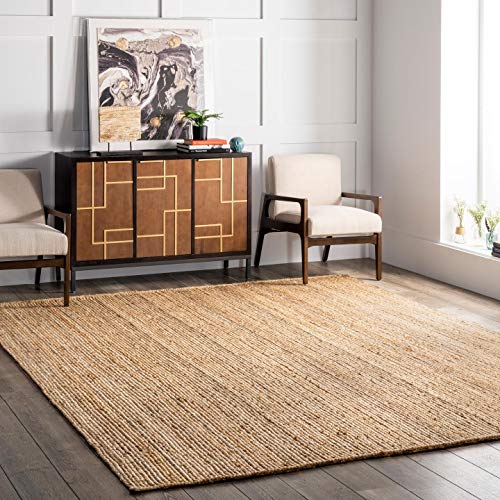
nuLOOM Rigo Jute Flatweave Rug 6×9 — Essential jute flatweave
The Rigo is the woven category reduced to its essence: natural jute, woven flat, in a solid sandy tone that agrees with every floor and nearly every furnishing philosophy invented since. There is no pile to crush, no pattern to tire of and no colour to clash, only texture, honest, fibrous and quietly beautiful in raking light. Households that understand flatweave buy this rug the way cooks buy a good knife, as a permanent tool rather than a decoration.
Six by nine is the thinking household’s size. It slides under a dining table for six, anchors a sofa group in a modest living room and layers over a larger neutral carpet with the proportions designers use in photographs. Because jute flatweave is thin, doors clear it, chairs glide on it and a broom crosses it in seconds, which is why so many owners end up buying a second for another room rather than a different rug entirely.
Jute asks for two honest acknowledgements. It is a natural fibre that prefers dry rooms and prompt attention to spills, since it absorbs rather than repels, and its texture is firm and slightly coarse compared with cotton, a quality barefoot traditionalists love and softness seekers should test before committing a bedroom to it. Within those terms, the Rigo is the reference flatweave against which this whole guide is measured.
The Rigo has a second career in many homes as a photographer’s and stylist’s friend, because its neutral texture flatters anything placed on it, from furniture being sold to children being photographed. A surface that makes other things look good, without asking for attention, is the definition of a household staple, and this rug has quietly become one in thousands of rooms.
- Natural jute woven into a solid flatweave field
- Six by nine footprint for dining and living layouts
- Thin profile clearing doors and gliding under chairs
- No pile, simplifying sweeping and everyday upkeep
- Earthy texture suited to layered, natural schemes
Strengths
- Essential natural texture flatters nearly every scheme
- Flat profile makes doors, chairs and brooms effortless
- Versatile size layers beautifully over larger carpets
Trade-offs
- Jute absorbs spills and prefers dry rooms
- Firm, coarse hand may disappoint softness seekers
- Natural fibres shed slightly in early weeks
Best for: dining rooms, layered living rooms and lovers of natural texture.
Not suited for: bathrooms, damp spaces or anyone wanting plush underfoot.
Natural jute staples are restocked regularly, although check price on Amazon still beats assuming any size is waiting.

SAFAVIEH Montauk Hand-Woven Cotton Rug 8×10 — Hand-woven cotton stripes
Cotton is the flatweave fibre for people who love the look but want a gentler handshake. The Montauk, hand-woven in ivory and olive, feels noticeably softer underfoot than jute while keeping the category’s thin, quarter-inch profile, and its full eight by ten span brings that woven softness to a proper living room scale. The olive striping gives the field a coastal, collected character that reads as design rather than utility.
Hand weaving leaves its evidence in the best way: slight variations in tension and tone that make the surface feel made rather than manufactured. In a bedroom or living room that difference registers subconsciously as warmth, and the cotton’s matte softness pairs beautifully with linen upholstery, pale wood and the layered textiles of a relaxed, gathered interior. It is the woven pick most likely to be mistaken for a far pricier artisan piece.
Cotton’s honesty includes its vulnerabilities. It shows spills more readily than jute’s forgiving brown, it prefers spot attention and dry rooms and its pale ivory sections will record a busy household’s history if asked to serve at a front door. Place it where bare feet and admiration are plentiful and mud is rare, and it returns a softness within the flatweave family that the other picks cannot quite match.
The Montauk’s olive deserves a styling note: it is one of the few colours that flatters both warm wood and cool grey in the same room, mediating between generations of furniture that otherwise argue. Transitional households, forever negotiating between inherited pieces and new ones, will find this striped cotton an unusually gifted peacekeeper at floor level.
- Hand-woven cotton with ivory and olive colouring
- Low profile stated at a quarter inch thickness
- Full eight by ten coverage for living rooms and bedrooms
- Made in India with visible hand-woven character
- Softer hand than jute alternatives in this guide
Strengths
- Cotton softness gentler than jute under bare feet
- Hand-woven variation reads as artisan craftsmanship
- Olive striping gives flatweave unusual design presence
Trade-offs
- Pale ivory sections record spills and traffic honestly
- Cotton prefers spot care over enthusiastic washing
- Too refined for muddy entrances or pet headquarters
Best for: bedrooms and relaxed living rooms wanting soft, artisan flatweave.
Not suited for: entrances, pet zones or anywhere mud arrives daily.
Hand-woven cotton arrives in smaller batches, therefore check price on Amazon early if artisan softness appeals most.

nuLOOM Elfriede Jute Flatweave Rug 7.5×9.5 — Generous natural canvas
Size is this Elfriede’s argument. At seven and a half by nine and a half feet it covers the awkward middle ground between the standard six by nine and the full eight by ten, suiting long living rooms, open-plan dining zones and bedrooms where the smaller size strands the furniture and the larger crowds the walls. In natural solid jute it becomes a canvas: a calm, textured ground across which a household’s real colours, wood, books, plants and textiles, can perform.
The weave itself is the Elfriede family’s familiar flat jute, thin, firm and honest, with the slight tonal variation that natural fibre brings to large surfaces. Across this bigger field that variation matters more, preventing the expanse from reading as flat or synthetic. Light moves across it through the day, and the rug quietly changes temperature from morning gold to evening shade without a single pattern to date it.
Choose it when the room’s proportions are the problem to be solved, or when layering plans call for a generous base beneath a smaller patterned rug. It shares jute’s standing terms: dry rooms, prompt blotting and an acceptance that its beauty is textural rather than soft. Households fluent in those terms will find this the most architecturally useful woven pick in the guide, the one that makes the room’s dimensions feel decided.
The larger Elfriede also earns its keep in rental homes, where its generous natural field covers a landlord’s tired flooring almost completely, transforming the room’s perceived quality without a single permanent change. When the tenancy ends it rolls up and leaves, taking its calm with it to the next address, which is more than can be said for most decorating.
- Natural jute flatweave in a solid, tonal field
- Seven and a half by nine and a half footprint
- Thin woven profile for doors, chairs and layering
- Generous base size for open-plan and long rooms
- Natural variation preventing large fields reading flat
Strengths
- Unusual size solves long and open-plan proportions
- Large natural canvas grounds colourful furnishings calmly
- Ideal base layer beneath smaller patterned rugs
Trade-offs
- Big field of jute is a lot of texture for small rooms
- Absorbs spills; demands dry placement and prompt blotting
- Firm surface offers no cushion for floor sitting
Best for: long rooms, open-plan zones and layered schemes needing a base.
Not suited for: small rooms or anyone seeking softness from their woven rug.
Larger flatweave footprints are stocked thinly, making check price on Amazon essential homework for open-plan rooms.

FRELISH DECOR Hand Woven Jute Rug 6×9 — Patterned hand-woven jute
Most jute flatweaves whisper; the FRELISH introduces a geometric design and lets the weave speak in sentences. Its hand-woven pattern gives a six by nine field a focal structure that plain jute lacks, making it the rare natural rug that can hold the centre of a living room or dining space without help from a layered partner. Farmhouse and rustic schemes, which can drift toward the bland when every surface is plain, gain exactly the definition this pattern provides.
Hand weaving shows in the geometry’s slight humanity, lines that breathe rather than march, and that quality keeps the pattern from feeling printed or mechanical. The jute itself remains the familiar firm, dry-loving fibre, sweeping clean in seconds and sliding under dining chairs without a murmur, so the design’s presence costs none of the flatweave practicality that recommends the category in the first place.
It suits hallways, kitchens’ dining ends and bedrooms wanting pattern without colour commitment, since the natural palette borrows its interest entirely from structure. Households committed to minimalist blankness may find the geometry busy, and jute’s spill terms apply unchanged. For everyone else, this is the woven pick with the strongest personality per square foot in the guide.
The FRELISH geometry has a talent for hallways, where its pattern gives the eye a rhythm to travel and disguises the directional wear that plain runners confess. A hall is a room’s introduction, and a woven pattern that stays handsome under the house’s heaviest traffic is making that introduction well every single day.
- Hand woven jute with a geometric woven design
- Natural tone deriving pattern from structure alone
- Six by nine size for hallways, dining and bedrooms
- Rustic farmhouse character with hand-made variation
- Flat profile for chairs, doors and quick sweeping
Strengths
- Geometric weave gives flatweave a genuine focal point
- Hand-woven irregularity keeps pattern warm, not mechanical
- Full flatweave practicality beneath the added design
Trade-offs
- Pattern may feel busy in strictly minimalist rooms
- Jute absorbs spills and prefers dry placement
- Geometric alignment demands care when positioning furniture
Best for: farmhouse and rustic rooms wanting pattern without colour.
Not suited for: minimalist schemes built on completely unpatterned surfaces.
Geometric hand-woven pieces vary between batches, so check price on Amazon and examine the current weave photographs closely.
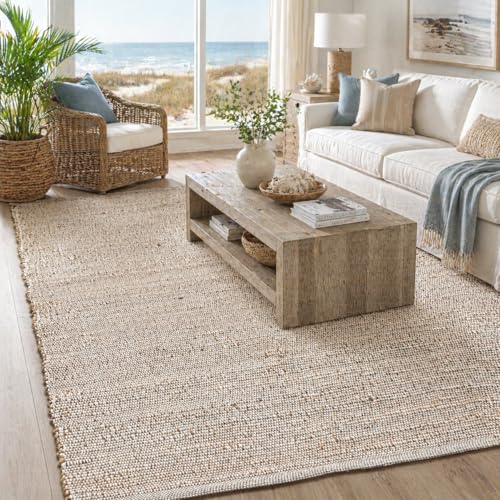
Chardin Home Jute Cotton Hand Woven Rug 5×7 — Braided blend, reversible
Blending fibres is the weaver’s oldest compromise, and the Chardin shows why it endures. Jute brings structure, texture and that natural golden tone; cotton brings softness, a paler cream note and a kinder surface for bare feet. Braided and hand woven at five by seven, the result is a rug that reads rustic from across the room and feels welcoming at close range, a combination neither fibre achieves as gracefully alone.
Reversibility doubles its usefulness in the smaller rooms this size serves. One face can take the traffic season while the other stays fresh for guests, or the household can simply flip it when the mood wants the braid’s emphasis reversed. At five by seven it suits dining nooks, bedrooms, offices and entryways with ambitions, and its boho farmhouse character layers happily over wood, tile or a larger plain carpet.
The blend inherits both parents’ terms: jute’s preference for dry rooms and prompt blotting, cotton’s willingness to show its history if neglected. It is not the rug for a mudroom’s front line. It is, however, the most versatile small woven in this guide, the pick for households that move rugs between rooms as seasons and needs change, and value a textile that looks considered from both sides.
The Chardin’s braid makes it the best woven in this guide for sitting on, relatively speaking. Its ridged texture gives just enough purchase and presence to serve as a meditation, reading or child’s tea-party surface where flat jute would feel stern. Small rooms with soft ambitions should start their woven journey exactly here.
- Jute and cotton blend, hand woven and braided
- Natural jute and cream colouring in farmhouse style
- Reversible construction offering two service faces
- Five by seven size for nooks, bedrooms and offices
- Natural fibre build for layered, textured schemes
Strengths
- Blend balances jute structure with cotton softness
- Reversible faces double styling and service life
- Portable size migrates happily between rooms
Trade-offs
- Smaller footprint will not anchor large seating groups
- Blend still prefers dry rooms and prompt blotting
- Braided texture traps crumbs more than flatweave rivals
Best for: dining nooks, bedrooms and offices wanting a versatile woven accent.
Not suited for: mudrooms or large rooms needing a full anchoring field.
Reversible braided rugs serve two seasons per purchase, hence check price on Amazon while the blend remains available.
nuLOOM Elfriede Jute Flatweave Rug 6×9 — Classic Elfriede, standard size
This second Elfriede listing brings the family’s proven jute weave down to the classic six by nine, the size that fits the greatest number of real rooms: dining tables for six, apartment living rooms, home offices and bedrooms where the larger sibling would crowd the skirting boards. Readers choosing between the two Elfriede entries are really choosing a dimension, since the weave, tone and temperament they deliver are the same trusted article.
That sameness is a recommendation in itself. The Elfriede weave has the flat, firm, naturally varied character that made jute flatweave a modern staple, thin enough for every door, honest enough for every scheme and tough enough for the dining room’s chair traffic. It layers over larger carpets with textbook proportions and disappears graciously under furniture when a room wants its floor calm rather than featured.
Apply the standard jute terms without exception: dry rooms, prompt blotting, sweeping rather than soaking and an appreciation of texture over softness. Households furnishing a first woven rug will find this the safest teacher in the guide, an affordable, classic field that explains the whole category by example. If it thrives in your home, its larger sibling and the cotton Montauk become confident next steps rather than experiments.
The classic Elfriede’s plainness is also its gift to collectors. Rugs, art and patterned textiles rotate above it across the years, and the field agrees with every one of them, because solid natural jute is the floor equivalent of a gallery wall. Households whose tastes evolve quickly need one surface that never has to change, and this is the strongest candidate in the guide.
- Natural jute flatweave in the Elfriede weave
- Classic six by nine footprint for most rooms
- Solid natural tone with inherent fibre variation
- Thin profile for doors, chairs and layering duties
- Same construction as the larger Elfriede entry
Strengths
- Standard size fits the widest range of real rooms
- Trusted weave with proven flatweave character
- Ideal first woven rug for households learning the category
Trade-offs
- Duplicates the larger Elfriede’s material limitations exactly
- Solid field offers no pattern interest on its own
- Firm jute texture will not please softness seekers
Best for: first woven purchases, dining rooms and apartment living spaces.
Not suited for: rooms needing the larger Elfriede’s generous coverage.
Standard sizes move fastest of all, which is why check price on Amazon should precede any furniture rearrangement.
How Do the Six Woven Rugs Compare on Fibre and Size?
| Pick | At a glance |
|---|---|
| nuLOOM Rigo Jute Flatweave Rug 6×9 | Natural jute flatweave, solid colour, six by nine, thin woven profile. |
| SAFAVIEH Montauk Hand-Woven Cotton Rug 8×10 | Hand-woven cotton, ivory and olive, low quarter-inch profile, eight by ten. |
| nuLOOM Elfriede Jute Flatweave Rug 7.5×9.5 | Natural jute flatweave, solid tone, seven and a half by nine and a half. |
| FRELISH DECOR Hand Woven Jute Rug 6×9 | Hand woven jute, geometric design, natural tone, six by nine, rustic style. |
| Chardin Home Jute Cotton Hand Woven Rug 5×7 | Jute cotton blend, hand woven braided, reversible, five by seven, boho farmhouse. |
| nuLOOM Elfriede Jute Flatweave Rug 6×9 | Natural jute flatweave, solid tone, six by nine, thin woven profile. |
Read the table as a map with two axes. Fibre runs from jute’s firm texture through the braided blend to cotton’s relative softness, while size runs from the Chardin’s portable five by seven to the Montauk’s full eight by ten. Your room’s job, anchor, layer or accent, fixes the size first; your bare feet and your scheme then choose the fibre, and the decision is usually complete within those two steps.
Note what the table does not contain: pile heights, plush claims or washing promises. Woven natural rugs live by sweeping, shaking, blotting and dry placement, and their beauty is textural rather than soft. Readers who reach this table still wanting a cloud should visit the soft rugs guide instead, with this guide’s blessing and its honest warning that it was never selling clouds.
What Makes Flatweave Different From Every Other Rug Type?
A flatweave rug has no pile at all. Its surface is the weaving itself, yarns interlaced at a single level, which produces a textile closer to a heavy fabric than to a carpet. The consequences cascade pleasantly: the rug is thin enough for any door, light enough to move between rooms, cool underfoot in summer and so quick to sweep that crumb management becomes a ten-second habit rather than a vacuuming appointment.
Texture replaces pile as the sensory event. Jute’s fibrous grain, cotton’s matte softness and a braid’s ridged rhythm all register underfoot and in raking light, giving rooms a tactile richness that flat surfaces like laminate cannot offer alone. Designers reach for flatweave precisely where a room needs interest without pattern or colour, which is a surprisingly common requirement in calm, natural interiors.
The trade-offs are equally structural. Without pile there is no cushion, so flatweave will not soften a fall or warm a cold floor the way shag does, and natural fibres absorb spills instead of repelling them. These are not flaws to be excused but properties to be placed correctly: dining rooms, layering schemes, warm climates and tidy households are flatweave’s native country, and there it outperforms plusher rivals on its own terms.
Longevity, placed correctly, is excellent. There is no pile to crush, mat or wear into lanes, so a well-woven flatweave ages by softening and mellowing rather than by balding. Natural jute and cotton rugs routinely serve for years in dining and living rooms, their surfaces growing more characterful, which is more than can be said for most textiles at the affordable tier.
How Do You Layer a Woven Rug Over Carpet or Hard Floors?
Layering is flatweave’s party trick, and the proportions are simple: a smaller woven rug over a larger, plainer base, with a generous border of the base showing on all sides. The classic pairing in this guide’s sizes is a six by nine jute over an eight by ten or nine by twelve neutral carpet, the woven layer supplying texture and definition while the base supplies softness and scale. The Rigo and both Elfriede entries were practically designed for this duty.
On hard floors, layering works in the opposite direction of softness: a woven rug over a thin pad gains a whisper of cushion and a great deal of grip while keeping its flat, architectural character. This is the arrangement dining rooms want, since chairs still glide and crumbs still sweep, but the field stays registered and the floor beneath is protected from chair-leg embroidery over the years.
Colour discipline makes layering look designed rather than accumulated. Keep the base quieter than the layer, or the layer quieter than the base, but never let both argue at equal volume. Natural jute over cream, ivory cotton over warm grey and the braided Chardin over almost anything neutral all obey the rule naturally, which is one reason natural fibres dominate the layering conversation entirely.
Seasonal layering is the advanced move. A woven rug alone cools a room beautifully through summer; add a smaller plush or patterned rug above it in winter and the same floor gains warmth and ceremony without storing either piece. Households in changeable climates find this rotation deeply satisfying, and it doubles the styling life of every rug involved, woven ones most of all.
How Should You Care for Jute and Cotton Woven Rugs?
Dry is the first commandment. Jute and cotton both absorb water, and a natural rug left damp will mildew, stain or weaken its fibres, so woven rugs belong in dry rooms and should be lifted, dried and aired promptly after any significant wetting. This single rule excludes bathrooms and mudroom front lines, and obeying it is responsible for most of the category’s happy long-term owners.
Daily care is delightfully primitive: sweep or shake. Flatweave releases crumbs, grit and pet hair to a broom in seconds, and a weekly shake outdoors clears what settles into the weave. Vacuuming works too, with suction and without an aggressive beater, which can fuzz natural fibres over time. No other rug category asks so little machinery of its owners, a virtue tidy households feel daily.
Spills demand speed rather than technique. Blot immediately, lift moisture upward and avoid soaking the area in the name of cleaning, since water driven deep into jute can leave a tide mark worse than the original spill. A dry, absorbent cloth, patience and moving air accomplish more than any enthusiastic scrubbing, and small, prompt blots are the entire secret of natural rugs that stay handsome.
Finally, rotate and rest the rug seasonally. Turning it end for end evens the sunlight and the traffic, while a day aired outdoors in dry weather refreshes natural fibres in a way no indoor routine matches. Reversible picks like the Chardin should actually be reversed, sharing wear between faces. These small rituals are the full maintenance contract, and they are lighter than any pile rug’s.
Why Do Designers Reach for Woven Rugs So Often?
Designers value control, and flatweave is the most controllable floor textile in existence. It adds texture without pattern risk, warmth of tone without colour commitment and a finished surface without visual noise, which makes it the perfect foundation beneath rooms whose interest lives in furniture, art and architecture. When a photographed interior looks calm and expensive, there is very often a natural flatweave doing the quiet work at its base.
It is also the layering professional’s medium. A woven rug can sit over carpet, under a smaller statement rug or alone on boards, changing roles as the scheme evolves, and few other purchases survive three redecorations without looking dated. Designers, who are paid to think in a room’s future tenses, naturally favour the textile with the most futures available to it.
There is an honesty argument too. Natural woven fibres declare their material completely: what you see is jute being jute, cotton being cotton, with no printed imitation of a nobler substance. In interiors increasingly suspicious of fakery, that material truth reads as quality regardless of tier, and it is why an affordable woven rug can sit beneath expensive furniture without embarrassing either party.
Finally, flatweave respects architecture. Thin, calm and edged cleanly, it lets floorboards show at the borders, lets a room’s proportions speak and never competes with the building itself. Old houses with beautiful floors and new houses with clean lines both benefit, which is a rare universality in furnishing and the deepest reason the category never leaves fashion for long.
How Does a Woven Rug Change With the Seasons?
Summer is flatweave’s triumph. Cool underfoot, quick to sweep of sand and garden dust and visually light even at large sizes, a woven rug lowers a room’s temperature by feel and by mood. Households in warm climates often keep woven rugs as their permanent summer flooring, storing nothing and changing nothing, because the surface suits the season so completely it seems to have been designed for it.
Winter asks the woven rug to share. Layered beneath a smaller plush rug, or simply left to ground a room of heavier textiles, it becomes the calm base of a warmer composition, its texture still visible at the borders where the eye needs rest. The layering sections of this guide exist because this seasonal partnership is where woven rugs earn their deepest loyalty.
Spring and autumn suit its maintenance rhythm: a shake outdoors, a rotation, a day of airing in dry weather. Natural fibres respond to that attention by looking refreshed rather than merely cleaned, their tones warming slightly with age and light. Owners who keep the rhythm describe their woven rugs as improving for the first years, a claim few other textiles at any tier can honestly make.
Across all four seasons the woven rug’s constancy is the point. It does not ask to be the room’s event; it asks to be its ground, in every sense, and a household that understands that request will find the thinnest textile in the house carrying more of the home’s character than pieces ten times its price.
What Should You Check When a Hand-Woven Rug Arrives?
Unroll it and read the surface like a page. Hand weaving carries slight variations in tension, tone and edge line, and the first task is distinguishing character from defect: gentle waviness and tonal life are character, while puckering that will not settle, loose ends or a weave open enough to see through are defects worth raising inside the return window, while remedies are still simple.
Check the dimensions honestly, since hand-woven rugs vary more from their stated size than machine-made ones. A few inches either way rarely matters under furniture, but in a tight dining layout it can decide whether chairs stay on the field. Measure before the furniture lands, adjust the placement to the rug you actually received and the room will look intentional rather than approximate.
Walk it barefoot and sit on it, because woven rugs are bought by the foot as much as the eye. Confirm that the texture pleases rather than merely impresses, especially where the rug will serve bedrooms or reading corners. A hand-woven rug that passes the eye, the tape and the foot in its first week will almost certainly be kept for years, which is the outcome everyone involved prefers.
Finally, let it settle before judging flatness. Natural fibres relax after unrolling, edges calm under furniture weight and the weave finds its level across several days. Photograph the room at the week’s end for the fair record. Most returns of hand-woven rugs are filed against packaging memory rather than the rug itself, and patience is the cheapest quality control in the entire category.
How Do Woven Rugs Behave in Homes With Pets?
Flatweave has a pragmatic case to make to pet owners. Hair sits on its surface where a broom or suction pass removes it in seconds, rather than descending into pile, and there are no loops tall enough to catch claws the way some weaves invite. Dogs in particular seem to appreciate the cool, firm surface in warm weather, claiming woven rugs as their summer beds without being asked.
The cautions are absorption and enthusiasm. Accidents must be blotted promptly, since natural fibres drink, and a determined scratcher can disturb any textile’s edges over time. Households that keep woven rugs in dry, supervised rooms and give pets their own beds nearby generally report excellent service, while mudroom duty should be assigned to sterner materials elsewhere in the house.
Judged fairly, woven rugs suit pet homes that are tidy by rhythm rather than by anxiety. The surface forgives hair completely, forgives dust generously and forgives liquid only briefly, which is a workable contract for most families and one this guide states plainly so that nobody signs it by accident.
Why Does Texture Matter More Than Colour in a Calm Room?
Calm rooms are built from near-neutrals, and near-neutrals live or die by texture. Without it, beige on cream on pale wood collapses into monotony; with it, jute’s grain against linen, cotton’s matte field beneath a braid, the whole room gains depth while its palette stays restful. Woven rugs are the largest texture a calm room can buy, which is why they appear in so many serene interiors that seem, at first glance, to contain almost nothing.
Light is texture’s collaborator. A low sun rakes across a woven field and reveals its structure in relief, so the room’s largest surface changes character from morning to evening without a single object moving. Households that live by natural light find this quiet theatre addictive, and it costs nothing beyond choosing a real weave over a printed imitation of one.
That is the woven category’s final argument: it offers the eye and the foot something genuine to rest on. In a house, surfaces that reward attention without demanding it are the definition of comfort, and no affordable textile provides them as honestly as natural fibre, woven flat and left to be itself.
How Should a First Woven Rug Be Chosen Without Regret?
Start with the classic, not the exception. A solid natural jute in the standard size, the Elfriede six by nine or the Rigo, teaches a household everything about flatweave’s feel, care and versatility at the lowest risk, and it remains useful forever as a layer or a dining rug even if tastes later graduate to cotton or pattern. First purchases in any category should be teachers, and these two teach kindly.
Live with it through a full season before buying its companions. The household will learn where woven surfaces delight, beside the bed or beneath the table, and where pile is genuinely missed, knowledge no guide can supply in the abstract. Second woven purchases made with that education are almost never regretted, because they are placed by experience rather than by hope.
What Happens When a Woven Rug Meets a Busy Dining Room for a Year?
The first month teaches placement: chairs find their lanes, the rug settles under the table’s weight and the household learns the broom’s ten-second route after meals. By the third month the woven field has become invisible in the best way, the calm ground nobody discusses, while quietly protecting the floorboards from the chair-leg calligraphy that unprotected dining rooms accumulate like a diary of every dinner ever served.
Across a year the natural fibres mellow. Jute warms slightly in tone where sunlight visits, cotton softens its hand and the whole surface takes on the relaxed character that newness cannot imitate. Owners often report the rug looking better at twelve months than at twelve days, an ageing direction almost unique among affordable textiles and the strongest evidence that the category’s reputation for longevity is earned rather than advertised.
The year’s spills, blotted promptly and mostly forgotten, rarely appear in that assessment. What appears instead is the floor beneath, unmarked, and the room above, composed. A woven dining rug’s biography is written in what did not happen to the room around it, which is a strange kind of success and, for the households living it, an entirely sufficient one.
How Can Woven Rugs Help a Rented Home Feel Owned?
Renters are forbidden most permanent improvements, which makes the large, reversible, traceless woven rug one of their strongest instruments. It covers tired flooring, defines rooms within open plans and imports natural material into interiors that landlords have rendered in laminate and magnolia, all while remaining a possession that leaves with the tenant and fits the next home’s different dimensions with surprising grace.
The psychological effect matters as much as the visual one. A household living on its own woven ground, surrounded by its own textures, stops experiencing the home as borrowed, and the years of a tenancy improve accordingly. When the deposit is reclaimed in full because the landlord’s floor was protected throughout, the rug has effectively paid rent on itself, which few furnishings at any tier can claim.
Why Do Woven Rugs Pair So Well With Wooden Furniture?
Wood and woven fibre share a language: both are plant materials whose beauty lives in grain, variation and matte honesty. A jute field beneath an oak table does not compete with the timber’s figure; it continues it at a different scale, so the room reads as one material conversation rather than a contest. Designers exploit this kinship constantly, and it is why natural rugs appear beneath wooden furniture in interiors across every budget and century.
The pairing also ages in harmony. Wood deepens, jute mellows and cotton softens on similar schedules, so a room furnished in both looks increasingly coherent rather than increasingly mismatched as the years pass. Few furnishing decisions offer that guarantee of growing agreement, and it costs nothing beyond choosing the natural version of the rug in the first place.
What Is the Smallest Change a Woven Rug Can Make to a Hallway?
A hallway woven rug changes the house’s handshake. It is the first texture a bare foot or a guest’s shoe meets, the surface that absorbs the entrance’s noise and the visual promise of the rooms beyond, and a natural weave makes that promise in the dialect of calm. Even a modest five by seven, like the braided Chardin laid at a hall’s seating end, can convert a corridor from a passage into a place.
It also protects the house’s hardest-working floor from its hardest-working traffic, taking the grit and the wear that would otherwise engrave the boards. A woven hall rug is therefore both welcome and shield, replaced in years rather than months and mourned, when its service ends, like any faithful piece of household infrastructure.
What Mistakes Ruin Natural Woven Rugs?
Placing jute or cotton in a damp room is the fatal error, and it is made constantly by buyers seduced by the spa aesthetic of natural fibres in bathrooms. Steam, splashes and permanently humid air are exactly what these fibres cannot forgive, and the resulting mildew is a property of the placement, not the product. Keep woven naturals in dry rooms and let synthetic or straw textiles take the wet duty elsewhere in the house.
Soaking a spill is the second error, committed with the best intentions. Flooding a jute stain with water and scrubbing drives the mark deeper, spreads it through absorbent fibres and can set a tide ring that outlives the original accident. Blot, lift, dry and repeat with minimal moisture. In natural fibre care, restraint is not passivity; it is the technique itself, and it must be taught to everyone in the household before the first glass tips.
Expecting softness from flatweave disappoints buyers who ordered by photograph. A woven rug feels firm, cool and textural, which devotees love and comfort seekers may not, especially in bedrooms where bare feet expect kindness. Test the category with a classic, affordable field like the Elfriede six by nine before committing a whole scheme, and let your own feet cast the deciding vote with full information.
Finally, dragging heavy furniture across a woven rug can distort its weave, especially at the edges where tension lives. Lift furniture or slide it on pads, straighten the rug afterwards and let it settle flat before judging its lines. Woven textiles are strong in service and delicate in handling, a combination worth respecting during the ten minutes of arrangement that decide years of appearance.
Final Recommendation
For most households the classic Elfriede six by nine is the woven category’s wisest first purchase: natural, flat, versatile and honestly priced, it teaches the whole flatweave philosophy by example. Rooms needing architectural scale should step up to the larger Elfriede or the Rigo’s essential jute, while pattern lovers take the FRELISH geometry and small-space stylists the reversible braided Chardin for its two-faced usefulness.
The Montauk stands apart as the soft-hearted woven, hand-woven cotton for bedrooms and living rooms where flatweave’s look is wanted with a gentler touch. None of the six will cushion a fall or forgive a flood, and all six will sweep clean in seconds, layer like professionals and age by mellowing rather than wearing out. That is the woven bargain, stated in full.
Choose the fibre your feet prefer and the size your room’s architecture demands, and the thinnest rug in the house may become its hardest-working surface. In a home, calm is a feature as real as warmth or light, earned daily and noticed most when it is absent, and no floor delivers calm quite as honestly, quietly or durably as woven natural fibre.
Frequently Asked Questions
Can a woven jute rug go under a dining table?
It is one of the category’s best jobs. Flatweave lets chairs glide, sweeps clean of crumbs in seconds and its natural tone hides the dining room’s daily dust. Choose a size that keeps pulled-out chairs on the rug, blot spills promptly rather than soaking them and the jute will serve for years. The Rigo and both Elfriede entries suit this duty particularly well.
Are woven rugs comfortable underfoot?
They are comfortable the way linen is comfortable: cool, natural and textural rather than cushioned. Cotton, as in the Montauk, feels gentler than jute, and layering any flatweave over a thin pad adds a whisper of give. Readers seeking genuine sink and warmth should choose a pile rug instead; readers seeking a calm, firm, natural surface will find woven rugs deeply satisfying.
How do I keep a flatweave rug from slipping?
A rug pad is the complete answer on hard floors, adding grip, protecting the floor and giving the weave a foundation that keeps it flat and registered. Reversible and lighter picks benefit most. On carpet, a woven layer usually settles by its own texture, though a grip layer helps in high-traffic arrangements. Never let a woven rug surf; its edges wear first when it travels.
Can I wash a jute or cotton woven rug?
Not in the enthusiastic, machine sense that synthetic washable rugs invite. Natural woven rugs prefer sweeping, shaking, suction and prompt blotting, with careful hand attention for marks and thorough drying afterwards. This restraint is the category’s one real demand, and households that accept it find natural flatweave among the lowest-maintenance floors they own.
Why are there two Elfriede rugs in this guide?
Because they are two sizes of one trusted weave, and size is a genuine decision in flatweave. The six by nine suits most dining and living rooms, while the seven and a half by nine and a half solves longer, open-plan spaces. Listing both lets readers choose the dimension their architecture needs while keeping the material they have already decided they trust.
Do natural woven rugs shed?
Some loose fibre appears in the first weeks as the weave settles, especially with jute, and regular sweeping clears it quickly. Shedding that persists heavily is unusual for well-made flatweave, since there is no pile to lose. What owners mostly notice instead is the opposite: how little a woven rug releases compared with the plush alternatives elsewhere in the house.
Related Guides
The woven story ends here, but the house has other rooms and other questions, so keep reading with these guides from the same team, each written for a different corner, a different material and a different decision: Best Animal Pillows Best Backpacking Sleeping Quilts Best 8×10 Rugs Best All-Natural Pillows.


