What's inside
- Key Takeaways
- Quick Picks
- How Did We Choose These Low-Shed Towel Sets?
- Why Do Some Towels Shed So Much More Than Others?
- How Do the Six Sets Compare at a Glance?
- How Should You Wash New Towels So the Lint Settles Fast?
- What Does GSM Actually Tell You, and What Does It Hide?
- Which Colour Hides Lint Best While a Set Settles?
- What Mistakes Make Towels Shed Longer Than They Should?
- How Many Towels Does a Household Actually Need Per Person?
- What Do Hems, Borders and Edges Tell You About a Towel?
- How Do Hard Water and Detergent Residue Change a Towel?
- Should You Choose Bath Towels or Bath Sheets at This Size?
- When Is a Towel Finished, and How Should You Retire It?
- How Should You Set Up a Guest Bathroom That Stays Lint-Free?
- What Should You Check in the First Week Before Keeping a Set?
- How Do You Store Towels So They Age Gracefully?
- Final Recommendation
- Frequently Asked Questions
- Related Guides
As an Amazon Associate I earn from qualifying purchases. This post may contain affiliate links at no extra cost to you.
cottageverdict.com is reader-supported. When you buy through links on our site, we may earn an affiliate commission.
Where to buy: all six sets below are sold on Amazon, and each name links to its listing so you can check colours, set composition and care labels before ordering. Anyone hunting for the best bathroom towels that do not shed deserves one honest sentence before the shopping starts: every new cotton towel sheds some lint in its first few washes, because loose surface fibres from weaving have to leave somehow. The realistic goal is a towel whose shedding settles quickly and stays settled — and that outcome is decided by staple length, yarn construction and your own first washes far more than by any promise printed on a band.
There is also a fairness point to make on behalf of the towels themselves. A household that washes a new set once, mixed with everything, softened generously and dried on a line over a radiator, has not tested the towel — it has tested a worst-case routine, and even excellent cotton will look guilty under it. Judge these sets by the routine this guide sets out, and the differences that remain between them are the real differences: weight, composition, colour and hand-feel, which are exactly the things a buyer can choose between honestly.
Lint is not a trivial complaint. It coats dark tiles, clings to damp skin, fills the dryer’s filter and makes a new bathroom feel grubby within a week. But it is also a solvable one, and the solution is mostly about choosing long-staple cotton, reading set compositions carefully, and washing new towels like you mean it before they ever meet a guest. The six sets here are all Turkish cotton, all machine washable, and each approaches the low-lint brief from a slightly different angle of weight, colour and set design.
Key Takeaways
- Some lint in the first few washes is normal for any cotton towel; low-shed means it fades fast, not that it never happens.
- Long-staple cotton is the strongest structural defence, because longer fibres stay anchored in the yarn.
- Fabric softener and dryer sheets coat fibres and can worsen both linting and absorbency; skip them for towels.
- Wash new towels separately, more than once, before judging them or mixing them with dark laundry.
- Weight around 600 GSM balances plushness with drying speed; heavier towels feel luxurious but linger damp.
- Set composition matters: a four-pack of full bath towels solves a different problem than a mixed six or eight pieces.
Quick Picks
| Pick | Badge | Why it earns a place |
|---|---|---|
| Cotton Paradise Turkish Towel Set 6 Piece | Best Complete Set | A six-piece, 600 GSM cotton set in beige, OEKO-TEX certified and built for quick drying. |
| American Soft Linen Turkish Towel Set 6 PC Grey | Best Grey Six-Piece | Two bath towels, two hand towels and two washcloths at 600 GSM in a lint-forgiving grey. |
| American Soft Linen Turkish Bath Towels 4PC White | Best Bath-Only Pack | Four full 27×54 bath towels in white for households that only run out of the big size. |
| Chakir Turkish Linens Bath Towels 4-Pack White | Best Classic White | A plush, absorbent four-pack of white bath towels with OEKO-TEX certification. |
| White Classic Luxury Bath Towel Set of 8 | Best Eight-Piece Value | Eight pieces at a denser 700 GSM, mixing bath towels, hand towels and four washcloths. |
| Chakir Turkish Linens Bath Towels 4-Pack Gray | Best Gray Bath Pack | The Chakir bath four-pack in gray, for bathrooms where white shows every mark. |
How Did We Choose These Low-Shed Towel Sets?
Fibre came first. Every set on this list is one hundred percent cotton, and the Turkish cotton framing matters because the category is associated with longer staple fibres; long fibres twist into stronger yarns with fewer loose ends standing proud of the surface, and loose ends are precisely what lint is made of. Short-staple cotton can feel fluffy in the shop and then release fluff for months, because thousands of fibre tips were never securely held. We cannot measure staple length from a listing, so we favoured established towel makers whose descriptions commit to cotton content and weight rather than hiding behind the word plush.
Weight came second, read as a range rather than a contest. The sets here sit at 600 GSM with one denser 700 GSM entry, and that band is deliberate: heavy enough for a satisfying wrap and real absorbency, light enough to dry on a rail between morning showers. Much heavier towels shed their early lint for longer simply because there is more surface fibre to clear, and they punish small bathrooms with a permanent damp smell. Much lighter towels dry fast but feel like an apology after a bath.
Certification and composition closed the shortlist. OEKO-TEX certification appears across most of these listings and speaks to what the fabric carries against skin, which matters for something pressed to a face daily. Composition decided the final order: mixed sets for households furnishing a whole bathroom, bath-only four-packs for households whose hand towels outlive their bath towels three to one, and colour choices weighed honestly — white that can be bleached back to bright, grey and beige that forgive the lint they do release while it settles.
Why Do Some Towels Shed So Much More Than Others?
A towel is a forest of loops, and every loop is yarn, and every yarn is fibres twisted together. Where fibres are short, their ends work free under the friction of washing and drying, and each freed end becomes lint on your tiles or a grey felt in the dryer filter. Where fibres are long, the twist holds them along their length, and the surface stays coherent. That is the whole structural story, and it is why two towels that feel identical in a shop can behave completely differently by the tenth wash.
Manufacturing adds a second act. Towels are cut from wide woven cloth, and cut edges release fibres until the hems settle; a new towel also carries surface fibres loosened during weaving and finishing. Those early fibres were never really part of the towel’s working surface, which is why the first washes shed the most and why judging any towel before wash three is judging an unfinished product. Excess dye leaves in the same washes, which is why dark or saturated towels should travel through their early laundry life alone.
Your laundry habits write the third act. Overloading the machine grinds towels against each other and against zips and denim, tearing fibres free. Fabric softener coats what remains, weakening absorbency while making the surface slippery rather than stable. Tumble drying, by contrast, is lint’s exit route: the filter catches what the wash loosened, which is why a towel dried on a line can seem to shed forever — the fibres have nowhere to go except your bathroom floor, one shake at a time.

Cotton Paradise Turkish Towel Set 6 Piece — Best Complete Set
Cotton Paradise builds the most straightforward answer to furnishing a bathroom from one box: six pieces of 600 GSM Turkish cotton in a warm beige, certified under OEKO-TEX, and described by its maker as quick drying and lightweight for its class. The beige deserves a word of its own. Lint is pale, and on beige it is nearly invisible during the settling-in washes, which makes this the diplomatic choice for a household that wants the low-shed result without the white-towel bleach routine or the dark-towel lint spotlight.
At 600 GSM the set sits in the balanced band this guide keeps returning to: enough loop density to dry a person properly, not so much mass that the towels sulk on the rail until evening. The quick-drying character matters for lint too, because towels that dry fully between uses go back into the wash less urgently and get handled less overall. Expect the usual first-wash fluff — the listing’s promise is a well-made cotton set, not a lint-free miracle — and expect it to taper quickly if you wash the set separately, without softener, and tumble it dry while it settles.
- Pieces: six-piece towel set
- Material: 100 percent cotton, Turkish
- Weight: 600 GSM
- Colour: beige
- Certification: OEKO-TEX
- Care: machine washable
Strengths
- Complete set furnishes a bathroom in one purchase
- Beige hides early lint better than white or charcoal
- Balanced weight dries between daily uses
Trade-offs
- Single colourway limits mixing and matching
- Beige cannot be bleached back like white can
- First washes still shed, as all cotton does
Best for: setting up a main or guest bathroom in one order. Not suited for: households that bleach their towels as a matter of routine.
Rotate this set deliberately in its first month. With six pieces in play, mark one bath towel as the benchmark and notice how its surface behaves across the first five washes while its siblings rotate through the rail; that small observation tells you when the whole set has settled and can join general laundry. Guest-bathroom buyers should do the settling washes before the towels ever meet a guest, because a new towel’s worst lint days are its first three, and there is no reason a visitor should host them.

American Soft Linen Turkish Towel Set 6 PC Grey — Best Grey Six-Piece
American Soft Linen spells out its six pieces with unusual clarity: two bath towels at 27×54, two hand towels at 16×28 and two washcloths at 13×13, all in grey, all 600 GSM Turkish cotton with OEKO-TEX certification. That arithmetic suits the standard family bathroom, where the bath towels do the heavy work, the hand towels live beside the sink, and the washcloths rotate fastest of all. Grey is the thinking person’s lint colour — pale fluff disappears against it, and so do the faint marks that send white towels to the bleach while they are still young.
The brand’s pitch leans on softness and absorbency with quick drying, and the 600 GSM weight supports the claim in the way this guide trusts: enough cotton to drink water off skin, not so much that a hand towel stays clammy beside the basin. Grey also future-proofs the set against the slow colour drift of mixed laundry; a grey towel washed with everything still looks like itself at month six. Run the settling washes separately anyway, skip softener so the loops keep their grip, and this is the set most households will find easiest to live with while it calms down.
- Pieces: two bath, two hand, two washcloths
- Sizes: 27×54, 16×28 and 13×13 inches
- Material: 100 percent Turkish cotton
- Weight: 600 GSM
- Colour: grey
- Certification: OEKO-TEX
Strengths
- Exact piece sizes are stated plainly in the listing
- Grey forgives both lint and everyday marks
- Balanced composition matches a standard bathroom
Trade-offs
- Only two bath towels for a busy household
- Grey cannot take a whitening wash
- Hand towels at this weight need rail space to dry
Best for: family bathrooms that want one honest set in a forgiving colour. Not suited for: large households that burn through bath towels daily.
Consider buying the settling-in period a head start: wash this set twice before its first morning on duty, with the second wash followed by a thorough tumble dry, and most of the loose weaving fibre will already be in your filter rather than on your floor. After that, grey’s camouflage handles the remainder. Households pairing this set with dark bathroom tiles get the full benefit; the floor stops telling tales about the towels, and the towels stop being accused of crimes the grout committed.

American Soft Linen Turkish Bath Towels 4PC White — Best Bath-Only Pack
Plenty of households do not need a set at all; they need bath towels, because bath towels are what wear out, disappear into gym bags and get claimed by teenagers. This four-pack answers that exact shortage: four full-size 27×54 bath towels in white, 600 GSM Turkish cotton, OEKO-TEX certified, with no hand towels or washcloths padding the box. Buying only the size you lack is also a quiet lint strategy, since every piece in the wash is a piece you actually use and settle properly, rather than a spare shedding in a cupboard rotation nobody tracks.
White is the demanding colour and the forgiving one at the same time. It shows early lint against a dark bathroom floor, which this guide will not pretend otherwise about, but it is the only colour here that can be washed hot and brightened back when months of use grey it. Hotels choose white for operational reasons, not aesthetics: one laundry standard for everything, no dye lots to match, stains treated rather than hidden. A home that runs a disciplined hot wash can borrow that whole system with this pack, and the towels will repay it by looking new far longer than coloured rivals.
- Pieces: four bath towels
- Size: 27×54 inches each
- Material: 100 percent Turkish cotton
- Weight: 600 GSM
- Colour: white
- Certification: OEKO-TEX
Strengths
- Four of the size households actually run out of
- White tolerates hot washes and brightening
- No filler pieces inflating the set count
Trade-offs
- Hand towels and washcloths must come from elsewhere
- Early lint shows plainly on dark floors
- White demands laundry discipline to stay white
Best for: restocking bath towels in a white-towel household. Not suited for: furnishing a bathroom from empty rails.
Four matching bath towels also simplify the settling routine: one load, washed alone twice before service, tumbled dry, done. After that, keep them as their own wash load permanently if you can; white cotton washed with coloured loads greys by inches, and the pack’s whole appeal is the bright, uniform row on the rail. Households with hard water should watch for mineral dulling and use a periodic rinse aid approach rather than softener, which coats the loops and trades absorbency for a slippery hand-feel nobody asked for.
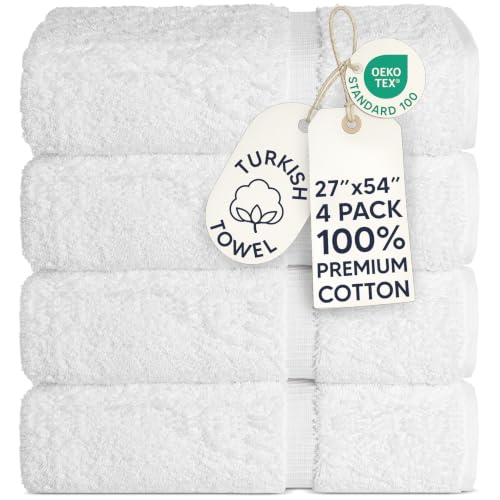
Chakir Turkish Linens Bath Towels 4-Pack White — Best Classic White
Chakir’s white four-pack is the traditionalist’s entry: premium Turkish cotton bath towels at the same full 27×54 size, OEKO-TEX certified, described as soft, plush and absorbent without exotic claims. Where the American Soft Linen pack above speaks the language of systems and hot washes, Chakir speaks the language of the towel itself — the wrap after a bath, the weight in the hand, the surface against shoulders. Readers choosing between the two white packs are really choosing a temperament, since the measurable facts sit close together.
Plushness is worth one caution in a low-shed guide. A plusher surface means more loop area and therefore more early fibre to clear in the settling washes; that is not a defect, it is arithmetic, and it resolves with the same separate washes and tumble drying this guide prescribes everywhere. What you receive in exchange is the dense, hotel-adjacent feel that makes white towels a small daily ceremony. Keep softener away from these loops especially — coating a plush towel is how a premium surface turns glassy and starts pushing water around instead of drinking it.
- Pieces: four bath towels
- Size: 27×54 inches each
- Material: 100 percent Turkish cotton
- Colour: white
- Certification: OEKO-TEX
- Character: soft, plush, absorbent
Strengths
- Plush hand-feel suits bath-first households
- Classic white fits any bathroom scheme
- Established towel specialist behind the listing
Trade-offs
- Plush surface has more early lint to settle
- Bath towels only, like its white rival above
- White shows marks between washes
Best for: readers who want the classic plush white bath towel. Not suited for: anyone furnishing hand-towel rails from the same box.
A note on rotation: four identical towels invite a simple discipline — always take from the left of the folded stack and return laundry to the right, so wear and washing spread evenly and no single towel ages into the scratchy one everyone avoids. Even wear also means even lint behaviour; a set that settles together stays predictable together, and the day one towel starts shedding again years later, it is telling you its loops are finally wearing through, which is information worth having.

White Classic Luxury Bath Towel Set of 8 — Best Eight-Piece Value
White Classic goes bigger on both axes: eight pieces — two bath towels, two hand towels and four washcloths — at a denser 700 GSM, under a hotel collection banner. The washcloth count is the tell about who this set is for. Households that use a fresh washcloth daily, for faces, children or skincare routines, burn through them faster than any other piece, and four in the box means the laundry rhythm can breathe. The extra weight gives the bath towels a heavier drape than the 600 GSM sets, which some readers will read as luxury and others as a longer wait on the drying rail.
Heavier cotton and the low-shed brief need an honest paragraph together. More GSM is more fibre, and more fibre is a longer settling period — expect this set to ask for an extra separate wash or two before its lint calms to the level of its lighter rivals. That is a fair trade when it is chosen knowingly: you are buying density and a washcloth wardrobe, and paying for them partly in patience. Tumble drying is close to mandatory for this set in its first month; line-dried, its loose fibre has no exit and will keep reappearing on skin and tiles long after a tumble-dried twin has settled.
- Pieces: two bath, two hand, four washcloths
- Material: 100 percent Turkish cotton
- Weight: 700 GSM
- Colour: white
- Collection: hotel style
- Character: densest set in this line-up
Strengths
- Four washcloths suit daily-fresh-cloth households
- Dense weave feels substantial after a bath
- Full bathroom covered by a single set
Trade-offs
- Longest lint-settling period of the six
- Heavier towels dry slowly on a rail
- Only two bath towels despite the piece count
Best for: washcloth-heavy routines and readers who love a heavy towel. Not suited for: small bathrooms where towels must dry fast between uses.
Plan this set’s laundry as a standing appointment rather than an afterthought. Eight pieces at this density fill a machine properly on their own, which is genuinely good for them — a full but not crammed load, warm water, no softener, then a real tumble dry — and that same load keeps their white uniform. Let them share with jeans and zips and the loops will pill and tear early; the set rewards the household that gives towels their own ecosystem and punishes, gently and visibly, the one that does not.

Chakir Turkish Linens Bath Towels 4-Pack Gray — Best Gray Bath Pack
The gray twin of Chakir’s white pack keeps the formula — four 27×54 Turkish cotton bath towels, OEKO-TEX certified, plush and absorbent — and changes the one variable that decides how a bathroom feels day to day. Gray hides the two things white advertises: the pale lint of the settling weeks and the faint cosmetic marks of ordinary life, from toothpaste flecks to the shadow a mascara’d face leaves behind. In a shared or family bathroom, that camouflage is not vanity; it is the difference between towels that look cared for and towels that look accused.
Gray also plays well with the mixed-colour reality of most homes. It sits calmly beside navy, blush or the beige Cotton Paradise set above without demanding a scheme, and it forgives the occasional wash alongside darker laundry that would slowly ruin a white pack’s brightness. What it cannot do is take a bleach rescue, so stains must be treated promptly rather than banked for a whitening day that will never come. Treat this pack as the low-maintenance branch of the Chakir family: same cotton, same size, less laundry theatre.
- Pieces: four bath towels
- Size: 27×54 inches each
- Material: 100 percent Turkish cotton
- Colour: gray
- Certification: OEKO-TEX
- Character: plush, absorbent, low-visibility lint
Strengths
- Gray hides settling lint and daily marks alike
- Full bath size in a simple four-pack
- Blends with almost any bathroom palette
Trade-offs
- No bleaching option when stains set in
- Bath size only, no companion pieces included
- Plush surface still needs its settling washes
Best for: family and shared bathrooms that want calm-looking towels. Not suited for: bleach-and-brighten laundry households.
One practical pairing worth considering: this gray pack beside the white Chakir pack above gives a household a two-tier system — gray for the everyday family bathroom, white reserved for guests and the good rail — while keeping size, feel and laundry behaviour identical across both. Guests get the ceremony, family gets the camouflage, and the person doing laundry gets one simple cotton routine that covers everything they own.
How Do the Six Sets Compare at a Glance?
| Pick | Pieces | Weight | Colour |
|---|---|---|---|
| Cotton Paradise Turkish Towel Set 6 Piece | Six-piece set | 600 GSM | Beige |
| American Soft Linen Turkish Towel Set 6 PC Grey | 2 bath, 2 hand, 2 cloths | 600 GSM | Grey |
| American Soft Linen Turkish Bath Towels 4PC White | 4 bath towels | 600 GSM | White |
| Chakir Turkish Linens Bath Towels 4-Pack White | 4 bath towels | Plush cotton | White |
| White Classic Luxury Bath Towel Set of 8 | 2 bath, 2 hand, 4 cloths | 700 GSM | White |
| Chakir Turkish Linens Bath Towels 4-Pack Gray | 4 bath towels | Plush cotton | Gray |
How Should You Wash New Towels So the Lint Settles Fast?
Begin before the towels ever touch a body. Wash the new set alone — its own load, nothing else invited — in warm water with a modest measure of detergent, and run that load twice before first use if the lint coming off in the filter suggests it. The point of the solitary washes is extraction: loose weaving fibre and excess dye need somewhere to go, and a dedicated load with a tumble dry afterwards sends both into the filter and the lint trap instead of onto your other laundry.
Keep three things out of the towel wash permanently. Fabric softener coats loops in a waxy film that reduces absorbency and loosens the surface’s grip on its own fibres; dryer sheets do a lighter version of the same job; and bleach, outside of an occasional rescue for whites, roughens cotton over time and gives fibres more ends to shed from. A splash of plain white vinegar in the rinse is the folk remedy that actually earns its place, helping strip detergent residue that stiffens loops, though it is a helper, not a requirement.
Dry them like you mean it. Tumble drying is not the enemy of a good towel — for the first month it is the mechanism that finishes the manufacturing process, carrying away everything the washes loosened. Shake each towel out before it goes in, dry on a moderate heat until genuinely done, and clean the filter between loads while the set is settling; a clogged filter in week one is the signature of a normal towel doing normal things. Line drying can take over once the lint has calmed, ideally with a short tumble at the end to soften the loops.
What Does GSM Actually Tell You, and What Does It Hide?
GSM — grams per square metre — measures how much cotton sits in a given area of towel, and it is useful precisely as far as it goes. It tells you density, which correlates with absorbency and drape: the 600 GSM sets here drink more and hang heavier than a thin 400 GSM towel, and the 700 GSM White Classic set out-densities them all. What GSM cannot tell you is fibre length, and fibre length is the low-shed variable. A short-staple towel can be woven densely and still shed for months, while a long-staple towel at a modest weight can settle in three washes.
Read GSM, therefore, as a comfort dial rather than a quality verdict. Turn it up and you gain plushness and absorbency while paying in drying time, rail space and a longer lint-settling period. Turn it down and the towel dries like a shirt and wraps like one too. The band between roughly 500 and 700 is where most households land happily, and every pick in this guide lives inside it deliberately. Anyone advertising a number far above that band is selling you a blanket with ambitions, and your bathroom rail will file the complaint.
Which Colour Hides Lint Best While a Set Settles?
Lint is pale grey-white, whatever towel it escaped from, so the camouflage question answers itself in one direction: mid-tone colours — the grey and beige in this line-up — make loose fibre nearly invisible on both the towel and, to a degree, the floor beneath the rail. White towels show lint against dark tiles but hide it against themselves; dark towels, which this shortlist avoids, perform the worst trick of all, displaying every pale fibre on their surface like dust on a piano.
Colour choice also decides your rescue options years later. White can be hot-washed and brightened when life greys it, which is why two of the white packs here will out-look their coloured rivals at year three in a disciplined laundry household. Grey and beige cannot be rescued that way, but they rarely need rescuing, because they never promised brightness in the first place. Choose according to which kind of ageing you would rather manage: the slow fade you can bleach back, or the steady mid-tone that asks nothing of you.
What Mistakes Make Towels Shed Longer Than They Should?
The most common mistake is impatience at the judging stage: towels condemned as lint factories after one wash, when the first wash is precisely when an honest cotton towel sheds its manufacturing loose ends. Judge at wash five, not wash one. Close behind comes the overloaded machine — towels crammed against denim and zips get abraded from both sides, and abrasion manufactures fresh lint from fibre that was perfectly secure. Give the set room to tumble and it will stop volunteering its surface.
Softener deserves its own paragraph in the mistakes section because it is usually added with kind intentions. The coating that makes a towel feel slick in the shop display is the same coating that stops loops gripping water and gripping each other; owners then wash more often because the towel absorbs less, and wash a coated towel more often and you have built a lint machine. The final mistake is storage: towels folded damp into a closed cupboard mildew at the loop roots, weakening fibres that then shed in the next wash while smelling of the cupboard. Dry fully, fold loosely, and let air be part of the storage system.
How Many Towels Does a Household Actually Need Per Person?
The arithmetic that keeps lint — and laundry panic — low is simpler than the linen cupboard suggests. Two bath towels per person in rotation is the working minimum: one in use, one in the wash or on the rail, with a third per person turning a good system into a comfortable one. Hand towels rotate faster because they never fully dry beside a busy sink; plan two per bathroom. Washcloths follow appetite — daily users should own enough for a fresh one each day between washes, which is exactly the gap the four-cloth White Classic set exists to fill.
Rotation is a lint policy as much as a convenience. A towel rested a full day between uses dries to the loop roots, and dry loops resist the fibre damage that damp, re-used towels accumulate. Households that run one towel per person until it begs for the wash are not being frugal; they are shortening the towel’s life and increasing its shed, because a perpetually damp towel goes into every wash carrying mildew-weakened fibre. The cupboard, in other words, is part of the laundry system, and a slightly larger one produces cleaner behaviour from every towel in it.
Guests deserve their own small reserve, kept folded and finished — already through their settling washes — rather than borrowed from the family rotation at the last minute. Two guest bath towels and two hand towels cover most visits, and because they wash rarely, they stay at their best for years. When the reserve starts rotating into daily use during laundry backlogs, that is the household’s signal to buy another everyday set, not to let the good towels be ground down.
What Do Hems, Borders and Edges Tell You About a Towel?
Turn any towel over and read its edges before its face. The long sides are selvedges, woven closed in the loom, and they should run straight and tight; the short ends carry the hems, and it is hem stitching that decides whether a towel survives five years of tumble drying or unravels in its second winter. Look for dense, even stitching with no skipped runs, because a hem that opens releases a steady supply of cut fibres — a towel can shed from a failing hem long after its loops have settled, and owners misdiagnose it as bad cotton when it is actually bad sewing.
The decorative border woven near each end — the dobby band — is more than decoration. That flat strip is where a towel is gripped, hung and folded most, and a well-woven band stiffens the end against the stretching that distorts cheaper towels into trapezoids. It also gives the eye a reference: on a quality towel the band sits parallel to the hem and the whole rectangle stays rectangular wash after wash. Distortion is a lint clue too, since a towel pulled out of shape is a towel whose yarns are sliding, and sliding yarns free their fibres.
Finally, rub the surface hard with a dry palm before the first wash and look at your hand. A faint dusting is the normal manufacturing residue this guide keeps describing. A palm that comes away flocked suggests either very short staple or a finish-heavy fabric, and that towel — whatever its label — should be bought in small quantities first, settled through five washes, and only then multiplied across the household.
How Do Hard Water and Detergent Residue Change a Towel?
In hard water postcodes, towels age by mineral as much as by friction. Calcium deposits lodge between fibres, stiffening loops until they snap rather than bend, and snapped fibres are lint with a delayed fuse — the towel feels harsh first and starts shedding again months later, long after its settling period should have closed the subject. The countermeasures are unglamorous: do not overdose detergent, since undissolved product adds its own crust; run an occasional hot wash for whites; and consider a water-softening rinse approach if every textile in the house is going cardboard at once.
Detergent residue writes a similar story from the other direction. Too much product for the load size leaves a film that makes loops feel slick and absorbency fall, tempting owners into hotter, harsher, more frequent washing — the exact regime that manufactures lint. The fix is a strip wash: a hot cycle with no detergent at all, letting the water pull out what months of generous measuring poured in. Towels that emerge softer and thirstier were never wearing out; they were wearing their own soap.
None of this requires a laboratory. It requires noticing that a towel’s behaviour at month eight is a report on your water and your scoop size as much as on its cotton, and adjusting the cheapest variable first. Fibre quality decides the towel’s ceiling, but laundry chemistry decides how close to that ceiling it lives.
Should You Choose Bath Towels or Bath Sheets at This Size?
Every bath towel in this guide measures 27×54 inches, the standard bath towel footprint, and the size deserves defending because bath sheets — their oversized cousins — tempt buyers with wrap-around luxury. A bath sheet undeniably swallows a person more completely, and taller or broader readers may find the standard size genuinely insufficient as a wrap. But the sheet’s extra area is also extra wet cotton: slower to dry on the rail, heavier in the machine, longer to settle its lint, and more likely to be washed alone in a half-empty drum that tumbles it against itself.
For most bodies and most bathrooms, 27×54 is the size the whole ecosystem assumes — rails are spaced for it, machines balance around a few of them, and sets are priced around it. The wrap problem, where it exists, is often a technique problem in disguise: a towel used straight from a warm rail, wrapped high and tucked, covers more than a larger towel draped low and loose. Readers who know from experience that standard towels fail them should honour that knowledge and shop sheets deliberately, accepting the laundry costs with open eyes.
Children redraw the calculation again. A 27×54 towel is a blanket on a six-year-old, which they experience as luxury and the laundry experiences as a full-size load for a half-size person. Households with small children often run a mixed fleet — standard towels for adults, smaller ones for children — and graduate pieces upward as the children grow, which also spreads wear across more cotton and keeps any single towel’s shedding phase from dominating the bathroom.
When Is a Towel Finished, and How Should You Retire It?
A towel is done when its loops are. The signs arrive in a reliable order: absorbency fades so water smears rather than sinks, the surface looks flat in the centre where bodies press hardest, edges fray beyond the hem’s ability to hold them, and — the sign this guide cares about — lint returns after months or years of calm, because worn loops are breaking down into the fibres they were spun from. A towel shedding again in year three is not betraying you; it is reporting its own retirement, and no wash routine reverses it.
Retirement need not mean the bin. A finished bath towel still has honest work in it as a car-drying cloth, a pet towel, a spill mat under the washing machine or a kneeling pad for garden work, and demoting it keeps a younger towel from being sacrificed to those jobs. What a finished towel should not do is stay on the guest rail, where its scratch and smear will be read as the household’s standard. Move it down the hierarchy with gratitude and replace from the top.
Replacements bought one set at a time, settled through their early washes before they are needed, keep the whole system calm. The panicked emergency purchase — guests arriving Friday, towels bought Thursday, lint everywhere Saturday — is how most households end up owning towels they resent. A linen cupboard with one settled spare set in reserve is the entire secret, and it costs less than the resentment does.
How Should You Set Up a Guest Bathroom That Stays Lint-Free?
Guest bathrooms fail on towels more than on any other detail, because the towels there live a strange life: long idle weeks folded in a closed room, then sudden service for visitors who judge the whole house by them. The preparation is entirely in the timing. Guest towels should complete their settling washes when they are bought, not when the visit is announced, and they should be stored with air around them — a shelf or an open basket — rather than sealed in a cupboard where a faint mustiness will greet the first unfold.
Colour strategy flips for guests. At home, grey and beige camouflage the everyday; for guests, white sends the message that the towels are laundered hot and held to a standard, which is why hotels converged on it. The white packs in this guide exist for exactly that rail. Fold them with the dobby band showing, hang a fresh hand towel the morning visitors arrive, and put the family’s everyday set out of sight rather than asking guests to guess which rail is theirs.
One fresh washcloth per guest per day is the small luxury people remember, and it is cheap to provide from a set with four in the box. Retire guest towels downward the moment they lose their brightness or their loops flatten; a guest set’s entire value is its first impression, and a demoted set serves the family bathroom honourably for years afterwards.
What Should You Check in the First Week Before Keeping a Set?
Run the settling protocol and keep score like a scientist for one week. Note the lint in the dryer filter after washes one, three and five: the pile should shrink visibly each time, and a set whose filter load refuses to decline by wash five is telling you its staple is shorter than its marketing. Rub a damp forearm across a dried towel and look for clinging fibres; test absorbency by how a wet handprint behaves — it should vanish into the loops, not sit on them. Check hems after the tumble dry for any stitch giving way while returns are still easy.
Also test the towel in the life it will actually live. Hang it on your real rail and time how long it takes to feel dry again; a set that is still cool and damp at the next morning’s shower will be washed more often than planned, and every plan in this guide bends around that fact. If two sets are auditioning, wash them separately and judge them separately — shared loads let a bad shedder hide behind a good one’s filter, and let a good towel be blamed for a bad one’s lint on the tiles.
Keep the packaging until the verdict is in, and do not buy the second set, the matching colour or the gifts for relatives until the first set has passed its fifth wash. Towels are a decade-long relationship bought on ten minutes of shop-floor hand-feel; the first week at home is the only honest interview they will ever give you, so conduct it properly.
How Do You Store Towels So They Age Gracefully?
Storage is where good towels go to be quietly ruined. A stack folded tight and sealed in a closed cupboard for months traps the last traces of moisture at the fold lines, and mildew works there invisibly until the towel smells faintly of the cupboard itself — a smell owners often misread as the towel’s fault and attack with harsher washing, which only adds fibre damage to the original problem. The defences are dull and total: towels enter storage bone dry, folds are loose, and the cupboard door or the shelf allows some exchange of air with the room.
Rotate the stack as you rotate the towels in use. New laundry goes to the bottom or the back, the next towel is always taken from the top or the front, and no towel sits at the bottom of a pile for a season quietly compressing its loops flat. Compressed loops recover in the wash, mostly, but a towel stored crushed under six others for months comes out looking tired in a way that takes several washes to forgive. Cedar, lavender and other scented neighbours are personal taste; the structural point is air, dryness and turnover, and a cupboard that has those three needs no perfume.
Finally, store the settling spares separately from the settled fleet, labelled in your own mind if not on the shelf. A new set mid-settling, grabbed in a hurry and hung for a guest, will shed its early lint in the worst possible place. One shelf for towels in service, one spot for towels in preparation, and the household’s lint story stays boring — which, for towels, is the happiest ending available.
Final Recommendation
Most bathrooms will be happiest starting with the American Soft Linen Turkish Towel Set 6 PC Grey, whose clear composition and forgiving colour make the settling weeks painless. Furnishing from empty, the Cotton Paradise Turkish Towel Set 6 Piece covers the room in one beige, balanced box, while white-towel households restocking the big size should take the American Soft Linen Turkish Bath Towels 4PC White and run it hot and separate. Whichever set lands on your rail, wash it alone twice, keep softener away from it forever, tumble it dry while it settles, and judge it at the fifth wash — that is when a good towel shows you the quiet, lint-light years it intends to give you.
Frequently Asked Questions
Is it normal for new towels to shed a lot at first?
Yes. Loose fibres from weaving and cutting leave in the earliest washes, and the filter of your dryer will collect a surprising felt of them. Shedding that fades across the first handful of washes is a towel finishing its manufacture, not failing.
How many washes before a good towel stops shedding?
Most well-made cotton sets settle noticeably by the third to fifth wash when they are washed separately and tumble dried. Denser sets, like the 700 GSM entry here, can take a couple of washes longer simply because they carry more surface fibre.
Does fabric softener really make lint worse?
It contributes. Softener coats fibres, reducing absorbency and loosening the surface’s coherence, and towels washed in it often shed longer while drying you less. Towels are the one laundry load that genuinely does better without it.
Are Turkish cotton towels automatically low-shed?
No label guarantees it. The advantage is probabilistic: Turkish cotton is associated with longer staple fibres, which anchor better in the yarn. Construction and your first washes still decide the outcome, which is why this guide weighs all three.
Should I wash towels on hot or warm?
Warm suits coloured sets and preserves dyes; white cotton tolerates and benefits from hotter washes that keep it bright. Follow the care label on your set first, and always wash new towels separately regardless of temperature.
Can I mix these sets in one wash once they have settled?
Yes, with colour sense. Whites keep their own load if you want them to stay bright, while the grey and beige sets here can travel together happily once their early dye and lint have cleared. Keep zips, hooks and denim out of towel loads at any age, since abrasion is the one lint source that never retires.
Why do my towels feel scratchy after line drying?
Air-dried loops set stiff as they dry, especially in hard water areas. A short tumble after line drying, or a full tumble while a set is young, relaxes the loops. Persistent scratchiness after many washes usually signals detergent residue rather than the cotton itself.
Related Guides
Comfort upgrades tend to travel from room to room. In the bedroom, Best Gel Pillows for Side Sleepers applies the same fibre-and-construction honesty to cooling pillows. For a warmer bed at the other end of the day, Best Electric Blankets covers heated layers with safety first. And the air in a steamy bathroom benefits from the thinking in Best Air Purifiers for Bad Smells, where carbon weight matters more than brochure coverage.


