What's inside
- Key Takeaways
- Quick Picks
- How Did We Choose These High-Traffic Rugs?
- Comparison Table
- Why Do Family Room Rugs Fail, and What Prevents Each Failure?
- Pattern, Solid Dark or Plain Weave: Which Camouflage Strategy Suits Your Traffic?
- How Should You Protect the Whole Route, Not Just the Family Room?
- How Do You Clean a High-Traffic Rug on a Family Schedule?
- What About Pets, Toddlers and Wheels in the Family Room?
- How Many Crossings Does a Family Room Rug Actually Endure?
- What Does Non-Shedding Really Mean for a Busy Household?
- How Should Edges and Corners Be Managed in a Busy Room?
- How Do You Keep a Busy Room’s Rug Smelling Fresh?
- When Is a Commercial Rug the Right Choice at Home?
- How Should a Family Rug Be Replaced Without Waste?
- How Should You Budget for Durability Across a Whole House?
- What Does a Rug Need to Survive a House Renovation?
- How Do You Teach Children and Guests to Live With a Hard-Working Rug?
- What Mistakes Do Families Make Buying a Busy-Room Rug?
- Final Recommendation
- Frequently Asked Questions
- Related Guides
As an Amazon Associate I earn from qualifying purchases. This post may contain affiliate links at no extra cost to you.
cottageverdict.com is reader-supported. When you buy through links on our site, we may earn an affiliate commission.
Where to buy: each linked name in this guide opens its Amazon listing, where you can check price on Amazon and confirm the fibre, dimensions and wash guidance before ordering. The best area rugs for a family room with high traffic are specified the way commercial floors are specified: fibre that resists crushing, pile low enough to vacuum clean in one pass, patterns that hide the evidence between cleans, and construction that survives the route from front door to kitchen being walked four hundred times a week.
A family room is not a showroom with children in it. It is a thoroughfare, a wrestling ring, a cinema, a homework floor and a dog’s racetrack sharing one rectangle of flooring. Rugs die there in predictable ways — pile crushed into grey paths, edges curled by scooters, stains layered like geology — and every pick in this guide was chosen against those specific failure modes rather than for how it photographs on day one.
Polypropylene deserves its reputation in this setting. The fibre resists stains inherently, shrugs off moisture, and springs back better than most natural fibres at this class; several picks here use it or similarly hard-wearing synthetics. Combined with low pile — which denies dirt a hiding depth and lets chair legs and toy wheels roll — it is the engineering answer to family traffic, and the guide leans on it deliberately.
Shape variety matters because traffic has geography. The set includes room rugs at 4×6, 5×7 and 8×10 for the family room itself, plus two runners — a 3×10 vintage medallion and a 2×8 modern abstract — for the hallways and kitchen runs that feed it. Protecting only the destination while the corridor wears out is a half-finished job, and households feel the difference.
One pick, the Garland Sparta, comes from the commercial end of the market: a basic, hard-wearing polypropylene rug of the kind used where traffic is measured in thousands of crossings. It is included honestly in that role — not as a style statement, but as the durability benchmark the prettier rugs are judged against.
Key Takeaways
- Family-room rugs fail by crushed pile, curled edges and layered stains — choose against those failures.
- Polypropylene and low pile form the durability core of every serious high-traffic pick.
- Patterns that busy the eye hide crumbs, pet hair and wear paths between vacuums.
- Runners protect the hallway and kitchen routes that feed the family room.
- A commercial-grade basic rug sets the durability benchmark for the whole category.
- Washable construction turns a major spill from a disaster into a laundry task.
Quick Picks
| Pick | Badge | Why it stands out |
|---|---|---|
| Garland Rug Sparta Non-Slip Rug 4×6 Black | Commercial-Grade Benchmark | A black 4×6 polypropylene rug from the commercial basics shelf — durability first, decoration later. |
| 3×10 Washable Hallway Runner Vintage Medallion | Best Hallway Runner | A grey vintage medallion runner, 3×10, washable and water resistant for the home’s busiest corridor. |
| 5×7 Washable Black Solid Rug Stain-Resistant | Best Solid Black Workhorse | A solid black 5×7 with a grip backing and stain-resistant finish, built like a stage floor for family life. |
| Gertmenian Comfy Weave Rug 4×6 | Softest Durable 4×6 | A navy 4×6 woven rug that pairs a soft hand with non-shedding, stain-resistant durability. |
| Uermei 2×8 Washable Runner Rug | Best Kitchen and Laundry Runner | A 2×8 neutral abstract runner in brown-grey, washable and low pile, for kitchen and laundry runs. |
| Lofus 8×10 Boho Floral Rug | Best Large Family Centrepiece | An 8×10 boho floral in brown with water repellency — the pretty face of the durability brief. |
How Did We Choose These High-Traffic Rugs?
Fibre and pile came first. We favoured polypropylene and comparable hard-wearing synthetics at low pile heights, because traffic crushes tall pile into visible lanes within a season. Listings were read for non-shedding behaviour and stain resistance, since a rug that sheds into a busy room adds its own debris to the household’s workload.
Second was cleanability under real conditions. Washable picks had to be genuinely machine washable at their listed size, and the non-machine-washable commercial pick had to offer simple hose-or-vacuum maintenance instead. A family room rug will meet every substance a household contains; the only question is whether cleaning it is a chore or a catastrophe.
Third was traffic geography. We assembled the set so a household can protect a whole route — entry runner, kitchen runner, family room rug — in compatible styles, and we included both patterned camouflage and a solid black option, because some rooms hide wear with pattern and others with sheer darkness.
We also mapped each pick against the room’s furniture reality: castor chairs, recliners with sweeping bases, toy storage dragged nightly. A rug that survives feet but rucks under a recliner’s arc has failed a family room’s actual examination, so flat-lying behaviour under moving furniture was part of every judgement.
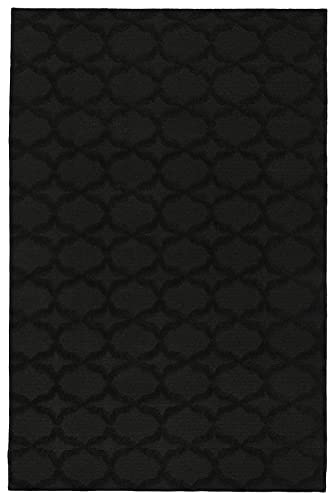
Garland Rug Sparta Non-Slip Rug 4×6 Black — Commercial-Grade Benchmark
Every category needs its honest benchmark, and in high-traffic rugs it is the Garland Sparta: a non-slip polypropylene 4×6 in black, described by its maker for living rooms and hallways and built in the commercial-basic tradition where appearance is a distant second to survival. This is the rug class that serves in rental hallways, mudrooms and shop entrances, and it earns its place in a family guide for exactly that pedigree.
Polypropylene at low pile is the durability argument in its purest form. The fibre does not absorb spills, resists crushing, and vacuums clean without drama; the non-slip backing keeps a 4×6 from becoming a sled on hard floors. In black, it hides the family room’s daily evidence with the subtlety of a tarpaulin, which, on the route between a garden door and a sofa, is a genuine virtue.
Set expectations as its maker does: this is a functional mat-rug, thin and businesslike, not a soft place to sprawl for film night. Use it where traffic is fiercest — the door swing, the corridor pinch point, under the homework table — and let softer picks carry the lounging zones. Judged as armour rather than upholstery, it is close to unbeatable value in effort per year of service.
A placement doctrine for the Sparta: put it where feet change direction. Direction changes — at door swings, corridor junctions, the pivot before a staircase — grind grit into a floor with a twisting motion that straight walking never matches, and they are where finishes die first. A commercial-basic rug stationed at the pivot absorbs that grind for years, asks only to be vacuumed and occasionally hosed, and can be replaced without ceremony when it finally surrenders. Armour is cheapest where the battle is.
In a rental property, the Sparta performs one more service: it is the rug a landlord would choose. Tenants who lay commercial-basic protection at the traffic points signal exactly the care that gets deposits returned and references written warmly, and when the tenancy ends the rug leaves with the tenant, having kept the hallway’s finish out of the checkout report entirely. Few purchases argue for their owner in absentia; this unglamorous rectangle does, in writing, at inspection.
- Footprint: 4 x 6 ft
- Fibre: polypropylene, commercial-basic build
- Colour: black
- Profile: low pile with non-slip backing
- Intended zones: living rooms, hallways, heavy-traffic areas
Strengths
- Commercial-grade durability at the traffic pinch points
- Polypropylene shrugs off spills and crushing alike
- Black hides heavy soil between cleanings
Trade-offs
- Thin, functional feel — not a lounging surface
- Plain appearance contributes nothing decorative
- 4×6 covers a zone, not a whole family room
Best for: door swings, corridor pinch points and homework-table zones.
Not suited for: the centre of a family room meant for sprawling.

3×10 Washable Hallway Runner Vintage Medallion — Best Hallway Runner
Traffic begins in the hallway, and this 3×10 runner is built for the corridor’s specific brutality: every journey in the house, made at walking pace, in a straight line that wears a path down any rug’s centre. The vintage medallion pattern in grey is the camouflage strategy — a busy, faded motif that refuses to show a wear lane — and the runner’s width covers the corridor’s walking line with margin to spare.
It is washable, water resistant, non-slip and described as pet friendly, a specification list that reads like the hallway’s own diary: wet boots, dog shake-offs, dropped drinks carried to the kitchen. Low pile lets doors along the corridor swing and lets a vacuum do the whole run in two passes.
At ten feet it covers most family hallways in one piece, avoiding the seam where two shorter runners meet and inevitably creep apart. Grey medallion styling also bridges rooms gracefully, working between a farmhouse living room and a modern kitchen without arguing with either. If your family room rug is the destination, this runner is the road, and roads wear out first.
Hallway acoustics are this runner’s unlisted talent. A hard corridor is a drum that broadcasts footsteps to every bedroom, and ten feet of low-pile medallion turns the drum into a path — night-time trips to the kitchen stop announcing themselves to the whole house. Families with a light sleeper will feel that benefit more than any stain statistic, and it arrives free with the coverage the hallway needed anyway.
The medallion runner in a house with a staircase deserves its own logistics note: corridors that turn a corner defeat a single straight runner, and the honest solutions are a runner to the turn plus a mat beyond it, or a willingness to let the corner go bare and heavily vacuumed. Forcing one long runner around a bend guarantees a folded, creeping hazard at exactly the point where people pivot — the worst place in the house for a rug to misbehave.
- Footprint: 3 x 10 ft runner
- Design: vintage medallion in grey
- Profile: low pile, washable, water resistant
- Backing: non-slip, pet-friendly positioning
- Zones: hallway, entryway, kitchen, living room routes
Strengths
- One-piece coverage for most family hallways
- Medallion pattern refuses to show a centre wear lane
- Water resistance handles boots and dog shake-offs
Trade-offs
- Runner width may crowd a very narrow corridor
- Grey palette will not warm a cold-toned hall by itself
- Ten feet of rug needs a large wash or a laundromat
Best for: the main hallway route between front door and family room.
Not suited for: short landings where a 3×10 must fold or turn.

5×7 Washable Black Solid Rug Stain-Resistant — Best Solid Black Workhorse
Where the Sparta is armour for a zone, this black 5×7 is armour for a room. The solid black field is a deliberate durability decision: at family-room scale, an unpatterned dark surface swallows the evidence of traffic — crumbs, ash, pet hair of the darker varieties, the grey bloom of a wear path — more completely than any print, and its vintage styling keeps the black from reading as stark or office-like.
The construction brief is endurance. A stain-resistant finish buys time against the juice, coffee and mystery liquids a family room generates, the low pile presents a dense, tightly finished face that chair legs and castors roll across without digging in, and the non-slip backing keeps a hard-worked rug from migrating toward the sofa one millimetre per film night. It is, in the plainest sense, a rug built to be walked on by everyone, constantly.
Machine washing completes the specification: a 5×7 that folds into a domestic drum means the season’s accumulation can be reset in an afternoon rather than negotiated with a cleaning service. Solid black does show pale lint and light pet hair — the one soil it cannot hide — so households with white cats should weigh the medallion instead. For everyone else, this is the family room’s hardest-working rectangle.
Under a dining set, the black 5×7 performs a quieter trick than camouflage: it makes chair legs disappear. Dark chairs on a dark field read as a single composed setting, crumbs vanish from the visual record between vacuums, and the room’s attention rises to the table, the food and the people — which is where a family room wants it. Its vintage softening keeps that darkness warm rather than corporate, a distinction felt most on winter evenings.
A homework station is the black 5×7’s second career: under the table where a family’s school-age shift works every evening, its surface tolerates chair scraping, pencil sharpenings and the glue incidents of primary education while its darkness composes the scene for the morning after. When the station migrates — as homework stations do, room to room, year to year — a washable 5×7 migrates with it, which is more than can be said for the furniture.
- Footprint: 5 x 7 ft
- Colour: solid black, vintage styling
- Surface: stain-resistant finish over low pile
- Backing: non-slip grip backing
- Care: machine washable at full size
Strengths
- Solid black conceals wear paths and dark soil completely
- Stain-resistant finish buys blotting time at family scale
- Folds into a domestic machine despite its room size
Trade-offs
- Pale lint and light pet hair show on black
- Solid field offers no pattern interest to a quiet room
- Black can feel heavy in a small, dim family room
Best for: family rooms with dark pets, stoves and heavy daily traffic.
Not suited for: homes with white cats or rooms starved of light.

Gertmenian Comfy Weave Rug 4×6 — Softest Durable 4×6
The Gertmenian answers the objection that durable means uncomfortable. Its comfy weave construction is described as super soft while remaining non-shedding and stain resistant, and at 4×6 in navy it suits the family room’s secondary zones — before the fireplace, under the reading chair, beside the sofa where feet and dogs actually land — where softness is wanted but traffic is still relentless.
Navy is the diplomat of dark colours: it hides soil nearly as well as black while bringing colour temperature and a friendlier relationship with wood, brass and cream textiles. In a family room whose main rug is patterned, a navy woven 4×6 at the hearth gives the scheme a calm second voice without competing.
The maker’s intended rooms — foyer, living room, kitchen, entryway, bedroom — tell the story of a rug built to be moved where traffic demands. Woven softness plus stain resistance is a rare pairing at this size, and households that have given up on soft rugs surviving family life should test their pessimism against this one.
The Gertmenian’s weave deserves a word about bare feet in winter. Woven constructions hold a little air in their structure, and on a cold floor that translates into a step that feels kinder than a printed flat rug of the same thickness. At a hearthside, where the household gathers in socks, that kindness is the difference between a rug people perch on the edge of and a rug people settle into — and settled people are the family room’s entire purpose.
The navy Gertmenian beside a dog’s bed creates the household’s most honest zone: the place where the animal actually lives, soft enough for old joints, dark enough for the hair, and washable enough for the realities. Owners often discover that specifying one zone properly for the dog ends the dog’s colonization of every other textile in the room — a peace treaty written in navy weave, at 4×6 scale.
- Footprint: 4 x 6 ft
- Colour: navy, Romi design
- Construction: comfy weave, super soft finish
- Behaviour: non-shedding and stain resistant
- Zones: foyer, living room, kitchen, entryway, bedroom
Strengths
- Genuinely soft hand in a durability category
- Navy hides soil while warming a scheme
- Non-shedding keeps busy rooms cleaner
Trade-offs
- 4×6 serves zones rather than whole rooms
- Softness invites sitting — and the crumbs that follow
- Navy shows pale lint more than mid-tones
Best for: hearthsides, reading chairs and secondary family zones.
Not suited for: covering a whole seating arrangement alone.

Uermei 2×8 Washable Runner Rug — Best Kitchen and Laundry Runner
The kitchen run — sink to stove to fridge — is the hardest-worked two feet of flooring in a family house, and the Uermei’s 2×8 runner is shaped exactly for it. Its neutral modern abstract in brown and grey camouflages the flour, crumbs and splashes of a cooking household, while the low pile keeps it under doors and out of the way of rolling bins and stools.
Washable and non-slip, it is positioned by its maker for entryways, laundry rooms and kid-and-pet households — the wet, gritty, high-turnover zones. A laundry runner earns special mention: it catches the drips between washer and sink, softens the standing spot at the folding counter, and washes alongside the loads it serves.
Abstract patterning is the quiet advantage here. Unlike a medallion, an abstract field has no centre to wear visibly and no orientation to argue about, so the runner can be flipped end for end to distribute wear — a small, real longevity trick that patterned runners forbid. For the working corridors of a family home, this is the most practical eight feet in the guide.
Laundry rooms deserve the Uermei’s specific virtues stated plainly: it is the room where water escapes, detergent drips and socks fall, and a washable runner that can join the very loads it serves closes the loop elegantly. Its abstract neutrality also suits a room nobody decorates on purpose, giving the hardest-working corridor in the house a finished look for the price of remembering to shake it on Saturdays.
A galley kitchen too narrow for the Uermei’s full width can still borrow its logic by running the runner along the work side only, where the cook stands and the spills land, leaving the passing lane bare for trolleys and bins. Partial coverage honestly placed beats full coverage awkwardly folded, in kitchens as in hallways, and the runner’s low pile forgives the improvisation by lying flat wherever it is asked to.
- Footprint: 2 x 8 ft runner
- Design: neutral modern abstract, brown grey
- Profile: low pile, washable, non-slip
- Positioning: kid and pet friendly, high-traffic areas
- Zones: hallway, kitchen, entryway, laundry
Strengths
- Abstract field allows end-for-end flipping to spread wear
- Kitchen-run dimensions fit sink-to-stove routes
- Neutral brown-grey hides cooking debris gracefully
Trade-offs
- Narrow width will not serve a wide hallway alone
- Abstract design contributes calm, not character
- Kitchen duty means frequent washing in busy homes
Best for: kitchen runs, laundry rooms and back-door entries.
Not suited for: wide hallways needing full-width coverage.

Lofus 8×10 Boho Floral Rug — Best Large Family Centrepiece
Not every high-traffic rug has to look like equipment. The Lofus scales the family brief to 8×10 in a boho floral brown, carrying a whole seating arrangement while its listing promises the working virtues: non-slip placement, low pile, stain and water repellency, a soft skin-friendly surface, and tolerance for high-power vacuuming. It is the pick for families who refuse to choose between a room that looks loved and a rug that survives being loved on.
Brown floral is camouflage with charm. The warm ground and busy botanical pattern dissolve crumbs, pet hair and the grey of a wear path into the design, and the 8×10 scale means the pattern’s busiest, most forgiving zones can be positioned where traffic concentrates. Repellency handles the drinks trolley and the toddler’s cup with equal calm.
At this size, washing is a large-drum or laundromat occasion, and the rug’s softness will invite the whole family onto the floor — which is rather the point of a family room. Households wanting one large, warm, hard-working centrepiece rather than a patchwork of zones will find the Lofus the most complete answer in this guide.
The Lofus at full size changes how a family room sounds during a gathering. Eight by ten feet of soft, low field under a crowd absorbs the clatter that hard floors amplify, so conversation stays conversation instead of becoming a contest. Hosts notice it first at the moment a dropped glass lands quietly instead of ringing — a small mercy that repeats at every party the rug serves, for years.
For a family room that hosts a weekly film club, a scout troop or a gaming circle, the Lofus’s scale is social infrastructure: everyone fits on the rug, the rug forgives everyone, and the host’s only job is the wash that follows the season rather than the anxiety that accompanies the evening. Durability, at that point, is indistinguishable from generosity — the rug lets its owners say yes to the house being used, which is the family room’s founding purpose.
- Footprint: 8 x 10 ft
- Design: boho floral in brown
- Surface: stain and water repellent, low pile
- Cleaning note: tolerates high-power vacuuming
- Backing: non-slip for living rooms and offices
Strengths
- Full seating scale with genuine traffic credentials
- Busy brown floral dissolves daily evidence
- Repellent surface suits drinks, toddlers and dogs
Trade-offs
- Large size needs laundromat washing capacity
- Floral pattern is a strong decorative commitment
- Soft invitation means more floor picnics — and crumbs
Best for: family rooms wanting one warm, large, hard-working centrepiece.
Not suited for: minimalist rooms or homes with only a small washer.
Comparison Table
| Pick | Footprint | Construction route | Traffic role |
|---|---|---|---|
| Garland Rug Sparta Non-Slip Rug 4×6 Black | 4 x 6 ft | Polypropylene commercial basic | Pinch-point armour |
| 3×10 Washable Hallway Runner Vintage Medallion | 3 x 10 ft | Washable medallion runner | Hallway route |
| 5×7 Washable Black Solid Rug Stain-Resistant | 5 x 7 ft | Stain-resistant solid | Room-scale workhorse |
| Gertmenian Comfy Weave Rug 4×6 | 4 x 6 ft | Soft woven, stain resistant | Comfort zone durability |
| Uermei 2×8 Washable Runner Rug | 2 x 8 ft | Washable abstract runner | Kitchen and laundry run |
| Lofus 8×10 Boho Floral Rug | 8 x 10 ft | Repellent boho floral | Family centrepiece |
Why Do Family Room Rugs Fail, and What Prevents Each Failure?
Crushed pile is the first failure: tall fibres bend under repeated footsteps and eventually stay bent, engraving grey lanes along the room’s routes. Prevention is specification, not care — low, dense pile has almost nothing to crush, which is why every pick here keeps its profile close to the floor. Once lanes appear in a tall rug, no cleaning reverses them; the fibre has fatigued, not merely soiled.
Stain layering is the second. Individual spills, each half-treated, oxidise into a general dinginess that owners perceive as the rug ‘just being old’. Washable construction is the true prevention, because it resets the whole field rather than negotiating with each mark; stain-resistant finishes are the supporting act, buying the minutes between spill and blot that decide whether a mark sets.
Edge failure is the third and least discussed. Corners curl from heat, humidity and being kicked by passing feet, then catch toes and vacuum heads until they tear. Rugs that lie flat, with weight or grip in the backing and no thick border to lever against, resist the cycle; rotating the rug twice a year distributes the abuse that starts it.
If the budget allows only one purchase this season, protect the route before the room: a runner at the entry and the hall will extend the life of whatever already lies in the family room, including a rug you currently believe is failing. Many a condemned centrepiece has been reprieved by two humble runners upstream, quietly intercepting the grit that was killing it. The same logic scales downward as well as up: a single washable mat inside the garden door, shaken daily and washed weekly, can add a visible year to a hallway runner, which in turn adds its own year to the centrepiece — protection, like traffic, travels in a chain, and the cheapest link defends all the others.
Pattern, Solid Dark or Plain Weave: Which Camouflage Strategy Suits Your Traffic?
Busy patterns — the medallion runner, the boho floral — hide variety: crumbs of every colour, mixed pet hair, the odd crayon incident. They suit households whose soil is diverse and whose cleaning is weekly. Their weakness is the wear lane, which a pattern can mask but not erase, and a strongly centred motif can make a lane more visible by contrast at its edges.
Solid dark surfaces — the Sparta, the black 5×7 — hide uniformity: ash, dark hair, tracked grit, the grey bloom of wear. They suit stove-owning, dark-pet households and rooms with strong light, where black reads as depth rather than gloom. Their confession is pale lint, which they display proudly; a lint roller by the sofa is the honest accessory.
Textured plains like the navy weave split the difference, using surface variation instead of print to break up the eye’s evidence. They are the choice when a room already has pattern elsewhere and the rug’s job is to be quietly competent — the family equivalent of a good referee, noticed only when absent.
How Should You Protect the Whole Route, Not Just the Family Room?
Walk your house as traffic does: front door, hallway, kitchen edge, family room, garden door. Every metre of that route wears, and protecting only the destination leaves the corridor floors — often the home’s best timber — taking the full abrasion of grit carried indoors. Runners exist for the corridor’s shape: the 3×10 medallion for the hall, the 2×8 abstract for the kitchen run, each washable because corridors collect what shoes bring in.
Sequence the protection by grit. The entry runner should be the most sacrificial surface in the house, shaken often and washed without sentiment; the family room rug, furthest from the door, can afford to be the prettiest, because the runners upstream have already taken the worst of the load. Households that grade their rugs this way find every layer lasts longer.
Keep the style loosely related along the route — shared tones or a common vintage note — so the protection reads as a scheme rather than a series of accidents. Function laid end to end can still look like design, and in a family house that is the only kind of design that survives.
How Do You Clean a High-Traffic Rug on a Family Schedule?
Little and often beats heroic and rare. A two-minute vacuum of the traffic lanes every couple of days removes grit before feet grind it into the pile’s base, which is where permanent dulling begins. Full vacuuming weekly, with the rug lifted monthly to clear beneath it, keeps the whole system honest; grit under a rug abrades the floor and the backing simultaneously.
Washable picks should actually be washed — seasonally at minimum, and after any major incident while it is fresh. Shake outdoors first, wash cold and gentle, dry fully before relaying, and use the occasion to rotate the rug half a turn so the next season’s traffic falls on fresh territory. Rotation is the cheapest longevity treatment any rug can receive.
For the non-machine-washable commercial pick, the routine is vacuum, spot-clean, and an outdoor shake or hose in summer. Polypropylene tolerates this simplicity indefinitely, which is why it equips so many working floors; the Sparta asks for the least ceremony of any pick in the guide.
What About Pets, Toddlers and Wheels in the Family Room?
Pets add claws, hair and accidents to the traffic equation. Low pile denies claws a purchase and hair a hiding place, so a vacuum actually retrieves the hair instead of combing it deeper; repellent and stain-resistant surfaces convert accidents from emergencies into laundry. Dark and patterned picks forgive the interval between incident and discovery, which in a real household can be a full school day.
Toddlers contribute spills and a low eye level. A rug for a crawling child should be soft enough at the surface — the Gertmenian weave or the Lofus floral — and washed often enough that the floor-level world stays fresh. Low pile also keeps dropped snacks visible rather than archived, a hygiene point parents appreciate at weaning scale.
Wheels are the overlooked traffic: castors, scooters, toy trucks, robot vacuums. Low, dense surfaces roll kindly and do not ruck under a turning castor, while thick pile stops small wheels dead and twists under office chairs. A family room that doubles as a home office should treat castor behaviour as a specification, and every pick here passes it.
How Many Crossings Does a Family Room Rug Actually Endure?
Count honestly for a day and the number startles: a household of four, moving between door, kitchen, sofa and garden, crosses its family room rug several hundred times, and a dog multiplies the figure beyond arithmetic. Across a year the rug under a family absorbs footfall comparable to a small shop’s entrance, which is why this guide borrows commercial thinking — fibre, density, camouflage — rather than showroom thinking.
Crossings are not equal. The route to the kitchen carries grit from the door; the route to the garden door carries it back wet; the semicircle before the sofa carries bare feet and spilt drinks. A rug specified for the worst route and rotated so routes move will outlast a rug specified for the average, because fibres fail at their maximum load, not their mean.
This is also why runners matter statistically. Every crossing intercepted upstream by a hallway or entry runner arrives at the family rug cleaner, and grit removed early cannot abrade later. The system of rugs in a busy house behaves like a series of filters, and the centrepiece’s lifespan is decided largely by the cheap runners nobody admires.
What Does Non-Shedding Really Mean for a Busy Household?
A shedding rug is a debris source disguised as a floor covering. New rugs shed loose fibre for their first weeks — normal and temporary — but a rug that sheds indefinitely adds its own material to every vacuum load, dulls its own pattern, and deposits fibre on socks, clothes and the dog. In a high-traffic room, where the vacuum already has honest work, a non-shedding construction is a measurable saving of effort.
Low-pile synthetic rugs shed least because their fibres are continuous and anchored rather than cut and loose. Several picks here state non-shedding behaviour in their listings, and it is a claim worth weighting in a family room precisely because the room’s other debris — crumbs, hair, craft glitter — is already a full-time adversary.
Judge shedding after the honeymoon. Any rug can behave for a fortnight; the question is the third month, when traffic has worked the surface hard. Owners who report a rug still shedding at that age are describing a construction that will thin visibly within a few years, and in a family room that thinning will map the traffic routes like a contour diagram.
How Should Edges and Corners Be Managed in a Busy Room?
Corners fail first because they are kicked, caught by vacuum heads, and lifted by curious toddlers and dogs. A rug that arrives with flat, well-finished edges and a grippy backing resists the first curl; once a corner lifts, every passing foot folds it further, and the crease becomes permanent. Catch a lifting corner early — a night under a heavy book after a wash often resets it — because a trained-flat corner stays flat and a trained-up one never recovers.
Edge binding quality is the quiet specification to inspect on arrival. Stitched or well-sealed edges survive the vacuum’s edge tool and the scooter’s wheel; raw or glued edges fray into whiskers that traffic then pulls. In a family room, five minutes of inspection on day one predicts the rug’s appearance in year three more reliably than any pattern choice.
Furniture can be conscripted as edge defence. A rug whose vulnerable corners sit under a bookcase leg or a sofa foot is a rug whose corners will behave, and arranging that overlap when the room is first laid out costs nothing. Traffic engineers its solutions; households can too.
How Do You Keep a Busy Room’s Rug Smelling Fresh?
Odour in a family rug is rarely the rug’s fault; it is the biography of everything the rug absorbed and kept — damp paws, milk, the dog’s opinion of the garden. Prevention is ventilation and rhythm: a rug vacuumed often holds less organic material, and a washable rug washed seasonally never accumulates a biography long enough to read aloud.
Sunlight is the old, free treatment. A washable rug draped outdoors on a dry, bright morning airs through in hours, and the ultraviolet does quiet work that no scented product matches. Households without outdoor space can borrow the effect with an open window and a fan, though nothing fully substitutes for a garden rail in June.
Resist masking sprays as a strategy. They layer scent over source, and the combination announces itself to guests more loudly than either would alone. If a washed, aired rug still smells, the source is usually beneath it — mop the floor at the next wash — or the rug has reached the honest end of its service and is asking, politely, to retire.
When Is a Commercial Rug the Right Choice at Home?
When the location is a thoroughfare first and a room second. Entries inside the door swing, the corridor pinch, the patch before a washing machine, the floor under a homework table where chairs scrape hourly — these are commercial locations wearing domestic clothes, and a commercial-basic rug like the Sparta serves them without pretension or disappointment.
The mistake is expecting upholstery from armour, or armour from upholstery. A Sparta in the lounging centre will feel mean; a soft floral at the garden door will die young. Households that assign each rug its correct military rank — armour at the gates, comfort at the hearth — stop replacing rugs prematurely, which is the entire economics of this category.
There is also a staging argument: when a house is being sold or let, a fresh commercial-basic rug in the traffic zones signals maintenance to a viewer’s subconscious more cheaply than any other single purchase. It will not be admired. It will be believed, which in a hallway is worth more.
How Should a Family Rug Be Replaced Without Waste?
Retire in stages. A family room rug demoted to the garage, the workshop or the dog’s corner of the utility room can serve years more where appearance matters less, and its replacement arrives with the household’s goodwill rather than its guilt. Rugs that are merely tired, not torn, also serve community halls, kennels and moving days as padding — ask before binning.
When a rug truly ends — backing cracked, edges gone, odour beyond washing — dispose of it as the bulky textile it is, through the channels your area provides for mattresses and carpets rather than the household bin where rules forbid. Synthetic rugs are not yet widely recyclable, which is one more argument for buying the durable specification first and replacing rarely.
Keep the paperwork of the replacement: size, fibre, the date it went down. Households that record these things discover their own traffic’s true cost per year, and the next purchase becomes an informed specification instead of a hopeful guess. The family room keeps its records in the rug itself; a notebook merely translates.
How Should You Budget for Durability Across a Whole House?
Allocate by crossings, not by room prestige. The hallway runner and the entry rug will die youngest and should be bought as honest consumables — good enough to work, cheap enough in effort to replace — while the family room centrepiece, protected upstream, justifies the largest share of the budget because its protected life will be longest. Households that invert this, splurging at the door and economising at the centre, replace both too often.
Cost per year is the only honest metric in this category. A rug that serves six years at a family room’s centre costs less annually than a bargain replaced twice, and it spares the household two cycles of choosing, carrying and disposing. Durability is therefore not the expensive option; it is the option whose expense is visible once instead of repeatedly.
Keep the receipts and the dates. A household that knows its hallway runner lasted thirty months under its actual traffic can specify the next one precisely, and that small archive turns rug buying from folklore into facilities management — which, in a busy family house, is exactly what it is.
What Does a Rug Need to Survive a House Renovation?
Renovation dust is the finest, most abrasive material a rug will ever meet, and the correct specification for a renovation is removal: roll the good rugs, store them sealed, and lay a commercial-basic sacrifice in any room that must stay in use. The Sparta class of rug exists for this season of a house’s life, and it has saved more centrepiece rugs than any cleaning product ever bottled.
If a family rug must stay down through works, vacuum it daily with the machine emptied often, because plaster dust loads a filter and a pile with equal speed. Wash it the week the builders leave, before the household’s ordinary traffic grinds the residue into the pile’s base, and inspect its backing for the grit that collects beneath a rug in a dusty house.
And when the renovation reveals new floors, re-specify the rugs to the new surface rather than returning the old arrangement from habit. A house that has changed its floors has changed its traffic’s terms, and the rug system — runners, armour, centrepiece — should be re-planned on the fresh map, not restored from memory.
How Do You Teach Children and Guests to Live With a Hard-Working Rug?
Mostly, you do not have to. A rug specified for real traffic asks nothing of the people crossing it — no shoe rules at the sofa, no coaster anxiety, no flinch when a tower of blocks falls — and that absence of rules is precisely what a family room is for. The household’s energy goes into the wash rhythm, which adults control, rather than into policing children, which nobody controls for long.
Where a habit genuinely helps, make it geographical rather than moral: shoes off at the runner, because the runner is there; drinks on the table, because the table is there. Children absorb arrangements of furniture far more reliably than lectures about flooring, and a route of rugs laid with intent teaches its own etiquette silently, hundreds of crossings a week.
Guests read the room the same way. A house whose centrepiece plainly forgives — patterned, dark, washable, already bearing its life with grace — gives visitors permission to relax, and relaxed guests are the entire point of inviting them. The most durable rug in this guide is, in that sense, also the most hospitable object in the house.
What Mistakes Do Families Make Buying a Busy-Room Rug?
Family rooms expose rug-buying errors faster than any other space. These are the mistakes that return, flattened and stained, to be replaced within a year.
- Buying tall plush pile for a thoroughfare room. The pile crushes into grey lanes within a season, and no cleaning product reverses fatigued fibre.
- Choosing a pale rug and a dark dog. Camouflage is a specification; ignoring your household’s actual soil colours guarantees visible evidence daily.
- Protecting the family room but not the hallway. Corridor floors take the grit first and wear fastest, and they are usually the floors worth most.
- Skipping rotation. The same traffic on the same fibres every month halves a rug’s useful life; a half-turn twice a year doubles the territory.
- Treating stain resistance as stain immunity. Finishes buy blotting time, nothing more; a spill left until morning has used the gift and set anyway.
- Buying a rug too small for the seating group. Front legs off the rug create a rocking, creeping arrangement that drags the rug out of square weekly.
Final Recommendation
Build from the traffic outward. Put the Sparta’s commercial toughness where the wear is fiercest, run the medallion or the Uermei abstract along the routes that feed the room, and then choose the room rug itself by camouflage strategy: solid black for dark soil and stove ash, navy weave for a soft secondary zone, the Lofus floral at 8×10 when one warm centrepiece must do everything. Every layer washable or hose-simple, every pile low, every pattern employed in the honourable work of hiding real life between cleans.
A family room rug is not failing when it looks used; it is failing when it looks used up, and the distance between those two states is exactly what fibre, pile and pattern decide. Choose the specification that matches your household’s honest traffic, rotate it with the seasons, and the rug at the centre of your family’s life will still be serving — unglamorous, unbowed — when the children who tested it have grown tall enough to help you carry it to the wash.
Measure your own traffic for one ordinary day before you order — count the crossings, note the wet route and the grit route, and let that census choose the fibre and the camouflage. A rug bought for the household you actually are will still be serving the household you become.
Frequently Asked Questions
Is polypropylene a good fibre for a family room rug?
Yes — it is the workhorse of this category. Polypropylene resists stains and moisture inherently, tolerates crushing better than most fibres at this level, and vacuums clean easily. The Sparta shows the fibre in its commercial form; several other picks use similarly hard-wearing synthetics.
How low should the pile be in a high-traffic room?
Low enough that a vacuum’s suction meets the pile’s base and chair castors roll without twisting the rug. All the picks here are low pile; if a listing boasts plush depth, it belongs in a bedroom, not on a family thoroughfare.
Can a solid black rug really hide family wear?
It hides dark soil, ash and wear bloom exceptionally well, and displays pale lint just as honestly. Households with light-coloured pets should choose a busy pattern instead; households with dark pets and a stove will find black close to magic.
How often should a family room rug be washed or cleaned?
Vacuum lanes every few days, the whole rug weekly, and wash washable rugs seasonally or after major spills. Rotate the rug half a turn at each wash so traffic distributes across the whole surface over the year.
Do I need runners if I already have a big family room rug?
Usually, yes. The hallway and kitchen routes carry grit to the big rug and wear their own floors meanwhile. A washable runner at the entry and along the kitchen run protects both the floors and the centrepiece, and each layer lasts longer for it.
Related Guides
Durability thinking extends across the house, and readers speccing a hard-working home often continue with Best Area Rugs for Allergies for the low-pile, wash-often approach to cleaner floors, and Best Area Rugs for Dark Hardwood Floors when the traffic runs over timber worth protecting; the mud-season companion guide is Best Area Rugs for a Simplistic Room, and the small-space version of the same durability brief lives in Best 3×5 Rugs for Mudrooms.


