What's inside
- Key Takeaways
- Quick Picks
- How Did We Choose These Farmhouse Rugs?
- Comparison Table
- What Makes a Rug Read as Farmhouse Rather Than Merely Vintage?
- Dark Brown or Cream: How Does Dominant Tone Change a Farmhouse Room?
- How Should a Farmhouse Rug Be Sized for a Dining Table?
- How Do You Wash and Care for a Large Vintage-Style Rug?
- How Can Farmhouse Rugs Warm Up Rooms That Are Not Farmhouses?
- How Does Distressing Actually Work as a Design?
- What Should a Farmhouse Rug Do in the Kitchen Itself?
- How Do Farmhouse Rugs Pair With Real Timber and Stone Floors?
- Can Farmhouse Style Survive a Household With Teenagers and Dogs?
- How Should You Mix Farmhouse Rugs Across Adjoining Rooms?
- What Is a Sensible Budget Order for a Farmhouse Room?
- How Should a Farmhouse Rug Behave at the Threshold of the Garden?
- What Farmhouse Rug Mistakes Appear in Photographs but Not in Life?
- How Does a Farmhouse Rug Age Across a Decade of Washes?
- What Mistakes Do Farmhouse Rug Buyers Keep Making?
- Final Recommendation
- Frequently Asked Questions
- Related Guides
As an Amazon Associate I earn from qualifying purchases. This post may contain affiliate links at no extra cost to you.
cottageverdict.com is reader-supported. When you buy through links on our site, we may earn an affiliate commission.
Where to buy: each linked name in this guide opens its Amazon listing, where you can check price on Amazon and confirm the colourway, wash instructions and backing before ordering. The best farmhouse area rugs share a recognisable recipe: a vintage pattern — usually a medallion or a faded traditional motif — deliberately distressed, printed or woven in earthy, sun-worn tones, and built thin and washable enough for a house that actually works for a living.
Farmhouse style is not a museum aesthetic. It comes from farm kitchens and mudrooms, places where floors took boots, dogs, dropped pans and harvest dirt, and where a rug earned its place by surviving all of it while softening a hard room. That is why the modern farmhouse rug is almost always low pile and machine washable: the look is inherited, but the maintenance is contemporary, and nobody’s grandmother scrubbed a 9×12 on a washboard.
Distressing is the style’s signature and its most practical feature. A medallion that arrives pre-faded, its pattern worn at the centre and edges as if decades of feet had passed, forgives the real wear your household adds. New marks join the pattern’s story instead of vandalising it, which is why these rugs dominate busy family rooms where a pristine rug would look anxious within a month.
The six picks divide mainly by dominant tone and scale. Dark brown grounds from Lotus Karen and JOOJA bring the moody, grounded end of farmhouse; cream and beige grounds from AMOAMI, Sasttie and HUGEAR keep rooms bright and airy; and a green-brown medallion at 9×12 offers the largest, most colourful statement. Sizes run 5×7 to 9×12, so both a reading corner and a full farmhouse dining table are covered.
All six are washable, low pile and non-slip per their listings. What differs is mood, and mood is a real specification in a style built on atmosphere: choose the tone first, the size second, and the exact medallion last, because the tone is what you will feel every time you enter the room.
Key Takeaways
- Farmhouse rugs pair vintage medallion patterns with deliberate distressing and earthy tones.
- Distressed patterns forgive real wear — new marks blend into the design’s own fading.
- Dark brown grounds feel moody and grounded; cream and beige grounds keep rooms bright.
- Every pick here is washable, low pile and non-slip, true to the style’s working roots.
- Sizes run from a 5×7 reading corner to a 9×12 that seats a full farmhouse table.
- Choose dominant tone first, then size, then the exact medallion variation.
Quick Picks
| Pick | Badge | Why it stands out |
|---|---|---|
| Lotus Karen 5×7 Vintage Washable Rug | Best Dark Brown Accent | A dark brown 5×7 vintage rug that grounds small farmhouse corners with moody warmth. |
| JOOJA 9×12 Dark Brown Vintage Rug | Best Moody 9×12 | A dark brown 9×12 vintage rug with soft low pile for large, grounded farmhouse rooms. |
| AMOAMI 5×7 Boho Farmhouse Vintage Rug | Best Cream and Beige Brightener | A cream-beige 5×7 farmhouse vintage rug, ultra soft and rubber backed, for bright rooms. |
| Sasttie 8×10 Washable Vintage Rug Beige | Best Beige 8×10, Faux Cashmere Feel | An 8×10 beige vintage rug in low-pile faux cashmere, thin and skin-friendly. |
| HUGEAR Beige Washable 8×10 Rug Vintage | Best Durable Beige for Dining | A beige 8×10 vintage farmhouse rug emphasising durability, softness and non-shedding. |
| Vintage Distressed Medallion Rug 9×12 Green Brown | Best Green-Brown Medallion | A 9×12 green and brown medallion, ultra-thin and lightweight, for colourful farmhouse rooms. |
How Did We Choose These Farmhouse Rugs?
Tone coverage came first, because farmhouse is a palette before it is a pattern. We made sure the final six span the style’s real range — dark browns, warm creams, soft beiges and a green-brown — so a reader furnishing a white-walled bright farmhouse and a reader furnishing a timber-heavy moody one both find their ground. Any guide whose six rugs are six shades of beige has not understood the assignment.
Construction honesty came second. These are modern washable rugs wearing vintage designs, mostly printed or flat-woven at low pile, and we favoured listings that state their washability, non-slip backing and stain behaviour plainly. A farmhouse rug that cannot go in a machine betrays the working-house logic the style celebrates.
Third, we weighed how each pattern wears its distressing. Convincing distress fades a motif unevenly — stronger at the centre, softer at the borders — while lazy distressing looks like a photocopy error. The picks below carry the more convincing kind, at scales from a 5×7 accent to two full 9×12 room rugs.
We also considered how each rug would look after its twentieth wash, because farmhouse is a long-tenancy style. Patterns whose distressing would absorb gradual fading scored over crisp designs whose every wash would register as loss; in this category, ageing gracefully is a specification, not a hope.
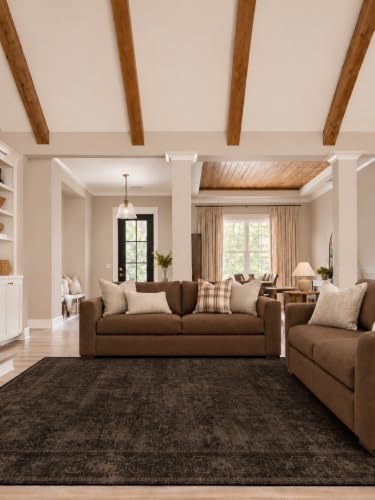
Lotus Karen 5×7 Vintage Washable Rug — Best Dark Brown Accent
The Lotus Karen is farmhouse after sunset: a dark brown vintage design, distressed and boho-touched, that gives a small room the grounded feeling of old timber and lamplight. At 5×7 it suits the places where that mood concentrates — a reading corner with a leather chair, the space before a fireplace, a bedroom that wants weight rather than airiness.
Dark grounds are the forgiving end of the palette. Mud season, dog traffic and the ash that escapes a stove all disappear into a brown vintage pattern, and the rug’s stain-resistant, easy-clean build backs the colour’s promise. It is the pick for households whose farmhouse is a working one, with boots at the door and no interest in tiptoeing.
Non-slip backing and low pile keep the small footprint well behaved under a chair that gets dragged daily. Brown this deep will darken a small, dim room, so give it a pale wall or a light sofa to push against; balanced that way, it delivers more atmosphere per square foot than anything else in this guide.
A hearthside note for the Lotus Karen: brown vintage patterning is the natural companion of woodsmoke and leather, and its distressed centre gives a fireside chair a sense of having been sat in for decades — in the flattering sense. If your room has a stove, position the rug so its most faded passage sits where feet rest before the fire; the wear you add will continue the pattern’s own story so seamlessly that guests will assume the rug came with the house.
One more household will claim the Lotus Karen: the home office in a spare room that doubles as a guest space. Dark vintage patterning under a desk reads as a study’s gravity during the week and as a guest room’s warmth at the weekend, and its forgiving ground hides the evidence of both employments — chair castor dust in one shift, suitcase scuffs in the other. Small rugs that can hold two jobs are the farmhouse economy in miniature.
- Footprint: 5 x 7 ft
- Dominant tone: dark brown
- Design: vintage distressed, boho influence
- Profile: low pile, washable, stain resistant
- Backing: non-slip for living and dining spaces
Strengths
- Dark ground hides mud, ash and dog traffic superbly
- Concentrated farmhouse mood for corners and hearths
- Stain resistance matches the colour’s forgiving nature
Trade-offs
- Deep brown darkens small or north-facing rooms
- 5×7 limits it to accent duty in larger spaces
- Boho touches may not suit a strict traditional scheme
Best for: reading corners, hearthsides and working farm entrances.
Not suited for: small dim rooms that need every source of brightness.

JOOJA 9×12 Dark Brown Vintage Rug — Best Moody 9×12
Scale the Lotus Karen’s mood up to a whole room and you get the JOOJA: 9×12 of dark brown vintage patterning, distressed in the moody farmhouse manner, soft underfoot despite its low pile. It is built for the big room at the heart of a farmhouse — the one with the long table, the wood stove, the sofa everyone ends up on — where a pale rug would look lost and a dark one looks inevitable.
At 9×12 the practicalities change. The rug carries a full dining set with chairs pulled out, or a complete living arrangement with walking space around it, and its stain-resistant surface handles the traffic those gatherings generate. Washing a rug this size is a laundromat or large-drum event, and buyers should plan for that honestly rather than discovering it in a muddy February.
The dark vintage ground performs its camouflage at scale, which is precisely what a hard-working big room needs. Pair it with pale walls, linen and light wood to keep the mood grounded rather than gloomy, and it becomes the most atmospheric large rug in this guide — farmhouse as a feeling, not a theme.
The JOOJA’s size changes its cleaning contract, and buyers should sign it knowingly: plan the laundromat trip as a seasonal ritual, perhaps with the autumn deep clean, and rely on vacuuming and spot care between those occasions. Dark brown is the ideal colour for that contract, because the interval between washes is exactly where pale rugs confess and this one does not. Its softness under a long dining table, meanwhile, silences chair scrape in a way guests feel without noticing.
The JOOJA under a pool table, a games table or a teenager’s sprawling homework empire deserves mention, because big rooms in farmhouses collect big uses. Its dark field tolerates the chalk dust, the dropped snacks and the chair migrations of a games room while still looking like a deliberate, moody choice rather than a sacrificial surface. When the room returns to adult service for a dinner, the same rug composes itself instantly — range is a form of durability too.
- Footprint: 9 x 12 ft
- Dominant tone: dark brown
- Design: vintage distressed, moody farmhouse style
- Profile: soft low pile, washable, stain resistant
- Rooms: living room, bedroom, dining room, office, dorm
Strengths
- Room-scale dark ground for big farmhouse living spaces
- Camouflages the traffic of gatherings and daily work
- Soft feel despite a practical low pile
Trade-offs
- Needs laundromat capacity to wash
- Dark palette demands pale walls or furniture for balance
- A 9×12 dominates — little else in the room can compete
Best for: large farmhouse living and dining rooms with light walls.
Not suited for: small rooms or homes with only a compact washer.

AMOAMI 5×7 Boho Farmhouse Vintage Rug — Best Cream and Beige Brightener
AMOAMI represents the bright wing of farmhouse: a cream and beige vintage design, distressed to a faded softness, that keeps a room’s light bouncing while still delivering the medallion character the style requires. It is the rug for white shiplap walls and pale sofas — the farmhouse of magazine mornings rather than lamplit evenings.
The listing emphasises an ultra-soft, low-pile surface on a rubber backing, a combination that suits bedrooms particularly well: soft for bare feet at dawn, grippy enough to stay put when the bed is made with enthusiasm. Machine washable, it can live in a working room without the anxiety a pale rug usually brings — the washability is what makes the cream defensible.
Honesty about pale grounds applies: cream shows what brown hides, and this rug will ask for its washes. But the distressed pattern breaks up the field so everyday dust does not announce itself, and for rooms whose whole scheme is light and air, no darker pick can substitute. Bright farmhouse is a legitimate farmhouse; this is its best 5×7 expression here.
Cream rugs live or die by their first spill, so rehearse the response: blot, never rub, cold water first, and let the machine do the rest on wash day. The AMOAMI’s distressed pattern is an ally in that rehearsal, because its faded field refuses to show the faint shadow a treated spill sometimes leaves. Bedroom placement, away from the kitchen’s flight path, stacks the odds further — this is a rug that rewards being given the gentle room.
For a nursery in the farmhouse manner, the AMOAMI’s cream softness has an argument beyond brightness: a pale rug shows a crawling baby’s world honestly, every crumb and fluff visible for removal, which many parents prefer to camouflage at floor level. Its washability carries the room through the weaning months, and its rubber grip keeps the surface steady under a learning-to-stand grip on the furniture. Gentle room, gentle rug, strict laundry — a workable triad.
- Footprint: 5 x 7 ft
- Dominant tone: cream and beige
- Design: boho farmhouse vintage distressed
- Profile: ultra-soft low pile, machine washable
- Backing: rubber non-slip backing
Strengths
- Brightens pale farmhouse schemes without losing character
- Ultra-soft surface suits bedrooms and bare feet
- Rubber backing keeps a light rug firmly placed
Trade-offs
- Cream ground shows spills sooner than brown rivals
- Rubber backing wants a check under it on delicate floors
- Pale palette can feel cool in a room lacking warm wood
Best for: bright bedrooms and white-walled farmhouse living rooms.
Not suited for: mud-season entryways or homes with dark-haired pets.

Sasttie 8×10 Washable Vintage Rug Beige — Best Beige 8×10, Faux Cashmere Feel
The Sasttie scales the bright farmhouse idea to 8×10 and adds a tactile twist: a low-pile faux cashmere surface, thin and soft against skin, in a beige vintage distressed pattern. Large pale rugs live or die by their texture, because a flat beige expanse can read as emptiness; the soft, cashmere-like hand of this one gives the expanse a quiet luxury that suits a calm living room or a serene main bedroom.
Thin is a feature here, not a compromise. The rug slides under doors, lies flat quickly, folds for a large wash, and its non-slip backing keeps the big field planted. Stain resistance is claimed and welcome, because an 8×10 in beige will meet coffee, wine and dog eventually, and the household that chooses it should choose its washability with equal deliberation.
Beige vintage at this scale is the decorator’s neutral: it warms grey sofas, cools busy rooms, and lets timber and black accents do the talking. If your farmhouse scheme is built from natural materials and needs a floor that supports rather than performs, the Sasttie is the supporting actor of the year.
The Sasttie’s faux cashmere surface has a social consequence worth planning for: people sit on it. A large, soft, pale rug in a calm room becomes the children’s headquarters, the dog’s chosen nap field and the floor seat of every conversation, which is lovely and also a traffic pattern. Its stain resistance and washability are therefore not fine print but the main text, and households should schedule its washes the way they schedule the dog’s bath — regularly, and before visitors.
The Sasttie’s thinness suits one more modern farmhouse reality: underfloor heating. Thick rugs insulate against a heated floor’s warmth, while a thin, low-pile field lets the heat through and still softens the step, so rooms designed around radiant floors lose none of their engineering to their decorating. Check any rug’s suitability for your system, but know that the thin builds in this guide start with the advantage.
- Footprint: 8 x 10 ft
- Dominant tone: beige
- Design: vintage distressed, thin profile
- Surface: low-pile faux cashmere, skin-friendly
- Profile: washable, non-slip, stain resistant
Strengths
- Faux cashmere hand gives a large pale rug quiet luxury
- Thin body folds and washes more easily than padded rivals
- Beige neutrality supports timber and black accents
Trade-offs
- Beige field shows dark spills across a large area
- Thin profile offers little cushioning on hard floors
- Subtle pattern may read plain in a room wanting drama
Best for: calm, material-led living rooms and main bedrooms.
Not suited for: households wanting a bold patterned centrepiece.

HUGEAR Beige Washable 8×10 Rug Vintage — Best Durable Beige for Dining
HUGEAR’s beige 8×10 is the workhorse specification of the bright farmhouse idea: vintage distressed patterning, a durable and soft build, non-slip and non-shedding, sized for the living room or the dining room and clearly content to serve either. Its listing reads like a checklist written by someone who has cleaned up after a farmhouse dinner, and that is a compliment.
Dining is where this rug’s virtues compound. Chairs slide on low pile, the distressed beige pattern forgives the evidence of meals, the non-shedding surface keeps fibres out of the food zone, and when the season’s accumulation demands it, the whole rug goes through a wash. Under a table for eight, it supplies the farmhouse atmosphere while behaving like equipment.
Compared with the Sasttie, the HUGEAR trades a whisper of softness for a sturdier brief; compared with the dark browns, it keeps a room bright at the price of showing more. Families choosing one big beige rug for a room that eats, plays and hosts will find this the most balanced version of the idea in the guide.
Under a dining table the HUGEAR reveals its second talent: acoustics. A big soft field under eight chairs turns the scrape-and-clatter of a farmhouse dinner into something muffled and convivial, and in a hard-floored room that difference is the difference between a meal that feels rowdy and one that feels warm. Hosts who love a full table and hate a loud room will find this beige workhorse doing quiet diplomatic work at every sitting.
A holiday-let note for the HUGEAR: beige vintage photographs as calm competence in a listing, survives a season of guests who will never read its care label, and washes back to listing condition between lets. Hosts learn to furnish for the photograph and the laundry in equal measure, and this rug is one of the rare large pieces that satisfies both departments without a meeting.
- Footprint: 8 x 10 ft
- Dominant tone: beige
- Design: vintage distressed, neutral farmhouse
- Profile: durable, soft, non-shedding, low pile
- Backing: non-slip, washable construction
Strengths
- Balanced spec for dining and family living at once
- Non-shedding surface suits food zones
- Distressed beige forgives meal evidence gracefully
Trade-offs
- Beige still asks for regular washing in busy homes
- Less plush than the faux cashmere alternative
- Neutral design will not anchor a room by itself
Best for: farmhouse dining rooms and family rooms at 8×10 scale.
Not suited for: rooms wanting one dramatic, dark centrepiece.
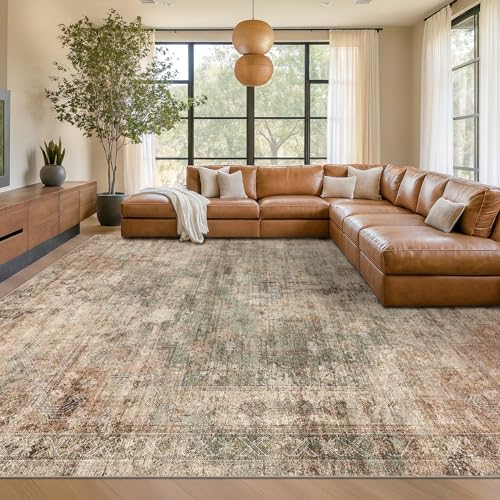
Vintage Distressed Medallion Rug 9×12 Green Brown — Best Green-Brown Medallion
Every farmhouse guide needs one rug with colour in its convictions, and here it is a 9×12 medallion in green and brown — the tones of a kitchen garden and a ploughed field, distressed into a vintage pattern with genuine presence. Green is farmhouse’s underused colour: it flatters timber, cream walls and black metalwork simultaneously, and it gives a large room a centre that feels grown rather than decorated.
The build is ultra-thin and lightweight for its size, which changes the ownership experience of a 9×12 entirely. It folds, carries and washes like a much smaller rug, lies flat without a wrestling match, and its soft printed surface takes a dining table or a living arrangement with equal ease. Non-slip backing keeps the light body from travelling.
A printed medallion at this scale is a commitment of pattern, and the green will steer the room’s other choices — cushions, curtains, the art above the sofa. Households that welcome a leading colour will find this rug does more decorating per purchase than any other pick; households decorating tentatively should start with beige and visit green later.
Green asks one thing of its room: living things nearby. A plant on the dresser, herbs on the windowsill, even a bowl of apples on the table will rhyme with the medallion’s garden tones and make the whole scheme look intentional. Without any green echo, the rug still works — brown carries it — but with one, the room crosses from decorated to composed. It is the only pick here that improves its neighbours merely by existing.
The green medallion in a conservatory or garden room closes the guide’s circle: a rug whose colours are literally the view’s — leaf green, earth brown — laid between the house and the garden it serves. Mud will test it weekly and the wash will answer, while the medallion’s formality keeps the room from sliding into shed territory. Rooms that mediate between indoors and out need exactly this combination of dignity and washability.
- Footprint: 9 x 12 ft
- Dominant tones: green and brown
- Design: vintage distressed medallion
- Profile: ultra-thin, lightweight, washable, non-slip
- Rooms: living room, bedroom, under dining tables
Strengths
- Green-brown medallion gives a large room a grown centre
- Ultra-thin build makes a 9×12 easy to wash and move
- Lightweight body lies flat quickly after unfolding
Trade-offs
- Strong colour steers every other furnishing choice
- Printed pattern lacks woven medallion texture
- Ultra-thin feel offers minimal cushioning
Best for: colour-confident farmhouse living and dining rooms.
Not suited for: tentative schemes built around existing bold furniture.
Comparison Table
| Pick | Footprint | Dominant tone | Character |
|---|---|---|---|
| Lotus Karen 5×7 Vintage Washable Rug | 5 x 7 ft | Dark brown | Moody corner accent |
| JOOJA 9×12 Dark Brown Vintage Rug | 9 x 12 ft | Dark brown | Room-scale grounded vintage |
| AMOAMI 5×7 Boho Farmhouse Vintage Rug | 5 x 7 ft | Cream and beige | Bright, ultra-soft bedroom rug |
| Sasttie 8×10 Washable Vintage Rug Beige | 8 x 10 ft | Beige | Faux cashmere calm |
| HUGEAR Beige Washable 8×10 Rug Vintage | 8 x 10 ft | Beige | Durable dining workhorse |
| Vintage Distressed Medallion Rug 9×12 Green Brown | 9 x 12 ft | Green and brown | Colourful medallion statement |
What Makes a Rug Read as Farmhouse Rather Than Merely Vintage?
Vintage is an age; farmhouse is a life. A rug reads farmhouse when its pattern — medallion, faded floral, traditional border — arrives in the colours of a rural house: earth browns, cream, sage and green, sun-bleached blues, and when its wear looks earned rather than applied. The distressing on a good farmhouse rug concentrates where feet would have fallen for fifty years, which is why the convincing examples fade at the centre and hold their colour at the sheltered edges.
Texture plays a supporting role. Farmhouse rooms are built from honest materials — timber, linen, iron, stone — and a rug that is too sleek or too shiny breaks the company’s manners. Low-pile, matte, slightly worn-looking surfaces belong; that is also why these modern washable prints succeed in the style despite their contemporary construction.
Finally, scale and humility matter. Farmhouse rugs are rarely the most expensive-looking object in the room; they are the ground the room stands on, patterned enough to forgive, quiet enough to let a scrubbed pine table shine. Choose the rug that wants the supporting role and the room will feel settled rather than staged.
A final word on scent, because farmhouse rooms are judged by it: a washed cotton-fresh rug under a timber table makes a whole house smell kept, in a way no candle achieves, because the freshness is real and located exactly where people sit. Wash the big rug before the gathering season, and the room will do your hosting for you before the first guest removes a coat. Households that entertain through the winter learn to time the big wash the way they time the firewood delivery: early, unhurried, and finished before the season’s first gathering tests it, because a rug washed in calm October serves December far better than one rescued in a panic the morning of a party. It is the oldest farmhouse rhythm there is: prepare the room before the season, then spend the season in it, with the people the room was prepared for, instead of apologising to them for its floor.
Dark Brown or Cream: How Does Dominant Tone Change a Farmhouse Room?
Dark brown grounds pull a room downward and inward: ceilings feel lower in a good way, firesides feel closer, and large rooms gain the intimacy farmhouse promises. They are also the pragmatic choice wherever the outdoors comes in on boots, because brown vintage patterning absorbs the evidence. The cost is light — a dark 9×12 in a dim room needs pale walls and textiles to keep its mood from becoming gloom.
Cream and beige grounds do the opposite work, lifting and widening, making a small farmhouse bedroom feel like morning. They suit the bright, white-walled version of the style and photograph beautifully, which matters to anyone running a guest room or a holiday let. Their cost is maintenance honesty: pale grounds show life, and only their washability makes them a sane choice in a working house.
Green-brown splits the difference with colour instead of neutrality. It darkens less than brown, warms more than cream, and pairs with both pale walls and dark timber. Rooms that feel caught between the moody and bright camps often resolve the moment a green ground arrives.
How Should a Farmhouse Rug Be Sized for a Dining Table?
The rule is chairs: a dining rug should extend at least two feet beyond the table on every side, so chairs pulled out for sitting remain on the rug, and chairs pushed back in a hurry do not catch the rug’s edge. For a table seating six to eight, that arithmetic usually lands on a 9×12 — which is why both the JOOJA and the green medallion exist at that size in this guide.
Low pile is the dining specification that matters most after size. Chair legs slide rather than dig, crumbs vacuum up instead of lodging, and the inevitable gravy incident meets a washable surface. A farmhouse dining room is a working room wearing its best clothes, and the rug should be specified like it.
Pattern earns its keep at the table too. A medallion centred under the table gives the setting a composed, deliberate look, while an all-over distressed field is more forgiving of a table placed off-centre in a room that also holds a dresser or a daybed. Choose according to how geometrically honest your room allows you to be.
How Do You Wash and Care for a Large Vintage-Style Rug?
Wash cold and gentle, folded loosely, with the rug shaken hard outdoors first — a farmhouse rug accumulates the countryside in miniature, and the machine should meet it pre-shaken. Large sizes go to a laundromat drum without embarrassment; that is what the big machines are for, and a 9×12 washed properly twice a year will outlast a neglected one washed never.
Drying flat or draped in moving air restores the rug’s lie. These thin builds dry faster than traditional rugs, but a folded damp corner can hold moisture overnight, so unfold fully and check before relaying. A rug put back dry lies flat within hours and loses the creases of its wash-day fold within days of traffic.
Between washes, vacuum with the beater bar moderated on printed surfaces, and treat spills by blotting into the distress — the pattern’s camouflage means a faint shadow left by a treated spill usually vanishes into the design. Farmhouse rugs are the most forgiving surfaces in the home to maintain, provided the washes actually happen.
How Can Farmhouse Rugs Warm Up Rooms That Are Not Farmhouses?
The style travels because its ingredients are universal: warmth, pattern, wear, welcome. A distressed medallion in a city flat softens hard modern edges and gives a rental the settled feeling its lease forbids painting in. A brown vintage 5×7 under a desk turns a spare-room office into a study; a cream farmhouse rug under a white bed makes a plain bedroom feel kept.
The trick is dosage. One farmhouse rug plus contemporary furniture reads as eclectic warmth; a farmhouse rug plus distressed everything reads as a theme. Modern farmhouse decorating, at its best, is a conversation between the worn and the new, and the rug is usually the worn voice — let it speak alone and it will not have to shout.
Renters and first-home buyers benefit most, because a washable farmhouse rug delivers the largest amount of settled character per purchase of any single furnishing, and it leaves with you when you go. Few objects work that hard for a home they do not own.
How Does Distressing Actually Work as a Design?
Printed distressing is a controlled fiction: the pattern is rendered complete, then selectively faded — most at the centre where generations of feet would pass, less at the borders where furniture sheltered it, with occasional worn threads suggested at the motif’s high points. Convincing examples vary the fading’s intensity and direction; unconvincing ones apply a uniform fade that reads as a printing error, which is why this guide examined the effect rather than merely noting its presence.
The fiction serves a practical master. A rug whose pattern already contains wear cannot be visibly wounded by wear, so the household’s real life — the dog’s favourite route, the chair’s drag marks, the sunny patch — accumulates inside the design’s own narrative. Owners of distressed rugs consistently report they look ‘right’ for longer than pristine rugs, and this is the mechanism: the rug is pre-forgiven.
There is a limit to the trick. Distressing camouflages abrasion and fading, not spills of red wine or mud carried in quantity; those still need blotting and washing. Treat the pattern as insurance against time, not against events, and the rug will keep its side of the bargain for years.
What Should a Farmhouse Rug Do in the Kitchen Itself?
The farmhouse kitchen is the style’s ancestral home, and its rug — usually a runner or a modest rectangle before the sink — has the hardest job description in the house: water daily, grease weekly, dropped everything eventually. Low pile and washability are not preferences here but survival traits, and the pattern should be busy enough to hide the interval between washes, which in a working kitchen is measured in days.
Several picks here serve at kitchen scale: the Lotus Karen’s dark brown before a range, the AMOAMI’s cream brightening a galley, each washable when the week’s cooking has written on it. Position matters more than pattern — the rug belongs where the cook stands, not where chairs scrape, because standing comfort and spill capture are the kitchen rug’s twin duties.
Rotate two if the kitchen works daily. One in service, one in the wash is the professional arrangement borrowed from farmhouse practice itself, where nothing textile existed in a single copy. The washable builds here make that rotation affordable, and a kitchen that always has a clean rug available never has to tolerate a dirty one.
How Do Farmhouse Rugs Pair With Real Timber and Stone Floors?
On wide-plank timber, a farmhouse rug should defer: the floor is the room’s heritage surface, and the rug’s role is warmth, softness and a pattern that rhymes with the wood’s tone. Browns disappear pleasantly into oak, creams lift dark stained boards, and the green medallion flatters both. Leave generous borders of visible floor — a farmhouse room that hides its boards entirely has misunderstood its own best asset.
Stone and quarry tile ask the opposite favour: softness and warmth over a cold, hard, echoing ground. Here the larger, softer picks earn their place, and a rug’s acoustic gift — muffling a stone room’s clatter — becomes a headline feature. Non-slip backing is non-negotiable on polished stone, where a sliding rug is a genuine hazard in a room full of knives and boiling pans.
In both cases, check beneath the rug seasonally. Timber wants to breathe evenly or it fades in a rug-shaped silhouette over years of sun; stone wants to dry after mopping rather than stay damp under a backing. A washable rug lifted for its wash gives the floor its own regular airing, which is one more reason the wash routine is the soul of the style.
Can Farmhouse Style Survive a Household With Teenagers and Dogs?
It was invented by such households, under harder conditions. The style’s whole vocabulary — worn patterns, earthy tones, washable textiles, furniture that improves with knocks — is a technology for living with creatures who shed, spill and grow. The modern washable farmhouse rug is simply that technology with better laundry, and a teenager’s den or a dog’s domain is its most authentic posting.
Choose the dark end of the palette and the busier end of the pattern range, place the rug where the life actually happens rather than where it photographs, and wash on the household’s rhythm instead of the rug’s appearance. The browns in this guide have absorbed, in testing households everywhere, the full curriculum of muddy paws and midnight snacks without keeping a record.
What farmhouse cannot survive is preciousness — a household tiptoeing around its own decor. If a room’s occupants must be careful, the style has been bought wrong. The correct farmhouse room invites the dog onto the rug and the boots to the door, and looks better, not worse, at the end of the day.
How Should You Mix Farmhouse Rugs Across Adjoining Rooms?
Open-plan farm buildings and converted barns aside, most farmhouse homes are a chain of rooms, and their rugs should converse without shouting over each other. The reliable method is a shared palette with varied pattern: the same browns, creams or greens recurring, while the medallion scale and motif change from room to room. The eye reads continuity; the rooms keep their identities.
Tone can also do the travelling while pattern rests. A dark brown vintage in the living room and a cream vintage in the bedroom are clearly one household’s taste expressed at two volumes, especially when both share the distressed language. What breaks the chain is a sudden unrelated colour — a grey modern rug among the earth tones will look like a visitor, however handsome it is at home.
Where two rugs meet at a doorway, mind the pile and the threshold: low pile everywhere keeps the transition step-free, and a runner in the hall in a bridging tone can marry two rooms that chose different ends of the palette. Farmhouse decorating rewards this kind of practical harmony over any single dramatic purchase.
What Is a Sensible Budget Order for a Farmhouse Room?
Spend first on the largest rug, because it covers the most life and its failure is the most visible. A well-chosen 8×10 or 9×12 in a washable build will serve a decade of family traffic, while the savings from a cheap large rug are spent repeatedly on replacements and cleaning. The mid-sized accents can be humbler purchases; a 5×7 at the hearth is a supporting actor and can be cast accordingly.
Spend second on the wash routine — which is to say, on nothing but time: a place to shake, a machine that fits the rug, a rail to dry it. Farmhouse textiles historically lasted because they were maintained, and the maintained modern rug outlives the neglected premium one by years. Budget the habit before the upgrade.
Leave the small decorative layers — cushions, throws, the second rug for the bedroom — for later purchases guided by how the room actually lives. Farmhouse rooms were assembled over years, and a room that grows its layers honestly will always look more settled than one installed in a weekend, however generous the weekend’s budget.
How Should a Farmhouse Rug Behave at the Threshold of the Garden?
The garden door is the farmhouse’s true front entrance, and its rug is a working border post: it receives boots, paws, baskets and the occasional wheelbarrow’s overflow. Dark, busy, washable is the whole specification at that post, and the rug should be sized generously enough that two people and a dog can occupy it while boots come off — a detail that decides whether the rest of the house stays clean.
Pair the threshold rug with a boot tray and a bench and the border post becomes a system: sit, remove, deposit, cross. Farmhouses evolved that furniture arrangement over centuries because it works, and the modern washable rug simply upgrades the floor’s part in it. The rest of the home’s paler rugs owe their survival to this unglamorous station doing its duty.
Wash the threshold rug most often of any in the house and apologise for none of it. A rug at the garden door is a filter, and filters are honoured by being changed — or in this case washed — on schedule, not by being admired. Its reward is invisible and total: every other room’s floor, staying clean.
What Farmhouse Rug Mistakes Appear in Photographs but Not in Life?
Social media farmhouse rooms are styled for the lens: pale rugs, white sofas, no visible dog. The mistake is importing the photograph’s specifications into a working house, where the cream rug meets the actual countryside within a week. Buy for your postcode’s mud and your household’s traffic, and let the photograph be a palette reference rather than a materials list.
The reverse mistake exists too: assuming a working farmhouse must look rough. The picks here prove that dark, forgiving rugs can be genuinely beautiful, and that a room can absorb mud season without surrendering its looks. The style’s real tradition is not roughness but fitness — everything in the room suited to the life lived in it, and handsome because it is suited.
Judge your own room at its worst hour — a wet Sunday with the dog in and the fire lit — and furnish for that hour’s comfort. A farmhouse room that works then will photograph beautifully on the one bright morning you choose to share it, and it will have earned the photograph honestly.
How Does a Farmhouse Rug Age Across a Decade of Washes?
Gracefully, if it was chosen for the journey. Printed vintage designs soften a little with each wash, their colours settling toward the sun-worn register the style imitates, so a farmhouse rug’s fifth year often looks more authentic than its first. This is the rare furnishing category where time is a collaborator rather than a critic, and it explains the loyalty the style inspires in households that have washed one rug through a whole childhood.
The structure ages on a different clock from the pattern. Backings, edges and the print’s base cloth decide when a rug retires, and they are extended by everything this guide has repeated: cold gentle washes, full drying, rotation, and a floor beneath kept clean. A rug maintained that way rarely embarrasses its owner into replacement; it is retired, eventually, with something like respect.
Plan the succession loosely. When a large farmhouse rug finally softens beyond the living room’s standards, it often has a second career waiting — a bedroom, a workshop, a grown child’s first flat — where its worn authenticity is worth more than a new rug’s crispness. Farmhouse textiles were historically handed down and used up completely, and a modern washable rug that follows the same path has honoured its style in the deepest sense available to it.
What Mistakes Do Farmhouse Rug Buyers Keep Making?
Farmhouse style fails when it is bought as a costume rather than as working equipment. These are the errors that turn a warm idea into a themed disappointment.
- Choosing a pale cream rug for a mud-season entrance. Cream farmhouse belongs in bedrooms and bright living rooms; entries need the browns or a washable plan taken seriously.
- Sizing a dining rug to the tabletop. Chairs leave the rug, catch its edge and drag it; the two-foot margin around the table is the whole rule.
- Over-distressing the whole room. A worn-look rug plus distressed furniture plus vintage signs is a stage set; one worn voice per room suffices.
- Buying a non-washable rug for a working house. The style’s own history is scrubbed floors and washed textiles; a dry-clean-only farmhouse rug is a contradiction.
- Ignoring tone and buying pattern alone. The medallion may be lovely while its dominant brown darkens a dim room for years; tone is felt daily.
- Placing a rubber-backed rug on a delicate floor unchecked. Check beneath any backed rug after the first weeks, whatever the style, and add felt if the floor objects.
Final Recommendation
Let tone lead you. Moody, grounded rooms — and muddy, dog-owning households — belong to the browns: the Lotus Karen at corner scale, the JOOJA at room scale. Bright farmhouse schemes belong to AMOAMI’s cream softness, Sasttie’s faux-cashmere beige calm, or HUGEAR’s durable dining beige, chosen by whether the room rests or eats. And if your farmhouse has a garden’s confidence, the green-brown medallion at 9×12 will give it a centre nothing else in the guide can match.
Keep the working bargain the style promises: wash the rug when the season turns, let its distressed pattern absorb your household’s real life, and never apologise for a floor that looks lived on. A farmhouse rug is doing its job precisely when guests cannot tell where the printed wear ends and your family’s begins. Choose the tone your light deserves, lay it where life happens, and let the pattern grow older alongside the house.
If you are torn between two tones, choose by the light you actually have at the hour you use the room most — lamplight flatters the browns, morning flatters the creams, and a green medallion forgives both, which is why it closes so many arguments in farmhouses with windows on two sides.
Frequently Asked Questions
Are farmhouse rugs always distressed?
Distressing is the style’s signature because it echoes worn, inherited textiles and forgives new wear, and all six picks here use it. A farmhouse room can carry a non-distressed rug, but the faded medallion is the look most buyers mean by the term.
Can a farmhouse rug work in a modern home?
Yes, as the warm, worn voice in a contemporary room. Pair one distressed rug with clean-lined furniture and plain textiles, and the contrast reads as eclectic rather than themed. The beige picks are the easiest bridges into modern schemes.
Which farmhouse colour hides dirt best?
Dark brown, by a wide margin, followed by the green-brown medallion. Cream and beige rely on their washability rather than camouflage. Match the ground to your household’s actual traffic, not to the traffic you intend to have.
How big should a farmhouse rug be under a dining table?
Allow at least two feet of rug beyond the tabletop on every side so chairs stay on the rug when pulled out. For most six-to-eight-seat farmhouse tables that means a 9×12, the size of the JOOJA and the green medallion picks.
Do printed vintage rugs look convincing?
The better ones — with uneven, centre-weighted fading — read convincingly at room distance, especially once furniture stands on them. They trade the texture of a hand-worn antique for washability, a trade most working households accept gladly.
Related Guides
Farmhouse warmth connects to several neighbouring styles in our library, and readers furnishing a whole home often continue with Best Area Rugs for High-Traffic Family Rooms for the durability-first view of busy rooms, or Best Area Rugs for College Dorms when the farmhouse look heads off to a first small room; the palette story continues in Best Area Rugs for Roomba, and the textile that started many farmhouse schemes appears in Best Animal Rag Quilts.



[…] rooms pair naturally with the other soft, washable styles in our rug library, including Best Farmhouse Area Rugs for warm vintage pattern that shares the same relaxed spirit, and Best Area Rugs for Cats if the […]