What's inside
- Key Takeaways
- Quick Picks
- How We Chose These Picks
- Which of the Best Compact Upright Vacuums Fits a Small Home Like Yours?
- How Do the Six Compacts and Alternatives Compare?
- How Should You Measure Your Storage Before Choosing?
- What Cleaning Pattern Suits a Compact Upright Best?
- How Do Compacts Handle the Hard-Floor-Plus-Rug Layout?
- What Should Older or Smaller Users Prioritise in This Class?
- How Do You Keep a Small Cup From Becoming a Big Annoyance?
- How Does a Compact Behave in a House-Share?
- What Happens When a Compact Meets a Full Spring Clean?
- How Should Students Choose Their First Vacuum?
- What Is the Difference Between a Compact Upright and a Stick Vacuum?
- How Do You Vacuum a Small Home With a Sleeping Baby or a Night Worker?
- What Should You Inspect Monthly on a Compact Upright?
- How Well Do Compacts Serve Homes With Mostly Hard Floors?
- When Should a Small Home Skip the Compact and Buy Standard?
- How Does a Compact Serve a Home Office or a Spare Room?
- What Should You Know About Cords on Compact Machines?
- How Can a Compact Help a Home Feel Ready for Guests Quickly?
- What Mistakes Do Compact Upright Buyers Make Most Often?
- How Should You Decide Between the Two Bissell Compacts?
- How Should You Clean a Compact Between Homes When You Move?
- Final Recommendation
- Frequently Asked Questions
- Related Guides
As an Amazon Associate I earn from qualifying purchases. This post may contain affiliate links at no extra cost to you.
cottageverdict.com is reader-supported. When you buy through links on our site, we may earn an affiliate commission.
Where to buy: each model below is available through Amazon, and its name in the Quick Picks table, the individual reviews and the comparison table links to its listing, where you can check price on Amazon and confirm dimensions, weight and what’s in the box. The best compact upright vacuums solve a problem that has nothing to do with dirt: the cupboard. Apartment dwellers, dorm residents and owners of smaller houses routinely own a vacuum too large for the storage they actually have, so the machine migrates to a garage, a car boot or a relative’s house — and a vacuum that lives elsewhere cleans nothing. Compact uprights keep the upright’s honest floor head and standing posture while shrinking the body until it fits the shallow cupboard, the space beside the washing machine, the gap behind a door.
Shrinking an upright is an engineering negotiation. The dust cup gets smaller, the head gets narrower, the cord may shorten, and the question for every model is what it refused to surrender. Some protect above-floor reach with wands. Some protect weight, dropping toward seven or eight pounds. Some protect the full-size feel of the clean itself. The six picks here negotiate differently, and this guide’s job is to make the terms of each bargain plain, so a small-home buyer can choose which compromise matches the rooms they actually clean.
Geography matters too. These machines serve homes where the cleaning round is measured in rooms you can count on one hand, where the vacuum may be carried by a student, an older relative or a child earning pocket money, and where hard floors and low rugs outnumber deep carpets. In that territory a compact upright is not a lesser vacuum. It is the correctly sized one, and oversizing is the mistake, not the other way round.
Key Takeaways
- Storage fit is the first specification: measure the cupboard before falling for any feature list.
- The lightest pick, Eureka’s Airspeed, is listed at 7.7 lb, light enough for almost any household member to carry.
- Bissell fields two compacts here, the 3508 and the Turbo 3437F, divided by wand style and power brief.
- Two picks convert or reach beyond their footprint: the Dirt Devil Simplistik Plus works as a 3-in-1, the compacts’ wands cover stairs.
- The Amazon Basics and Eureka NEU182B are the full-size guests in this list, included for small homes with bigger dirt.
- Narrower heads mean more passes in large rooms, the standing tax of the compact format.
Quick Picks
| Pick | Badge | Why it earns its place |
|---|---|---|
| Bissell CleanView Compact Upright Vacuum 3508 | Best Compact for Apartments | Scatter-free hard-floor manners and a removable wand in the footprint small homes asked for. |
| Eureka Airspeed Ultra-Lightweight Vacuum NEU10AE5 | Best Featherweight Pick | Listed at just 7.7 lb with pet-hair intent, a brush and a crevice tool, and a washable filter. |
| Bissell CleanView Compact Turbo Upright 3437F | Best Compact With Full-Size Ambition | Bissell pitches it as full-size power in compact form, with a quick release wand for reach. |
| Dirt Devil Simplistik Plus 3-in-1 Vacuum | Best Convertible for Dorms | One slim machine covering stick, hand and upright-adjacent duties in the smallest spaces. |
| Amazon Basics Upright Bagless Vacuum | Best Compact-Alternative With Tools | A standard upright footprint but a small-home soul: tools included, detachable handle, 25ft cord. |
| Eureka PowerSpeed Upright Vacuum NEU182B | Best Compact-Alternative for Capacity | A 2.6L cup and five height settings at ten pounds, for small homes with family-scale dirt. |
How We Chose These Picks
We measured the category against the rooms it serves. First, stored size and weight, because a compact that fails the cupboard test fails entirely. Second, hard-floor behaviour, since small homes are disproportionately hard-floored and a head that scatters litter across a studio kitchen wastes the format’s speed advantage. Third, reach: in a small home the upright is usually the only vacuum, so a wand or a convertible mode is not garnish but the whole above-floor department. Fourth, cup practicality — small cups are acceptable, fiddly cups are not, because emptying happens often in this class and should stay a ten-second, low-dust event.
Two full-size machines appear deliberately at the end of the list. Some small homes have big dirt — a shedding dog in a two-bedroom flat generates family-scale debris in apartment-scale rooms — and for those readers the honest recommendation bends toward capacity and tools while keeping weight near ten pounds. We labelled both as compact-alternatives rather than pretending they shrink, because honesty about format is this guide’s house rule.
Which of the Best Compact Upright Vacuums Fits a Small Home Like Yours?

Bissell CleanView Compact Upright Vacuum 3508 — Best Compact for Apartments
Start with the kitchen floor, because that is where this Bissell makes its argument. Small homes concentrate cooking, eating and entry traffic into a few square metres of hard floor, and the daily debris there — rice, litter tracked from a tray, the crumb halo around a highchair — is exactly what a badly behaved brush roll redistributes. Bissell’s scatter-free technology is designed to contain that debris at the head instead of flicking it onward, and in a compact home the benefit compounds: fewer passes, less time, and no grit migrating into the bedroom rug on the same clean.
The removable extension wand is the second half of the apartment case. A studio or one-bedroom flat has perhaps six above-floor jobs that matter — sofa edges, the stair tread if there is a mezzanine, skirting tops, the car’s front seats if it parks outside — and a wand that comes away in seconds lets one small machine cover all of them without a second appliance competing for the same cupboard. Bissell’s long association with pet households shows in the tuning; the brand expects hair in the cup and designs the emptying accordingly.
Judge it as a compact and it is coherent: narrower head, modest cup, quick rather than monumental cleans. Ask it to deep-clean a four-bedroom house weekly and the arithmetic of passes and emptying will argue back. Within the apartment brief, though, it is the most complete answer here, which is why it leads the list.
- Body brief: compact upright for apartments and dorms
- Hard-floor design: scatter-free technology, per the listing
- Above-floor: removable extension wand
- Debris handling: bagless cup, pet-aware tuning
- Cleaning style: fast, frequent, room-by-room
Strengths
- Contained hard-floor pickup suits kitchen-centred flats.
- Wand reach makes it the only vacuum a small home needs.
- Footprint respects shallow cupboards and tight halls.
Trade-offs
- Narrow head taxes any unexpectedly large room.
- Compact cup fills quickly during spring cleans.
- Deep-pile rugs are maintenance work, not its showcase.
Best for: apartments and small homes with mostly hard floors and a pet.
Not suited for: large houses wanting one-pass-per-room cleaning width.

Eureka Airspeed Ultra-Lightweight Vacuum NEU10AE5 — Best Featherweight Pick
Seven point seven pounds is the whole review, almost. At that weight the Airspeed stops being an appliance you schedule and becomes one you grab: carried one-handed between rooms, lifted over a sleeping dog, wielded by an older parent who has quietly stopped using a heavier machine and whose floors have noticed. Eureka labels it senior-friendly, and the kindness is mechanical rather than patronising — low weight, straightforward controls, a washable filter that asks for a rinse rather than a purchase, and tools (a brush and a crevice tool, per the listing) covering the corners and upholstery of a modest home.
Pet hair is in its stated brief, alongside carpet and hard floor, and in small homes that trio is the entire flooring census. The Airspeed’s agility is its cleaning method: because it is effortless to deploy, it gets deployed daily, and daily light passes on a small floor area outperform the weekly heroic clean that heavier machines inspire. Hair never gets the week it needs to weave itself into the rug. The cup is compact-scale, which the deployment pattern forgives, since a daily cup is rarely a full cup.
The limits are structural and should be respected. A featherweight head has less planted authority on carpet, so deep pile work is slower and shallower than a heavier rival’s. The machine is a sprinter in a category where some homes need a plough. But for bungalows, flats, and any household where the vacuum’s user values their back, the Airspeed’s bargain — weight surrendered, everything else adequate — is the wisest trade on this page.
- Body brief: ultra-lightweight upright
- Weight: 7.7 lb, per the listing
- Tools named: brush and crevice tool included
- Filter: washable
- Stated surfaces: pet hair, carpet and hard floor
Strengths
- Lightest body here; almost anyone can carry it.
- Grab-and-go weight encourages genuinely daily use.
- Washable filter and included tools complete the kit.
Trade-offs
- Light head has less authority in deep pile.
- Compact cup assumes frequent, smaller cleans.
- Not the choice for large, carpeted floor plans.
Best for: bungalows, flats and any user who prizes a light carry.
Not suited for: deep-carpet homes needing planted, heavyweight agitation.

Bissell CleanView Compact Turbo Upright 3437F — Best Compact With Full-Size Ambition
Bissell’s own pitch for the Turbo is the compact category’s central promise stated boldly: full-size power in compact form. Treat that as a direction rather than a measurement — what it means in the hand is a machine that does not feel apologetic on carpet, with turbo suction as the listing’s phrase, while still storing like its smaller sibling. For a small home with real carpet — a carpeted two-bedroom flat, a dorm suite with rugs over everything — that ambition is exactly the point of difference, because the featherweights can feel under-gunned when the floor fights back.
The quick release wand separates it from the 3508 in daily use. Both reach above the floor; the Turbo’s wand is built for speed of transition, clicking away for a stair tread or a cobweb and returning without a negotiation. In homes where the vacuum round includes a staircase or a mezzanine, those saved seconds per transition decide whether above-floor work happens weekly or seasonally. The design brief names apartments and dorms, yet the machine’s temperament suits any small home that resents being treated as a lesser cleaning problem.
Choosing between the two Bissells is a floor question. Mostly hard floors with scattered debris: the 3508’s scatter-free head is the sharper tool. Meaningful carpet that needs convincing: the Turbo’s brief is yours. Either way the compact tax applies — cup and head are scaled to the format — and either way Bissell’s pet-household heritage keeps hair handling sensible rather than theatrical.
- Body brief: compact upright, turbo positioning
- Maker’s pitch: full-size power in compact form
- Above-floor: quick release wand
- Stated homes: apartments and dorms
- Cleaning style: carpet-confident small-home rounds
Strengths
- Strongest carpet confidence in the true-compact group.
- Fast wand transitions keep above-floor work weekly.
- Stores like a compact while working with ambition.
Trade-offs
- Hard-floor scatter control is the sibling’s party trick.
- Compact cup and head still apply on big days.
- Overkill for a hard-floored studio’s gentle needs.
Best for: carpeted flats and dorms wanting compact storage without meekness.
Not suited for: hard-floor studios prioritising scatter control above all.

Dirt Devil Simplistik Plus 3-in-1 Vacuum — Best Convertible for Dorms
The Simplistik Plus refuses the premise that one shape must do everything, and converts instead: a stick for floors, a hand vacuum for the desk and the car seat, a slim upright-adjacent stance for the daily round. In a dorm room — the extreme case of compact living, where the vacuum competes for space with a mini fridge and a semester of laundry — that convertibility is not a gimmick but the only way one purchase covers the floor, the bedding and the crumbs inside a laptop bag’s blast radius. Bagless debris handling keeps the running costs at zero, which student budgets correctly treat as a headline feature.
Its cleaning personality is maintenance, not restoration. Hard floors and low rugs, done often, stay genuinely clean under its care; the hand mode handles the windowsill, the shelf dust and the car footwell during visits home. What it will not do is resurrect a neglected carpet or serve a family house, and its cup is sized for the debris of one or two people living in one or two rooms. Read generously, those are not flaws but the honest borders of the smallest format in this guide.
As a first vacuum bought with a first kettle and a first set of pans, it has a particular charm: it teaches its owner the habit of little-and-often cleaning at the exact age when cleaning habits form. Many graduates keep theirs for years as the second machine in bigger homes, which tells you the format’s usefulness survives the dorm it was bought for.
- Body brief: 3-in-1 convertible, lightweight
- Modes: stick, handheld and compact floor cleaning
- Debris handling: bagless
- Stated homes: dorms, apartments and small spaces
- Cleaning style: frequent maintenance passes
Strengths
- Three modes cover floor, desk and car-seat jobs.
- Slimmest storage profile in this entire guide.
- Zero consumable costs suit student budgets.
Trade-offs
- Maintenance power only; neglected carpet defeats it.
- Smallest cup here, emptied often by design.
- Not a true upright despite the company it keeps.
Best for: dorm rooms and studios needing one convertible machine.
Not suited for: family homes or deep-carpet rescue work.

Amazon Basics Upright Bagless Vacuum — Best Compact-Alternative With Tools
This is the honest guest at the compact table: a standard upright that earns its invitation through temperament rather than dimensions. Small homes with serious above-floor needs — stairs with a turn, bunk beds, a car that doubles as a second wardrobe — often find true compacts under-tooled, and the Amazon Basics answers with crevice and upholstery tools in the box, a handle that detaches for reach, and a 25ft cord that treats a small home’s socket layout generously. Its 1.7L cup sits between the compacts and the family machines, a capacity that matches two-bedroom reality.
The washable filter keeps the ownership story simple, and the black-and-white design stores without visual protest in a hallway. On floors it covers carpet and hard floors with the composed adequacy that defines the house-brand brief at its best: nothing theatrical, everything present. For a small home whose dirt includes stairs and upholstery, that completeness can outweigh a few saved inches of cupboard, provided the cupboard can in fact take it — measure first, as this guide keeps insisting, because this is the pick that punishes optimistic measuring.
It is also the natural stepping stone in the list: the machine for the renter whose next home will be bigger, bought once and carried forward. Compacts bought for a studio often get replaced at the first house; this one simply moves and keeps working, which reframes its slightly larger footprint as an investment rather than a compromise.
- Body brief: standard upright, small-home temperament
- Cup: 1.7L; cord: 25ft, per the listing
- Tools: crevice and upholstery tools in the box
- Reach: detachable handle for above-floor work
- Filter: washable
Strengths
- Tool kit handles stairs and upholstery properly.
- Long cord flatters small-home socket layouts.
- Graduates to a bigger home without replacement.
Trade-offs
- Needs a true upright’s storage space.
- Heavier presence than the featherweight compacts.
- Cup sits mid-class rather than leading it.
Best for: small homes with stairs, bunks and upholstery in the workload.
Not suited for: the very shallowest cupboards on this page.
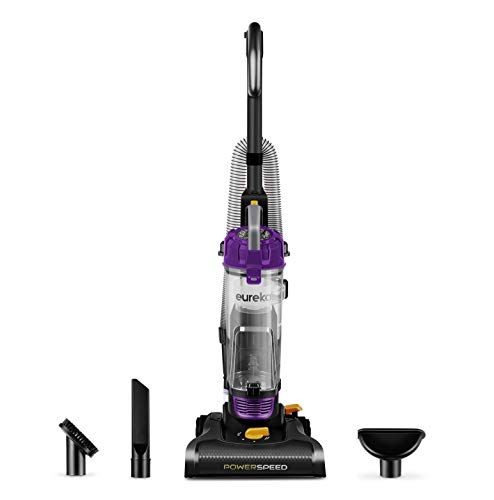
Eureka PowerSpeed Upright Vacuum NEU182B — Best Compact-Alternative for Capacity
Some small homes produce improbable volumes of debris: the two-bedroom flat with two indoor cats, the house-share with a gravel drive, the family squeezed into a cottage. For them the compact question inverts — not how small can the vacuum be, but how much capacity and adjustment can be carried at a weight a small home tolerates. The NEU182B’s answer is a 2.6L cup and a five-position brush height dial inside a ten-pound body, which is family-machine substance at the very edge of compact manners.
The height dial earns fresh praise in this context because small older homes have the wildest flooring: a plush bedroom carpet inherited from previous owners, boards in the hall, a rug of mysterious depth in the lounge. Five settings let one machine humour all of it without stalling or skating. The cup, meanwhile, changes the emotional texture of the weekly clean in a high-debris home — the job finishes before the cup does, which sounds trivial and is in fact the difference between a routine kept and a routine resented.
Its purple finish and standard footprint mean the cupboard question must be answered honestly; this is an alternative to a compact, not a compact. But for the high-debris small home it resolves the category’s tension in the other direction, and readers in that situation will recognise their household in this paragraph more than in any featherweight’s.
- Body brief: standard upright, capacity-led
- Weight: ten pounds; cup: 2.6L, per the listing
- Brush control: five height positions
- Stated work: pet hair, carpet and hard floor
- Cleaning style: fewer interruptions, longer arcs
Strengths
- Biggest cup here for high-debris small homes.
- Height range humours eccentric inherited flooring.
- Weight stays carryable despite the substance.
Trade-offs
- Full footprint; not a true compact by any measure.
- Colour and size dominate a small hallway.
- More machine than a tidy studio will ever need.
Best for: small homes with family-scale pet hair and mixed floors.
Not suited for: minimal studios where storage is the entire question.
How Do the Six Compacts and Alternatives Compare?
| Model | Format truth | Weight / size note | Signature strength |
|---|---|---|---|
| Bissell CleanView Compact Upright Vacuum 3508 | True compact upright | Apartment footprint | Scatter-free floors, wand reach |
| Eureka Airspeed Ultra-Lightweight Vacuum NEU10AE5 | True compact upright | 7.7 lb | Featherweight daily handling |
| Bissell CleanView Compact Turbo Upright 3437F | True compact upright | Compact with ambition | Carpet confidence, quick wand |
| Dirt Devil Simplistik Plus 3-in-1 Vacuum | Convertible 3-in-1 | Slimmest storage | Modes for every dorm job |
| Amazon Basics Upright Bagless Vacuum | Standard upright | 25ft cord, 1.7L cup | Tools and detachable handle |
| Eureka PowerSpeed Upright Vacuum NEU182B | Standard upright | 10lbs, 2.6L cup | Capacity plus height range |
The format-truth column is the one to trust. Everything else follows from it: true compacts trade capacity for storage, convertibles trade power for modes, and the two standard uprights trade footprint for substance.
How Should You Measure Your Storage Before Choosing?
Measure the space the vacuum will actually occupy, not the space you wish existed. Height first, since compact uprights still stand tall even when their bodies shrink; then depth, because a shallow airing cupboard rejects machines by their handle angle; then the door swing, because a vacuum that fits only when the door cannot close fits nowhere. Compare those three numbers with the listing dimensions of your shortlisted models and be pessimistic by a centimetre in every direction. Brooms, ironing boards and the mop all believe they own the same cupboard, and the vacuum must win its territory against them.
Consider the alternative addresses too. A compact can live behind a bedroom door, in the understairs triangle, or in the gap between wardrobe and wall, and several of these picks were clearly designed with such improvisations in mind. The Simplistik’s slimness suits a gap; the Airspeed’s lightness suits a hook-and-lift arrangement for the able; the Bissells suit the classic cupboard. Deciding the address before the model reverses the usual, sadder order in which a vacuum is bought, admired and then exiled.
What Cleaning Pattern Suits a Compact Upright Best?
Little and often is not a slogan in this format; it is the engineering assumption. A compact’s cup, head width and cord are all sized for a round of two to four rooms, and owners who clean in that rhythm find the machines entirely sufficient. The pattern that works: one room properly each weekday evening on rotation, or the whole small home twice a week in sessions under twenty minutes. Debris never accumulates to the level where a small cup or a narrow head becomes a grievance, and the home lives at a constant, pleasant standard instead of oscillating between blitz and backlog.
Technique adapts to the narrower head by slowing slightly and overlapping lanes by a third. That sounds slower and is, per square metre, yet the total session in a small home stays short because there are fewer square metres. Save the slow, deliberate passes for the rug and the entryway, where dirt concentrates, and move briskly over the bedroom’s open floor. A compact rewards an owner who cleans like a gardener — regularly, lightly, without drama — and gently punishes the procrastinator, which some households honestly need.
How Do Compacts Handle the Hard-Floor-Plus-Rug Layout?
That layout is the small home’s signature: boards or laminate as the field, one or two rugs as islands. The transitions are where compacts earn or lose their reputation. A well-mannered head climbs the rug’s edge without folding it, agitates the island properly, and steps back down without scattering the board’s grit. Scatter control, the 3508’s headline, matters most at exactly this boundary, because debris flicked off a rug onto boards reads as the vacuum spreading dirt rather than gathering it.
Help the machine with two habits. Vacuum the rug first, while the cup is empty and airflow is at its best, then take the surrounding boards, so anything the rug releases is collected in the same session. And keep rug edges honest: a rug that curls will defeat any head, compact or otherwise, and a strip of rug tape costs less than the frustration. Owners who run this order find the mixed layout stops feeling like two different cleaning problems and becomes one short round.
What Should Older or Smaller Users Prioritise in This Class?
Weight, then handle height, then emptying mechanics — in that order, and the Airspeed exists because Eureka understood the sequence. A machine at 7.7 lb can be lifted over thresholds and carried to a car without planning. Handle height matters because a compact’s shorter body can force a taller user to stoop or a smaller user to push at an awkward angle; where possible, test the posture in the first week and use the return window ruthlessly if your back objects. Emptying should be a one-hand, low-drop operation over a bin, and any cup that requires shaking, twisting and prayer will be emptied less often than it should.
Controls deserve a glance too. This class is mercifully free of touchscreens, and the best of it can be operated by feel: a foot pedal for the recline, a switch for the power, a dial for height. For a household where the vacuum is shared across generations, that tactility is accessibility. The senior-friendly language in the Eureka listings is marketing, but it points at a real design ethic that other buyers — anyone with a bad shoulder, a small frame or a healing wrist — benefit from equally.
How Do You Keep a Small Cup From Becoming a Big Annoyance?
Empty earlier than the line. In compact machines the fill line is an upper bound, not a target, and performance is happiest in the cup’s lower two-thirds. Build the emptying into the round itself: finish a room, glance at the cup, empty if it is past halfway, continue. The ten seconds disappear into the session instead of accumulating into a mid-rug crisis. Pet homes should treat this as doctrine, because hair’s volume is mostly air and a compact cup can go from fine to felted within a single sofa’s worth of shedding.
The filter shares the discipline. Small filters load proportionally faster, so the rinse rota for a compact in a pet home is better measured in fortnights than months. Let it dry fully, keep the cup’s seals wiped, and the machine’s voice stays level. Owners often describe a compact as having lost power at six months when what it has lost is merely airflow to a clogged filter — a thirty-second diagnosis that saves a needless replacement.
How Does a Compact Behave in a House-Share?
Shared houses are a stress test no laboratory simulates: five adults, one vacuum, a rota that exists mostly as a rumour, and floors that receive the combined debris of five lives. Compacts survive this environment better than their size suggests, for two reasons. They are light enough that the rota’s weakest participant can still carry the machine to their room, and they are simple enough that nobody needs training to use one. A complicated machine in a house-share gets used by one person; a compact gets used, eventually, by everyone, and total cleanliness follows total usage.
The cup is the diplomatic frontier. Agree as a house that whoever fills it empties it, and write the filter rinse onto the same rota as the bins. House-shares that adopt those two rules find a budget compact lasting the whole tenancy. Those that do not will discover that a neglected filter performs exactly as badly in a shared house as in a family one, only with more suspects. Choose a mid-list pick with a washable filter and a forgiving cup — the Airspeed or the 3508 — and let simplicity govern.
What Happens When a Compact Meets a Full Spring Clean?
It copes, on one condition: the work is staged. A spring clean asks for furniture moved, rugs taken up, skirting lines addressed and upholstery stripped — a volume of debris that will fill a compact cup repeatedly and a duration that will test a narrow head’s patience. Stage the home room by room across a weekend rather than in one heroic Saturday, empty without resentment, and let the wand earn its keep on the revealed edges and corners that fifty weeks of furniture hid. The machine’s lightness becomes an asset here, since spring cleaning involves carrying the vacuum into every improvised position a home can offer.
What a compact should not be asked to do is the rug taken outside and beaten’s worth of embedded winter grit in a single pass. Work the worst rug in slow lanes, twice, and accept the result as the format’s honest best. Owners who stage the spring clean this way report the surprising truth that the compact’s limitations mostly vanish, because the limitations were always about volume per session, and staging is volume management by another name.
How Should Students Choose Their First Vacuum?
Start from the room, not the shop. A dorm room with hard floors and one rug wants the Simplistik’s modes or the Airspeed’s lightness. A student house with carpeted bedrooms wants a true compact upright, because shared student carpets accumulate a semester’s evidence at a rate no stick forgives. Budget honestly for the whole purchase: the machine, plus nothing, is the beauty of this bagless class — no bags, rinsable filters, and electricity measured in pennies per clean. A vacuum that costs nothing to run gets run, which in a student house is the entire battle.
Think about the machine’s second life, too. The first vacuum commonly follows its owner to the first flat and the first job, serving as the main machine in small spaces and the second machine thereafter. A pick with a wand and a washable filter adapts to each stage. Buying the absolute cheapest object in the category usually means buying twice; buying at the level of these six usually means buying once and demoting gracefully.
What Is the Difference Between a Compact Upright and a Stick Vacuum?
Posture and intent. A compact upright stands on its own, carries its motor and cup in a single body, and pushes a floor head designed to be the whole story on carpet and boards alike. A stick distributes its weight along a wand, often converts to a handheld, and is designed around speed of deployment rather than planted cleaning authority. The overlap is real — the Simplistik lives in both worlds — but the centre of gravity of each format differs, and so does the cleaning it rewards: uprights reward the thorough weekly round, sticks reward the daily ninety seconds.
Small homes often end up owning the logic of both in one machine or two. If forced to one, choose by your dominant failure. Floors that get properly dirty — gritty, hairy, carpeted — want the upright’s head and cup. Floors that get lightly dirty but constantly want the stick’s immediacy. This guide’s list leans upright because the keyword’s homes asked for a machine that stands, stores and cleans like one, only smaller.
How Do You Vacuum a Small Home With a Sleeping Baby or a Night Worker?
Quietly is not available; briefly and considerately is. Compact machines are noisier per minute than premium models but finish small homes in fewer minutes, and scheduling does the rest: clean the far rooms during the sleeper’s deepest hours only if the household agrees, otherwise bank the noisy work into the wakeful windows and use a hand brush for emergencies in between. Soft furnishings and rugs muffle; hard floors broadcast. Reorder the round to start on carpet and end on boards near the door, and the session’s loudest phase finishes furthest from the sleeper.
Frequency again rescues etiquette. A compact run little and often at civilised hours keeps the home at standard without any single session long enough to become a grievance. Households with shift workers often settle on a fixed twenty-minute window attached to a handover moment in the day, and the machine’s lightness means whoever is awake can perform it. The vacuum becomes part of the household’s clock rather than an interruption of it.
What Should You Inspect Monthly on a Compact Upright?
Four things, in five minutes. The brush roll, spun by hand, should turn freely with no hair binding its ends and no grit embedded in its bristles. The cup’s seals should be wiped clean so the lid closes against rubber rather than against a gasket of dust. The filter should be checked against its rinse rota and replaced in the machine only when fully dry. The cord and plug should be glanced over for the nicks that small-home storage, with its tight cupboards and dragged corners, inflicts more often than spacious storage does.
Add a seasonal fifth: the wand and hose path, cleared of the sock, the hair tie and the small toy that every household eventually feeds its vacuum. A compact’s narrower passages block sooner than a full-size machine’s, and a partial blockage masquerades as weak suction for weeks before anyone investigates. The monthly five minutes is the entire price of keeping the machine at its first-month standard for years.
How Well Do Compacts Serve Homes With Mostly Hard Floors?
Very well, and arguably this is their home turf. Hard floors need containment, edge reach and frequent light passes more than they need deep agitation, and a compact delivers all three at a weight that encourages the frequency. The cautions are the familiar ones: keep the brush roll free of trapped grit that could mark a floor, raise or gentle the head on soft vinyl, and let scatter-aware designs do their work at a walking pace rather than a charge. A mop follows for the bonded film, as with any vacuum, but the dry standard a compact maintains between mops is genuinely high.
Rugs on those hard floors should be treated as the session’s main event, cleaned first and slowly, since they hold the majority of the home’s trapped dust. The rest of the round is maintenance theatre by comparison. Owners of hard-floored flats who adopt that order often find their compact, bought as a compromise, quietly outperforming the full-size machine they left at their parents’ house — on their floors, in their rooms, at their rhythm.
When Should a Small Home Skip the Compact and Buy Standard?
When the dirt is out of scale with the rooms. A small home with two large shedding dogs, a gravel drive and a mudroom’s worth of boots generates debris at a rate that turns a compact cup into a metronome of interruptions, and the NEU182B or a similar standard machine at a still-carryable weight is the honest recommendation — which is why it sits in this list as the alternative. The same applies where carpet is deep and wall-to-wall: the standard machine’s planted head and wider path are not luxuries there but the correct physics.
The deciding question is not the home’s square footage but its debris per square foot, multiplied by how often you realistically clean. High debris and weekly cleaning: go standard. Moderate debris and frequent cleaning: the compact is not a compromise at all, merely the right size of tool. This guide’s six exist so that both answers can be bought from one page, with the formats labelled truthfully.
How Does a Compact Serve a Home Office or a Spare Room?
Secondary rooms are where compact uprights quietly justify themselves. A home office accumulates a particular dust — paper fibres, crumbs at the desk’s foot, the grit that office chairs grind into one square metre of carpet — and it accumulates in a room the main vacuum visits last and least. A compact that lives near the office, or is light enough to fetch without negotiation, keeps that room at standard in three-minute sessions between calls. The spare room follows the same logic: a compact pass the day before guests arrive replaces the guilty expedition with the big machine.
The wand matters in both rooms, for skirting behind desks, the tops of bookcases and the cobwebbed corner above the spare bed. A compact with reach is a room-finishing tool, not merely a floor tool, and rooms finished regularly never need rescuing. If your home has several such secondary spaces, weight and wand should outrank cup size in your choice, because the sessions will be short, frequent and full of furniture.
What Should You Know About Cords on Compact Machines?
Compact bodies sometimes carry shorter cords, a trade made for weight and storage that the buyer should discover in the listing rather than in the hallway. In a small home the penalty is mild — rooms are close, sockets are near — but measure your longest run, from the far bedroom’s corner to its socket, and compare it honestly. A cord that reaches turns the round into one continuous motion; a cord that almost reaches inserts a replug into every session, and small frictions compound into skipped cleans.
Cord storage on a compact is usually a pair of hooks and a hope. Wind loosely, let the plug end hang free rather than strained, and the cable will outlast the machine’s other parts. Where a compact serves a single small flat, consider leaving it plugged at its home socket if the layout allows: the machine that is already connected is the machine that gets used for the two-minute jobs that keep a small home feeling cared for.
How Can a Compact Help a Home Feel Ready for Guests Quickly?
By being fast to the evidence. Guest-readiness is a targeted art: the entryway’s grit, the living room rug’s traffic lane, the bathroom’s hard floor, the sofa’s cushions. A compact covers that circuit in ten minutes because it deploys in seconds, turns in the bathroom’s tight geometry, and its wand freshens the sofa without a second appliance. The deep clean is not the goal; the visible standard is, and compact machines are built at exactly that scale of intervention.
Keep the cup emptied and the filter on its rota so the guest circuit never begins with maintenance. Households that adopt the ten-minute circuit stop experiencing visitors as a cleaning deadline and start experiencing the vacuum as what this category always promised: a small machine, close at hand, equal to the size of the life around it.
What Mistakes Do Compact Upright Buyers Make Most Often?
Assuming compact means weak is the first, and it misreads the category: these machines trade area coverage and capacity, not basic competence on the floors they are sized for. The second is the mirror error — buying a compact for a large home because it was inexpensive, then spending its life doing double passes in double rooms. The third is skipping the storage measurement and discovering the cupboard veto after delivery. The fourth is treating the convertible modes of a 3-in-1 as a bonus rather than testing them; a dorm buyer who never converts the Simplistik owns a worse stick, while one who converts it daily owns three tools.
The fifth is neglecting the wand test. In a one-vacuum home, above-floor reach is half the machine’s job description, yet buyers routinely discover a wand’s absence or awkwardness only when the first cobweb season arrives. Check it in week one, on the actual stairs, with the actual sofa. Compacts forgive many things; being the wrong shape for your home’s second half is not among them.
How Should You Decide Between the Two Bissell Compacts?
Put the question to your floors and let them answer without sentiment. Walk your home and estimate honestly: if seven of every ten steps land on hard flooring, the 3508’s scatter control and wand make it the sharper daily tool, and its carpet adequacy will cover the remaining steps without complaint. If the ratio reverses — carpeted bedrooms, carpeted landing, rugs layered over the boards for warmth — the Turbo’s carpet confidence becomes the daily difference, and its hard-floor manners remain entirely respectable. Homes near the middle should choose by the room they clean most resentfully, because a vacuum is loved or abandoned at its worst room, not its best.
Storage and users cast the tie-breaking votes. Both store compactly; both carry Bissell’s pet tuning. If several people share the machine, pick the one whose wand motion the least handy person finds natural in a thirty-second test. Small ergonomic preferences, repeated weekly for years, outweigh paper specifications with a reliability that surprises everyone who has not lived it.
How Should You Clean a Compact Between Homes When You Move?
Moving house is the compact’s finest hour and its filthiest week, because it will clean the old home’s farewell round and the new home’s arrival round back to back. Empty the cup after the old home, rinse the filter if the rota allows a full day’s drying during the move, and let the machine travel in the car rather than the van, where its brush roll and cup survive the journey uncrushed. At the new home, resist cleaning everything at full intensity on day one; the compact’s rhythm is staged, and a room a day while boxes empty will beat a heroic session conducted around furniture that has not found its place.
That portability is worth naming as a category virtue. A vacuum that one person can carry down three flights, load beside the kettle box and deploy within minutes of arrival changes how a move feels at its most chaotic hour. Several owners in this class report that the compact bought for a first flat became the permanent machine precisely because moving with it was so painless, and the bigger vacuum they later acquired is the one that now feels like furniture.
Final Recommendation
Let the floor plan vote first. Hard-floored apartments with a pet will be happiest with the Bissell CleanView Compact Upright Vacuum 3508, carpeted small homes with the Bissell CleanView Compact Turbo Upright 3437F, and anyone carrying the machine often with the featherweight Eureka Airspeed Ultra-Lightweight Vacuum NEU10AE5. Dorms belong to the Simplistik Plus, tool-hungry small homes to the Amazon Basics, and high-debris small homes to the NEU182B’s capacity.
Measure the cupboard tonight, before the shortlist hardens into a purchase, because in this category the best vacuum is quite literally the one that fits your home — first in its cupboard, then everywhere else.
Frequently Asked Questions
Is a compact upright powerful enough for a home with a dog?
For a small home, yes, provided the cleaning rhythm is frequent. Dog hair is a volume problem more than a power problem, and a compact used every other day never lets it accumulate into the woven-in layer that defeats light machines. Choose a pet-briefed model, empty the cup early and often, and keep the brush roll clear. A large home with a large dog is a different calculation and deserves a full-size machine.
How much storage space does a compact upright really save?
Enough to matter in the spaces that decide the question: a shallower cupboard depth, a narrower footprint behind a door, and in the Airspeed’s case a body light enough for wall-adjacent storage solutions. The convertible Simplistik saves the most, collapsing the idea of a vacuum into a slim stick’s silhouette. Check the listed dimensions against your measured space rather than trusting the word compact alone.
Can a compact upright be the only vacuum in a home?
In a small home, that is precisely its design brief, provided it carries a wand or converts for above-floor work. Stairs, upholstery and skirting tops are the jobs that expose a floor-only machine, so audit the pick’s reach before buying. The models here with wands or 3-in-1 modes pass that audit; a bare floor-only compact in a one-vacuum home will leave its owner improvising within a month.
Do compact vacuums work on carpet or only hard floors?
They work on carpet, with the honest caveat that deep pile slows them and asks more passes. Low and medium pile — the small-home norm — is well within their ability, and the Turbo-badged Bissell is pitched specifically at carpet confidence. Thick, plush carpeting across a whole home is the territory where a compact stops being the right tool and a standard upright takes over.
How often will I empty a compact dust cup?
More often than a full-size cup, and by design. In a pet-free small home, expect to empty every session or two; with shedding animals, during the session as well. Treat the fill line as a ceiling rather than a goal and the habit becomes painless. The upside is a cup that is light to carry and quick to rinse, keeping the whole maintenance loop at the scale of the home it serves.
Related Guides
Compact uprights pair naturally with a stick for the stairs-and-crumbs circuit and with a canister where hard floors dominate, and our related reading follows both threads before leaving flooring altogether. Move on to Best Cordless Stick Vacuums for Pet Hair if the compact starts travelling too often, browse Best Smart Meat Thermometers for the kitchen drawer upgrade that cooking households eventually make, and finish with Best Kitchen Sinks Undermount 60 40 for the renovation end of the small-home story.


