What's inside
- Key Takeaways
- Quick Picks
- How We Chose These Picks
- Which of the Best Home Upright Vacuums Fits Your Floors?
- How Do the Six Machines Compare at a Glance?
- How Should You Match an Upright to Your Carpet Pile?
- What Is the Sensible Way to Vacuum a Whole House?
- How Do You Vacuum Stairs Without Hating the Job?
- What About Homes With Shedding Pets?
- How Long Will a Budget Upright Realistically Last?
- How Should You Manage the Cord So It Stops Managing You?
- What Can These Machines Do for Allergy Management at Home?
- How Noisy Is a Saturday-Morning Clean, Really?
- Why Do Renters Keep Choosing This Class of Vacuum?
- When Does a Home Need a Second, Smaller Vacuum?
- How Should You Deep-Clean a Room Seasonally With an Upright?
- What Should You Check in the First Fortnight With a New Upright?
- How Do You Keep Hard Floors Safe Under a Spinning Brush?
- What Mistakes Do Upright Buyers Make Most Often?
- How Does Cup Size Change the Way a Clean Feels?
- What Role Does the Upright Play in a Home With a Robot Vacuum?
- How Should You Read an Upright Listing Without Being Misled?
- How Should a Growing Family Reassess Its Upright?
- Final Recommendation
- Frequently Asked Questions
- Related Guides
As an Amazon Associate I earn from qualifying purchases. This post may contain affiliate links at no extra cost to you.
cottageverdict.com is reader-supported. When you buy through links on our site, we may earn an affiliate commission.
Where to buy: all six machines below are listed on Amazon, and their names in the Quick Picks table, the review sections and the comparison table link to the relevant listing, where you can check price on Amazon and verify cord length, weight and included tools before ordering. The best home upright vacuums share one unfashionable trait: they plug into a wall. In a market enchanted by batteries, the corded upright remains the machine that cleans a whole house on a Saturday without negotiating with a runtime estimate, and that simple endurance is why this category refuses to die. A family home produces family-scale dirt — grit walked in from the garden, cereal ground into the dining rug, a dog’s worth of hair redistributed nightly — and it produces it in every room, on the same morning, usually an hour before guests arrive.
Every pick here is a lightweight bagless upright, or in one case a stick machine that moonlights in the role, because the modern version of this category has quietly abandoned the heavyweight designs of twenty years ago. Ten pounds or thereabouts is now normal, dust cups have replaced bags, and washable filters are standard thinking. The differences that remain are about height adjustment for different pile depths, how the machine behaves on hard floors, what tools ride along, and whether carrying it upstairs feels like exercise or like punishment. Those are the axes this guide grades on.
One honesty note shapes the whole list. None of these is a premium sealed-system machine with a lifetime belt and a decade-long warranty, and none is priced or built as one. They are the attainable end of the upright world, aimed at renters, first homes, family houses that need a dependable weekly workhorse, and anyone who would rather replace an inexpensive vacuum in several years than finance a flagship. Judged on those terms, several of them are genuinely excellent.
Key Takeaways
- Corded power means a full-house clean finishes in one session, with no battery arithmetic halfway up the stairs.
- Two Eureka PowerSpeed models anchor the list; the NEU280 leans on its upgraded cyclone system, the NEU182B on a large 2.6L cup and five height settings.
- Weight hovers near ten pounds across the group, so carrying between floors is realistic for most adults.
- The Dirt Devil Power Express is a stick machine included for small homes where a true upright will not store.
- Washable filters appear across the line-up and quietly cut the running costs that bagless designs promise.
- Height adjustment is the feature to interrogate if your home mixes deep rugs with bare boards.
Quick Picks
| Pick | Badge | Why it earns its place |
|---|---|---|
| Eureka PowerSpeed Upright Vacuum NEU280 | Best All-Round Family Upright | An upgraded cyclone system, washable filter and a senior-friendly brief make it the easiest default recommendation. |
| Eureka PowerSpeed Upright Vacuum NEU182B | Best for Mixed Pile Heights | Five brush-roll height settings and a generous 2.6L cup at only ten pounds suit homes with varied flooring. |
| Dirt Devil Endura Lite Upright Vacuum | Best Straightforward Simplicity | A no-drama bagless upright for carpet and hard floor that asks little of its owner beyond emptying the cup. |
| Amazon Basics Upright Bagless Vacuum | Best Tool Kit Included | Crevice and upholstery tools, a detachable handle and a 25ft cord cover the above-floor jobs too. |
| Dirt Devil Power Express Stick Vacuum | Best for Very Small Homes | A corded stick format for dorms and compact flats where storage space outranks deep-clean muscle. |
| Bissell CleanView Compact Upright Vacuum 3508 | Best Compact True Upright | Scatter-free technology and a removable extension wand in a body sized for apartments and smaller houses. |
How We Chose These Picks
Whole-house duty set the entry bar. A candidate had to be bagless for low running costs, light enough to carry between floors without dread, and equipped to move between carpet and hard floors without a tool change ceremony. We read listings for the unglamorous specifications that decide weekly life: dust cup capacity, because a cup that fills mid-room teaches owners to postpone vacuuming; height adjustment range, because a brush roll set wrong either skates over pile or bogs down in it; cord length, because re-plugging four times per floor is a tax on willingness; and filter washability, because a filter you can rinse is a filter that actually gets maintained.
We also kept one deliberate outlier. The Power Express is a stick, not an upright, and it stays in the list because a meaningful slice of homes searching this category live in spaces where a full upright has nowhere to stand. Flagging its format honestly, and grading it as a small-space solution rather than a family workhorse, serves those readers better than pretending the category has hard borders. Everything else here is a true upright with a floor head, a handle and whole rooms in mind.
Which of the Best Home Upright Vacuums Fits Your Floors?

Eureka PowerSpeed Upright Vacuum NEU280 — Best All-Round Family Upright
The NEU280 is the machine to hand a household that wants one vacuum, kept in the hall cupboard, capable of the entire weekly round without discussion. Eureka positions it around an upgraded cyclone system, and cyclonic separation matters in a bagless upright for a practical reason: as the cup fills with the fluff and grit of a family week, a good cyclone keeps debris spinning down and the airflow path clearer for longer, so the last room cleans more like the first. The listing calls the design senior-friendly, which translates to light weight and controls that do not require a manual or youthful knees, and those qualities help every generation that shares a house.
Pet hair and the carpet-to-hard-floor transition headline its brief. On carpet the brush roll works hair out of pile where it has been walked in; on hard floors the same head, sensibly adjusted, sweeps without the snowplough effect that pushes grit ahead of cheaper machines. The washable filter completes a low-fuss ownership loop: rinse it, let it dry fully, and the consumables budget for the year stays close to zero. For homes where the vacuum is infrastructure rather than hobby, that loop is the product.
Where does it bend? Bagless cups of this class need emptying more often than bagged rivals during a big clean, and the emptying itself is a small dust event best done outside or over a bin with the cup tapped decisively. The machine also asks you to manage a cord, which is the category’s standing bargain. In return it offers the most balanced sheet in this group: no single headline specification, just competence distributed evenly across the jobs a home actually generates.
- Format: corded bagless upright
- Separation: upgraded cyclone system, per the listing
- Filter: washable
- Surfaces: carpet and hard floor, with pet hair emphasis
- Handling brief: lightweight, senior-friendly design
Strengths
- Even competence across carpet, boards and pet hair.
- Cyclone separation keeps late-clean performance closer to early.
- Washable filter keeps yearly consumable spending minimal.
Trade-offs
- Cup emptying is dustier than swapping a sealed bag.
- Cord management is part of every session by design.
- No premium sealed-system filtration claims at this level.
Best for: a single-vacuum household wanting the weekly round handled without fuss.
Not suited for: allergy-focused buyers seeking a fully sealed, bagged filtration system.
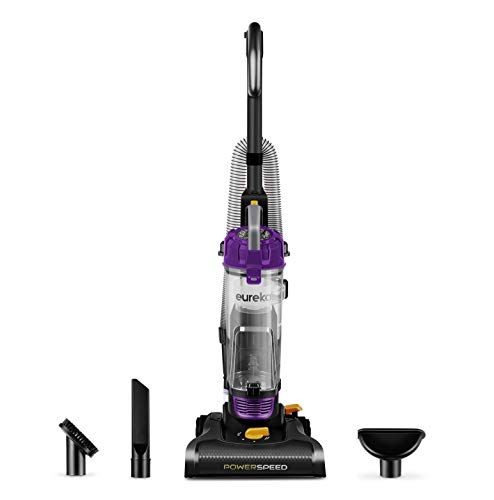
Eureka PowerSpeed Upright Vacuum NEU182B — Best for Mixed Pile Heights
If the NEU280 is the generalist, the NEU182B is the sibling with two specifications worth circling. The first is its five-height brush roll adjustment. Homes rarely have one floor: there is the low office carpet, the medium living-room pile, the plush rug someone loved in the shop, and the hard kitchen. Each wants the brush at a different height, close enough to agitate, high enough not to stall or scatter. Five settings give you a fighting chance of matching all four without the machine protesting, and owners who actually use the dial — it takes a second, at the start of each room — get visibly better pickup for their trouble.
The second is capacity. A 2.6L dust cup at a machine weight of ten pounds is a generous pairing, and it changes the rhythm of a big clean: fewer interruptions, fewer trips to the bin, less of the performance sag that comes from a cup packed to its line. The purple finish divides opinion and is entirely irrelevant to its work, though it does make the machine easy to spot in a dim garage. Pet hair, carpet and hard floor are again the stated territory, and the PowerSpeed family’s shared manners apply — light to push, light to carry, easy to live beside.
Choosing between the two Eurekas comes down to your floors. Uniform medium carpet throughout? The NEU280’s cyclone emphasis is the tidier story. A patchwork of rugs and boards at different depths? The NEU182B’s adjustment range and bigger cup answer the actual problem. Neither answer is wrong, which is why both earn places here rather than one crowding the other out.
- Format: corded bagless upright
- Weight: 10lbs, per the listing
- Dust cup: 2.6L capacity
- Adjustment: five brush-roll height settings
- Surfaces: pet hair, carpet and hard floor
Strengths
- Height range suits genuinely mixed flooring in one home.
- Large cup stretches the distance between emptying trips.
- Ten-pound body keeps stairs and storage painless.
Trade-offs
- The dial only helps owners who remember to turn it.
- Bold colour will not blend into every hallway.
- Same bagless emptying dust puff as its sibling.
Best for: homes layering rugs of different depths over hard floors.
Not suited for: single-surface homes paying for adjustment they will never touch.

Dirt Devil Endura Lite Upright Vacuum — Best Straightforward Simplicity
Dirt Devil built its name on machines that assume the owner has better things to think about, and the Endura Lite continues the tradition with unusual purity. It is a bagless upright for carpet and hard floor, described by its maker as powerful and lightweight, with a cord, a cup and a job to do. There is no app, no screen, no mode menu to scroll while standing in a dirty hallway. For a second home, a rental property, a teenager’s first flat or a family that keeps breaking complicated appliances, that restraint is not a missing feature. It is the feature.
The Endura name refers to the filtration and debris-handling side of the design, intended to keep performance steadier as the cup loads. In weekly terms it means the machine tolerates the realistic pattern — vacuumed hard before guests, ignored for a fortnight after — without punishing the owner with a dramatic loss of pickup the moment the cup is half full. Light weight makes it the vacuum most likely to be fetched for a single-room emergency, and frequency of use, as any honest cleaning guide admits, beats theoretical power in determining how clean a house actually stays.
Set expectations at the level the machine sets for itself. The tool selection and finish are workmanlike rather than lavish, and long sessions on deep plush pile are outside its happiest territory. Within its brief — hard floors, ordinary carpets, regular use, minimal thought — it is a difficult machine to criticise, and its simplicity gives it a longevity advantage: there is very little aboard to go wrong in an interesting way.
- Format: corded bagless upright
- Surfaces: carpet and hard floor
- Handling brief: lightweight, home use focus
- Debris system: Endura design for steadier loaded performance
- Controls: deliberately simple, no app layer
Strengths
- Nothing to configure before it starts cleaning well.
- Light body encourages quick single-room deployments.
- Tolerant of irregular, real-world cleaning schedules.
Trade-offs
- Accessory set is functional rather than generous.
- Deep plush carpet is beyond its preferred ground.
- Finish and fittings feel utilitarian up close.
Best for: rentals, second homes and anyone allergic to appliance complexity.
Not suited for: buyers wanting a rich tool kit and premium fittings.

Amazon Basics Upright Bagless Vacuum — Best Tool Kit Included
House-brand appliances live or die on whether the specification sheet was written by someone who cleans. This one reads well: a 1.7L dust cup, a washable filter, a 25ft cord, and — the detail that lifts it — crevice and upholstery tools included, with a detachable handle that converts reach into a practical thing rather than a brochure claim. The stairs, the sofa cushions, the car footwell on a desperate Sunday: those jobs are where uprights usually surrender and owners start improvising with the wrong nozzle. This machine at least arrives dressed for them.
The 25ft cord deserves its own sentence because cord length quietly governs room-to-room flow. In an average house it means a hallway socket can serve two bedrooms and the landing, and the clean proceeds in a continuous pass instead of a series of expeditions. The cup is smaller than the big Eureka’s, so the trade is explicit: tools and reach in exchange for more frequent emptying on large cleans. For apartments and medium homes, where a full cup rarely happens in one session anyway, that trade tilts in this machine’s favour.
On floors it covers the standard brief of carpet and hard floors with the brush and airflow expected at this level. The detachable handle also helps with cobweb duty along ceiling edges, an unglamorous job that homes need twice a year and that separates a household tool from a floor-only appliance. As a first vacuum for a first home, bought alongside the mop and the kettle, it makes a composed case for itself.
- Format: corded bagless upright
- Dust cup: 1.7L capacity
- Cord: 25ft, per the listing
- Tools: crevice and upholstery tools included
- Handle: detachable for above-floor reach
- Filter: washable
Strengths
- Included tools cover stairs, sofas and car footwells.
- Long cord reduces socket-hopping on a floor.
- Detachable handle turns reach jobs into quick jobs.
Trade-offs
- Smaller cup fills sooner on whole-house cleans.
- House-brand resale and spares ecosystem is thinner.
- No height-adjustment headline to match the NEU182B.
Best for: first homes and apartments wanting one machine plus its tools.
Not suited for: large houses where cup capacity dominates the session.

Dirt Devil Power Express Stick Vacuum — Best for Very Small Homes
Let us be precise about what this is: a corded stick vacuum, included in an upright guide under a flag of honesty. It does not have an upright’s floor head width, cup size or carpet conviction. What it has is a silhouette that stores in the gap beside a fridge, a weight that one hand manages, and enough ability for the floors of a dorm room, a studio or a small apartment where the entire cleaning round is measured in minutes. For those homes, the best upright is arguably the machine that fits the home, and this is the shape that fits.
The cord, unfashionable as ever, is an asset in small spaces: no battery to degrade in a hot cupboard, no runtime cliff, and the whole flat lies within one socket’s reach anyway. Bagless debris handling keeps costs at zero beyond electricity. On hard floors and low rugs — the surfaces small homes actually have — a stick’s lighter head is nimble around furniture legs and under the bed frame that dominates a studio. Daily five-minute passes, which this format encourages, keep a small space feeling genuinely clean.
The boundaries are equally clear. Hand it a family house with deep carpets and it will spend a long time achieving a mediocre result, because that is not the brief it was built for. Its cup is small, its head is narrow, and both facts are the price of the storage miracle. Read it as the answer to a floor-plan problem, not as a budget substitute for a true upright, and it is a very good answer indeed.
- Format: corded stick vacuum, bagless
- Intended spaces: dorms, apartments and other small homes
- Storage: slim profile for gaps and cupboards
- Surfaces: hard floors and low rugs happiest
- Power: corded, no battery to maintain
Strengths
- Stores where a full upright physically cannot.
- One-handed weight suits quick daily passes.
- Corded design sidesteps battery ageing entirely.
Trade-offs
- Not a true upright; deep carpet defeats its brief.
- Small cup and narrow head slow larger jobs.
- Above-floor tool work is limited by format.
Best for: studios, dorms and compact flats with mostly hard floors.
Not suited for: family houses needing whole-home deep carpet cleaning.

Bissell CleanView Compact Upright Vacuum 3508 — Best Compact True Upright
Bissell’s CleanView Compact answers the same storage problem as the stick above but from inside the upright family: a real upright floor head and handle, compressed into a body sized for apartments and dorms. The headline technology is scatter-free cleaning, aimed at the hard-floor annoyance where a brush roll flicks litter and kibble ahead of the machine instead of under it. Anyone who has chased the same dry bean around a kitchen floor for three passes understands why that claim leads the listing. On hard surfaces, containing debris at the head is worth more than raw pull.
The removable extension wand is the second practical idea. Compact uprights often strand their owners at skirting level, unable to reach a stair tread or a sofa’s edge without hauling the whole body. A wand that detaches quickly turns the machine into its own above-floor tool, which in a small home — where the vacuum must be every vacuum — matters disproportionately. Bissell’s pet-focused heritage also shows in the general tuning; small homes with a cat produce a concentrated version of the hair problem, and this machine is pitched squarely at it.
Compromises follow the compact brief. The cup and head width are scaled down, so a large house will feel the extra passes and emptying trips. But as a true upright that stores in a shallow cupboard, cleans hard floors without scattering their contents and reaches its own stairs, the 3508 occupies a niche the bigger machines cannot enter, and it occupies it convincingly.
- Format: corded bagless compact upright
- Hard-floor trait: scatter-free technology, per the listing
- Reach: removable extension wand
- Intended spaces: apartments, dorms and smaller homes
- Design: compact footprint for shallow storage
Strengths
- Scatter-free head tames litter on kitchen floors.
- Extension wand covers stairs without a second machine.
- Genuine upright layout in a cupboard-friendly body.
Trade-offs
- Scaled cup and head slow very large cleans.
- Compact dimensions limit deep-pile ambition.
- Tool set centres on the wand rather than extras.
Best for: apartment dwellers wanting a real upright that stores small.
Not suited for: big multi-storey houses cleaning in long sessions.
How Do the Six Machines Compare at a Glance?
| Model | Format | Cup / cord notes | Defining trait |
|---|---|---|---|
| Eureka PowerSpeed Upright Vacuum NEU280 | Upright | Washable filter | Upgraded cyclone, all-round balance |
| Eureka PowerSpeed Upright Vacuum NEU182B | Upright | 2.6L cup, 10lbs | Five height settings |
| Dirt Devil Endura Lite Upright Vacuum | Upright | Bagless cup | Deliberate simplicity |
| Amazon Basics Upright Bagless Vacuum | Upright | 1.7L cup, 25ft cord | Crevice and upholstery tools |
| Dirt Devil Power Express Stick Vacuum | Stick | Slim storage | Small-space format |
| Bissell CleanView Compact Upright Vacuum 3508 | Compact upright | Extension wand | Scatter-free hard-floor work |
The table compresses; the reviews above carry the judgement. In short: capacity and adjustment live with the Eurekas, tools with the Amazon Basics, simplicity with the Endura Lite, and the two compact shapes divide by whether you still want a true upright head.
How Should You Match an Upright to Your Carpet Pile?
Brush height is the quiet determinant of upright happiness. Set the head too high on medium pile and the roll skims, polishing the surface while the grit stays buried at the roots. Set it too low on plush carpet and the machine growls, drags and can stall its own brush, while the operator concludes wrongly that the vacuum is weak. The working test is tactile: on the correct setting the machine pulls itself forward gently and the handle vibrates with agitation without fighting your arm. Work through the settings on your deepest rug once, memorise the number or notch, and repeat that small ritual whenever the floor changes character.
Hard floors invert the logic. A brush spinning at carpet height can scatter debris and, on delicate surfaces, is simply unnecessary agitation. Some owners switch the roll off where the machine allows; others raise the head and slow down. Either way, the transition between rooms deserves three seconds of thought, because those three seconds are the difference between a vacuum that seems temperamental and one that seems telepathic. Homes with one continuous surface can ignore this entire section, which is its own kind of luxury.
What Is the Sensible Way to Vacuum a Whole House?
Order matters more than effort. Begin at the furthest bedroom and work toward the front door, so the cord and the machine never cross freshly cleaned carpet. Carry the machine upstairs first if the home has two floors; gravity is a better assistant on the way down. In each room, work the perimeter slowly — that is where dust concentrates and where the head’s edge cleaning is tested — then cover the field in overlapping lanes at a pace that lets the brush agitate rather than skim. Two slow passes over the traffic lane in front of a sofa outperform five hurried ones everywhere.
Empty the cup when it reaches its marked line, not when it begs. A bagless cup past its line starts returning dust to the filter, and performance falls in a way owners misdiagnose as motor failure. Rinse washable filters on a rota tied to something memorable — the first weekend of the month works — and let them dry a full day before refitting, because a damp filter in a warm cupboard grows the musty smell people blame on the vacuum itself. Ten minutes of this discipline per month is the entire maintenance contract for most of this group.
How Do You Vacuum Stairs Without Hating the Job?
Stairs defeat full-size uprights by geometry, so technique and tools take over. Where a machine offers a detachable handle, a wand or hose-fed tools, work from the bottom step upward with the body parked safely on the floor below, never balanced on a tread. The crevice tool handles the junction where tread meets riser, which is where stair dirt actually lives; the upholstery tool, run slowly, lifts the compressed traffic lane in the centre of each step. Compact models like the Bissell can sometimes be carried and used on the stairs directly, one hand on the rail, but only where the body is light enough to control without leaning.
Frequency rescues the whole enterprise. Stair carpet shows wear in its centre strip years before the rooms do, largely because grit is ground in by every passing foot. A quick tool pass weekly — five minutes, no full session — removes the abrasive load and visibly extends the carpet’s life. Households that adopt that habit stop dreading stairs, because the job shrinks from an event into a routine.
What About Homes With Shedding Pets?
Hair changes the workload in three ways. It fills cups faster, it wraps brush rolls, and it weaves itself into upholstery where floor heads cannot go. The first is solved by emptying without pride mid-clean. The second is solved by a monthly brush inspection: flip the machine, cut the wound hair along the roll’s groove if it has one, and spin the roll by hand to confirm it turns freely. A roll strangled by hair still rotates, which is the trap — it just stops agitating, and the vacuum quietly becomes a loud broom.
The third is a tools question, and it is why the Amazon Basics earns its badge in pet homes despite its smaller cup: the upholstery tool is the difference between a sofa that sheds onto guests and one that does not. Pet owners should also vacuum more often in smaller doses. Hair removed on Tuesday never gets walked into the pile by Friday, and the light weight of every machine here makes that pattern physically plausible in a way a sixteen-pound flagship never did.
How Long Will a Budget Upright Realistically Last?
Expect years, not decades, and plan accordingly. The wear items are the brush roll, its belt where the design uses one, filters and the cup’s seals. All are cheap and, on mainstream brands like Eureka, Bissell and Dirt Devil, easy to source. The motors in this class are simple and durable; what usually ends a budget upright’s life is a cracked cup, a worn brush housing or an owner who stops maintaining it and concludes it died. Treat the machine as a five-to-eight-year appliance with light upkeep and it will usually honour that estimate.
Storage shapes lifespan too. A vacuum kept in a damp garage ages faster than one in a hall cupboard, and a cord wound tightly around its hooks for years will eventually crack its insulation at the strain points. Coil loosely, store dry, and empty the cup before putting the machine away rather than letting a full cup sit and smell. None of this is heroic. It is the ordinary care that separates the upright that is replaced in irritation from the one that is replaced, eventually, with mild gratitude.
How Should You Manage the Cord So It Stops Managing You?
Experienced upright owners develop a cord ritual without noticing. Start in the room furthest from where you will finish, with the cord paid out behind you in loose loops over one forearm, and work toward the socket so the machine always moves away from the slack rather than over it. Vacuum the centre of each room first and the doorway last, which keeps the cord out of the head’s path. When you change rooms, carry the loops rather than dragging the plug across floors it has just cleaned. It sounds fussy for exactly one session; by the third it is muscle memory, and the cord’s reputation as the category’s great burden shrinks to its real size, which is a minor chore performed on autopilot.
Cord care extends the machine’s life, too. Never yank the plug from the socket by the cable, never run the head over the cord itself — a brush roll will chew insulation surprisingly fast — and store the cord in wide loops rather than the tightest wrap the hooks allow. If the cord is damaged, that is a repair-or-replace decision, not a tape-and-hope decision. A 25ft cord like the Amazon Basics model’s also reduces how often any of this matters, since fewer socket changes mean fewer chances to fight the cable per clean.
What Can These Machines Do for Allergy Management at Home?
Honesty first: none of the six is a sealed, hospital-grade filtration system, and anyone with a diagnosed dust allergy under medical advice should shop that specific category. What a regularly used bagless upright does contribute is removal. Dust that is in the cup is not in the carpet, and the single largest allergy lever available to any household is vacuuming frequency on soft furnishings and bedroom floors, where mites and their debris concentrate. A light machine that gets used twice a week improves a bedroom’s dust load more than a superior machine that is used monthly because it is heavy and lives in the garage.
Technique sharpens the benefit. Vacuum bedrooms slowly, with extra passes over the strip beside the bed. Empty the cup outdoors or into an outside bin, and consider wearing a simple mask for that thirty seconds if dust provokes you, because cup emptying is the one moment a bagless design returns its catch to the air. Rinse filters on schedule; a clogged filter is not filtering, it is merely obstructing. Those habits, layered on any pick here, deliver most of what this price class can honestly offer an allergy-aware home.
How Noisy Is a Saturday-Morning Clean, Really?
Budget uprights are not quiet machines, and pretending otherwise helps nobody. They are, however, brief. A whole house takes most owners between twenty and forty minutes, and the practical etiquette is scheduling rather than engineering: not during a baby’s nap, not opposite a night-shift sleeper’s morning, and in flats, not before a civilised hour on weekends. Within the clean itself, hard floors amplify the sound while carpet muffles it, so reordering rooms to finish on carpet gives the household a gentler ending.
Some of the perceived noise is maintenance in disguise. A brush roll wound with hair thumps. A cup overfilled whines as airflow strains. A loose tool rattles in its clip for an entire session, announcing itself as mechanical distress. Keep the machine maintained and the sound settles to its honest level, which most households tolerate as the noise of a job being finished properly. If someone in the home works nights permanently, the conversation changes and a quieter category deserves a look, but for the standard Saturday pattern, duration beats decibels as the thing to optimise.
Why Do Renters Keep Choosing This Class of Vacuum?
Rental homes concentrate every argument for the lightweight bagless upright. Floors are mixed and unknown until moving day. Storage is a shallow cupboard if fortune smiles. The tenancy may last a year, making a decade-grade appliance a stranded investment, and the deposit often depends partly on carpets leaving in good order, which rewards frequent, easy vacuuming. A machine in this class costs little enough to buy without a committee meeting, moves house in one hand and stores in the space rentals actually provide.
There is also a landlord-shaped consideration: hard floors in rental kitchens and bathrooms are frequently older vinyl or laminate that resents aggressive brush action. A height-adjustable or scatter-aware head treats those surfaces gently. And when the lease ends, the same machine that handled the rental handles the first owned home’s bedrooms without embarrassment. Several picks here are bought twice by the same people — once for the flat, once for the house — which is its own kind of review.
When Does a Home Need a Second, Smaller Vacuum?
The upright’s weakness is the small, sudden job: a shattered crisp packet, litter kicked across the mat, the daily drift in the hallway. Hauling out a full machine for ninety seconds of work means the work often waits, and waited-on grit gets walked through the house. That is the honest case for pairing — a handheld or stick for the daily ninety seconds, the upright for the weekly truth. The Power Express in this list can itself be that second machine in a home whose main vacuum is heavier, and the Bissell Compact can play either role depending on the size of the home around it.
Resist the opposite error, which is a cupboard of overlapping machines each doing the weekly job slightly differently. Two machines with distinct duties get used; three with the same duty breed decision fatigue and dust. Choose the upright here as the anchor, add one quick-response partner if your life generates daily debris, and let that be the fleet. Homes with stairs sometimes add a third only in the sense that the upstairs machine never travels: a compact kept on the landing is not extravagance, it is how the top floor gets cleaned at all.
How Should You Deep-Clean a Room Seasonally With an Upright?
Twice a year, a room deserves the full ceremony, and an upright is the right celebrant. Move the furniture to one side — all of it, not the apologetic shuffle — and vacuum the exposed half slowly, including the pale rectangle where the sofa stood, which will show you exactly how much dust a room accumulates in the places nobody sees. Run the crevice tool along every skirting junction and behind radiators. Then swap the furniture to the cleaned half and repeat. Wash or check the filter before you start, because a seasonal clean is the longest session of the year and the machine should begin it at full strength.
Upholstery joins the ceremony. Sofa cushions off, tool over every surface, into the seams where coins and crumbs conduct their archaeology. Curtains get a gentle pass if the fabric tolerates it. The point is not perfection; it is resetting the room’s dust baseline so the weekly rounds have less to manage. Owners who do this in spring and autumn find the ordinary cleans getting shorter, which is the closest thing cleaning offers to compound interest.
What Should You Check in the First Fortnight With a New Upright?
Use the return window as a test programme. Clean your hardest room — the one with the rug, the pet and the gritty doorway — and inspect the result at floor level in daylight, not from standing height in lamplight. Check the cup after one room to learn its true filling rate in your home, since that number, not the litre figure, governs your sessions. Run the machine on every surface you own, including the bathroom mat and the doormat itself, and confirm the height settings behave. Carry it up your stairs once at the end of a clean, when you are tired, because that is the honest version of the test.
Also test the boring promises: the cord reaches where the listing implied, the tools click on and stay on, the cup releases without a dust explosion, the filter comes out without a video tutorial. A machine that passes the fortnight will almost certainly serve for years, because uprights rarely develop new personalities later. One that annoys you in week one will annoy you in year three at exactly the same points, only louder.
How Do You Keep Hard Floors Safe Under a Spinning Brush?
Most hard floors tolerate these machines well, but three precautions separate care from hope. First, keep the brush roll clean: a single trapped screw or piece of gravel in the roll becomes a tiny lathe tool dragged across your boards. A ten-second roll check before hard-floor sessions prevents the only real damage risk. Second, raise the head or slow down on soft vinyl and older laminate, whose surfaces mark more readily than tile or sealed wood. Third, empty grit from the cup’s intake path regularly, because debris dribbling from a clogged head can be ground under the wheels on the next pass.
The scatter question belongs here too. Dry litter on a hard floor tests the head’s design more than its power, and the Bissell Compact’s scatter-free brief exists precisely because owners complained. Whatever model you choose, approach scattered debris slowly and head-on, letting the head ingest rather than charge. Technique forgives many specifications, and on hard floors technique is most of the story.
What Mistakes Do Upright Buyers Make Most Often?
Buying for the largest room and storing for the smallest is the classic error: the machine that cleans the lounge beautifully but lives in the garage because the cupboard rejects it will be used half as often as a compact it outperforms on paper. Measure the cupboard. A second mistake is ignoring cord length and then blaming the machine for a session chopped into socket-sized fragments. A third is running one height setting across every surface for years, then rating the vacuum mediocre at jobs it was never adjusted to attempt.
The fourth mistake is treating bagless as maintenance-free. Bagless means no bags to buy; it does not mean no filter to rinse, no cup to empty at the line and no brush to de-hair. Owners who accept the small contract get the performance the design promises. Owners who do not are, in effect, reviewing a different and worse machine of their own making.
How Does Cup Size Change the Way a Clean Feels?
Capacity sounds like a specification and behaves like a mood. A 2.6L cup, as on the NEU182B, lets a three-bedroom clean proceed as one continuous story: rooms flow into each other, the machine’s note stays constant, and the operator finishes with the mild satisfaction of a job done in a single arc. A 1.7L cup inserts a chapter break. Neither is objectively superior; the break bothers some owners intensely and others not at all, and it correlates with house size more than with patience. Big homes with pets should treat capacity as a headline feature, because pet hair is mostly air and fills volume absurdly fast.
There is a counter-consideration: a large cup emptied rarely is heavier at the bin and dustier in the event. Owners with dust sensitivity sometimes prefer smaller, more frequent, smaller-cloud emptying. Know which person you are. The litre number on the listing is the beginning of that self-knowledge, and the fortnight test described earlier is where you confirm it.
What Role Does the Upright Play in a Home With a Robot Vacuum?
An increasingly common one: senior partner. The robot maintains, the upright restores. Edges, stairs, upholstery, the seasonal furniture ceremony and the deep carpet work all remain upright territory even in automated homes, and a lightweight corded machine is the ideal complement precisely because it is not asked to be charming or autonomous — only powerful, available and quick to deploy when the human decides a room needs the truth. Homes that own both tend to vacuum more in total, not less, because each machine is used for what it does without resentment.
If that is your plan, choose the upright for tools and height range rather than for cup size, since the robot will keep daily volume low. The Amazon Basics with its attachments, or the NEU182B with its adjustment dial, fit the partnership best. And keep the upright’s sessions monthly-deep rather than weekly-routine; the division of labour is the entire point.
How Should You Read an Upright Listing Without Being Misled?
Translate every claim into the question it answers. Lightweight: compared with what, and is a number given? The NEU182B’s stated ten pounds is a fact; an unnumbered adjective is a hope. Pet hair: does the listing name a tool, a brush design or a height range that addresses hair, or is the animal merely photographed nearby? Washable filter: genuinely rinseable, or merely replaceable at a price? Cord length, cup litres and height settings are the hard numbers in this class, and listings that provide them, as these six do in varying combinations, deserve more trust than listings that traffic in wattage theatre.
Finally, read the omissions. No height adjustment mentioned usually means none fitted. No tools listed usually means none in the box. None of that makes a machine bad — the Endura Lite’s plainness is its charm — but it should be priced and chosen as what it is. A listing read this way stops being advertising and becomes a specification, which is the only basis on which a vacuum should ever be bought.
How Should a Growing Family Reassess Its Upright?
Families outgrow vacuums the way they outgrow shoes: gradually, then at a holiday. The signals are a cup that fills twice per clean where it once filled once, a nursery rug the machine cannot quite refresh, and a second floor that has quietly stopped being vacuumed because carrying the machine upstairs lost its argument with tiredness. When two of those three appear, the answer is rarely a bigger version of the same thing; it is a reassessment of the whole system — perhaps a lighter upright for the weekly round, perhaps a second compact kept upstairs, perhaps tools the current machine never had.
The picks in this guide were chosen to age gracefully through that reassessment. A machine demoted to upstairs duty or second-home duty has not failed; it has been promoted into a fleet. Buy the upright that fits the home you have, use it fully, and let the family’s growth, rather than a catalogue, tell you when the fleet expands.
Final Recommendation
For most family homes the Eureka PowerSpeed Upright Vacuum NEU280 is the calm default: balanced, washable-filtered and easy on every generation of user. Homes with genuinely varied pile should step sideways to the Eureka PowerSpeed Upright Vacuum NEU182B for its adjustment range and bigger cup, while tool-driven cleaners — stairs, sofas, cars — will get more from the Amazon Basics Upright Bagless Vacuum and its included kit. The Endura Lite serves simplicity, the Power Express serves floor plans with no storage, and the Bissell Compact serves small homes that still want a proper upright head.
Pick by your floors and your cupboard rather than by any single specification, and the machine you bring home will still be earning its place long after the novelty of choosing it has faded into the weekly round.
Frequently Asked Questions
Is a corded upright still worth buying over a cordless model?
For whole-house cleaning, yes. A cord delivers full power for as long as the session lasts, with no runtime ceiling and no battery that will age into a replacement purchase. Cordless machines win for quick spot cleans and homes where outlets are scarce. Many households end up with one of each, but if only one vacuum can be bought, the corded upright remains the safer single answer for a full family clean.
How often should I wash the filter on a bagless upright?
A monthly rinse suits most homes, more often where pets or renovation dust are involved. Rinse until the water runs clear, then let the filter dry completely — a full day is a safe rule — before refitting it. A damp filter restricts airflow and can smell musty. Never run the machine without the filter in place, however tempting a quick job makes it seem.
Why does my upright leave a line of grit at the edge of the room?
Edge lines usually come from pace and adjustment rather than failure. Slow down along the perimeter so the head’s edge has time to work, check the brush height suits that surface, and run the head parallel to the skirting rather than at an angle. If the line persists, inspect the brush roll for wound hair narrowing its effective width, and clear the cup if it is past its fill line.
Can these lightweight uprights handle thick, plush carpet?
They can maintain it, with the height set high, but deep plush is not their favourite ground and progress will be slower than on medium pile. Homes dominated by thick carpet should prioritise the model with the widest height adjustment, the NEU182B here, and test the setting on the deepest rug first. If the brush stalls repeatedly at every setting, the honest answer is a heavier machine class altogether.
What should I check before assuming a budget upright is broken?
Work through the unglamorous list: cup emptied to below its line, filter rinsed and fully dry, brush roll spinning freely by hand with no hair binding its ends, hose and intake path clear of the sock or toy that every household eventually feeds it. Most sudden performance losses in this class resolve somewhere on that list, usually at the brush roll.
Related Guides
An upright covers the weekly deep clean, yet most homes pair it with something quicker for daily crumbs and something smaller for the car. Our handheld roundup is the natural companion read, and the two further guides below wander into the kitchen and bathroom corners of the same home-care shelf. Continue with Best Cordless Handheld Vacuums for Pet Hair and Cars for the grab-and-go partner, then look at Best Ducted Range Hoods Under Cabinet for the room where cooking undoes your cleaning fastest, and finish with Best Luxury Freestanding Bathtubs for the upgrade end of the bathroom.


