What's inside
- Key Takeaways
- Quick Picks
- How Did We Judge Mats on Cleanliness?
- How Do the Six Picks Compare on Upkeep?
- Why Does Drying Speed Matter More Than Absorbency?
- How Often Should a Fabric Bath Mat Actually Be Washed?
- How Do You Keep the Floor Beneath a Mat Fresh?
- What Is the Right Way to Refresh a Stone Mat?
- How Should Humid Bathrooms and Weak Ventilation Change Your Choice?
- Which Cleaning Mistakes Quietly Make Mats Worse?
- How Do You Know When a Mat Should Be Replaced?
- How Should Guest Bathrooms and Second Bathrooms Be Handled?
- What Does a Sensible Weekly Hygiene Rhythm Look Like?
- How Can You Tell Whether Your Ventilation Is Helping Enough?
- How Do Hard Water and Product Residue Affect a Mat Over Time?
- What Should You Do After Illness or a Houseful of Guests?
- How Does the Season Change a Mat’s Hygiene Needs?
- Final Recommendation
- Frequently Asked Questions
- Related Guides
As an Amazon Associate I earn from qualifying purchases. This post may contain affiliate links at no extra cost to you.
cottageverdict.com is reader-supported. When you buy through links on our site, we may earn an affiliate commission.
Where to buy: Each mat in this shortlist is sold through Amazon; use a linked name to reach its listing, check price on Amazon there, and read the care instructions twice, because hygiene lives in those details.
A bath mat is the hardest-working textile in the house and the one most likely to be quietly unhygienic, because it does its job while soaked, warm, and pressed against a floor that rarely dries completely. Searching for the best bath mats for cleanliness is really a search for materials and habits that interrupt that damp cycle: surfaces that release water quickly, constructions that survive frequent washing without falling apart, and routines a real household will actually keep on a tired Thursday evening. Comfort matters here, but it ranks second to a mat that can be returned to genuinely clean, genuinely dry, again and again.
Two philosophies dominate the clean-mat world, and this guide puts them head to head. Stone mats made from diatomaceous earth pull water off feet and evaporate it from a hard, mineral surface that never goes into a washing machine at all. Fabric mats, chenille and memory foam, catch more water and feel kinder, but they ask for laundry discipline in exchange. Neither philosophy wins universally; the right answer depends on how many people shower, how humid the room stays, and whether anyone in the house reliably hangs a mat up to dry.
A note on honesty before the picks: a cleaner mat supports a fresher bathroom and more comfortable routines, and that is the claim this guide makes. Mats are household textiles, not medical devices, and nothing below promises health outcomes. What good hygiene design can do is remove the persistent dampness that makes bathrooms smell stale and feel neglected, and that everyday freshness is worth pursuing on its own terms.
Key Takeaways
- Drying speed decides cleanliness more than any antibacterial slogan, because a dry surface gives grime nowhere comfortable to linger.
- Stone mats sidestep laundry entirely, asking only for air, an occasional rinse, and rare light sanding to refresh absorption.
- Fabric mats stay hygienic only with a rhythm: regular machine washing, thorough drying, and airing between showers.
- Rubber backings protect floors yet trap moisture underneath, so lifting and airing the mat matters as much as washing it.
- Households with several daily showers should favour the fastest-drying option their feet can tolerate.
- Replacing a mat whose backing has cracked or whose pile stays musty after washing is a hygiene decision, not extravagance.
Quick Picks
| Pick | Badge | Why it made the list |
|---|---|---|
| Sutera Stone Bath Mat | Fastest-drying surface | Diatomaceous earth in a slate tone that drinks water from feet and dries itself in open air. |
| TOSORO Stone Bath Mat | Compact stone option | A sandstone-finished diatomite slab sized for smaller floors that still want laundry-free upkeep. |
| OLANLY Chenille Bathroom Rug | Washable chenille leader | Quick-drying rubber-backed chenille that tolerates the frequent machine cycles hygiene demands. |
| DEXI Chenille Bath Rug | Big washable coverage | A large chenille field for busy family bathrooms that still commits to regular washing. |
| LuxUrux Chenille Bath Mat | Quick-dry plush pick | Light, plush microfiber chenille that dries fast between showers and launders without fuss. |
| OLANLY Memory Foam Bath Mat | Cushioned washable choice | Thick foam comfort for people who will not give up softness, in a machine-washable build. |
How Did We Judge Mats on Cleanliness?
Every candidate was interrogated with the same unfriendly questions. How long does the surface stay wet after two showers in a row? Where does the water go, into a machine-washable pile, into a stone that evaporates it, or into a backing layer that hides it? What maintenance does the listing actually describe, and would a busy person perform that maintenance weekly for a year? Mats that could not answer those questions with a plausible routine were set aside, however plush they felt.
Drying architecture mattered more than absorbency headlines. A mat can absorb impressively and still fail hygienically if it holds that water until midnight in a steamy room. Stone scored highly because evaporation begins immediately across its whole face. Chenille scored well when its pile was paired with quick-drying claims and a backing that did not seal moisture in. Foam required the most scrutiny, since thick cores dry slowly, and only a washable, well-backed example earned a place.
Longevity under cleaning closed the assessment. A mat that survives fifty washes with its backing intact is cleaner in year two than a delicate mat washed six times and then neglected because its owner fears ruining it. Hygiene is a behaviour supported by design, so durability and simplicity were treated as cleanliness features in their own right throughout this shortlist.

Sutera Stone Bath Mat — Fastest-drying surface
Step off a shower onto the Sutera and the strangest thing happens: your footprints appear as dark wet marks, then fade while you brush your teeth. That vanishing act is diatomaceous earth doing its one job brilliantly, pulling water into a mineral matrix and surrendering it to the room’s air across the whole slate-toned surface. From a cleanliness standpoint, the appeal is profound, because there is no damp pile harbouring the day, no backing glued against wet tile, and nothing to feed into a washing machine on a schedule you will eventually break.
Care reshapes itself around air rather than laundry. The listing describes a natural material that restores with light sanding, which addresses the one way stone mats age: oils and soap film can slowly seal the pores, absorption softens, and a gentle sanding reopens the surface. Day to day, a rinse and a spell standing in moving air keep it honest. Households that run an extractor fan, or can lean the mat near a window between showers, will see the fastest drying of any pick in this guide.
The compromises are tactile and thermal. Stone feels firm and cool, even chilly on a winter morning, and there is no cushion for anyone who lingers at the mirror on sore feet. It also asks for a flat, stable floor and a household that will not drop heavy glass bottles onto it. Accept those terms and the Sutera offers the lowest-effort hygiene routine here: dry feet, dry floor, almost no chores.
- Material: diatomaceous earth stone
- Finish highlighted: slate tone
- Drying style: evaporates in open air
- Care: rinse, air, occasional light sanding
- Laundry required: none
Strengths
- Surface dries itself between showers
- No washing machine in its routine
- Sanding refreshes tired absorption
Trade-offs
- Firm, cool feel under bare feet
- Needs flat placement to sit safely
- Heavy bottles dropped on it are unwelcome
Best for: busy households wanting the driest possible floor with almost no laundry effort.
Not suited for: anyone who equates a bath mat with softness, or bathrooms with uneven old floors.

TOSORO Stone Bath Mat — Compact stone option
The TOSORO brings the same diatomite logic to a smaller footprint, listed at 23.5 by 15 inches in a sandstone finish, and that size is its hygiene argument as much as its space argument. A compact slab in a compact bathroom leaves more hard floor exposed to air and mopping, so the room as a whole dries faster than one carpeted wall to wall with absorbent fabric. In ensuites and cloakrooms where ventilation is modest, shrinking the wet zone is a genuinely clean strategy.
Its surface behaviour mirrors its larger rival: water spreads, darkens the sandstone tone briefly, then lifts away as the stone breathes. The non-slip character described in the listing matters for cleanliness indirectly, because a mat that stays aligned keeps wet footprints on the stone rather than smeared across surrounding grout. Grout, once repeatedly soaked, becomes the hardest part of any bathroom to keep fresh, so containing water on an evaporating surface protects the room beyond the mat itself.
Small size cuts both ways, of course. Two people stepping out in sequence may overflow its hospitality, and bathers who exit a tub along its length will land partly on tile. Treat the TOSORO as a precision instrument for a single shower door or a tight basin zone, and its laundry-free routine feels like a small daily gift rather than a compromise.
- Size from listing: 23.5 by 15 inches
- Material: diatomaceous earth diatomite
- Finish highlighted: sandstone
- Drying style: quick evaporation
- Care: wipe or rinse, then air
Strengths
- Shrinks the damp zone in small rooms
- Keeps water off vulnerable grout lines
- Fits tight floors larger stones cannot
Trade-offs
- Modest span for two-person routines
- Firm feel, like every stone surface
- Tub users may step beyond its edge
Best for: ensuites, cloakrooms, and single-shower homes wanting laundry-free drying in miniature.
Not suited for: long tubs or couples showering back to back on a tight schedule.
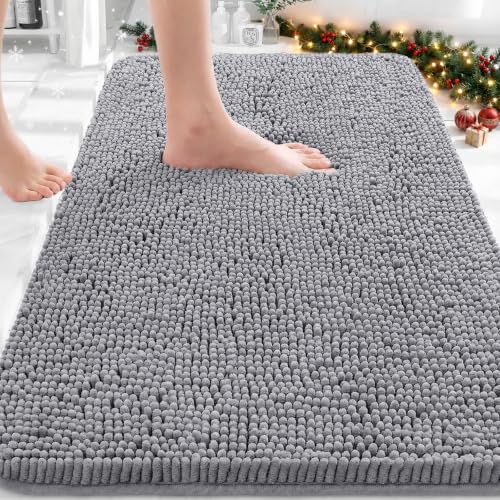
OLANLY Chenille Bathroom Rug — Washable chenille leader
Plenty of households will never accept a stone slab, however clever, and for them cleanliness must come from a fabric mat that welcomes the washing machine instead of fearing it. The OLANLY chenille, listed at 30 by 20 inches in grey with a quick-drying rubber backing, is built for exactly that bargain. Its loops absorb the step-out splash generously, then the whole mat goes into a cool wash, comes out, dries comparatively quickly, and returns to duty without drama or special detergents.
The rubber backing deserves both praise and supervision. It shields the floor from through-soaking and keeps the mat planted, yet any impermeable layer can hold a film of moisture against tile if the mat is never lifted. The hygienic habit is simple: drape the mat over the tub edge or a rail for an hour after morning showers, a few times a week, and the underside dries before anything stale can develop. That tiny ritual, plus a weekly wash, keeps this chenille fresher than far more elaborate systems that nobody maintains.
Grey is a sensible hygiene colour here, not for hiding dirt, which no colour should be asked to do, but for showing moisture honestly while masking the faint tonal wear that frequent washing eventually brings. If your household’s cleanliness style is regular laundry rather than mineral evaporation, this is the most balanced fabric route in the guide.
- Size from listing: 30 by 20 inches
- Surface: absorbent chenille pile
- Backing: rubber, quick-drying build
- Care: machine washable
- Colourway highlighted: grey
Strengths
- Tolerates the frequent washing hygiene needs
- Backing protects floors from soak-through
- Chenille comfort suits lingering routines
Trade-offs
- Underside needs airing to stay fresh
- Relies on owners keeping a wash rhythm
- Slower to dry than a stone surface
Best for: fabric lovers who will happily wash weekly and air the mat between showers.
Not suited for: anyone honest enough to admit the mat will rarely reach the laundry.

DEXI Chenille Bath Rug — Big washable coverage
Family bathrooms produce water at industrial scale: two showers before school, a bath that becomes a splash experiment, a dog rinsed after a muddy walk. The DEXI answers with coverage, a 36 by 24 inch chenille field in grey that catches the whole scatter pattern instead of letting half of it reach grout and skirting. Containment is a cleanliness feature in such rooms, because water that lands in a washable mat is water that never soaks into the floor’s seams.
The cost of that coverage arrives on laundry day, when a large, saturated chenille is a heavy armful that needs a machine with room to agitate properly and enough drying time afterwards to return fully dry. Cramming it into a small drum or folding it damp into a cupboard undoes the entire hygiene project. Households choosing the DEXI should pair it with a second, smaller mat for wash days, or time laundry for a morning when the bathroom sees less traffic.
Its thick, shaggy pile also asks for a vacuum or a vigorous outdoor shake between washes, since deep pile collects hair and grit that a wash alone struggles to evict. Build those two habits, containment plus debris removal, and a big family bathroom can stay remarkably fresh on a fabric system. Skip them, and no mat of any size will rescue the room.
- Size from listing: 36 by 24 inches
- Surface: thick, shaggy chenille
- Backing: non-slip design
- Care: washable, needs full drying room
- Colourway highlighted: grey
Strengths
- Contains family-scale splashing effectively
- Protects grout across a wide zone
- Plush field suits bath-time with children
Trade-offs
- Heavy and slow when fully saturated
- Deep pile traps hair between washes
- Needs a spare mat on laundry days
Best for: large, busy family bathrooms with a proper-sized washing machine and drying space.
Not suited for: small flats where a saturated 36-inch mat has nowhere generous to dry.

LuxUrux Chenille Bath Mat — Quick-dry plush pick
The LuxUrux occupies the friendly middle of this guide: plush microfiber chenille, light grey, 30 by 20 inches, non-slip and machine washable, with quick drying emphasised in its listing. That quick-dry character is its cleanliness credential, because in a two-shower household the mat that dries between the morning rush and an evening bath spends far fewer hours in the damp state where staleness develops. Lightness helps too; a mat that is easy to lift gets lifted, aired, and washed more often than a cumbersome one.
Its paler tone contributes an unexpected hygiene benefit: soil shows. Where a dark mat can look acceptable while quietly accumulating grime, light grey reports its condition honestly, prompting a wash at the right moment rather than a week late. Households that respond to visual cues will keep this mat cleaner than a camouflaging one, simply because it asks at the right time.
Softness remains the reason to choose it over stone, and there is no shame in that trade. A mat people enjoy stepping onto gets used properly, flat and in place, while an austere surface that bathers avoid by stepping around only spreads water across the floor it was meant to protect. Compliance, in hygiene as in medicine’s gentler cousins, is a feature.
- Size from listing: 30 by 20 inches
- Surface: plush microfiber chenille
- Backing: non-slip design
- Care: machine washable, quick dry
- Colourway highlighted: light grey
Strengths
- Dries promptly between shower sessions
- Light tone signals wash day honestly
- Easy weight encourages regular airing
Trade-offs
- Shows spills that darker mats conceal
- Plush pile holds more water than stone
- Needs the wash rhythm fabric always needs
Best for: two-shower households wanting softness with the fastest fabric drying here.
Not suited for: homes where a visible soil cue would be ignored for weeks anyway.

OLANLY Memory Foam Bath Mat — Cushioned washable choice
Memory foam is the hardest material to keep fresh and the easiest to love, and this guide includes the OLANLY foam mat, 30 by 20 inches in black with a non-slip backing, for readers who know themselves: they will not step onto stone in January, full stop. Given that honesty, the cleanest foam is one that is machine washable, generously sized so splashes land on it rather than around it, and owned by someone willing to give it the longest drying time in this lineup.
Foam’s hygiene weakness is its core, which drinks deeply and exhales slowly. The countermeasures are behavioural: stand the mat on edge or drape it after showers so both faces meet moving air, wash it on the schedule rather than when it announces neglect, and never fold it away while the centre still feels cool and heavy with moisture. A fan in the room, or an open door after bathing, shortens the damp window dramatically.
Black helps cosmetically by hiding the faint shadowing that repeated compression leaves, though it will display pale soap flecks that a quick shake removes. Choose this mat as a deliberate comfort purchase with a maintenance contract attached, and it will stay fresh; choose it as a fit-and-forget product, and stone would have served you better.
- Size from listing: 30 by 20 inches
- Core: thick memory foam
- Backing: non-slip design
- Care: machine washable, slow to dry
- Colourway highlighted: black
Strengths
- Cushioning encourages proper in-place use
- Washable build supports a real routine
- Black masks compression shadowing well
Trade-offs
- Core dries slowest of the six picks
- Demands airing after nearly every shower
- Pale residue shows on the dark surface
Best for: comfort devotees willing to air and wash foam on a faithful schedule.
Not suited for: humid, fanless bathrooms or anyone seeking a low-effort routine.
How Do the Six Picks Compare on Upkeep?
| Pick | System | Main chore | Drying character |
|---|---|---|---|
| Sutera Stone Bath Mat | Mineral stone | Rinse and rare sanding | Evaporates fastest |
| TOSORO Stone Bath Mat | Mineral stone | Wipe, rinse, air | Fast in small zones |
| OLANLY Chenille Bathroom Rug | Washable chenille | Weekly wash, airing | Moderate, backing-aware |
| DEXI Chenille Bath Rug | Washable chenille | Wash, shake, dry fully | Slow when saturated |
| LuxUrux Chenille Bath Mat | Washable chenille | Wash, quick airing | Fastest fabric here |
| OLANLY Memory Foam Bath Mat | Washable foam | Wash, extended airing | Slowest overall |
The table exposes the real decision: you are choosing a chore you will tolerate for years. Stone owners trade laundry for occasional surface care, fabric owners trade softness for a weekly rhythm, and foam owners accept the longest drying in exchange for cushion. Cleanliness follows whichever chore actually happens in your house, not whichever sounds noblest in a product description.
Why Does Drying Speed Matter More Than Absorbency?
Absorbency is a moment; dryness is a condition. A mat that drinks a whole shower’s runoff and then sits saturated until evening has merely relocated the bathroom’s dampness into a thicker, warmer reservoir pressed against the floor. A mat that absorbs modestly but returns to dry within the hour has genuinely removed water from the room’s system. That is why the stone picks, whose capacity looks unimpressive beside a thirsty chenille, lead this guide on cleanliness: their water leaves, promptly and completely, through evaporation.
Think about the hours in a mat’s day. In a household with showers at seven and eight in the morning and another at ten at night, a slow fabric mat may spend most of its life at least partly damp, especially in winter when bathrooms stay cool and steamy. Each damp hour is an hour in which the underside, the pile’s base, and the floor beneath remain in the state that produces stale smells and that grey, tired look around a mat’s edges. Shortening damp hours is the entire game, and every habit in this guide, from airing to extractor fans, serves that single metric.
Absorbency still matters at the margins. A mat that cannot handle the initial splash sends water sideways onto grout, and grout is porous, slow to dry, and miserable to deep-clean. The ideal fabric mat therefore pairs adequate absorption with a structure that releases water to air quickly: open chenille loops, modest thickness for its size, and a backing that protects the floor without sealing the pile’s moisture inside a plastic envelope.
Judge any mat you already own by the evening test. Touch its centre and its underside at bedtime on a normal day. If either still feels cool and damp, the mat is spending its life wet, and the remedies are behavioural first, more airing, more washing, better ventilation, and replacement only if the material itself refuses to dry even when given every chance.
How Often Should a Fabric Bath Mat Actually Be Washed?
For a family bathroom in daily use, weekly washing is the honest baseline, with a second wash in weeks of heavy traffic, illness in the house, or visible soiling. A mat used by one person in a well-ventilated room can stretch to ten days without complaint, while a mat serving a gym-like rotation of teenagers should not see a second weekend. These are household-freshness judgements, not sterile standards, and they flex with the room: humidity, ventilation, and the number of wet feet matter more than any calendar printed on a care blog.
Wash fabric mats in cool to warm water with a measured dose of detergent, since excess soap lodges in pile and backing, attracts grime, and leaves the mat feeling stiff and faintly sour even straight from the machine. Skip heavy fragranced softeners, which coat absorbent fibres and trade function for perfume. An extra rinse, where the machine offers one, pays for itself in freshness, particularly for thick chenille like the DEXI and for foam, whose core can harbour detergent the way it harbours water.
Drying completes the wash, and it is the half most often botched. A mat returned to the floor while its backing still feels cool has not finished laundry day; it has merely been wetted, warmed, and laid back over its own moisture. Dry mats fully, on a line, over a rail, or with the machine’s gentle cycle where the care label allows, and confirm the centre, the last place to dry, before the mat resumes duty.
Rotation is the cheat code that makes weekly washing painless. Two mats alternating means one can dry for a full day without leaving the floor bare, and both wear out at half speed. Buy the second mat in the same order if you can, keep the pair on opposite weeks, and the whole hygiene routine stops depending on laundry finishing at a heroic hour.
How Do You Keep the Floor Beneath a Mat Fresh?
The square of floor hidden under a mat lives a different life from the rest of the room: darker, damper, and visited by the mop only when someone remembers to lift its cover. That square deserves deliberate attention, because a spotless mat laid over a neglected patch simply perfumes a problem. Once a week, when the mat goes to the wash, mop and dry the footprint it leaves behind, and let the floor air while the mat is away rather than covering it again immediately.
Backings influence this hidden zone enormously. Solid rubber, like the OLANLY chenille’s, protects against soak-through during use but can hold a breath of condensation against cool tile afterwards. Non-slip dotted or textured undersides allow slightly more air exchange. Neither design excuses permanent placement: every mat in this guide benefits from being draped or stood on edge regularly, and stone mats, which sit in direct contact, should be lifted during the weekly floor clean so their underside and the tile both dry completely.
Watch the edges for intelligence about your routine. A pale tide line on the tile around a mat’s usual position means water is escaping sideways and drying there repeatedly, a sign to size up, reposition, or choose a faster-drying system. Darkening grout in the footprint means moisture is lingering too long beneath. Both messages arrive early and quietly; acting on them costs a repositioned mat, while ignoring them costs a regrouting conversation nobody enjoys.
Ventilation is the floor’s best friend and the mat’s too. An extractor run for twenty minutes after showers, a door left ajar, or a window cracked when weather allows will do more for under-mat freshness than any scented spray, because moving air is the mechanism by which every material in this guide actually becomes clean-smelling again.
What Is the Right Way to Refresh a Stone Mat?
Stone mats ask so little that owners sometimes neglect the little until absorption noticeably fades. The daily routine is nothing at all beyond letting air reach the surface; standing the mat in a ventilated spot after the morning rush accelerates drying and is worth the five seconds it takes. Weekly, a rinse under the shower or a wipe with a damp cloth removes the soap film and body oils that feet deposit, and the mat should dry fully before returning to service.
Over months, mineral deposits and oils can glaze the pores of diatomaceous earth, and footprints begin lingering instead of vanishing. This is the moment the Sutera’s listing anticipates with light sanding: a fine sanding sheet, gentle pressure, a few passes across the surface, then a brush-down to clear dust, reopens the texture. It is a five-minute, twice-a-year task, closer to sharpening a knife than to deep cleaning, and it restores the mat’s party trick almost completely.
Stains on stone deserve patience rather than aggression. Most marks are surface deposits that sanding or a careful wipe will lift, and harsh scrubbing with stiff brushes risks polishing one patch smooth while the rest stays thirsty. Work evenly across the whole face whenever you sand, so absorption stays uniform and footprints fade at the same pace everywhere.
Finally, respect the material’s one fragility: stone is hard but not forgiving of impacts or flexing. Place it on a flat surface, avoid standing it where it can topple onto tile, and keep heavy glass containers on shelves rather than balanced at its edge. Treated like the mineral slab it is, a stone mat can outlast several generations of fabric rivals.
How Should Humid Bathrooms and Weak Ventilation Change Your Choice?
Some bathrooms never truly dry: internal ensuites without windows, basement bathrooms, rooms whose extractor fan rattles bravely and moves almost nothing. In those spaces, material choice becomes destiny, because a slow-drying mat in a slow-drying room is damp around the clock. Stone is the strongest answer available here, since its evaporation works across a broad surface and does not depend on laundry logistics, and the compact TOSORO suits the small floors such rooms usually have.
If fabric is non-negotiable in a humid room, choose the thinnest, fastest build that still feels acceptable, which in this lineup points to the LuxUrux, and commit to hanging it over the tub or a heated rail after every single use rather than leaving it flat. A heated towel rail, where one exists, transforms fabric hygiene in damp rooms by giving the mat a daily drying appointment it cannot miss. Without such help, rotate two mats so each gets a full rest day in the driest room of the house.
Foam deserves a frank warning in this context. A thick memory foam core in a steamy, fanless ensuite may never reach fully dry between daily showers, and a mat that never dries cannot stay fresh regardless of washing, because the wash itself adds another saturation to recover from. Comfort lovers in humid homes should either improve ventilation first or accept stone’s firmness as the price of a room that smells like nothing at all, which is the finest smell a bathroom can have.
Small behavioural upgrades compound: shorter showers with the door ajar afterwards, squeegeeing the shower walls to remove water at source, and keeping the mat’s zone out of the direct splash path of a handheld shower all reduce the load any material must handle. Hygiene is a system, and the mat is only its most visible employee.
Which Cleaning Mistakes Quietly Make Mats Worse?
The commonest error is the heroic, infrequent wash: a mat neglected for a month, then boiled with a double dose of detergent and returned to service still faintly musty, because the problem was never only surface soil but weeks of damp embedded in backing and pile. Regular modest washing beats occasional deep rescue every time, for mats as for most household textiles. Second comes overdosing detergent generally, whose residue attracts fresh grime and leaves mats grey and stiff within a few cycles.
Third is drying theatre, the mat draped damply over the tub for an hour and declared done while its centre remains wet. Fourth is storing a spare mat folded in a warm cupboard before it has fully dried, an error discovered by nose weeks later. Fifth is washing a rubber-backed mat at high heat repeatedly, which can crack the backing into flakes that trap moisture and shed onto the floor, converting a hygiene tool into a hygiene problem with confetti.
Stone owners make their own signature mistake: scrubbing with oily or waxy cleaners that seal the pores they were trying to clean. Plain water, a soft cloth, and patience handle nearly everything a stone mat meets, and sanding handles the rest. Another is placing stone on a soft or uneven base where it rocks minutely with each step, wearing its underside and annoying everyone; a flat home is a functional requirement, not a suggestion.
Underlying several of these errors is a scheduling fantasy, the belief that a perfect Sunday reset will compensate for six days of neglect. Mats reward the opposite temperament: small, frequent, unglamorous attention, a shake here, an airing there, a wash that happens because it is Tuesday. Cleanliness, in a bathroom, is a rhythm rather than an event.
How Do You Know When a Mat Should Be Replaced?
Retire a fabric mat when its backing cracks, flakes, or loses grip, because a sliding mat is a safety problem and a cracked backing traps moisture in its fissures. Retire it when a musty note survives a proper wash and a full dry, since that persistence means the material’s depths are holding what the surface routine cannot reach. Retire it when the pile stays matted and grey after cleaning, when edges curl despite washing, or when the mat takes noticeably longer to dry than it did when new, all signs that fibres and foam have compacted past usefulness.
Stone mats announce retirement differently and much later. A slab that no longer absorbs after an honest sanding, or one that has cracked, has finished its service; until then it can usually be revived. This longevity is part of stone’s cleanliness case, because a mat replaced every year spends part of each cycle in its tired, less hygienic phase, while a durable mat stays in its prime for far longer.
Replacement is also the moment to reassess the system rather than reflexively reordering the same product. If the old mat failed through neglect, buy the lower-maintenance material this time. If it failed through humidity, address ventilation or move to stone. If it simply wore out after faithful service, reorder with confidence and consider buying its successor as a pair, so rotation can begin from a position of strength.
How Should Guest Bathrooms and Second Bathrooms Be Handled?
A little-used bathroom tempts owners to forget its mat entirely, yet low traffic creates its own hygiene quirk: a mat washed rarely because it looks clean may still hold weeks of accumulated humidity from the occasional shower, ageing quietly in a closed room. The remedy is calendar-based rather than use-based. Wash a guest mat monthly whether it looks ready or not, and leave the guest bathroom door open between visits so air circulates through a room that otherwise sits sealed and still.
Stone performs gracefully in guest settings because it asks nothing between visits and greets the first guest with a dry, neutral surface rather than fabric that has been breathing closed-room air for a month. Fabric fans can achieve the same readiness by storing the guest mat washed and fully dried in the linen cupboard, laying it down only when visitors are expected, which also keeps it looking newer for far longer than floor duty would allow.
Second bathrooms in family homes often become the children’s bathroom, which inverts the problem: traffic is high, care is low, and splash volume is heroic. There, durability and washability outrank every other virtue, pointing to chenille with a robust backing, a spare in rotation, and a house rule that the mat gets hung over the tub after bath time. Teaching that one habit to children does more for the room’s freshness than any product upgrade a parent can buy.
Ensuites attached to bedrooms deserve a final mention, because their mats dry in air shared with sleeping quarters. A mat that stays damp in an ensuite humidifies the bedroom’s edge and can make the whole suite feel less fresh by morning. Fast-drying choices and a door left open after the last shower keep the suite’s air as pleasant as its linens.
What Does a Sensible Weekly Hygiene Rhythm Look Like?
Picture the rhythm as four small appointments rather than one grand cleaning day. On wash morning, the mat goes into the machine with the bathroom towels, its natural laundry companions, while its footprint of floor gets mopped and left bare to breathe. By evening the mat, fully dried, returns. Twice during the week, after showers, someone drapes it over the tub edge for an hour, a task so small it can attach to toothbrushing without feeling like housework at all.
Once a week, give the surface itself ten seconds of attention: a shake outside for fabric, a wipe for stone, a glance at edges and underside for early warnings. Once a month, step back and judge the system honestly. Is the mat drying fully on ordinary days? Does the room smell like nothing by evening? Has the backing stayed supple and whole? Those three questions, answered monthly, catch nearly every decline while it is still cheap to fix.
Stone households keep the same rhythm with the chores translated: a weekly rinse instead of a wash, the same floor moment beneath the slab, the same monthly judgement, and a sanding pencilled in perhaps twice a year when footprints start lingering. The parallel structure is the point. Cleanliness does not care which material you chose nearly as much as it cares that a rhythm exists and survives contact with busy weeks, holidays, and the general entropy of domestic life.
Write the rhythm where it will be seen, on the inside of the bathroom cupboard door if necessary, when a new mat first arrives. Habits formed in the first fortnight tend to persist for the product’s life, while routines postponed until the mat already smells tired rarely form at all.
How Can You Tell Whether Your Ventilation Is Helping Enough?
Use the mirror as an instrument. After a normal shower with the fan running or window open, note how long the mirror stays fogged. If it clears within roughly the time it takes to dress, moving air is doing useful work and any mat in this guide can succeed with ordinary care. If fog clings for the better part of an hour, every material will struggle, drying times will stretch, and your first hygiene purchase should arguably be a better fan or a timer that keeps the existing one running after you leave the room.
The towel test adds a second reading. A bath towel hung after use should feel dry to the touch by the next morning in a healthy bathroom. Towels and mats share the same air, so a room that cannot dry a towel overnight will not dry a foam mat either, whatever its label promises. Improving that one overnight result, through ventilation, a heated rail, or simply leaving the door open, upgrades the hygiene of every textile in the room simultaneously.
Humidity also travels. An internal bathroom venting poorly can lend its dampness to adjacent wardrobes and hallways, which is why persistent mustiness around a bathroom door deserves attention beyond the mat itself. Mats are the messengers in this story, rarely the root cause, and replacing messenger after messenger without addressing the room’s air is the most expensive mistake in this entire category.
How Do Hard Water and Product Residue Affect a Mat Over Time?
Hard water leaves mineral scale wherever it dries, and a bath mat is one of its favourite canvases. In fabric, minerals stiffen fibres gradually, reducing absorbency and giving pile a scratchy, tired hand that owners often misread as the mat wearing out. A periodic wash with a modest splash of white vinegar in the rinse, where the care label tolerates it, can loosen that build-up and restore some softness, though it should be an occasional treatment rather than a weekly habit.
Stone mats meet hard water differently: minerals can pale the surface and slow absorption as deposits settle into the pores. The same light sanding that refreshes oils also addresses mineral glazing, which is convenient, since one maintenance act answers both of the stone’s ageing mechanisms. Rinsing with plain water after showers in very hard-water homes slows the accumulation noticeably.
Residue from bath oils, conditioners, and rich body washes coats both materials over time, and it is the main reason a mat can feel less absorbent while looking perfectly clean. The cure is the same in both worlds: a thorough rinse cycle for fabric, a proper rinse and dry for stone, and a little suspicion toward any routine that adds fragranced products to the mat itself. Absorbency is a surface property, and surfaces stay honest when they are kept free of films.
None of this requires special equipment or expensive treatments, only the recognition that water quality is part of a mat’s working environment. Households that soften their water will notice mats of every kind lasting longer and smelling fresher, one of the quieter dividends of a purchase usually justified by kettles and shower glass.
What Should You Do After Illness or a Houseful of Guests?
Ordinary routines deserve a temporary upgrade after the house has been unwell or unusually full, and the mat is a sensible place to apply it. Wash fabric mats promptly on the warmest setting their care labels allow, dry them completely, and consider giving the bathroom a resting day with the spare mat in service. Wipe stone mats down thoroughly, rinse them, and let them dry in the best airflow the house offers before they resume their post.
These are comfort and freshness measures, the domestic equivalent of changing the sheets after a guest leaves, and they are worth doing for the feeling of a reset as much as for any invisible benefit. A bathroom that has been returned to its baseline, mat included, helps a household feel that an episode has properly ended. That psychological freshness is a legitimate part of what cleanliness means at home, provided nobody confuses it with medical promises, which this guide has been careful never to make.
Return to the normal rhythm afterwards rather than letting the upgraded routine become a permanent burden. Systems survive because they are proportionate, and a mat routine that feels like a hospital protocol will be abandoned by February. Enough, done regularly, beats everything, done occasionally, in bathrooms as in most of domestic life.
A closing practical thought on spares: label nothing, organise everything. Keep the resting mat where air reaches it, on a hook or rail rather than folded in a drawer, and the rotation will manage itself. The households that succeed at mat hygiene are rarely the most fastidious; they are simply the ones whose storage and laundry arrangements make the clean choice the easy choice, day after ordinary day, without relying on memory or motivation.
How Does the Season Change a Mat’s Hygiene Needs?
Winter is the sternest season for bathroom textiles, because cold rooms dry slowly, windows stay shut against the weather, and heating cycles create condensation on the coolest surfaces, often the floor around the tub. Mats that cruised through summer on a weekly wash may need an extra airing each day in January, and foam owners in particular should watch the evening touch test more closely when the house is sealed tight. Summer reverses every term: warm air, open windows, and faster evaporation forgive routines that winter would punish, which is why a mat bought in July can disappoint by December if its owner’s habits never adjusted.
Seasonal guests complicate the calendar further, since holiday households double their shower count precisely when drying conditions are worst. Planning a spare mat before December, rather than improvising during it, is the difference between a rotation and a crisis. Treat the seasons as part of the product specification, and the mat you choose will feel adequate all year instead of brilliant for half of it.
Before ordering, stand in your bathroom and rehearse the routine your favourite pick will demand, honestly, at the hour you are usually most tired. If the rehearsal feels easy, buy with confidence; if it already feels like a negotiation, choose the lower-maintenance material and let the house win.
One more encouragement for households on the fence between systems: you are allowed to run both. Stone at the shower door, where traffic is wettest, and a washable chenille at the bath, where children kneel and splash, is a perfectly coherent arrangement that many experienced homes arrive at after trying each philosophy alone.
Final Recommendation
Choose the Sutera if your household wants the simplest hygienic life and can accept a firm, cool landing, the TOSORO if that same logic must fit a small floor, and the LuxUrux or OLANLY chenille if softness matters and weekly washing is a habit your home genuinely keeps. Take the DEXI for family-scale splashing with laundry capacity to match, and the OLANLY foam only with airing discipline firmly promised. The cleanest mat is never the one with the boldest claim on its label; it is the one whose care routine still happens in February, and a bathroom kept on that honest rhythm smells fresh in a way no fragrance can imitate.
Frequently Asked Questions
Are stone mats really more hygienic than fabric ones?
They stay dry for more hours of the day, and dryness is the main everyday defence against stale, neglected surfaces. A diligently washed fabric mat can be perfectly fresh, but stone achieves freshness with far less ongoing effort from its owner.
Can I put a bath mat in the dryer?
Follow the individual care label, because backings differ. Many chenille mats tolerate gentle tumble drying, while rubber backings and foam cores often prefer air drying, which also protects their shape and grip over time.
Why does my mat smell musty right after washing?
Usually it went back to the floor before drying completely, or excess detergent remained in the pile. Rewash with a modest dose, add an extra rinse, and dry it until the centre and backing feel entirely dry to a pressing palm.
How do I stop water pooling under a stone mat?
Lift it during the weekly floor clean so both faces dry, keep it on a flat surface, and check that shower spray is not reaching beyond its edges. Pooling usually signals splash escaping the mat rather than the stone failing.
Is a thicker mat always less hygienic?
Not always, but thickness extends drying time, and drying time is the variable that matters. A thick mat with faithful airing and washing stays fresh; a thin mat abandoned damp in a steamy room does not.
Should guests get a different mat?
A fresh spare for guests is a kind touch and easy with a two-mat rotation: the resting mat, fully washed and dried, simply takes the guest shift while the regular mat takes its turn in the laundry.
Related Guides
Keep exploring the bathroom with Best Bath Sheets and Large Towels for the textiles that share your laundry rhythm, plan tidier storage through Best Bathroom Storage and Vanity Cabinets, wake more gently with Best Alarm Clocks with Bedside Lamps on mornings after late baths, and read Best Air Purifiers for Mold Spores for a comfort-focused look at fresher air in damp-prone homes.


