What's inside
- Key Takeaways
- Quick Picks
- How Did We Choose These Picks for Real Play?
- How Do the Six Picks Compare Side by Side?
- What Makes a Rug Safe Enough for a Toy Room?
- How Do Wheels, Blocks and Paint Treat a Play Rug?
- Which Size Suits a Playroom, a Bedroom Corner or a Classroom?
- How Do You Clean a Toy Room Rug Without Losing a Weekend?
- How Should a Toy Room Rug Share Space With Storage?
- What About Noise, Neighbours and Apartment Playrooms?
- How Do You Choose Colours That Hide a Working Floor?
- When Should a Play Rug Be Replaced?
- How Can a Rug Help Children Tidy the Toy Room?
- What Should You Check in the First Week With a New Play Rug?
- How Do You Layer Play for Different Ages on One Rug?
- What Flooring Underneath Suits a Play Rug Best?
- How Do Grandparents and Guests Use the Toy Room?
- Can a Play Rug Help With a Child’s Daily Routine?
- What Is the Difference Between a Play Rug and a Play Mat?
- How Do You Keep a Play Rug Smelling Fresh?
- Why Do Teachers Choose Rugs Like These for Classrooms?
- How Should You Introduce a New Rug to the Room?
- What Does a Play Rug Cost You in Time Each Week?
- A Short Note on Sound, Sleep and the Room Next Door
- What Mistakes Turn a Play Rug Into a Problem?
- Final Recommendation
- Frequently Asked Questions
- Related Guides
As an Amazon Associate I earn from qualifying purchases. This post may contain affiliate links at no extra cost to you.
cottageverdict.com is reader-supported. When you buy through links on our site, we may earn an affiliate commission.
Where to buy: tap any linked name below to open its Amazon listing, where you can check price on Amazon and confirm the backing material, pile height and washing directions before ordering. The best area rugs for toy rooms begin with one safety boundary that shapes everything else in this guide: a play rug is a supervised play surface, not a sleep surface, and a baby under twelve months should never be put down to sleep on a play rug, however soft its pile feels.
That boundary is not a warning against rugs; it is what makes choosing one simple. A toy room rug exists for awake, watched play: tummy time with an adult beside the mat, toddlers driving cars along printed roads, school-age children sprawled over a board game. Sleep belongs in a cot or bed arranged for sleep, and keeping those two surfaces separate in your mind lets you judge a play rug on play’s terms: grip, washability, durability and delight.
Play is rough work. Toy cars are dragged sideways, wooden blocks topple, juice cups tip, paint water changes colour twice an afternoon, and a favourite rug will be driven on, danced on and occasionally napped beside by a child who falls asleep mid-game and gets moved to a proper bed. The surface has to shrug off dragging wheels without its fibres tearing, release paint and juice in a normal wash, and hide the faint evidence of a hundred afternoons in its pattern.
Grip matters in both directions. Children need a rug that does not skate across the floor when they launch themselves at it, and adults crossing the room carrying a laundry basket need the same. Every pick here carries a non-slip backing, and several use TPE or silicone-style grip described by their makers, because a toy room floor is the most dynamic surface in the house.
The six picks divide into three families: two cheerful checkered rugs that simply make a room feel like play, three road and city maps that turn the floor into a game, and one alphabet rug that folds early learning into the corners of the day. All are low pile and washable, because a toy room rug that cannot go in the machine is a rug on borrowed time.
Key Takeaways
- A play rug is for supervised, awake play only; babies under twelve months never sleep on one.
- Low pile lets toy car wheels roll freely and lets blocks stand without wobbling.
- Machine washability is non-negotiable where juice, paint water and snacks share the floor.
- Non-slip backings such as TPE keep the rug planted during launches, dances and tumbles.
- Busy patterns in mid tones hide the scuffs and faint stains of daily play best.
- Road-map and alphabet designs turn floor time into play without buying another toy.
Quick Picks
| Pick | Badge | Why it stands out |
|---|---|---|
| GarveeHome Checkered Colorful Kids Rug 5×7 | Rainbow Checkerboard Anchor | A rainbow checkered 5×7 with a TPE backing that turns a playroom floor into the brightest square in the house. |
| JINCHAN 5×7 Washable Kids Playroom Rug | Cream Checkered Diamond Calm | A cream-ground checkered diamond 5×7 that keeps a shared family play space bright without turning it into a circus. |
| Kids Play Rug Road Track 4×6 Washable | Road Track Imagination Engine | A 4×6 printed road network for toddlers’ cars, washable and non-slip, sized for bedroom play corners. |
| OHDS Kids Car Rug Play Mat 5×7 | Town Map for Bigger Fleets | A 5×7 town and road map rug, soft and washable, for children whose car collections have outgrown a corner. |
| Kids Carpet Playmat City Life Rug | Classic City Life Original | The long-running city life playmat design, a proven town layout that generations of toy cars have driven across. |
| Mtandyx Kids Playroom ABC Rug 3×5 | Alphabet Learning Corner | A 3×5 washable rug carrying the alphabet, numbers, days, seasons, shapes and colours for a compact learning corner. |
How Did We Choose These Picks for Real Play?
We required three things of every candidate: a low-pile surface that wheels and building blocks can actually use, a non-slip backing suited to hard family floors, and machine washability stated by the maker, because toy rooms generate laundry at a rate no spot-clean-only rug survives. Sizes centre on 5×7, the footprint that fits a playroom or a bedroom’s play half, with a 4×6 road rug and a 3×5 alphabet rug for smaller corners.
We also judged the designs as play equipment, not just décor. A road print earns its place when its streets are wide enough for real toy cars and its layout invites a story; a checkered print earns its place when its colours stay cheerful after repeated washing and its pattern forgives the marks of play. Adult taste mattered last, but it mattered: these rugs live in family rooms too, so none of them screams.

GarveeHome Checkered Colorful Kids Rug 5×7 — Rainbow Checkerboard Anchor
The GarveeHome leads with joy: a rainbow checkerboard across a full 5×7 that announces the room’s purpose the moment the door opens. Checkerboards are secretly practical in play spaces, because the grid gives children a ready-made geography for games, sorting toys by colour, parking cars in squares, claiming kingdoms, and the pattern’s many colours absorb the visual noise of scattered toys instead of fighting it.
Underneath, the listing describes a TPE backing, low pile and stain resistance, with machine washability for the inevitable juice incident. TPE grips hard floors confidently, which matters when a running child brakes on the rug’s edge, and the low pile keeps wheels rolling and towers standing. For a dedicated playroom or a classroom corner, this is the rug that does the decorating and the disciplining of the space at once.
- Size listed: 5×7
- Construction: low-pile washable surface
- Pattern: rainbow checkerboard
- Backing: TPE non-slip
- Care: machine washable per maker guidance
Strengths
- Grid pattern doubles as a game board and sorting map
- TPE backing grips hard floors during energetic play
- Rainbow colours hide mixed toy clutter visually
Trade-offs
- Boldest look here; too much for a calm nursery corner
- Bright squares show dark crumbs between washes
- 5×7 needs a genuinely spare patch of floor
Best for: dedicated playrooms and classroom corners full of energy
Not suited for: rooms meant to double as quiet guest space

JINCHAN 5×7 Washable Kids Playroom Rug — Cream Checkered Diamond Calm
The JINCHAN answers the shared-room problem: how to mark out a play zone in a living room or open family space without surrendering the whole room to primary colours. Its cream background with a colourful checkered diamond design reads playful at child height and pleasantly light at adult height, and that double register is rare enough to be worth leading with.
It is soft, non-slip and washable, sized 5×7 for a proper play territory with room for a toy kitchen, a road set and two children who both insist on the same corner. The cream ground will show spills sooner than a darker rug, which is the honest price of its brightness, but because the whole rug goes in the wash, that price is measured in laundry cycles rather than in permanent stains.
- Size listed: 5×7
- Construction: soft low-pile washable surface
- Pattern: checkered diamond on cream
- Backing: non-slip
- Care: machine washable per maker guidance
Strengths
- Cream ground brightens shared family rooms
- Playful pattern without overwhelming adult décor
- Full 5×7 gives siblings room to play side by side
Trade-offs
- Pale ground shows juice and paint sooner
- Soft surface invites lounging pets as well as children
- Less grip drama than the TPE-backed GarveeHome
Best for: living rooms that host play by day and adults by night
Not suited for: art-heavy households wanting stains to stay invisible

Kids Play Rug Road Track 4×6 Washable — Road Track Imagination Engine
A road rug is a toy that never needs batteries, and this 4×6 lays out a town of streets scaled for the die-cast cars and wooden vehicles toddlers actually own. The printed track gives solitary play a structure: garages get chosen, routes get repeated, traffic jams get narrated. In a bedroom corner or a small playroom, 4×6 is enough road to matter while leaving space for a bookshelf, a toy box and the adult who will inevitably be directed to act as a level crossing.
The listing describes it as non-slip and washable, the two qualities that decide whether a themed rug survives toddlerhood. Roads invite crawling-speed play at floor level, so the surface takes knee wear and snack spills in equal measure, and a rug that can be lifted, washed and relaid flat keeps the town open instead of closing it for stain treatment.
- Size listed: 4×6
- Construction: low-pile printed play surface
- Pattern: road and car track town layout
- Backing: non-slip
- Care: washable per maker guidance
Strengths
- Printed roads structure hours of vehicle play
- 4×6 fits bedroom corners and small playrooms
- Washable surface survives snack-fuelled traffic
Trade-offs
- Theme narrows as children outgrow vehicle play
- Track layout dictates where toys naturally gather
- Too small for several children playing at once
Best for: toddlers and preschoolers devoted to cars and trucks
Not suited for: older children wanting a neutral hangout floor
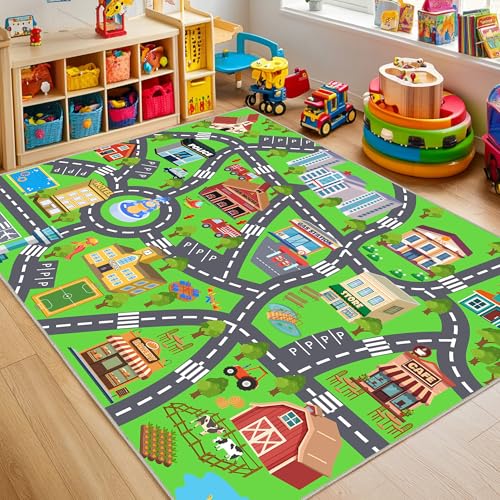
OHDS Kids Car Rug Play Mat 5×7 — Town Map for Bigger Fleets
The OHDS scales the road idea up to 5×7, and the extra territory changes the play. A bigger town supports two children driving at once without constant border disputes, longer routes that loop past more buildings, and the kind of elaborate traffic story that needs a hospital, a school run and a construction site operating simultaneously. Families graduating from a first road rug usually discover that floor space, not imagination, was the limit.
It is described as soft, washable and stain resistant with a non-slip build, suited to classrooms and nurseries as well as bedrooms. The softness matters at this size because a 5×7 town becomes the room’s main floor, sat on, lain on and read on between driving sessions, and a purely functional mat would make those in-between hours less pleasant than they should be.
- Size listed: 5×7
- Construction: soft low-pile play surface
- Pattern: town and city road map
- Backing: non-slip
- Care: washable per maker guidance
Strengths
- Roomy map supports two drivers without disputes
- Soft enough for reading and resting between games
- Washable and stain resistant for classroom-level use
Trade-offs
- Commits a large floor area to one theme
- Town print dominates a small bedroom visually
- Heavier to lift and wash than the 4×6 road rug
Best for: siblings sharing a serious toy car collection
Not suited for: tiny bedrooms where the bed already rules the floor

Kids Carpet Playmat City Life Rug — Classic City Life Original
Some designs persist because they work, and the City Life playmat is the established example of the road rug idea, a town layout refined by years of being driven on. Its streets, buildings and everyday scenes give children a recognisable little world, the kind where the shops and houses prompt the stories as much as the cars do, and its familiarity makes it an easy gift purchase for grandparents who remember the genre fondly.
As a play surface it follows the same rules as the others here: keep it for supervised play on the floor, vacuum up the grit that toy wheels grind in, and clean spills promptly so the town stays bright. Its enduring popularity also means replacement or a matching second rug for another room is easy to find, a small practical mercy in a category where designs vanish quickly.
- Size listed: see listing for current size options
- Construction: low-pile printed play carpet
- Pattern: city life town scene
- Backing: non-slip style playmat base
- Care: follow maker guidance; vacuum and spot clean promptly
Strengths
- Proven town layout that prompts storytelling play
- Familiar design, easy to replace or duplicate
- Everyday scenes suit a wide age range of children
Trade-offs
- Design is traditional rather than fresh
- Check current size options carefully before ordering
- Surface care guidance varies by production run
Best for: families wanting the classic, proven town playmat
Not suited for: parents chasing a distinctive new design

Mtandyx Kids Playroom ABC Rug 3×5 — Alphabet Learning Corner
The Mtandyx packs a preschool wall chart into a 3×5 floor: alphabet, numbers, weeks, seasons, shapes and colours arranged for a child to point at, hop between and gradually own. Used casually, without lessons or pressure, that kind of print turns waiting time into learning time; a child lining up shoes by the rug is absorbing letter shapes whether anyone calls it education or not, and we make no grander promise for it than that.
At 3×5 it fits the spaces the bigger rugs cannot: beside a toddler bed, under a small table, in the corner where a reading chair and a basket of books live. It is soft, non-slip and washable, so the learning corner can sit near snacks and paint without anxiety, and its modest size makes it the easiest rug in this guide to wash frequently and rotate with the seasons it depicts.
- Size listed: 3×5
- Construction: soft low-pile washable surface
- Pattern: alphabet, numbers, weeks, seasons, shapes, colours
- Backing: non-slip
- Care: washable per maker guidance
Strengths
- Dense learning print rewards everyday pointing and play
- Compact size fits reading corners and bedside spaces
- Easy to wash often thanks to its small footprint
Trade-offs
- Busy print is a lot in a very small, calm room
- Educational theme ages out as reading becomes fluent
- Too small to anchor a whole playroom
Best for: a preschool learning corner in a bedroom or hallway nook
Not suited for: a main playroom needing one large shared surface
How Do the Six Picks Compare Side by Side?
| Pick | Size | Surface | Backing or base | Care route |
|---|---|---|---|---|
| GarveeHome Checkered Colorful Kids Rug 5×7 | 5×7 | Low-pile checkerboard print | TPE | Machine washable |
| JINCHAN 5×7 Washable Kids Playroom Rug | 5×7 | Soft checkered diamond print | Non-slip | Machine washable |
| Kids Play Rug Road Track 4×6 Washable | 4×6 | Printed road track | Non-slip | Washable |
| OHDS Kids Car Rug Play Mat 5×7 | 5×7 | Town road map print | Non-slip | Washable |
| Kids Carpet Playmat City Life Rug | Varies | Printed city scene | Playmat base | Spot clean, vacuum |
| Mtandyx Kids Playroom ABC Rug 3×5 | 3×5 | Educational ABC print | Non-slip | Washable |
The honest split in this table is between stages and maps. The two checkered rugs stage any game a child invents, while the three road and city prints supply the game itself, and the alphabet rug teaches quietly from the corner. Most toy rooms are happiest with one of each kind across childhood: a map for the vehicle years, a stage for everything after, and learning woven in at the edges.
What Makes a Rug Safe Enough for a Toy Room?
Safety here starts with the boundary from the introduction, repeated because it matters: the rug is a supervised play surface, and sleep, especially for a baby under twelve months, belongs on a proper sleep surface, never on the play rug. Within play, the first physical requirement is grip. A rug that slides turns every lunge into a fall, so the non-slip backings across these picks, TPE on the GarveeHome and maker-described grip on the others, are the foundation everything else stands on.
Surface height comes next. Low pile is safer for crawlers and new walkers than deep plush because little feet and knees meet a predictable floor, toys do not vanish into fibres, and small objects, the beads, buttons and puzzle pieces of play, stay visible where adults can spot and remove them. A toy room rug should be inspected at adult eye level and at floor level, because the two views reveal different hazards.
Cleanliness is a safety feature too. A washable rug that actually gets washed carries less of the dust, pollen and yesterday’s snack that floor-level breathing zones collect. Choose the rug your laundry routine can handle, keep a simple rhythm of vacuuming and washing, and the play surface stays what it should be: the cleanest, grippiest, most inviting square of floor in the house.
How Do Wheels, Blocks and Paint Treat a Play Rug?
Toy wheels are abrasive in a quiet way. A car dragged sideways scuffs fibres like sandpaper, and a hundred afternoons of it will polish a weak surface into visible lanes. Low, dense piles resist that wear best, which is why every pick here keeps its pile short; the print may fade gracefully over years, but the surface should not tear, pill or shed its pattern in patches.
Building blocks test a rug differently: they need it flat. A tower on plush pile leans from the first storey, while a tower on low pile stands or falls by engineering alone, which is the fairness children demand from their materials. The checkered rugs in particular make honest building ground, their grids even helping young architects line up walls and roads for their constructions.
Paint and juice are the third test, and the answer is speed plus washability. Blot the spill, rinse what lifts easily, and let the machine finish the job at the next wash rather than scrubbing a themed print into a pale scar. Patterns in mid tones with plenty of internal detail, checkerboards and town maps alike, forgive the faint shadows that even good washing leaves behind.
Which Size Suits a Playroom, a Bedroom Corner or a Classroom?
A dedicated playroom earns a 5×7. It holds a play kitchen at one end, a road layout at the other and the migrating pile of soft toys in between, and it gives siblings parallel territory, which prevents more arguments than any house rule. The GarveeHome, JINCHAN and OHDS are all cut for that job, differing in mood rather than in footprint.
A bedroom corner wants a 4×6 or less. The road track rug at 4×6 leaves the bed, wardrobe and door swing their own space while still giving a child a defined world of their own, and the 3×5 alphabet rug fits the reading corner that even a small bedroom can spare. Measure the corner honestly; a play rug that blocks a wardrobe door will be folded away within a week.
Classrooms and daycare corners should copy the playroom logic with extra weight on washing. A 5×7 washable rug that can be laundered over a weekend and relaid Monday is worth more than a plusher piece that must be professionally cleaned, and bright, forgiving patterns keep a hard-working room looking cheerful between those washes.
How Do You Clean a Toy Room Rug Without Losing a Weekend?
Build the routine around the machine. Shake or vacuum the rug before washing to remove the grit and small debris that play grinds in, wash cold and gentle according to the maker’s directions, and dry it flat or draped so air reaches both sides. Low-pile rugs dry quickly, and a rug washed on Saturday morning is usually ready for Monday’s play, which is the rhythm that keeps the habit alive.
Between washes, a toy room rug benefits from a nightly two-minute reset that children can join: toys back in their boxes, a quick vacuum of the crumbs and craft debris, a damp cloth on any spill before it sets. Framed as closing the room for the night, that reset protects the rug more than any product, because grit left overnight is grit ground in by tomorrow’s first game.
Rotate the rug occasionally if sunlight falls across it, and inspect the backing when you do. A backing that still grips keeps the room safe; a backing that has gone smooth or crumbly after many washes is the rug asking to be retired to a less demanding job, such as under a storage shelf, and replaced where children launch themselves daily.
How Should a Toy Room Rug Share Space With Storage?
The rug and the storage should plan each other. Low shelves and open boxes belong around the rug’s edges, close enough that a child can fetch and return toys without crossing the room, far enough that the play territory stays clear in the middle. When storage crowds onto the rug itself, the play surface shrinks daily until the rug is merely a decorative border around a toy pile, which serves nobody.
Think of the rug’s pattern as part of the system. A checkerboard’s squares become parking bays, sorting zones and shop counters when an adult names them once, and a road map’s buildings tell children where the town’s toys live. That gentle structure makes tidying faster, because putting things away means returning them to a place the floor itself describes, a trick teachers have used with classroom rugs for decades.
Leave one edge of the rug completely clear as the entrance. Children, like adults, read a clear edge as a doorway, and play stays on the rug more reliably when arriving and leaving has a defined path. That same clear edge is where an adult can kneel to join a game without dismantling a construction, a small courtesy that keeps grown-ups welcome in the room.
What About Noise, Neighbours and Apartment Playrooms?
A toy room rug is also a sound treatment. Blocks clatter, cars rumble and small feet drum, and a rug over hard floors absorbs a share of that energy before it reaches the ceiling below. Low-pile rugs absorb less than plush ones, admittedly, but they absorb far more than bare boards, and the non-slip layer beneath adds its own small muffling effect.
In an apartment, placing the play rug away from the wall shared with a quiet neighbour, and keeping the most percussive toys, wooden railway, block towers, toward the rug’s centre, makes a real difference to the household’s diplomacy. A rug pad beneath a thin play rug can add cushioning for sound as well as comfort, provided the combined stack still grips the floor as one planted unit.
None of this requires silence, only consideration, and a well-chosen rug is the cheapest consideration there is. Families who move play from a bare kitchen floor to a rug in the corner usually notice the room feels calmer even at the same volume, because softened sound reads as gentler play to everyone listening, including the players.
How Do You Choose Colours That Hide a Working Floor?
Mid tones are the working colours of a playroom. Very pale rugs advertise every crumb and crayon mark, very dark rugs advertise every pale crumb and dusting of flour from a play kitchen, and both will look tired between washes. The middle band, warm creams with pattern, mixed rainbow squares, printed towns full of greys and greens, hides the ordinary evidence of play until wash day arrives.
Pattern density matters as much as colour. A design with detail at the scale of a child’s hand breaks up stains and scuffs so the eye cannot find their edges, while a large plain field shows every mark in full. That is why the prints in this guide are busy in the right way: their detail is the camouflage that lets a hard-working rug look fresh on a Tuesday, not just on the day it was washed.
If the room doubles as a guest room or study, borrow the JINCHAN’s compromise: a pale ground lifted by a patterned centre. Guests see a bright, calm rug; children see a play field; and the pattern sits exactly where the play, and therefore the wear, actually happens. Colour strategy in a toy room is not about taste alone, but about placing forgiveness where the floor needs it most.
When Should a Play Rug Be Replaced?
Grip goes first. A backing that has smoothed, cracked or lost its hold after many washes turns the rug from safety equipment into a hazard, and no amount of surface charm justifies keeping it under running children. Test the rug monthly with a firm push at its corner; if it travels easily on your floor, its playroom service is over.
Surface wear tells the second half of the story. Print worn pale along the main routes is cosmetic and even charming, but fibres that have thinned to the backing, edges that curl despite washing, or a smell that survives a proper wash all say the rug has given what it has. Retire it to a garage or storage corner where its remaining life is useful, and replace it where children play.
Children outgrowing a theme is the happiest reason to replace a rug, and it is worth planning for rather than resisting. A road rug that served from two to six can give way to a checkered stage for board games and building projects, and the Mtandyx’s alphabet can hand over to a plain reading-corner rug. Floors that grow with children keep rooms feeling current instead of preserved.
How Can a Rug Help Children Tidy the Toy Room?
A defined rug gives tidying a border, and borders are what make tidying comprehensible to a four-year-old. Everything on the rug belongs to play; everything off it is put away. That single visible rule, repeated kindly, does more than a shelf of labelled boxes, because the child can see success: a clear rug at the end of the day is a finished job they can point to.
Patterns deepen the game. Checkerboard squares can be counted as toys are parked on them, road maps give every vehicle a street to sleep on, and the alphabet rug lets a child put the letter toys to bed in order. Tidying that borrows the rug’s own logic feels like finishing the game rather than being interrupted by chores, which is why teachers lean on their classroom rugs at clean-up time.
Adults have one job in the system: keep the promise small. Five minutes, one rug, everything visible returned to its place, is achievable daily; a whole-room deep tidy demanded nightly collapses within a week. The washable rugs in this guide support the rhythm by forgiving the days it slips, and by washing clean when the week’s evidence needs resetting.
What Should You Check in the First Week With a New Play Rug?
Lay it flat and let it settle, then watch how it behaves under real play. Does it creep toward the door? Does a corner lift where children pivot? Does the surface show every mark or shrug them off? A week of ordinary use answers those questions more honestly than any inspection on delivery day, and it answers them while returns and exchanges are still simple.
Wash it once during that first week, even if it looks clean. You will learn how it folds into your machine, how long it takes to dry in your home and whether it relays flat, and that knowledge decides whether the rug’s washability is a real feature of your household or a claim on a label. A rug that washes easily will be washed often, which is the entire point.
Finally, watch the children rather than the rug. The right play surface disappears into the play: nobody comments on it, nobody avoids it, games simply happen there. If the rug becomes the room’s main topic, slipping, shedding or showing every spill, it is the wrong rug, and the six picks here were chosen so that at least one of them can quietly become invisible in the right way.
How Do You Layer Play for Different Ages on One Rug?
A toy room often serves a toddler and a seven-year-old in the same hour, and the rug has to hold both childhoods at once. The practical answer is zoning within the rug: the older child’s constructions claim one end, where blocks and tracks need undisturbed territory, while the toddler’s push-along toys orbit the other end and the edges, where an adult can sit within arm’s reach of the smallest player.
Low pile serves both ends equally, which is why it anchors this whole guide. The toddler crawls and cruises on a predictable surface, the older child builds on a flat one, and neither is favoured by the floor. What differs is supervision: the rug gathers the children into one watched space, and that gathering, more than any product feature, is how a play surface earns the word safe.
Rotate the prized positions fairly. The window end, the end nearest the toy shelf, the square beside the reading chair all carry status among children, and a rug whose zones are renegotiated weekly teaches the geography of sharing better than a lecture. The floor cannot raise your children, but a well-chosen one can host the lessons kindly.
What Flooring Underneath Suits a Play Rug Best?
Hard floors are the play rug’s natural partner. Wood, laminate, vinyl and tile all give the non-slip backing something to grip, keep spills from soaking into anything permanent, and let the rug be lifted for a full clean underneath. In most family homes the toy room rug exists precisely because the hard floor beneath is practical but unforgiving, and the rug supplies the warmth and softness the floor lacks.
Placing a play rug over wall-to-wall carpet is possible but less happy. The stack can creep, the surface feels vague underfoot, and spilled paint now threatens two layers instead of one washable one. If the room is carpeted, a thinner, firmer play rug behaves best, and the grip question deserves a careful test in the first week rather than an assumption.
Underfloor heating is worth a thought before ordering. Most low-pile synthetic play rugs sit happily on gently heated floors, but thick foam-backed pieces can insulate the heat and feel clammy. Check the maker’s guidance for your specific pick, keep heating at normal domestic levels, and remember that a washable rug you can lift makes checking the floor beneath a two-minute job.
How Do Grandparents and Guests Use the Toy Room?
A toy room that only works for children fails half its life, because grandparents read stories there, guests’ children join in, and adults end up cross-legged on the floor more often than any of them predicted. A rug with some softness, like the JINCHAN or OHDS, respects those knees, while the road rugs give visiting children an instant game that needs no explanation from anyone.
Seating at the rug’s edge helps everyone. A low cushion, a pouffe or the bottom step of a bunk turns the rug into a theatre with a front row, and stories, puppet shows and board games all gain from that arrangement. When you choose the rug, imagine the audience as well as the players; a 5×7 holds both, which is another reason it dominates this guide.
There is a courtesy point too: a toy room rug that looks cheerful rather than chaotic lets the whole room stay presentable when visitors tour the house. The checkered and town prints here were picked partly for that social duty. A playroom will never be a showroom, but a good rug keeps it proudly a playroom instead of apologetically a mess.
Can a Play Rug Help With a Child’s Daily Routine?
Routines stick when places hold them, and a rug can be a place. Morning play happens on the rug, the reading cushion comes out after lunch on the rug, the tidy-up song ends the day on the rug. Children who cannot read a clock can read a room, and a defined, inviting floor gives the day’s chapters a setting that repeats until the rhythm feels like their own idea.
Quiet time deserves a mention, because not every hour on a play rug is loud. A child who is not napping but needs to downshift can lie on the rug with books or a puzzle while the room rests around them. That is awake, supervised rest, entirely different from sleep, and a soft low-pile surface makes it comfortable without blurring the boundary this guide keeps repeating.
Parents find their own routines settle on the rug too: the folding of small clothes during play, the coffee placed safely at the rug’s edge, the evening sort of toys into tomorrow’s starting positions. A washable, grippy, cheerful floor becomes the household’s shared workbench, and choosing it well pays out in dozens of small, unrecorded moments every week.
What Is the Difference Between a Play Rug and a Play Mat?
The words are used loosely in listings, but the distinction that matters is construction. Foam play mats are usually thick, wipeable tiles or folding panels, excellent for a baby’s first floor months and for cushioning tumbles, while play rugs are textile surfaces, thinner, grippier on hard floors, better looking in a family room and, in the cases gathered here, machine washable rather than merely wipeable.
Each has its season. A foam mat under a learning-to-crawl baby is a fine supervised play choice, and many families then graduate to a rug as the child walks, builds and drives, because the rug’s low textile pile serves wheels, towers and dancing feet better than foam’s soft give. Neither replaces the other’s strengths, and neither is a sleep surface at any age.
The picks in this guide are rugs, chosen for the years when play is mobile and imaginative. If your child is still in the earliest floor stage, treat this guide as the next step rather than the first one, and let the road maps and checkerboards wait until little hands are ready to drive on them, which arrives sooner than any new parent believes.
How Do You Keep a Play Rug Smelling Fresh?
Smell is a washing schedule made noticeable. Crumbs, milk, paint water and the occasional accident all soak a play rug’s fibres, and a surface that is only ever vacuumed will eventually announce its history. The cure is the rhythm this guide keeps recommending: vacuum often, blot spills at once, and machine wash the rug regularly enough that freshness is maintained rather than rescued.
Air helps between washes. A rug draped over a chair in a sunny room for an afternoon dries the deep fibres that daily use dampens, and shaking it outdoors removes the grit and dust that hold odours. Low-pile rugs respond quickly to that treatment because there is simply less depth for smells to hide in, another quiet dividend of choosing pile height for play rather than for looks.
Avoid heavy fragranced sprays as a substitute for washing. They mask a dirty rug for a day and leave residues that attract more dirt, and in a room where children press their faces into the floor during play, a genuinely clean rug is worth more than a perfumed one. Washable construction is the fragrance strategy; everything else is decoration on top of it.
Why Do Teachers Choose Rugs Like These for Classrooms?
A classroom rug is a piece of classroom management disguised as furniture. It gathers children into one visible, bounded place for stories and instruction, gives each child a square or a street or a letter to call their own during group time, and softens the noise of thirty small people sharing one hard-floored room. The picks here, washable, grippy and patterned, follow the same logic teachers use.
Durability decides the rest. A school rug is vacuumed daily, washed hard and sat on by a rotating cast, so low pile, forgiving patterns and honest washability outrank softness every time. Home playrooms are gentler workplaces, but borrowing the teacher’s criteria, grip, washability, pattern that hides wear, buys a family rug that will not embarrass itself by half-term of its first year.
The educational prints earn a teacherly nod as well, with a caveat this guide has kept: a rug printed with letters supports learning the way a bookshelf supports reading, by making the material present, attractive and handled daily. It does not teach by itself. The teaching is done by the adults and children playing on it, which is exactly as it should be.
How Should You Introduce a New Rug to the Room?
Unroll it when the children are there to see it, because a play rug arrives as an event and letting them watch the town appear or the checkerboard spread across the floor buys immediate affection for the new territory. Give it a name if the children want one; a rug called the Town or the Squares will be defended, tidied and shown to visitors with a seriousness that no adult instruction could manufacture.
Set the first game up before you step away. Cars parked on their streets, a tower begun in one checkerboard square, the alphabet’s first letter hunted for and found: that first played-on moment converts the rug from furniture into place. After that, the floor does its own persuading, and the routines described throughout this guide, the gathering, the tidying border, the washing rhythm, grow out of ordinary days rather than rules posted on a wall.
What Does a Play Rug Cost You in Time Each Week?
Honesty about upkeep helps a purchase succeed. A toy room rug asks for a few minutes of vacuuming several times a week, a blot-and-wash response to spills, and a full machine wash every few weeks depending on how artistic and snack-heavy the play has been. Spread across a month that is perhaps an hour of attention, and in exchange the room’s largest surface stays clean, grippy and pleasant to sit on.
The rugs that fail families are rarely the ones that wore out; they are the ones whose care nobody had time for, chosen too plush to vacuum quickly or too large to wash at home. Every pick in this guide was filtered against that failure. If your household’s honest rhythm is one wash a month and a fast nightly vacuum, choose the thinnest, most forgiving pattern here and the rug will thrive on exactly that rhythm.
A Short Note on Sound, Sleep and the Room Next Door
Playrooms are loud by design, and the rug’s softening of that loudness is a gift to the rest of the house, particularly to anyone resting, working or studying on the other side of the wall. Nothing in this guide asks a play rug to be a nursery floor or a bedroom carpet; its acoustic job is daytime work, absorbing the clatter of blocks and the drumming of small feet so that play can be wholehearted without the whole household having to join in by ear. Choose the rug, place it well, and let the door, the rug and the tidy-up song together mark the boundary between the playroom’s joyful noise and the quiet the rest of the home is owed.
What Mistakes Turn a Play Rug Into a Problem?
Treating the play rug as a nap surface is the mistake this guide opened with, and it is worth closing with too. Children do fall asleep mid-play; the adult’s job is to move them to a proper bed or cot, and babies under twelve months should never be placed to sleep on a play rug at all. Play surfaces and sleep surfaces are different equipment, and keeping them separate is simple, loving housekeeping.
Buying deep plush for a toy room is the second error. Towers topple, wheels bog down, small parts disappear into the pile and crumbs settle beyond a vacuum’s reach. The softness that looks inviting in a photograph becomes the room’s daily frustration, which is why every pick here keeps its pile low and its surface honest.
A third mistake is choosing a pale, plain rug for a room where paint and juice are regulars. It will look wonderful for one week and apologetic forever after. Mid-tone patterns with internal detail, checkerboards, maps and busy educational prints, are not a compromise in a toy room; they are the professional choice for a floor that works for a living.
Finally, skipping the grip check. A beautiful rug that slides is a hazard wearing a costume, so test the backing on your actual floor in the first days, reposition until it sits planted, and never layer a play rug over a loose mat or another rug where the stack can travel together under a running child.
Final Recommendation
If the room is a true playroom, start with the GarveeHome and its TPE-backed checkerboard, the most complete package of grip, washability and play value here. If play shares the family living room, the JINCHAN’s cream diamond keeps adults sane while children claim their territory, and if a small driver rules your house, the road rugs will earn their floor space every single day.
Choose the rug your laundry can keep clean and your floor can hold still, keep sleep for the bed and play for the floor, and the toy room becomes the easiest room in the house to love, because a washable square of colour that stays exactly where you put it turns daily chaos into something that can be tidied, washed and begun again tomorrow.
One last practical word: measure the play corner, check your washing machine’s appetite for a folded 5×7, and order the size your room and your laundry agree on, because the best toy room rug is never the most elaborate one in the catalogue. It is the one still lying flat, bright and firmly planted a year from now, under a game you have never seen before, invented on the spot by the children it was bought for. Keep the receipt and the care label together in a drawer, and the whole arrangement stays as simple in year two as it was on the first bright morning.
Frequently Asked Questions
Can a baby play on these rugs during tummy time?
Yes, with an adult right there, which is what supervised play means. Tummy time and floor play on a clean, low-pile, non-slip rug are exactly what these surfaces are for. What they are not for is sleep: if the baby dozes off, move them to their cot or bed, and never place a baby under twelve months down to sleep on a play rug.
Why is low pile better than a plush rug for play?
Wheels roll, blocks stand and small toys stay visible on low pile, while plush swallows pieces, topples towers and traps crumbs beyond vacuuming. Low pile is also easier to wash and faster to dry, which matters in a room that generates spills daily. Children lose nothing; they gain a floor that cooperates with their games.
How do I get paint and juice out of a play rug?
Blot immediately, lift what you can without scrubbing, and machine wash the rug cold and gentle at the next opportunity, following the maker’s directions. Most washable play rugs release water-based paint and juice well when treated quickly. The patterns recommended here, checkerboards, maps and busy educational prints, also hide any faint shadow that remains.
Will a road rug hold a child’s interest for long?
Road rugs tend to age with the driver rather than expiring on a birthday. Toddlers push cars along the streets, preschoolers build stories and rules around the town, and older children use the map as a base for elaborate vehicle worlds. When the theme finally fades, a washable 5×7 like the OHDS still serves as a general play surface under other games.
What size rug does a classroom corner need?
A 5×7 is the practical standard, large enough for a group to sit in a circle and for centres of play to coexist, small enough to launder over a weekend. Choose a washable, non-slip, mid-tone pattern that forgives heavy use, and check the backing after each wash, since a classroom rug’s grip is a safety feature used by many children daily.
Related Guides
For neighbouring rooms and the next stage of childhood floors, these guides continue the story: Best Area Rugs for Wood Floors, Best Animal Rugs for Baby and Kids Rooms, Best Basement Workout Rugs, Best Baby and Toddler Rugs.



[…] a long runner raises. See Best Non-Slip Bath Rugs for a deeper look at backing technologies, Best Area Rugs for Toy Rooms if the family bathroom doubles as a play space, and Best Wool Area Rugs for natural-fibre warmth […]
[…] cover neighbouring problems, from play surfaces to natural fibres and whole-apartment planning: Best Area Rugs for Toy Rooms, Best Wool Area Rugs, Best Bamboo and Seagrass Rugs, Best Apartment […]