What's inside
- Key Takeaways
- Quick Picks
- How Did We Choose These Pads and Rugs for Wood?
- How Do the Six Picks Compare Side by Side?
- Why Do Cheap Backings Damage Wood Floors?
- How Does Grit Under a Rug Grind a Finish Dull?
- Should You Choose Felt, Rubber or Both Under a Rug?
- How Thick Should a Rug Pad Be on Hardwood?
- How Do Light and Dark Wood Floors Change the Pad Question?
- What About Wood Floors in Kitchens and Dining Rooms?
- How Do You Trim a Pad to Fit Properly?
- What Should Happen When a Spill Soaks Through?
- How Do Pads Help With Sound in Flats and Old Houses?
- When Is a Rug on Wood Simply the Wrong Idea?
- How Do You Move Heavy Furniture Across a Protected Rug?
- What Is the Seasonal Lift-and-Look Routine, Exactly?
- How Should Renters Protect a Landlord’s Wood Floor?
- Do Heated Wood Floors Change the Rules?
- How Long Do Felt Pads Last, and When Do They Retire?
- What Order Should You Buy the Layers In?
- How Do You Test a Pad in Its First Month?
- Why Does This Guide Put Three Pads Before Three Rugs?
- A Short Word on Cost, Since Floors Are Expensive
- What to Do While the Pad Is on Order
- What Mistakes Put Wood Floors at Risk?
- Final Recommendation
- Frequently Asked Questions
- Related Guides
As an Amazon Associate I earn from qualifying purchases. This post may contain affiliate links at no extra cost to you.
cottageverdict.com is reader-supported. When you buy through links on our site, we may earn an affiliate commission.
Where to buy: every linked name below opens its Amazon listing, where you can check price on Amazon and verify the pad thickness, the backing material and the floor finishes each maker approves before ordering. The best area rugs for wood floors are really two purchases wearing one name: a protective pad underneath that decides whether your boards stay beautiful, and a rug on top that decides how the room looks and feels.
Wood floors fail under rugs in quiet ways. Grit trapped beneath a rug grinds a dull patch into the finish with every footstep. A cheap latex or rubber backing, left for years, can react with some floor finishes and leave a ghost of itself when the rug is finally lifted. A heavy rug without a pad creeps, and its backing scuffs as it travels. None of these disasters arrive dramatically; they accumulate invisibly, which is why the layer you cannot see deserves first place in this guide.
So the structure here is deliberate. The first three picks are rug pads, the protective layer, in felt-and-rubber, pure felt and thin felt-rubber forms. The last three picks are rugs, the visible layer, all in natural jute or flatweave constructions whose undersides are comparatively kind to boards, provided the right pad sits between them and the finish. Buy the system, not just the surface.
A word on finishes, because pads are not universal. Solid hardwood with a polyurethane finish tolerates the widest range of pads, while oiled, waxed and some site-finished floors ask for pure felt and caution with rubber compounds. Every pad below is described by its maker as safe for hardwoods, but your floor’s finish is the senior authority, and a patch test in a hidden corner is cheap insurance before a whole room is committed.
Colour gets a brief, practical say rather than a chapter. Light and dark wood both appear in the guidance sections, but this guide refuses to repeat a colour-matching lecture; the floor-protection decisions come first, and a jute-toned top layer, as it happens, sits peacefully on almost every board colour ever milled. Protect first, decorate second, and the floor will thank you in a decade.
Key Takeaways
- The pad is the protective layer that decides your floor’s future; the rug is only the visible layer.
- Felt pads cushion and protect without sticking; felt-plus-rubber adds grip for rugs that creep.
- Avoid cheap latex and rubber backings left for years on finishes they can mark or react with.
- Grit under a rug is sandpaper: lift and clean beneath regularly, pad or no pad.
- Jute and flatweave rugs make kind top layers, but they still belong over a pad on wood.
- Check any pad against your specific floor finish, and patch test in a hidden corner first.
Quick Picks
| Pick | Badge | Why it stands out |
|---|---|---|
| RUGPADUSA Dual Surface Rug Pad 8×10 | Best All-Round Protection | A quarter-inch felt and rubber pad, 8×10, that cushions like felt and grips like rubber for rugs that wander. |
| RUGPADUSA Basics 100% Felt Rug Pad 8×10 | Purest Felt Cushion | A quarter-inch pad of pure felt, 8×10, for floors and finishes that should touch nothing but fibre. |
| Songrey Non-Slip Rug Pad 8×10 | Thinnest Grip Layer | An eighth-inch felt and rubber pad, 8×10, for hallways, doorways and rugs that must stay low and stay put. |
| SAFAVIEH Natural Fiber Jute Rug 5×8 | Classic Jute Top Layer | A knotted jute 5×8 with a substantial pile, the natural-fibre classic to lay over any pad in this guide. |
| nuLOOM Rigo Flatweave Rug 5×8 | Easiest Flatweave Top Layer | A natural solid flatweave 5×8 that lies calmly over a thin pad and lets dining chairs travel freely. |
| DEXI Woven Jute Rug 8×10 | Largest Handmade Jute | A hand-braided woven jute 8×10 in beige natural tones for big living rooms that need texture at scale. |
How Did We Choose These Pads and Rugs for Wood?
We split the judging into the two layers. For pads, the criteria were material honesty, felt content, thickness appropriate to the job, and a maker’s explicit statement of safety for hardwood and other hard floors. For the rugs above them, we favoured natural-fibre and flatweave constructions with stable undersides, in sizes that pair naturally with standard pad dimensions, and we avoided deep-pile pieces whose weight and movement complicate life on boards.
Thickness was judged by room, not by luxury. A quarter inch of felt is a fine cushion under a living room rug and a tripping, door-catching nuisance in a hallway, so the set includes a thinner eighth-inch option for traffic routes and doorways. Every combination below can be assembled from standard 8×10 and 5×8 footprints, trimmed where a maker allows, so no reader needs a bespoke size to protect a floor properly.

RUGPADUSA Dual Surface Rug Pad 8×10 — Best All-Round Protection
The Dual Surface is the pad most wood-floor households should start with, because it solves the two problems at once: the felt face cushions the rug and spreads the pressure of furniture legs, while the rubber face grips the boards and stops the whole arrangement travelling. At a quarter inch thick it gives a living room rug a settled, upholstered feel underfoot without raising it into door-swing trouble in most rooms.
Its dual nature is also its flexibility. Placed felt-up beneath a rug that tends to creep within its own backing, or rubber-up where the rug’s underside is slick, it adapts to the pairing in front of it. The maker describes it as safe for all floors, and for standard sealed hardwood it is the confident default: the pad you buy once and move from rug to rug as the room’s look changes over the years.
- Size listed: 8×10
- Thickness: 1/4 inch
- Construction: felt with rubber backing
- Grip: non-slip rubber face
- Floor safety: described as safe for all floors
Strengths
- Cushioning and grip combined in one layer
- Quarter-inch loft makes thin rugs feel substantial
- Adaptable orientation for different rug backings
Trade-offs
- Rubber face deserves a finish check on oiled floors
- Thicker than needed under doorways and hall runners
- Costs more than a basic grip sheet, fairly
Best for: living room rugs on sealed hardwood that creep or feel thin
Not suited for: delicate oiled finishes that should meet felt only

RUGPADUSA Basics 100% Felt Rug Pad 8×10 — Purest Felt Cushion
Where the Dual Surface hedges with rubber, the Basics pad commits to felt alone, and for certain floors that purity is the entire point. Oiled and waxed boards, older finishes of uncertain chemistry, and anyone who has ever peeled a rubber backing off a floor and found its portrait printed in the finish will understand why a pad with nothing to react, stick or transfer is worth having in the house.
Felt protects by cushioning and by stillness of a different kind: it does not grip hard, so a rug over pure felt may travel slightly on a very smooth floor, but the felt itself never bonds to the finish beneath it. The maker describes this pad as safe for all floors and finishes including hardwoods, and at a quarter inch it gives dining and living rugs a dense, quiet step that thin grip sheets cannot imitate.
- Size listed: 8×10
- Thickness: 1/4 inch
- Construction: 100% felt
- Grip: minimal; relies on rug weight
- Floor safety: described as safe for all floors and finishes including hardwoods
Strengths
- Nothing in it can react with or stick to a finish
- Dense felt cushioning under furniture and feet
- The cautious choice for oiled or antique boards
Trade-offs
- Rugs can drift slightly on very smooth floors
- No grip help for lightweight rugs in traffic lanes
- Same loft as the dual pad, so doors still need checking
Best for: oiled, waxed or cherished hardwood under heavier rugs
Not suited for: lightweight rugs that already wander across the room
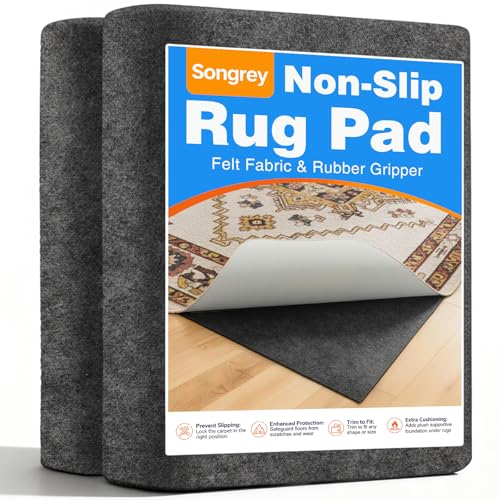
Songrey Non-Slip Rug Pad 8×10 — Thinnest Grip Layer
The Songrey is the thin option, an eighth of an inch of felt fabric with a rubber backing, and thinness is a feature with its own territory. Under a hall rug, beneath a rug a door must clear, or in a kitchen where a tripping edge matters more than cushioning, this pad grips the boards, steadies the rug and otherwise stays out of the way, which is exactly what traffic routes ask of a protective layer.
It also suits renters and lighter rugs. A thin rug over a thin pad still feels like a rug rather than a mattress, chairs slide and castors roll without climbing a felt hill, and the whole stack can be lifted easily for the regular under-rug cleaning that wood floors demand. The listing describes cushioned felt with rubber backing made to hold area rugs stable on hardwood, and that modest promise is precisely delivered.
- Size listed: 8×10
- Thickness: 1/8 inch
- Construction: felt fabric with rubber backing
- Grip: non-slip rubber backing
- Floor safety: made for hardwood floors per listing
Strengths
- Low profile clears doors and avoids trip edges
- Grips lightweight rugs that felt alone cannot hold
- Easy to lift for under-rug cleaning routines
Trade-offs
- Less cushioning underfoot than quarter-inch pads
- Rubber backing needs the usual finish check
- Thin felt spreads furniture-leg pressure less fully
Best for: hallways, doorways and kitchens on hardwood
Not suited for: living rooms wanting a plush, cushioned step

SAFAVIEH Natural Fiber Jute Rug 5×8 — Classic Jute Top Layer
Above the pad sits the visible decision, and the SAFAVIEH jute is the classic of its kind: knotted natural jute fibres in a 5×8 with a three-quarter inch pile that feels closer to a textile landscape than a flat mat. Its texture warms a room of smooth boards instantly, because the eye and the foot both register the contrast between milled timber and hand-worked fibre.
Jute’s honesty includes its underside, which is rough enough that this rug should never sit directly on a finished floor; over one of the felt pads above, that roughness becomes grip rather than abrasion, and the pairing is the whole lesson of this guide in one stack. The maker describes it as durable and friendly to busy households, and in an entryway or living room over a pad, it earns that description for years.
- Size listed: 5×8
- Construction: knotted natural jute fibres
- Pile: 3/4 inch per listing
- Backing: natural fibre underside; use over a pad
- Care: vacuum without a beater bar; blot spills
Strengths
- Rich natural texture against smooth boards
- Substantial feel suits living rooms and entries
- Pairs with any pad in this guide
Trade-offs
- Must not sit directly on a finished wood floor
- Jute dislikes soaking; spills need blotting, not washing
- Sheds some fibre early in its life
Best for: living rooms and entries over a felt pad
Not suited for: direct contact with bare finished boards

nuLOOM Rigo Flatweave Rug 5×8 — Easiest Flatweave Top Layer
The Rigo is the diplomat of top layers: a solid natural flatweave, 5×8, with no pile to crush, no pattern to argue with furniture, and a low, even surface that dining chairs and desk castors cross without complaint. On wood floors its flatness is a protective virtue in itself, because the rug does not rock or bunch as furniture moves, and bunching is what drags grit across a finish.
Flatweave still belongs over a pad on boards, and the Songrey’s thin grip layer is its natural partner, together making a stack barely thicker than the rug alone while keeping the finish safe and the rug planted. The Rigo’s simplicity also makes it the easiest of the three rugs here to live with under a table, where spills can be blotted from a flat surface before they think about reaching the floor beneath.
- Size listed: 5×8
- Construction: flatweave, natural solid colour
- Pile: flat, no raised pile
- Backing: woven underside; use over a pad
- Care: vacuum regularly; blot spills promptly
Strengths
- Flat surface suits dining chairs and rolling castors
- Calm solid colour pairs with any board tone
- Thin stack with a thin pad clears most doors
Trade-offs
- No cushioning to speak of underfoot
- Shows spills plainly until blotted
- Still needs a pad; flatweave is not a free pass
Best for: dining rooms and home offices on wood floors
Not suited for: anyone wanting softness from the rug itself

DEXI Woven Jute Rug 8×10 — Largest Handmade Jute
The DEXI takes jute up to 8×10, hand-braided and woven, and at that size the texture becomes architecture: a whole seating arrangement gathered onto a natural fibre field that warms wide boards and large rooms without introducing pattern or colour arguments. Its beige natural tone is the peacemaker shade, as at home over pale oak as over darker stained boards.
An 8×10 rug is also the strongest argument in this guide for the pad beneath it, because a piece this size is lifted rarely and lived on constantly, so the layer protecting the finish has to be right from day one. Pair it with the Dual Surface or the pure felt Basics in the matching 8×10, vacuum the surface without aggressive beating, and lift a corner seasonally to check that the world underneath is as calm as the one on top.
- Size listed: 8×10
- Construction: hand-braided woven jute
- Pile: low woven profile
- Backing: natural woven underside; use over a pad
- Care: vacuum gently; blot spills; avoid soaking
Strengths
- Covers large seating areas in one natural field
- Handmade braiding gives rich, quiet texture
- Beige tone suits light and dark boards alike
Trade-offs
- Large and heavy to lift for under-rug cleaning
- Jute and soaking water are enemies
- Needs the matching investment in an 8×10 pad
Best for: large living rooms over a full-size felt pad
Not suited for: small rooms or floors cleaned beneath weekly
How Do the Six Picks Compare Side by Side?
| Pick | Size | Surface | Backing or base | Care route |
|---|---|---|---|---|
| RUGPADUSA Dual Surface Rug Pad 8×10 | 8×10 pad | Felt plus rubber, 1/4 inch | Rubber grip face | Trim to fit if needed |
| RUGPADUSA Basics 100% Felt Rug Pad 8×10 | 8×10 pad | 100% felt, 1/4 inch | None; felt both faces | Trim to fit if needed |
| Songrey Non-Slip Rug Pad 8×10 | 8×10 pad | Felt with rubber, 1/8 inch | Rubber backing | Trim to fit if needed |
| SAFAVIEH Natural Fiber Jute Rug 5×8 | 5×8 rug | Knotted jute, 3/4 inch pile | Natural underside | Vacuum, blot spills |
| nuLOOM Rigo Flatweave Rug 5×8 | 5×8 rug | Flatweave solid | Woven underside | Vacuum, blot spills |
| DEXI Woven Jute Rug 8×10 | 8×10 rug | Braided woven jute | Natural underside | Vacuum gently, blot |
The comparison that matters is vertical. Choose your pad by floor finish and traffic, a quarter inch of felt or felt-and-rubber for living rooms, an eighth inch where doors and hallways rule, then choose your rug by room job, knotted jute for texture, flatweave for chairs and castors, braided jute for scale. Any pad here under any rug here is a defensible stack; a rug alone on bare boards is the only wrong answer in the guide.
Why Do Cheap Backings Damage Wood Floors?
The damage mechanism is chemistry plus time. Inexpensive latex and rubber backings can contain compounds that interact with certain floor finishes, particularly some polyurethane and site-applied coatings, gradually softening, yellowing or bonding to the surface. Because the rug hides the process, the first evidence often appears years later, when the rug is lifted for replacement and its outline, or its backing’s texture, has transferred to the boards.
Not every rubber backing is a villain, and the pads in this guide come from makers who state their floor safety plainly, but the rule for wood is to prefer known materials: felt first, reputable rubber compounds second, anonymous spongy backings never. When a rug arrives with a backing you cannot identify, the felt pad stops being optional and becomes the barrier that makes the question irrelevant.
Time is the multiplier in every case. A backing that would be harmless for a season can mark a finish over five years, so the patch test and the seasonal lift-and-look described later in this guide are not fussiness. They are how you catch a slow reaction while it is still a rumour rather than a refinishing bill, and they take less time than one thorough vacuuming.
How Does Grit Under a Rug Grind a Finish Dull?
Every shoe carries the street in miniature: sand, gravel dust and grit that migrate across the floor and settle at the rug’s edges, then work beneath it. Once under the rug, those particles sit between a moving surface and a finished board, and each footstep presses and drags them a fraction. Multiplied by thousands of steps, the rug becomes a slow sanding machine polishing a dull patch into exactly the shape of your furniture arrangement.
A pad interrupts the machine in two ways. It holds much of the grit that reaches it away from the finish, and it cushions the pressure that would otherwise drive particles into the coating. But no pad licenses neglect: the under-rug space still needs a regular clean, lifting the rug, vacuuming the boards, and letting everything dry fully before the stack goes back down.
The routine is lighter than it sounds. Small rugs can be lifted monthly; large ones, seasonally, with a helper and a plan. What matters is that it happens at all, because the dull patch is preventable at every stage and reversible at almost none. Wood floors forgive many things, but they keep receipts, and grit is the entry they record most faithfully.
Should You Choose Felt, Rubber or Both Under a Rug?
Felt is the protector. It cushions furniture pressure, muffles sound, and presents no chemical threat to any finish, which is why the pure felt Basics pad is the default for oiled, waxed and antique floors. Its weakness is movement: on a polished floor a rug over felt alone can travel, slowly and crookedly, until someone kneels and hauls it back into line.
Rubber is the anchor. A rubber face or backing grips boards and holds the arrangement still, which hallways, lightweight rugs and busy households genuinely need. Its weakness is the caution from the previous section: rubber compounds vary, finishes vary, and the pairing deserves a maker’s safety statement plus your own patch test rather than blind trust in either direction.
Felt-and-rubber hybrids exist precisely because most homes need both virtues, and the Dual Surface and Songrey represent the two thicknesses of that compromise. Choose by room: hybrids where rugs wander or traffic is heavy, pure felt where the finish is precious or the rug is heavy enough to hold itself still, and thin hybrids where doors pass overhead and every millimetre of height is spoken for.
How Thick Should a Rug Pad Be on Hardwood?
A quarter inch is the living room standard, thick enough to change how a rug feels, to spread a sofa leg’s pressure across the finish, and to quiet footsteps, yet thin enough that most interior doors, which rarely pass over living room rugs anyway, are untroubled. Both quarter-inch pads here serve that standard, differing in grip rather than in loft.
An eighth inch is the traffic standard. Hallways, kitchens, landings and any rug a door crosses want the Songrey’s profile, because a pad’s edge is a trip line and its height is a door’s clearance, and in those places protection means grip and a barrier, not cushioning. Nobody regrets a thin pad in a hallway; many regret a thick one by the second stubbed toe.
Thicker than a quarter inch is where wood floors stop benefiting. Very thick pads make rugs feel unstable, bunch under castors, lift edges into trip territory and can hold a rug so high that furniture rocks. On carpet, loft is luxury; on boards, loft beyond a point is leverage working against the finish, and this guide’s ceiling of a quarter inch is deliberate.
How Do Light and Dark Wood Floors Change the Pad Question?
Briefly, because protection outranks palette in this guide: they do not change it at all. A pale oak floor and a dark stained floor need the same felt barrier, the same grit routine and the same caution with unidentified backings. What changes is only how visible the damage is when the rules are skipped, and there the pale floor hides a dull patch longer while the dark floor advertises every scratch and pale wear line immediately.
If anything, dark floors argue for stricter habits, because the contrast between a protected area and a ground-dull one is stark when a rug moves rooms. Owners of dark boards should be the most faithful lift-and-look practitioners, and the most suspicious of grit, since a single pale track across a dark finish reads like a headline.
The top layer can then do the little colour work required. Natural jute’s mid tone bridges both worlds, lightening a dark room’s floor plane slightly and grounding a pale room without glare, which is one reason all three rugs here live in the same natural family. When protection is handled, decorating gets to be this simple.
What About Wood Floors in Kitchens and Dining Rooms?
Kitchens test the stack with water. Spills that would be trivial on tile sit on wood as a threat, so the kitchen arrangement wants the thinnest, grippiest pad, the Songrey, under a flatweave like the Rigo that can be lifted in seconds when a pan of water goes over. Speed of lifting is a protective feature in a kitchen, and heavy, plush stacks fail that test however beautiful they are.
Dining rooms test it with chairs. Every meal drags four to eight chair legs across the rug, and a rug that bunches under that treatment drags grit with it. A flat stack, thin pad, flatweave rug, stays calm, and felt chair glides on the chair legs themselves complete the system, because protecting a floor is a team effort between everything that touches it.
Both rooms reward a smaller rug than instinct suggests. A rug that covers only the working zone, under the table, along the sink run, is easier to lift, clean beneath and replace, and it leaves the rest of the boards visible, which in a wood-floored kitchen is rather the point of having them.
How Do You Trim a Pad to Fit Properly?
Measure the rug, subtract roughly an inch on every side, and mark the pad before any cutting begins, because a pad trimmed by eye in place always ends up wavy. Felt cuts cleanly with strong scissors for small adjustments or a sharp utility knife and a straightedge for long lines, working on a protected surface that is not, under any circumstances, the floor the pad exists to defend.
Fit is checked by laying the pad, then the rug, and walking the edges. If the pad peeks, trim again; if the rug’s edge floats because the pad ends too far inside, you have over-trimmed and the pad will serve a smaller rug elsewhere in the house. Pads are forgiving purchases that way: an 8×10 trimmed wrong for the living room becomes two perfect pads for bedroom rugs.
Keep the offcuts. A strip of felt pad is the finest furniture glide material in the house, ideal under the legs of a heavy bookcase or the feet of a piano, and a square of it under a plant pot has saved many a board from a slow leak. The protective layer, once in the house, tends to find protective work everywhere.
What Should Happen When a Spill Soaks Through?
Lift the rug first and ask questions later. A spill that has soaked through is already in contact with the finish, and every minute of delay is the finish drinking. Blot the boards, dry them thoroughly with air and patience, and inspect for clouding once dry, because a finish that has gone milky in a patch needs attention before the rug returns to hide it again.
The pad’s behaviour now earns its keep. Felt absorbs a share of the spill and holds it away from the boards, buying you time, but a soaked pad must be dried fully, flat and aired, before it goes back, since a damp pad relaid on wood simply continues the accident in slow motion. Rubber-faced pads wipe clean more easily, which is one reason kitchens suit them.
The rug itself, if it is jute, should be blotted, never soaked, and dried with air moving across both sides. If that sounds like a lot of lifting and drying, it is, and it is still cheaper and kinder than the refinishing that a spill left under a rug for a weekend can arrange. Wood rewards households that react quickly and punishes only those that delegate spills to time.
How Do Pads Help With Sound in Flats and Old Houses?
A felt pad is a muffler fitted to the floor. Footsteps, chair legs and dropped objects all transmit through a rug on bare boards into the structure, and a quarter inch of dense felt absorbs a meaningful share of that energy before it becomes the downstairs neighbour’s evening. In flats, that absorption is a diplomatic asset worth more than the pad’s price within the first month.
Old houses add their own acoustics: boards that flex and creak, joists that drum. A pad cannot silence a loose board, but it spreads the load of a footstep so the board flexes less sharply, and it removes the gritty scuff sounds that make footsteps upstairs sound like weather. The pure felt pad, with no hard layer, is the quietest of the three here.
Choose thickness by room again. The living room over a neighbour’s bedroom deserves the quarter inch; the hallway over your own kitchen can make do with the Songrey’s eighth. Sound, like protection, is a layer decision, and the household that thinks in layers tends to be the household whose floors, and neighbours, stay calm for years.
When Is a Rug on Wood Simply the Wrong Idea?
A rug is wrong where water lives permanently: in front of a leaking appliance, under a frequently splashed sink in a room that never dries, or over boards already suffering damp from below. Textiles hold moisture against finishes, and no pad converts a wet corner into a dry one. Fix the water first; the rug conversation can resume when the floor is sound and dry.
It is also wrong, temporarily, on a freshly finished floor. New coatings cure over days to weeks depending on the product, and a rug laid too early can imprint, stick or trap the very compounds the finish is releasing. Follow the finisher’s curing guidance before any pad or rug goes down, and let a beautiful new floor be bare and admired for its first chapter.
Finally, a rug is wrong when nobody will lift it. A household that knows it will never clean beneath a rug is better served by a small, light rug it will lift, or by bare boards honestly maintained, than by a grand stack quietly grinding grit for a decade. The best floor protection is the kind that fits the household’s real habits, which is the standard this entire guide has tried to keep.
How Do You Move Heavy Furniture Across a Protected Rug?
Furniture moving day is when pads prove their worth or get their revenge. Slide, never drag, and put felt glides or the pad offcuts mentioned earlier under every leg before anything travels, because a sofa leg dragged across a rug concentrates its whole weight into a moving point that can tear fibres, bunch the pad and score the finish beneath in one journey.
Work in stages for large pieces: lift one end, check the pad is still flat and in place, then move the other end, rather than hauling the whole piece and discovering the pad has rucked into a ridge under the rug’s centre. A rucked pad is worse than none for a while, because its ridge becomes a pressure line across the boards under every subsequent footstep.
After the move, walk the whole rug slowly and feel for lumps, then lift corners to confirm the pad still sits its inch inside the edges. Rooms change, furniture migrates, and the protective layer only protects when it lies as flat as the day it was fitted, so the two-minute audit after any rearrangement belongs in the household’s habits alongside the seasonal clean.
What Is the Seasonal Lift-and-Look Routine, Exactly?
Choose a dry day, recruit a second pair of hands for anything 8×10, and roll the rug toward you rather than dragging it sideways, so grit on its underside is carried away instead of across the boards. Vacuum the exposed floor thoroughly, including the pale outline where dust has settled around the rug’s former edges, and let your eyes travel slowly: you are looking for dull patches, sheen changes, tackiness and any backing ghost beginning to print itself.
Vacuum the pad’s underside and the rug’s backing while they are up, shake what can be shaken outdoors, and let everything breathe for an hour before the stack is rebuilt. That hour is the floor’s only holiday, and in damp climates it is also insurance that no hidden moisture gets sealed back against the finish for another season.
Then rebuild in order: pad flat and trimmed inside its inch, rug centred and walked flat, furniture back with its legs on felt. The whole ritual takes under an hour twice a year, and it converts the two slow injuries of wood floors, grinding and ghosting, from surprises at replacement time into items you have been watching, calmly, all along.
How Should Renters Protect a Landlord’s Wood Floor?
Renters carry a sharper version of the owner’s problem, because the floor’s condition is measured at departure against a deposit. The felt pad is the renter’s best friend: it prevents the grit grinding and backing marks that landlords photograph, and it lifts away at the end leaving nothing behind, unlike adhesive grip tapes that can pull finish or leave residue arguments.
Photograph the floors before the first rug goes down and keep the pad and rug receipts with the tenancy papers. If a question arises later, a documented system of felt protection, seasonal cleaning and reasonable care answers it better than any verbal assurance, and most landlords, shown that system at the start, relax about rugs entirely.
Choose sizes you can lift alone for the clean-beneath routine, because a renter’s 8×10 that needs two people and a free afternoon will be cleaned beneath less often than promised. A pair of 5×8 stacks, or one 5×8 in the main room, often protects a rented floor more faithfully in practice than a grander arrangement that defeats its own maintenance.
Do Heated Wood Floors Change the Rules?
Gentle underfloor heating is compatible with most felt pads and natural-fibre rugs, but the stack is an insulator, and a quarter inch of felt plus a dense jute rug will noticeably slow the warmth reaching the room. In a heated-floor home, the thin Songrey under the flatweave Rigo is the considerate combination, protecting the boards while letting the heating system do the job it was installed for.
Heat also sharpens the backing caution. Warmth accelerates the chemistry between questionable rubber or latex compounds and floor finishes, so on a heated floor the case for pure felt, or for a pad with an explicit safety statement, becomes stronger rather than weaker. Patch test on the warmest zone of the floor, where any reaction will declare itself first.
Dryness is the third effect: heated boards dry a spill’s evidence quickly on the surface while moisture underneath a rug lingers, so the lift-and-dry response to a soak-through matters even more. None of this forbids rugs on heated wood; it simply promotes the thin, honest, felt-first end of this guide’s range, which is where heated floors were always going to be happiest.
How Long Do Felt Pads Last, and When Do They Retire?
A quality felt pad under a living room rug commonly serves for many years, because its work is static: it is compressed, walked on and otherwise left in the dark. Its retirement signs are thinning you can feel through the rug, a permanent crush under the sofa’s favourite leg positions, and edges that have frayed or curled enough to stop lying flat beneath the rug.
Rubber-faced pads add one more sign: a backing that has gone tacky, crumbly or smooth has finished its service and should leave the floor promptly, since those are the very states in which backings misbehave against finishes. Retire by condition, not by calendar, and inspect at every seasonal lift so the decision is made by evidence rather than by accident.
A retired pad is not waste. Sound pieces become furniture glides, workbench mats, kneeling pads for gardening and liners under storage boxes in the attic, all jobs where felt’s cushioning and neutrality shine. The pad that protected your floor for a decade usually spends its retirement protecting everything else you own, which is a fair second career for a layer nobody ever saw.
What Order Should You Buy the Layers In?
Pad first, even if the rug has not been chosen, because the pad’s size and material follow from the floor and the room, which you already know, while the rug follows from taste, which benefits from time. A household that owns the right 8×10 felt pad can audition rugs over it for years, changing the room’s whole character while the protective decision stays made.
If the rug already exists, measure it honestly, since rugs are often slightly smaller than their label claims, and size the pad to the real footprint minus its inch. Bring the rug’s backing into the decision too: a rug with a slick underside wants the rubber-faced pad, a heavy rug with a rough underside is content on pure felt, and a thin rug in a hallway wants the Songrey’s low grip.
Budget follows the same order. Spend on the pad’s material quality before the rug’s fashion, because the pad is the decade purchase and the rug is the changeable one. The six picks here were assembled so that a reader can buy one pad and one rug in any combination and own a complete, floor-safe system, which is the only kind of rug buying wood floors have ever asked for.
How Do You Test a Pad in Its First Month?
Live on the stack and interrogate it weekly. Walk the rug’s edges in socks and feel for pad peek or ridge lines, open any door that crosses it a dozen times, and pull the dining chairs in and out through a real week of meals. Then lift one corner and look at the boards: they should show nothing but boards, clean and unchanged, which is the only report card a protective layer is ever issued.
If the rug travels, note the direction and distance before adjusting anything, because creep tells you whether the fault is grip, pad size or a rug that is simply too light for its traffic. Small evidence, early, is the whole method of this guide: a pad system checked in its first month and twice a year afterwards will never present its owner with the kind of surprise that requires a sander and a free weekend.
Why Does This Guide Put Three Pads Before Three Rugs?
Because readers buy in the order they read, and floors are injured in the order of neglect: the hidden layer is skipped, postponed or bought as an afterthought with whatever backing the rug happened to arrive with. Reversing the catalogue, pads first and rugs second, mirrors the physical stack honestly and makes the protective decision while the reader’s attention is fresh, rather than in a footnote after the pretty photographs.
The rugs chosen for the top of the stack were then held to a standard the pads set: natural fibres, stable constructions, no mysterious coatings, nothing that needs to be forgiven. A household could pair any pad here with any rug here and sleep soundly, and that interchangeability, not any single product, is the recommendation this guide most wants to leave on the floor.
A Short Word on Cost, Since Floors Are Expensive
Refinishing a wood floor costs more than every item in this guide combined, usually several times over, and it costs a week of displaced furniture and dust in the bargain. Against that arithmetic, a quality felt pad is not an accessory purchase but the cheapest insurance a floor owner can buy, priced like a rug and working like a policy that pays out silently every single day it lies there.
That is why this guide resists the false economy of the thinnest anonymous grip sheet sold as a pad. A grip sheet has its hallway uses, and the Songrey is a proper felt version of the idea, but a living room floor deserves the full felt layer its finish will be judged by in a decade. Buy the protection once, buy it honestly, and spend the savings on the rug everyone actually sees.
What to Do While the Pad Is on Order
A floor does not have to stay unprotected while you wait for a pad to arrive. Keep the rug off the boards entirely if the wait is short, or, if the room must function, lay a clean cotton sheet or an old flatweave blanket beneath the rug as a temporary felt substitute and treat the arrangement as a draft, not a solution. Vacuum the boards before anything goes down, check the temporary layer weekly for grit, and replace it with the real pad the day it lands, because temporary protection has a habit of becoming permanent exactly when nobody is watching it any longer.
What Mistakes Put Wood Floors at Risk?
Laying a natural-fibre rug straight onto finished boards is the headline mistake, and it is made constantly because jute looks so wholesome. Its underside is abrasive, its fibres trap grit against the finish, and within a year the boards beneath can carry a matte rectangle that no cleaning removes. Every rug in this guide, however natural, belongs over a pad.
Trusting an unidentified backing for years runs second. If you cannot name what touches your floor, you cannot know what it is doing there, and the seasonal lift-and-look is the only audit that counts. The day a backing feels tacky, smells sharply chemical or leaves a sheen on the boards, it leaves the floor, whatever the rug above it cost.
A third mistake is sizing the pad equal to the rug or larger, so its edge peeks out as a pale frame and a trip line. A pad should sit an inch or so inside the rug’s footprint on all sides, invisible and untrodden, doing its work in the dark. Measuring and trimming before laying, not after, is the professional order of operations.
Finally, washing or wet-mopping a rug in place on wood. Water that soaks through a rug and sits against a finish can cloud and lift it, and jute in particular holds moisture like a sponge pressed to the boards. Clean rugs lifted, floors dry, and never let a damp rug be relaid because the surface feels dry while its underside is still holding the weather.
Final Recommendation
If you buy one thing from this guide, buy the pad, because floors outlast rugs by decades and the Dual Surface felt-and-rubber pad in a quarter inch will protect almost any sealed hardwood under almost any rug you already own. Choose the pure felt Basics where your finish is oiled, waxed or precious, the thin Songrey where doors and hallways rule, and then let the jute or flatweave above it be a purely decorative decision, which is what rugs were always supposed to be.
A wood floor records how it was treated more honestly than any other surface in a home, so treat the hidden layer as the real purchase and the visible one as the pleasure, and in ten years, when the rug is lifted for its successor, the boards beneath will look like the day the first pad went down, which is the only verdict that matters here.
Measure your rug, name your floor’s finish if you can, and let those two facts choose the pad before a single pattern is admired; the household that buys in that order rarely has a floor story to tell, and with wood, no story is the happiest ending available. Keep the pad’s packaging note with your floor paperwork, and future you, lifting a corner in five years, will know exactly what has been standing guard underneath. It is a small filing habit that turns a hidden layer into a documented one, which is all any floor has ever asked of the people living above it. Floors remember kindness for decades, and they are generous about returning it at resale, at redecorating and on every quiet barefoot crossing in between. Start with the corner test this week. It takes ten minutes. Do it before the next wash day arrives.
Frequently Asked Questions
Can I put a jute rug directly on hardwood if I vacuum often?
Vacuuming helps the surface but not the underside, where jute’s rough fibres and trapped grit work against the finish with every step. Frequent vacuuming slows the process; it does not change its nature. A felt pad between jute and boards is inexpensive compared with refinishing, and it converts the rug’s roughness into grip, so the honest answer is to always use the pad.
Will a rubber-backed pad definitely damage my floor?
No, and this guide recommends two rubber-faced pads from makers who state their floor safety. The risk lives in unidentified, ageing or very cheap rubber and latex compounds reacting with particular finishes over years. Protect yourself with the maker’s statement, a patch test in a hidden area, and a seasonal lift to inspect the boards, and a quality rubber grip layer is a reasonable, useful choice.
How much smaller than the rug should the pad be?
About an inch inside the rug’s edges on all sides is the standard allowance. That keeps the pad invisible, keeps its edge out of the walking line, and lets the rug’s own edge lie flat on the floor so it does not become a trip lip. All three pads here are sold in standard sizes that trim cleanly with strong scissors or a utility knife on a safe surface.
Does a pad stop a rug sliding on polished boards?
A rubber-faced pad, the Dual Surface or the Songrey, is made for exactly that and will hold most rugs still on polished floors. Pure felt will not add grip, so a wandering rug over felt is telling you to change the pad, not to add tape or adhesives to the floor, which create their own finish risks and residues.
How often should I clean under a rug on wood floors?
Monthly for small rugs in busy rooms, seasonally for large ones, and immediately after any spill that might have soaked through. Vacuum the boards, check for grit lines at the rug’s edges and any change in the finish, and let the floor dry fully before relaying the pad and rug. It is a short ritual that prevents the two classic wood-floor injuries, grinding and ghosting.
Related Guides
Neighbouring guides take the floor story further, from shedding surfaces to learning corners and the bath: Best Area Rugs That Don’t Shed, Best Educational Rugs for Baby and Kids, Best Bath Rugs, Best Area Rugs for Bamboo Floors.


