What's inside
- Key Takeaways
- Quick Picks
- How did we choose these picks?
- Comparison Table
- Why must ash be completely cold before vacuuming?
- What makes a filter heat-rated, and why does ordinary filtration fail on ash?
- How do you clean a fireplace with an ash vacuum, step by step?
- What mistakes do ash-vacuum owners repeat every winter?
- How should pellet stove owners schedule ash cleaning?
- How do you dispose of collected ash safely around the home and garden?
- What should you wear and protect while cleaning a hearth?
- How does ash from different fuels behave in a vacuum?
- What are the signs that an ash vacuum needs attention beyond emptying?
- How should you clean around a wood stove without disturbing its seals and gaskets?
- Why do ash vacuums belong beside the hearth rather than in a distant cupboard?
- How do you keep ash from tracking through the rest of the house?
- What should renters and chimney-sweep schedules change about ash vacuuming?
- How do you choose between the two PowerSmith models in practice?
- What is the safest way to handle a first ash clean in a home you have just moved into?
- How should ash vacuums be stored through the summer?
- Why does the room still look dusty after sweeping a hearth with a broom?
- How do you teach other household members the ash routine without nagging?
- What role does an ash vacuum play in a home heated mainly by wood?
- A final word on patience as a fireplace tool
- How do outdoor fire pits and braziers change the ash routine?
- What should you do if you suspect ash in the canister is warm?
- How does a well-kept hearth change the feel of a room?
- One small habit that protects every session
- Final Recommendation
- Frequently Asked Questions
- Related Guides
As an Amazon Associate I earn from qualifying purchases. This post may contain affiliate links at no extra cost to you.
cottageverdict.com is reader-supported. When you buy through links on our site, we may earn an affiliate commission.
Where to buy: each linked ash machine below leads to its Amazon listing, where you can check price on Amazon and confirm the canister size, hose, tools and heat-rated filter set included for your hearth before ordering anything.
The best ash vacuums for fireplaces exist because ordinary vacuums and ash are a dangerous mismatch. Ash is not household dust: it is fine enough to pass through standard filters and coat a room, abrasive enough to punish motors, and, most importantly, capable of hiding a live ember for many hours beneath a grey, innocent surface. A dedicated ash vacuum answers with a metal canister, a heat-rated filtration path and a hose and wand built for hearth work rather than carpet.
One rule governs everything in this guide and it deserves stating before any product is named: only ever vacuum cold ash. Cold means the fire has been out long enough that the ash bed is cool throughout, not merely grey on top. When in doubt, wait longer, spread the ash thinly with a metal shovel and check for any warmth with the back of a hand held near, never pressed into, the pile. No convenience, no schedule and no machine in this list justifies vacuuming warm embers, and a heat-rated filter is a safety margin, not permission.
With that rule fixed, the differences between models become practical. Capacity decides how often a winter of fires interrupts you. Filtration design decides whether the finest grey dust stays in the canister or mists into your living room. Hose length, wheels and wand shape decide whether cleaning the firebox is a two-minute ritual or a wrestling match performed on your knees. The four linked models below cover the main shapes of hearth ownership, from open fireplaces to pellet stoves.
Two prose-only discussions complete the picture. Pellet-stove-specific kits concentrate on the narrow passages and burn-pot corners of those appliances, while metal-bucket shop-vac conversions are the improvised route many owners consider, with honest strengths and real compromises. Neither gets a link, because the point of both sections is judgement rather than a purchase, and a household that understands them will choose its linked machine more wisely.
Key Takeaways
- Cold ash only, always: never vacuum warm embers, whatever the filter rating says.
- PowerSmith’s PAVC101 is the classic dedicated hearth machine for straightforward fireplace duty.
- The larger PAVC102 adds capacity, wheels and a blower function for bigger cleaning rounds.
- Snow Joe’s ASHJ201 brings a 4.8-gallon metal canister and a gentler motor to the category.
- VANPORE’s 5.2-gallon model is aimed at pellet stoves, fireplaces and fire pits alike.
- Heat-rated, washable filtration is what separates an ash vacuum from a shop vac in a costume.
Quick Picks
| Pick | Badge | Why it made the list |
|---|---|---|
| PowerSmith Ash Vacuum PAVC101 | The classic hearth choice | 10-amp dedicated ash canister with metal body and heat-rated filtration for routine fireplace cleaning. |
| PowerSmith Ash Vacuum PAVC102 | Best for bigger rounds | Four-gallon capacity, wheeled base, blower mode and a pellet stove hose among its tools. |
| Snow Joe Ash Vacuum ASHJ201 | Gentlest dedicated option | 4.8-gallon bagless metal canister with a 4-amp motor for home, garage and outdoor hearths. |
| VANPORE Ash Vacuum for Pellet Stoves | Best for pellet households | 5.2-gallon wheeled metal machine with strong suction for stoves, grills and fire pits. |
| Pellet-Stove-Specific Kits (Prose-Only) | For narrow stove passages | Slim hoses and small nozzles that reach burn pots and baffles a standard wand cannot. |
| Metal-Bucket Shop-Vac Conversions (Prose-Only) | The improvised route | A metal bucket separator ahead of a shop vac, discussed with its real limits. |
How did we choose these picks?
Selection started with construction, because a plastic canister has no business holding material that might conceal heat. Every linked model here uses a metal canister, and each was checked for a filtration path designed for fine ash rather than adapted from coarse workshop debris. Heat-rated, washable filters were treated as the category’s defining feature, since ash dust is fine enough to defeat ordinary foam and paper arrangements quickly and completely.
Motor power was read in context rather than as a contest. Ash is light; the challenge is filtration resistance and fine-particle capture, not lifting gravel. A moderate motor behind a clean, well-sealed filter outperforms a huge motor behind a clogged one within minutes. Capacity, hose quality and the honesty of each listing’s stated purpose were weighed next, favouring machines that describe themselves as ash tools for hearths and stoves rather than general vacuums wearing an ash label.
The prose-only entries were chosen because owners meet both ideas early: the pellet kit when a stove manual demands crevice cleaning, and the bucket conversion when a workshop already holds a shop vac. Both deserve a fair hearing and clear limits, particularly around filtration, because the difference between a safe improvisation and a risky one lies entirely in the filter stage and the temperature of what is being cleaned.
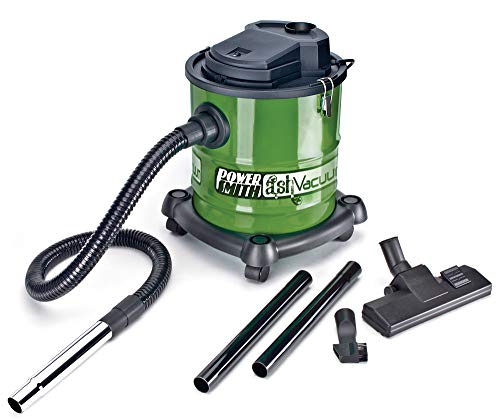
The PAVC101 is the machine many hearth owners picture when the category is mentioned: a green and black metal canister, a ten-amp motor, and a filtration system built around a heat-resistant, washable filter with a pre-filter stage. Its three-gallon capacity suits the rhythm of a household fireplace, where ash is removed in modest amounts often, rather than in one heroic seasonal excavation. The sixteen-foot power reach in its specification reflects real hearth placement, where sockets are rarely where the fire is.
In use, its virtues are focus and simplicity. The hose and wand are shaped for firebox corners, the canister tolerates the knocks of hearth tools, and the filter can be washed and returned rather than replaced on a subscription of consumables. Suction through fine ash depends on keeping that filter clean, and owners who tap and wash it on schedule report a machine that feels unchanged across winters. It is not the largest or quietest option here, but as a dedicated, single-purpose tool kept beside the fireplace, it defines the category’s centre of gravity.
Storage is the other half of its appeal. The canister sits compactly in a hearth-side cupboard or garage corner, and because it is a cold-ash tool only, it should live away from the temptation of quick warm cleanups. Pair it with a metal ash bucket and a shovel for the bulk work, let the vacuum handle the fine remainder and the hearth apron, and the whole fireplace stays cleaner with less airborne dust than any broom ever achieved.
PowerSmith Ash Vacuum PAVC101 — The classic hearth choice
- Format: dedicated ash canister, metal body
- Motor: 10 amp
- Capacity: 3 gallons
- Filtration: heat-rated washable filter system
Strengths
- Purpose-built for ash rather than adapted
- Washable filtration keeps running costs low
- Compact enough for hearth-side storage
Trade-offs
- Three gallons fills fast in deep winter
- Not intended for warm ash under any reading
- Single-purpose tool with no carpet ambitions
Best for: households with a regularly used open fireplace
Not suited for: pellet households needing stove-specific reach first

The PAVC102 scales the same idea up and out. Four gallons of metal canister ride on a wheeled base, the hose runs to ten feet, and the accessory set widens to include a crevice tool, a brush nozzle, a pellet stove hose and adapters, so one machine can move from open fireplace to stove maintenance without improvisation. A blower function adds a second personality, useful for clearing a hearth apron or blowing dust from a stove’s exterior vents before the detailed work begins.
The extra capacity changes the cleaning rhythm in larger homes. Instead of emptying after every couple of fires, the canister absorbs a longer stretch of winter, and the wheels spare your back the filled-canister carry across the room. Filtration remains the heat-rated, washable PowerSmith arrangement, and the same discipline applies: performance across a season is a story about filter care, not motor size.
Choose the 102 when your hearth is a home’s main heat source, when a wood stove and a fireplace both need serving, or when mobility around a big hearth matters. It asks for more storage room than its smaller sibling and rewards the space with fewer interruptions. For a single modest fireplace used on weekends, its capacity is generous to the point of indulgence, which is a pleasant fault but a fault in fit nonetheless.
PowerSmith Ash Vacuum PAVC102 — Best for bigger rounds
- Format: dedicated ash canister on wheels
- Motor: 10 amp, with blower function
- Capacity: 4 gallons
- Tools: crevice, brush, pellet stove hose, adapters
Strengths
- Wheeled base suits larger cleaning rounds
- Broad tool set covers stoves and fireplaces
- Bigger canister means fewer emptying trips
Trade-offs
- Needs more storage space than the 101
- Blower mode is a bonus, not a core need
- Capacity tempts owners to delay emptying
Best for: homes where the hearth is a primary heat source
Not suited for: occasional weekend fireplaces in small flats

Snow Joe’s ASHJ201 approaches ash with a lighter touch: a 4-amp motor, a bagless metal canister of 4.8 gallons, and a presentation aimed at home, garage and outdoor spaces as much as the formal fireplace. The gentler motor is not a weakness in this category, because ash asks for filtration and capture rather than brute lift, and a quieter, less aggressive machine can be the pleasanter companion for indoor hearth work where the vacuum operates in a living room rather than a workshop.
Its capacity is the surprise: the largest canister among the first three picks, paired with the mildest motor, which suits households that generate ash steadily and prefer infrequent emptying over maximum pace. The metal canister and ash-rated filter keep it honest as a dedicated tool rather than a general canister in disguise, and its outdoor flexibility suits fire pits and garage stoves within the same cold-ash rules.
Judge it by temperament. If your cleaning style is unhurried and your hearth modest, the ASHJ201’s calm manners and big bin are a coherent package. If you maintain a hard-working wood stove daily and want the strongest pull through a loading filter, the PowerSmith models argue louder. Either way, the Snow Joe proves the category is not a one-brand conversation, and competition here keeps the dedicated features honest.
Snow Joe Ash Vacuum ASHJ201 — Gentlest dedicated option
- Format: bagless ash canister, metal body
- Motor: 4 amp
- Capacity: 4.8 gallons
- Setting: home, garage and outdoor hearths
Strengths
- Generous capacity with gentle manners
- Calmer motor suits living-room use
- Flexible across fireplaces and fire pits
Trade-offs
- Mild motor works slower through heavy loads
- Filter care still decides performance
- Less specialised tooling than PowerSmith 102
Best for: unhurried households with modest hearths
Not suited for: daily wood-stove users wanting maximum pace

The VANPORE is the capacity leader of this guide at 5.2 gallons, a wheeled metal machine rated at 1200 watts and presented for pellet stoves first, with fireplaces, pellet grills, wood stoves and fire pits all named in its brief. That breadth suits the modern pellet household, where the stove is an appliance with a maintenance schedule and the same owner may also run a grill and a fire pit through the seasons.
Pellet ash differs from log ash: it is finer, produced steadily, and tangled up with the stove’s narrow internal passages. A machine serving it needs suction that survives fine dust loading and tools that reach where pellets burn. The VANPORE’s positioning answers that need directly, and its wheels and capacity support the workshop-and-stove rounds pellet owners actually perform, moving between appliance, hearth and outdoor pit in one session.
As with every pick here, the heat rule is absolute: pellet stoves must be off, unplugged where the manual directs, and cold before any vacuum approaches the burn pot. Within that discipline, the VANPORE is the natural first look for a pellet-centred home that wants one substantial ash machine rather than a small hearth tool plus improvisation.
VANPORE Ash Vacuum for Pellet Stoves — Best for pellet households
- Format: wheeled ash vacuum, metal construction
- Power: 1200W
- Capacity: 5.2 gallons
- Focus: pellet stoves, fireplaces, grills, fire pits
Strengths
- Largest capacity in this guide
- Pellet-first design suits appliance maintenance
- Wheels ease movement between stove and pit
Trade-offs
- Big footprint for a small hearth corner
- Power is wasted on tiny occasional fires
- Still strictly a cold-ash tool
Best for: pellet stove households with several ash sources
Not suited for: small flats with a single decorative fireplace
A pellet stove hides its ash in architecture: the burn pot, the heat-exchange passages, the gaps behind baffles where a standard wand simply cannot go. Pellet-specific kits, discussed here as a category, answer with slim flexible hoses, small angled nozzles and brush tips sized for those channels. Used with any sound ash vacuum, they turn a frustrating partial clean into the thorough maintenance stove makers assume when they write their service schedules.
Their limits deserve equal clarity. A kit is an accessory, not a filtration system, and it inherits every safety property of the machine behind it. Narrow hoses clog if asked to swallow clinker and unburned pellets in bulk, so the bulk still belongs to a brush and metal pan first. Bought as the finishing half of a proper setup, though, a pellet kit is among the highest-value additions a stove owner can make, because a clean burn pot and clear passages return heat that ash insulation quietly steals.
Pellet-Stove-Specific Kits (Prose-Only) — For narrow stove passages
- Format: slim hoses and small nozzles, accessory category
- Purpose: burn pots, baffles and heat passages
- Partner: any sound dedicated ash vacuum
- Tier: modest accessory-level commitment
Strengths
- Reaches passages standard wands cannot
- Improves stove efficiency through real cleaning
- Small, cheap and easy to store
Trade-offs
- Accessory only, no filtration of its own
- Narrow hoses clog on bulk debris
- Useless without the cold-ash discipline
Best for: pellet owners whose stove cleaning feels incomplete
Not suited for: open-fireplace households with no narrow passages
The conversion idea is seductive: place a metal bucket with a separator lid between the ash and a shop vac you already own, so the bulk drops into steel and only fine dust travels onward. As an improvisation it has real merits, including capacity and the reuse of an existing motor, and in workshops it is a long-standing pattern for coarse debris. Ash, however, tests exactly the part of the system the improvisation leaves weakest, which is the final filtration inside the shop vac itself.
Standard shop-vac filters are built for sawdust and rubble, not for ash’s finest fraction, and that fraction will pass, coat the room and punish the motor unless a genuinely fine, heat-tolerant filter stage is fitted and maintained. The bucket also adds trip hazards and seals that must be perfect every time. Our honest verdict: a conversion can be made respectable by an owner who upgrades filtration seriously and obeys the cold-ash rule absolutely, but a dedicated machine remains the safer, simpler recommendation for a living-room hearth.
Metal-Bucket Shop-Vac Conversions (Prose-Only) — The improvised route
- Format: metal separator bucket ahead of a shop vac
- Strength: bulk capacity from equipment owned
- Weak point: final filtration inside the shop vac
- Tier: improvised, owner-assembled
Strengths
- Reuses a motor many workshops already own
- Steel bucket handles bulk ash confidently
- Separator reduces load on the main filter
Trade-offs
- Fine ash defeats standard shop filters
- Seals and hoses multiply failure points
- No heat rating as a complete system
Best for: workshop owners willing to upgrade filtration properly
Not suited for: anyone seeking the safest simple hearth solution
Comparison Table
| Pick | Format | Standout strength | Watch-out |
|---|---|---|---|
| PowerSmith Ash Vacuum PAVC101 | Metal canister | Classic dedicated hearth cleaning | Modest capacity |
| PowerSmith Ash Vacuum PAVC102 | Metal canister, wheeled | Capacity plus blower and stove hose | Storage footprint |
| Snow Joe Ash Vacuum ASHJ201 | Metal canister | Big bin, gentle motor | Slower through heavy loads |
| VANPORE Ash Vacuum for Pellet Stoves | Metal, wheeled | Largest capacity, pellet focus | Bulky for small hearths |
| Pellet-Stove-Specific Kits (Prose-Only) | Accessory | Reaches burn pots and baffles | No filtration of its own |
| Metal-Bucket Shop-Vac Conversions (Prose-Only) | Improvised | Reuses an existing shop vac | Filtration is the weak link |
Why must ash be completely cold before vacuuming?
Because ash insulates. A fire can leave embers alive beneath a grey surface for many hours, sometimes into the next day, and those embers are invisible until disturbed. A vacuum concentrates airflow over whatever it collects, which is precisely what a buried ember needs to flare, and it collects that material into a canister full of fine, dry fuel. Heat-rated filters and metal canisters reduce the consequences of a mistake; they do not make the mistake safe, and no responsible guide will soften that sequence.
Practical cold discipline is simple. Let the fire die naturally rather than smothering it into hidden embers, wait until the following day for routine cleaning where possible, spread the ash with a metal shovel and look for any glow in a darkened room, and hold the back of your hand near the surface to sense warmth without touching. Ash that passes those checks, in a stove or fireplace that feels cold throughout, is ready. Ash about which you feel any doubt is not, and waiting costs nothing beside the alternative.
What makes a filter heat-rated, and why does ordinary filtration fail on ash?
A heat-rated filter uses materials and construction that tolerate elevated temperatures without softening, shrinking or releasing what they have captured, and it is paired with a pre-filter that shoulders the bulk load. Just as important is fineness: ash particles include a fraction so small that ordinary foam or coarse paper passes them freely, so an ash system layers capture, with the washable main filter fine enough to hold the grey dust that would otherwise exit as a visible plume and settle across the room you just cleaned.
Ordinary vacuums fail on ash twice over. Their filters clog almost immediately because the fine fraction blinds the surface, collapsing suction, and what does pass through is exhausted as dust or carried into motor bearings that were never meant to breathe abrasive powder. Even a single well-meaning session can age a household vacuum noticeably. The dedicated machine’s sealed, layered, washable path is not marketing decoration; it is the entire technical difference between the categories.
How do you clean a fireplace with an ash vacuum, step by step?
Begin the day after the fire, with the cold checks done and a metal bucket and shovel beside you. Remove logs, grate and the bulk of the ash by shovel into the bucket, because no vacuum should be asked to swallow the whole bed when a shovel does it silently in a minute. Then vacuum the firebox floor, corners and throat ledges with slow strokes, letting the hose work the seams where fine ash hides, and finish with the hearth apron and the first stretch of floor where ash tracks on shoes and paws.
Empty the canister into the metal bucket outdoors or into a lidded metal container, never into a plastic bin liner indoors, and let collected ash sit in that metal container, away from combustibles, for a further cooling period before disposal, because caution compounds cheaply here. Tap or wash the filter as the maker directs once it is back indoors, check the hose for compacted ash at its bends, and store the machine clean. Performed this way, the whole ritual takes minutes and leaves the room without the grey film that sweeping guarantees.
What mistakes do ash-vacuum owners repeat every winter?
Impatience leads the list: vacuuming in the morning after an evening fire because guests are coming, trusting the grey surface, and learning about insulation the frightening way. The second mistake is neglecting the filter until suction dies, then blaming the motor, when ash filtration needs tapping and washing on a schedule tied to use rather than to failure. A close third is using the ash machine as a general garage vacuum for sawdust and rubble, contaminating its filter with material it was not layered for.
Storage errors complete the set. Ash left sitting in the canister for weeks can hold moisture, corrode and smell, while a canister emptied promptly and stored dry stays neutral for years. Owners also forget that the hose and wand, having lived in ash, should not be borrowed for indoor dusting duties elsewhere. Keep the ash system a closed loop, hearth to metal container to clean storage, and it remains the safest tool in the house rather than a grey exception to every rule.
How should pellet stove owners schedule ash cleaning?
Pellet stoves reward rhythm because they produce ash steadily and hide it structurally. The burn pot wants frequent light attention, the ash pan wants emptying before it overflows into passages it can block, and the heat-exchange areas want a deeper clean on the maker’s schedule, always with the stove off and cold. An ash vacuum with a pellet hose or a prose-only style kit makes each of those jobs faster and cleaner, which is precisely why the schedule gets kept instead of deferred.
Watch the stove’s behaviour as your reminder system. Lazy flame, reduced heat and pellets backing up all whisper that ash is insulating or obstructing something. Respond with a full cold clean rather than turning the feed up to compensate, because burning harder into a dirty stove wastes fuel and stresses components. Owners who treat ash removal as part of running the appliance, like filling the hopper, enjoy steadier heat and fewer midwinter surprises than owners who treat it as an occasional rescue.
How do you dispose of collected ash safely around the home and garden?
Keep the metal container as the ash’s home until disposal day, standing it on a non-combustible surface away from fences, sheds and stored fuel. When it is thoroughly cold and rested, wood ash can go to general waste according to local rules, or to the garden in modest amounts where soil suits it, since wood ash is alkaline and carries minerals that some beds welcome and others, particularly around acid-loving plants, do not. Coal ash and pellet ash from treated fuels deserve more caution and should follow local guidance rather than garden folklore.
Never rush this chain. The fires that make headlines begin with ash that felt cold, placed in a bag, a plastic bin or a cardboard box beside something flammable. Every step in this guide, from the next-day rule to the metal container’s rest period, exists because ash’s danger is patience rather than drama. Build the safe sequence once, repeat it without variation all winter, and it becomes as automatic as locking the door.
What should you wear and protect while cleaning a hearth?
A dust mask is sensible for anyone, because even the best filtration stirs some ash at the shovel stage, and gloves protect hands from both grit and the occasional sharp clinker or nail hiding in a firebox. Lay a washable mat or old sheet across the hearth apron and the floor in front of it, since fine ash tracks astonishing distances on socks and paws, and keep the room’s soft furnishings in mind when you choose where to set the canister down between passes.
Close the room’s door if the house has draughts that wander, and avoid running ceiling fans during the clean, because moving air redistributes the finest fraction faster than any vacuum can claim it. Afterwards, a damp wipe of the hearth surround captures what no airflow should be trusted with. These small courtesies to the room are the difference between a hearth that is cleaned and a room that merely changes where its ash lives.
How does ash from different fuels behave in a vacuum?
Log ash is bulky, pale and full of charcoal fragments that should mostly leave by shovel. Pellet ash is finer, denser in the filter and produced in a steady stream that rewards frequent light cleaning. Coal ash is heavier, grittier and more abrasive, and it punishes filters and hoses faster, which argues for shorter emptying intervals and stricter filter care in coal-burning homes. Fire-pit ash arrives mixed with sand and soil, and the vacuum should meet it only after the same cold discipline and a shovel has removed the bulk.
Knowing your fuel’s character lets you schedule honestly. A weekend log fire needs the vacuum monthly and the shovel weekly; a pellet stove heating a home needs both on a tighter rhythm. The machines in this guide span that range deliberately, from the compact PAVC101 to the big wheeled VANPORE, because the right capacity is the one matched to your fuel’s habits rather than to the largest number on a comparison table.
What are the signs that an ash vacuum needs attention beyond emptying?
Falling suction with a clean filter points to the hose or wand, where compacted ash builds at bends and at the cuff joints; a flexible rod or a gloved finger, with the machine unplugged, clears most of it. A canister that smells stale when empty has usually stored damp ash at some point and wants a wash and a thorough dry. Seals that no longer sit flat leak fine dust visibly at the joints during use, and replacing a tired seal restores more performance than any amount of filter washing.
Listen to the motor as well. A change in note, a new harshness or a smell of strain during ordinary work suggests the machine is breathing through a restriction somewhere in its path. Work from the head backwards: nozzle, hose, canister inlet, pre-filter, main filter. Ash machines are simple, honest systems, and nearly every decline they suffer announces its location to an owner willing to spend ten unhurried minutes finding it.
How should you clean around a wood stove without disturbing its seals and gaskets?
Work gently around door gaskets and glass. The vacuum’s nozzle should lift ash from the stove’s ledges and the hearth beneath, not worry at rope seals or scrape across glass that scratches and clouds. Use a brush nozzle where surfaces are finished, keep the metal wand for the firebox floor and ash pan cavity, and never lever against stove components to reach a corner, because a bent baffle or a torn gasket costs more heat in a week than the hidden ash cost in a season.
While the stove is cold and open, take the chance to look rather than merely clean: check the burn pot for clinker, the ash pan for overflow, and the door seal for the pale line that betrays a leak. An ash vacuum session that doubles as an inspection keeps a stove efficient and safe in a way that pure cleaning cannot. This is another reason the pellet kits discussed earlier earn their keep, since their slim tools clean and reveal in the same pass.
Why do ash vacuums belong beside the hearth rather than in a distant cupboard?
Tools that live where they work get used at the right moment, and ash work has a right moment: the cold morning after, when the firebox is ready and the room is quiet. A machine stored three rooms away invites postponement, and postponed ash becomes tracked ash, then grey film on everything. The compact models in this guide were chosen partly for hearth-side storage, in a fireside cupboard, a deep hearth recess or the nearest utility space, with hose coiled and filter clean from the last session.
Proximity also protects the safety routine. A dedicated machine, used for nothing else, kept beside its single job, reinforces the closed loop this guide keeps describing: cold checks, shovel, vacuum, metal container, filter care, store. Borrow that machine for a garage project and the loop breaks; the filter returns full of sawdust and the next hearth session inherits the mess. Specialisation feels like a luxury until you notice it is actually a safety system wearing a storage decision as its disguise.
How do you keep ash from tracking through the rest of the house?
Most ash migration happens on feet, paws and clothing in the hour after a fire is tended, not during the vacuum session itself. A stiff mat at the hearth’s edge, a habit of brushing boots and the dog at the door, and a washable runner on the route to the ash container all intercept the grey traffic before it reaches pale carpets. Vacuum that route last in your session, after the firebox, so the machine gathers the day’s footprints as its final act rather than its first.
Clothing deserves a thought as well: hearth work in a dedicated old jumper and an apron keeps ash off the clothes you will later wear onto the sofa. Shake those garments outdoors, not in the hallway, and keep them with the hearth tools. Households that treat ash as a material with routes, like mud in a farmhouse, find it stays a hearth matter; households that treat it as a cleaning problem alone chase its footprints through every room all winter.
What should renters and chimney-sweep schedules change about ash vacuuming?
A vacuum cleans the firebox and hearth; it does not clean the flue, and no amount of enthusiastic wand work up the throat replaces a professional sweep on the schedule your fuel and usage demand. Renters should confirm that a fireplace is approved for use and recently swept before building any routine around it, and landlords’ rules about ash disposal, often specifying metal containers, align happily with the safety sequence this guide describes.
Keep a simple log if you burn often: dates of sweeps, filter washes and any stove parts replaced. When a sweep or a stove engineer visits, that log turns guesswork into conversation, and it protects warranties that assume maintenance happened. The ash vacuum is the daily servant of the system, but the system’s safety rests on the chimney, the stove’s integrity and the owner’s calendar, in that order.
How do you choose between the two PowerSmith models in practice?
Count your fires and measure your storage. A household burning most evenings in one main fireplace will fill three gallons quickly enough that the PAVC102’s extra capacity, wheels and blower stop being luxuries and become the difference between a kept routine and a resented one. Its pellet hose also future-proofs the purchase if a stove joins the household, and its tool set retires a drawer of improvisations.
The PAVC101 wins where the hearth is smaller, the storage is a single cupboard and the fires are frequent but modest. It is the easier machine to keep beside the fireplace, which this guide has argued is half the safety system, and its simplicity leaves less to clean, store and lose. Neither choice is a compromise; they are the same idea fitted to two sizes of winter, and choosing by your real burning pattern rather than by specification envy is the whole decision.
What is the safest way to handle a first ash clean in a home you have just moved into?
Assume nothing about the ash already in the firebox. Its age, its fuel and its history are unknown, so treat it as potentially harbouring embers until a full cold check, performed patiently, says otherwise. Shovel the bulk into a metal container and let that container rest outdoors on a non-combustible surface before disposal, and inspect the firebox, throat and hearth for cracks, loose bricks or a damaged liner while it is empty, because a new home’s first clean is also its first inspection.
Have the chimney swept before your first fire rather than after your first season, and let the sweep’s verdict decide whether the fireplace joins your heating life or remains decorative. Only then does the vacuum routine in this guide begin, on a known system, with known fuel, under your own discipline. Inherited ash is the one load in this entire topic that deserves extra suspicion, and giving it that suspicion costs one careful afternoon.
How should ash vacuums be stored through the summer?
Clean the machine as if winter were watching: canister emptied and washed if it needs it, filter washed and dried completely, hose checked for compacted residue at its bends, and the whole unit stored dry in its usual place rather than buried under garden furniture in a damp shed. A summer of damp storage undoes a winter of good habits, growing smells in seals and corrosion on the canister’s rim that the first autumn session will distribute around the room.
Use the quiet season for the small renewals: a replacement filter if the old one has served several winters, a new seal if the lid’s fit has loosened, and a note in the calendar for the autumn sweep. When the first cold evening arrives, the system wakes ready, and the first fire’s ash, given its full day to cool, meets a machine in perfect order. Seasonal tools reward seasonal owners, and the ash vacuum is the most seasonal tool in the house.
Why does the room still look dusty after sweeping a hearth with a broom?
Because a broom is an ash redistribution device. Its bristles flick the fine fraction airborne, where it drifts on the room’s warm currents and settles over hours onto shelves, fabrics and the television screen, while the coarse fraction gathers obediently into the pan and creates the illusion of success. Anyone who has dusted a mantel the day after sweeping a hearth has met the missing ash personally.
The vacuum reverses that physics by capturing at the point of disturbance, which is why hearth households that convert describe the change as disproportionate to the tool’s simplicity. The room does not merely look cleaner on the day; it stays cleaner between fires, because each session removes the fine reservoir that sweeping kept in circulation. That compounding effect, week over week, is the deepest argument for a dedicated machine, deeper even than its safety case, and the safety case was already sufficient.
How do you teach other household members the ash routine without nagging?
Write the sequence on a card kept with the machine: cold checks, shovel first, vacuum second, metal container, filter glance, store dry. A visible card beats a remembered lecture, especially for the teenager asked to clean before guests or the partner who burns the fire most but cleans it least. Agree the non-negotiable aloud once, that warm ash is never vacuumed by anyone for any reason, and let the card carry the rest without further speeches.
Demonstrate the full routine once, slowly, including the filter care that newcomers always skip, and then trust the system you have built. Households fracture over ash when the rules live in one person’s head and emerge as criticism; they run smoothly when the rules live on a card, the tools live beside the hearth, and the machine’s condition makes the last cleaner’s care, or neglect, kindly visible to the next.
What role does an ash vacuum play in a home heated mainly by wood?
In a wood-heated home the ash vacuum stops being an accessory and becomes infrastructure, as essential as the log store and the moisture meter. Ash removal sets the stove’s efficiency, the room’s air and the household’s fire safety simultaneously, and a dedicated machine makes that removal frequent, clean and unremarkable. Owners in this life measure their machines in winters rather than features, and they choose capacity and filtration accordingly, which is why the larger wheeled models exist.
They also build redundancy into the routine: a second filter so one can dry while the other works, a metal container with a lid that truly fits, and a standing arrangement with a sweep. If wood is your heat, read this guide’s linked picks from the top of the range downwards, and let the prose-only sections harden your routine rather than decorate it. The stakes of a lazy ash habit scale with every cord you burn.
A final word on patience as a fireplace tool
Every safety rule in this guide reduces to patience: waiting a day, resting a container, drying a filter, sweeping a flue on schedule rather than on suspicion. Ash punishes hurry and rewards delay with a reliability that feels almost moral. The good news is that patience, once installed as the household’s default, costs nothing and feels like nothing; it is simply the order in which things are done.
Buy the machine that fits your hearth, keep it beside its work, and let patience operate it. A winter of fires cleaned that way leaves a home warmer, a room cleaner and a family entirely unbothered by drama, which is the highest praise any hearth tool can earn.
How do outdoor fire pits and braziers change the ash routine?
Outdoor ash cools faster in open air but faces weather the indoor hearth never meets: rain that turns ash to alkaline slurry, and wind that can fan a buried ember during the clean itself. Choose a calm, dry moment, perform the same cold checks with extra respect for gusts, and shovel before vacuuming so the machine meets only the fine remainder. A wheeled model like the Snow Joe or the VANPORE earns its keep here, travelling from house to pit without a filled canister carried at arm’s length.
Never bring the pit’s ash indoors in the vacuum and forget it there; empty into the metal container outside, let it rest in the open away from fences and decking, and store the machine clean and dry as always. Outdoor fires feel informal, and that informality is exactly why their ash deserves the formal routine. The ember does not know it was a garden party.
What should you do if you suspect ash in the canister is warm?
Stop, unplug the machine, and carry the whole canister, without opening it, to a safe outdoor spot on a non-combustible surface, away from buildings, vehicles and stored fuel. Leave it there, closed, and monitor from a distance; do not open it to investigate, because opening feeds oxygen to exactly what you fear. If there is any sign of smoke, heat or smell intensifying, call your local fire service for advice rather than improvising heroics with a garden hose over a machine connected to your household electrics.
Afterwards, treat the incident as information rather than embarrassment: the cold check failed, so lengthen it, and review whether a different household member needs the routine card rather than a telling-off. Machines survive most scares when they are moved outside promptly and left alone; households survive them by learning once. Then replace any filter that was exposed to heat before trusting the machine indoors again.
How does a well-kept hearth change the feel of a room?
A fireplace that is cleaned properly stops perfuming its room with yesterday’s fire. The mantel stays dustable rather than gritty, fabrics near the hearth stop greying at their edges, and the fire itself, lit in a clean box with clear airways, burns brighter and more honestly. Visitors notice none of this directly; they simply register that the room feels cared for in a way they cannot name.
That unnamed feeling is the ash vacuum’s real product, delivered one cold, patient, well-filtered session at a time, all winter long.
One small habit that protects every session
Before the hose ever enters the firebox, glance at the whole scene once: grate cool, tools metal, container ready, mat down, machine’s filter known to be clean. That five-second survey, repeated until it is reflex, catches the forgotten step while it is still free to fix. Rituals protect people precisely because they do not depend on memory, mood or how busy the morning is, and ash work, of all household work, deserves a ritual.
Keep that survey, keep the card by the machine, and keep the metal container lidded and resting where it belongs, and the rest of this guide becomes simple shopping rather than safety advice.
The hearth rewards households that treat it as a small, well-run system: fuel stored dry, chimney swept on time, ash handled cold, and tools that live within arm’s reach of the work they were bought to do, season after season.
With those habits in place, choosing between the four linked machines becomes a calm question of capacity and temperament.
That calm, finally, is what a good ash vacuum is really selling.
Final Recommendation
Match the machine to your hearth’s workload: the PowerSmith PAVC101 for the classic fireplace routine, the PAVC102 when capacity, wheels and a blower earn their storage space, the Snow Joe ASHJ201 for gentler, big-bin cleaning, and the VANPORE when a pellet stove anchors your heating. Add a pellet kit’s reach where narrow passages demand it, and think carefully before improvising a shop-vac conversion for a living-room fire. Whatever you choose, let the cold-ash rule outrank every feature on this page, because the safest ash vacuum is the one whose owner never asks its heat rating to prove itself.
Frequently Asked Questions
How long should I wait before vacuuming ash after a fire?
Wait until the ash is cold throughout, which for most fireplaces means the next day at least. Spread the ash with a metal shovel, look for glow in a darkened room and sense for warmth with the back of a hand held near the surface. Any doubt at all means waiting longer; no cleaning schedule justifies vacuuming warm embers.
Can I use an ash vacuum for a pellet stove and a fireplace?
Yes, provided the stove is off and completely cold, and the machine’s tools reach your stove’s passages. Models like the PowerSmith PAVC102 include a pellet stove hose, and the VANPORE is designed pellet-first. A slim accessory kit can add reach to any of the linked machines for burn pots and baffles.
How often should the filter be cleaned?
Tap or wash it whenever suction softens and on a regular schedule tied to how often you burn, following the maker’s instructions and letting a washed filter dry fully before refitting. Fine ash blinds filters faster than owners expect, and most performance complaints in this category are filter stories rather than motor stories.
Is a shop vac with a metal bucket just as good?
It can collect bulk ash, but its standard filtration passes the finest ash fraction, coating the room and the motor, and the assembled system carries no heat rating as a whole. A dedicated ash vacuum’s layered, heat-rated, washable filtration is the safer recommendation for indoor hearths.
Where should I put ash after vacuuming it?
Into a lidded metal container kept away from combustible material, where it should rest for a further cooling period before disposal. Never tip vacuumed ash into a plastic bin or cardboard, indoors or out, because the entire discipline of ash handling exists to respect how long embers can hide.
Related Guides
Specialist tools reward further reading: Best Vacuum Attachments explains the nozzles that finish hearth work, Best Bagless Backpack Vacuums covers cleaning power carried very differently, and Best Affordable Vacuums for Pet Hair handles the other fine dust in a hearth home, while Best Air Purifiers for Mold addresses airborne particles beyond the fireplace.


