Our Top Picks
 INNOVA HEALTH AND FITNESS ITM5900 Advanced Heat andOne Size47 x 28 x 62 inches60 poundsCheck on Amazon



What's inside
- How to read this guide
- What an inversion table is and how gravity does the work
- Angle control: straps, ratchets, handles, and preset stops
- Frame, capacity, and stability
- Ankle locking systems: where comfort and security meet
- Backrest padding, head support, and comfort accessories
- Safety certification and the details that prevent accidents
- Assembly, folding, and storage footprint
- Who should not use an inversion table
- Maintenance: bearings, straps, and bolts
- Check prices on Amazon
- Choosing by body and by room
As an Amazon Associate I earn from qualifying purchases. This post may contain affiliate links at no extra cost to you.
How to read this guide
An inversion table looks simple from across a room: a padded bed, a steel frame, and a pivot somewhere near the middle. Living with one is less simple. The angle you can hold comfortably, the way your ankles are secured, the floor space the feet demand, and the small mechanical details that decide whether the bed moves smoothly or lurches all shape whether the table gets used three times a week or folded away and forgotten behind a door. This guide works through those details in the order they matter, starting with control and structure and ending with the body and room the table has to fit.
How we built this guide matters for how you read it: As an Amazon Associate we earn from qualifying purchases. That relationship does not change the specification thresholds we apply below, and it does not add a product to a shortlist or remove one from it. We compare published specifications, manuals, safety listings, and owner documentation for the category as a whole, and we describe ranges that are typical for full-body inversion tables rather than promising that any single unit will suit any single back.
One boundary is worth stating plainly at the start. This guide covers full-length inversion tables only, the kind where you lie back on a bed, lock your ankles, and rotate the whole body around a pivot. Seated inversion chairs are a different product class with a different posture, a different pivot geometry, and a different set of trade-offs, and they are covered elsewhere. If you are cross-shopping the two, read this guide for what a table does well and read the chair coverage separately before deciding which posture your body and your room can actually support.
Nothing here is medical advice. Inversion changes blood pressure distribution, pressure inside the eye, and load through healing tissue, and the section later in this guide on who should not use a table is not a formality. Treat the specifications as shopping information, treat the cautions as a prompt to talk with your own clinician, and treat any claim that a device will fix a diagnosed condition with the scepticism it deserves. A well-chosen table is a piece of home equipment. It is not a treatment plan.
Where numbers appear, they are given as typical ranges for the category: user weight capacities in pounds and kilograms, height adjustment ranges in feet and inches or centimetres, foam thickness in millimetres, frame tube dimensions, and folded footprints. Ranges are more honest than a single heroic figure, because two tables with the same headline capacity can behave very differently once a tall user, a soft floor, and a steep angle are combined. Read each range against your own measurements rather than against an idealised average user who does not exist.
What an inversion table is and how gravity does the work
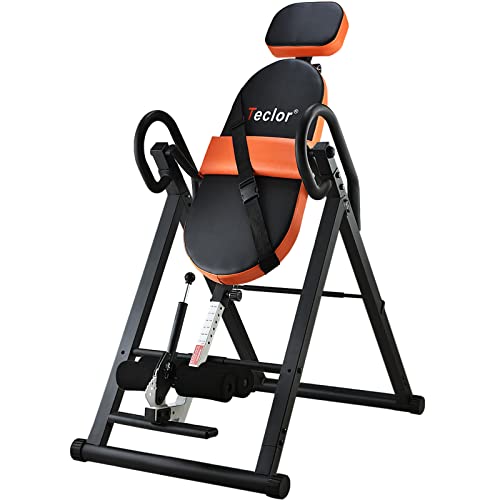
An inversion table is a rotating bed mounted in an A-frame or rectangular steel frame. You stand on a foot platform, lean back against the bed, secure your ankles in a locking system at the lower end, and then shift your weight — often simply by raising your arms — so the bed rotates around its pivot. As the head end drops and the feet rise, gravity pulls along the length of the spine rather than across it, and the compressive load that standing and sitting place on the discs and facet joints is reduced for as long as the position is held.
The mechanism is traction by body weight, nothing more exotic than that. There is no motor in most home tables, no pump, and no active stretching force beyond what your own mass provides once the angle passes horizontal. That simplicity is the appeal: the dose is controlled by angle and time, both of which you set. It is also the limitation. The same body weight that unloads the spine loads the ankles, the knees, and the cardiovascular system in ways that have to be respected, which is why control systems and ankle hardware get so much attention in this guide.
Partial inversion versus full inversion
Partial inversion means any angle short of fully upside down: the bed tilted so the head is below the feet by perhaps twenty, forty, or sixty degrees. Most people, most of the time, work in this band. Decompression begins well before vertical, blood pressure effects are milder, the ankles carry less shear, and returning upright is a calm, unhurried movement rather than a test of nerve. For a first month of use, and for many long-term users permanently, partial angles are not a compromise. They are the point.
Full inversion means the bed rotates to roughly vertical, head directly below feet, with the body hanging from the locked ankles and the bed surface sometimes swinging clear of the back entirely. Some tables allow the bed to move past the frame stops so the user hangs freely; others keep the back supported all the way. Full inversion maximises traction and allows certain stretching and abdominal movements that partial angles do not, but it also maximises every caution in this guide. A table that cannot be limited reliably to partial angles is a poor choice for a beginner, however impressive its maximum angle sounds.
Between those poles sits the practical question of granularity. A table that offers only free rotation asks your balance and arm position to find and hold every angle. A table with a strap or preset stops lets you repeat yesterday’s comfortable angle exactly today. Repeatability sounds like a small thing until you realise that a routine built on a known angle and a known duration is the routine people actually keep. Chasing a slightly different tilt every session, and overshooting into discomfort twice a week, is how tables end up on resale listings.
Session length deserves the same realism. Category guidance in manuals commonly describes short early sessions — a minute or two at a shallow angle — building gradually as the user learns how their head, ears, and blood pressure respond. The return to upright is part of the session, not an afterthought: pausing at horizontal to let pressures equalise before standing is written into many manuals for a reason. When you compare tables, favour the ones whose controls make slow, staged movement easy over the ones whose marketing celebrates how fast or how far they rotate.
The pivot, balance, and why height setting changes everything
Every table rotates around a pivot, and every user has a centre of mass that sits somewhere along the bed. The height adjustment on the main shaft exists to bring those two points into a workable relationship. Set the height correctly and the bed responds to small arm movements with smooth, predictable rotation. Set it too long and the bed feels reluctant, tipping late and then all at once. Set it too short and it can feel eager to flip, which is unnerving at exactly the moment calm matters most.
This is why the height range and the fineness of its increments are genuine performance specifications, not sizing trivia. Two users who differ by five centimetres can need different settings, and the same user may adjust the setting as footwear, ankle holder position, or confidence changes. Look for clear markings, a locking pin or clamp that cannot drift mid-session, and enough range that neither the tallest nor the shortest intended user is working at the very end of the adjustment, where geometry is usually at its worst.
Balance also explains why published weight capacity and published height range must be read together. A user near the top of the weight range and the top of the height range is asking the most of the pivot bearings, the frame, and the ankle lock simultaneously. Sensible manufacturers rate their tables for that combined case; sensible buyers leave margin anyway. If you sit near both limits on a given model, the next size or class up is usually the wiser purchase, even before comfort enters the discussion.
Angle control: straps, ratchets, handles, and preset stops
Angle control is the system that decides how far the bed rotates and how confidently you can return. Four approaches dominate the category, and many tables combine two of them. Understanding what each one does at the moment you are tilted, head down, and reaching for a control is more useful than any feature list, because a control that cannot be reached or operated calmly from an inverted position is decoration, not control.
The limiting strap
The simplest limiter is an adjustable strap or tether connecting the bed to the frame. Shorten it and the bed stops early; lengthen it and the bed travels further. Straps are cheap, quiet, and effectively stepless within their range, which makes them good for fine personal angles. Their weaknesses are consistency and wear. Webbing can stretch slightly, buckle positions can be hard to reproduce exactly, and a strap that is awkward to adjust invites users to leave it at one setting forever — fine if that setting suits them, limiting if their practice develops.
Check how the strap adjusts: a cam buckle that can be set before mounting is calmer than a friction slider that must be wrestled under load. Check also what the strap is made of and how it attaches, because it is a genuine safety component. Stitching at the anchor points, the width of the webbing, and any fraying along the edges are inspection items for the life of the table, and they appear again in the maintenance section for that reason. A table that treats the strap as an accessory rather than a structural part is telling you something about its priorities.
Ratchet and preset stop systems
Some tables replace or supplement the strap with a mechanical stop system: a notched bar, a pin that engages a series of holes, or a ratchet that clicks through defined angles. The virtue is repeatability. A preset at a moderate angle today is the same moderate angle next month, which suits households where two people share a table and want to return to their own settings without guesswork. The cost is granularity; if your comfortable angle falls between two notches, you live with the nearer one or fall back on arm position to trim the difference.
Ask how the preset is selected and, just as importantly, how it is overridden in a hurry. A pin that must be pulled while the bed is loaded behaves differently from a lever that can be released from the handles. Read the manual’s description of changing angles mid-session rather than assuming it is easy. Also note whether the stop system limits rotation in both directions or only downward; a bed that can swing past upright when you return too enthusiastically needs a different kind of attention.
Handle length and reach
Long handles that run alongside the bed give an inverted user something substantial to pull on to return upright, and they double as a steadying grip while mounting. Short handles or small grips near the pivot save space and weight but demand more from the user’s arms and confidence. Neither is automatically better. Longer steel adds kilograms, and on a table that will be folded and moved often that weight is felt weekly. The honest test is reach: from a moderate angle, with ankles locked, can a user of your height grasp the handles without stretching so far that their shoulders leave the bed?
If you are comparing tables for a household with mixed confidence levels, weight the control system more heavily than any other section of this guide. The nervous user does not need a bigger maximum angle. They need a strap or stop they trust, handles they can reach, and a return motion slow enough to feel boring. Boring, in this category, is a compliment. It means the engineering is doing the work instead of the user’s nerve.
Frame, capacity, and stability
The frame carries everything: you, the bed, and the dynamic loads of rotation, which are higher than the static load of simply lying still. Most home tables use powder-coated steel tube, in round or rectangular section, joined by bolts, welds, or a mixture. Tube wall thickness and diameter are rarely both published, but capacity ratings, frame weight, and footprint together give a fair picture of how seriously a frame has been built. A very light table with a very high claimed capacity deserves a slower, more sceptical read than a heavier table with a modest one.
Weight capacity in pounds and kilograms
Published user weight capacities for home inversion tables commonly fall somewhere in the region of 250 to 350 pounds, roughly 113 to 159 kilograms, with heavy-duty models rated above that band and compact budget frames below it. Treat the rating as a ceiling for the whole system — frame, pivot, bed, and ankle lock together — not as a target to approach. A user within about three-quarters of the rated limit will generally experience less flex, quieter bearings, and a calmer rotation than a user at ninety-five percent of it, even though both are technically within specification.
Capacity interacts with clothing, with the ankle holder setting, and with how abruptly a user moves. Dropping into inversion rather than easing into it multiplies momentary load. So does using the inverted position for vigorous exercise, which some tables explicitly support and others explicitly exclude in their manuals. Before assuming a table can be used for inverted sit-ups or loaded stretching, check that the manual permits it for your weight. The frame may tolerate it; the ankle lock, which then carries the full dynamic load through two padded clamps, is often the real limit.
Height range and bed length
Height adjustment ranges in this category typically span something like 4 feet 10 inches to 6 feet 6 inches, approximately 147 to 198 centimetres, though compact and extra-tall models sit outside that band at either end. What matters is not the headline span but where you fall inside it. A user near the middle of the range gets the best-balanced pivot behaviour and the full choice of ankle positions. A user at the extreme end should look carefully at bed length as well, because a bed that ends mid-shoulder-blade changes both comfort and balance.
Bed length and width are comfort specifications with structural consequences. A longer, wider bed supports the shoulders and hips without edge pressure, but it needs more clearance to rotate — the head end sweeps an arc that must miss skirting boards, radiators, and furniture. Measure the rotation envelope, not just the static footprint. Manuals usually give assembled dimensions; the swept space during inversion can exceed the depth figure by a surprising margin, and discovering that with the table assembled is an avoidable annoyance.
Footprint, base width, and floor behaviour
Stability comes from geometry: the width between the feet, the length of the base rails, and how the frame resists the rocking moment as the bed rotates. Wider bases feel calmer, especially at steeper angles and for heavier users, but they claim more floor. Look for end caps or feet designed to spread load and grip, cross-braces that stop the legs splaying under load, and a stance that keeps all feet planted when the user shifts. Any table that can be made to lift a foot with a firm sideways push at the bed, unloaded in a showroom sense, is asking questions you do not want answered at sixty degrees.
Floors are part of the system. Hard floors transmit noise and let smooth feet creep; thick carpet lets feet sink unevenly and can tilt the whole frame by a degree or two, which the pivot will faithfully convert into asymmetric rotation. Many owners place tables on a firm mat or a sheet of rigid board over carpet, which also protects flooring from point loads. If your only available space is deep-pile carpet in a rented room, that constraint belongs in the buying decision, not in a later improvisation.
For readers weighing inversion against seated and reclining recovery equipment, our guide to best massage chairs with stretch explains how powered stretch programmes compare with gravity-based traction, and which users tend to prefer a chair’s supported posture over a table’s hanging one.
Ankle locking systems: where comfort and security meet
Ask long-term owners what decided whether they kept using a table and the ankle system comes up with striking regularity. It is the only part of the machine that holds you when the bed passes horizontal, and it does so through some of the narrowest, bonest anatomy on the body. A lock that is secure but bruising will shorten sessions and then end them. A lock that is plush but vague will undermine confidence at exactly the angles where confidence is the product. The goal is a system that feels like neither: present, even, and forgettable.
Ratchet closures
Ratchet systems close padded front and rear holders around the ankles in small, audible increments. The clicks are useful feedback — many users count them to reproduce yesterday’s fit — and the fine increments suit narrow ankles that slip through coarser systems. A release lever, often positioned so it can be reached by bending at the waist before inverting or by a long handle, lets the holder open fully. Examine the release carefully. You will operate it while bent forward with blood already shifting; a small, stiff, or ambiguous release is a design flaw that no amount of padding redeems.
Ratchets also concentrate pressure if the padding compresses unevenly, because the closing force follows the strap path. Front and rear pads of different densities are a thoughtful sign: the front of the ankle, over the tendons, tolerates less focal pressure than the Achilles side. Wear socks of a consistent thickness during early sessions so fit comparisons are honest, and treat footwear rules in the manual seriously — most systems are designed around flat, secure shoes or bare ankles in socks, not loose trainers that can deform inside the clamp.
Pull-pin and spring-loaded closures
Pin-based systems slide the front holder along a track and lock it with a spring pin engaging a row of holes. They are mechanically simple, easy to inspect, and easy to understand, which counts for a great deal in a product that holds a person upside down. Their steps are coarser than a ratchet’s, so some users land between sizes and compensate with sock thickness or pad position. The pin itself is the inspection point: it should seat fully, with a positive feel, every time. A pin that can sit half-engaged on a hole edge is the kind of detail to check on day one and monthly thereafter.
Spring-loaded designs that grip as you step in and release with a lever aim to make mounting a one-motion task, helpful for users whose forward reach is limited. The trade-off is complexity inside a housing you cannot see into. If a design hides its mechanism, the manual’s cleaning and inspection guidance matters more, because grit and carpet fibre migrate into exactly these housings in home use. A system you can wipe down and visually check has a quiet long-term advantage over a sealed one that works beautifully until the week it does not.
Strap and roller systems
Some tables, particularly lighter and older designs, secure the feet with straps over rollers or bars rather than enclosing clamps. Properly adjusted, rollers can spread load along the front of the ankle and feel surprisingly kind. Poorly adjusted, they allow heel lift and a slow creep that the user notices only when the bed is steep. If you are considering such a design, the questions are adjustability per foot — left and right ankles often differ — and whether the strap can be tensioned from a standing, unloaded position rather than by guesswork after mounting.
Whichever system a table uses, test the logic of escape before the logic of comfort. From a shallow angle, can you return upright and release your ankles without hurry, without tools, and without needing a second person? Could you do it with slightly shaky hands on a day when a head rush caught you off guard? Manufacturers design for the calm case. Buyers should think about the worst plausible minute, because a system that passes that thought experiment will handle a thousand calm sessions without comment.
Padding inside the holders deserves its own measurement habit. Foam that starts at a comfortable thickness can pack down over a year of use, changing both fit and pressure distribution. Some holders use replaceable pads; most do not, which makes initial density important. Press a thumb firmly into the pad: it should compress and recover, not bottom out against the shell immediately. High-density foam around the ankle, like the foam in the backrest discussed next, is a place where a few millimetres of material translate directly into minutes of comfortable session time.
Backrest padding, head support, and comfort accessories
The bed is where you spend the session, and its construction ranges from a simple fabric sling stretched over a frame to a thick, contoured, foam-padded board. Neither extreme is automatically right. Sling beds conform, breathe, and keep weight down; padded boards distribute pressure evenly, support the lumbar curve in a defined way, and give accessories something solid to attach to. Your preference will be shaped by session length, room temperature, and how much lateral support your shoulders want when fully inverted.
Foam thickness and support layers
Padded beds in this category commonly use foam in the region of 20 to 50 millimetres thick — roughly three-quarters of an inch to two inches — sometimes layered, with a firmer base under a softer surface. Thickness alone is a weak predictor of comfort. A thin, well-shaped pad on a rigid board can feel better over ten minutes than a thick, soft pad that lets the shoulder blades sink and the spine flex sideways. What you are buying is pressure distribution, and that comes from the combination of board shape, foam density, and cover tension.
Mesh and fabric beds take the opposite approach: no meaningful foam at all, with support coming from the tension of the woven surface. They run cooler, which matters in un-air-conditioned rooms and for users who find that warmth plus inversion brings on nausea. They also make the frame’s cross-members easier to feel if the weave stretches with age. If a mesh bed appeals, ask how the panel is replaced when it eventually sags, because a bed whose surface cannot be renewed has a built-in retirement date.
Seams and cover materials are unglamorous and decisive. Stitching placed where the shoulder blades rest will be found by your back within a week. Vinyl covers wipe clean and shrug off sweat but can feel clammy; woven covers feel kinder and absorb more, which commits you to airing the bed after use. In a household where the table lives in a spare bedroom rather than a gym, the woven option usually wins on willingness to use it, and willingness, again, is the metric that decides whether any of the engineering matters.
Headrests and lumbar accessories
Most tables provide some form of head support: an extension of the bed, a separate padded pillow, or an adjustable headrest that slides to suit torso length. At steep angles the head’s weight transfers through this support, and a headrest set too low flexes the neck in a way users often misread as a problem with inversion itself. Adjustability here interacts with the height setting, so expect a session or two of small experiments before the combination settles. Mark or note your settings once they work; households that skip this step re-derive them weekly.
Lumbar pillows and bridge accessories — pads that support the lower back’s curve while inverted — are offered across the category, sometimes included, sometimes sold separately. They change the feel of traction noticeably, supporting the lumbar spine so the stretch distributes rather than concentrating at one segment. As a feature class they are worth having available, particularly for users whose backs are happiest with support rather than free hanging, but they are personal: the same pad that relieves one user crowds another. Treat any lumbar accessory as an experiment with a return path, not as a guaranteed upgrade.
Heat and vibration accessories exist in this category too, usually as pads that strap to the bed and add warmth or gentle massage during a session. As features, they add weight, a power lead to manage, and one more thing to clean. They may suit users who already know warmth helps their back settle; they do nothing for the structural questions this guide prioritises, and they should never be the reason a marginal frame or a poor ankle lock gets forgiven. Buy the table first, on structure and control. Let accessories be the garnish they are.
Posture support does not end when the session does, and readers setting up a whole room for back care may also value the seating analysis in best computer chairs for posture and comfort, which looks at how daytime sitting posture interacts with evening recovery routines.
Safety certification and the details that prevent accidents
Safety in this category is a stack of small things rather than a single heroic feature. Certification sits at the top of the stack because it means an independent body has examined the design against a published standard. Below it sit the mechanical details: floor grip, folding locks, pinch-point management, and the clarity of warnings. A table can be strong and still be careless; strength is tested in the frame section above, while this section is about whether the design has thought about the ordinary ways home equipment hurts people — slips, traps, collapses, and surprises.
UL 1647 and what certification actually covers
In North America, the relevant standard for motorised and manual exercise equipment of this type is UL 1647, and tables certified to it will carry the listing in their documentation and usually on a label on the frame. Certification examines structural integrity under load, stability, the security of locking mechanisms, and the adequacy of warnings, among other requirements. It does not certify that inversion will help your back. It certifies that the machine has been assessed as a machine, which is exactly the assurance a buyer cannot generate for themselves from photographs and a specification table.
Absence of a listing is not proof that a table is dangerous, and listings vary by market — European models may reference different standards and marks. But the presence of a recognised listing shifts the burden of proof in a useful direction, and in a category where the user hangs upside down by the ankles, that shift is worth paying attention to. If a listing is claimed in marketing, look for it in the manual or on the rating label rather than only in the headline copy. Claims that survive into compliance documents are the ones that were checked.
Floor grip, transport, and folding locks
Non-slip feet or end caps are the frame’s interface with your floor, and they wear. Rubber compounds harden with age and lose grip, especially in rooms that get cold. A table that walked a few centimetres across a hard floor during a session is delivering a clear message; find out whether replacement feet are available before you need them. Similarly, check how the table is meant to be moved. Some frames include transport wheels that engage when the frame is tilted; others expect to be carried, which for a steel table of twenty or more kilograms is a two-person sentence in the manual that becomes a one-person injury in real life if ignored.
Folding designs introduce a specific hazard class: a frame that folds for storage must not be able to fold, or partially collapse, in use. Look for a positive locking mechanism on the folding joint — a pin, a clamp, a detent with a deliberate release action — and a manual that tells you to verify it before every session. The check takes seconds. Build it into the mounting routine the way pilots build checks into a cockpit flow, because the failure it prevents is rare precisely until the day it is not.
Pinch points deserve a walk-around inspection on any new table. The pivot area, the ankle mechanism, and folding joints all bring steel close to skin or clothing at some point in their travel. Guards, covers, and sensible clearances are the manufacturer’s job; keeping loose clothing, jewellery, and long hair away from the mechanism is yours. Households with children need a further rule, stated plainly: an inversion table is not climbing equipment, and a folded or stored table should be secured so it cannot be unfolded by curious hands. Locking the bed or removing a key pin where the design allows it is worth the small weekly effort.
Assembly, folding, and storage footprint
An inversion table arrives as a box of steel, a bed, and a bag of fasteners, and the quality of that first hour predicts a surprising amount of the ownership experience. Assembly in this category typically involves bolting the frame together, mounting the bed and pivot, fitting the ankle system, and setting the height and angle limiter. Instructions vary from excellent exploded diagrams with numbered hardware to photocopied ambiguity. Before buying, the manual is usually available as a download; reading its assembly section is a legitimate comparison step that almost nobody takes and everybody benefits from.
What assembly actually involves
Expect the build to need common hand tools, a clear floor area larger than the finished footprint, and ideally a second person for the steps where the bed meets the frame. Fastener quality shows immediately: bolts that thread cleanly, lock nuts where vibration demands them, and a small surplus of washers are signs of a manufacturer who has assembled their own product recently. Torque guidance matters more than it appears to. Pivot bolts set too tight make rotation notchy; set too loose they introduce play that grows. Where a manual gives a tightness description rather than a figure, follow it literally and re-check after the first week, when new joints have settled under load.
Build in a calibration session rather than treating assembly as finished when the last bolt turns. Set the height, fit the ankle holders, attach the limiting strap at a shallow angle, and go through the mounting, tilting, pausing, and returning sequence at partial angles before anyone attempts anything steep. This is also the moment to place the table in its real position and check the rotation envelope against walls and furniture, to fit any floor protection, and to decide where the manual will live so it can be found in six months.
Folding and the true cost of storage
Most home tables fold in one of two ways: the bed folds up against the frame, or the frame itself collapses to a flatter profile. Folded dimensions in the category commonly land somewhere around a depth of 25 to 35 centimetres against a wall, with the full height and much of the width retained — a tall, flat object rather than a small one. Measure the intended storage spot with those proportions in mind. A table that fits under no bed and behind no door, in a home without a garage, will live assembled in the middle of life, and that is a legitimate outcome only if the room can absorb it gracefully.
Folding frequency is the honest variable. A table folded after every session must fold easily, with locks that can be operated without kneeling on concrete or pinching fingers, and a folded stance that is stable enough not to topple if brushed. A table folded twice a year for guests can tolerate a more involved process. Match the design to your real pattern, not the aspirational one. Owners consistently report that the table stored assembled gets used, and the table stored awkwardly gets sold, and the mechanism quality in between those outcomes is mostly about friction — physical and psychological.
Weight completes the storage picture. Steel tables in this category commonly weigh somewhere between about 20 and 35 kilograms assembled. That is movable by one fit adult over a short distance and a poor idea over stairs. If the table must change floors, or travel between a house and another property, weight and folded shape stop being specifications and become the decision. Some lighter designs exist, trading frame mass for capacity; the frame section above explains what that trade costs, and it should be made knowingly.
For households comparing inversion with other substantial home recovery furniture, the space and weight discussion in best captain chairs for exercise offers a useful parallel on how large exercise seating behaves in ordinary rooms.
Who should not use an inversion table
This section is the most important in the guide, and it is deliberately plain. Inversion shifts blood toward the head, raises pressure in the eyes and sinuses, loads healing tissue in unusual directions, and changes how the heart works against gravity. For many healthy adults those shifts are modest and temporary. For people with particular conditions they can be dangerous, and no specification in the earlier sections — no frame rating, no certification, no ankle pad — changes that. If any of the following applies to you, the correct next step is a conversation with your clinician, not a purchase.
Conditions where inversion is commonly ruled out
High blood pressure, whether treated or not, heads most manufacturers’ exclusion lists, because inversion adds a further pressure rise on top of an already elevated baseline. Glaucoma and other conditions involving pressure inside the eye, including recent eye surgery and retinal problems, appear alongside it, since the pressure increase during inversion is direct and measurable. Pregnancy is a standard exclusion: the cardiovascular and abdominal mechanics of inversion are inappropriate, and the fall risk of mounting and dismounting compounds it. These are not edge cases invented by cautious lawyers; they reflect the basic physiology of hanging head-down.
Hernia — abdominal, inguinal, or hiatal — is another recurring exclusion, because inversion increases intra-abdominal pressure and changes the forces on the weakened tissue. Recent surgery, recent fractures, and spinal conditions involving instability, severe osteoporosis, or recent disc injury belong in the same conversation, as do middle and inner ear conditions that affect balance, a history of stroke or transient ischaemic episodes, heart conditions, and the use of anticoagulant medication. Joint replacements and significant knee or ankle problems matter too, for the mechanical reason that the ankles and knees carry the load that makes the therapy work.
Age interacts with several of these factors, and so does medication. Some blood pressure medicines, for example, change how the body responds to rapid posture shifts, which is precisely what returning upright from inversion involves. None of this is a reason for alarm in a healthy user; all of it is a reason why a five-minute conversation with a clinician who knows your history is worth more than any amount of reading, including this guide. If a clinician advises against inversion, that advice closes the question, and the recovery budget is better spent on equipment that works with your body rather than against its constraints.
Practical cautions for everyone else
Even clear of the exclusion list, sensible use has rules. Do not invert alone during your first sessions; have someone in earshot who knows how to help you return upright. Do not invert immediately after a heavy meal, after alcohol, or when dizzy, unwell, or unusually tired. Start at shallow angles for short periods and increase one variable at a time — angle or duration, never both on the same day — so that if your head, ears, or stomach object, you know which change caused it. Return upright in stages, pausing at horizontal, and sit or stand slowly afterwards.
Stop signals are simple and should be obeyed without negotiation: pain that is sharp or new, dizziness that does not settle at horizontal, nausea, visual disturbance, unusual headache, or any feeling that something is wrong in a way you cannot name. The table will still be there tomorrow. Users with back conditions under active treatment should also tell their treating clinician that they are using inversion, because it may interact with a rehabilitation programme’s sequencing — a detail that matters more than whether the table has a lumbar pillow.
Children and teenagers require a specific mention. Growing spines, open growth plates, and a child’s tolerance for risk make inversion equipment an adult product in both manuals and common sense. Do not let children play on, climb on, or experiment with a table, and do not assume a light body weight makes inversion safe for them. The exclusions above are written for adults considering their own use; they are not a checklist that qualifies a child by omission.
Maintenance: bearings, straps, and bolts
An inversion table has few moving parts, which makes its maintenance short, cheap, and easy to postpone indefinitely. Resist that. The parts that move — the pivot bearings, the ankle mechanism, the folding joints — are the parts your safety hangs from, literally. A quarterly ten-minute inspection, plus a few habits around cleaning and storage, is the whole programme, and it catches the wear patterns that matter while they are still cosmetic rather than structural.
The pivot and its bearings
The pivot should rotate smoothly and quietly through its full travel, with no notch, grind, or sideways play. Grinding suggests contamination or a worn bearing surface; play suggests fasteners or bushings that have loosened or worn. Many designs use bushings or sealed bearings that need no lubrication, and adding oil where the manual does not call for it can attract grit and make things worse. Follow the manual’s specific guidance. Where lubrication is specified, use the type named, sparingly, and wipe away the excess. Where it is not, keep the area clean and dry and investigate noises rather than masking them.
Straps, webbing, and soft parts
The angle-limiting strap is a wear item. Inspect the webbing along its length for fraying, cuts, or glazing where it passes through the buckle, and inspect the stitching at both anchors under good light. Webbing that has lost its flexibility or shows broken fibres at an edge should be replaced, not trusted at a slightly shorter setting. The same light-and-fingers inspection applies to ankle pads and bed covers: splits in vinyl let sweat into foam, foam that stays damp degrades and smells, and a bed that smells is a bed that stops being used. Wipe covers after sessions in warm rooms, let the bed air before folding it away, and keep the table out of prolonged direct sunlight, which ages both webbing and foam quietly and thoroughly.
Fasteners and frame checks
Bolts loosen under cyclic load; that is a property of bolts, not a defect in your table. Work around the frame with the correct tools on a regular rhythm — after the first week of use, then quarterly is a sane pattern for most households — checking pivot bolts, frame joints, ankle mechanism mounts, and handle fixings for snugness. Do not overtighten into soft threads or cracked powder coat; snug and secure is the goal. While you are there, look at the frame itself: chips in the coating that reach bare metal will rust in a garage environment, welds should show no cracking, and feet or end caps that have worn smooth should be replaced before the table starts to travel across the floor.
Readers maintaining a broader home recovery setup will find the upkeep philosophy in best commercial massage chairs familiar, since heavy-duty chairs and tables share the same rule that small scheduled checks prevent large unscheduled failures.
Check prices on Amazon
Live listings for the shortlist in this guide are pulled from Amazon below, so prices and availability are always current at the moment you look.

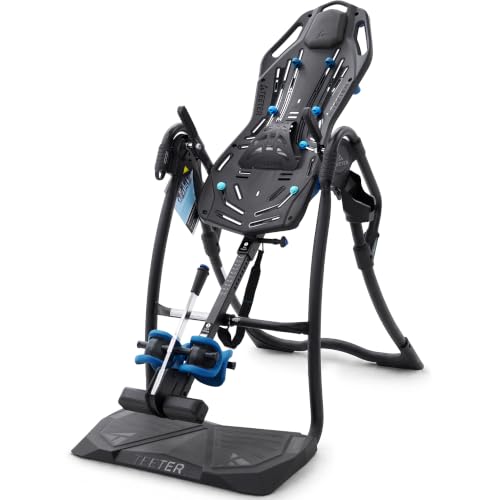

Choosing by body and by room
Comparison ends, as it should, with the two contexts no specification sheet can see: your body and your room. The right table is the one whose capacity, height range, ankle system, and control style fit the person who will use it, standing in the space where it will actually live. Work through the following matching exercise honestly and most shortlists resolve themselves, because the category’s real differences are differences of fit rather than differences of quality at a given level of construction.
Matching the table to the user
Start with the numbers you cannot negotiate. Your weight, with margin below the rated capacity. Your height, comfortably inside the adjustment range rather than at its edge. Your ankles, knees, blood pressure, eyes, and medical history, cleared through the cautions section rather than waved past it. Then move to the preferences that decide daily satisfaction: whether you want the repeatability of preset stops or the fine grain of a strap, whether long handles reassure you or merely add weight, whether a padded board or a mesh bed suits your room’s temperature and your back’s preferences.
Consider also who else will use the table. A second user multiplies the value of clear height markings, quick ankle adjustment, and a control system that can be reset between people without a ritual. It also multiplies the case for margin: size the table for the larger user and let the smaller user enjoy the surplus stability. Households where one person is enthusiastic and one is nervous should buy for the nervous person’s confidence, because a table only one person uses is half a purchase, and confidence, as established, is built from controls and locks rather than from maximum angles.
Matching the table to the space
Measure three footprints, not one. The assembled footprint where the table stands in use. The swept footprint of the bed’s rotation, checked against walls, radiators, low shelves, and the swing of any door. And the folded footprint against its storage wall, with the door of that room still able to close. Add ceiling height to the list for full inversion: a tall user hanging vertically needs the head end’s lowest point to clear the floor with margin, which sounds obvious and is nevertheless the measurement most often skipped in low-ceilinged rooms and basements.
Bring the decision together in a short written checklist before ordering: capacity margin confirmed, height range confirmed, medical cautions cleared, control system chosen for the least confident user, ankle system understood including its release, certification located in the documentation, rotation envelope measured, storage measured, assembly help arranged. Nine lines. A table that passes all nine on paper will very likely pass in the room, and a table that fails two should be replaced on the shortlist rather than rationalised, because rationalisations are heavy, made of steel, and difficult to return.
Used well, an inversion table earns its floor space quietly: a few unhurried minutes, a spine allowed to lengthen under nothing more complicated than gravity, and a routine modest enough to survive busy weeks — and when the session ends and you are standing level again, the measure of the right table is that your thoughts have already moved on to the kettle, the evening, and everything that is not your back.