What's inside
- Key Takeaways
- Quick Picks
- How Did We Choose These Captain’s Chairs?
- The Line-Up at a Glance: Legs, Wheels and Surfaces
- What About the Bankers Chair, the Captain’s Desk-Bound Cousin?
- Fixed Legs or Casters — Which Captain Belongs at Your Table?
- How Do You Care for Vinyl and PU at a Working Table?
- Where Did the Captain’s Chair Come From, and Why Does the Form Persist?
- How Should a Captain’s Chair Be Matched to an Existing Dining Set?
- Which Captain’s Chair Mistakes Cost Buyers Most?
- What Should You Check When the Chair Arrives?
- Final Recommendation
- Frequently Asked Questions
- Related Guides
As an Amazon Associate I earn from qualifying purchases. This post may contain affiliate links at no extra cost to you.
cottageverdict.com is reader-supported. When you buy through links on our site, we may earn an affiliate commission.
Where to buy: all six chairs sit on Amazon, each linked below to its own listing, where you can check price on Amazon, confirm whether casters are included or the chair stands on fixed legs, and verify the finish against your table before ordering. In this class the caster question is the very first one to settle, because it divides the picks into two genuinely different kinds of furniture.
The best leather captain’s chairs carry a name with a story: the captain’s chair is the broad, arm-wrapped seat from the head of the table, descended from shipboard and tavern furniture, built for someone who presides. The modern versions in this guide serve dining rooms, poker tables, desks and kitchen dinettes — and the first duty of this guide is the same duty the material demanded in its sibling classes. Despite the keyword, the verified captain’s chair class is upholstered in vinyl and PU, with faux leather where a listing says leather at all. Not one pick below is genuine hide. We say so in the introduction rather than the footnotes, and each pick names its actual surface from its own listing title, because a chair bought for a decade of family dinners deserves an honest label.
There is a second honesty in this class worth appreciating before it is criticised for the first. Captain’s chairs are among the few furniture categories where makers still state the unfashionable facts in their titles — small, in one listing; plastic-adjacent candour about vinyl in others; full dimensions in a third. A category that tells you a chair is small, synthetic and exactly thirty-one inches high is a category that can be shopped rationally, and this guide has leaned on those stated facts throughout. Where a listing was vague — one title’s unqualified leather wording — the pick section says so and tells you where to verify. That is the correct division of labour between a guide and a listing: the guide flags, the listing answers, and the buyer decides with both in hand, which is all that honest shopping has ever required of anyone, in any furniture class, at any price point worth paying.
That honesty should not read as disappointment. Vinyl and PU are defensible choices at a dining table — arguably the correct ones. Dining chairs meet gravy, wine, children’s hands and the weekly wipe-down, and a surface that releases all of it without a care routine has a real claim on the head of the table. What the captain’s form adds is presence and arms: this is the chair that turns one seat at the table into a place, and the six picks below divide by mobility. Two stand on fixed legs in the traditional manner, four roll on casters, and that split — presiding versus circulating — is the decision this guide is really about.
The sibling class deserves a mention before the picks. The bankers chair — the wooden, often green- or oxblood-upholstered desk chair of library photographs — overlaps the captain’s brief at the desk end, and shoppers picturing that object should know it lives in a neighbouring category with its own listings, discussed here at class level without picks. What follows is strictly the captain’s form: wide seats, enclosing arms, dining and desk duty, in vinyl and PU, judged on the honesty of their labels and the sense of their construction.
Key Takeaways
- No verified captain’s chair here is genuine leather — the class is vinyl and PU, named per pick from each listing’s own title.
- The decisive split is mobility: four picks roll on casters, two stand on fixed legs like traditional dining captains.
- Boss Office Products anchors the class with two vinyl chairs, one fixed and one castered, in burgundy and black.
- The Steve Silver pick is the only listing here that states full dimensions — 25 by 25 by 31 inches — in its title.
- Vinyl and PU suit dining duty honestly: both wipe clean after meals in a way hide owners would envy.
Quick Picks
| Pick | Badge | Why it earns its place |
|---|---|---|
| Boss Captain’s Chair Burgundy Vinyl | Traditional Fixed Captain | Burgundy vinyl on a classic fixed frame — the head-of-table chair in its oldest colours. |
| Boss Captain’s Chair Black Vinyl with Casters | Rolling Office Captain | The same Boss lineage in black vinyl, on casters, for desks and dinettes that need movement. |
| MODERION Faux Leather Captain’s Chair | Wide Desk Captain | Faux leather with cherry walnut legs and a wide seat pitched at desks and kitchens alike. |
| Tufted Leather Rolling Captain Chairs Set of 2 | Tufted Rolling Pair | A matched pair of small tufted rolling captains with nailhead trim for dining sets that move. |
| Captain’s Rolling PU Chair with Casters | Poker Night Roller | Black PU, high back, arms and casters — the listing itself names poker and dinette duty. |
| Steve Silver Captain’s Chair Gray Vinyl | Measured Gray Captain | Gray vinyl with nailhead trim and a cherry finish, and dimensions stated where rivals stay silent. |
How Did We Choose These Captain’s Chairs?
Verification in this class meant three checks per listing: a captain’s format — wide seat, arms, dining or desk intent — a named upholstery material in the title, and a clear statement of legs or casters. The material check did the heaviest work, because captain’s chairs are marketed with leather language more freely than almost any other furniture class; listings that hid behind an unqualified “leather” with no material line were excluded, and the six that remain say vinyl, PU or faux in their own words. That candour, in this category, is a quality signal in itself.
We then balanced the list across the class’s real divisions. Fixed against rolling, single against the one matched pair, desk against dining, traditional burgundy and black against the gray and cherry finishes that modern dining rooms ask for. A guide with six identical black rolling chairs would be accurate and useless; the captain’s chair is bought to complete a specific table, so the survey mirrors the variety of tables. Readers ready to leave the captain’s form for full theater seating will find the genuine-leather end of the market surveyed in Best Genuine Leather Media Room Chairs, where hide is the entry requirement rather than the marketing rumour.
One exclusion deserves stating: the exercise and van captain’s chairs that crowd search results for this phrase are different products wearing a borrowed name, built for gyms and vehicle conversions. They were left to their own categories. Everything below is furniture for rooms where people eat, work and play cards — the captain’s chair’s actual centuries-old beat.
We should also record what this class does not contain, because the absence shapes expectations. There are no reclining captains here, no swivel-tilt mechanisms of the executive kind, and no captain’s chairs with stated weight capacities in their titles — a silence this guide notes rather than fills, since a dining chair’s capacity is rarely its maker’s headline and inventing one would repeat the category’s sins in a new direction. Buyers for whom a stated capacity is essential should shop the desk-chair classes where capacities are published, and accept the captain’s form as what it is: furniture judged by fit, finish and honesty of material, in a tradition that predates specification sheets by several hundred years.

Boss Captain’s Chair Burgundy Vinyl — Traditional Fixed Captain
Boss Office Products has made this chair, in this colour, for long enough that the burgundy vinyl captain is close to a category archetype. The listing title is admirably blunt — a captain’s chair, in burgundy vinyl, full stop — and the chair it describes is the fixed-leg presiding seat: broad, arm-wrapped, upholstered in the deep red that dining rooms and traditional offices have chosen for generations because it flatters dark wood and forgives the evidence of dinners.
Fixed legs are a deliberate choice, not a missing feature. A captain’s chair at the head of a table should feel planted; the person in it is the room’s anchor, and a chair that stays where it was placed supports the theatre of that role. In a home office the same planted quality suits a guest or conference seat that should not wander across the floor between meetings. Vinyl at a dining table is the practical surface — the wipe after a meal takes seconds — and burgundy hides the minor scuffs of chair-against-table life better than black or gray will.
The trade is immobility in rooms that rearrange often, and a colour with strong opinions: burgundy presides happily over mahogany and walnut, argues with pale Scandinavian schemes, and should be chosen by households whose wood tones already lean warm. Buyers who love the form but need the chair to travel should stay with Boss and take the castered sibling below; buyers furnishing the classic dining room can stop here, because this is the chair the category is named after in most people’s minds.
Burgundy’s longevity as a colour choice deserves a word, because it is easy to mistake for mere habit. Deep red-brown upholstery sits at the exact intersection of formality and warmth: darker and more serious than tan, warmer and more forgiving than black, and uniquely kind to the wood tones — mahogany, walnut, dark oak — that traditional dining furniture is actually made from. It also ages gracefully in the specific way dining chairs age, absorbing the minor darkening of years of use into its own depth rather than displaying it. A household that hosts holidays in a wood-panelled or warmly painted room will find this chair looks more correct with every year, which is the opposite trajectory from fashionable colours, and one reason the design has outlived several generations of dining trends without needing to change.
- Material: vinyl upholstery, burgundy
- Format: single captain’s chair, fixed legs
- Intended duty: head of dining table, traditional office
- Maker: Boss Office Products
- Where to buy: the Boss Captain’s Chair Burgundy Vinyl listing on Amazon — check price on Amazon
Strengths
- The archetypal captain’s chair — form, colour and material all classic.
- Fixed stance suits the presiding seat at a table’s head.
- Vinyl wipes clean after meals without a care routine.
Trade-offs
- No casters, so rearrangement means lifting, not rolling.
- Burgundy commits the room to warm, traditional wood tones.
- Vinyl, plainly — no hide exists in this class.
Best for: the head of a traditional dining table or a classic office’s guest seat. Not suited for: rooms that rearrange weekly, where the castered picks earn their wheels.
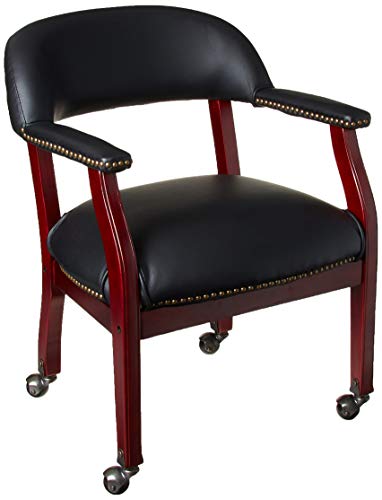
Boss Captain’s Chair Black Vinyl with Casters — Rolling Office Captain
The black castered Boss is the same idea set in motion: a captain’s chair in black vinyl, on casters, aimed at the desk and the dinette rather than the formal table’s head. The captain’s form at a desk is an old and sensible arrangement — arms for the long sit, a broad seat for the person who runs the meeting, and upholstery that reads as furniture rather than as office equipment. Black vinyl keeps that reading neutral enough for any office that has outgrown mesh chairs and wants its seating to look like a decision.
Casters change the chair’s social life. A rolling captain circulates: it pulls up to the desk, turns to the side table, joins the dinette for a working breakfast, and returns. In open-plan homes where one good chair serves three stations, that circulation is the entire value proposition. The cautions are the caster cautions everywhere — hard floors will be marked by careless wheels over years, and a rolling chair at a dining table invites the fidgeting that fixed chairs politely forbid, which households with small children will have opinions about.
Against its burgundy sibling, this chair trades ceremony for utility, and the choice between them is really a choice about the room’s tempo. Static room, formal table, long dinners: the fixed burgundy. Working room, moving chair, desk at its centre: this black roller. That Boss sells both under one lineage makes the comparison honest — the difference is intent, not quality tier — and a household furnishing both a dining head and a desk could buy the pair of siblings without a single styling argument between them.
The desk case deserves one more consideration: hours. A captain’s chair at a desk is sat in longer than any dining chair, and its arms and seat width are doing ergonomic work whether or not the listing uses the word. The broad seat suits the shifting, cross-legged, leaned-back postures of a long working day better than a narrow task chair, while the arms give the forearms a resting place that keeps shoulders down. What it does not offer is the task chair’s adjustability — no height mechanism is claimed in this listing — so measure the desk’s underside and the chair’s seat height against each other before committing. A captain at the right height is a throne for the working day; at the wrong height it is a handsome argument you lose every morning.
- Material: vinyl upholstery, black
- Format: single captain’s chair on casters
- Intended duty: desk, dinette, flexible office seating
- Maker: Boss Office Products
- Where to buy: the Boss Captain’s Chair Black Vinyl with Casters listing on Amazon — check price on Amazon
Strengths
- Casters give the captain’s form a working, circulating life.
- Black vinyl suits modern offices and dinettes neutrally.
- Shares its lineage with the fixed archetype — a known quantity.
Trade-offs
- Wheels can mark hard floors over years of use.
- Rolling at a dining table encourages fidgeting formality purists dislike.
- Vinyl surface, as with every verified pick in this class.
Best for: desks and dinettes needing one handsome chair that moves between stations. A poor fit for: the formal table’s head, where planted ceremony matters more than motion.

MODERION Faux Leather Captain’s Chair — Wide Desk Captain
The MODERION listing casts the widest net in this guide: a large dining chair with arms, a solid wood wide office desk chair, a faux leather boss captain’s chair, a classic accent for the kitchen, finished with cherry walnut legs and black upholstery. Listings that claim everything usually deliver nothing, but the underlying object is coherent — a wide, fixed, arm-wrapped chair in black faux leather on wooden legs — and each of those claimed rooms is a plausible home for exactly that object. Width is the headline: this is the captain for the sitter who finds standard dining chairs pinched.
Cherry walnut legs against black upholstery is a considered combination, warm below and neutral above, and it lets the chair sit at a walnut or cherry table without demanding the whole set match. As a desk chair it offers the captain’s alternative to the executive chair’s bulk — arms and presence without a five-star base — which suits home offices furnished as rooms rather than as workstations. In the kitchen, at the head of a farmhouse table, the same chair reads as the host’s seat, wide enough for the long, leaned-back end of a meal.
The breadth that recommends it also bounds it: measure the chair against your table’s apron height and the space between neighbouring chairs, because a wide captain at a crowded table steals elbow room from both adjacent seats. It is a head-of-table chair by dimension as much as by style. Buyers with a generous table and a generous sitter will find the class’s most accommodating fixed option here; buyers with a compact dinette should look to the smaller rolling pair below instead.
There is a hospitality argument for width that goes beyond the sitter’s own comfort. The head-of-table chair is where a host seats the guest of honour, the grandparent, the friend who has had a long year — and a wide, armed, substantial chair communicates welcome before a word is spoken, in a way a standard side chair pulled from the set cannot. Hosts who entertain deliberately will recognise the MODERION’s brief instantly: it is the chair that makes one place at the table feel chosen. That theatre is the captain’s chair’s oldest function, older than dining clubs and ships alike, and width is its main instrument. If your table seats six and one of them matters most each time, this is the pick that understands the assignment.
- Material: faux leather upholstery, black
- Format: single wide captain’s chair, fixed legs
- Legs: solid wood, cherry walnut finish
- Intended duty: dining head, desk, kitchen accent
- Where to buy: the MODERION Faux Leather Captain’s Chair listing on Amazon — check price on Amazon
Strengths
- The widest seat brief in the guide — room for larger sitters.
- Cherry walnut legs warm the black upholstery intelligently.
- One chair plausibly serves desk, dining and kitchen duty.
Trade-offs
- Width crowds compact tables and tight dining sets.
- Faux leather — the class material, stated plainly.
- Fixed legs only; no rolling variant in this listing.
Best for: larger sitters and generous tables wanting a fixed, wide captain. Not the right match for: small dinettes, where its width becomes the room’s problem.

Tufted Leather Rolling Captain Chairs Set of 2 — Tufted Rolling Pair
This listing is the set-builder’s entry: two small tufted rolling captain’s chairs, wooden dining chairs with arms and casters, finished with vintage nailhead trim on solid wood. Note the word small in the title — the maker states it, and this guide respects it. These are compact captains, scaled for dining sets where the chairs must tuck, turn and circulate in ordinary rooms, and sold as the matched pair that a dining table’s two heads or a pair of desk corners actually need.
Tufting and nailhead trim on a rolling chair is a deliberate anachronism, and a charming one: the furniture language of a Victorian dining room mounted on the mobility of a modern one. For households whose dining table doubles as the homework station, the craft table and the holiday overflow, chairs that roll between duties while looking like antiques resolve a real tension. The pair format matters practically as well — dining captains are rarely bought singly, and a factory-matched two avoids the dye-lot lottery of ordering a second chair later.
The cautions follow from the stated scale. Small captains suit smaller sitters and tighter tables; a tall or broad household should test the dimensions carefully against the MODERION’s width-first brief. The listing’s “leather” wording is also the loosest in this guide — the title does not qualify the material beyond the word itself — so buyers should read the listing’s specification section for its exact material statement before ordering, applying the same discipline this guide applied to the whole class: in captain’s chairs, the surface is a synthetic until a listing proves otherwise, and no listing here proved otherwise.
The small scale has one more virtue worth recording: tuckability. Dining chairs that store their own footprint — pushed fully under the table, arms clearing the apron — return the room to its daytime self, and small rolling captains do this better than any other pick here, rolling in and out without the scrape-and-lift of fixed legs. In apartments where the dining table is also the room’s centre of gravity, that daily tidiness compounds. The vintage detailing then earns its keep at the moments the table is dressed — holidays, birthdays, the dinners where the room is looked at — because a tufted, nailheaded chair photographs and presents like celebration furniture while behaving like utility furniture the other three hundred days. Few chairs in this class manage both registers; the pair format means the effect arrives doubled, at both ends of the table at once.
- Material: leather-worded upholstery — read the listing’s specification for its exact material statement
- Format: set of 2 small rolling captain’s chairs
- Construction: solid wood dining frame with casters
- Detailing: tufting and vintage nailhead trim
- Where to buy: the Tufted Leather Rolling Captain Chairs Set of 2 listing on Amazon — check price on Amazon
Strengths
- A factory-matched pair, which dining captains are usually bought as.
- Tufting and nailhead trim give rolling chairs an antique finish.
- Compact scale suits ordinary dining rooms and dual-duty tables.
Trade-offs
- Small sizing, stated by the maker — larger sitters should look elsewhere.
- The title’s material wording is unqualified; verify the specification before buying.
- Casters at the table will not suit every household’s formality.
Best for: dining sets wanting a matched, mobile, traditionally detailed pair. Poorly suited to: large sitters or wide tables, where the MODERION’s brief fits better.

Captain’s Rolling PU Chair with Casters — Poker Night Roller
The most candid listing in this guide belongs to this black PU chair, whose title reads like a seating plan: dining chair with casters and arms, captain’s rolling PU chair, dinette set furniture, poker chairs with wheels, kitchen table rolling chairs, high back chair on casters. Strip the keyword enthusiasm away, sentence by sentence, and a clear object remains — a high-backed, arm-wrapped PU chair on casters, built for tables where people sit for hours and move often. The poker mention is the tell: game tables are the captain’s chair’s second ancestral home, and this chair is dressed for it.
Game-night duty imposes specific demands that this format answers well. Players shift, lean, reach and occasionally celebrate; casters absorb the movement that would scrape fixed legs across a floor for four hours. The high back supports the leaned-back bluff better than a standard dining side chair, and arms give chips, cards and elbows their territories. PU is the correct surface for a room where drinks live beside felt — a wipe restores the chair between hands, and black hides the evening’s minor history.
The same mobility that serves a game table can annoy a formal dining room, and the listing’s breadth of claimed rooms should be read as enthusiasm rather than as six separate endorsements. Judge it as what it most clearly is: a rolling game-and-dinette captain in honest PU. Households furnishing a dedicated games corner, a basement table or a kitchen dinette where chairs circulate all day will find the class’s most purpose-fitted roller here; households furnishing a dining room that hosts two formal dinners a year should take the fixed Boss instead.
Consider also the basement and garage conversions where game tables increasingly live. Those rooms run cooler, dustier and more spill-prone than dining rooms, and furniture sent there should be chosen like equipment: surfaces that wipe, bases that roll over concrete or thin carpet, colours that do not report dust. This PU roller is the only pick whose specification reads as if it anticipated that exile, and there is no shame in the assignment — a chair that hosts a weekly game for a decade has lived a fuller life than a formal chair sat in twice a year. Buy it for the room it will actually serve, keep a cloth near the table, and the chair will hold up its end of the ritual for years.
- Material: PU upholstery, black
- Format: single rolling captain’s chair
- Back: high back design on casters
- Intended duty: poker and game tables, dinettes, kitchen tables
- Where to buy: the Captain’s Rolling PU Chair with Casters listing on Amazon — check price on Amazon
Strengths
- Purpose-fitted to game tables, where casters earn their keep hourly.
- PU is named outright — the most candid material label here.
- High back and arms suit long sessions better than side chairs.
Trade-offs
- The listing claims many rooms; its heart is the games table.
- Rolling formality will not suit ceremonial dining.
- Black PU shows dust and pale marks between wipes.
Best for: poker nights, game rooms and busy dinettes. A weak match for: formal dining rooms, which the fixed picks serve with more dignity.
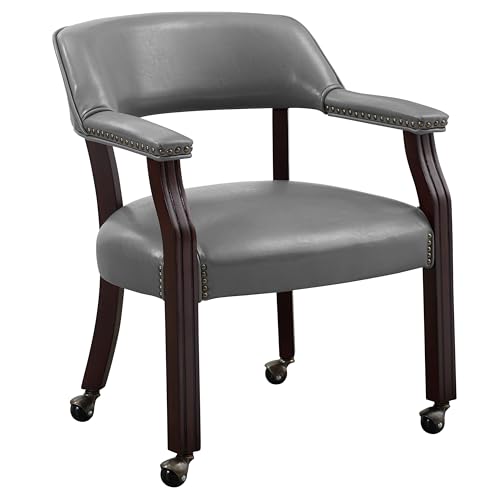
Steve Silver Captain’s Chair Gray Vinyl — Measured Gray Captain
Steve Silver’s captain closes the list with two distinctions. The first is colour: gray vinyl, where the rest of the class wears burgundy, black or brown — and gray is what contemporary dining rooms, with their pale woods and matte metals, have been asking this traditional form for. The second distinction is rarer and, for a careful buyer, more valuable: the listing states the chair’s full dimensions in its title — 25 inches long, 25 inches wide, 31 inches high. In a class where dimensions are often an archaeological dig through a listing, that upfront measurement is a small act of respect.
The specification around those numbers is coherent: dual-purpose intent covering dining and desk, nailhead trim for the traditional detail, a cherry finish warming the gray, and casters for mobility. The 31-inch height is worth dwelling on — this is a lower captain than the high-backed poker roller, closer to classic dining proportions, which means it tucks under standard aprons and suits tables where a towering chair would overwhelm the setting. Gray plus cherry is a transitional combination, at home in rooms that mix periods rather than committing to one.
Buyers furnishing low, tailored club seating in the next room may notice how naturally this chair’s gray would converse with the designs in Best Club Chairs — the captain and the club chair are cousins, both born as the substantial seat in the room, and a house that loves one usually has a corner for the other. Within this guide, the Steve Silver is the measured, modern-finished option: the captain for the buyer who reads dimensions first and colour charts second, and who wants the tradition without the burgundy.
Gray also future-proofs in a way the saturated colours cannot. Dining rooms get repainted, tables get replaced, and a burgundy chair carries its commitments into every new scheme, while gray vinyl beside a cherry finish can migrate from a traditional room to a transitional one to a modern one across a decade of redecoration, changing partners without changing itself. For buyers who furnish slowly and keep things long — the natural audience for a dimension-stating listing — that adaptability is a genuine feature, as real as the casters. The nailhead trim keeps the chair from drifting fully modern, holding one foot in the tradition the form comes from; the result is a chair with two passports, which is precisely what a dual-purpose listing promises and, for once, delivers.
- Material: vinyl upholstery, gray
- Format: single dual-purpose captain’s chair on casters
- Dimensions: 25 in L x 25 in W x 31 in H, as stated in the listing title
- Detailing: nailhead trim, cherry finish
- Where to buy: the Steve Silver Captain’s Chair Gray Vinyl listing on Amazon — check price on Amazon
Strengths
- Full dimensions stated in the title — unique candour in this class.
- Gray vinyl answers modern dining palettes the classics ignore.
- Lower, classic proportions tuck under standard table aprons.
Trade-offs
- The 31-inch back is lower than keen head-resters may want.
- Vinyl, like every pick here — the class ceiling applies.
- Casters included, so formal fixed-chair households should note it.
Best for: modern and transitional dining rooms wanting a measured, gray captain. Not suited for: buyers wanting the tallest back or the deepest traditional colour.
The Line-Up at a Glance: Legs, Wheels and Surfaces
| Chair | Surface, as listed | Base | First duty |
|---|---|---|---|
| Boss Captain’s Chair Burgundy | Vinyl | Fixed legs | Head of a traditional table |
| Boss Captain’s Chair Black | Vinyl | Casters | Desk and dinette circulation |
| MODERION Captain’s Chair | Faux leather | Fixed wood legs | Wide seat at desk or table head |
| Tufted Rolling Captain Chairs | Leather-worded — verify specification | Casters, set of 2 | Matched dining pair |
| Captain’s Rolling PU Chair | PU | Casters | Game table and dinette |
| Steve Silver Captain’s Chair | Vinyl | Casters | Modern dining, measured fit |
Two fixed, four rolling; three colours plus gray; one pair. The table compresses the guide’s argument: choose the base by the room’s tempo, the colour by the room’s wood, and the size by the sitter — and let the surface be what every honest listing in this class says it is. Shoppers comparing against powered seating should note that the electronic end of the chair market, surveyed in Best Electronic Massage Chairs, makes the opposite trade: mechanism over joinery, positions over presence.
What About the Bankers Chair, the Captain’s Desk-Bound Cousin?
Searchers for this class often carry a second picture in mind: the bankers chair, that wooden desk chair with a curved top rail and deep green or oxblood upholstery, photographed in libraries for a century. It deserves a clear paragraph here, at class level, because it overlaps the captain’s desk brief while remaining a different product. The bankers chair is a swivel-and-tilt desk chair in essence, built around a wooden frame with upholstery as an accent; the captain’s chair is an upholstered chair in essence, built around its seat and arms with wood as the structure. One is a wooden chair that is padded; the other is a padded chair that is framed.
The practical consequence is where each belongs. A bankers chair serves a single desk, a single sitter, and a traditional study aesthetic, and it rarely travels to a table. The captains in this guide serve tables first and desks second, and the castered ones travel constantly. Shoppers whose picture is the library photograph should shop the bankers class deliberately rather than expecting a captain to impersonate it; shoppers whose picture is the head of a table — the majority of this search — are in the right guide, and the six picks above cover that picture in every base, colour and width the verified market currently offers.
Fixed Legs or Casters — Which Captain Belongs at Your Table?
The fixed-versus-rolling decision deserves more than a preference, because it follows from how the room is used. Fixed captains belong where the chair’s position is ceremonial or constant: the head of a dining table, the guest seat in an office, the reading corner that never rearranges. Their stillness is a feature — the chair becomes part of the room’s architecture, and sitters unconsciously treat it with the respect furniture in a fixed place receives. Rolling captains belong where the chair works multiple stations or the table hosts movement: games, crafts, homework, the dinette that is also a desk. Their mobility is the feature, and the cost — floor wear, fidget, a whisper less formality — is paid gladly by rooms that rearrange weekly.
Flooring arbitrates ties. Casters on hardwood or tile will, over years, polish tracks and collect grit that scratches; a rug under the table or caster cups mitigates most of it. Casters on carpet roll reluctantly and can make a chair feel broken rather than mobile. Fixed legs on hard floors need pads; on carpet they settle into the pile and stay, which is either stability or imprisonment depending on the room’s habits. Read your floor before your heart, and this class divides itself cleanly in two.
How Do You Care for Vinyl and PU at a Working Table?
Dining-duty synthetics live harder than their living-room cousins, and their care is mostly about rhythm. Wipe the seat and arms after meals that involved children, sauces or celebration — thirty seconds with a damp cloth while the table is being cleared — because vinyl and PU release fresh spills completely and yesterday’s spills only mostly. Weekly, work a cloth into seams and around any tufting or trim, where crumbs and grease migrate. Monthly, inspect the arm tops and front seat edge, the friction zones where coatings age first, so a small wear patch is noticed while it is still a cleaning question rather than a replacement question.
Keep solvents, abrasive pads and hide conditioners away from these surfaces; warm water and mild soap are the whole pharmacopoeia. Heat is the slow enemy — a captain pulled up to a radiator or baked by a south window will age its coating years early — and sunlight through dining-room glass does the same work more slowly.
Legs, casters and trim have their own small calendar. Felt pads under fixed legs compress and should be renewed each year; caster axles collect hair and thread in dining rooms more than anywhere else in the house, and a monthly pick-out keeps the roll smooth and the floor unmarked. Nailhead trim, where a pick carries it, wants a soft brush rather than a cloth, which snags. None of this exceeds a few minutes a month, and it is the whole maintenance contract of this class — a fact worth remembering when a hide chair’s care routine is quoted as the price of authenticity. The captain’s chair was built for rooms that host life; its modern surfaces were chosen to survive hosting, and a few minutes a month is all the survival asks.
None of this is burdensome, and it is materially less than genuine leather asks, which is the honest heart of this class’s appeal: the captain’s chair was always working furniture, and vinyl and PU are working surfaces.
Where Did the Captain’s Chair Come From, and Why Does the Form Persist?
The captain’s chair began where its name says: aboard ship, where the captain’s seat at the cabin table was built broad, low and arm-wrapped to hold its occupant steady in a moving room, and to mark rank in a space where rank was survival. Taverns and coaching inns adopted the form for the same double reason — comfort through a long evening, and a visible head to every table — and Windsor-style makers gave it the spindled, wooden grammar that American dining rooms inherited. The modern vinyl versions in this guide are several translations away from that origin, but the DNA is legible in every pick: width, arms, presence, a seat that is also a position.
The form persists because the social need persists. Every table still has a head, every game still has a host, every desk still implies someone in charge of it. Furniture that marks that place honestly — without pretending to be an antique or a hide it is not — earns its floor space in any century. That is also why this guide refuses to apologise for the class’s materials: a ship’s captain’s chair was oiled wood and canvas-grade practicality long before it was a leather showpiece, and a wipeable vinyl captain at a family table is closer to the original’s spirit than a delicate hide chair nobody dares sit in during dinner.
How Should a Captain’s Chair Be Matched to an Existing Dining Set?
Match temperature before tone. Dining woods divide into warm families — cherry, walnut, mahogany, honey oak — and cool ones — gray-washed, white-painted, pale ash — and a captain’s chair from the wrong family will argue with the table forever, whatever its individual merits. Burgundy and cherry-finished picks belong to the warm family; the Steve Silver’s gray was made for the cool one; black, as ever, is the diplomat that can visit either, though it leans formal in both. Within the right family, exact matching is unnecessary and even undesirable: the captain should read as the set’s elder relative, not its identical twin.
Height is the second match. The captain’s back should rise clearly above the side chairs’ backs — that silhouette difference is the entire point — but not so far that the table looks like a throne room diorama. A few inches of difference reads as hierarchy; a foot of difference reads as a mistake in ordering. Finally, arm height must clear the table’s apron with the sitter’s hands in their lap, a measurement worth taking physically with a tape and a seated volunteer, because aprons vary more than any other dimension in dining furniture and no listing can know yours.
Which Captain’s Chair Mistakes Cost Buyers Most?
Believing the word leather is the expensive one, and it is expensive in disappointment rather than money: the buyer who thinks they purchased hide will judge a perfectly good vinyl chair as a fraud, when the fraud was only in the reading. This guide’s insistence on naming surfaces exists to prevent exactly that divorce between expectation and object. The second mistake is buying casters for a ceremonial room or fixed legs for a working one — a mismatch of tempo that no quality of chair can overcome, because the chair will be fought daily in the wrong direction.
Third, buyers forget the table. A captain’s chair must clear the apron, coexist with its neighbouring chairs’ elbows, and match the table’s wood temperature; a chair measured against a room but not against its table is half-measured. Fourth, pairs are ordered as two singles months apart, arriving as cousins. Fifth, dimensions go unread — the one listing here that prints them in its title is the exception that exposes the habit. Each mistake is a reading failure before it is a furniture failure, and each is avoidable in the ten minutes before ordering rather than the ten days after delivery.
What Should You Check When the Chair Arrives?
Captain’s chairs are bulky deliveries, and the arrival check is worth doing properly. Inspect the upholstery under the room’s brightest light for transit scuffs, paying attention to the arm fronts and the back’s top rail, where boxes rub. Sit and lean: a new chair should be silent, and a creak at the arm joint on day one is a warranty conversation, not a personality trait. For castered picks, roll the chair across your actual floor and look at what the wheels leave behind on the first pass, while returning is still effortless; for fixed picks, check all four legs meet the floor together on a hard surface, since a rocking captain at a dining table will be blamed on the floor for years if it is not caught in the first week.
Then place the chair at the table and sit through one real meal in it before discarding any packaging. Clearance questions that looked fine on paper — apron height, elbow room, the distance to the sideboard when the chair is occupied — reveal themselves only in use. A captain’s chair changes a table’s geometry more than any other single piece of dining furniture, and the meal test is the only honest proof that the change is the one you intended.
Final Recommendation
Take the fixed burgundy Boss for the traditional table’s head, the black castered Boss for the working desk, the MODERION for width, the tufted pair for a matched dining set that moves, the PU roller for the games table, and the Steve Silver for the modern room that measures first. None is leather, all are honestly something else, and the captain’s chair — broad, armed, presiding — survives the translation into vinyl and PU with its dignity intact, because its dignity was never in the hide. It was in the shape, and the shape is here in full.
One discipline before ordering, borrowed from every class in this batch where material language runs loose: open the listing, find the material line, and read it as the whole contract. If it says vinyl, PU or faux, you know your chair and can buy it gladly. If the wording drifts into unqualified leather language with no specification behind it — as one listing here does — treat that vagueness as the product information it is, and either verify the specification section to your satisfaction or move to a pick whose maker stated the surface plainly. The captains that name their materials are not confessing a weakness; they are demonstrating the exact quality — candour — that predicts how the rest of the chair was made.
Frequently Asked Questions
Are any captain’s chairs here made of real leather?
No. The verified class is vinyl, PU and faux leather, named per pick from each listing’s title. One listing uses the word leather without qualifying it, and this guide flags that wording and advises reading its specification section before ordering. Genuine hide in a substantial armchair form lives in the club chair class instead.
What makes a chair a captain’s chair?
A wide seat, enclosing arms, and a presiding role — at a table’s head, a desk, or a game table. The form descends from shipboard and tavern furniture built for the person in charge of the room. Arms and width are the non-negotiables; legs or casters vary by era and by listing.
Should dining captains have casters?
Only if the table’s life involves movement — games, crafts, homework, rearranging. Ceremonial dining suits fixed legs, which keep the chair planted and the occasion formal. Consider the floor too: casters mark hard floors over years and roll poorly on deep carpet.
How many captain’s chairs does a dining set need?
Traditionally two — one at each head of the table — with armless side chairs between. That is why the tufted pair in this guide exists as a set. A single captain suits a desk or a small table’s one head; beyond two, the form’s presence becomes competition rather than ceremony.
What is the difference between vinyl and PU upholstery here?
Both are synthetic coatings over a backing, and in daily dining use they behave as close cousins: wipeable, spill-resistant, and indifferent to conditioners. Vinyl is the older, firmer tradition in contract furniture — the Boss and Steve Silver picks — while PU tends to feel slightly softer and appears on the game-room roller. Choose between chairs on form, base and colour rather than on this distinction, which matters less than any of those.
Can a captain’s chair work as an everyday desk chair?
Yes, with one measurement honoured: seat height against your desk’s underside, since these chairs offer presence rather than the height adjustment of a task chair. The castered Boss and the wide MODERION are the natural desk candidates here. For very long daily hours, alternate with your main task chair or accept the captain as the meeting-and-reading seat it was shaped to be.
How do I stop casters from marking my floor?
Keep the wheels clean — grit embedded in a caster is what scratches — and consider a low-pile rug or mat under the table where rolling is constant. Check the wheels monthly in a games room, where debris is plentiful, and replace a damaged caster promptly rather than letting it carve its opinion into the floorboards.
Is vinyl a bad material for a dining chair?
No — for dining duty it is arguably the sensible one. It wipes clean after meals, tolerates children and celebrations, and asks for mild soap rather than conditioners. Its limits are lifespan and ageing character compared with hide, not daily performance, and at a working table daily performance is the point.
Related Guides
The captain’s chair’s closest domestic relative is the host chair at a table’s head, examined from the dining side in Best Chairs for the Head of a Dining Table — a useful companion read for anyone deciding how much presence one seat at the table should carry, and how that presence should be shared around the room’s other chairs over the years ahead.



[…] planning seating for older relatives at home will find the same arm-leverage logic developed in Best Leather Captain’s Chairs, where armed dining chairs take centre […]