What's inside
- Where to buy these six cloth packs
- Quick Picks
- How these picks were chosen
- The six cloth packs, reviewed one by one
- Size, count and colour: the six packs compared
- How to choose a reusable makeup cloth that fits your routine?
- Building the wash-and-rotate habit that makes reusables work
- The disposable comparison, done honestly
- Common mistakes with reusable cleansing cloths
- Final recommendation
- Questions people ask about makeup removing cloths
As an Amazon Associate I earn from qualifying purchases. This post may contain affiliate links at no extra cost to you.
As an Amazon Associate, cottageverdict.com earns from qualifying purchases.
Perspective first, because this category is chronically mis-shelved in people’s minds: the best makeup removing cleansing towels are not towels in the bath sense at all. They are small reusable microfiber face cloths, most of them between 6×6 and 13×13 inches — washcloth scale, not bath scale — designed to lift makeup with water and a soft fibre surface, then go in the wash and do it again tomorrow. The six packs below span that honest range: two sets of palm-size 6×6 squares, a 12×12 fingertip cloth set, two mid-size reusable cloth packs, and a 13×13 set at the generous end. Every one is microfiber, every one is reusable, and the differences that matter are size in the hand, pack count against your laundry rhythm, and the small logistics of bags, colours and drying speed. A note on language, observed throughout this guide: where listings speak about skin — phrases such as for all skin types or for multiple skin types — that is the makers’ own wording, reported here as listing language. This guide makes no medical or dermatological claims of its own; it compares cloths, sizes and packs, and leaves skin advice to the people qualified to give it.
One clarification before the packs themselves, because the vocabulary of this aisle confuses newcomers: pads, cloths and towels here all name the same species — a reusable microfiber square used with water, and sometimes with a cleanser, to lift makeup from the face. The listings use the words interchangeably, and so, within reason, does this guide. What never changes is the scale. If a product in this category arrives looking like it could dry a body after a shower, it has wandered in from a different aisle entirely.
Where to buy these six cloth packs
Puomue’s twelve-pack of 6×6 multicolor cloths opens the list as the high-count, small-format staple for daily makeup wearers. The grey 12-pack that follows, also 6×6, adds a mesh laundry bag to the same palm-size idea. Cosy Family’s ten-pack steps up to 12×12 fingertip facial cloths in black and grey for people who want a cloth that covers the whole face at once. UWEME’s four-pack is the minimalist option, reusable microfiber cloths whose listing describes them as fast drying. Nugilla’s eight-pack occupies the sensible middle, soft reusable face cloths in a count that suits a weekly wash rhythm. Orighty closes the list at the largest size, six black cloths at 13×13 inches with quick drying named in its title.
Quick Picks
| Pick | Best for | Headline facts from the title |
|---|---|---|
| Puomue Makeup Remover Cloth 12 Pack 6×6 Multicolor | Daily wearers wanting many small cloths | 12 pack, 6×6 inches, microfiber, multicolor |
| Makeup Remover Cloth 6×6 Reusable Face Towels 12 Pack Grey | Organized laundry with a mesh bag | 12 pack, 6×6 inches, grey, mesh bag included |
| Cosy Family Makeup Remover Wash Cloths 10 Pack 12×12 | Full-face coverage in one cloth | 10 pack, 12×12 inches, fingertip facial cloths, black grey |
| UWEME Makeup Remover Cloths 4 Pack Reusable Face Wash | Minimalists and travel kits | 4 pack, microfiber, fast dry per the listing |
| Nugilla Makeup Remover Cloths 8 Pack Reusable | A balanced weekly rotation | 8 pack, microfiber, reusable face wash cloths |
| Orighty Microfiber Makeup Remover Cloths 13×13 6 Pack Black | The largest cloth in the hand | 6 pack, 13×13 inches, black, quick dry |
How these picks were chosen
Size honesty governed the whole selection. Rather than pretend these cloths compete with bath towels, the list embraces the category’s real dimensions and spreads them deliberately: 6×6 squares for targeted removal and low laundry bulk, 12×12 and 13×13 cloths for people who cleanse the whole face in one pass. Pack count was the second axis, ranging from UWEME’s four to the twin twelve-packs, because the correct count is a function of how often a household washes — a daily makeup wearer on a weekly laundry cycle needs a different drawer from an occasional wearer washing twice a week. All six are microfiber and all six are reusable, which is the category’s founding bargain: a cloth that replaces the daily disposable, provided its owner actually launders and rotates it. Colour was treated as a practical feature, not decoration — black and grey cloths conceal mascara’s evidence between washes, while the multicolor pack lets a household assign colours to people or purposes. Finally, listing language about skin was recorded but never adopted: when a title says a cloth suits all skin types, the review attributes that phrase to the listing, because a buying guide for cloths has no business issuing skin verdicts.
Rotation maths will recur throughout the reviews, so here is the principle once, plainly: you need at least as many cloths as days between laundry loads, plus a drying margin. The golfer in the family faces the same arithmetic outdoors with the waffle towels in Best Towels for Golf, where pack counts and clips solve a similar carry-and-clean problem on the course.
The six cloth packs, reviewed one by one

Puomue Makeup Remover Cloth 12 Pack 6×6 Multicolor
Twelve cloths at six inches square is a system disguised as a product. Puomue’s pack, in multicolor microfiber, is built for the person who wears makeup most days and removes it every night: one cloth per evening, a small basket by the sink, and a single weekly wash that resets the whole fleet. The listing describes the cloths as ultra soft and reusable, and frames them as face towels for women, with its own wording about suitability for all skin types — the maker’s claim, noted here as listing language rather than this guide’s verdict. Six inches is the deliberate scale of targeted work: folded in quarters, a 6×6 cloth presents eight small clean faces in sequence, which suits eye makeup and lipstick removal where precision matters more than acreage. The multicolor assortment is quietly functional, letting a user assign colours — one for eyes, one for the rest of the face, one for a partner or a teenager — without a word of negotiation.
- Dimensions from the title: 6 x 6 inches
- Contents: 12 pack, multicolor
- Material: microfiber, described as ultra soft
- Skin wording in the listing: for all skin types (maker’s phrasing)
- Laundry accessories: none mentioned in the title
Strengths
- Twelve cloths make a true one-per-day rotation between weekly washes.
- Small format folds into many clean surfaces for detailed eye work.
- Colours allow assignment by person or purpose across the household.
Trade-offs
- A 6×6 cloth will not cover a full face in a single luxurious sweep.
- Small cloths are easy to lose in a mixed laundry load without a bag.
- Multicolor may not suit a bathroom styled in strict monochrome.
The habit this pack rewards is the basket system: clean cloths stacked visibly, used cloths dropped into a small open container, never draped damp over the tap to be reused tomorrow. That rhythm is what turns a reusable cloth from a nice idea into the household’s actual routine, and twelve is the count that makes the rhythm survive a busy week. Makeup artists who work at home will also appreciate the colour coding during a multi-face day. For the nightly-removal majority, this is the list’s most natural default. Check price on Amazon for the multicolor dozen in the small format.
The dozen-count deserves one more angle: it changes what a cloth is allowed to be. When cloths are scarce, each one is precious and gets reused past its moment; when twelve wait in the stack, a cloth can be retired mid-routine the instant its surface is loaded, and a fresh square takes over without a thought. That abundance produces a gentler technique — no scrubbing with a spent corner to make one cloth do — and gentler technique is the whole point of microfiber’s softness. Households with teenagers learning makeup will find the multicolor dozen quietly educational too: a colour per person ends the shared-cloth argument before it starts, and the basket system teaches the laundry rhythm that every reusable product in adult life will later demand.
Best for: daily makeup wearers building a one-cloth-per-day rotation. Not suited for: anyone who wants a large cloth that covers the face in one pass.

Makeup Remover Cloth 6×6 Reusable Face Towels 12 Pack Grey
This twelve-pack shares the Puomue’s dimensions and count — 6×6 inches, a dozen cloths — and differentiates itself with two decisions: a single grey colourway, and a mesh bag included in the box. The listing describes reusable microfiber face cloths for washing the face and removing makeup, sold as makeup remover pads in cloth form. Grey is the pragmatist’s colour in this category, because mascara and foundation leave their testimony on pale cloths long after washing, while grey absorbs the evidence into its tone and keeps the drawer looking respectable. The mesh bag is the more consequential inclusion: small cloths vanish inside washing machines, lodging in sleeves and drum seals, and a bag converts a twelve-pack that dwindles to nine into a twelve-pack that stays twelve.
- Dimensions from the title: 6 x 6 inches
- Contents: 12 pack, grey
- Material: microfiber
- Included extra: mesh bag, per the listing
- Colour options in this pack: single grey colourway
Strengths
- The mesh bag protects the whole investment at every single wash.
- Grey hides cosmetic staining between laundry days better than pale shades.
- A dozen cloths support the same daily rotation as the multicolor pack.
Trade-offs
- One colour for all twelve removes the colour-assignment trick.
- The small square format remains a targeted tool, not a full-face cloth.
- Households must actually use the bag, or its advantage evaporates.
Choosing between this pack and the Puomue is a genuine fork in domestic philosophy. Colour-coding households — partners, teenagers, anyone sharing a bathroom — should take the multicolor dozen. Solo users and laundry realists should take the grey dozen and its bag, because the most common failure of small-cloth systems is not fibre quality but attrition in the wash. The listing’s pad language is also telling: these squares are the reusable answer to the cotton pad, used the same way, folded the same way, and binned never. That mental model helps new users adopt them without changing a single gesture of their evening routine. Check price on Amazon for the grey dozen with the mesh bag.
The mesh bag’s value compounds in a way that only becomes visible after a year. Fleets do not usually die; they dwindle — one square in a gym bag, one behind the machine, one sacrificed to a paint spill — until the rotation breaks and the disposables creep back. A bag arrests that entropy at the exact point it occurs, the wash, and grey arrests the other entropy, the visible staining that makes a clean cloth look tired. Together they make this the pack most likely to still be a functioning twelve-pack on its second anniversary, which is a more meaningful quality metric than any softness adjective. Renters in shared houses, whose laundry passes through communal machines, should weight the bag even more heavily: it is the difference between a system and a hope.
Best for: solo users and shared bathrooms that value laundry discipline. Not suited for: households that assign cloths by colour.

Cosy Family Makeup Remover Wash Cloths 10 Pack 12×12
Cosy Family doubles the cloth and keeps the count high: ten fingertip facial cleansing cloths at 12 by 12 inches, in black and grey, described as soft microfiber for hand and makeup use. Twelve inches square is the classic washcloth dimension, and it changes the experience completely — the cloth drapes over the whole face, warms under water, and turns removal into the flannel moment many people remember from childhood, now in microfiber. Fingertip in the listing’s phrasing points at control: a larger cloth wrapped around the hand gives a padded, steerable surface for working around the eyes and along the hairline. Black and grey together are the two most forgiving colours in the category, and ten cloths sustain a five-day rhythm of two-a-day users or a ten-day rhythm of nightly ones.
- Dimensions from the title: 12 x 12 inches
- Contents: 10 pack, black grey
- Material: microfiber, described as soft
- Format: fingertip facial cleansing cloths
- Stated uses: hand and makeup
Strengths
- Full-face coverage in one warm, draped pass — the comfort pick.
- Ten cloths is a generous count at this larger size.
- Black and grey conceal cosmetic marks between washes.
Trade-offs
- Larger cloths take more drawer, wash and drying space than 6×6 squares.
- A big cloth is clumsier for precision work on a single eyelid.
- Two dark colours only; colour-coding by person is limited.
Who is the 12×12 really for? The double-cleanser, the full-face-of-makeup wearer, the person whose evening ritual is a small ceremony rather than a task. A cloth this size also moonlights honourably — as a hand cloth by the sink, a travel washcloth, a warm compress carrier — and its listing’s hand-and-makeup framing quietly admits that versatility. Households converting from disposable wipes often find the transition easiest at this size, because the gesture they already love, the big warm cloth, survives intact while the waste disappears. If the small squares read as austerity, this pack reads as comfort with a conscience. Check price on Amazon for the ten large cloths in black and grey.
There is a sensory argument for the big cloth that spec sheets cannot capture. Warm water in a 12×12 microfiber drape holds heat against the face for those ten seconds that constitute the day’s only pause for many people, and a routine with a pause in it gets kept. The small-square systems are efficient, and efficiency is a virtue, but the households that sustain reusable habits for years tend to be the ones whose routine feels like a reward rather than an optimization. Cosy Family’s ten-pack is built for those households. The black-grey pairing also travels across bathroom styles without complaint — marble, metro tile, farmhouse wood all accept it — so the cloths will survive a redecoration that might strand a more colourful fleet.
Best for: full-face cleansing rituals and former disposable-wipe devotees. Not suited for: minimal drawers or precision-only eye makeup removal.
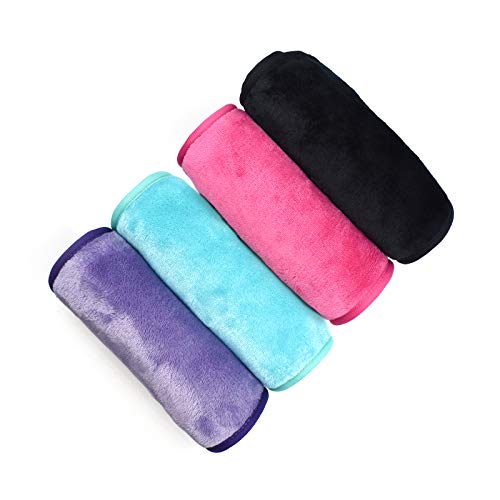
UWEME Makeup Remover Cloths 4 Pack Reusable Face Wash
Four cloths is a philosophy: buy few, wash often, own nothing you cannot account for. UWEME’s pack pairs that minimalism with a listing that describes reusable, fast-drying microfiber face towels, and carries the maker’s own phrase about suiting multiple skin types — again, listing language, reported rather than endorsed here. Four cloths suit the occasional makeup wearer, the traveller whose kit must stay small, and the person testing whether reusable cloths fit their life before committing to a dozen. Fast drying, if the household hangs them properly, is what makes a four-count viable at all: a cloth used at night, washed or rinsed and hung, can return to duty quickly enough that four never feels like a shortage for a light user.
- Contents: 4 pack
- Material: microfiber
- Quality named: fast dry, per the listing
- Cloth dimensions: not stated in the listing title
- Skin wording in the listing: for multiple skin types (maker’s phrasing)
Strengths
- The lowest-commitment route into reusable removal — ideal for testing the habit.
- Fast-dry positioning suits travel bags and small, steamy bathrooms.
- Four cloths occupy almost no drawer or shelf space.
Trade-offs
- Daily wearers on a weekly wash cycle will run this pack dry by Thursday.
- Unspecified dimensions leave the in-hand size a small unknown.
- No stated laundry bag, so small-cloth attrition is the owner’s problem.
Travel is where this pack quietly shines. Four microfiber cloths weigh almost nothing, dry on a hotel rail overnight, and spare the traveller the packet of disposable wipes that leaks, dries out or runs out on day nine of ten. Gym bags make the same argument at smaller scale. The pack also serves as the sensible second purchase: the household that owns a dozen at home and four for the road has solved both theatres. What it should not be asked to do is carry a heavy daily routine alone — that is a count problem, not a quality problem, and the larger packs exist precisely to solve it. Check price on Amazon for UWEME’s compact four-pack.
Minimalist packs have one more use that deserves naming: the guest and the hospital bag, the gym locker and the office drawer. Life generates small cleansing emergencies in places where a full fleet cannot live, and a four-pack distributed singly solves them all — one cloth in the travel wash bag, one in the gym kit, one at a partner’s flat, one at home. No other pack here subdivides as gracefully, because subdividing a twelve-pack still leaves abundance everywhere, while the UWEME was designed, in effect, as four independent single-cloth outposts. Buyers whose makeup life is genuinely occasional — weekends, events, photographs — will also find four to be the count that matches reality, with none of the drawer guilt that an untouched dozen can induce.
Best for: travellers, gym kits and first-time testers of reusable cloths. Not suited for: daily full-makeup wearers washing once a week.

Nugilla Makeup Remover Cloths 8 Pack Reusable
Nugilla’s eight-pack is the list’s exercise in moderation: not the austerity of four, not the abundance of twelve, but the count that matches the most common real rhythm — makeup most evenings, laundry roughly weekly, one cloth in use while a spare dries. The listing describes soft microfiber reusable face wash cloths for women, without dimensional fanfare, and that plainness has its own appeal: this is the pack for buyers who have already decided on the category and simply want a sensible fleet. Eight also divides beautifully — four by the sink and four in the wash, or a set at home and a set in a partner’s bathroom — and divisibility is an underrated virtue in household systems.
- Contents: 8 pack
- Material: microfiber, described as soft
- Format: reusable face wash cloths
- Cloth dimensions: not given in the listing title
- Extras in the title: none mentioned
Strengths
- Eight is the natural fleet size for a weekly laundry rhythm.
- Splits cleanly between two bathrooms, or home and travel.
- Soft microfiber positioning matches the category’s core promise.
Trade-offs
- Without stated dimensions, size-in-hand is the buyer’s uncertainty.
- Heavy twice-daily users will still outrun eight cloths.
- No bag or colour system is promised to organize the fleet.
Moderation packs like this one are often the second purchase a household makes, after learning its real numbers from a first pack that was too small or too large. Nugilla’s eight lands where experience says the answer usually is. It also suits the shared-bathroom truce: four cloths each for two people, no colour system required, the drawer divided by shelf rather than by hue. Buyers who value a quiet, unbranded-feeling utility — soft cloths that simply work — will find the listing’s restraint reassuring rather than sparse. Check price on Amazon for the balanced eight-pack from Nugilla.
Eight is also the count that best survives a household’s imperfect weeks. The twelve-pack assumes the laundry happens; the four-pack assumes it happens often; the eight-pack assumes, realistically, that laundry sometimes slips by two days and that a cloth sometimes gets borrowed for a non-makeup emergency — a spill, a mirror, a child’s face at a birthday party. Slack is a design feature in domestic systems, and Nugilla’s fleet carries exactly the slack that lived experience recommends. That is why this pack is so often the recommendation for the undecided: not because it wins any single specification, but because it forgives the most futures, including the future where the household’s makeup habit doubles or halves.
Best for: weekly-rhythm households wanting the Goldilocks count. Not suited for: buyers who need confirmed dimensions before ordering.

Orighty Microfiber Makeup Remover Cloths 13×13 6 Pack Black
Orighty brings the largest cloth on the list and the darkest colour: six black microfiber cloths at 13 by 13 inches, described as super soft and quick drying, for cleansing. Thirteen inches is washcloth-plus — enough to wrap a hand completely, drape the whole face, or fold into a thick pad with layers to spare — and black is the colour that makeup itself would choose, since mascara, liner and long-wear foundation all but disappear against it between washes. Six cloths at this size carry more total fabric than the twelve-packs of 6×6 squares, so the count comparison is deceptive: this is a substantial fleet wearing a smaller number. Quick drying, named in the listing, matters more at this size too, because a big cloth holds more water and a slow big cloth stays damp longest.
- Dimensions from the title: 13 x 13 inches
- Contents: 6 pack, black
- Material: microfiber, described as super soft
- Quality named: quick dry
- Stated purpose: face towels for cleansing
Strengths
- The most generous cloth in the hand — full coverage, thick folds, warm drape.
- Black conceals cosmetic evidence better than any other colour here.
- Quick-dry positioning answers the big cloth’s one real weakness.
Trade-offs
- Six cloths is the tightest rotation among the larger formats.
- Black-only limits colour assignment in shared bathrooms.
- Big cloths are overkill for a quick lipstick-only removal.
Evening-routine maximalists will recognize their cloth immediately. The 13×13 supports the full ritual — warm the cloth, drape, breathe, then work section by section with fresh folds — and its blackness keeps the drawer looking composed even on day five of the rotation. It is also the most convincing former-flannel conversion tool here, since its dimensions match the cotton washcloths many people grew up with, easing the switch from disposables or from cotton to microfiber without changing the choreography. Feet up at the end of the day, households that pair a good cloth with comfortable footwear for the evening wind-down might glance at Best Platform Slippers for the house shoes that complete the ritual. Check price on Amazon for Orighty’s big black six-pack.
Black cloths carry one psychological benefit their owners mention consistently: they lower the emotional cost of heavy makeup days. A pale cloth after a full evening look can look ruined even when perfectly clean, and that sight discourages the next use; a black cloth emerges from the same evening looking composed, and from the wash looking new. For performers, dancers, models and anyone whose work involves serious makeup several nights a week, that composure is not vanity but morale, and the 13×13 format gives those users the surface area their removal actually requires. Orighty’s pack is the professional-adjacent choice of this list precisely because it was specced — size, colour, drying — the way working routines would spec it.
Best for: full-ritual cleansers who want the largest, darkest cloth. Not suited for: precision-only users or strict colour-coders.
A short word on how to read the makers’ language in this category, since these listings, like all listings, mix data with weather. The data is dimensions, count, fibre and named extras such as a mesh bag. The weather is the adjectives — ultra, super, premium — and the skin-suitability phrases, which this guide attributes to their makers every time they appear. Neither habit is cynical; it is simply how a careful reader separates what can be verified from the shelf from what can only be experienced at the sink. Shoppers who learn that separation here will find it serves them in every aisle, from golf towels to bath mats, where the same grammar of claim and fact repeats.
Notice what the table cannot show: hand size. A 6×6 cloth in a large hand is a postage stamp; in a small hand it is a pad with room to fold. A 13×13 reverses the problem, generous for most, cumbersome for the truly petite. Households buying for one known pair of hands should let those hands vote — the whole category is tactile, and the right size is the one that disappears into the routine rather than the one that wins an argument about square inches.
Size, count and colour: the six packs compared
| Pack | Cloth size | Count | Distinguishing detail |
|---|---|---|---|
| Puomue Makeup Remover Cloth 12 Pack 6×6 Multicolor | 6×6 in | 12 | Multicolor assignment system |
| Makeup Remover Cloth 6×6 Reusable Face Towels 12 Pack Grey | 6×6 in | 12 | Mesh laundry bag included |
| Cosy Family Makeup Remover Wash Cloths 10 Pack 12×12 | 12×12 in | 10 | Fingertip facial cloths, black grey |
| UWEME Makeup Remover Cloths 4 Pack Reusable Face Wash | Not given in title | 4 | Fast dry positioning, minimal count |
| Nugilla Makeup Remover Cloths 8 Pack Reusable | Not given in title | 8 | Balanced mid-size fleet |
| Orighty Microfiber Makeup Remover Cloths 13×13 6 Pack Black | 13×13 in | 6 | Largest cloth, black, quick dry |
Read the table as two decisions wearing one coat. The size decision is about hands and habits: small squares for folded precision, big cloths for draped coverage. The count decision is about laundry: divide your wash interval by your daily usage and the fleet size chooses itself. Colour, the third column in spirit, is about evidence management — how visible you want yesterday’s mascara to be. No row of this table is the correct one; each is correct for a different bathroom, and the reviews above exist to help you recognize yours.
Plan for the drying geography of your bathroom
Cloths dry where air moves, and bathrooms differ enormously in moving air. A windowless interior bathroom with a weak fan will keep a thick stack of large cloths damp for a day, which argues for smaller cloths, darker colours and a rotation with margin — or for drying the fleet on a rail outside the bathroom entirely. A bright, ventilated room forgives any format here. Audit your air before your aesthetic, because a cloth that never quite dries will be blamed for a problem the room created.
Three numbers decide this purchase, and none of them is printed in large type: the evenings between your laundry loads, the cloths each evening consumes, and the hours your bathroom needs to dry a cloth fully. Everything else — fibre adjectives, colour, even the mesh bag — is refinement. Get the three numbers right and even the humblest pack here will feel custom-built; get them wrong and the finest fleet will feel like a shortage wearing a disguise.
How to choose a reusable makeup cloth that fits your routine?
Count backwards from laundry day
Write down, honestly, how many evenings pass between your laundry loads, and how many cloths each evening consumes. Multiply, add two for drying margin, and you have your fleet size — for most nightly wearers on a weekly cycle, that arithmetic lands on eight to twelve, which is why the list is weighted there. Occasional wearers can let UWEME’s four carry them, but only if the fast-dry habit of hanging each cloth openly is real rather than aspirational.
Let your makeup style pick the cloth size
Full-face wearers — foundation, contour, the complete architecture — need the drape of 12×12 or 13×13 to work in sections without reusing a soiled surface. Eye-and-lip minimalists are better served by 6×6 squares folded into fresh faces, where a big cloth would be mostly wasted acreage flopping around a precise job. Mixed routines split the difference with Nugilla’s mid fleet or a two-size drawer, small squares for eyes and a large cloth for the weekly full removal.
Treat colour as a maintenance decision
Black and grey are not aesthetic timidity; they are evidence management for households that launder weekly. Multicolor is not frivolity; it is an assignment system for shared bathrooms. White and pale cloths, notably absent from this list’s packs, demand a laundry tempo most households do not keep. Choose the colour strategy that matches the wash rhythm you actually have, and the drawer will look cared-for on day six, not just on day one.
Water temperature and companions matter to the ritual’s feel, if not to this guide’s comparisons. A cloth warmed under the tap and used unhurriedly will always outperform the same cloth used cold and fast, which is why the larger formats — they hold warmth longer — earn such loyalty among evening-routine devotees. The point for buyers is simple: if your removal is a two-minute unwind, cloth size is comfort equipment, and the 12×12 and 13×13 packs are not indulgences but the correct tools for the job as you actually perform it.
Gifting in this category is underrated, and the packs divide by recipient in a way worth spelling out. The multicolor dozen suits the new makeup wearer — a teenager building a first routine — because colour assignment and abundance forgive beginner chaos. The black Orighty six suits the practised wearer whose evenings are elaborate. The UWEME four slips into a travel-themed gift without bulk. And the Cosy Family ten, in its spa-like black and grey, is the one that reads as a pampering present rather than a household supply. A cloth fleet is a gift that gets used the same night it is given, which puts it ahead of most objects in its class.
Building the wash-and-rotate habit that makes reusables work
Reusable cloths fail socially, not technically: the technology is a piece of microfiber, but the system is a basket, a bag and a rhythm. Put clean cloths where the makeup comes off, not in a distant cupboard. Give used cloths an open, airy container — never a closed, damp pile, which is where freshness goes to die. Wash little and often within the household’s normal loads, use the mesh bag if your pack blessedly includes one, and hang cloths fully open to dry so the next evening’s cloth is a pleasure rather than a penance. Households that install this small infrastructure in week one report, almost universally, that the disposables were never missed; households that skip it blame the cloths, unfairly, by week three.
Travel kits, gym bags and office drawers deserve their own paragraph in the choosing, because a cloth system that only works at home is half a system. The small squares travel invisibly — two in a wash bag cover a long weekend — while a single 12×12 or 13×13 covers a trip’s full routine with nightly rinsing and open hanging. UWEME built its whole identity on this portability, but every pack here subdivides: Nugilla splits four-and-four, the dozens split across two households’ worth of bathrooms. Buyers who travel for work should decide the split before choosing the pack, since a fleet that cannot divide will be unpacked, borrowed from and slowly lost to hotel rails.
Parents of young children will find an unadvertised use waiting in any of these packs: the gentle, washable, always-available cloth for faces, hands and the mysterious stickiness that toddlers generate. That is not the listings’ purpose and this guide does not rebrand the cloths as baby products — it simply notes that households consistently discover the second career, and that fleets sized with a little slack, like Nugilla’s eight or the dozens, absorb the discovery without breaking the evening rotation.
One more comparison hides inside the category itself: cloth versus the bare hands and cleanser routine that minimalist skincare advocates prefer. Hands ask nothing of a drawer, but they also give the evening no texture, no warmth ritual and no visible evidence that the day has been taken off — a surprising number of people keep the cloth habit for that small ceremony alone. The packs here are cheap ceremonies, measured in pennies of laundry, and their persistence in bathrooms that have tried every simplification suggests the ceremony is load-bearing. Buy the fleet that makes your version of it pleasant, and the practical benefits arrive as a bonus.
The disposable comparison, done honestly
Reusable cloths are usually sold against disposable wipes and cotton pads, and the comparison deserves fairness in both directions. Disposables win on exactly one axis: they ask nothing of a laundry system, which is why they remain the right tool for festivals, hospital stays and genuine chaos. On every other axis the cloths in this list prevail over time — no packet drying out, no running out on a Sunday night, a softer and more controllable surface, and a drawer that costs a household a handful of washes a month instead of a standing weekly purchase. The environmental arithmetic follows the same shape: a fleet of microfiber cloths laundered within ordinary loads displaces hundreds of single-use items a year per wearer. The honest conclusion is not that disposables are wicked but that they are a poor default — a backup’s job description — and that the six packs above exist to take over the default at six different scales of routine.
One caveat belongs in any honest account: a reusable system only delivers its advantages if it is actually used, and a drawer of cloths abandoned in week two is worse than the wipes it replaced. That is why this guide keeps returning to counts, bags and baskets. The cloth is the easy part of the purchase; the habit is the product.
Apartment living adds one more consideration: shared and laundromat washing. Cloths that travel to a communal laundry need the bag even more than home fleets do, and they need a colour that will not be mistaken for anyone else’s — the multicolor and black fleets both survive communal systems with their identities intact, while a lone pale cloth is a cloth donated. Students in halls, in particular, should treat the bag-and-dark-colour combination as the price of keeping a fleet at all, and the small squares’ low replacement pain as a genuine feature of the format.
Finally, a word about scent and freshness, the invisible specification. A cloth system smells exactly as good as its drying discipline, no better, and every pack in this list is equally hostage to that law. The households that report their cloths still fresh at year two are never the ones with a secret product; they are the ones whose used cloths hang openly, whose loads run little and often, and whose clean stack lives in moving air. Build that, and any of these six fleets will smell like nothing at all — which, for an object pressed to the face nightly, is the highest praise available.
One sentence of summary before the pitfalls: in this category, logistics is quality, and the best cloth in the world loses to a mediocre cloth inside a working system every single week of the year.
Common mistakes with reusable cleansing cloths
Buying four cloths for a seven-day habit. The shortage arrives on Thursday, the disposable packet comes back out, and the reusable experiment is declared a failure. Count from laundry day first, as the guide above insists, and the experiment succeeds on arithmetic alone.
Reusing yesterday’s damp cloth. A used cloth draped over the tap is not a system; it is a compromise that feels unhygienic because it is one. The entire point of the multi-packs is a fresh cloth per session — use the fleet as designed.
Expecting a 6×6 square to perform like a flannel. Small cloths are precision instruments. Buyers who want the warm, draped, full-face moment should choose the 12×12 or 13×13 formats and stop asking the squares to be something they never claimed to be.
Letting small cloths loose in the wash. Six-inch squares migrate into sleeves, seals and oblivion. A mesh bag — included with the grey twelve-pack, worth adding for any other — keeps a fleet at full strength for years.
Reading listing skin phrases as medical advice. When a title says a cloth suits various skin types, that is the maker’s marketing language. This guide compares cloths; questions about your own skin belong to qualified professionals, not to a towel review.
Household composition shifts the answer in predictable ways. A solo wearer in a small flat should privilege drying speed and the bag — the grey dozen, or UWEME’s four in a steamy bathroom where nothing dries fast. A couple sharing one sink should privilege assignment — multicolor, or Nugilla split across two shelves. A family with makeup-age teenagers should privilege abundance and dark colours, because the fleet will be raided, borrowed and occasionally conscripted for nail polish emergencies that this guide does not officially sanction. Naming your household honestly is worth more than any single specification in the spec boxes above.
There is also a two-stage strategy that experience recommends to the genuinely undecided. Start with UWEME’s four as a fortnight’s experiment: if the basket empties faster than the wash cycles, the habit has taken and the fleet should grow toward eight or twelve; if four cloths sit mostly untouched, the household’s makeup life is occasional and no larger pack would have earned its drawer. Experiments beat speculation in domestic systems, and this category, unusually, offers an experiment at the price of a sandwich.
Storage aesthetics, finally, are not trivial. A stack of folded cloths in an open basket reads as a considered bathroom; the same cloths balled in a drawer read as laundry. The multicolor dozen photographs as cheerful, the black fleets as spa-calm, and the grey as quietly professional. Since these objects will be seen twice a day for years, their look in the stack is a legitimate part of the purchase — choose the one your eye will enjoy at 7 a.m. in February, not merely the one that wins on count.
The replacement question — when does a microfiber cloth retire? — has a household answer rather than a calendar one. A cloth retires when it stops feeling pleasant against the face, when its surface has gone from soft to tired, or when it has been conscripted once too often for household spills. Because the packs here are counted in fours, eights, tens and dozens, retirement is a gentle slope rather than a cliff: the fleet thins, the favourite cloths take more turns, and the next pack is ordered when the basket starts emptying before laundry day. Households that treat the fleet as a living system, topped up rather than replaced wholesale, spend the least and waste the least across the years.
There is a small ritual upgrade hidden in the larger packs that deserves mention before the verdicts. Two cloths, used in sequence — the first for the main removal, the second, fresh and warm, for the final pass — transform a chore into something closer to a spa minute, and the counts in the Cosy Family and Orighty packs were plainly chosen by people who understand that doubling. Solo users with a weekly wash can afford the two-cloth ritual on eight to twelve cloths if some evenings stay makeup-free; heavy users should let the dozens carry it. It is the kind of luxury that costs nothing but arithmetic.
Climate closes the case. In humid regions, drying is the scarce resource, and the fast-dry positioning of the UWEME and Orighty packs, hung openly, is worth more than raw count; in dry, heated homes, any fleet dries overnight and the choice returns to size and colour. Households that have moved between climates often discover their once-perfect system failing for reasons that have nothing to do with the cloths — a useful reminder that in this category the bathroom, the laundry and the weather are all silent partners in every purchase.
Final recommendation
For the typical nightly wearer, begin with the arithmetic winners: Puomue’s multicolor dozen if your bathroom is shared and colour-coding will keep the peace, the grey dozen with its mesh bag if you wash solo and value the laundry discipline. Ritual cleansers who want the full warm drape should take Cosy Family’s 12×12 ten-pack, or Orighty’s 13×13 black six if maximum cloth and minimum visible evidence are the priorities. Nugilla’s eight is the balanced default for anyone unsure, and UWEME’s four is the traveller’s and tester’s pack — small, fast-drying and honest about its limits. Whichever fleet you choose, install the basket-and-bag system on day one, and the switch from disposables becomes permanent within a fortnight. For the feet that carry you through that evening routine in winter, Best Insulated Slippers rounds up the warm house footwear worth considering.
The questions below are the ones that survive the spec boxes — the things buyers actually puzzle over at the sink rather than on the shelf. They share a theme: this category is won or lost on systems, not on any single cloth, and the answers keep returning to counts, drying and honest expectations about what listing language can and cannot promise.
And a closing observation from the households that have run these systems longest: the cloth drawer becomes a small census of a life. The travel four live in the wash bag, the black six own the evening, the colours belong to whoever claimed them in the first week and defend their ownership cheerfully for years. Objects used nightly acquire that kind of biography, which is one more reason to choose the fleet deliberately rather than by whichever pack happens to be pictured first.
Questions people ask about makeup removing cloths
Are these cloths really towels, or something else?
Something else, and the distinction helps: they are washcloth-scale microfiber face cloths, 6×6 to 13×13 inches in this list, built for facial cleansing and makeup removal. Expecting bath-towel behaviour from them disappoints; using them as the precision, reusable tools they are satisfies.
How many cloths does one person need?
One per cleansing session, multiplied by the days between your laundry loads, plus a drying margin of two. Nightly wearers washing weekly land on eight to twelve; occasional wearers washing twice a week can live happily with four to six, especially with fast-drying cloths hung openly.
Do the listings’ skin-type phrases guarantee suitability?
No — and this guide is careful to present phrases like for all skin types as the makers’ own listing language, not as verified or medical claims. Cloth choice here is about size, count and care. Anyone with specific skin questions should consult a qualified professional rather than a product title.
Why do so many packs choose black or grey?
Because makeup leaves coloured evidence and dark cloths conceal it between washes, keeping the rotation looking fresh across a weekly cycle. Multicolor packs solve a different problem — assigning cloths to people or tasks — which is why both strategies appear in this list.
Can one cloth handle a full face of makeup?
The larger formats can: a 12×12 or 13×13 cloth folds into multiple fresh sections, enough for a full face worked methodically. Small 6×6 squares are better folded for targeted zones — eyes, lips — and heavy full-face wearers often keep one large cloth for the main pass and a square for the details.
What should a cloth feel like when it is working properly?
Soft, heavy with water, and smooth in motion — a cloth that drags is either too dry or loaded past its surface, and both are technique signals rather than product failures. The larger cloths make the sensation easiest to learn, because their folds keep presenting fresh, wet surface; the small squares teach the same lesson faster, since their limited area forces the folding discipline that good removal is built on.
Is a bigger fleet always better?
No. A fleet larger than the wash rhythm needs becomes storage, and cloths stored damp or forgotten help nobody. The right size is the one that empties just as laundry day arrives.
Choose the fleet your laundry rhythm can feed, hang each cloth to dry like you mean it, and let the nightly ritual end with a fresh square of microfiber rather than another disposable in the bin.


