What's inside
- Where to buy these picks
- Quick picks at a glance
- How these picks were chosen
- The six picks in detail
- Side-by-side comparison
- How do you choose a hallway runner that stays flat and put?
- Laying a runner so the corridor keeps its line
- The hallway runner’s year: wear lanes, washes and rotation
- Common mistakes
- Final recommendation
- Frequently asked questions
As an Amazon Associate I earn from qualifying purchases. This post may contain affiliate links at no extra cost to you.
As an Amazon Associate, cottageverdict.com earns from qualifying purchases.
The best runner rugs for hallway use are a study in flatness. A hallway is not a room you sit in; it is a route — the most walked, most vacuumed, most door-crossed strip of floor in the house — and the rug that serves it has to lie low, stay put and wash without complaint. Every pick in this guide is a flat, washable runner, because a thick or wandering runner in a corridor is not a comfort but an obstruction with a pattern on it.
The six split by length first: a long 2’6″ x 12 statement piece for a true hall, three 2×8 runners for standard hallways, entries and kitchen runs, and two 2×6 runners for short halls, galley kitchens and beside-bed duty. Widths sit between 2 and 2.5 feet, which is the honest corridor range — wide enough to walk on rather than along, narrow enough to leave a border of floor showing on both sides, which is what makes a runner look placed instead of wedged.
Style divides between vintage-look patterns — beige, turmeric and grey, sage floral, blue boho floral — and one solid black pointillism design. All six claim non-slip grip, most through a rubber backing named in the listing, and all are described as low pile or thin. The reviews below read those claims strictly and note where a listing’s promises end, because a runner’s life is hard and its listing should be harder.
A note on expectations before the reviews: a hallway runner will not feel luxurious, and it should not try to. Its virtues are obedience and endurance — lying where it is put, washing without drama, and looking respectable after a year of the house’s worst traffic. Judged on those terms, the six below are strong; judged as bedroom rugs they would all fail, which is why this guide never asks them to be bedroom rugs, even when their listings cheerfully suggest the bedroom among their talents.
Where to buy these picks
Six flat runners, sorted in the order you will meet them in the reviews.
- Hallway Washable Runner Rug 2’6×12: the 12-foot beige vintage runner, the only true hall-length piece here, washable and soft with a farmhouse lean.
- Restydon 2×8 Runner Rug: the beige 2×8 that calls itself thin and stain resistant, aimed at every room a runner can serve.
- Madane Hallway Runner Rug 2×8: the turmeric and grey vintage 2×8, ultra-thin and low-pile, for entrances and laundry rooms as much as halls.
- OLANLY 2×6 Washable Runner Rug Blue: the blue boho floral 2×6 with a farmhouse border, spill and stain resistant for kitchen duty.
- Yamaziot 2×8 Hallway Runner Rug: the sage green floral 2×8 with a named rubber backing, for a softer botanical note in the hall.
- AREDO Runner Rug 2×6: the black 2×6 in solid pointillism, the graphic modern option with a rubber backing of its own.
Quick picks at a glance
Notice the uniformity underneath the variety: washable, low or thin pile, non-slip. That is not a lack of imagination in the shortlist — it is the hallway brief itself, and the variety lives in length, colour and pattern where it belongs.
| Pick | Best for | Standout detail from the listing |
|---|---|---|
| Hallway Washable Runner Rug 2’6×12 | Long halls and open-plan runs that defeat standard 8-foot runners | The 12-foot length in a soft beige vintage farmhouse style, washable and non-slip |
| Restydon 2×8 Runner Rug | The all-purpose neutral runner for halls, kitchens and entries alike | Thin, soft, stain resistant and washable in a go-anywhere beige at 2×8 |
| Madane Hallway Runner Rug 2×8 | Entrances and laundry rooms that need the thinnest washable profile | Machine washable, low-pile and ultra-thin in turmeric and grey vintage |
| OLANLY 2×6 Washable Runner Rug Blue | Kitchens and short halls wanting colour with a defensive specification | Blue boho floral border at 2×6, low pile, spill and stain resistant per the listing |
| Yamaziot 2×8 Hallway Runner Rug | Soft-scheme hallways and kitchens wanting a botanical note with a named backing | Sage green distressed floral, low pile, with rubber backing stated in the listing |
| AREDO Runner Rug 2×6 | Modern halls and kitchens wanting a solid dark runner that hides a week of traffic | Solid black pointillism at 2×6, low pile, with non-slip rubber backing stated |
How these picks were chosen
The shortlist was filtered by three hallway non-negotiables. The runner had to be washable in its listing’s own words, because a corridor rug absorbs the house’s entire foot traffic and everything carried on those feet. It had to claim non-slip grip, ideally with a named rubber backing, because a runner is walked on at speed, in socks, often in the dark. And it had to sit low — low pile, thin or ultra-thin in the title — because hallway doors swing over rugs and a runner that catches a door is a runner that gets kicked into a corner within the month.
Within those filters, lengths and looks were deliberately spread: one 12-foot piece because long halls exist and are underserved, 2×8 as the standard-bearer size, 2×6 for the short runs, and a pattern range from faded vintage to solid black so that both the farmhouse hall and the modern flat find a candidate. Colour claims are reported as the listings give them, and no fibre content has been assumed where a title stays silent.
Runners that reach a staircase meet a different brief entirely — treads and long stair rolls are compared in Best Stair Runner Rugs.
The six picks in detail
Reviews judge each runner on route-work: staying flat, staying put, washing well and fitting its stated length to a real corridor.

Hallway Washable Runner Rug 2’6×12
Length is this runner’s whole pitch: 2 feet 6 inches wide and a full 12 feet long, in a beige vintage farmhouse pattern, washable, soft and non-slip. Its listing ranges it across kitchen, entryway, bathroom, living room and bedroom, but a 12-foot runner has one true home — the long hallway — and that is where this review keeps it.
Listing facts at a glance
- Size: 2’6″ x 12′ — the longest here
- Design: Vintage, beige, farmhouse style
- Surface: Soft floor mat, per the listing
- Backing: Non slip, stated in the title
- Care: Washable, per the listing
Strengths
- Twelve feet covers a real hall in one piece, no seams or doubled runners
- The extra 6 inches of width suits broader hallways and kitchen runs
- Vintage beige is the most forgiving palette for a high-traffic route
Trade-offs
- A 12-foot washable still asks a lot of a domestic machine and drying space
- Too long for most entries and kitchens despite the listing’s enthusiasm
- Pile height is not stated, so door clearance should be checked on arrival
Long hallways are where runner shopping usually fails, because the standard sizes stop at eight feet and leave the last stretch of hall bare or doubled with a visible, trip-catching seam. A single 12-foot piece restores the corridor’s line: one pattern, one wear track, one rug to lift on wash day. The vintage beige styling is the right camouflage for the job, since a hall runner’s pattern is mostly seen in passing and in fragments, and a faded traditional design reads as intentional at every fragment while hiding the route’s daily dust between vacuums.
Ownership scales with size. Washing a 12-foot runner is a laundry event — check the listing’s care guidance against your machine’s real capacity, and plan drying space along a banister or over doors rather than discovering the problem with a wet rug in your arms. The listing does not state a pile height, so on arrival the door test matters: swing every door that crosses it before the layout is declared finished. None of that diminishes the piece; it simply prices the luxury of the one-piece hall, and for long corridors the price is worth paying once.
The 12-foot runner has one more talent its size creates: sound. A long hall is the house’s echo chamber, and twelve continuous feet of soft surface changes the acoustic of the whole route — footsteps soften, the front door’s close loses its slap, night trips stop announcing themselves. In flats and terraces, that acoustic work is shared with the neighbours below, who will never know which purchase to thank. It is the benefit owners of long runners mention most after the first month, ahead of the warmth and the look, and it scales with every foot of length.
Best for: long hallways, L-shaped entries and open-plan runs needing one continuous line.
Not suited for: short halls and small kitchens, where twelve feet becomes a folding problem.
If your hall outruns standard runners, check the 12-foot beige runner on Amazon

Restydon 2×8 Runner Rug
The Restydon is the generalist at the standard size: 2×8, beige, non-slip and washable, described as thin and soft with a stain-resistant claim, and listed for kitchen, entryway, bedroom, bathroom and nursery as well as the hallway. In a guide of specialists it is the one to shortlist when the runner’s exact room is still being decided.
What the listing states
- Size: 2×8
- Profile: Thin and soft, per the listing
- Colour: Beige, neutral
- Backing: Non slip, stated in the title
- Extra claim: Stain Resistant — the listing’s wording
Strengths
- Thin profile plus washability is the hallway core brief in one listing
- Neutral beige crosses rooms without a redecoration argument
- Stain resistance adds a first line of defence for kitchen and entry duty
Trade-offs
- A pattern-free neutral shows marks a vintage print would hide
- Stain resistance is claimed without a stated standard
- Thin means minimal cushion for beside-bed use
Neutral runners earn their keep in rented homes and indecisive ones. A beige 2×8 can start in the hall, migrate to the kitchen when a patterned piece takes its place, and end beside a bed without ever clashing with a scheme, and the Restydon’s thin, washable build suits every one of those postings. The stain-resistant claim is worth most in the kitchen and entry roles, where the runner meets cooking splashes and wet shoes; read it as the listing states it — a resistance, buying wiping time — with the wash as the guarantee behind it.
Thinness deserves its usual honest footnote. A thin runner is a route covering, not a comfort surface: it will not cushion a bedside landing like a pile rug, and on a cold hall floor it warms the look more than the foot. What it returns is obedience — doors clear it, it lies flat quickly after washing, and it does not curl into the traffic’s path. For the hallway itself, which is this guide’s subject, obedience is the higher virtue, and the Restydon is the safest pair of hands in the six.
Neutral beige has a resale and re-letting dimension worth naming. A runner that offends no scheme survives redecoration, which in a hallway — the room redecorated last and least — can mean a decade of service. The Restydon’s thin washable build supports that longevity physically, while its colour supports it aesthetically; most runners die of fashion or of filth, and this one is armoured against both. In a guide full of patterns chosen for particular rooms, the plain beige is the pick for the household that intends to stop thinking about its hallway entirely.
Best for: hallways, kitchens and entries in homes that value one neutral, washable workhorse.
Not suited for: bedside use where a soft, cushioned landing is the actual brief.
For the safest all-round specification, see the Restydon 2×8 runner on Amazon

Madane Hallway Runner Rug 2×8
The Madane states its thinness twice, and this review believes it: a 2×8 vintage runner in turmeric and grey, machine washable, low-pile, soft and ultra-thin, non-slip, pitched at entrances, foyers, laundry rooms and living rooms as well as halls and kitchens. It is the door-clearance specialist of the guide.
Specification snapshot
- Size: 2×8 (8 ft)
- Profile: Low-pile, ultra-thin
- Colour: Turmeric / Grey, vintage
- Backing: Non-slip, stated in the title
- Care: Machine washable — stated explicitly
Strengths
- Ultra-thin low pile is the best door-clearance specification here
- Machine washable is stated outright, not implied
- Turmeric and grey is a warm, dirt-forgiving vintage palette
Trade-offs
- Ultra-thin offers the least underfoot warmth of the six
- The warm palette will not sit quietly in a cool-toned hall
- Softness is claimed but thin construction caps how soft it can feel
Doors decide hallway rugs more than feet do. The entrance door with its draught seal, the laundry room door that swings over the machine’s flood zone, the hall cupboard doors — each is a scythe that a plush runner meets daily. An ultra-thin, low-pile runner passes under all of them, and the Madane’s listing is the most explicit here about both the profile and the machine washing that a thin build makes practical: an 8-foot rug this thin folds into a domestic machine and dries in hours, which quietly changes how often it will actually be washed.
The turmeric and grey pairing is a considered choice for an entrance. Grey carries the dirt story; turmeric warms it out of institutional territory and flatters wood floors and warm lighting. In a laundry room — a setting the listing names and few rivals do — the same runner absorbs the drip route between machine and sink while asking nothing but a wash alongside the towels. Expect route covering rather than comfort, and expect it to be very good at exactly that.
Entrance runners live a double life as the house’s weather report. The Madane at the front door will record every wet week in its fibres between washes, and its ultra-thin build is what makes responding easy — a thin runner dries over a banister in hours, where a thick one would still be damp at the weekend. Households in wet climates should weight drying speed as heavily as washing itself; a runner that washes beautifully and dries slowly spends its life in rotation rather than on the floor, and the Madane’s specification avoids that trap by construction.
Best for: entrances, foyers and laundry rooms where doors and drips rule the brief.
Not suited for: cold halls where underfoot warmth is the main reason for buying a runner at all.
Where door clearance is the whole problem, view the Madane ultra-thin runner on Amazon

OLANLY 2×6 Washable Runner Rug Blue
The OLANLY brings the colour: a 2×6 washable runner in blue, with a boho vintage floral border in farmhouse style, soft and non-slip, low pile, and carrying the most explicit spill claim in the guide — spill and stain resistant. Its listing aims it at hallway and kitchen first, then entryway, laundry, office and bedroom.
The listing in brief
- Size: 2×6
- Pile: Low pile
- Design: Blue boho vintage floral border, farmhouse
- Backing: Non slip, stated in the title
- Extra claim: Spill & Stain Resistant — the listing’s wording
Strengths
- Spill and stain resistance is the kitchen runner’s most useful claim
- A bordered floral design makes a short runner look finished, not cut down
- Low pile plus washable keeps the care routine light
Trade-offs
- 2×6 is short for a true hallway — measure before falling for the colour
- Blue is a palette commitment the neutrals avoid
- Resistance claims still end at the washing machine for real spills
Short runners live or die on whether they look intentional. A 2×6 in a plain weave can read as the offcut of a bigger idea, while a bordered design — a defined floral edge framing a field — reads as a finished object at exactly its size. The OLANLY’s boho floral border does that work, and in a kitchen, its stated home ground, the border also frames the working strip between sink and cooker where a runner earns its wash. Blue, meanwhile, is the kitchen-friendly colour: it sits calmly against white units, wood and steel, and shows flour dust less dramatically than black.
The spill and stain resistant claim should be read as the listing’s promise of a first response, not a force field: liquids bead or sit long enough to be lifted, and what gets through still meets a washable rug. That two-layer story is the correct one for a kitchen runner, where spills are not accidents but a daily category. In the hallway the same piece works as the colour injection a neutral corridor often needs, provided six feet is genuinely the length of the route — a runner that ends mid-hall helps no one.
Bordered patterns have a placement superpower in short spaces: they tell you when they are straight. A plain 2×6 can sit two degrees off-axis invisibly for months, quietly troubling everyone who walks it, while a bordered floral announces its alignment at a glance and can be nudged true with a toe. In a kitchen, where the runner aligns with units and appliances, that self-reporting quality keeps the whole room looking squared away. It is a small virtue that compounds daily, like most of the virtues in this category.
Best for: kitchens, short halls and entries wanting colour plus a spill defence.
Not suited for: long hallways, where its six feet will simply run out.
For colour that can handle a kitchen, check the OLANLY blue floral runner on Amazon
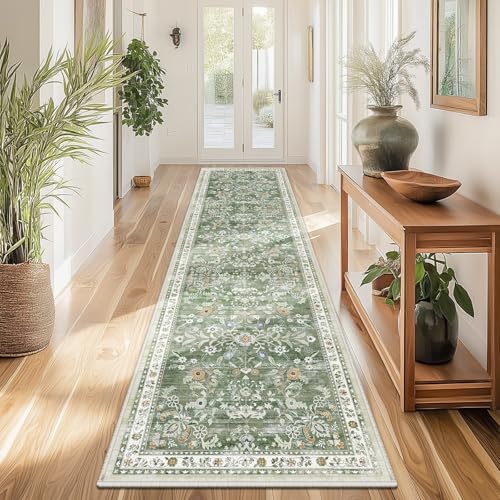
Yamaziot 2×8 Hallway Runner Rug
The Yamaziot is the gentle one: a 2×8 washable runner in sage green, with a soft boho floral design in a distressed low-pile finish, a stain-resistant claim, and — usefully — a backing the listing actually names: rubber. It is pitched at kitchen, hallway and entrance, the three routes where that backing will be tested hardest.
Facts taken from the title
- Size: 2×8
- Pile: Low pile, distressed finish
- Colour: Sage green, boho floral
- Backing: Rubber backing — stated in the listing
- Extra claim: Stain Resistant — the listing’s wording
Strengths
- A named rubber backing is the most concrete grip claim in the guide
- Distressed floral hides wear in the pattern’s own texture
- Sage green suits the soft, botanical schemes other runners ignore
Trade-offs
- Distressed styling reads as worn to eyes that prefer crisp pattern
- Sage is a specific palette that will fight warm-toned halls
- Stain resistance remains a claim to be backed by the wash
A named backing matters because non-slip is otherwise a promise about a material nobody identifies. Rubber backing on a low-pile runner is the classic hallway construction — the rug grips, lies flat, and resists the slow creep that turns a corridor rug into a corridor obstacle — and the Yamaziot is one of only two picks here whose listing specifies it. For a kitchen run, where the cook pivots a hundred times an evening, that specification is worth more than another adjective about softness.
The distressed floral is a taste decision wearing practical clothes. Distressing pre-forgives the wear pattern a hallway will impose — the centre fades first on any runner, and a design that begins faded simply ages in public more gracefully. Sage green narrows the buyer pool honestly: in a white-and-oak hall or a botanical kitchen it will look chosen, while against terracotta or warm grey it may sulk. Buy it for a room whose palette it completes, and its specification will do the rest.
Sage deserves a moment on light. Hallways and kitchens with north light run cool and grey for much of the year, and a sage green — a greyed green — harmonises with that light instead of fighting it, where a warm beige can turn sallow. The Yamaziot in a north-facing hall will look like itself at noon in February, which is the hardest test a corridor colour faces. Its rubber backing settles the practical side; the colour, in the right light, is not a compromise at all but the most sophisticated choice in the six.
Best for: sage and botanical schemes, and buyers who want the backing named, not implied.
Not suited for: crisp, formal hallways where a distressed finish reads as damage.
If a named rubber backing settles your mind, see the Yamaziot sage runner on Amazon

AREDO Runner Rug 2×6
The AREDO closes the list in black: a 2×6 runner with a non-slip rubber backing named in its title, washable, soft and low pile, in a solid colour finished with a pointillism style. Its settings list is the widest here — kitchen, hallway, entryway, bedroom, laundry — and its design is the only solid in a field of vintage prints.
Title facts, plainly
- Size: 2×6 ft
- Pile: Low pile
- Design: Solid black, pointillism style
- Backing: Non slip rubber backing — stated in the listing
- Care: Washable, per the listing
Strengths
- Rubber backing is named outright, matching the Yamaziot for grip credibility
- Solid black hides traffic soil better than any pattern here
- Pointillism texture keeps a solid colour from reading flat
Trade-offs
- Black shows pale lint, pet hair and dust that patterns would hide
- A solid dark runner can visually narrow a small, dim hallway
- 2×6 limits it to short routes and single work zones
Every guide needs its graphic option, and the AREDO is this one’s: no vintage fade, no floral, just a black field with a pointillist texture to break the light. In a modern hallway — white walls, pale wood, black fittings — it lands like punctuation, and in a kitchen it does the oldest trick in the category, swallowing the week’s traffic soil into a colour that refuses to report it. The pointillism matters more than it sounds; a dead-flat black runner shows every scuff as a shine, while a dotted texture scatters both light and blame.
The specification is as serious as the styling: rubber backing named, low pile, washable. The honest counterweight is pale debris — black is a magnet for visible lint and light pet hair, and households with a white cat should consider themselves warned by name. At 2×6 it suits the galley kitchen, the short entry and the bedside as much as the short hall, and its listing’s wide setting list is, for once, believable, because a solid black flat runner genuinely does go anywhere a route needs covering.
Black runners and light are the opposite bargain, and it is worth being precise about who wins it. In a hall with a glazed door or a kitchen with real daylight, the AREDO’s black field is a design asset — it grounds pale schemes and makes white units look whiter. In a windowless internal corridor lit by one bulb, the same field absorbs the little light there is. The runner is identical; the room decides. That is why this guide keeps returning colour questions to the buyer’s own worst-hour test rather than to photographs taken in showroom noon.
Best for: modern schemes, galley kitchens and short halls that want grip and camouflage.
Not suited for: homes with pale pets or dim halls that a black strip would darken further.
For the modern, graphic end of the range, look at the AREDO black runner on Amazon
Side-by-side comparison
Length runs down the first column in descending order of commitment: the 12-foot piece, the three standard 2x8s and the two 2×6 specialists for short routes and kitchens.
| Pick | Size or format | Surface and pile | Care and backing notes from the listing |
|---|---|---|---|
| Hallway Washable Runner Rug 2’6×12 | 2’6″ x 12′ | Vintage beige, soft; pile height not stated | Washable; non slip claim |
| Restydon 2×8 Runner Rug | 2×8 | Thin, soft, beige neutral | Washable; stain resistant claim; non slip |
| Madane Hallway Runner Rug 2×8 | 2×8 | Low-pile, ultra-thin, turmeric/grey vintage | Machine washable; non-slip claim |
| OLANLY 2×6 Washable Runner Rug Blue | 2×6 | Low pile, blue boho floral border | Washable; spill & stain resistant claim; non slip |
| Yamaziot 2×8 Hallway Runner Rug | 2×8 | Low pile distressed floral, sage green | Washable; rubber backing; stain resistant claim |
| AREDO Runner Rug 2×6 | 2×6 ft | Low pile, solid black pointillism | Washable; non slip rubber backing |
Grip claims separate into two kinds in the last column — named rubber backings and general non-slip promises — and on a corridor walked in socks at night, that difference is worth the attention this table gives it.
How do you choose a hallway runner that stays flat and put?
Five checks, in the order that rules out the wrong runners fastest.
Measure the route, then subtract the doors
A runner should cover the walked line, not the whole corridor: leave floor border on both sides and stop short of the ends so the piece reads as placed. Then walk the route and mark every door that swings across it, because each swinging door sets a maximum thickness. The sizes here — 2×6, 2×8 and the 2’6″ x 12 — cover most real halls between them, but only your tape measure knows which one your corridor is, and a runner even a foot too long will bunch at the end it cannot pass.
Try the sock test on your current floor before ordering anything: walk the route in socks at your natural pace, including the turn at the end. If your feet slide now, grip is your first criterion and the named rubber backings move to the top of the list. If they do not, you have the luxury of choosing on pattern and length alone.
How flat does it need to lie?
Flatness is a pile question. Low pile, thin and ultra-thin — the words these listings use — describe runners that clear door seals, lie down quickly after washing and present no edge to catch a toe at night. If the hall has generous door clearances and cold floors, a merely low-pile piece is fine; if doors graze the floor, the ultra-thin Madane specification is the one to chase. No runner in this guide is plush, deliberately: a hallway is the last place to buy cushion at the price of clearance.
Flatness has a seasonal footnote: doors swell. A door that clears a runner in January may graze it in a humid August, which argues for choosing the thinner specification whenever a door’s clearance is merely adequate today. The ultra-thin and low-pile listings exist because carpenters and weather conspire against hallway rugs annually.
Is the backing named or merely implied?
Non-slip appears in all six titles, but only the Yamaziot and AREDO name the mechanism — rubber backing. A named material can be checked on arrival and its grip judged honestly; an unnamed claim asks for trust. Either way, test the laid runner in socks at walking pace before the household adopts it, and re-test after the first wash, since washing is when backings and floors renegotiate their grip.
Ask the backing question of the floor as well as the rug. Rubber backings grip smooth floors best and can be reluctant on deep carpet; a runner bought for a hard hall may misbehave if it later migrates to a carpeted landing. Households that rotate rugs between floors should expect to re-test grip at every new posting, as this guide keeps insisting, because grip is a relationship, not a property.
How dirty is your route, really?
Count the traffic honestly: dogs, children, a garden door, a kitchen at one end. Heavy routes want the defensive claims — stain resistance on the Restydon and Yamaziot, spill and stain resistance on the OLANLY — plus a pattern that hides the interval between washes, which is the vintage prints’ quiet talent. Light routes, an adults-only flat’s hall, can afford the solid black or the plain beige and their cleaner look.
Dirt has a colour, and it is your household’s colour: garden soil, city dust, beach sand and dog are four different palettes. Hold the candidate patterns against your actual threshold dirt — vintage prints forgive the widest range, the black hides the dark end of it, and pale solids forgive almost nothing. The runner lives at the border between outside and in; dress it for the border it will actually patrol.
Will you wash it at the size you bought?
Washability is only real if your machine and your drying space agree. A 2×6 washes like a towel’s bigger sibling; a 12-foot runner is a planned event. Check the listing’s care instructions against your machine before the long runner is ordered, and think about where twelve feet of wet rug will dry in February. The best runner is the one whose wash day you will actually perform, on schedule, without dread.
The wash question has a frequency twin: how often will this route demand it? A runner washed monthly should be the easiest wash you own, which pushes the smaller sizes up the list for high-traffic homes. A runner washed twice a year can afford to be the 12-foot statement. Match the size to the rhythm, not just to the corridor.
Laying a runner so the corridor keeps its line
A runner’s placement is measured in centimetres of discipline. Centre it on the walked line rather than the architectural centre if the hall’s traffic runs off-axis — many do, hugging the side away from a staircase or toward the kitchen door — and leave the border even on both sides, because an uneven border is the one flaw every visitor’s eye catches without knowing why. At the ends, stop the runner short of doorways it does not serve; a runner that pokes into a side room reads as an accident, while one that ends with clear floor before the threshold reads as a decision.
Then give it a day of traffic before judging the grip. New runners can carry a factory stiffness that relaxes, and backings settle into a floor’s texture over the first week. If a corner lifts, it will lift in the same place every time — the door-swing corner, the pivot point at the kitchen end — and that is information, not failure: that corner is where a grip check after each wash matters most. A runner that lies flat and central makes the whole corridor feel maintained, an effect out of proportion to its cost.
One placement refinement separates good corridors from great ones: align the runner with the sightline, not the walls. Stand at the hall’s main entrance and look along it; the line your eye travels is the line the runner should centre on, which in older houses — where walls wander — is often a few centimetres off the architectural centre. The eye forgives a border that varies against a wandering wall; it does not forgive a runner that crosses its own sightline at an angle. Fit to the view and the hall feels straightened, whatever the walls are doing.
The flat-and-washable logic continues at the front door’s other end — the guide to Best White Hotel Towels covers the crisp end of household textiles.
The hallway runner’s year: wear lanes, washes and rotation
A hallway runner wears in a lane. The centre line, where feet actually fall, will fade and flatten ahead of the edges, and vintage or distressed patterns absorb that biography gracefully while solids report it honestly. Rotation helps where the layout allows: turning a runner end-for-end at each wash swaps the door-end wear with the quiet-end wear, and doubles the time before the lane becomes a story. Runners with symmetrical patterns — most of these — rotate invisibly; a bordered design like the OLANLY’s rotates fine too, since its border runs all the way around.
Wash rhythm follows the route, not the calendar. A kitchen runner in a cooking household may want a fortnight; a guest-hall runner, a season. The discipline that matters is drying: a runner relaid damp will smell of its own backing within days and lose grip while it dries unevenly, so give it air on both sides before it returns to the floor. Treated that way, a flat washable runner is close to immortal by textile standards — which is fortunate, because a good one becomes part of how the house feels to come home to.
There is a case for owning the hallway runner in duplicate, and it is practical rather than indulgent. A second, identical runner means wash day never leaves the route bare — the clean one goes down as the dirty one comes up — and both pieces wear at half speed, because each rests while the other works. For the standard 2×8 sizes especially, the pair costs less than most single ‘premium’ runners and outlasts them by years. Households that find their rhythm with a runner often arrive at the duplicate within the first winter, and wonder why the idea is not printed on the box.
Sound is a hallway runner’s hidden job. Corridors are echo chambers by construction — long, hard, narrow — and a runner absorbs the footfall noise that otherwise announces every trip to the bathroom at night. Even the thinnest piece here changes the acoustic of a hall noticeably, and in flats the neighbour below benefits as much as the household above. If night noise is part of your motivation, weight coverage over pattern: the longest runner your hall accepts will do more for quiet than any other single change to the space.
Light matters in the opposite direction. Hallways are often the darkest route in the house, and a runner is the largest single surface in it. A beige or sage piece lifts the route’s brightness every hour of the day, while the black AREDO deepens a hall that may already struggle for light — striking at noon, cave-like by evening. Judge the colour against your hall at its worst hour, not its best, because that is when you will live with it most honestly.
Renters should read this category with particular pleasure: a runner is the highest-impact, lowest-commitment change a rented hallway allows. It needs no fixing, leaves no trace, warms the arrival, quiets the route and moves house in a roll. The washable, rubber-backed pieces here are effectively deposit-proof decorating, and a household that expects to move within a few years can buy with confidence that the runner’s second home is already anticipated by its design.
Finally, a word for the hallway nobody thinks about: the one at 6 a.m. in winter, crossed barefoot to a cold kitchen. Every runner in this guide, however thin, takes the edge off that crossing, and the household will feel the purchase most at the hour no photograph shows. Judge the finalists partly by that imagined morning, because it repeats more often than any dinner party the hallway will ever host.
The hallway is also the house’s delivery route — parcels, prams, bikes, the Christmas tree — and a runner takes that freight so the floor does not have to. Flat washable runners shrug off wheel marks and tree needles with a wash, where a bare floor shows every December permanently. Households that host, haul and celebrate heavily should read the washable claims in this guide as freight insurance, because that is what they functionally are.
There is a rental-deposit angle unique to hallways: they are the first surface a landlord inspects and the one whose scratches are hardest to argue about. A runner down from the first week of a tenancy is a documented act of care that protects boards through years of boots and furniture moves. The rubber-backed pieces here, tested for grip and lifted for cleaning days, are effectively a preservation system wearing a pattern.
Consider, too, the hallway’s role in a house sale. Viewers form their verdict in the first ten seconds, standing on your runner, and a clean, well-fitted, quiet corridor tells them the house is maintained before they reach a single room. A tired runner tells the opposite story just as fast. When a sale approaches, the runner is the cheapest staging in the building — and the one already doing daily work while it stages.
Finally, the dog’s verdict deserves recording, because dogs vote on hallways with their whole bodies. A grippy runner turns the corridor from a skating rink into a route a dog can take at dignity, especially an older dog whose hips have opinions about laminate. Households often buy the runner for the floor and discover they bought it for the dog; either way, the grip specification is the one doing the kindness.
Aging in place gives the hallway runner one more serious job. The corridor is where an older resident walks most, often at night, often carrying something, and a flat runner with tested grip is fall prevention disguised as decor. The specification details this guide has been pedantic about — low pile so a shuffling gait clears it, grip verified rather than assumed, no curled edges at the ends — are precisely the details that decide whether a runner helps or harms in that household. Bought with that user in mind, the hallway runner stops being a furnishing choice and becomes part of how a home stays a home for longer.
And for the household that simply cannot decide between two finalists, there is an honourable tiebreak: order the smaller commitment first. A 2×6 in the chosen pattern proves the colour, the grip and the wash in the real corridor within a week, and if it passes, its bigger sibling follows with confidence while the small one retires to the kitchen or the bedside. It is the same audition logic this batch applied to turf mats, and it works here for the same reason — corridors, like balconies, are easier to judge with a rug in them than from a photograph of somebody else’s.
Common mistakes
Runner mistakes are geometry mistakes — the product is simple, so the errors are all in the fitting.
Buying the room’s size instead of the route’s. A hallway’s dimensions are not the runner’s dimensions. Buy for the walked line with borders and end clearance, or the runner will bunch, poke into doorways and look wedged no matter how good its pattern is.
Ignoring the door swing test. One grazing door will destroy a runner’s flatness and your patience within a week. Swing every door that crosses the route before committing to a thickness — or choose the ultra-thin specification and skip the suspense.
Trusting a non-slip claim untested. Claims are listings talking; your floor is the referee. Test in socks, at pace, on day one and after the first wash. A runner that moves in a corridor is a hazard wearing a pattern.
Choosing pale and plain for a garden-door route. A light, unpatterned runner at a muddy threshold becomes a diary of every wet paw and boot. Put the vintage prints and defensive claims where the weather enters, and save the neutrals for cleaner routes.
Letting wash day slip forever. A washable runner that is never washed becomes a dirt trap with a pattern, and its backing grip fades under the grime. The wash is the maintenance; schedule it like the route depends on it, because it does.
Centring the runner on the room instead of the route. Halls are walked asymmetrically — along the kitchen side, away from the stair side — and a runner centred on the architecture can leave the actual traffic line half on its edge. Watch the route for a day and centre the rug on the feet, not on the floor plan.
Final recommendation
For the standard hallway, the 2×8 size is the centre of gravity: the Restydon for a neutral, stain-resistant all-rounder, the Madane when doors demand the thinnest machine-washable profile, and the Yamaziot when a named rubber backing and a sage floral suit the scheme. The 12-foot beige runner stands alone for long halls — nothing else here attempts its job — and it earns its extra wash-day effort the first time the corridor reads as one line.
At 2×6, the OLANLY brings colour with a spill defence for kitchens and short entries, while the AREDO’s black pointillism and rubber backing serve the modern, graphic end of the range. Every pick is flat, washable and grippy on paper; the reviews have shown you where each paper claim is strongest. Measure the route, test the grip, and the hallway will take care of itself.
If the decision stalls between two finalists, let the door test break the tie in imagination: picture each candidate under your tightest door swing on a wet February evening, with the shopping in one arm. The runner that survives that picture without a flicker of doubt is the one your household will still be pleased with in its third winter.
Runners sorted, the bathing end of the house gets its own deep comparison in Best Freestanding Air Tubs.
Frequently asked questions
What size runner does a hallway need?
Most halls suit a 2×8, leaving a border of floor on both sides and clearance at the ends. Short halls, galley kitchens and entries often fit a 2×6 better, while genuinely long corridors are the case for the 2’6″ x 12 piece here. Measure the walked route rather than the room, and check every door swing that crosses it before choosing.
Are these runners really washable?
Each listing here says so — the Madane states machine washable outright, and the others are sold as washable runners. Practical washability still depends on your machine: a 2×6 is easy, a 12-foot runner is an event. Read the listing’s care instructions for your chosen size and plan drying space before wash day, not during it.
How do I keep a runner from sliding?
Start with the listings that name their mechanism — the Yamaziot and AREDO state rubber backing — and then verify on your own floor: walk it in socks at pace on day one and again after the first wash. A runner centred on the traffic line with furniture-free ends will also creep less than one constantly caught by a door.
Low pile or ultra-thin — what is the difference in a hall?
Low pile is the standard flat runner profile: it clears most doors and lies flat after washing. Ultra-thin, the Madane’s specification, sits lower still, for doors with tight seals and floors where any ridge is felt. Both give up cushion; the hallway trades that happily, since clearance and flatness matter more on a route than softness does.
Can a hallway runner work in the kitchen?
Yes — most of these listings name the kitchen themselves, and the flat, washable, non-slip brief is identical. For kitchen duty, weight the defensive claims: the OLANLY’s spill and stain resistance, the Restydon’s and Yamaziot’s stain resistance. Just size it to the working strip between sink and cooker rather than to the room.
Do hallway runners work on stairs’ landings and turns?
A flat runner can dress a landing, but corners and turns are where straight runners end — an L-shaped hall usually wants two pieces butted at the turn rather than one piece folded or cut, since a fold in a traffic line is a trip edge. For the staircase itself, treads and stair rolls are a different product family, covered in the stair runner guide linked from this one.
Measure the route honestly, and a flat runner will make the whole house feel better arrived at.


