Our Top Picks
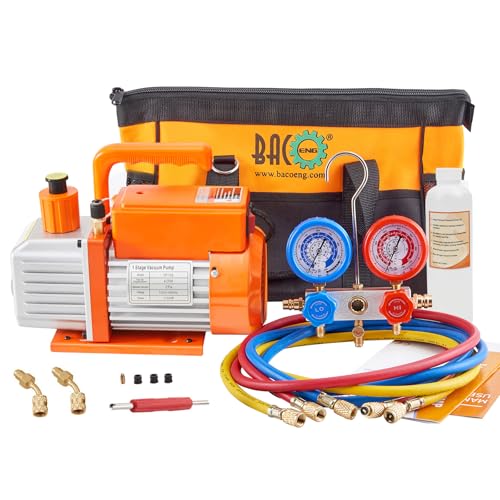
 BACOENG 3.6CFM 1/4HP AC Vacuum Pump and Gauge11"x4.7"x9.1"11 x 4.7 x 9.1 inches18.21 poundsCheck on Amazon


What's inside
- Why the vacuum step decides how a mini split performs
- What a vacuum pump actually does during a mini split install
- How to choose: CFM, stages, motors, and refrigerant fit
- The eight kits, product by product
- Setting up the pump, manifold, and hoses correctly
- A careful evacuation, step by step in plain language
- Pump oil, maintenance, and storage between jobs
- Safety, refrigerant rules, and when to hire a certified technician
- Which of these eight kits fits which reader
- Common evacuation mistakes that undo good equipment
- Frequently asked questions
- Check prices on Amazon
- The bottom line
As an Amazon Associate I earn from qualifying purchases. This post may contain affiliate links at no extra cost to you.
Why the vacuum step decides how a mini split performs
A mini split can be mounted neatly, wired correctly, and flared with care, and still disappoint for years if the evacuation step is rushed. Before refrigerant moves through a newly installed line set, the copper lines and the indoor coil contain ordinary air and, with it, moisture. Air does not belong inside a sealed refrigeration circuit. It does not condense the way refrigerant does, it raises pressures in ways that make the system work harder, and it leaves water vapour free to mix with oil and refrigerant. Over time, that moisture can contribute to acid formation, corrosion inside the circuit, and ice at metering points. A vacuum pump is the tool that removes that air and moisture before the service valves are opened and the factory charge is released.
That is why choosing the best vacuum pump for mini split work is less about chasing the biggest number on a box and more about matching a pump and gauge kit to the job in front of you. Most single-zone and small multi-zone residential installs use relatively short line sets. A mid-sized rotary vane pump in the range covered by the kits in this guide will pull those lines down efficiently, provided the hoses are sound, the connections are tight, and you give the evacuation enough time to do its real work. The gauge set matters just as much as the pump itself, because the manifold is how you connect, isolate, monitor, and confirm that the circuit is holding before you move on.
This guide is built around eight specific vacuum pump kits that were selected for this topic in advance. Each one is discussed only on the basis of what its full product title actually states, plus general, well-established practice for evacuation, oil care, and safe installation work. Where a title states a flow rating, a motor type, a refrigerant list, or an included accessory, that detail is used. Where a title is silent, no figure is invented for it. That discipline matters in HVAC, because a single wrong assumption about refrigerant compatibility or motor design can turn a routine install into an unsafe one.
The eight kits fall into a few clear families. Three come from BACOENG, including a sparkless model named for R32 work and two 3.6 CFM kits with different motor and refrigerant details. Four come from VIVOHOME, spanning 3.5 CFM and 4 CFM single-stage rotary vane designs, one of them named for A2L refrigerants. One VTG VOGTEN kit offers the highest stated flow in the group at 4.5 CFM, and one XtremepowerUS kit rounds out the list with a manifold-focused package. Read as a group, they cover the refrigerants most mini split owners will encounter in product titles: R32, R410a, R22, R134a, and, on the A2L-focused VIVOHOME kit, R1234yf and R454B as well.
What a vacuum pump actually does during a mini split install
Evacuation is often described as sucking the air out, and that shorthand is fine for a first picture. A rotary vane pump connected through a manifold gauge set lowers the pressure inside the line set and indoor coil far below atmospheric pressure. As pressure falls, air is drawn out through the hoses and exhausted by the pump. Just as importantly, the boiling point of water falls with pressure. Moisture that would sit as liquid inside a cool copper line can turn to vapour at a deep vacuum and be carried out with the air. That drying effect is the deeper purpose of the process, and it is why a quick pull that merely moves a compound gauge needle is not the same thing as a proper evacuation.
Installers talk about vacuum depth in microns. A micron is a very small unit of pressure, and a micron gauge gives a far more useful picture of a deep vacuum than the low-side dial of a manifold alone. Manifold gauges are essential for connection and control, and every kit in this guide is sold as a pump and gauge or manifold package, but their analogue low-pressure scales were not designed to resolve the fine differences that separate a damp system from a dry one. If you are equipping yourself for careful mini split work, treat the manifold as your connection hub and consider a dedicated micron gauge as a companion instrument rather than expecting the manifold dial to tell the whole story.
A sound evacuation also includes a standing check. Once the pump has pulled the system down and the circuit is isolated from the pump, the vacuum should hold steady. A rapid rise points to a leak or to a connection that is not sealing. A slow rise that levels off can point to moisture still leaving the system. Neither result should be ignored or explained away. Opening the service valves on a system that has not held a vacuum simply locks the problem inside, where it becomes far harder and more expensive to correct. Patience at this stage is cheaper than compressor trouble later.
How to choose: CFM, stages, motors, and refrigerant fit
CFM and the size of the job
CFM, or cubic feet per minute, describes how much air a pump can move. The kits in this guide state ratings of 3.5 CFM, 3.6 CFM, 4 CFM, and 4.5 CFM where a rating is given in the title. For typical residential mini split line sets, those figures sit in a practical band. A higher rating can shorten the initial pull-down on a larger or longer system, but it does not replace a proper standing vacuum check, and it does not dry a wet system instantly. If you install one mini split at a time in a house or cottage, a 3.5 or 3.6 CFM kit is a reasonable centre of gravity. If you handle longer runs, multi-zone work, or simply want more headroom, a 4 CFM or 4.5 CFM kit gives you that extra capacity on paper.
Single-stage rotary vane designs
Several titles in this group state the design plainly: the VIVOHOME A2L kit is described as 1 stage, the VIVOHOME 4 CFM kit is described as 1 stage, and the standalone VIVOHOME pump is described as a single stage rotary vane model. A single-stage rotary vane pump uses a rotating vane assembly, sealed and lubricated by vacuum pump oil, to draw gas in and exhaust it. For residential mini split evacuation, a well-maintained single-stage pump is a common and workable choice. Its real-world performance depends heavily on oil condition. Clean oil seals better and protects the vanes; oil contaminated with moisture pulls poorly and can leave you chasing a vacuum level the pump can no longer reach.
Sparkless motors and A2L refrigerants
Two titles in this guide call out a sparkless motor. The BACOENG R32 kit names a sparkless motor for R32, R410a, and R22 work, and the VIVOHOME A2L kit names a sparkless motor alongside R32, R1234yf, R454B, R134a, R410a, and R22. That wording matters because R32 and several newer refrigerants are classed as A2L, meaning mildly flammable. Equipment intended for service around A2L refrigerants is designed to reduce ignition sources, and a sparkless motor is part of that picture. If your mini split nameplate says R32, do not treat refrigerant fit as a minor detail. Match the pump, the recovery equipment, the leak detection approach, and your working environment to the refrigerant class, and follow the equipment and system manufacturer instructions for that refrigerant.
Refrigerant lists in a title are a starting point, not a licence
Every title here lists refrigerants, and those lists differ. Some centre on R410a and R22, the refrigerants long associated with mini split and residential air conditioning work. Others add R134a, which is more often linked with automotive and some refrigeration work, and a few list older refrigerants such as R12 and R502. A long list usually signals a kit marketed across HVAC, automotive, and refrigeration tasks rather than a kit designed only for mini splits. Use the list to confirm that your refrigerant is named, then confirm the details that the title cannot settle: the correct adapter for your service port, the correct hose fittings, and the procedures your system manufacturer requires.
The eight kits, product by product
1. BACOENG R32 AC Vacuum Pump and Gauge Set, 4 CFM, with sparkless motor
The full title of this kit is BACOENG R32 AC Vacuum Pump and Gauge Set, 4 CFM HVAC Vacuum Pump Kit for Mini Split System, Sparkless Motor for R32 R410a R22 Refrigerants, with an R410a Mini Split Adapter and 3x5FT Hoses. That is the most mini split specific title in the entire group. It leads with R32, states a 4 CFM rating, names the sparkless motor directly, and confirms the adapter and hose set that a mini split installer actually needs on the day.
For an owner installing a newer R32 mini split, that combination is the headline. R32 systems are increasingly common, and they ask for more care around ignition sources than the R410a generation that preceded them. A pump whose title explicitly pairs a sparkless motor with R32 belongs at the top of a shortlist for that work, not as an afterthought. The same title also names R410a and R22, so the kit is not limited to a single refrigerant generation, which helps if you maintain an older system alongside a newer one.
The stated 4 CFM rating places it above the 3.5 and 3.6 CFM kits in this guide for pull-down capacity, while the included set of three 5FT hoses and the manifold gauges give you the standard three-hose arrangement for connecting the system, the pump, and a charging or monitoring path. Nothing in the title claims a micron rating or a second stage, so judge it as what it states itself to be: a single-purpose, mini split focused, sparkless kit with solid stated capacity. If your install is an R32 unit and you want the title-level reassurance to match, this is the clearest fit in the group.
2. BACOENG 3.6CFM AC Vacuum Pump and Gauge Set for R410A and R22
The second BACOENG title reads BACOENG 3.6CFM AC Vacuum Pump and Gauge Set, HVAC Vacuum Pump Kit for Mini Split System for R410A R22 Refrigerants, with R410a Mini Split Adapters and 3x5FT Hoses. Strip away the overlap with its sibling and the differences are instructive. The stated rating is 3.6 CFM rather than 4 CFM, the refrigerant list in the title is R410A and R22 without R32, and no sparkless motor is claimed in the title.
That profile suits the large installed base of R410a mini splits very well. If your outdoor unit nameplate says R410a, this kit names your refrigerant, names mini split systems directly, includes mini split adapters in the plural, and includes the same style of three 5FT hoses for the manifold hookup. For a single residential install or for maintenance work on an R410a system you already own, the slightly lower stated CFM is unlikely to be the factor that decides your result; hose condition, connection quality, oil condition, and a patient standing check will matter more.
3. VIVOHOME A2L 1/4 HP 3.5CFM 1 Stage AC Vacuum Pump and Manifold Gauge Set
The VIVOHOME A2L title is the longest refrigerant list in the group: VIVOHOME A2L 1/4 HP 3.5CFM 1 Stage AC Vacuum Pump and Manifold Gauge Set, 110V HVAC Vacuum Pump Kit with Sparkless Motor for R32 R1234yf R454B R134a R410a R22 Car Automotive Mini Split AC Systems. In one title it states the horsepower, the 3.5 CFM rating, the single-stage design, the 110V supply, the sparkless motor, and six named refrigerants spanning newer A2L options and long-established ones.
That breadth makes this kit the natural pick for a reader whose work crosses categories. A household might have an R32 mini split indoors and vehicles that use R134a or R1234yf, and this title names all of those worlds at once. The explicit A2L framing in the product name itself, rather than a single refrigerant buried in a list, signals that the kit is positioned for the newer refrigerant generation. If buying once for several kinds of service work appeals to you, this is the title that argues for itself most strongly.
4. VTG VOGTEN 4.5 CFM AC Vacuum Pump and Gauge Set
The VTG VOGTEN title reads VTG VOGTEN 4.5 CFM AC Vacuum Pump and Gauge Set for R134a R12 R22 R502, AC Vacuum Pump Kit for Mini Split, HVAC, and Auto Systems, with 2 R134a Can Taps, 2 R410a Adapters, Vacuum Oil, and a Storage Bag. Its 4.5 CFM rating is the highest stated in this guide, and its accessory list is the most detailed. Can taps, two R410a adapters, vacuum oil, and a storage bag are all named in the title itself.
Read that title carefully, though, because it rewards attention. The headline refrigerant list is R134a, R12, R22, and R502, a list rooted in automotive and older refrigeration work, while the mini split relevance arrives through the named R410a adapters and the explicit mention of mini split systems among its uses. That is not a contradiction, but it does mean an R410a mini split buyer should confirm the full gauge and hose arrangement suits their unit rather than assuming every part of the kit was designed around mini splits alone.
Where this kit earns its place is capacity plus completeness. If you want the strongest stated pull in the group, value having oil and a storage bag named in the box, and work across auto and HVAC jobs, the VOGTEN package is easy to understand. The storage bag is a small detail with real consequences: pumps, hoses, and gauges that live in a bag stay cleaner, get damaged less often in a garage or van, and are far more likely to be complete when the next job comes around.
5. VIVOHOME 1/3 HP 4CFM 1 Stage AC Vacuum Pump and R134a Manifold Gauge Set
This VIVOHOME title states VIVOHOME 1/3 HP 4CFM 1 Stage AC Vacuum Pump and R134a Manifold Gauge Set, 110V Rotary Vane HVAC Vacuum Pump Kit, Leak Detector, for R410a R12 R22 R502 Car Air Conditioning Refrigeration Recharging. Three details stand out. It pairs a 4 CFM rating with a 1/3 HP motor, it states the rotary vane design in the title, and it names a leak detector as part of the kit, the only title in this group to do so.
The refrigerant framing needs the same careful reading as the VOGTEN kit. The manifold gauge set is named for R134a, and the stated refrigerant list is R410a, R12, R22, and R502. R410a is named, which is what a mini split buyer needs to see, but the kit is plainly positioned across car air conditioning, refrigeration, and recharging work as well. A leak detector is a genuinely useful companion for install work, because finding a leaking flare or connection before charging saves refrigerant, time, and a return visit. Treat its inclusion as a bonus that supports good practice rather than a substitute for a standing vacuum check, which remains the install-day standard.
6. BACOENG 3.6CFM 1/4HP AC Vacuum Pump and Gauge Set with copper motor
The third BACOENG title reads BACOENG 3.6CFM 1/4HP AC Vacuum Pump and Gauge Set for R134a R410a R22, HVAC Vacuum Pump Kit with Copper Motor, 5FT 3-Color Hoses, for Automotive A/C and Mini Split Systems. It shares the 3.6 CFM rating of the other BACOENG kit in this guide, adds a stated 1/4HP figure, and distinguishes itself with a copper motor and a set of 5FT 3-color hoses.
Colour-coded hoses are one of those features that sound cosmetic until you are kneeling beside an outdoor unit with three connections to keep straight. The conventional arrangement assigns colours to the low-pressure, high-pressure, and service or charging lines, and having that coding built into the hose set reduces the chance of a crossed connection, especially for an owner who does this work once a year rather than every week. The title names R410a among its refrigerants and names mini split systems among its uses, so the core mini split case is covered in the title itself.
7. XtremepowerUS HVAC Vacuum Pump Manifold Gauge Set
The XtremepowerUS title reads XtremepowerUS HVAC Vacuum Pump Manifold HVAC R134a, R12, R22, R410a, A/C Refrigeration R134, R134 Quick Connector AC Manifold Gauge Air Conditioner Oil Bottle with Bag. It is the least tidy title in the group, and it is also the one where restraint matters most. The title names R410a among its refrigerants, names a manifold gauge, a quick connector, an oil bottle, and a bag, but it does not state a CFM rating, a horsepower figure, or a stage design.
8. VIVOHOME 110V 1/4 HP 3.5 CFM Single Stage Rotary Vane AC Vacuum Pump
The final title is VIVOHOME 110V 1/4 HP 3.5 CFM Single Stage Rotary Vane AC Vacuum Pump, HVAC Vacuum Pump for Mini Split Automotive Air Conditioner R134a R12 R22 R502 R410a AC System with Oil Bottle. Unlike the other VIVOHOME entries, this one is a pump title rather than a pump and manifold gauge set title. No gauge set is named. That single difference changes who should buy it and why.
If you already own a manifold gauge set you trust, or you are replacing a pump while keeping your existing gauges and hoses, a pump-only purchase avoids paying twice for the same instruments. The stated figures are clear: 110V supply, 1/4 HP, 3.5 CFM, single stage rotary vane design, an oil bottle included, and a refrigerant list that includes R410a alongside R134a, R12, R22, and R502. Mini split use is named directly in the title.
Setting up the pump, manifold, and hoses correctly
Good evacuation starts before the pump is switched on. Lay out the manifold, hoses, adapters, and pump on a clean, dry surface near the outdoor unit. Inspect every hose for cracks, flattened sections, and damaged sealing washers. A hose that looks tired is not a minor flaw; the entire evacuation depends on a handful of seals holding a deep vacuum, and the cheapest seal in the chain can defeat the most capable pump in this guide. Replace suspect washers, keep hose ends capped or covered when stored, and never drag hose ends through grit or soil on the way to the unit.
Check the pump oil before you connect anything. Vacuum pump oil should be visible at the correct level in the sight glass and should look clean. Cloudy or dark oil has absorbed moisture or wear debris and will limit the vacuum the pump can reach. Several titles in this guide name included oil or an oil bottle, including the VOGTEN kit, the XtremepowerUS kit, and the standalone VIVOHOME pump, which reflects how central oil is to ownership. Fill or change oil on a level surface, use proper vacuum pump oil rather than a substitute, and dispose of used oil responsibly through local collection routes.
Connect the manifold to the service port using the correct adapter for your mini split, a point the BACOENG and VOGTEN titles address by naming R410a adapters. Connect the pump to the manifold centre hose, and keep hose runs as short and direct as the layout allows. Open the manifold valves according to the gauge set instructions, confirm every unused port is capped, and only then start the pump. If the gauge behaviour looks wrong immediately, stop and re-check connections rather than letting the pump run against an obvious leak and drawing moist air across your oil for no benefit.
Homeowners comparing cooling options alongside an install often ask how a ductless system stacks up against portable and window units for a single room, and a useful starting point is the guide at best 12000 btu portable air conditioners for the portable side of that comparison. The evacuation guidance here, though, applies specifically to refrigerant line sets. Window and portable units arrive as sealed appliances and never ask you to pull a vacuum, which is one of the honest trade-offs of choosing a mini split: better installed performance, in exchange for an install process that must be done properly.
A careful evacuation, step by step in plain language
Begin with the system fully assembled and pressure-checked according to the mini split manufacturer instructions. Flare connections should be made with proper tools, aligned without force, and tightened to the specified approach for your unit. A vacuum pump cannot fix a bad flare. If a joint is damaged or cross-threaded, remake it. Evacuation will reveal leaks, but it should be a verification step for sound work, not a diagnostic lottery for careless work.
With the manifold connected and the pump oil confirmed, start the pump and open the path to the line set. The bulk of the air leaves early, and the gauge will move quickly at first. Resist the urge to treat that early movement as completion. The slower phase that follows, where moisture leaves the lines and the vacuum deepens gradually, is where the value of the process sits. Keep the pump exhaust in mind as well: pumps discharge a fine oil mist during heavy pull-down, so position the pump so the exhaust is not blowing directly at you or into an enclosed space, and keep the area ventilated.
When the vacuum has deepened and stabilised, isolate the system from the pump by closing the manifold valves, then switch the pump off. Now watch. A system that holds its vacuum through a patient standing period has passed the most practical field check available at install time. A system whose vacuum climbs quickly has a leak to find. A system that climbs slowly and then levels may still be giving up moisture, in which case further evacuation is the answer. Some installers use a triple evacuation approach on problem systems, breaking the vacuum with dry nitrogen between pulls under professional procedure; that is a technique to follow only with the right equipment, training, and manufacturer guidance, not an improvisation.
Only when the vacuum holds should the service valves be opened to release the factory charge into the line set, following the exact sequence in your mini split manual. Some systems require additional refrigerant for line sets longer than a stated length, and that calculation belongs to the manual and, in many places, to a licensed installer. After charging, the connections should be checked for leaks with an appropriate method, the caps replaced and tightened, and the system run through its operating modes to confirm cooling, heating where fitted, drainage, and quiet operation.
If you are weighing a mini split against a window unit for a bedroom or small flat, the overview at best 8000 btu air conditioners covers the sealed-appliance route, where none of this evacuation work applies. Readers planning a cottage cooling setup may also find the smaller-room options at best 5000 btu compact window air conditioners worth a look before committing to a refrigerant-based install. Those comparisons are about choosing the right category, and they sit alongside, not instead of, doing a mini split install correctly once you have chosen one.
Pump oil, maintenance, and storage between jobs
Vacuum pumps are simple machines with one non-negotiable appetite: clean oil. Oil seals the vanes, lubricates the moving parts, and carries away heat and contaminants. Every evacuation loads the oil with some of the moisture pulled from the system. An owner who installs one mini split and then stores the pump for two years with wet oil inside is storing a corroding, poorly performing tool. The kind routine is short. Check oil before a job, change it when it looks contaminated, and change it after a notably wet evacuation even if it still looks acceptable.
Run the pump briefly after an oil change to circulate the fresh oil, and store the pump with its ports capped so damp air and dust stay out of the mechanism. Keep hoses coiled without sharp bends, keep the manifold where its gauges will not be knocked, and use the storage bag where a title includes one, as the VOGTEN and XtremepowerUS kits do. A kit stored as a kit is a kit you can trust on the next job. A pump on a shelf, hoses in a bucket, and an adapter lost in a drawer is how install day turns into a parts hunt.
Safety, refrigerant rules, and when to hire a certified technician
Refrigerant work sits at the boundary between confident home maintenance and regulated trade work, and the boundary matters. In many jurisdictions, handling refrigerant, charging systems, and working with certain refrigerant classes require certification or a licence, and mini split manufacturers may tie warranty coverage to installation by a qualified installer. None of that is boilerplate to skim past. Before you buy any kit in this guide, check the rules where you live, read your mini split warranty terms, and be honest about which parts of the job you are equipped and permitted to do.
A2L refrigerants raise the stakes on that honesty. R32 is mildly flammable, and the sparkless motor titles in this guide exist for a reason. Working with A2L refrigerants calls for suitable equipment, good ventilation, no ignition sources in the work area, and procedures that assume the refrigerant deserves respect. If your system uses R32, R454B, or another A2L refrigerant and you are not trained for that class, the right decision is to hire a certified technician who is. The cost of a professional install visit is small next to the cost of a refrigerant incident or a voided warranty.
Electrical and mechanical safety deserve the same plain treatment. The VIVOHOME titles state a 110V supply, which matches ordinary North American outlets, but any pump should be run from a sound outlet with its cord inspected and kept clear of the work area. Never run a pump in standing water, never defeat a plug or guard, and keep hands, clothing, and tools clear of moving parts and hot surfaces. Refrigerant itself can cause cold burns, and a discharging line should never be treated casually. Eye protection and gloves are ordinary, sensible kit for this work.
There are also clear signs to stop and call a professional mid-job. A vacuum that will not deepen despite sound connections and fresh oil, a flare that weeps repeatedly after being remade, a system that loses its standing vacuum quickly, or any situation where refrigerant has escaped unexpectedly are all stop points, not challenges to push through. A certified technician brings recovery equipment, electronic leak detection, a micron gauge, and experience with exactly these failures. Knowing where your competence ends is part of doing good work, not an admission against interest.
For readers still deciding between a professionally installed ductless system and a simpler sealed unit for a larger room, the roundup at best 10000 btu window air conditioners sets out the window category in the size range many people compare against a small mini split. That choice, made honestly at the start, prevents the most common bad outcome of all: a mini split bought for a job a simpler appliance would have done, then installed in a hurry because the refrigerant steps were never really wanted.
Which of these eight kits fits which reader
If your mini split is an R32 model, start with the two sparkless titles. The BACOENG R32 kit is the most directly aimed at your job, with its 4 CFM rating, sparkless motor, R410a mini split adapter, and three 5FT hoses all named in one title. The VIVOHOME A2L kit is the alternative if your work also spans vehicles and other A2L refrigerants, accepting its lower stated 3.5 CFM rating in exchange for the widest refrigerant list in the group.
If your system is a confirmed R410a model, your field widens. The BACOENG 3.6CFM kit with mini split adapters is the straightforward purpose-labelled choice. The BACOENG copper motor kit adds 3-color hoses and automotive range. The standalone VIVOHOME pump suits owners who already have gauges. The VIVOHOME 4 CFM kit adds a leak detector and more stated horsepower for mixed car and home work, and the VOGTEN kit offers the highest stated CFM and the fullest named accessory list for readers who work across several kinds of systems.
Common evacuation mistakes that undo good equipment
The most common mistake is impatience: pulling a vacuum until the manifold needle moves, declaring victory, and opening the service valves with moisture still in the lines. The second is trusting a leaking connection chain, where a worn hose washer or a loosely seated adapter lets air in as fast as the pump removes it. The third is old oil. A pump filled with contaminated oil can run all afternoon and never reach the vacuum a system needs, leaving the operator blaming the lines for the pump’s limitation.
Frequently asked questions
Is 3.5 CFM enough for a residential mini split?
For typical single-zone residential line sets, a 3.5 CFM pump such as the two VIVOHOME models with that stated rating is a workable capacity. Pull-down speed also depends on hose size and condition, connection quality, and line set length. What decides success is reaching and holding a deep vacuum, not the rating alone, so pair any pump in this range with sound hoses and a patient standing check.
Do I need a sparkless pump for an R32 mini split?
R32 is an A2L, mildly flammable refrigerant, and equipment for A2L service is designed to limit ignition sources. The BACOENG R32 kit and the VIVOHOME A2L kit both state a sparkless motor in their titles. If your system uses R32, favour equipment explicitly positioned for it, follow the manufacturer instructions for that refrigerant, and use a certified technician where training or local rules require one.
Can one kit serve both a mini split and a car?
Several titles say so directly. The VIVOHOME A2L kit names car, automotive, and mini split systems in one title, the BACOENG copper motor kit names automotive and mini split use, and the VOGTEN kit names mini split, HVAC, and auto systems. Confirm that the gauge scales, hoses, and adapters suit each job, because a shared pump does not automatically mean every accessory fits every port.
Why does my vacuum rise after I isolate the system?
A fast rise usually points to a leak at a flare, adapter, hose seal, or service port. A slower rise that levels off can point to moisture still leaving the system. Neither should be ignored. Find and fix a leak, or continue evacuating a damp system, and repeat the standing check until the result is stable before any refrigerant is released.
How often should vacuum pump oil be changed?
Change it whenever it looks cloudy, dark, or contaminated, after evacuating a notably wet system, and before a job if the pump has been stored a long time with used oil inside. Clean oil is what lets a rotary vane pump reach a deep vacuum at all. Kits that include oil or an oil bottle in the title make that first fill and the habit of regular changes easier to keep.
Check prices on Amazon
Live listings for the shortlist in this guide are pulled from Amazon below, so prices and availability are always current at the moment you look.


The bottom line
The best vacuum pump for mini split work is the one whose stated refrigerant fit matches your system, whose capacity suits your line sets, and whose included adapters and hoses let you connect without improvisation on install day. On title evidence, the BACOENG R32 kit is the clearest match for newer R32 systems, the VIVOHOME A2L kit is the broadest sparkless option, the VOGTEN kit leads on stated CFM and named accessories, and the remaining BACOENG and VIVOHOME packages give R410a owners a sensible spread of complete kits and one focused pump-only choice. Whichever you choose, the result will be decided as much by fresh oil, tight connections, and a vacuum that demonstrably holds as by the name on the pump. Do that part patiently, respect the refrigerant you are working with, and bring in a certified technician whenever the job crosses the edge of your training or your local rules. A mini split installed that way has every chance to run quietly and efficiently for years.
As an Amazon Associate we earn from qualifying purchases. This disclosure applies to qualifying purchases made through links connected with this guide, and it does not change the product evidence or selection standards described above.