Our Top Picks
 Camco Tastepure RV Water Filter 2-pk2 Count (Pack of 1)3 x 3.88 x 12.19 inches1.85 poundsCheck on Amazon
 Camco Tastepure RV Water Filter1 Filter & Hose Connector2.5 x 2.5 x 10.5 inches1.09 poundsCheck on Amazon
 GLACIER FRESH RV/Marine Water Filter with 2 FlexibleRV 4 Count3 x 0.5 x 1.2 inches3.54 poundsCheck on Amazon
 GLACIER FRESH RV/Marine Water Filter with 1 FlexibleRV 2 Count3 x 0.5 x 1.2 inches1.76 poundsCheck on Amazon


What's inside
- Best RV Water Filter Options for Fresher Water at the Campground
- How an Inline RV Water Filter Works
- What to Look for Before You Buy
- The Eight Filters in This Guide
- How These Filters Compare at a Glance
- Installing an Inline Filter the Right Way
- Everyday Habits That Keep Water Tasting Fresh
- Troubleshooting Common Inline Filter Problems
- Frequently Asked Questions
- Check prices on Amazon
- Choosing Your Filter
As an Amazon Associate I earn from qualifying purchases. This post may contain affiliate links at no extra cost to you.
Best RV Water Filter Options for Fresher Water at the Campground
Water is the first utility you connect when you arrive at a site, and it shapes almost everything that follows. It fills your kettle in the morning, it rinses vegetables before dinner, it washes dust off your hands after setting up, and it becomes the ice, the coffee, and the simple glass of water you reach for at the end of a long drive. Yet campground water is unfamiliar water. One park draws from a well, the next from a municipal line, and a third from a system that sits quiet for weeks between busy weekends. Taste, odor, chlorine, and sediment can change from one stop to the next, even when the water itself is perfectly usable for filling a tank.
That unpredictability is exactly why an inline RV water filter has become standard gear for so many campers. An inline filter sits outside the rig, between the campground faucet and your drinking water hose, so every drop that enters your freshwater system passes through it first. There is nothing to install inside a cabinet, nothing to cut into plumbing, and nothing to remove when you change rigs. You thread it on, you flush it briefly, and you fill as usual. When the season ends or the filter reaches the end of its useful life, you unscrew it and thread on a fresh one.
This guide walks through eight inline options built around that simple idea. All eight connect through a standard garden hose style setup, all eight focus on the everyday complaints RVers talk about most, namely bad taste, odors, chlorine, and sediment, and several add rust reduction, flexible hose protectors, or larger multi-packs for people who travel often. Some use granular activated carbon and KDF filtration, often shortened to GAC and KDF. One carries NSF/ANSI certification in its name. One is an XL format. Others keep things deliberately simple, giving you a stack of identical filters so a replacement is always in the storage bay when you need it.
How an Inline RV Water Filter Works
An inline filter is a sealed canister with a female hose thread on one end and a male hose thread on the other. Water enters from the campground spigot, moves through the filtration media inside, and exits toward your RV. Because the filter lives outside the rig, it protects everything downstream at once: the freshwater tank, the pump, the faucets, the shower, and any appliance that draws from the same system. It also means a clogged or exhausted filter is easy to spot and easy to swap, since you never need to open a plumbing compartment to reach it.
Most of the filters in this guide rely on two media that complement each other. Granular activated carbon, or GAC, is valued for improving taste and odor. As water passes over the carbon, chlorine and many of the compounds that make water taste flat, stale, or faintly chemical are reduced, which is why carbon is so common in drinking water products. KDF media works alongside the carbon and is widely used in RV filters to help control sediment-related issues and support the carbon bed. When a product title lists GAC and KDF together, it is describing that paired approach: carbon for taste and odor, KDF as a partner medium in the same canister.
Sediment handling matters just as much, especially at older parks. Fine grit, sand, and rust particles can travel through campground lines after maintenance, after heavy rain, or when a system has sat unused. Left alone, that grit ends up in your tank, your faucet aerators, and your water heater. An inline filter intercepts much of that material before it enters the rig, which is one reason many owners treat the filter as protection for the plumbing as much as an improvement for drinking water. Several options below specifically name sediment reduction, and one also names rust, which is a useful clue if you frequently visit parks with older iron pipework.
There are limits worth understanding. An inline hose filter is a taste, odor, chlorine, and sediment tool. It is not a purifier, and it does not turn questionable water into safe water. If a campground posts a boil notice or you doubt the source, follow the park guidance and your own judgment regardless of what filter you own. Think of the filter as the layer that makes good campground water taste better and keeps grit out of your system, and you will have exactly the right expectations for everything in this guide.
What to Look for Before You Buy
Filtration media and stated reductions
Start with the reductions a filter actually claims. The common thread across this group is bad taste, odors, chlorine, and sediment, and those four cover the vast majority of campground complaints. If a title also mentions rust, that is worth noting for older parks. If a title mentions GAC and KDF, you know the media pairing inside. If certification matters to you, look for the option in this list whose title states NSF/ANSI certification directly, rather than assuming every carbon filter carries the same credentials. Matching the claim to your concern is more useful than chasing the longest claim list.
Pack size and replacement rhythm
Inline filters are consumables. Common guidance is to replace them seasonally, sooner if flow slows noticeably or taste returns, and always after storage conditions that could have damaged the filter. That rhythm makes pack size a practical decision rather than a bargain hunt. A single filter suits a trial or a short season. A two-pack gives you one in use and one in reserve. Four-packs suit frequent travelers, full-season campers, and anyone who would rather not think about reordering mid-trip. Consider where you will store spares, keep them dry and protected from freezing, and write the install date on the housing with a marker so memory never has to guess.
Hose protectors and connection strain
The connection point is the weak spot in any hose setup. A stiff hose hanging from a filter can kink, pull sideways on the threads, and stress the faucet or the filter neck. A flexible hose protector is a short spring-like or bendable section that sits between the spigot and the filter, absorbing that angle so the hose hangs more naturally. Several filters below include one or two protectors in the box, which saves buying them separately and means the protector is there from the first trip. If you often connect to faucets that sit close to the ground, inside recessed boxes, or at awkward angles, a protector is not a luxury. It is the part that keeps the whole setup from fighting you.
Size, flow, and everyday handling
A standard inline filter is compact enough to live in a small tote with your hose and regulator. An XL format gives you a larger canister, which some owners prefer for longer stays and higher water use, as long as storage allows. Whatever size you choose, fit the filter in the flow direction marked on the housing, hand-tighten, and check for drips under pressure before you walk away.
The Eight Filters in This Guide
Camco Tastepure RV Water Filter 2-pk – GAC & KDF Filtration-Made in the USA | Advanced RV Inline Water Filter with 6-Step Patent-Protected Filtration – Camping Essentials for Fresh Drinking Water (40045)
The Camco Tastepure two-pack is a natural starting point for owners who want a proven name, a spare on board, and a filtration description that goes a step further than most. The title confirms GAC and KDF filtration, states that the filter is made in the USA, and describes a 6-step patent-protected filtration process. That six-step wording signals a layered approach inside the canister, where water passes through successive stages rather than a single loose bed of media, and it is the detail that sets this particular Camco apart from its own single-filter sibling further down the list.
In daily use, the appeal is straightforward. You get two identical inline filters, so the first goes on the hose at the start of the season and the second waits in the storage bay for the moment flow drops or taste creeps back. There is no need to hunt down a replacement in an unfamiliar town, and no temptation to stretch an exhausted filter for one more trip. For couples who camp once or twice a month through spring, summer, and early fall, a two-pack maps neatly onto a replace-by-season rhythm, with the spare covering a mid-season swap if a particularly silty park shortens the first filter’s life.
This option does not list a flexible hose protector in its title, so use one you already own or add one if your usual parks have low or recessed faucets. Thread the filter on in the direction of the flow arrow, flush briefly until the water runs clear, then connect your hose and fill as normal.
Camco Tastepure RV Water Filter – GAC & KDF Filtration – Made in the USA | Advanced RV Inline Water Filter with Flexible Hose Protector – Camping Essentials for Fresh Drinking Water (40043)
This single Camco Tastepure filter covers the same core ground as the two-pack above, with GAC and KDF filtration and made in the USA stated right in the title, but it changes the buying proposition in one important way: a flexible hose protector is included. That small addition changes the experience at the spigot more than you might expect. The protector flexes where a rigid connection cannot, letting the hose drop naturally instead of kinking at the filter neck, and it takes strain off the threads on both the faucet and the filter itself.
Choose this version if you are buying your first inline filter and want the connection hardware handled in the same box. There is nothing else to remember, nothing else to order, and the setup at your first site is simply spigot, protector and filter, then hose. It is also a sensible pick for owners whose previous filter cracked or leaked at the neck, since that failure almost always traces back to side strain from a stiff hose rather than a fault in the filtration media. Solving the strain problem is worth more than any marginal difference in media between similar filters.
As a single unit, it asks you to stay on top of replacements yourself. Write the install date on the housing, keep an eye on flow as the season progresses, and reorder when taste starts to return rather than after it has fully returned. The filter is described for fresh drinking water and as a camping essential, which matches how most owners will use it: on the fill hose, every fill, all season. If you later decide the format works for you, stepping up to the two-pack above for the following season is an easy progression, since the filtration approach and hose connections remain familiar.
GLACIER FRESH RV/Marine Water Filter with 2 Flexible Hose Protectors 4 Pack | Greatly Reduces Bad Taste, Odors, Chlorine and Sediment in Drinking Water
The Glacier Fresh four-pack is built for people who go through filters steadily and would rather stock up once. Four filters cover a long season of frequent travel, a full year of moderate use, or a household that splits time between road trips and weekends away. The title states that the filter greatly reduces bad taste, odors, chlorine, and sediment in drinking water, which is the complete set of everyday campground concerns in a single sentence, with no extra claims to decode.
Two flexible hose protectors are included, and that number is more thoughtful than it first appears. One protector can live permanently on your main fill setup, while the second covers a spare hose, a second rig, or the inevitable moment a protector goes missing in a dark storage bay. Owners who use the same filter style at a marina will also appreciate the RV and marine description in the title. A boat on a dock faces the same unfamiliar water problem as an RV in a park, and a filter that is described for both saves you maintaining two different systems.
With four filters in hand, discipline matters more than anything. Store the spares in their packaging, in a dry compartment, away from freezing temperatures, and rotate them in order rather than opening several at once. Once a filter has been wetted and used, treat it as the active filter until it is done; do not swap back and forth between part-used filters, since a damp filter left sitting in a warm bay is not at its best. Used in that orderly way, this pack is arguably the most convenient option in the guide for high-mileage travelers who want replacements to be a non-event. You simply reach into the bay, thread on the next filter, flush, and fill.
Camco Tastepure XL RV Water Filter w/Flexible Hose Protector – Made in USA | Advanced RV Inline Water Filter – Compatible w/ Garden & Drinking Water Hoses – Gardening, Car Washing, & More (40019)
The Camco Tastepure XL takes the familiar Tastepure formula and puts it in a larger canister. The title confirms the flexible hose protector is included, states made in USA, and describes compatibility with garden and drinking water hoses, with gardening and car washing named among the additional uses. That broader description makes the XL the most versatile filter in this guide, and for some households that versatility is the whole point. The same filter style that serves the RV can also serve the garden hose at home between trips.
Why choose the larger format? Owners who stay in one place for extended periods, fill large tanks, or run a lot of water through the rig each day often prefer a bigger canister under the simple logic that more media takes longer to exhaust. The XL will take a little more room in your water tote and weighs more in the hand than a standard inline filter, so measure your storage if space is genuinely tight, as it can be in a small camper or a van conversion. For a mid-size or larger RV with a dedicated water bay, the difference is unlikely to matter at all.
RVGUARD Inline RV Water Filter, 4 Pack | Reduces Odors, Bad Taste, Rust, Chlorine, Ideal for RV and Marine Use
The RVGUARD four-pack earns its place in this guide with one word the other multi-packs do not lead with: rust. The title states that the filter reduces odors, bad taste, rust, and chlorine, and describes it as ideal for RV and marine use. Rust is a specific, recognizable problem. It shows up as a faint orange tint in a glass, as speckling in a sink, and as the metallic edge in water drawn from older park systems with aging iron lines. If you have ever filled up at a charming older campground and watched the water run slightly discolored for the first few seconds, you already know why a rust mention matters.
Beyond that distinction, the proposition is practical. Four filters give you the same stock-up convenience as the other four-packs here, which suits seasonal travelers, full-timers who move often, and anyone who keeps a second setup for a boat. The marine mention is not decoration. Dock water and campground water share the same variability, and a filter described for both environments can move between them without any change in fittings, since both rely on the same hose thread standard.
One handling note applies at rust-prone parks: flush with patience. Run water through the filter and hose briefly before filling, until it looks and smells clean, and expect that filter to reach the end of its life sooner than usual. That is exactly why the spare filters in a four-pack matter.
GLACIER FRESH RV/Marine Water Filter with 1 Flexible Hose Protectors 2 Pack | Greatly Reduces Bad Taste, Odors, Chlorine and Sediment in Drinking Water
This Glacier Fresh two-pack is the smaller sibling of the four-pack covered earlier, with the same stated reductions for bad taste, odors, chlorine, and sediment in drinking water, and the same RV and marine description. The differences are quantity and hardware: two filters instead of four, and one flexible hose protector instead of two. For many owners, that is not a compromise at all. It is simply the right amount.
Think about how a typical season actually unfolds. A filter goes on in spring, a spare rides along for the mid-season change, and the season wraps up before a third is needed. A two-pack covers that arc exactly, without leaving extra filters to store through winter. The single included protector equips your main fill hose, which is the connection that matters, and if you run only one hose setup, one protector is genuinely all you need. Owners downsizing from a big rig, or outfitting a compact camper where every tote is shared space, will appreciate a pack that does not ask for storage they do not have.
This is also a sensible first purchase if you like the Glacier Fresh approach but want to live with the format for a season before committing to a larger stock. The connections, the flushing routine, and the replacement rhythm are identical to the four-pack, so stepping up later changes nothing about how you work at the spigot. Pair it with a dated note on the housing each time you swap, and by the end of the season you will know your own consumption rate precisely, which makes the next buying decision, two or four, an informed one rather than a guess.
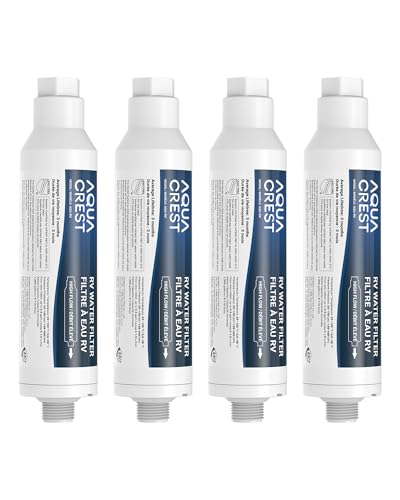
AQUA CREST RV Inline Water Filter, Garden Hose & Camper Water Filter | NSF/ANSI Certified, Reduces Chlorine, Odor, Bad Taste and Sediment in Drinking Water, GAC & KDF Filtration, 4 Pack
The Aqua Crest four-pack stands out for a credential none of the other titles in this guide state: NSF/ANSI certification. For buyers who look for third-party standards language when they choose anything connected to drinking water, that line in the title will likely decide the shortlist on its own. Certification speaks to a product being evaluated against a recognized standard, and many owners simply feel better filling a tank, a kettle, and a child’s water bottle through a filter that carries it.
The rest of the title is equally complete. The filter reduces chlorine, odor, bad taste, and sediment in drinking water, uses GAC and KDF filtration, and is described as both a garden hose and camper water filter, which underlines the standard hose connection and the ease of moving it between home and campground use. Four filters in the box put it in the same stock-up category as the other four-packs here, so the certification does not come at the cost of convenience. You can outfit the rig, keep spares in reserve, and still have the standards language you were looking for.
Crystala Filters RV/Marine Inline Filter with 2 Flexible Hose 3-Pack | Greatly Reduces Bad Taste, Odors, Chlorine and Sediment in Drinking Water
The Crystala three-pack occupies the middle ground that many buyers quietly want. Two filters can feel lean for a long season, four can feel like a commitment, and three lands right between them: one in service, one ready for the mid-season swap, and one more for the late-season trip or the unexpected silty park that shortens a filter’s life. The title states that the filter greatly reduces bad taste, odors, chlorine, and sediment in drinking water, covering the standard four concerns without embellishment.
Two flexible hose protectors are included, which is generous for a three-pack and genuinely useful. As with the Glacier Fresh four-pack, the second protector equips a spare hose or a second setup, and the RV and marine description means that second setup can just as easily be a dock hose as a campground hose. Owners who keep gear in two places, some in the RV and some at a seasonal site or a boat, will find the pairing of three filters and two protectors maps well onto that divided life.
Crystala is a good fit for the deliberate buyer who has done the math on their own season. Count your trips, estimate a filter for each major stretch of travel, and see whether the answer is three. For a household that camps monthly from spring through fall, with one longer tour in the middle, it very often is. Store the spares dry, note install dates as you go, and let the pack carry you through the year without a mid-season reorder or a leftover filter rolling around the bay next winter.
How These Filters Compare at a Glance
Stepping back, the eight options divide along a few clear lines. On pack size, the single Camco with hose protector suits first-time buyers, the two-packs from Camco and Glacier Fresh suit a standard season with a spare, the Crystala three-pack suits a longer or less predictable season, and the four-packs from Glacier Fresh, RVGUARD, and Aqua Crest suit frequent travelers and anyone stocking up once for the year. None of these is inherently better. The right count is the one that matches your travel calendar, because a filter only helps when a fresh one is actually on board.
On hardware, the included hose protector is the detail to check before you order. The single Camco, the Camco XL, both Glacier Fresh packs, and the Crystala pack all include at least one protector in the title. The Camco two-pack and the RVGUARD and Aqua Crest packs do not list one, which simply means you should confirm what is already in your water tote. Many experienced owners already own a protector from a previous setup, in which case a pack without one costs you nothing at all.
While you are planning the rest of your rig’s water and living setup, it helps to think about the appliances that depend on the same supply, and our guide to compact dish care on the road is a useful companion read at best rv dishwashers for anyone weighing how filtered water and small appliances fit together in a tight galley.
Installing an Inline Filter the Right Way
Installation takes only a few minutes, but the order of steps matters. Begin by checking the flow direction marked on the filter housing. Inline filters are directional, and fitting one backwards reduces its effectiveness and can disturb the media bed. Next, attach the flexible hose protector to the campground faucet if your filter includes one or you own one separately, then thread the filter onto the protector or directly onto the faucet. Hand-tighten firmly without tools, since over-tightening with a wrench can crack plastic threads or distort the sealing washer.
Before connecting your drinking water hose, flush the new filter. Open the faucet gently and let water run through the filter into a bucket or onto a gravel area. New carbon filters commonly release fine dark particles at first, which is simply loose carbon dust washing out of the media. Let the water run until it is clear, then close the faucet. This short flush is one of the most skipped steps in RV water care, and skipping it is the main reason people sometimes see specks in the first fill from a fresh filter.
Now connect your drinking water hose to the outlet side of the filter and run the other end to your RV fill inlet or city water connection. If you use a pressure regulator, the common arrangement is regulator at the faucet, then filter, then hose, though owners vary the order; what matters most is that connections are clean, washers are seated, and nothing is cross-threaded. Open the faucet fully and walk the line, checking each joint for drips. A slow drip at a thread usually means a worn washer or grit on the sealing face, both of which are quicker to fix at setup than after the tank is full and the bay is closed.
Laundry on the road benefits from the same filtered supply, since every appliance in the rig drinks from the same line, and readers planning a fuller onboard setup may also want to look at best rv washers when considering how water quality affects fabrics, seals, and machine life over a long season of travel.
Everyday Habits That Keep Water Tasting Fresh
Flush at every new site
Make a brief flush part of your arrival routine, not just a first-use step for a new filter. Campground lines sit unused between guests, and the first water out of a spigot has often been standing in the park plumbing. Run the filter and hose for a short while before filling, until the water runs cool, clear, and neutral in smell. It costs a minute and a small amount of water, and it protects your tank from the least appealing water the park has to offer.
Replace on a seasonal rhythm
Inline filters do their work silently, which means they also exhaust themselves silently. Taste returning, flow slowing at the faucet, or a filter that has simply been in service across a whole season are all signs to swap. Many owners adopt a simple rule: a fresh filter at the start of the season, another partway through if travel is heavy, and never carrying a used filter over into a new year. Marking the install date on the housing turns that rule from an intention into a fact you can check at a glance.
Drain, dry, and store with care
Between trips, drain the filter by holding it vertically and letting water run out, then cap the ends if caps are available or store it upright in a clean tote. Never leave a wet filter sealed in a hot compartment for weeks if you can avoid it, and never let a filter freeze with water inside. Freezing can crack the housing and damage the media structure, and a filter that has frozen should be replaced rather than trusted. In winter, the safest place for a used filter is retirement, and the safest place for your spares is a dry, indoor spot where temperatures stay moderate.
Protect the hose side too
Good water habits travel well beyond the RV park, too, since the same thinking about clean, comfortable rest applies at a tent site, where browsing best camping top quilts can help you round out a sleep setup that matches the care you put into your water and kitchen systems.
Troubleshooting Common Inline Filter Problems
If flow drops suddenly at a new park, suspect sediment before you suspect the filter’s age. A park that has just serviced its lines can send a slug of grit downstream that loads a filter in a single fill. Try the filter at the next site before condemning it, and if flow stays poor, replace it and note the park in your log. Keeping a spare on board, which is the whole logic behind the multi-packs in this guide, turns this problem from a trip disruption into a two-minute swap.
If you see leaks at the filter connections, shut off the faucet, relieve pressure, and inspect the washers. Hose washers harden and flatten with age, and a washer that looks intact can still fail to seal. Carry a small packet of spare washers in your water tote, replace them at the first sign of persistent dripping, and check that no grit is trapped on the sealing face. If the housing itself is cracked, especially after a freeze or a drop onto concrete, replace the filter outright. A cracked canister will not heal, and water under pressure always finds the weakness.
Frequently Asked Questions
Where does an inline filter go, before or after the hose?
It goes at the faucet end, before your drinking water hose, so that all water passing through the hose and into the RV has already been filtered. The usual order is faucet, hose protector if you use one, filter, then hose to the rig. Fitting the filter at the RV end would work mechanically, but it would leave the hose itself unfiltered and add awkward weight at the inlet, so the faucet end is the standard and sensible position.
Can I use the same filter for a boat?
Several filters in this guide are explicitly described for RV and marine use, including both Glacier Fresh packs, the RVGUARD four-pack, and the Crystala three-pack. Dockside water connects with the same hose threads and raises the same taste, odor, chlorine, and sediment concerns, so a filter described for both settings moves between them without any adaptation. Just keep the same habits: flush first, note the install date, and replace on schedule.
How do I know when to replace my filter?
Watch for returning taste or odor, a noticeable drop in flow, or simply the calendar. A filter that has served a full season of regular travel has done its job. Because you cannot see the media inside a sealed canister, time and performance are your only gauges, which is why writing the install date on the housing is such a useful habit. When in doubt, replace it. The multi-packs in this guide exist precisely so that a fresh filter is never a shopping trip away.
Does an inline filter make unsafe water safe?
No. These filters improve taste, odor, chlorine, and sediment, and some also address rust. They are not purifiers and they do not disinfect. If a park issues a water advisory, follow it. If a source looks or smells genuinely wrong, do not fill from it, filtered or not. Use the filter for what it is designed to do, making good campground water taste better and keeping grit out of your plumbing, and rely on park guidance and your own judgment for safety decisions.
What should I do with my filter over winter?
Remove it before freezing weather, drain it thoroughly, and do not plan to reuse a filter that has frozen with water inside it, since ice can crack the housing and damage the media. Many owners simply retire the active filter at the end of the season and start spring with a fresh one, which is another argument for the multi-packs above. Store unused spares indoors, dry, and away from deep cold, ready for the first trip of the new season.
Finally, remember that water care is part of a bigger road routine that includes keeping the tow vehicle and daily gear in shape, and drivers who handle their own quick cleanups between stops may find best 12 volt wet dry car vacuums worth a look as a companion for the same storage bay that holds the hose, the regulator, and your spare filters.
Check prices on Amazon
Live listings for the shortlist in this guide are pulled from Amazon below, so prices and availability are always current at the moment you look.

Choosing Your Filter
In short: the Camco single suits first-time buyers, the Camco two-pack adds a spare, and the Camco XL adds size and versatility. For stocking up, Glacier Fresh pairs quantity with protectors, RVGUARD adds rust reduction, and Aqua Crest leads on NSF/ANSI certification with GAC and KDF media. The Glacier Fresh two-pack and Crystala three-pack cover the middle ground for owners who know their season.
Whichever you choose, the routine is the same, and it is a kind one: connect at the faucet, mind the flow arrow, flush until clear, fill with confidence, and replace on a seasonal rhythm. Do that, and the humble inline filter becomes one of those pieces of gear you stop thinking about entirely, which is the highest compliment any piece of camping equipment can earn. The water simply tastes like water, trip after trip, park after park.
Disclosure: As an Amazon Associate we earn from qualifying purchases. This guide was prepared to help you compare inline RV water filters on their stated features, pack sizes, and included hardware, and product descriptions can change over time, so please check the current listing details before you buy.