What's inside
- Where to Buy a Washer That Earns Its Space in an RV
- Key Takeaways
- Quick Picks
- How Did We Judge Washers for a Life Measured in Gallons and Amp-Hours?
- How Much Water and Power Does Laundry on the Road Really Take?
- What Wardrobe Choices Make RV Laundry Easier Before Any Machine Is Bought?
- Where Does a Portable Washer Live in a Moving Vehicle?
- How Do You Build a Laundry Routine That Survives a Whole Season?
- What Should You Check Before the First Wash in a New Rig?
- How Do You Dry Clothes Well When No Machine in This Guide Heats Air?
- Common Mistakes When Washing on the Road
- What Does a Laundry Day Look Like at Three Kinds of Pitch?
- How Do You Choose Between This Guide’s Picks With a Tape and a Tank Gauge?
- Final Recommendation
- Which Pick Suits Which Traveller? Five Road Portraits
- How Do You Keep a Portable Washer Healthy Across Miles and Seasons?
- Frequently Asked Questions
- Related Guides
As an Amazon Associate I earn from qualifying purchases. This post may contain affiliate links at no extra cost to you.
cottageverdict.com is reader-supported. When you buy through links on our site, we may earn an affiliate commission.
Where to Buy a Washer That Earns Its Space in an RV
The best RV washers answer to a stricter landlord than any apartment: your rig’s water tank, its power system, and the few square feet a laundry machine is allowed to occupy between the galley and the bed. Every pick in this guide was chosen against those three budgets, using only what its listing title states — capacities in cubic feet or pounds, cycle counts, drain arrangements, and the RV, dorm, and apartment uses the makers themselves name. A washer that ignores the tank or the inverter is not compact; it is just small and disappointing.
The class divides into two honest families. Full-automatic single tubs — the BLACK+DECKER, the COMFEE, and the Winado — wash and spin in one drum on programmes you set and leave. Twin tubs — the Auertech, the COSTWAY, and the SUPER DEAL — wash in one tub and spin in a second, smaller one, with you moving the load between them. That second family needs a truth printed early: a twin tub’s spinner removes water by centrifugal force; it is not a heated dryer, and no pick in that family will hand you warm, dry clothes. Each twin-tub review repeats that fact in its own words, because a traveller planning around a dryer that does not exist will plan badly.
One more family deserves a mention for completeness. Permanently installed RV washer-dryer combos — the Splendide class, plumbed and vented into the rig — were covered in an earlier round of our laundry guides, and they remain the right answer for full-timers with a dedicated laundry bay. This guide serves the larger tribe: travellers who need laundry that can live in a shower stall, a storage bay, or a corner of the galley, and be moved when the road changes its mind. When the washing is done, the same rig’s evenings belong to gentler machinery, a theme our dryer coverage in Best Energy Star Dryers continues for readers heading back to a house with a laundry room.
Key Takeaways
- Three picks are full-automatic single tubs and three are twin tubs; the twin tubs wash and spin but do not heat-dry, and each review says so.
- Capacities are stated two ways in the titles — cubic feet for the automatics, pounds for the portables — and the guide never converts one into the other.
- Drainage divides the list: drain pumps on the Auertech and Winado, a gravity drain on the SUPER DEAL, and a sink adapter kit with the BLACK+DECKER.
- Every title names RV, dorm, apartment, or camping use, so the picks are portable by design rather than by optimism.
- Water and power discipline — small loads, full loads, loads matched to tank and battery — matters more on the road than any cycle menu.
- Installed vented combos exist as a separate class, referenced here without a link because earlier guides covered them.
Quick Picks
| RV washer | Our badge | The short case for it |
|---|---|---|
| BLACK+DECKER 3.0 Portable Washer BPW30MW | Best full-automatic capacity | A 3.0 cu. ft. portable with a 26.5 lb. stated capacity, six cycles, and a quick-connect sink adapter in the box. |
| COMFEE Portable Washing Machine 2.4 Cu Ft | Best RV-named all-rounder | A 2.4 cu. ft. LED-display compact whose title names RV use outright, with a child lock for travelling families. |
| Auertech 28lbs Twin Tub Washer Mini Compact | Best twin-tub capacity | An 18 lb. washer beside a 10 lb. spinner, semi-automatic, with a drain pump for controlled emptying. |
| COSTWAY Portable Washing Machine 12Lbs Washer 8Lbs Spinner | Best timer-simple twin tub | A 20 lb. total twin tub with timer control, sized and priced by its title for RVs, apartments, and dorms. |
| SUPER DEAL Compact Mini Twin Tub Washing Machine 13lbs | Best camping-weight twin tub | A 13 lb. wash-and-spin twin tub with a built-in gravity drain, named for camping and RV use in its title. |
| Winado 15.6LBS Full Automatic Portable Washer | Best automatic with a steel drum | A 15.6 lb. full-automatic with a stainless steel drum, ten wash programmes, and a drain pump. |
How Did We Judge Washers for a Life Measured in Gallons and Amp-Hours?
We started with the titles’ own numbers and refused to translate between them. Cubic feet and pounds measure different things — drum volume and load weight — and a guide that converts casually invents precision the makers never claimed. So the automatics are compared by their stated cubic feet and cycles, the twin tubs by their stated wash and spin pounds, and the reader is told, in the capacity section below, how to think about both units against a real bundle of travelling clothes.
Then we weighed the road-specific details each title offers: how the machine fills, how it empties, and what it asks of the rig. A drain pump empties uphill into a sink or shower tray; a gravity drain needs the machine raised and a downhill path, which a campsite does not always provide. A quick-connect sink adapter, included with the BLACK+DECKER, turns a galley tap into a fill point without plumbing. These unglamorous lines in a title decide whether a washer is a servant on the road or a puzzle.
Finally, we kept the two families separate in the rankings rather than crowning one machine overall. A full-automatic and a twin tub are different bargains with your time: one takes longer per load and none of your attention, the other finishes fast and takes your hands at the transfer. Travellers know which currency they are richer in, and the reviews are written so that knowledge, not our preference, makes the choice.
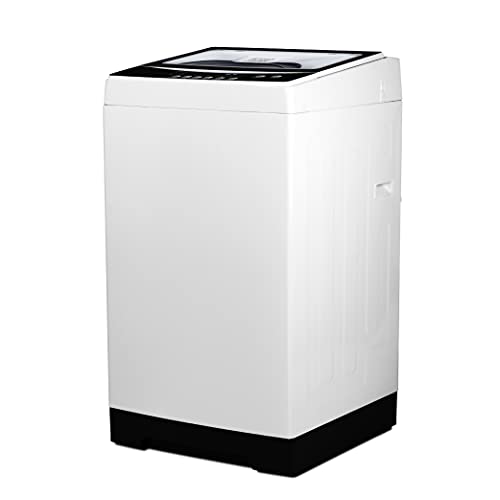
BLACK+DECKER 3.0 Portable Washer BPW30MW — Best full-automatic capacity
The BLACK+DECKER is the largest automatic in this guide by both of its stated measures: a 3.0 cu. ft. drum and a 26.5 lb. capacity, with six cycles and a transparent lid. In RV terms, that is the machine for travellers who stay in larger rigs or park for weeks at a time and want laundry to feel like laundry — load it, choose a cycle, and return to dry-spun clothes ready for the line. The transparent lid is a small mercy on the road, letting you confirm a load is behaving without breaking the cycle’s seal.
Its title’s most road-worthy line is the quietest: a quick-connect sink adapter and drain hose are included. Filling and emptying are where portable washers earn or lose their welcome in a rig, and a maker who ships the adapter understands the assignment. Six cycles cover the travelling wardrobe’s real range, from mud-season jeans to the gentle end of the drawer, and the white BPW30MW body suits the light interiors most rigs are finished in. It asks, in return, for the most space and water of any pick here — a trade the review’s verdict states plainly.
- Capacity as titled: 3.0 cu. ft. drum, 26.5 lb. load capacity
- Cycles as titled: six, with a transparent lid for watching the load
- Connections named: quick-connect sink adapter and drain hose included
- Format: full-automatic portable washer, model BPW30MW
- Where to buy: the BLACK+DECKER 3.0 Portable Washer BPW30MW listing on Amazon — check price on Amazon
Strengths
- The roomiest automatic here, ready for a couple’s weekly wash in fewer loads.
- An included sink adapter removes the fill-and-drain improvisation lesser portables demand.
- Six cycles and a see-through lid make for set-and-return washing with oversight.
Trade-offs
- The biggest appetite for water and space in this guide — small rigs should measure twice.
- Its capacity tempts overloading, which portable drums punish with poor cleaning and vibration.
- Like all automatics here, it spins but does not heat-dry; line or airer space is still required.
Best for: larger rigs and long stays where laundry day should feel like home. Not suited for: compact vans where every litre and litre-bucket of space is spoken for.
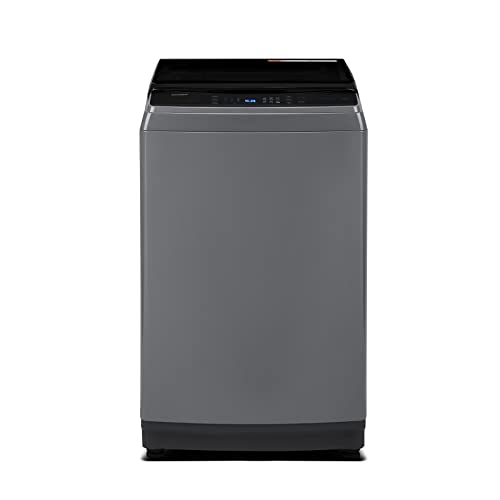
COMFEE Portable Washing Machine 2.4 Cu Ft — Best RV-named all-rounder
The COMFEE earns its place by naming the life directly: its title lists RV alongside dorm and apartment, and builds the machine to match — a 2.4 cu. ft. compact with an LED display and a child lock, finished in magnetic gray. The child lock is the detail that tells you the maker pictured a travelling family rather than a solo nomad, and in a rig where small hands live at appliance height, a locked control panel is not a luxury feature.
Its title also carries an environmentally friendly claim, which this guide repeats as the maker’s wording rather than as a measured fact — on the road, the honest environmental lever is your own load discipline, washing full loads at sensible temperatures. The LED display earns its keep in a dim rig at night, and the 2.4 cu. ft. drum sits in the class’s sweet middle: meaningfully smaller in appetite than the BLACK+DECKER, meaningfully larger in capacity than the twin tubs below. For households that also keep a cottage base, the same middle-path thinking shapes our guide to Best Integrated Washer Dryers, where fitted laundry serves the permanent end of a travelling life.
- Capacity as titled: 2.4 cu. ft. compact drum
- Controls named: LED display and child lock
- Uses named in title: RV, dorm, and apartment, in magnetic gray
- Programmes: the title says eight models — read as its programme count on the listing
- Where to buy: the COMFEE Portable Washing Machine 2.4 Cu Ft listing on Amazon — check price on Amazon
Strengths
- RV use named in the title, with a child lock that suits travelling families.
- A mid-size drum balances water appetite against load capacity better than either extreme.
- An LED display stays readable in a dim rig during evening washes.
Trade-offs
- Smaller than the BLACK+DECKER, so large households will run it more often.
- Its environmental claim is the maker’s wording; your load habits decide the real footprint.
- Spin-dried is not heat-dried — drying space remains part of the laundry plan.
Best for: travelling families wanting an automatic sized for a mid-size rig. A poor fit for: solo travellers who would rather trade automation for the twin tubs’ speed.
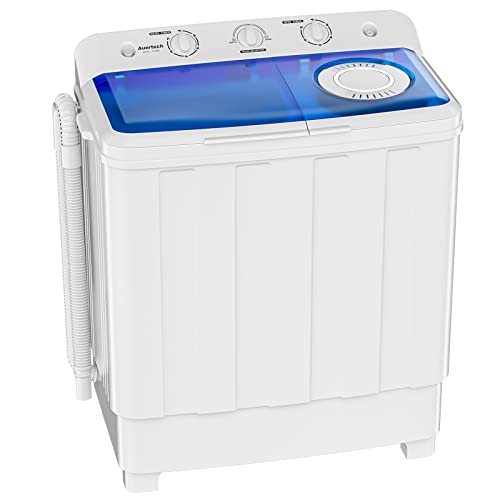
Auertech 28lbs Twin Tub Washer Mini Compact — Best twin-tub capacity
The Auertech leads the twin-tub family on stated numbers: 28 lbs in total, divided as an 18 lb. washer and a 10 lb. spinner, in a semi-automatic mini compact body with a drain pump. Now the sentence this family always carries: the spinner is a centrifugal extractor, not a dryer — clothes leave it damp and ready for the line, not warm and ready for the drawer. Travellers who understand that distinction tend to love twin tubs; travellers who miss it tend to write angry reviews of perfectly good machines.
Why love one? Because the twin-tub rhythm is fast and water-wise. While one load spins, the next can wash, and a morning’s laundry for a small crew finishes in a chain of short cycles that an automatic’s single long programme cannot match. The drain pump is this pick’s road virtue, emptying the tubs into a sink or shower tray without lifting the machine or hunting for a downhill slope. Semi-automatic means you are the programme — filling, timing, transferring — and for many travellers that involvement is the price of the speed, paid gladly.
- Capacity as titled: 28 lbs total — 18 lbs washer, 10 lbs spinner
- Type: twin tub, semi-automatic; the spinner extracts water and does not heat-dry
- Drainage named: drain pump for controlled emptying
- Uses named in title: dorms, apartments, and RVs
- Where to buy: the Auertech 28lbs Twin Tub Washer Mini Compact listing on Amazon — check price on Amazon
Strengths
- The largest twin-tub capacities here, split clearly between wash and spin.
- Overlapping wash and spin cycles make short work of a laundry morning.
- A drain pump frees you from gravity’s demands at awkward campsites.
Trade-offs
- You are the automation: filling, timing, and transferring loads by hand.
- The spinner leaves clothes damp; line-drying space is non-negotiable.
- Smaller spin capacity than wash capacity means spinning in batches.
Best for: hands-on travellers who value speed and water economy over automation. Not the right match for: anyone who wants to press a button and leave laundry entirely alone.
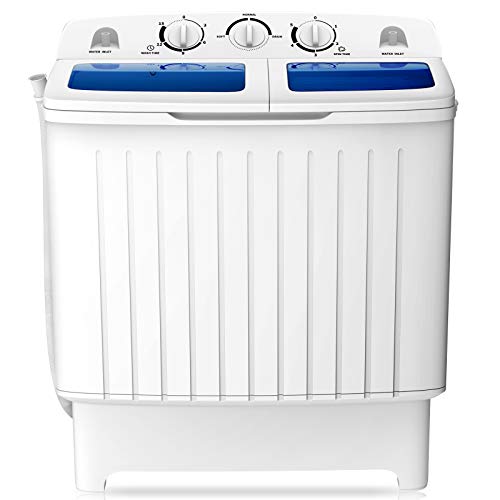
COSTWAY Portable Washing Machine 12Lbs Washer 8Lbs Spinner — Best timer-simple twin tub
The COSTWAY states its arithmetic in its name — a 12 lb. washer and an 8 lb. spinner making a 20 lb. twin tub — and keeps the rest of its title equally plain: durable design, timer control, compact laundry for RVs, apartments, and dorms, in blue and white. The same family truth applies and is repeated without embarrassment: the spinner wrings by centrifugal force, and drying finishes on a line or an airer, not inside this machine.
Timer control is the twin-tub way, and there is a case for its honesty. You learn exactly how long your clothes need, you stop the wash when the water tells you it is done, and no sensor’s opinion stands between you and a clean load. For travellers washing at hookups where water is metered by the tank rather than the tap, that manual economy becomes a genuine skill — loads sorted by soil, wash water judged by eye, spin times set by fabric weight. The COSTWAY’s modest capacities suit a solo traveller or a couple whose wardrobe is built for rotation rather than volume.
- Capacity as titled: 12 lbs washer and 8 lbs spinner, 20 lbs total
- Type: twin tub with timer control; spin extraction only, no heated drying
- Design as titled: durable design in blue and white
- Uses named in title: RVs, apartments, and dorms
- Where to buy: the COSTWAY Portable Washing Machine 12Lbs Washer 8Lbs Spinner listing on Amazon — check price on Amazon
Strengths
- Plainly stated capacities and controls, with nothing to decode.
- Timer control teaches water-wise washing that suits tank-limited travel.
- A compact footprint that suits smaller rigs and seasonal campsites.
Trade-offs
- Manual operation throughout — this machine assists, it does not automate.
- The 8 lb. spinner batches behind the 12 lb. washer on full loads.
- Clothes leave damp; drying depends on weather, line space, or a campsite’s facilities.
Best for: solo travellers and couples washing small, often, and by hand-guided timer. Poorly suited to: families hoping to clear a week’s laundry unattended.
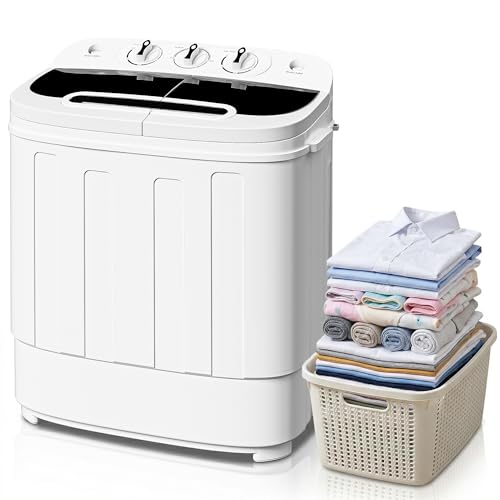
SUPER DEAL Compact Mini Twin Tub Washing Machine 13lbs — Best camping-weight twin tub
The SUPER DEAL is the smallest twin tub here at a stated 13 lbs total capacity, and its title aims it squarely at the road: camping, apartments, dorms, college, RVs, and small spaces, with a built-in gravity drain. The family sentence, third verse: its spin cycle extracts water by spinning, clothes come out damp, and no heated drying hides inside this compact body — plan the line, the airer, or the campsite’s facilities accordingly.
A gravity drain defines this pick’s campsite manners. The machine must sit above its drain point — on a stand, a step, or the edge of a shower tray — so water can run downhill out of it. Where that arrangement is easy, the SUPER DEAL is the simplest machine in this guide: no pump to power, no programme to learn, just wash, spin, drain, and hang. Where it is not easy, the Auertech’s pump earns its premium in convenience. Knowing which campsite you actually camp at, rather than the one you imagine, decides between them more honestly than any feature list.
- Capacity as titled: 13 lbs total, wash and spin cycle combo
- Type: compact mini twin tub; the spin cycle extracts water without heat
- Drainage named: built-in gravity drain — the machine must sit above the drain point
- Uses named in title: camping, apartments, dorms, college, RVs, small spaces
- Where to buy: the SUPER DEAL Compact Mini Twin Tub Washing Machine 13lbs listing on Amazon — check price on Amazon
Strengths
- The smallest, simplest twin tub here, easy to stow between laundry days.
- A gravity drain means fewer powered parts to manage off-grid.
- Camping named first among its uses, and the design honours the billing.
Trade-offs
- Thirteen pounds total asks for small, frequent loads.
- Gravity drainage needs a raised perch and a downhill path every wash day.
- Fully manual rhythm — wash, transfer, spin, hang — with no automation to delegate to.
Best for: campers and van travellers washing light loads with simple kit. A weak match for: anyone whose pitch offers nowhere to raise the machine for draining.

Winado 15.6LBS Full Automatic Portable Washer — Best automatic with a steel drum
The Winado closes the list by combining the automatic family’s convenience with a stated stainless steel drum and the longest programme menu here: ten wash programmes in a 15.6 lb. full-automatic body with a drain pump. Its title pairs the words washer and spin dryer, and this guide’s precision matters one last time: the drying here is spin drying — high-speed extraction that leaves clothes ready for the line quickly — inside the same drum, with no separate heated tumble involved.
A steel drum is worth its mention in a travelling machine, because drums in rigs endure vibration from two directions — the wash cycle’s and the road’s — and stainless steel shrugs at both while staying smooth against fabrics. Ten programmes suit a wardrobe that mixes trail gear, delicates, and ordinary cotton in one small closet. And the drain pump returns as the road-friendly detail it was in the Auertech: emptying where you choose, not where gravity permits. Travellers furnishing a home base between seasons will find the same programme-rich thinking, at house scale, behind the chairs-and-laundry comforts in Best Oversized Leather Chairs — different rooms, same philosophy of buying once for the life you actually live.
- Capacity as titled: 15.6 lbs, full-automatic portable washer
- Drum and programmes: stainless steel drum, ten wash programmes
- Drainage named: drain pump
- Drying as titled: spin drying in the drum — extraction, not heated tumble drying
- Where to buy: the Winado 15.6LBS Full Automatic Portable Washer listing on Amazon — check price on Amazon
Strengths
- Full automation with the widest programme choice in this guide.
- A stainless steel drum built for both wash-day and road-day vibration.
- A drain pump that empties on your terms at any pitch.
Trade-offs
- Fifteen-odd pounds of capacity serves light wardrobes, not family laundry days.
- Ten programmes is more menu than simple travellers will ever open.
- Spin-dried clothes still need air and line time before the drawer.
Best for: travellers wanting automatic washing and programme variety in a compact drum. Not suited for: campers who prefer the twin tubs’ manual water economy.
Experienced travellers keep one more habit that never appears in a listing: they wash before the wardrobe is desperate. A portable run at leisure, with a half-full laundry bag and a sunny afternoon available, is a pleasant interlude; the same machine run at crisis point, with every garment spoken for and rain arriving, is a small emergency with a motor. The machine does not change between those scenes — the planning does — and the whole of this guide, from its capacities to its drainage details, is really an argument for the leisurely version.
How Much Water and Power Does Laundry on the Road Really Take?
Think in loads, not in machine specifications. Every load you run spends tank water twice in spirit — once washing, once rinsing — and spends battery or hookup power on the motor and, in automatics, on the programme’s full duration. The twin tubs spend less water per garment when run in chains, because their wash water can serve successive lightly soiled loads under your judgement; the automatics spend predictability instead, metering each load the same way regardless of your attention. Neither is virtuous in itself; the virtue is matching the machine to the resource you actually carry.
Practical discipline shrinks both budgets. Wash full loads rather than frequent small ones, since a half load spends nearly a whole load’s water on half the clothes. Time laundry for hookup days when the rig is connected, and let tank days be for travelling. Spin thoroughly — extraction is the cheapest drying there is, because every drop the spinner removes is a drop the line, the airer, or the campsite’s dryer never has to handle. Travellers who internalise those three habits find any pick in this guide affordable to run; travellers who do not will find even the smallest machine extravagant.
What Wardrobe Choices Make RV Laundry Easier Before Any Machine Is Bought?
The travellers with the easiest laundry days chose their clothes before they chose their washer. Fabrics that wash quickly, rinse cleanly, and dry overnight on a line — merino, synthetics, thin cottons — turn any pick in this guide into a capacious one, while heavy denim, thick fleece, and structured garments consume a portable’s capacity and a line’s patience out of all proportion to their number. A wardrobe audited for washability is worth several pounds of machine capacity, and it costs nothing but honesty at the packing stage.
Colour discipline helps the small-load life as well. A travelling wardrobe built from colours that can share a wash — the deep and the neutral travelling together without incident — fills loads efficiently instead of stranding single bright garments in their own expensive cycles. Two or three such shared palettes, rotated, cover a season’s appearances while keeping every load full and every tank respected. Laundromat travellers learned this arithmetic decades ago; portable owners simply practise it with better scenery.
Bedding and towels remain the honest exception, and planning for them at facilities — as the routine section suggests — is not a defeat but a division of labour. The portable owns the wardrobe, the facility owns the duvet, and the traveller owns a system with no weak point. Every durable road routine has that shape: each job given to the tool that does it gladly, and no tool resented for the jobs it was never built to do.
Where Does a Portable Washer Live in a Moving Vehicle?
The honest answer is: somewhere it can be level, secured, and within reach of water and a drain. Shower stalls are the classic RV laundry room, because they solve drainage and splashes at once and return to shower duty in minutes. Storage bays with a water point suit larger rigs. A galley corner suits long stays, when the machine earns a semi-permanent home and the quick-connect adapter stays attached. What every location shares is the need to travel secured — a washer that walks across a bay at highway speed arrives as parts, not as an appliance.
Levelling matters more than travellers expect. A portable washer standing out of level vibrates, walks, and spins unevenly, and in a rig the vibration travels through the whole structure to announce itself in every cupboard. Set the machine on a firm, flat surface, adjust its feet if it has them, and run the first spin with a hand nearby. Five minutes of levelling buys years of quiet laundry, in a vehicle where quiet is a structural feature, not a luxury.
How Do You Build a Laundry Routine That Survives a Whole Season?
Anchor the routine to the road’s own rhythm. Most travellers settle into a pattern of small washes at hookups and one larger laundry session at a facility every week or two for bedding and towels — the loads portable machines honestly cannot serve. The portable handles the wardrobe’s daily rotation, which is most of laundry’s frequency and nearly all of its urgency. A routine that assigns each load to the machine that suits it never feels like deprivation; a routine that asks a 13 lb. twin tub to wash a duvet feels like a feud.
Sort by the road’s categories rather than the house’s. Trail clothes, town clothes, and sleeping clothes wash on different urgencies and soil levels, and the twin tubs reward the sorting by letting wash water serve the cleaner loads first. Keep a small laundry kit with the machine — measured detergent doses, a mesh bag for small items, a short line and pegs that live in the same bay — because a routine whose tools are gathered is a routine that happens, while one that requires a scavenger hunt happens only when the wardrobe runs out.
Review the routine at each season’s turn. Routes change water availability, climates change drying, and travelling companions change the wardrobe’s size. The machine that suited a solo desert winter may strain under a coastal summer with a partner aboard, and noticing that early — while the answer is a different pick from this guide rather than a resentment — is the difference between travellers who adapt and travellers who endure.
What Should You Check Before the First Wash in a New Rig?
Run the machine empty, or with a sacrificial old towel, before trusting it with clothes you care about. The trial run teaches you the fill arrangement’s quirks, the drain’s behaviour, the spin’s vibration on your rig’s floor, and the programme or timer’s real duration — every fact you will want at leisure rather than mid-load with the tank gauge watching. Note how much water the trial used, by the tank gauge’s movement, and write the number where the machine lives; that single measured figure plans future laundry better than any specification.
Check the electrical side with the same care. Portable washers draw modest power by house standards and meaningful power by battery standards, and the trial run on your actual supply — hookup, generator, or inverter — tells you which laundry days are which. Listen for the inverter’s complaint, watch the battery monitor through a full cycle, and learn whether the machine and the kettle can share an hour. These are five-minute experiments with permanent value.
Finally, rehearse the stow. A portable washer earns its name twice — once in the wash and once in the packing — and the traveller who knows exactly where it rides, how it is secured, and how its hoses drain dry before stowing will still own a working machine in year three. Water left in hoses and tubs is the quiet enemy: it smells, it freezes, it grows. Drain everything, dry what you can, and let the machine travel as clean as the clothes it produces.
How Do You Dry Clothes Well When No Machine in This Guide Heats Air?
By treating extraction and air as a two-stage craft. Stage one happens in the drum or spinner: spin in batches the spinner can balance, spin twice for heavy cottons, and shake each garment out as it leaves the spin, because a garment shaken flat dries faster and softer than one hung in its spin-shaped wrinkles. Towels and denim reward the longest spins; delicates reward gentleness over dryness, since their drying finishes quickly in air regardless.
Stage two is the line, and the road offers it in more places than new travellers expect: an awning’s edge, a line between trees at a permitted pitch, a folding airer in the shower stall with the vent fan running, or the rig’s own ladder rack on a still day. Sequence the wash so drying starts in the morning’s moving air rather than the evening’s damp, and bring the last loads in before dewfall. In wet climates, the campsite’s facilities or a laundromat’s dryers take the heavy loads without shame — the portable’s job is the wardrobe’s rotation, not a vow of self-sufficiency.
The payoff for learning this craft is a wardrobe that lasts longer. Heat drying is hard on elastic, prints, and technical fabrics, and travellers who line-dry by necessity discover their clothes outlasting their house-bound friends’ identical garments. The twin tub’s damp output, mourned by the unprepared as a missing feature, is in that light the gentlest drying system on the road — it simply asks you to provide the weather.
Common Mistakes When Washing on the Road
The first mistake is believing a spinner is a dryer — the error this guide has flagged in every twin-tub review, because it ruins more laundry plans than any other. The second is overloading: portable capacities are stated plainly in these titles, and a drum stuffed past them cleans badly, spins worse, and strains every moving part. The third is ignoring the drain until the machine is full of water, at which point gravity and hose lengths become urgent tutors.
Fourth, travellers wash on tank water the night before a dry stretch, spending tomorrow’s drinking and cooking reserve on today’s shirts. Fifth, detergent dosing follows house habits, and a portable’s small drum concentrates the error into suds that rinse poorly and leave clothes stiff. Small machines want small doses. Each mistake is a planning failure rather than a machine failure — which is the encouraging news, because planning is free and improves with every trip.
What Does a Laundry Day Look Like at Three Kinds of Pitch?
At a full-hookup site, laundry is a pleasure disguised as a chore. The machine sits level by the rig, fills from the tap without arithmetic, drains without apology, and the line goes up between the awning arms while the kettle heats. This is the day for the week’s accumulated wash, run in chains or programmes while the travellers do nothing more strenuous than supervise with a book. Every pick in this guide is happy here; the differences between them all but vanish when water and power are unlimited.
At a water-and-electric pitch without a sewer connection, the grey tank becomes the budget. Laundry still runs, but it runs counted — loads chosen, rinse water respected, the drain hose routed to the tank rather than the ground, and the day’s total kept inside the tank’s patience. The twin tubs shine in this arithmetic because their water is visible and judged by eye; the automatics serve travellers who have learned their machines’ per-load appetite from the trial-run measurement and plan the tank around it.
Off-grid, laundry becomes an expedition of timing: a sunny midday, a water source the site permits, the smallest honest loads, and drying that starts the moment the spin stops. Some travellers decide, reasonably, that off-grid days are for travelling and hookup days are for washing, and their machines live stowed for the wild stretches. That is not a failure of the portable idea — it is the portable idea working as intended, a machine that serves when conditions suit and waits quietly when they do not.
How Do You Choose Between This Guide’s Picks With a Tape and a Tank Gauge?
Measure the space the machine may occupy — in the shower, the bay, or the galley — and write down all three dimensions, because portables are bought by capacity and returned by footprint. Then read your tank gauge’s story: the fresh capacity you actually carry between fills, minus drinking, cooking, and showers, is the laundry budget every load will draw against. A machine whose appetite fits that remainder, at the load frequency your wardrobe demands, is the right machine; a larger one is a promise to visit laundromats with a washer in the bay.
Then be honest about your hands. The automatics ask for none and the twin tubs ask for twenty minutes of pleasant involvement per laundry session, and travellers differ in which they would rather spend — there is no maturity ranking between the answers. The road is long, the laundry is weekly, and the machine that matches its owner’s temperament is the one still being used, willingly, in the third season. Choose that one, from whichever family it comes, and the choice will keep proving itself at every pitch.
Final Recommendation
Choose the BLACK+DECKER if your rig and your stays are large enough for laundry that feels like home, the COMFEE if a travelling family wants an automatic sized for the middle of the road, and the Winado if programme variety in a steel drum appeals. Choose the Auertech if twin-tub speed with a drain pump suits your hands-on rhythm, the COSTWAY for timer-simple economy, and the SUPER DEAL if your camping is light, simple, and gravity-friendly. Whichever family you join, spin hard, dry on the line, and let the road’s small laundries become one of its quiet pleasures — clean clothes, earned economically, in a machine that asked only for the space it truly needed.
Which Pick Suits Which Traveller? Five Road Portraits
The full-timing couple in a mid-size rig, parked by the month, are the BLACK+DECKER’s people: their laundry should feel like a utility room’s, their stays justify the water, and the included sink adapter will live permanently attached. The family roaming a school holiday in a compact caravan belong to the COMFEE — its child lock was designed for their evenings, and its mid-size drum matches a wardrobe of small clothes washed often.
The solo long-haul traveller who counts every litre is the Auertech’s natural owner, chaining twin-tub cycles at a hookup tap and spinning the week’s wardrobe dry-ish in an hour of pleasant, practised motion. The weekend camper with a small van and a smaller wardrobe belongs to the SUPER DEAL, provided the pitch offers a step or a stand for its gravity drain. And the Winado traveller is the one who wants the road to feel automated — ten programmes, a steel drum, a pump — in a rig that splits its year between sites and a home driveway.
The COSTWAY’s portrait is the budget-wise beginner: a first portable, plainly specified, bought to learn the twin-tub craft before deciding whether the road life is permanent. There is wisdom in that order. Portable laundry is a skill as much as a purchase, and the machine that teaches it cheaply and honestly has launched more happy full-timers than any flagship — because the travellers who learn on simple kit know exactly which conveniences they are paying for when they upgrade.
How Do You Keep a Portable Washer Healthy Across Miles and Seasons?
Rinse and dry after the last wash of a stay, not before the first wash of the next one. Detergent residue and standing water are the two slow poisons of portable machines, and both are defeated by the same five minutes: a clean-water rinse cycle or tub wipe, a spin with the tubs empty, lids left open to the air, and hoses drained along their full length. In freezing travel, that drainage is not hygiene but survival — water left in a pump or hose expands into repairs.
Travel the machine empty, secured, and upright where its design expects upright, with its hoses coiled inside the tub rather than trailing in the bay. Check its feet and level at each long stay, since a machine that walked an inch during a mountain descent will wash out of level until somebody notices. Wipe the exterior, clear any lint the cycle leaves behind, and run an occasional empty hot wash where the machine allows it, to keep the hidden waterways as honest as the visible ones.
Keep the manual with the rig’s other appliance papers and note the model number where a parts search can find it in one minute. Portable machines are simple, long-lived devices when their few moving parts are respected — motors, pumps, timers, belts — and the travellers still washing with a five-year-old twin tub are, without exception, the ones who drained it, dried it, and never once asked it to spin a load it could not balance.
Frequently Asked Questions
Do twin-tub washers dry clothes?
No — they spin them. A twin tub’s second tub extracts water by centrifugal force, leaving clothes damp and ready for line drying. No pick in the twin-tub family offers heated tumble drying, and each review in this guide states that plainly so your laundry planning rests on fact.
Which is better for an RV, an automatic or a twin tub?
Automatics trade your attention for their longer programmes; twin tubs trade your hands for speed and water economy. Rig size, tank capacity, and temperament decide. Larger rigs and longer stays favour the automatics here; small rigs and off-grid travel favour the twin tubs.
How do these washers fill and empty?
By the arrangements their titles state: the BLACK+DECKER includes a quick-connect sink adapter and drain hose, the Auertech and Winado carry drain pumps, and the SUPER DEAL uses a built-in gravity drain that needs the machine raised above its drain point. Check your rig’s taps and drain options against the pick you favour.
What about permanently installed RV washer-dryer combos?
They exist as a separate class — plumbed, vented units of the Splendide type — and were covered in an earlier round of our laundry guides. They suit full-timers with a dedicated laundry bay. This guide’s portable picks serve travellers who need laundry that can move, stow, and adapt.
How loud are these machines inside a rig?
A washing portable is a modest sound; a spinning one, unbalanced, is a memorable one. Level the machine, balance the load, and the spin settles into a hum the rig’s structure carries mildly. Judge the sound in your own vehicle during the trial run — a machine that is quiet in a showroom can sing through a particular floor, and the first week is when placement can still change.
Is a portable washer worth it for weekend trips?
For most weekenders, honestly, no — a laundry bag home serves a two-night trip better than any machine. The portable’s case builds with trip length: a week aboard starts to justify it, a month makes it obvious, and a season makes it indispensable. Buy for the trips you actually take, and let the weekend wardrobe travel home in the bag it came in.
Where should grey water from laundry go?
Where the site says it should — into the rig’s grey tank or the pitch’s designated drain, never onto open ground where rules or courtesy forbid it. Laundry water is grey water with detergent in it, and sites vary from full sewer hookups to strict carry-out policies. Ask when you arrive, route the hose accordingly, and treat the answer as part of the pitch’s hospitality rather than as bureaucracy.
Can a portable washer handle jeans and towels?
Singles and small numbers, yes; a wardrobe’s worth at once, no. One pair of jeans in a twin tub’s wash side, spun in a balanced batch, comes out well; three pairs defeat the capacity the title states and clean poorly for their trouble. Towels behave the same way — a couple per load, spun hard, dried on the line. Travellers who respect the arithmetic find portables surprisingly capable; travellers who test it find its limits exactly where the titles printed them.
What should I do if the machine vibrates or walks during the spin?
Stop the cycle, redistribute the load evenly around the tub, and check the machine’s level before restarting — an unbalanced spin is the portable’s way of reporting both problems at once. Heavy items washed singly are the usual culprits; pair a towel-heavy load across the drum or add a balancing garment. Persistent walking on a level floor with balanced loads deserves a look at the feet and the surface beneath them before the next wash day.
How do I wash in cold weather or at altitude?
Cold slows everything laundry touches: water arrives colder, drying takes longer, and frozen hoses end arguments quickly. Wash on the day’s warm side, dry in whatever sun and moving air the pitch offers, and drain the machine completely when nights freeze. At altitude, the washing itself changes little, but drying in thin, dry air can be surprisingly swift — travellers often find mountain laundry easier than coastal laundry, where damp air refuses the line’s best efforts.
Can I run a portable washer from solar and batteries?
Many travellers do, by treating laundry as a midday, full-sun activity and choosing loads the system can finish without draining the bank. The trial-run advice in this guide applies doubly off-grid: measure one full cycle against your battery monitor before committing a laundry day to it, prefer the twin tubs’ short manual cycles when power is tight, and let hookup days carry the automatics’ longer programmes.
What detergent suits a portable washer in an RV?
Small doses of a low-sudsing detergent suit small drums, and travellers who decant into a measured bottle dose more honestly than those who pour from a family-size container by eye. Where your route disposes of grey water matters too — follow each site’s rules, and where biodegradable products are required or courteous, choose them. The machine cares about dose; the landscape cares about chemistry.
How much laundry fits in a 15 to 28 lb. portable?
Think in outfits rather than household loads: several days of one traveller’s clothes, or a couple’s lighter rotation, per load at the larger twin-tub capacities — less at the compact end. Capacities here are stated in the titles’ own units and never converted, so compare like with like when you shortlist.
And photograph the setup that works — machine placed, hoses routed, line rigged — the first time a pitch’s arrangement comes together perfectly. Recreating a proven arrangement from a photograph takes two minutes at the next site; reinventing it from memory takes twenty and a little weather. Road craft is mostly this: noticing what worked, once, and refusing to make yourself invent it twice.
Keep a small card with the machine — its model, its measured water use from your trial run, and the load sizes that worked — taped inside the bay or cupboard where it lives. Travelling knowledge evaporates between seasons, and the card turns next spring’s first laundry day into a continuation rather than a rediscovery. The travellers who look effortlessly organised at the wash point are rarely more talented than anyone else; they are simply the ones who wrote things down while the lesson was fresh.
Related Guides
Travellers talk about their machines the way sailors talk about anchors — with the loyalty of people whose comfort has depended on an unglamorous object in unglamorous weather. That loyalty is earned at the level this guide has insisted on throughout: capacities that matched the titles, drains that behaved as described, and no spinner anywhere pretending to be a dryer. Choose the pick whose printed promises match your road, hold it to those promises kindly and exactly, and it will join the short list of equipment you would not travel without.
One closing thought for travellers still weighing whether a portable belongs aboard at all: count the laundromat hours of your last long trip, honestly, including the driving, the waiting, and the evenings reorganised around other people’s dryers. For most full-season travellers that count settles the question in a single sum, and the machine that replaces those hours — at any of this guide’s sizes, in either of its families — pays its space rent in reclaimed afternoons long before it pays it in clean shirts.
Portable laundry is a wider family than the road alone, and readers comparing stationary compact options should read Best Portable Washing Machines and Compact Washers, where the same capacity honesty is applied to apartment and dorm machines.



[…] mobile life around those story times may also appreciate the practical capacity checks in Best RV Washers, where small-space claims are verified with the same title-bound […]