Our Top Picks
 AQQA 320 GPH Aquarium Canister Filter320GPH for Up to 100 Gallon Tank7.5 x 7.5 x 15.5 inchesCheck on Amazon
 Marineland Magniflow 400 GPH Canister Aquarium FilterUp to 100-Gallons11 x 11 x 18 inchesCheck on Amazon
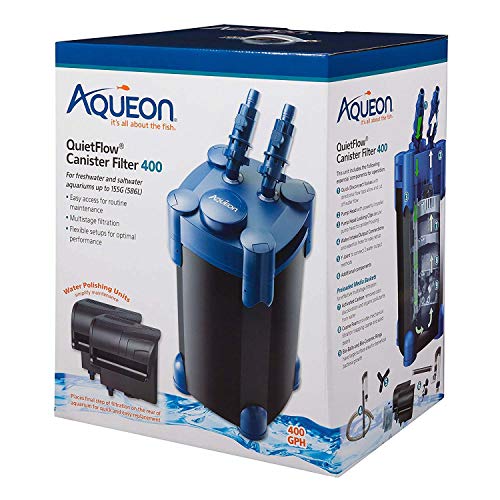 Aqueon QuietFlow Canister Aquarium Filter 100-150 Gallons100-150 Gallons8.5 x 8.5 x 20.5 inches19.45 poundsCheck on Amazon

What's inside
- Why a canister filter suits a 100 gallon aquarium
- Direct match or oversize: choosing your size strategy
- The eight filters at a glance
- How the three filtration stages work together
- Plumbing a 100 gallon tank: intake, return, and hose runs
- Maintenance rhythm for a large canister
- Questions keepers ask about 100 gallon canister filters
- Check prices on Amazon
- A final word before you buy
As an Amazon Associate I earn from qualifying purchases. This post may contain affiliate links at no extra cost to you.
A 100 gallon aquarium is a wonderful size to live with and a demanding size to filter. It is large enough for a real community of fish, a planted display with depth, or a group of larger species that would crowd a smaller tank, yet it is still a single system that most homes can support on one strong stand. That scale changes the filtration conversation completely. A small hang-on-back unit that copes on a modest tank will struggle here, not because the idea is wrong, but because the water volume, the waste load, and the distance the water has to travel all grow at once. A canister filter answers that problem neatly. It sits below or beside the tank, moves a large volume of water through a sealed body filled with media, and returns polished water through a spray bar or outlet that can be positioned where the tank needs movement most.
This guide covers eight canister filters that fit a 100 gallon aquarium in two sensible ways. Some are rated in their full product titles for tanks up to 100 gallons, which makes them a direct match for a typical stocking plan. Others are rated for 100 to 150 gallons or up to 175 gallons, which makes them an oversize choice for a heavily stocked tank, a tank with messy eaters, or a keeper who simply wants more media capacity and more reserve than a direct-match model provides. Both approaches are legitimate. The right one depends on your fish, your plants, your tolerance for maintenance, and the space inside your cabinet.
The eight models are the Fluval 407 Performance Canister Filter for Aquariums Up to 100 Gallons, the Penn-Plax Cascade Pro Series III Canister Filter 350 GPH Up To 100 Gallons, the Penn-Plax Cascade 1000 Canister Filter at 265 GPH for tanks up to 100 gallons, the AQQA 320 GPH Aquarium Canister Filter with 3 stage filtration for tanks up to 100 gallons, the Marineland Magniflow 400 GPH Canister Aquarium Filter for aquariums up to 100 gallons, the Aqueon QuietFlow Canister Aquarium Filter for 100-150 gallon tanks at 400 GPH, the fishkeeper 390GPH Canister Filter with 3-stage filtration for tanks up to 100 gallons, and the Fluval FX2 High Performance Canister Aquarium Filter for tanks up to 175 gallons. Every flow figure, gallon range, and media detail in the product sections below comes from those full titles, so you can compare like with like without guessing.
Why a canister filter suits a 100 gallon aquarium
The first advantage is media volume. Filtration is not really about a box that makes water look clear for a day. It is about giving beneficial bacteria a large, stable home, trapping solid waste before it breaks down, and, where you choose to use it, giving chemical media room to work. A canister body holds far more media than most filters that hang on the rim, and it holds that media in a forced path. Water cannot easily bypass the stack and sneak back to the tank untreated, because the sealed design pushes it through each stage in order. On a 100 gallon system, where a missed week of care shows up faster in a crowded tank, that capacity is a genuine safety margin.
The second advantage is a cleaner display. The main unit lives out of sight in the cabinet, and only the intake, the return, and their tubing enter the tank area. For a planted aquascape or a living-room show tank, that matters. Heaters and other equipment still need planning, but removing a large filter body from the back glass opens the view and makes lighting and lids easier to arrange. The third advantage is flexibility. Canister media baskets or trays can usually be arranged with a mix of mechanical, biological, and chemical media that suits your water and your stock, rather than a single fixed cartridge that you replace on a rigid schedule.
There are trade-offs, and a good guide should name them. A canister takes longer to open, clean, and restart than a small filter. It has hoses, valves, seals, and a lid that must be seated correctly. It also holds a meaningful volume of water below tank level, so careful setup and leak prevention matter. None of that should put you off. It simply means the best model for you is the one whose priming method, valve layout, and media arrangement you will actually maintain on a regular rhythm, because a filter that is cleaned on time outperforms a larger filter that is avoided for months.
Direct match or oversize: choosing your size strategy
Models rated up to 100 gallons are the straightforward choice for a normally stocked 100 gallon tank. That group in this guide includes the Fluval 407, both Penn-Plax Cascade models, the AQQA 320 GPH, the Marineland Magniflow, and the fishkeeper 390GPH. If your tank holds a moderate community, a planted display with a sensible fish load, or a species group that does not produce unusual waste, a direct-match canister with a healthy flow figure and a sensible media stack is a sound, proportionate answer. It also tends to fit a cabinet more easily and keeps the plumbing simple.
Oversize models earn their place when the tank asks more of the filter than the gallon number alone suggests. Goldfish-style waste loads, large cichlid-type appetites, turtle-adjacent mess in a fish-only setup, dense stocking, heavy feeding for growing fish, and a keeper preference for longer intervals between deep cleans all push in the same direction. The Aqueon QuietFlow, rated for 100-150 gallon tanks with 400 GPH in its title, is the middle step up. The Fluval FX2, rated for tanks up to 175 gallons, is the largest step in this group and adds a built-in powered water change system according to its title. Oversizing does not mean blasting the fish with current. It means more media, more reserve, and flow that can be directed, diffused with a spray bar, or softened by placement so the tank gets circulation without a permanent storm in one corner.
Flow figures deserve a calm reading. The titles in this guide list 265 GPH for the Cascade 1000, 320 GPH for the AQQA, 350 GPH for the Cascade Pro Series III, 390 GPH for the fishkeeper, and 400 GPH for both the Marineland Magniflow and the Aqueon QuietFlow. Those are the figures to compare, and they are title figures rather than a promise of what you will measure after media, hoses, and head height have their say. In real use, packed media and a rise from cabinet to rim always reduce what reaches the tank. That is another reason an apparently generous figure on paper can feel just right once the filter is installed and settled.
The eight filters at a glance
Fluval 407 Performance Canister Filter for Aquariums Up to 100 Gallons
The full title for this model is Fluval 407 Performance Canister Filter for Aquariums Up to 100 Gallons, with ultra-quiet operation and eTEC technology also named in the title. It is a direct match for a 100 gallon tank, and its appeal starts with that simple fit. A keeper who wants a recognised performance line, a rating that lands exactly on the tank size, and a design emphasis on quiet running will put this model near the top of a shortlist for a living room, a bedroom-adjacent tank, or an open-plan space where a constant hum would become the most memorable feature of the aquarium.
Quiet matters more on a large tank than many first-time buyers expect, because the filter runs all day and all night. Ultra-quiet operation in the title signals where the design effort has gone, and eTEC technology is the other headline the title gives. Beyond those points, the sensible way to judge the 407 for your setup is by the ordinary canister questions. Will it fit your cabinet with room to lift the lid and work on the media stack? Can you route the hoses without sharp bends? Does the priming routine suit you? A direct-match model that you can service comfortably will serve a 100 gallon tank well for years, and this one is built around exactly that brief.
Penn-Plax Cascade Pro Series III Canister Filter 350 GPH Up To 100 Gallons
The full title is Penn-Plax Cascade Pro Series III Canister Filter 350 Gph Up To 100 Gallons, described as the upgraded version of Cascade with a push-and-pull primer and preloaded media, including ceramic rings and bio-blocks. That title tells a helpful story. The 350 GPH figure places it comfortably in the middle of this group on flow, the up to 100 gallons rating makes it a direct match, and the preloaded media means the box arrives with a biological foundation already chosen for you. Ceramic rings and bio-blocks are classic biological media shapes, offering surface area for bacteria in forms that stack into a basket without collapsing into a solid lump.
The push-and-pull primer is the other practical headline. Priming is the step that fills the canister and hoses with water so the pump can move water instead of air, and it is the step new canister owners find least intuitive. A primer you push and pull to draw water through gives you a physical, repeatable way to start the siphon before you switch on. For a keeper who has wrestled an older filter into life by awkward filling and tilting, that detail alone can justify a place on the shortlist. As an upgraded version of an established line, this model also suits a buyer who likes a familiar family of products with a refreshed feature set.
Penn-Plax Cascade 1000 Canister Filter, 265 GPH, for tanks up to 100 gallons
The full title is Penn-Plax Cascade 1000 Canister Filter – 265 GPH Aquarium Filter for Tanks Up to 100 Gallons – 360 Degree Flow Valves, Poly Fiber Pads, Bio-Sponge and Activated Carbon – Fresh and Saltwater – 11.5x10x17in. This is the most specification-rich title in the group, and it rewards a careful read. The 265 GPH figure is the lowest flow number here, which makes this model a candidate for a 100 gallon tank where gentler movement is welcome, such as a planted display or a community of fish that dislike strong current, rather than a tank that needs forceful turnover. The stated dimensions, 11.5 by 10 by 17 inches, are unusually helpful, because cabinet fit is a real constraint and a title that gives you the footprint and height saves a round of measuring and hoping.
The media named in the title covers all three familiar jobs. Poly fiber pads handle mechanical trapping, bio-sponge supports biological filtration while also catching solids, and activated carbon provides chemical filtration for keepers who use it to polish water or remove unwanted compounds after treatment. The 360 degree flow valves suggest flexibility in how the hoses leave the unit, which can make routing inside a crowded stand much easier. Fresh and saltwater suitability in the title also widens its use if your plans change over time. For a buyer who values a fully described package over a headline flow number, the Cascade 1000 makes a clear case.
AQQA 320 GPH Aquarium Canister Filter, 3 stage filtration, up to 100 gallons
The full title is AQQA 320 GPH Aquarium Canister Filter, 3 Stage Filtration Fish Tank Filter, up to 100 Gallons, with push-button priming, dual flow control valves, and DIY filter media baskets, for freshwater and saltwater. Three ideas stand out. First, push-button priming is the simplest priming story in this guide: press, and the filling process is assisted rather than wrestled. If the filter lives deep in a cabinet and you clean it often, that convenience compounds. Second, dual flow control valves give you authority over the water movement, which helps when a direct-match filter needs softening for plants or particular fish, or when you want to slow things briefly during feeding or maintenance. Third, the DIY filter media baskets invite you to build the stack your tank actually needs instead of accepting a fixed arrangement.
The 320 GPH figure and the up to 100 gallons rating place it squarely in direct-match territory, and the explicit freshwater and saltwater wording keeps it flexible. The DIY basket idea deserves a moment of thought. A keeper who enjoys tuning a system, perhaps coarse sponge first, then biological media, then a fine polishing layer, will appreciate being able to arrange that order deliberately. A keeper who prefers everything decided in advance may lean toward a preloaded model instead. Neither instinct is wrong. This filter is aimed at the first kind of keeper, and it is honest about it in its own title.
Marineland Magniflow 400 GPH Canister Aquarium Filter, up to 100 gallons
The full title is Marineland Magniflow 400 GPH Canister Aquarium Filter, for aquariums up to 100 Gallons, described as an internal canister fish tank filter with 3-stage filtration, for freshwater and saltwater aquariums. The headline is flow. At 400 GPH it shares the highest title figure in this group, while still carrying a direct up to 100 gallons rating rather than an oversize one. That combination suits a 100 gallon tank that needs confident turnover in a single unit: a busy community, a tank with a lot of hardscape that creates dead corners, or a setup where the return has to push water a long way across a wide display.
The 3-stage filtration wording confirms the familiar mechanical, biological, and chemical progression is the design intent, and the freshwater and saltwater wording keeps the model in play for both kinds of keeper. With a higher flow figure, placement of the return matters. A spray bar along the back glass spreads the output, an outlet aimed along the surface creates broad movement, and plants or hardscape can break up a stream that feels too direct for shy fish. In other words, the Magniflow gives you movement to work with, and the aquascape decides how gentle or lively that movement feels in practice.
Aqueon QuietFlow Canister Aquarium Filter, 100-150 gallons, 400 GPH
The full title is Aqueon QuietFlow Canister Aquarium Filter 100-150 Gallons, a 100-150 gallon fish tank canister filter with biological, chemical and mechanical stages, a spray bar, and 400 GPH. This is the clearest oversize step in the guide that still keeps a 100 gallon tank inside its stated range at the bottom end. If your 100 gallon aquarium is generously stocked, or if you simply prefer buying filtration with headroom so the unit is never working at its limit, this rating band is exactly the one to look at. The 400 GPH figure matches the strongest direct-match model here, and the stated stages are listed in full, which makes the media conversation straightforward.
The included spray bar in the title is a small detail with an outsized effect. A spray bar spreads return water across a series of holes, evening out flow, helping surface movement, and reducing the single jet effect that can dig into substrate or push floating plants into one corner. For a wide 100 gallon display, even distribution is often the difference between a tank that looks calm and polished and a tank where debris collects in the same neglected corner every week. The QuietFlow name also signals an emphasis on running sound, which, as with the Fluval 407, matters in rooms where people sit, work, or sleep near the tank.
fishkeeper 390GPH Canister Filter, 3-stage filtration, up to 100 gallons
The full title is fishkeeper 390GPH Canister Filter, 3-Stage Filtration Aquarium Filter, with quartz balls and filter cotton, an ultra-quiet external aquarium canister filter for freshwater and saltwater up to 100Gal, at 25W. This title is refreshingly specific about media. Quartz balls are a biological medium, giving bacteria a durable surface to colonise, and filter cotton is a fine mechanical layer that traps small particles and polishes the water as it passes. Knowing those two are part of the package tells you the intended stack without any guesswork, and it suits a keeper who wants fine final polishing for a clear display.
The 390 GPH figure sits just below the two 400 GPH models, so on title flow this is one of the stronger direct-match options. Ultra-quiet wording appears again, which keeps it in contention for living spaces, and the freshwater and saltwater wording covers both uses. The 25W figure in the title is the stated power draw, useful when you are adding up what a large tank system asks of a socket strip alongside lighting, heating, and other equipment. Fine filter cotton does its polishing job by trapping what coarser layers miss, and that also means it is usually the layer you rinse or replace most often, so easy access to that stage is worth valuing when you compare cabinet routines.
Fluval FX2 High Performance Canister Aquarium Filter, up to 175 gallons
The full title is Fluval FX2 High Performance Canister Aquarium Filter for Up to 175 Gal, a fish tank multi-stage filtration unit with a built-in powered water change system and a basket-in-basket tray design. This is the heavyweight of the group. Rated up to 175 gallons, it treats a 100 gallon aquarium as a comfortable assignment rather than a ceiling, which makes it the natural pick for very heavy stocking, large and hungry fish, or a keeper who wants the most media reserve available in this line-up. Multi-stage filtration is the stated approach, and the basket-in-basket tray design suggests media organised in nested trays, a layout that helps keep different media types separated and easier to lift out in order during cleaning.
The built-in powered water change system is the feature that will sell this model to many large-tank keepers, because water changes are the biggest recurring chore at 100 gallons. Anything designed into the filter that assists moving water out and back in addresses real weekly effort, not a theoretical specification. Choosing the FX2 is a decision to prioritise capacity and convenience over compactness. Check your cabinet carefully, plan the hose runs, and be honest about whether the extra size fits your stand. If it does, a 100 gallon tank on an up to 175 gallon filter is a relaxed, forgiving combination that gives you room to stock thoughtfully and maintain on a steady schedule.
How the three filtration stages work together
Mechanical filtration is the bouncer at the door. Sponges, pads, poly fiber, and filter cotton catch uneaten food, plant fragments, and general detritus before that material decays in the water column. Several titles in this guide name their mechanical media directly: poly fiber pads on the Cascade 1000, filter cotton on the fishkeeper, and the sponges and pads that form the first layer in most stacks. Mechanical media is the layer you rinse most often, and it protects everything after it. If solids are allowed to coat biological media, the bacteria lose clean surface and the whole system becomes less efficient, so a humble pad cleaned on time does more for stability than its simplicity suggests.
Biological filtration is the quiet engine. Beneficial bacteria colonise hard, porous surfaces and convert waste compounds through the nitrogen cycle that every stocked aquarium depends on. Ceramic rings and bio-blocks on the Cascade Pro Series III, bio-sponge on the Cascade 1000, and quartz balls on the fishkeeper are all answers to the same need: durable surface area that stays submerged in flowing, oxygenated water. Biological media should be treated gently. Rinse it in water taken from the tank during a water change rather than under a hot tap, do not replace all of it at once, and do not let it dry out during a long cleaning session. The bacteria are the filter in the deepest sense; the pump and box exist to serve them.
Chemical filtration is the optional specialist. Activated carbon, named in the Cascade 1000 title, is the most familiar example, used to polish water, reduce discolouration, and remove certain compounds, including residues after a course of treatment has finished. The Aqueon title lists chemical as one of its three stages alongside biological and mechanical, which reflects the standard three-stage arrangement. Many keepers run chemical media only when they have a specific job for it, and use the basket space for extra biological media the rest of the time. That flexibility is one of the pleasures of a canister. The stack is yours to arrange, within the sensible rule that water should meet coarse mechanical media first, fine mechanical media next, biological media after that, and chemical media where its maker intends it to sit.
Plumbing a 100 gallon tank: intake, return, and hose runs
Placement shapes performance. A common and sensible arrangement puts the intake at one end of the tank and the return at the other, so water is drawn across the full length of the display and debris is encouraged toward the intake rather than settling midway. On a long 100 gallon tank that cross-flow matters, because a return and intake side by side can create a tidy loop in one corner while the far end stagnates. A spray bar, named in the Aqueon title, spreads the return along the back and is a favourite for planted tanks and for fish that prefer even, gentle movement. A single outlet nozzle gives a more directed stream, useful for surface agitation and for pushing water around hardscape.
Hose runs should be as short and smooth as the stand allows, without kinks, sharp bends, or long sagging loops where air and debris collect. Every extra rise and bend costs a little flow, which is worth remembering when a title figure looks generous on paper and merely adequate in the cabinet. Keep hoses away from cabinet door hinges, leave enough slack to pull the canister forward onto a tray for cleaning, and secure connections so a curious pet or a knocked bucket cannot tug a hose loose. If your wider home routine already involves equipment care in other rooms, the habit transfers well: readers comparing filtration for a big display often also browse guides such as the one behind best above ground pool robotic vacuums when they are thinking about how automated cleaning fits a busy household, and the underlying lesson is the same, which is that the tool only helps if its upkeep fits your week.
Surface movement deserves a deliberate decision. Gentle rippling at the surface supports gas exchange and discourages the dull film that can form on still water. Too much turbulence, on the other hand, can annoy floating plants and some fish, and can increase evaporation and salt creep on a saltwater setup. Aim the return so the surface moves without sounding like a small stream unless you enjoy that sound, and watch how food behaves at feeding time. If flakes are swept straight to the intake, soften the flow, move the outlet, or pause the filter briefly while feeding, rather than overfeeding to compensate and loading the media with waste.
Maintenance rhythm for a large canister
A 100 gallon canister does not need constant attention, but it does need a rhythm. A light routine might mean checking flow weekly by watching the return, rinsing the finest mechanical layer when it visibly slows the output, and opening the unit on a regular cycle to rinse sponges and pads in tank water removed during a water change. The exact interval depends on stocking and feeding. A tank of small community fish fed sparingly can go longer between deep cleans than a tank of large, enthusiastic eaters. Let the flow tell you the truth. A noticeable drop in return strength is the filter asking for mechanical cleaning, and answering promptly protects the biological stage from being smothered in trapped solids.
Work in a fixed order and maintenance becomes quick. Unplug the unit, close the valves, disconnect the canister, and carry it to a sink or work over a large tray or bucket. Open the lid, lift the baskets or trays out in order, and keep biological media damp in a bucket of tank water while you rinse mechanical media. Inspect the impeller area for grit, hair-like algae, and snail shells, because a small obstruction there can explain a rattle or a weak restart. Check hoses for algae growth inside, especially if light reaches them, and brush them through when the build-up narrows the bore. Before closing, run a finger around the main seal, remove any grit, confirm the seal sits flat in its groove, and consider the condition of the rubber: a seal that looks flattened, cracked, or nicked is a seal to replace before it teaches you why it mattered.
Media replacement should be staggered and purposeful. Mechanical pads that no longer rinse clean, or fine cotton that collapses and channels water around itself, should be renewed, ideally not all on the same day as a major biological change. Activated carbon, where used, exhausts and needs renewal on its own schedule if you rely on it continuously. Biological media, by contrast, is not a consumable in normal use. Ceramic rings, bio-blocks, bio-sponge, and quartz balls can serve for a long time, and the colonies living on them are an asset you have grown, so treat that stage as permanent infrastructure rather than a disposable cartridge. Record what you did in a simple notebook or phone note: date, which layers you rinsed, which you replaced, and any odd sounds. On a large tank, that small record prevents both neglect and over-cleaning.
Keepers who run other equipment around the home will recognise this rhythm of small, regular care. It is the same mindset that leads someone to compare outdoor cleaning options in best above ground vacuums and then check the seals and hoses on the equipment they already own, and the same reason people read up on best air purifiers dogs and then keep those filters on schedule once the machine is in the house.
Questions keepers ask about 100 gallon canister filters
Is one canister enough for a 100 gallon aquarium?
For most 100 gallon tanks, yes, provided the model is honestly matched to the stocking. Every model in this guide is rated in its title for at least up to 100 gallons, and the oversize options extend that ceiling to 150 or 175 gallons. A single well-maintained canister with a sound biological stage will carry a normally stocked community, a planted display, or a species tank comfortably. Some keepers of very heavily stocked large tanks run two filters for redundancy, so that one can be cleaned while the other carries the full load and a failure never leaves the tank unfiltered, but that is a belt-and-braces choice rather than a requirement at this size. If you go that route, stagger the cleaning of the two units by a few weeks so both biological stages are never disturbed together.
How often should the canister be opened?
Let flow and stocking set the interval rather than a universal number. Watch the return strength weekly, rinse fine mechanical layers when they begin to restrict output, and open the unit for a fuller clean on a regular cycle that suits your fish load, which for many 100 gallon keepers lands somewhere between monthly attention to the mechanical stage and a deeper basket-by-basket session less often. The fishkeeper design, with its filter cotton as a named layer, is a reminder that fine polishing media usually needs the most frequent attention in any stack. A simple written log turns guesswork into a pattern you can see, and after a few months you will know your own tank’s rhythm rather than borrowing someone else’s.
Can flow be too strong for the fish?
It can, and the answer is placement and diffusion before replacement. A spray bar spreads output, an outlet turned toward the glass or along the surface softens the effect in the swimming space, and hardscape creates sheltered pockets where fish can rest. Models whose titles mention flow control, such as the AQQA with its dual flow control valves, give you an additional lever. Observe the fish rather than the specification sheet. Fish that feed confidently, rest in varied spots, and are not permanently braced against a current are telling you the flow is right, whatever the gallon-per-hour figure says. Fish that hide in one corner all day are telling you the opposite, and they deserve a rearranged return before they get a new filter.
What should go in the baskets, and in what order?
Follow the water. Coarse mechanical media first, to catch the largest solids, then finer mechanical media such as pads or filter cotton, then the biological stage of ceramic rings, bio-blocks, bio-sponge, or quartz balls, with chemical media such as activated carbon placed where you have a specific job for it. The preloaded Cascade Pro Series III shows one ready-made answer, the DIY baskets of the AQQA invite you to build your own, and the basket-in-basket trays of the FX2 keep the layers physically separated for orderly cleaning. Whichever model you choose, keep the order stable once it works, because the bacteria colonise the stage they are given and reward consistency.
Does an oversize filter let you skip water changes?
No, and this point matters. A larger canister, even one like the Fluval FX2 with a built-in powered water change system named in its title, supports water changes rather than replacing them. Filtration processes waste and traps solids, but the dissolved load of a stocked tank is managed by removing and replacing water on a steady schedule. What oversizing does give you is stability between those changes, more media to buffer a busy week, and equipment that is never straining at its ceiling. Think of the FX2 feature as help with the chore, which at 100 gallons is a meaningful kindness, and keep the bucket or hose routine that your stocking demands.
Check prices on Amazon
Live listings for the shortlist in this guide are pulled from Amazon below, so prices and availability are always current at the moment you look.


A final word before you buy
A 100 gallon aquarium deserves a filter chosen with the same care as the tank itself, because the filter is the life-support that runs while you sleep, work, and go on holiday. Start with the size strategy that matches your honesty about stocking: a direct up to 100 gallons model for a typical load, the 100-150 gallon Aqueon QuietFlow for comfortable headroom, or the up to 175 gallon Fluval FX2 for the heaviest demands and the most media reserve. Compare the title flow figures calmly, from 265 GPH up to 400 GPH across this group, remembering that installed flow is always gentler than the number on the box. Pick the priming method, whether push-and-pull, push-button, or a traditional fill, that you will still be happy to use on a wet Sunday morning in February. Decide whether preloaded media or DIY baskets suit your temperament, check the cabinet dimensions twice, and plan the hose runs before anything arrives.
Then give the new filter a patient first month. Seed it with care if you are moving from an older unit, keeping established biological media in service alongside the new stack where your layout allows, because colonies transfer with media, not with good wishes. Watch the return, watch the fish, keep the mechanical layers rinsed, and resist the urge to rebuild a stack that is quietly working. Cottage life, and indeed any home that keeps animals and equipment in happy combination, runs on that sort of steady attention; it is why a household might research grooming gear in best blow dryers for dogs with the same care it gives to a filter, because in both cases the right tool, maintained on time, makes daily life with animals calmer for everyone involved.
Choose well, set up slowly, and maintain on rhythm, and any of these eight canister filters will keep a 100 gallon aquarium clear, stable, and a pleasure to sit in front of. The best filter in this guide is the one whose size, flow, priming, and media layout fit your tank, your cabinet, and your habits, and that fit is something you can now judge from the titles, the figures, and your own stocking plans with confidence.
Disclosure: As an Amazon Associate we earn from qualifying purchases. Product titles, flow figures, and gallon ratings in this guide are taken from the listings as published, and we recommend checking the current listing for your chosen model before ordering, since specifications and included media can change.