Our Top Picks
 Red & Blue Powder-Coated Replacement Washers for Washer2.5 inches2.5 x 2.5 x 0.1 inches0.15 poundsCheck on Amazon


What's inside
- Two games sharing one search term
- Washer toss rules and scoring in plain terms
- Washer size, weight, and why replacements must match
- The box itself: dimensions, cups, and surfaces
- Ring toss: rings, pegs, and a faster kind of fun
- Materials and weather: what survives a season outside
- Setting up the yard: surfaces, lanes, and safety margins
- Variations for children and small spaces
- Reading a listing without being misled
- Care, cleaning, and storage that actually prevent damage
- Choosing between the games, or making room for both
- Check prices on Amazon
- Developing a repeatable throw
As an Amazon Associate I earn from qualifying purchases. This post may contain affiliate links at no extra cost to you.
A search for washers and ring toss usually brings together two different backyard games that share a relaxed rhythm, a small footprint, and a habit of drawing in people who claimed they were only going to watch. One game sends flat steel washers gliding toward a box with a cup at its center. The other loops rope or rubber rings toward pegs on a cross-shaped base. Both reward a soft touch more than raw strength, both can be learned in a single round, and both leave plenty of room for conversation between turns. Choosing well means understanding how each game actually plays, because a set that delights one household can frustrate another if the yard is narrow, the players are young, or the ground is hard concrete rather than forgiving grass.
This guide walks through the two games side by side, then digs into the details that listings often compress into a single bullet point: box dimensions, cup diameter, washer size and weight, throwing distances, scoring conventions, materials, weather resistance, and storage. None of these details is glamorous on its own. Together they decide whether a set comes out of the shed every weekend or quietly gathers dust behind the mower. Read with your own space in mind, picture where the boxes or the peg base would sit, and think about who will actually play most often, because the best set is the one matched to your players rather than the one with the longest feature list.
Two games sharing one search term
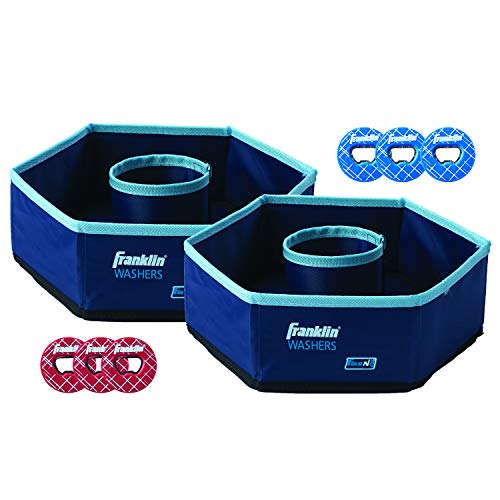
Washer toss, sometimes called washers, washer pitching, or Texas washers depending on region, centers on two boxes placed facing each other across the yard. Each box holds a single cup, usually a short section of pipe set into the middle of a carpeted or padded surface. Players stand beside one box and pitch washers toward the far box, aiming to land inside the cup for the highest value or anywhere inside the box for a smaller score. The flight of a washer is low and flat, more like skimming a stone than lobbing a ball, and a good pitch often slides across the box surface before settling.
Ring toss looks simpler and plays faster. A base, often shaped like a cross or a low square board, carries one or more upright pegs. Players stand at a marked line and toss rings, traditionally made of rope but now commonly molded rubber or plastic, trying to loop them over a peg. There is no sliding and little bounce when rope rings are used, so a round moves quickly and even very young players can succeed often enough to stay interested. The challenge scales by moving the throwing line farther back, which makes the same inexpensive set suitable for a mixed-age gathering.
The practical difference is space and tempo. Washer toss wants a clear lane roughly twenty feet long plus room to stand behind each box, and a single game to twenty-one points can stretch pleasantly across half an hour. Ring toss fits into a corner of a patio, can be set up in under a minute, and produces a winner in a fraction of that time. Households with a long, flat lawn often lean toward washers for its satisfying arc and its back-and-forth walking rhythm. Households with a small deck, a driveway, or mostly younger children often get more use from ring toss, at least as the first set they own.
Some combination products try to offer both games in one box, pairing a washer target with pegs or including rings alongside washers. These hybrids can be sensible for occasional play at gatherings, but specialists usually do each job better. A dedicated washer box has the depth, surface, and cup placement the game needs, while a dedicated ring toss base has peg spacing and ring sizes balanced for looping rather than sliding. If storage space is tight and the games will only come out a few times a year, a hybrid earns its place. If either game is likely to become a regular habit, separate purpose-built equipment tends to age better and frustrate less.
Washer toss rules and scoring in plain terms
House rules vary from street to street, and part of the charm of washers is that every family seems to keep one small variation it defends fiercely. Still, a widely shared framework lets strangers start a game without a long negotiation. Two boxes are placed so the cups sit about twenty feet apart, measured from the center of one cup to the center of the other. Some local traditions stretch that distance a little, and casual players shorten it freely, but twenty feet cup to cup is the reference point most sets and rule sheets assume. Players pitch from beside the near box, with a foot staying behind the front edge of that box as the washer leaves the hand.
Each player or team typically throws three or four washers per round, with the count depending on the set and the house custom. Many boxed sets include four washers per color, and games flow well when each side throws the same number in alternating fashion. Alternating throws matter more than they first appear to: throwing all of your washers in a row lets you settle into a rhythm, while alternating forces constant adjustment and gives each side the tactical chance to knock an opposing washer out of position or cover a scoring spot. Decide the order before the first pitch, flip a coin or toss one washer closest to the cup for the honor, and keep that order for the whole game.
Cancellation scoring and the road to twenty-one
The scoring convention that gives washers its tension is cancellation. After all washers are thrown in a round, only one side scores. A washer inside the cup is commonly worth three points, and a washer inside the box but outside the cup is worth one point. If both sides land washers in scoring positions, matching values cancel each other. Suppose one side lands a washer in the cup and another in the box, for a raw total of four, while the other side puts two washers inside the box worth two points combined. The difference, two points, goes to the first side, and the second side scores nothing that round. This arithmetic keeps games close, because a strong round by one player can be largely erased by a steady round from the other.
Games are usually played to twenty-one points. Some households require an exact finish or a margin of two points, while others accept the first side past twenty-one at the end of a completed round. Agree on the ending rule before play starts, since the final rounds feel very different under each version. Cancellation scoring also shapes strategy: a washer sitting in the box is never fully safe, because an opponent can cancel it with an equal landing or overturn the round entirely with a cup shot. Players who enjoy direct head-to-head swings, where one pitch can flip the scoreboard, tend to love this system. Groups that prefer every success to count may adopt simple additive scoring instead, and there is no harm in that choice as long as everyone knows which system is in force.
Leaners, hangers, and other edge cases
Edge cases generate the most discussion around a washer box, so settling them early keeps the afternoon friendly. A washer leaning against the inside wall of the box or resting partly on the rim is handled differently in different traditions. Some groups count any washer touching the inside of the box as in, others require the washer to lie fully within the box, and a few award a bonus for a hanger that dangles over the cup without falling in. None of these rulings is official in a universal sense, because casual washers has no single governing rulebook that every backyard follows. What matters is consistency within your game: announce the ruling, apply it to both sides, and write it on the underside of a box lid if arguments tend to recur.
Washers that bounce out deserve the same treatment. On a hard surface or a lively box floor, a well-aimed pitch can strike the back wall and hop out onto the grass. Most casual groups score the final resting position, wherever the washer stops, which keeps judging simple. A washer that lands on top of another washer, sometimes called a cap, usually counts according to its own position, and it can also shield the washer beneath it from being knocked away. Agree, too, on what happens when a thrown washer strikes a player or a pet wandering through the lane; the kind convention is a simple re-throw with no penalty, and a clear lane check before each pitch prevents most of those interruptions.
Foul lines sound formal for a lawn game, yet a loose understanding of where the pitcher may stand prevents the slow creep forward that otherwise shortens the distance throw by throw. The common approach is that the pitcher’s feet must stay behind the front plane of the near box until the washer is released. In doubles play, partners stand at opposite ends, so each player throws in both directions across the game without anyone relocating after every round. That arrangement also speeds play, since nobody waits for a group migration between rounds, and it gives each end of the lane its own small audience.
Washer size, weight, and why replacements must match
The washer itself is the soul of the game, and its dimensions are more standardized than many buyers expect. A typical game washer measures about two and a half inches across, with a center hole large enough to keep it light in the hand while the broad steel face gives it stability in flight. That diameter is not arbitrary. It pairs with the roughly four-inch cup opening so that a centered pitch drops cleanly while a slightly off-line pitch can still catch an edge and rattle in. A much smaller washer would fall into the cup too easily and feel insubstantial; a much larger one would bridge across the cup and turn good throws into frustrating rejections.
Weight shapes the throw as much as diameter does. Steel washers carry enough heft to hold a line in a light breeze and to arrive at the box with authority, sliding rather than skittering when they land flat. Lighter stamped washers tend to flutter, drift, and bounce, especially on hard box surfaces. Heavier is not automatically better, though: children and players with limited grip strength may struggle to control a very heavy washer over a full twenty-foot lane. Most households do well with the mid-weight steel washers that established sets include, and anyone buying replacements should match both diameter and approximate weight to the surviving originals so that one player’s equipment does not behave differently from another’s.
Color coatings serve a practical purpose before they serve decoration. Washers are usually finished in two contrasting colors, one per player or team, so scoring positions can be read at a glance from the throwing end. Powder-coated and painted finishes also add a thin layer of protection against moisture, although no coating survives forever once washers start striking each other and scraping across box floors. Expect the finish on the edges to wear first. That wear is cosmetic, and many longtime players treat bright metal showing through colored edges as a sign of a well-used set rather than a defect. What does matter is rust, which roughens the surface, changes the slide, and can stain carpeted boxes; the storage section later in this guide covers simple habits that keep rust at bay.
Replacement washers deserve a warning that listings rarely emphasize. Hardware-store washers that merely look similar often differ in thickness, hole size, or weight distribution, and a mismatched washer in a set creates quiet unfairness that players can feel before they can name it. If a washer is lost in the grass, and it will happen eventually, order replacements described for the game and sold in matched sets, or replace the full set of one color at once. Keeping one spare set in the storage box also solves the problem of a washer that rolls under a deck mid-game, an event that otherwise pauses play while someone fishes around with a rake handle.
The box itself: dimensions, cups, and surfaces
A classic washer box is close to square, commonly around fourteen inches by fourteen inches, with low walls that contain a sliding washer without turning the target into a deep bin. The proportions matter. A box much smaller than that punishes ordinary throws and makes the one-point landing feel like a lucky accident, while an oversized box flatters everyone and removes the satisfaction of a well-judged pitch. Height matters too: walls need enough rise to stop a washer arriving with pace, yet a low profile keeps the box easy to carry, easy to store, and less likely to tip when a washer strikes its side.
At the center sits the cup, most often a short length of pipe with an opening of about four inches across, set flush or slightly below the box floor so washers can slide over its rim without catching. The cup should sit firmly, with no wobble, because a loose cup shifts position over time and quietly changes the target. When reading a product description, look for how the cup is fixed in place and whether it can be removed for cleaning, since cups collect grit, grass seeds, and the occasional bottle cap over a season of outdoor play. A removable cup that lifts out makes the end-of-summer clean far easier.
Carpet, foam, and the question of bounce
The surface inside the box controls how a landing washer behaves, and this is where inexpensive sets most often disappoint. Bare plywood or hard plastic lets a washer arrive hot, strike, and bounce out, converting good pitches into near misses. A carpeted surface, the traditional choice, adds friction that checks the slide and deadens the impact, so a washer tends to stay where it lands. Foam padding under carpet softens the landing further and quiets the game, a real consideration when play continues into the evening near open windows. Outdoor carpet over a thin foam layer is the combination most long-running sets rely on, and it is worth prioritizing over decorative features when comparing options.
Carpet brings its own maintenance questions. It can hold moisture after dew or a passing shower, and a box stored damp will develop a musty smell or mildew spots. Surfaces described as outdoor or marine-style carpet handle wet conditions better than indoor offcuts, and a box that drains or dries quickly is worth more than one with a plush pile. Foam varies as well: dense foam keeps its cushioning across seasons, while very soft foam compresses permanently under the cup area where washers land most often. Pressing a thumb into a display model tells you little online, so descriptions that specify padding and surface materials in plain language are more useful than those that only promise premium quality.
Single-cup boxes and three-hole boards
Not every washer target is a single-cup box. A popular variation uses a flat or slightly inclined board with three holes arranged in a line or triangle, each hole carrying a different point value based on difficulty or distance from the throwing edge. Three-hole boards change the decision-making of a throw: instead of aiming everything at one cup, players weigh a safer hole against a valuable one, and scoring systems for these boards usually award escalating points per hole. Boards are often longer than boxes, fold for transport, and suit players who enjoy target variety within a single throw.
Choosing between the formats comes down to taste and tradition. The single-cup box is the classic game, with the cleanest cancellation scoring and the strongest emphasis on one repeated, grooved throwing motion. The three-hole board offers variety and can keep experienced players engaged when a plain box starts to feel solved. Households buying a first set usually do better with the traditional box, because its rules are the ones guests already half-know, and because replacement washers and rule references assume that format. Players who already own a box sometimes add a board later as a second game rather than a replacement.
Construction details separate a box that lasts from one that loosens by August. Corners should be joined securely, whether by screws, strong joinery, or reinforced brackets, because boxes get dropped, stacked, and occasionally used as improvised seats by children. The base panel needs enough thickness to resist flexing when carried by one wall. Handles or a folding design that locks the pair of boxes face to face into a carrying case are genuinely useful, since the two boxes, eight washers, and a measuring cord travel together or not at all. Latches on a case-style set should close positively and stay closed when the case is lifted by its handle; a latch that pops open in the driveway scatters washers with impressive efficiency.
Ring toss: rings, pegs, and a faster kind of fun
Ring toss strips target play down to its essentials. A base holds pegs upright, players toss rings from a line, and a ring that settles over a peg scores. Traditional sets use rope rings, formed from cotton or synthetic cord joined into a loop, tossed toward wooden pegs on a cross-shaped base with a taller or differently valued center peg. Modern sets often substitute molded rubber or plastic rings, which are uniform, washable, and bright, but behave a little differently in the air and on landing. Understanding those material differences helps a buyer predict how a set will feel on the first afternoon.
Rope rings fly softly and land where they fall, with almost no bounce or roll. That dead landing makes rope ideal around decks, patios, and younger children, because a missed ring drops rather than skittering under furniture. Rope also feels pleasant to hold and suits the traditional look many people picture for this game. Its weaknesses are weather and wear: natural fiber absorbs water, picks up dirt, and can fray at the join after heavy use. Synthetic rope answers most of those concerns while keeping the soft flight, which is why many outdoor sets now use it without advertising the change loudly.
Rubber and plastic rings are consistent in weight and diameter, shrug off rain, and rinse clean under a tap. They also bounce. A rubber ring that strikes a hard patio can rebound a surprising distance, and on a wooden deck it may roll to the edge and drop into the garden. For indoor or hard-surface play, that liveliness can be a drawback; for grass play, it barely matters. Plastic rings sit between the two, lighter than rubber and sometimes prone to drifting in wind. If a household expects to play mostly on a lawn with adults and older children, any of the three materials will serve. If toddlers and a small patio are the reality, rope is the forgiving choice.
Peg layout, distances, and scoring by peg
The classic base is a cross formed by two crossing bars, with a peg at each end and one in the middle, five pegs in total. Scoring usually values the center peg highest, because rings tossed toward the middle must pass the outer pegs and because the center is the natural aim point for every throw. Simpler sets for children may use a single peg on a stable base, removing all scoring debate and letting success come quickly. Larger sets add more pegs in a grid on a square board, each row or color carrying its own value, which suits group scoring games where several players keep a running tally across rounds.
Distance is the main difficulty dial. Young children might toss from three or four feet away, close enough that a ring over the peg happens several times in a short session. Adults commonly stand eight to ten feet back, and confident players extend that until clean successes become genuinely scarce. Because there is no single fixed distance the way washers has its twenty-foot convention, a ring toss set adapts to the space available simply by moving the line. Mark the line with a spare ring, a strip of tape on a deck, or a stick on grass, and move it between age groups rather than asking younger players to struggle at the adult mark.
Scoring conventions stay simple: each ring resting fully over a peg counts, a ring leaning against a peg does not, and if two rings land on the same peg both can count unless your group prefers otherwise. Games may run to a fixed total, a set number of rounds, or simply continue until interest moves elsewhere, which is a perfectly respectable ending for a game often played while food cooks. In team play, partners can alternate throws, and a helpful convention for mixed abilities is to let each player toss from the line that suits them, keeping competition friendly without handicaps or arithmetic.
Peg construction deserves a glance before buying. Pegs should be smooth, with rounded tops that let a ring slip over without snagging, and they should fix firmly into the base rather than wobbling in oversized holes. A slight taper helps rings settle. Bases need enough weight or width to resist tipping when a ring strikes a peg off-center; a featherweight base that skids across a deck with every hit quickly becomes annoying. Some bases fold or break down into the two crossing bars for storage, which is convenient, while one-piece molded bases trade that compactness for sturdiness and instant setup.
Materials and weather: what survives a season outside
Washer boxes and ring toss bases are built mainly from wood, molded plastic, or a combination of the two, and each material carries a distinct relationship with weather. Solid wood, often pine in moderately priced sets, looks at home in a garden and gives a box reassuring weight. Pine is soft enough to dent when a box is dropped on concrete, but dents in a game box are largely cosmetic. Plywood, especially exterior-grade material with sealed edges, resists warping better than a single wide board and is common in case-style folding sets. The enemy of any wooden set is standing water: a box left face-up through a week of rain will hold water in the cup recess and around the carpet, and repeated soaking swells joints and lifts finishes.
Outdoor finishes slow that process rather than stopping it. Spar varnish, exterior paint, and penetrating oils each protect differently. Paint gives the strongest surface barrier and allows color, but chips where washers strike the rim. Varnish keeps the wood visible and handles sun reasonably well, though it eventually needs renewal on surfaces in constant weather. Oil finishes are easy to refresh with a cloth and no sanding, at the cost of more frequent attention. Listings that name a finish type give a buyer something concrete to maintain; listings that say only weather resistant leave the upkeep plan vague. Whatever the finish, a set stored under cover between uses will outlast a nominally tougher set left out all season, so storage habits matter more than finish marketing.
Molded plastic sets answer weather worries by ignoring most of them. Rain runs off, colors are molded through the material rather than painted on, and a plastic box or base can be hosed clean. The trade-offs are feel and longevity of a different kind. Lightweight plastic boxes can shift when a washer lands hard, some plastics grow brittle after years of strong sun, and the sound of a washer on plastic is a clatter rather than the muted thud of carpet over wood. For a household that knows a set will live outdoors near a pool or be handled mostly by children, plastic’s indifference to weather is a rational choice. For players who value the traditional weight and sound of the game, wood with a maintained finish remains the benchmark.
Metal hardware quietly decides how a folding set ages. Hinges and latches on case-style washer boxes should be steel or another corrosion-resistant metal, fixed with screws long enough to bite into solid material. A hinge that rusts stiff makes a folding box awkward; a hinge that loosens makes it floppy and can pinch fingers. On ring toss sets, check how pegs attach: threaded pegs that screw into the base can be replaced if one breaks, while pegs glued into a thin base may take part of the base with them when they snap. Small replaceable parts extend the life of a set far more than a thick coat of paint does.
Weight is a material decision too. A pair of wooden washer boxes with steel washers inside is a satisfying object and a mildly serious carry from a garage to the far end of a garden. If the set will travel to parks, campsites, or relatives’ houses, total packed weight and a secure handle matter as much as playing quality. Plastic and thinner plywood sets travel easily and play acceptably, and many families keep a sturdy wooden set at home and a lighter set for trips. Being honest about where the game will actually be played prevents the common outcome of a beautiful set that never leaves the house because nobody wants to carry it.
Setting up the yard: surfaces, lanes, and safety margins
Washer toss asks little of a yard, but the little it asks matters. The lane between boxes should be reasonably flat and free of obstacles, because players walk it constantly and because a box sitting at a tilt changes the game. A slight slope can be managed by orienting the lane across the slope rather than up and down it, so both boxes sit at a similar angle. Check for sprinkler heads, exposed roots, and the shallow dips that collect water after rain; a box placed over a dip rocks when washers land, and rocking targets help nobody. Many players keep two short boards or shims in the storage case to level a box on imperfect ground, a humble accessory that earns its space quickly.
Grass is the friendliest surface around the boxes. It cushions missed washers, slows rolls, and spares the finish on washers and boxes alike. Very long grass, however, swallows washers and hides them at dusk, and a freshly mowed lane makes finding strays far easier. On a wooden deck, washers land loudly and can leave small marks over time, while the boxes themselves may slide on smooth boards unless they have rubber feet or a textured base. Concrete and paving produce the liveliest bounce and the fastest wear: washers strike hard, hop unpredictably, and gradually lose their coating, and a box on concrete benefits greatly from a padded interior. Sand, where available, plays beautifully for washers pitched around the boxes, since stray throws land softly and stay put, though sand inside the box must be brushed out before it grinds into the carpet.
Safety margins are simple but worth stating. Keep a clear area behind each box, because overthrown washers travel farther than new players expect, and nobody should stand in the throwing lane or walk across it while a round is live. Spectators, coolers, and pets belong to the sides. Steel washers are not dangerous projectiles in normal play, yet a washer to the ankle bone is memorable, so closed shoes are a sensible norm for players standing beside a box while partners throw toward them. In doubles, the waiting players stand beside their box, never behind it in the line of an overthrow, and everyone retrieves washers only after the round is complete and all throws are accounted for.
Ring toss needs far less ceremony. Place the base on the flattest patch available, because a leaning peg quietly favors rings tossed from one side. Keep the area behind the base clear if rubber rings are in use, since their bounce can carry them into flower beds or under decking. For evening play, position both games where existing garden lighting falls across the targets rather than into players’ eyes, and consider that a light-colored box or base reads far better at dusk than a dark one. A surprising number of backyard games end not because interest fades but because nobody can see the cup anymore.
If your gatherings often drift between lawn games and long stretches around the table, it helps to place the throwing lane where players can move between the two without crossing play.
For readers arranging a fuller backyard setup around the games area, our guide to best backyard pizza ovens covers outdoor cooking stations that pair naturally with an afternoon of lawn play.
That single sentence of planning, keeping food, seating, and the lane in separate zones, prevents the constant apologies and paused throws that fragment a game. Children especially benefit from a visible boundary for the lane, even if it is only a row of spare rings or a garden hose laid along each side.
Variations for children and small spaces
Both games bend gracefully toward younger players when adults resist the urge to enforce full distances. For washers, shorten the lane without apology: ten or twelve feet cup to cup lets a child land washers in the box regularly, and success is the entire point at that age. Lighter foam or plastic training washers exist for very young players and indoor practice; they will not replicate the flight of steel, but they let small hands learn the underhand motion safely. Some families keep the boxes closer together and move them apart gradually across a summer, turning distance itself into a quiet record of a child’s growing skill.
Scoring can soften too. Counting any washer that lands in the box, touches the box, or even finishes closest to the box gives beginners points to celebrate while they develop aim. A cooperative version, where everyone works together to reach a combined total against the boxes rather than against each other, suits groups where competition reliably produces tears. For ring toss, bring the line close, use the largest rings in the set, and count a ring that lands draped over a peg as a success for the youngest players. The equipment does not care which rules surround it, and a set that adapts will be used by the whole household instead of being reserved for adult evenings.
Small spaces reshape both games rather than excluding them. A single washer box against a wall, with players throwing toward it from whatever distance the patio allows, works as a solo or turn-based target game even without a second box or a full lane. Ring toss fits on a balcony, in a garage on a rainy day, or along a hallway with rope rings that cannot damage anything they touch. Apartment players should favor rope rings and foam washers, keep throws short, and place targets away from railings, because a washer that leaves a balcony is gone in every sense. The spirit of both games, a repeatable toss at a defined target, survives scaling down far better than games built around running or large equipment.
Mixed-age gatherings run best when the setup acknowledges different abilities openly. Two throwing lines, one for adults and one for children, marked in different colors, let everyone play the same round at a fair challenge. In washers, a household can pair an adult with a child as a doubles team, alternating throws toward the far box, which balances the scoring and gives the child a partner invested in every pitch. Nobody remembers who won most of these games a week later; they remember that the teams felt even and the lead kept changing.
Reading a listing without being misled
The most consequential confusion in washer set listings is also the simplest: how many boxes are actually in the carton. The game needs two boxes, yet some products are sold as a single box, either as a replacement, as a one-target variant, or as half of a set the seller expects you to complete. Photographs almost always show two boxes because that is how the game looks, and a low price that seems to undercut every comparable set often resolves into a single-box product once the description is read carefully. Confirm the box count in the written contents list, not the photograph, and do the same for washers: a full game needs enough washers for both sides, commonly four per color, and a set that includes only four washers total plays a shorter, less tactical round.
Ring toss listings have their own version of this trap. Count the rings and the pegs in the contents, because a base with five pegs and only five rings plays differently from one that includes spares, and a broken or lost ring in a no-spare set ends the game until a replacement arrives. Check whether the stated ring diameter suits the peg spacing; rings that are barely larger than the peg caps demand near-perfect throws and frustrate beginners, while very large rings make the center peg of a cross base too easy. Descriptions that give ring diameter, peg height, and base dimensions in numbers are far more useful than those relying on words like jumbo or family size.
Dimensions deserve the same skepticism in both games. For washer boxes, look for the outer measurements, the cup diameter, and the washer diameter together, since those three numbers describe the target a player actually faces. A listing that gives only the folded case size is describing storage, not play. For either game, note the total weight if the set will travel, and look for a contents list that names small parts: a measuring cord or distance marker, a storage bag for washers or rings, and a rule sheet are modest inclusions that signal a set designed by people who have actually packed one away in the dark at the end of an evening.
Ground cover under the play area changes comfort more than most buyers expect, especially during long tournaments on hard patios.
Anyone softening a concrete games corner can compare options in our roundup of best affordable outdoor rugs, which focuses on outdoor rugs that tolerate weather and foot traffic.
A rug under a washer lane will not change scoring, but it quiets stray landings and gives younger players a defined place to kneel while retrieving washers. Keep any rug flat and clear of the boxes themselves, so it never lifts a box edge or creates a lip that catches a sliding washer.
Care, cleaning, and storage that actually prevent damage
Steel washers ask for one habit above all: dry storage. Wipe washers with a cloth after play on wet grass, and store them in a dry bag or compartment rather than loose in a damp box. A light film of household oil on a cloth, applied occasionally to bare or worn washers, slows rust through a humid season, and any washer that does develop surface rust can be cleaned with a scouring pad and dried thoroughly before it rejoins the set. Rust left alone pits the surface, and pitted washers slide unpredictably and shed orange dust onto carpeted boxes, turning a small neglect into two problems.
The box interior needs air more than it needs cleaning products. After a wet session, leave boxes open in a sheltered spot until the carpet feels dry to the touch, then close and store them in a garage, shed, or covered area off bare ground. Mildew on carpet responds to a thorough drying and a brush with a mild household solution suited to outdoor fabric, followed by more drying; sealing a damp box shut is what turns a faint smell into a season-ending problem. Periodically lift out the cup, shake out accumulated grit, and check the box floor for the small stones that migrate in and create hard spots under the carpet where washers bounce oddly.
Wooden exteriors benefit from an annual look-over. Tighten hinge and handle screws, check corners for movement, and refresh the finish where it has worn through, particularly on the bottom edges that meet wet grass. Rope rings should be stored dry and out of prolonged sun, which weakens fibers over time, while rubber and plastic rings simply need a rinse when they get muddy and a storage spot away from extreme heat. Pegs that screw in should be removed or secured before transport so they do not snap against the base inside a crowded car. A set stored complete, counted as it goes away, is a set that starts instantly next time; the two minutes spent counting washers at pack-up are repaid every single outing.
Seating around the lane matters for the long, social games that washers encourages, since partners waiting at each end appreciate somewhere to rest between rounds.
Hosts who want the sidelines as comfortable as the game itself can browse our selections for best comfortable outdoor lounge chairs to find seating that suits extended backyard sessions.
Chairs placed well to the side, never behind the target box, keep spectators relaxed and out of the path of an enthusiastic overthrow. A small side table for drinks at each end completes a setup that can run comfortably for hours.
Choosing between the games, or making room for both
By now the shape of the decision should be clear. Choose washer toss as your primary set if you have a lane of flat ground, enjoy a game with real tactical depth, and like equipment with weight and tradition behind it. Its cancellation scoring produces close finishes, its skills develop over a whole summer, and a good wooden set becomes part of the furniture of a household’s outdoor life. Choose ring toss first if your space is compact, your players are young or mixed in ability, or you want a game that starts thirty seconds after someone suggests it and ends whenever the group is ready to move on. Its simplicity is not a lesser quality; it is the reason ring toss appears at gatherings where a twenty-one-point washers match would never get organized.
Many households eventually own both, and the pairing makes sense because the games serve different moments. Ring toss fills short gaps, entertains children while adults set up, and travels effortlessly. Washers anchors the long evening, gives adults a contest worth keeping score in, and rewards the player who practices a consistent pitch. If budget or storage forces a single purchase, let the deciding factors be your most common players and your actual ground, not the games you imagine hosting once a year. Equipment bought for the weekly reality gets used; equipment bought for an annual event mostly gets stored.
Before ordering either game, run through a short mental checklist grounded in the details covered above. For washers: two boxes confirmed, cup and washer diameters stated, carpeted or padded interior, washers in two colors with a sensible count, hinges and latches that suit how the set will travel. For ring toss: ring material matched to your surface and players, pegs firmly mounted with rounded tops, a base heavy enough to stay put, and a ring count that includes a spare if children will handle them. For both: a storage plan, a place to dry components, and a throwing distance your space can honestly provide. A set that passes that checklist does not need superlatives in its description to play well for years.
The ground beneath the whole arrangement deserves one last thought, because a defined games area tends to become the social center of a yard.
For a softer, more finished surface underfoot around the play zone, see our guide to best outdoor patio rugs for patio rugs sized and built for outdoor living areas.
Defining the zone, whether with a rug edge, a mowing line, or simply the habitual placement of chairs, signals to guests where play happens and where they can wander with a plate in hand. That small clarity keeps games running smoothly inside gatherings that also include food, music, and conversation.
A short word on house rules
Whatever set arrives, spend the first session establishing your household’s version of the game and write the essentials down: distance, washer or ring count per round, scoring values, how leaners count, and what total wins. A single page tucked inside the box lid ends most disputes before they start and lets guests join without a long briefing. Revisit the page after a few sessions, because the rulings that suit beginners may feel loose once everyone’s aim improves, and tightening a distance or adopting cancellation scoring at that point refreshes a familiar game. The written page also preserves the variations your family invents, which tend to become the traditions people ask about when they visit again.
Finally, remember that both games reward the same unglamorous virtues: a clear lane, equipment counted and stored dry, distances matched to the players present, and rules agreed before the first throw rather than negotiated after a disputed one. Get those basics right and the specific brand or finish matters far less than sellers suggest. A modest set, set up thoughtfully, will host more laughter in one summer than an elaborate set that stays in its carton because nobody can face assembling it.
Check prices on Amazon
Live listings for the shortlist in this guide are pulled from Amazon below, so prices and availability are always current at the moment you look.


Developing a repeatable throw
New washer players often ask about grip and release, and the honest answer is that consistency matters more than any single technique. Most players hold the washer flat between thumb and fingers, keep the wrist quiet, and swing the arm in a smooth underhand arc, releasing the washer level so it flies flat rather than wobbling end over end. A washer released with its face tilted tends to catch air, drift, and land on an edge, after which its bounce becomes anyone’s guess. Height is the other lever: a lower, driving flight suits windy days and carpeted boxes, while a slightly higher arc that drops the washer onto the surface can reduce sliding on slick floors. Changing one element at a time, and giving each change a full round before judging it, builds a repeatable motion faster than constant experimentation.
Ring toss technique is simpler to describe and harder to rush. A gentle underhand lob with a slight arc gives the ring time to flatten in the air and descend over the peg, whereas a hard, flat throw arrives too quickly and bounces off pegs it might otherwise have circled. Players who step into the throw usually lose accuracy, so a still stance with weight settled evenly tends to produce steadier results. For both games, the players who improve fastest are those who watch where every throw lands, adjust by small amounts, and resist blaming the equipment for a pattern that a modest stance change would correct within a few rounds of patient, unhurried practice at home.
Disclosure: This guide was prepared from published game conventions, manufacturer specifications, and documented product details for the sets discussed, so readers can compare options using the same measurements and rules outlined above. As an Amazon Associate we earn from qualifying purchases.
Set the boxes or pegs out this weekend, agree on your house rules before the first toss, and let the score take care of itself.