What's inside
- Key Takeaways
- Quick Picks
- How We Chose These Picks
- Which of the Best Memory Foam Slippers Fits Your Routine?
- How Do the Six Compare at a Glance?
- What Does Memory Foam Actually Do Inside a Slipper?
- How Can You Slow the Flattening Without Babying the Pair?
- Which Is Better for Tired Feet, a Clog or a Closed Heel?
- How Should Men Read Breathable Claims on Warm Slippers?
- Why Do Banded Sizes Feel Different in Week One and Week Four?
- What Separates a Bedroom Slipper From an All-Day House Shoe?
- How Do You Wash Memory Foam Slippers Without Ruining the Foam?
- When Has a Memory Foam Pair Earned Replacement?
- How Does Body Weight Change a Foam Pair’s Biography?
- What Is the Difference Between Foam Comfort and Real Support?
- How Should Couples With Different Feet Share a Slipper Shelf?
- Why Do Some Foam Slippers Smell Sooner Than Others?
- What Should You Wear Foam Slippers On, and Never On?
- How Do You Test a New Foam Pair During the Returns Window?
- How Does Foam Behave Differently in Summer and Winter?
- Why Does the Heel Always Settle First?
- How Should You Pack Foam Slippers for Travel Without Crushing Them?
- How Does Foam Serve a Household That Stands to Cook Every Night?
- What Is the Real Difference Between Thick Foam and Dense Foam?
- How Should Foam Slippers Be Aired Between Wears to Stay Sweet?
- Why Do Foam Pairs Make Such Revealing Gifts?
- How Does Foam Cope With a Household That Keeps Its Floors Cold on Purpose?
- Why Should You Keep the Box and Receipt for a Whole Season?
- How Does a Foam Pair Fit Into a Meditation or Yoga Corner at Home?
- Why Should You Retire a Foam Pair to the Guest Basket Instead of the Bin?
- What Is the Last Thing to Check Before the First Evening Ends?
- What Mistakes Do Buyers Make Most Often?
- Final Recommendation
- Frequently Asked Questions
- Related Guides
As an Amazon Associate I earn from qualifying purchases. This post may contain affiliate links at no extra cost to you.
cottageverdict.com is reader-supported. When you buy through links on our site, we may earn an affiliate commission.
Where to buy: the six pairs below are sold on Amazon, and the Quick Picks table, each review heading and the comparison table link to the listings, where you can check price on Amazon and verify the size band and care label for the exact colourway. The best memory foam slippers promise a footbed that learns your foot, and this guide takes that promise seriously enough to describe its whole life, from the first evening’s sink to the settled impression of month three.
Foam rewards informed buyers and disappoints hopeful ones, and the difference is expectation. Every review below states its pair’s size band as the listing states it, notes whether washing is claimed, and records compression as a trade-off in advance, so the pair you choose is the pair you actually receive across a whole winter rather than across a first impression.
Key Takeaways
- Memory foam moulds to your foot, then gradually keeps the impression permanently.
- Banded sizes fit best at their middle; edges should expect ease or snugness.
- Rotation between two pairs is the only reliable way to slow flattening.
- Washable claims appear on several picks; the delivered label governs the method.
- A clog’s open back trades stair security for unmatched step-in ease.
- Judge any foam pair at week six, when its settled character has arrived.
Quick Picks
| Pick | Badge | Why it earns its place |
|---|---|---|
| ULTRAIDEAS Memory Foam Slipper | Best Wool-Like Bedroom Classic | A grey wool-like bedroom slipper in sizes 9-10 with an anti-skid rubber sole for ladies. |
| VeraCosy Men’s Memory Foam | Best Men’s Matt Black Slip-On | A matt black men’s slip-on in 9-10 US, listed as breathable, supportive and machine-washable. |
| OOW Cozy Memory Foam House Slippers | Best Fuzzy Minimalist | A fuzzy women’s house slipper with memory foam and a short, unadorned listing that leaves sizing to the page. |
| EverFoams Curly Memory Foam Grey | Best Curly Grey Loafer | A grey curly fleece-lined loafer in 7-8 US, listed as machine washable and gift-ready. |
| isotoner Classic Clog Memory Foam | Best Classic Clog Shape | An ash clog in 7.5-8 with memory foam comfort and a non-slip sole from a long-running slipper name. |
| VeraCosy Corduroy Memory Foam Men | Best Corduroy Men’s Pair | A dark black corduroy men’s pair in 11-12 US, listed as breathable, lightweight and machine-washable. |
How We Chose These Picks
The foam itself was the entry requirement, so selection turned on everything around it. Size bands were recorded exactly as listed, from a narrow 7.5-8 clog to an 11-12 men’s pair, because foam comfort is meaningless inside the wrong volume. Soles were separated into rubber tread, non-slip claims and indoor briefs, since the sole outlives the cushion and must carry the pair’s second act.
Uppers were read for their working character: wool-like tidiness, corduroy’s structure, curly fleece’s warmth, plain pile’s simplicity. Washable claims were credited where listings make them and flagged for label confirmation everywhere. Above all, no pair was allowed to hide its material’s biography; compression appears in every trade-off list in this guide by design.
Which of the Best Memory Foam Slippers Fits Your Routine?

ULTRAIDEAS Memory Foam Slipper — Best Wool-Like Bedroom Classic
The ULTRAIDEAS slipper wears a wool-like face over a memory foam heart, sized 9-10 in grey, and aims squarely at the bedroom circuit: bed to bathroom to landing without a cold interval. Its anti-skid rubber sole is the grown-up detail, a real treaded bottom rather than a fabric afterthought, which steadies the pair on the smooth floors where bedroom slippers spend their lives. The 9-10 band should be read as written; a 9 gains ease, a 10 gains a close fit that the foam’s initial loft will exaggerate for a week.
That loft deserves its usual honest paragraph. Memory foam arrives generous, moulds to the foot’s geography within days, and then slowly surrenders height where the heel strikes, so by midwinter the pair feels supportive rather than pillowy. Nothing has gone wrong; the material has simply traded novelty for familiarity. Buyers who stand long stretches at a kitchen counter should note that a compressed foam footbed is a thin defence by month three, and this pair is happiest in the shorter, softer circuits of morning and evening wear.
- Stated size band: 9-10, grey
- Upper: wool-like textured finish
- Footbed: memory foam cushioning
- Sole: anti-skid rubber bottom
- Brief: indoor bedroom slipper
- Audience: women, per the listing
Strengths
- Rubber sole grips bedroom floors properly
- Wool-like face looks tidy in daylight
- Band sizing suits gift buying cautiously
Trade-offs
- Foam flattens under the heel over time
- Top of band fits snugly at first
- Bedroom brief limits outdoor ambition
Keep this pair’s diary honestly: note the month its cushion felt new, and the month it felt familiar, and you will know the brand’s true interval for your weight and routine. That private data is worth more than any review, including this one, when the replacement season arrives.
Best for: size 9-10 wearers wanting a classic bedroom pair with a real rubber sole
Not suited for: long-shift standers needing cushioning that will not thin by spring

VeraCosy Men’s Memory Foam — Best Men’s Matt Black Slip-On
VeraCosy cuts its men’s memory foam slipper in matt black, 9-10 US, with a slip-on shape that asks nothing at the door and a listing that claims breathability alongside the usual warmth. Breathable is the interesting word in a foam slipper, because foam footbeds run warm by nature; the claim points to an upper and lining chosen to vent some of that heat, which matters to men who wear slippers through a whole working day at home rather than for an evening’s circuit.
The listing also promises machine-washable care and indoor-outdoor range, a combination that suits a pair destined for workshop thresholds and kitchen duty. Both claims should be honoured on the label’s terms, with outdoor work kept to dry ground. The foam will compress on schedule, heel first, and the supportive wording in the listing should be understood as the shaped comfort of a new pair rather than a permanent structure; once the foam thins, support is mostly the sole’s doing, so judge this pair by its sole and upper as much as by its first week’s sink.
- Stated size band: 9-10 US, matt black
- Audience: men, slip-on entry
- Footbed: memory foam cushioning
- Claims: breathable and supportive, per listing
- Care: machine-washable, per the listing
- Range: indoor and outdoor, per listing
Strengths
- Understated black suits all-day home wear
- Washable claim fits working households
- Slip-on shape speeds every doorway
Trade-offs
- Foam support fades as cushion compresses
- Warm footbed despite breathable claim
- Outdoor range means dry ground only
A washable men’s pair earns a standing place by the washing machine’s schedule rather than the calendar’s: wash it with the week’s dark towels, on the label’s terms, and its freshness becomes a by-product of a routine that already exists instead of a special project that gets postponed.
Best for: men in the 9-10 band who live in slippers through the working day
Not suited for: anyone expecting permanent structured support from a foam footbed
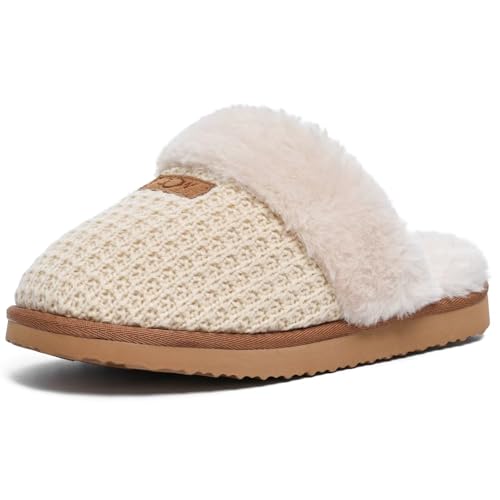
OOW Cozy Memory Foam House Slippers — Best Fuzzy Minimalist
The OOW listing is the minimalist of this six, a title so brief it names the category and little else: cozy house slippers for women, memory foam, fuzzy shoes for indoor wear. That brevity shifts work onto the buyer. No size appears in the title carried here, so the listing page’s own chart is the only sizing authority, and it should be consulted with a measured foot rather than a remembered shoe size, because fuzzy pile consumes internal room that external dimensions do not advertise.
What can be said from the fuzzy brief is that pile is the warmth strategy, trapping air at the surface while the foam handles the underfoot story. Expect the familiar foam biography, early loft giving way to a settled impression, and expect the pile to need airing between wears to stay sweet. A short listing is not a bad listing, but it rewards a careful buyer: confirm size, confirm care instructions on arrival, and let the pair prove itself in the first fortnight while returns remain simple.
- Form: fuzzy house slipper for women
- Footbed: memory foam cushioning
- Size: confirm on the listing page
- Care: confirm from the delivered label
- Territory: indoor wear, per the listing
- Listing style: brief, few stated extras
Strengths
- Fuzzy pile delivers immediate surface warmth
- Simple brief keeps the design unfussy
- Foam moulds closely to individual feet
Trade-offs
- Title states no size for guidance
- Care details must be checked on arrival
- Foam impression deepens with daily wear
For a brief listing, the first fortnight is the real specification sheet. Wear the pair through your actual evenings, note where it rubs, how its pile handles moisture and whether its size truth matches the chart, and let that evidence, gathered while returns are simple, decide its future.
Best for: careful buyers who read listing charts and labels before committing
Not suited for: shoppers who need sizing certainty from a title alone

EverFoams Curly Memory Foam Grey — Best Curly Grey Loafer
EverFoams returns in grey, sized 7-8 US, with the same curly wool-like texture and polar fleece lining that define the line, here in the colourway that hides a winter of hallway dust most gracefully. The loafer profile keeps it presentable, the fleece keeps it warm, and the banded size places its wearers precisely: comfortable at 7, close at 8, with the fleece’s first-week loft making the 8 feel closer still until the lining settles against the foot.
The machine washable claim in the listing is the maintenance headline, because fleece linings are where slippers go to smell old, and a washable fleece can be reset instead of endured. Follow the delivered label, wash gently, dry away from direct heat, and the curly upper keeps its texture. Underneath, the foam performs its standard arc of generosity and gradual compression, and rotating this pair against a second set of slippers is the cheapest way to keep its evenings feeling like its first month.
- Stated size band: 7-8 US, grey
- Upper: curly wool-like texture
- Lining: warm polar fleece
- Footbed: memory foam cushioning
- Care: machine washable, per the listing
- Shape: indoor cozy loafer
Strengths
- Grey hides winter dust gracefully
- Fleece lining resets with washing
- Loafer shape stays presentable daily
Trade-offs
- Upper band size fits closely initially
- Foam thins where the heel lands
- Curly pile collects lint readily
Grey fleece has a social talent: it looks intentional with everything a house wears, from pyjamas to the clothes you answer the door in. That versatility is why this colourway, in this band, is the one most likely to still be in daily service when brighter pairs have been demoted.
Best for: size 7-8 wearers wanting a washable fleece loafer in a forgiving colour
Not suited for: size 8 wearers who dislike any initial snugness

isotoner Classic Clog Memory Foam — Best Classic Clog Shape
The isotoner clog argues for the open back. A clog admits a foot without hands, without bending, without the heel negotiation that closed shapes demand at a dark bedside, and in ash, sized 7.5-8, this classic version adds memory foam and a non-slip sole to a silhouette the brand has refined for decades. The half-size in the band is a useful precision: 7.5-8 is a narrower promise than most bands make, and it should be trusted as the whole promise.
Open backs trade security for ease, and the trade shows on stairs and in hurried crossings, where a clog can part company with a foot that a closed heel would have kept. Walk, do not run, is the clog’s standing instruction. The foam underfoot compresses in the usual pattern, though a clog’s easy on-off life often means fewer continuous hours of load than a loafer endures, which can stretch the cushion’s good period across more calendar months. For bedside duty, bathroom trips and sofa evenings, few shapes are more honest about what they are for.
- Stated size band: 7.5-8, ash
- Shape: classic open-back clog
- Footbed: memory foam comfort
- Sole: non-slip, per the listing
- Entry: hands-free step-in
- Brand brief: long-running classic line
Strengths
- Step-in ease needs no hands or bending
- Narrow band states sizing precisely
- Non-slip sole steadies bathroom trips
Trade-offs
- Open back can slip during hurried stairs
- Foam compresses with steady use
- Clog shape offers little ankle warmth
A clog’s foam lives a gentler life than a loafer’s, because the pair is worn in episodes rather than in shifts. If your evenings are episodic, bedside, bathroom, sofa, the clog’s cushion may still feel generous in the season when a full-time pair has settled into familiarity.
Best for: bedside wearers in the 7.5-8 band who value hands-free entry above all
Not suited for: anyone who hurries on stairs or wants a closed, secure heel

VeraCosy Corduroy Memory Foam Men — Best Corduroy Men’s Pair
Corduroy is an underrated slipper fabric, ribbed enough to vent a little, sturdy enough to keep its shape when foam beneath it starts to settle, and VeraCosy uses it here in dark black for men’s sizes 11-12 US. Larger sizes are where slipper ranges often quietly end, so a listing that states 11-12 plainly, with fall and winter intent, non-slip footing and indoor-outdoor range, deserves credit for serving the feet that other brands treat as an afterthought.
The listing adds breathable, lightweight and machine-washable to its claims, a practical trio for a big pair that will work hard. Washing a larger pair needs drum room and full drying time, the two details labels assume and households forget. The foam will compress under a larger load faster than under a smaller one, simple physics that no brand escapes, so heavier wearers should expect the settled, thinner phase to arrive sooner and should judge the pair’s worth by its corduroy upper and sole, which are built to remain after the foam’s first act ends.
- Stated size band: 11-12 US, dark black
- Upper: corduroy with ribbed texture
- Audience: men, fall and winter brief
- Claims: breathable and lightweight, per listing
- Care: machine-washable, per the listing
- Sole: non-slip, indoor and outdoor range
Strengths
- Proper sizing for larger men’s feet
- Corduroy keeps shape as foam settles
- Washable build suits hard daily use
Trade-offs
- Heavier loads compress foam sooner
- Large pair needs generous wash space
- Drying takes longer than smaller pairs
Corduroy repays a clothes brush kept by the door. A weekly pass lifts the ribs, clears the lint that mats between them, and keeps a large pair looking engineered rather than exhausted, which matters in a size range where replacement choice is narrower than it should be.
Best for: men in the 11-12 band wanting a sturdy corduroy pair for winter
Not suited for: lighter wearers who would be swamped by the band’s volume
How Do the Six Compare at a Glance?
| Model | Form | Key trait | Signature strength |
|---|---|---|---|
| ULTRAIDEAS Memory Foam Slipper | Bedroom slipper | Anti-skid rubber sole | Classic wool-like comfort |
| VeraCosy Men’s Memory Foam | Men’s slip-on | Breathable washable build | All-day matt black ease |
| OOW Cozy Memory Foam House Slippers | Fuzzy slipper | Pile warmth, foam base | Unadorned cozy simplicity |
| EverFoams Curly Memory Foam Grey | Loafer slipper | Curly fleece-lined upper | Washable grey practicality |
| isotoner Classic Clog Memory Foam | Clog slipper | Open-back classic shape | Effortless bedside entry |
| VeraCosy Corduroy Memory Foam Men | Men’s slipper | Corduroy upper | Big-size winter practicality |
What Does Memory Foam Actually Do Inside a Slipper?
It flows, slowly, away from pressure and warmth. The foam’s cells soften where your foot heats them and yield where your weight loads them, so the footbed briefly becomes a negative of your sole, spreading load across a wider area than a flat insole manages. That spreading is the comfort people describe as sinking in, and for tired feet at day’s end it is a genuine kindness, easing the heel’s point pressure and the forefoot’s concentrated push.
The same flowing explains the material’s limit. Cells that yield daily do not all spring back, so the negative of your foot becomes permanent and shallower, and the spreading effect fades with the loft that created it. A memory foam slipper is therefore a consumable comfort with a generous first act, not a permanent orthopaedic structure, and every review in this guide scores its pair with that biography already written in.
How Can You Slow the Flattening Without Babying the Pair?
Rotation is the single effective kindness. A foam footbed given alternate days off recovers a portion of its loft as the cells relax back, while a pair worn sixteen hours daily writes its impression in permanent ink. Two mid-priced pairs rotated will still feel cushioned in the month when one premium pair, worn without rest, has gone thin and familiar.
Heat discipline comes second. Radiators, underfloor heating vents and sunny windowsills all age foam early, softening its structure when no foot is even present. Store slippers in the cool ordinary air of the bedroom. Third, keep the footbed dry, washing only as labels allow and drying fully, because moisture accelerates compression and invites the odour that makes owners retire pairs whose foam still had weeks of kindness left.
Which Is Better for Tired Feet, a Clog or a Closed Heel?
The clog wins the doorway and loses the staircase. Its open back offers the fastest, hands-free entry in footwear, ideal for the bedside, the bathroom trip and the sofa evening, and the isotoner in this list shows how refined that simple bargain can be. But an open back holds the foot by friction and habit alone, and hurried movement, especially descending stairs with full hands, can separate shoe from foot at the worst moment.
A closed heel or loafer shape follows the foot through every pace, suiting working days at home, frequent stairs and doorstep errands. The tiredness question cuts the other way than most buyers expect: feet that ache from standing need the pair that stays aligned under them, which is the closed shape, while feet that ache from a day inside boots often want only softness and freedom, which is the clog’s whole philosophy.
How Should Men Read Breathable Claims on Warm Slippers?
As a direction, not a measurement. No listing here publishes an airflow figure, so breathable tells you the maker chose an upper or lining intended to vent some heat, corduroy’s ribs or a lighter weave, rather than sealing the foot in pile. For men who wear slippers through a working day, that intention matters, because a foam footbed generates a warm microclimate and the upper decides whether the warmth stays pleasant or turns swampy by mid-afternoon.
Test the claim against your own routine in the first fortnight. If your feet end the day dry, the pairing of upper and routine works. If not, thin socks restore the balance for most wearers, absorbing moisture before the lining does and washing more easily than any slipper. Breathability is a partnership between a fabric and a household’s habits, never a property a label can guarantee alone.
Why Do Banded Sizes Feel Different in Week One and Week Four?
Because two things settle at once. The lining’s loft, fleece or pile standing proud in a new pair, compresses against the foot and frees internal room, while the foam footbed drops a few millimetres and lowers the foot deeper into the shoe. A banded size that felt daring at the top of its range on day one often feels merely close by week four, and a pair that felt perfect at the band’s bottom can drift toward loose.
Buy with the settled state in mind. If you sit at a band’s upper edge, expect a firm first week and judge fit after the lining settles, wearing your usual socks for the trial. If you sit at the lower edge, a pair that already slips at the heel when new will only wander more. The clog in this list narrows its band to a half-size span, which is the honest response to the problem: promise less, fit better.
What Separates a Bedroom Slipper From an All-Day House Shoe?
Mostly the sole and the schedule. A bedroom slipper works in short, soft circuits on familiar floors, and can therefore prioritise silence, softness and step-in ease over structure. An all-day house shoe accumulates thousands of steps on kitchen tile, takes doorstep weather in its stride, and needs a sole with real tread, an upper that holds its shape, and a footbed whose second act, after the foam settles, is still acceptable to stand in.
Several picks here straddle the border, claiming indoor-outdoor range and washable builds that suit long duty. The dividing question to ask of any of them is what remains when the foam thins: a good sole, a sturdy upper and a shape that stays on the foot. Pairs that answer well to that question graduate to all-day work. Pairs that were only ever their first week’s cushion should be loved within the bedroom circuit they were designed for.
How Do You Wash Memory Foam Slippers Without Ruining the Foam?
Start with the label, because washable in a listing title and washable on the delivered care tag are cousins, not twins, and the tag is the one that knows your pair’s glue and sole. Where machine washing is confirmed, use a gentle cold cycle, mild detergent, and company in the drum, a towel or two, so the pair does not batter itself hollow. Never wring a foam footbed; press water out with a towel instead.
Drying decides the outcome. Air at room temperature, toes propped open, away from radiators whose heat warps foam and soles alike, and allow a full day rather than an optimistic evening. A pair returned to feet while its core is still damp will compress faster, smell sooner and feel clammy in a way owners often misread as the foam failing. Patience at the drying stage is what makes the washable claim worth having.
When Has a Memory Foam Pair Earned Replacement?
When your thumb tells you. Press firmly where your heel lands and watch the recovery: foam that stays dented, or springs back without its old slow reluctance, has finished its cushioning career even if the upper remains handsome. A second witness is the sole, whose tread at the heel and ball should still show its pattern; a polished sole plus a dented footbed is a pair retiring on both of its safety systems at once.
Calendar expectations help planning rather than judgement. A daily-worn foam pair commonly gives its best across one winter and remains serviceable, thinner and firmer, into a second. Rotation doubles the calendar without doubling the cost per season. Keep the old pair for garden-door duty if its sole still grips dry ground, and let its demotion, rather than the bin, be the reward for its service.
How Does Body Weight Change a Foam Pair’s Biography?
Directly, through simple load. Foam compresses where pressure concentrates, and a heavier wearer concentrates more of it through the same heel area, so the settled phase arrives sooner and sits thinner. This is not a quality verdict on any pair in this list; it is the material obeying physics at different rates for different owners, and it explains why two households can report honestly opposite lifespans for the identical slipper.
Heavier wearers should therefore weight the non-foam virtues more heavily when choosing: a substantial sole, a sturdy upper, a shape that stays centred. Those are the components still at full strength in month six. Rotation matters doubly, since a rested foam recovers proportionally more when its daily load is greater. Judge any pair’s value by its whole system, and the foam’s faster biography becomes a planning fact rather than a disappointment.
What Is the Difference Between Foam Comfort and Real Support?
Comfort is what a surface does to pressure in the first minutes; support is what a structure does to alignment across hours. Memory foam is a comfort material of genius, spreading load and erasing point pressure, but it offers alignment only while its loft lasts, and a settled footbed aligns nothing. Listings that use the word supportive about a foam slipper are describing the shaped kindness of a new pair, and buyers who need genuine structural support for long standing should hear the word in that limited sense.
This guide makes no medical claims for any pick, and none should be read into a soft footbed. What foam honestly offers is a kinder interface between foot and hard floor for the ordinary circuits of home life, mornings, evenings, the bedside geography. Within that honest territory it is superb. Beyond it, in the territory of aching arches and clinical questions, the answers live in other products and other professions.
How Should Couples With Different Feet Share a Slipper Shelf?
They should not share pairs, only standards. A foam footbed moulds to one foot’s geography, and a second wearer inherits a map drawn for somebody else, compressing it further in the wrong places. Two pairs, each honestly sized, cost less than the replacement cycle that shared wear accelerates, and each keeps the hygiene of a single owner, which matters in footwear worn against skin daily.
Sharing the standards is the valuable part: measure both sets of feet in the evening, agree the house rules about outdoor thresholds and radiator storage, and keep both pairs in the same rotation discipline. Households that run one system with two pairs find both pairs lasting longer, because the habits that age foam, heat, damp, continuous wear, are household habits before they are individual ones.
Why Do Some Foam Slippers Smell Sooner Than Others?
Because foam is a sponge that also insulates. It holds warmth and moisture together in a closed structure, and that partnership is odour’s favourite climate. Pairs with washable builds can reset the clock in the machine; pairs without must rely on airing, rotation and the sacrificial sock. The difference between brands is mostly the difference between those maintenance routes, not a mysterious property of one foam over another.
Speed of drying is the hidden variable. A pair worn again while its core is still damp from yesterday will smell by the weekend whatever its price, while a pair given a full day of open air between wears can stay neutral for weeks. When a foam pair turns, owners tend to blame the material; the diary usually shows a rhythm problem, and rhythm is the one specification every household controls completely.
What Should You Wear Foam Slippers On, and Never On?
On the dry, familiar floors of your own house they are in their element: timber, laminate, tile and carpet all treat a foam pair kindly, and its sole, rubber or non-slip, was specified for exactly those surfaces. Wet grass, gravel paths and workshop floors are outside the treaty. Gravel writes itself into soft soles, wet ground soaks a footbed that then takes a day to forgive you, and workshop debris treats foam as a storage medium.
Keep the threshold rule that every guide in this series ends up preaching, because it works: slippers stop at the door in wet or dirty conditions, and a sacrificial outdoor shoe takes the strain. The foam pair’s whole biography, its loft, its smell, its sole, lengthens measurably when its world stays the size it was designed for.
How Do You Test a New Foam Pair During the Returns Window?
Wear it through your real life, not around it. The bedside circuit at night, the kitchen’s hard floor in the morning, the stairs you actually use, in the socks you actually wear, for the durations your evenings actually last. A pair tested on a carpeted lap of the living room has been tested for a life you do not lead. Note three things: heel security in your real gait, warmth at your real exposure, and the footbed’s feel at the end of the longest evening, not the start of the shortest.
Then check the label against the listing while the paperwork is still easy, confirm the washability you were promised exists in the delivered instructions, and photograph the size panel. A fortnight of honest testing converts a purchase into a decision, and it is the only research method that has ever predicted a slipper’s second winter accurately.
How Does Foam Behave Differently in Summer and Winter?
Temperature writes itself into foam. In a cold bedroom the material starts firmer each morning and softens as the foot warms it, so a winter pair’s first steps feel structured and its last steps feel moulded. In summer the same foam begins soft and stays soft, and a pair that felt supportive in January can feel vague in July even before any permanent compression is counted. Owners who judge a pair across one season only have measured half its character.
Warmth follows the same swing. A foam footbed insulates in winter and incubates in summer, which is why breathable uppers and open clogs earn their keep in the warm months of this list. Households in mixed climates often end with a seasonal rotation, a closed foam pair for the cold and an open or thinner pair for the heat, each resting while the other works, which doubles as the rotation discipline that preserves foam everywhere.
Why Does the Heel Always Settle First?
Because the heel is where walking begins and standing concentrates. Every step loads the heel’s small area with the body’s arrival, and every standing minute parks a disproportionate share of weight on the same few cells. The forefoot spreads its work across a wider, moving platform; the heel takes its work in one place, thousands of times a day, at the same angle. Foam keeps its diary where the entries are densest, and the heel writes the most entries.
You can read a worn pair like a record of its owner’s gait: a heel worn to one side, a forefoot polished under the big toe, an outer edge thinned by a turning foot. That record is not a defect to argue with but information to use, because the next pair can be chosen with the gait in mind, a sturdier sole where the wear concentrates, a shape that centres the foot where the record shows it wandering.
How Should You Pack Foam Slippers for Travel Without Crushing Them?
Flat, paired and protected from the suitcase’s heavy citizens. Foam recovers from hours of pressure far better than from days of it, so a pair crushed under books for a week of storage arrives with a head start on its own settling. Pack them soles together at the case’s top or in its lid, where the load is lightest, and let them breathe for an hour on arrival before judging their loft, because travel-compressed foam, like its owner, needs a moment to recover.
The travel case for foam is also the case for bringing them at all. Hotel floors, rented cottages and hospital wards are exactly the cold, unfamiliar surfaces where a known pair earns its luggage space, and a clog or loafer that has already moulded to your foot is a piece of home that fits in a shoe bag. Choose the pair whose settling is furthest along for travel, and keep the newest pair’s loft for the house it was bought to serve.
How Does Foam Serve a Household That Stands to Cook Every Night?
The cook’s evening is a standing shift on the hardest floor in the house, broken by heat, spills and constant small movement, and it is the sternest examination a foam pair can sit. In its first weeks a new pair passes beautifully, cushioning the tile and forgiving the pivots. By the time the footbed has taken its impression, the same pair offers a thinner defence, and the cook who bought foam as a standing solution discovers that the solution had a term written into its material.
The honest arrangement for a cooking household is rotation with intent: the newest foam pair takes the kitchen shift while its loft lasts, then graduates to the bedroom circuit as it settles, and a fresh pair takes the stove. Nothing is wasted, every stage of the foam’s biography has a duty matched to it, and the kitchen never has to stand on a footbed that has already given its best away.
What Is the Real Difference Between Thick Foam and Dense Foam?
Thickness is what a photograph sells; density is what a season reveals. A thick, light foam feels spectacular in the hand and compresses quickly under a heel, because its cells are mostly air arranged for a first impression. A denser foam of the same thickness feels firmer on day one, spreads load with more authority, and keeps a useful fraction of its character long after the airy rival has become a padded flat with a famous name.
Listings rarely publish density, so judge by behaviour and by the maker’s own language about longevity rather than loft. Press the display of your own experience: a pair whose first evening feels almost too firm often owns the better second winter. Buyers who learn to distrust the softest first squeeze buy fewer pairs across a decade, which is the only review metric that never lies.
How Should Foam Slippers Be Aired Between Wears to Stay Sweet?
Standing open, in the room’s ordinary moving air, with nothing stuffed inside them and nothing stacked on top. Airing is a passive process with active requirements: the opening must face the room, the pair must not be sealed in a box or a bag, and the interval must be honest, overnight at the minimum and a full day after any long or damp wear. A pair aired on a rack by the bed will outsmell a costlier pair suffocated in a drawer, whatever their respective foams promised at birth.
Sunlight is airing’s tempting exaggeration. A brief spell in a bright room is harmless, but a day on a sunny sill fades uppers and ages foam with heat it never asked for. Choose shade and airflow, the boring combination, because foam’s enemies are heat and trapped moisture, and shade with moving air defeats the second without feeding the first.
Why Do Foam Pairs Make Such Revealing Gifts?
Because they confess the giver’s knowledge of the recipient. A foam pair in the right band, in a colour the recipient actually wears, with a shape matched to their stairs and their habits, says that the giver has watched how this person lives at home. The same pair in a guessed size and a novelty colour says the opposite with equal clarity, and foam’s moulding makes the confession permanent, since a wrongly sized pair moulds itself to its wrongness and displays it nightly.
Give foam with the exchange path open and the size evidence gathered from a shoe the recipient already owns, and choose the clog where security is uncertain and the closed shape where the household’s stairs are known. A foam gift that fits becomes a daily reminder of competence; few presents at any price are worn as many hours as a slipper that got everything right.
How Does Foam Cope With a Household That Keeps Its Floors Cold on Purpose?
Some households run cool floors deliberately, for sleep, for economy or for a cellar’s honest temperature, and their foam starts every session in its firmest mood. The first minutes feel almost structured, then body heat persuades the material into its mould, and the pair performs a small daily thaw that its owners come to recognise as the house’s signature. In such homes the clog’s open back loses its appeal fastest, because a cold draught at the heel is the one sensation foam cannot argue with.
Choose closed shapes and warmer uppers for a deliberately cold house, and let the pair live in the room where it is worn rather than in a colder hallway, because a slipper stored at cellar temperature begins every evening as a small refrigeration unit. The foam will still settle on its usual schedule; cold changes its mornings, not its biography, and a pair judged kindly in a cold house has passed the sternest examination the category offers.
Why Should You Keep the Box and Receipt for a Whole Season?
Because a slipper’s defects declare themselves on a season’s timetable, not a week’s. A sole bond that will fail usually announces itself after weeks of flexing; a size truth that was masked by new pile reveals itself when the pile settles; a foam that will collapse early does so inside the first season, not the first fortnight. The box and receipt, kept until spring, are the paperwork of that timetable, and they convert a defect from an argument into an exchange.
Photograph the care label and the size panel at the same time, and keep the three together, paper or digital, in one place. Households that run this small archive spend less across a decade of slippers than households that shop brilliantly and document nothing, because every claim, exchange and repeat purchase in their history is backed by evidence gathered when gathering it cost nothing.
How Does a Foam Pair Fit Into a Meditation or Yoga Corner at Home?
A home practice corner is a floor discipline: cold boards at dawn, a mat that covers only part of the territory, and a practitioner who crosses between the two in bare or stockinged feet. Foam slippers serve the crossings and the preparation, the kettle, the window opened for air, the props gathered from another room, and then they are set aside in a pair, neatly, at the mat’s edge, where their softness stops being footwear and becomes part of the room’s intention to be gentle with the person in it.
The clog earns a particular place in that geography, because it can be left and resumed without hands at the exact border where hands are supposed to be emptying of tasks. Choose the practice pair for silence as much as for warmth, since a sole that announces every crossing works against the room’s whole purpose, and let it live at the corner rather than commuting from the bedroom, because a practice that requires a fetch is a practice that gets skipped on the coldest mornings.
Why Should You Retire a Foam Pair to the Guest Basket Instead of the Bin?
Because a settled pair is a calibrated kindness for a short stay. A guest wears a slipper for evenings, not for a season, and a footbed that has lost its loft for daily service still offers a visitor more comfort than a cold floor and more hygiene than a shared unwashed pair, provided the sole’s grip is honestly intact and the pair is laundered between households. Demotion to the basket is the foam pair’s honourable second career, and it extends the household’s hospitality without a new purchase.
The conditions are the retirement doctrine’s usual ones: tread present, structure sound, smell reset by a proper wash and a complete dry. A pair that meets them serves guests for a year beyond its personal service; a pair that fails any of them should leave the house entirely, because a guest deserves the household’s standards, not its exceptions. Keep the basket’s pairs labelled with their bands if sizes vary, and the offer at the door stays graceful.
What Is the Last Thing to Check Before the First Evening Ends?
Walk your whole geography once, slowly, in the new pair: the bathroom’s tile, the landing’s boards, the kitchen’s hard shine and every stair between them, carrying nothing and then carrying the ordinary things, a mug, a laundry basket, a sleeping child if the house provides one. A foam pair reveals its heel security, its sole’s conversation with each surface and its warmth at each exposure in that single circuit, and it reveals them while the returns window stands wide open.
End the circuit where the pair will live and look at where you have instinctively left it. If the pair has already found its place by the bed or the door without being assigned one, the purchase has begun succeeding. If it is still in your hands, being considered, give it the fortnight’s honest testing this guide prescribes, because a slipper should end its first evening as furniture, not as a question.
What Mistakes Do Buyers Make Most Often?
Expecting permanent loft is the founding mistake of foam ownership; the material’s comfort and its compression are the same property viewed at different dates. Next comes buying at a band’s extreme edge in thick socks and blaming the maker for arithmetic. Third, washing a pair whose label forbids it, or tumble-drying one whose label demands air, and shrinking a sound slipper into evidence.
Fourth, storing slippers on a heated floor or against a radiator, ageing the foam while nobody wears it. Fifth, judging a clog by loafer standards on stairs, or a bedroom pair by all-day standards at a worktop. Finally, retiring a pair for a tired upper while its sole and foam still serve, or keeping one whose sole has polished smooth because its upper still looks loved.
Final Recommendation
Start with the ULTRAIDEAS Memory Foam Slipper for the classic bedroom circuit, the isotoner Classic Clog Memory Foam if hands-free entry rules your evenings, and the VeraCosy Corduroy Memory Foam Men for larger feet in corduroy, rotating whichever you choose against a second pair from the first week.
Foam that is rested lasts, and a pair bought with its whole biography in view will never feel like a promise broken.
Frequently Asked Questions
How long does memory foam cushioning really last?
At its best across roughly one winter of daily wear, then serviceably thinner into a second season. Rotation between two pairs stretches the good period considerably, while heat, damp and continuous long days all shorten it. The thumb test at the heel tells you more than any calendar.
Is memory foam good for standing at a counter for hours?
Only in its early weeks. Once the footbed takes its permanent impression, long standing loads a much thinner cushion than the first evenings suggested. For counter work, favour the pairs here with substantial soles, rotate often, and treat foam as comfort rather than structure.
Can I machine wash every pair in this list?
No. Some listings claim machine-washable care and others are silent, and the delivered label is the authority for your exact pair. Where washing is allowed, use a gentle cold cycle and air dry fully away from radiators before wearing again.
Why does my size band feel tighter than my shoe size?
Linings occupy room that shoe lasts do not, and banded sizing covers two sizes with one volume. A foot at the band’s upper edge will feel close until fleece and foam settle over the first weeks. Measure in the evening, in your usual socks, against the maker’s chart.
Are open-back clogs safe on stairs?
They are the least secure shape here for hurried stairs, since nothing holds the heel. Walk deliberately, use the handrail with full hands, and choose a closed loafer shape if your evenings involve frequent stair trips carrying children, laundry or tea.
Related Guides
Foam comfort at the feet pairs with the washable question elsewhere in a hard-working home. Start with Best Washable Slippers, continue to Best Corner Whirlpool Bathtubs, and finish with Best Vibrating Travel Alarm Clocks.



[…] at home connects naturally to the rest of a comfort-led house. Start with Best Memory Foam Slippers, continue to Best Jacuzzi Bathtubs, and finish with Best Dishwashers With Fast Wash […]