What's inside
- Key Takeaways
- Quick Picks
- How We Chose These Picks
- Which of the Best Washable Slippers Fits Your Routine?
- How Do the Six Compare at a Glance?
- What Does Washable Actually Promise, and What Does It Leave Out?
- How Often Should Washable Slippers Go Through the Machine?
- Why Do Guest Slippers Deserve a System Rather Than a Spare Pair?
- How Should You Dry a Washed Slipper So It Keeps Its Shape?
- Which Washable Shape Suits Bare Feet Best Between Washes?
- What Should You Check on the Label of a Delivered Pair?
- How Do Washable Slippers Change a Household With Pets?
- When Does Washing Stop Reviving a Pair?
- How Do You Build a Laundry Rhythm a Household Will Actually Keep?
- What Temperatures and Cycles Do Washable Slippers Actually Prefer?
- Why Do Hotels and Spas Choose This Kind of Slipper?
- How Should Washable Slippers Be Handled After Illness in the House?
- What Is the Environmental Honest Case For and Against Washable Pairs?
- How Do You Keep a Washable Pair’s Sole Grippy Across Many Washes?
- How Do You Spot-Clean Between Washes Without Wasting the Rhythm?
- Why Does the First Wash Matter More Than Any Other?
- How Should a Household With One Machine Share Washing Capacity Fairly?
- How Do You Wash a Pair When Someone in the House Has Sensitive Skin?
- What Does a Washing Machine Do to a Sole Over Fifty Cycles?
- How Should Guest Pairs Be Stored Between Visits to Stay Fresh?
- Why Is Drying Space the Hidden Cost of a Washable Household?
- How Do You Handle a Pair That Comes Out of the Wash Still Holding a Smell?
- How Should Washable Slippers Travel?
- Why Do Some Washable Pairs Shrink and Others Never Do?
- How Do You Wash Slippers in a House Without a Machine of Its Own?
- Why Does a Washable Pair Belong in Every Hospital and Care Bag?
- What Is the First Thing to Do When a Washable Pair Arrives?
- What Mistakes Do Buyers Make Most Often?
- Final Recommendation
- Frequently Asked Questions
- Related Guides
As an Amazon Associate I earn from qualifying purchases. This post may contain affiliate links at no extra cost to you.
cottageverdict.com is reader-supported. When you buy through links on our site, we may earn an affiliate commission.
Where to buy: all six pairs below link to their Amazon listings from the Quick Picks table, the review headings and the comparison table, where you can check price on Amazon and confirm pack counts, size bands and care claims. The best washable slippers solve the oldest problem in the category, the pair that becomes part of the household’s smell by February, and this guide reads every washable claim the way a label deserves to be read, as a promise with conditions attached.
Washability is a system, not an adjective. It involves the maker’s testing, your machine’s gentleness, a drying day performed patiently, and a rotation that keeps a clean pair available. The picks below range from a six-pair guest system to large men’s staples, and each review states what its listing claims and what the claim quietly requires from you.
Key Takeaways
- Washable means washable on the label’s terms, never at any temperature you choose.
- Guest pairs should be laundered after each visiting household, without exception.
- Drying fully matters as much as washing; a damp core smells and compresses faster.
- Open scuffs air between wears and stretch the interval between washes.
- Large men’s pairs need drum room, towel company and a full day to dry.
- Retire a pair for failed tread or structure, not for a smell a wash can fix.
Quick Picks
| Pick | Badge | Why it earns its place |
|---|---|---|
| VeraCosy Men’s Two-Tone Washable | Best Men’s Washable Staple | A dark gray and blue men’s two-tone pair in 11-12 US, listed as machine washable and lightweight. |
| Spa Guest Slippers 6 Pairs Washable | Best Guest Set of Six | Six reusable pairs sold for guests, hotels and households, listed as washable and non-slip. |
| HomeTop Fuzzy Loafer Slippers | Best Fuzzy Washable Loafer | A grey fuzzy curly fur loafer in 7-8 US, listed as machine-washable for indoor and outdoor wear. |
| EverFoams Fuzzy Slippers Cream | Best Cream Gift Pair | A cream white fuzzy pair in 9-10 US, listed as breathable, lightweight and machine-washable. |
| Snug Leaves Scuff Slippers | Best Washable Scuff | A cheetah brown scuff in 7-8 US with plush faux fur, pillow-soft cushion and an anti-slip TPR sole. |
| RockDove Men’s Two-Tone Slipper | Best Men’s Washable Classic | A men’s two-tone memory foam pair in 11-12, dark grey and blue, listed as machine washable. |
How We Chose These Picks
Every pick had to carry a washable or reusable claim in its listing, and that claim was then interrogated. Could the shape plausibly survive cycles: glued soles, pile textures and knit uppers were each considered against heat and agitation. Could the household plausibly perform the routine: pack size, drum room and drying time all counted, because a washable pair that never gets washed is an ordinary pair with better marketing.
Range mattered next. A guest system, personal loafers, an open scuff and large men’s staples solve different laundry problems, and the list was built to cover the household’s whole map rather than six versions of one foot. Size bands are quoted exactly as listed wherever a listing states them.
Which of the Best Washable Slippers Fits Your Routine?

VeraCosy Men’s Two-Tone Washable — Best Men’s Washable Staple
VeraCosy’s two-tone men’s slipper treats washing as a headline rather than a footnote, and in dark gray and blue, sized 11-12 US, it is aimed at the larger-footed man whose slippers work a full domestic shift. The listing’s cluster of claims, machine washable, lightweight, non-slip, indoor and outdoor, describes a utility pair: the one worn for bins, basements and kitchen duty, then washed back to respectability when the week has marked it.
A pair this size needs a drum with room and a drying day with patience, the two practical footnotes to any washable claim on a large slipper. Wash it with towels for company, press rather than wring, and let air finish the job away from radiators. The memory foam within will compress on its familiar schedule, faster under a heavier load, so the pair’s long-term value lives in its washable upper and its sole, both of which are built to be reset repeatedly while the foam slowly settles into familiarity.
- Stated size band: 11-12 US, dark gray/blue
- Audience: men, two-tone design
- Care: machine washable, per the listing
- Build: lightweight with non-slip sole
- Range: indoor and outdoor, per listing
- Footbed: cushioned house slipper base
Strengths
- Washable build resets a hard-working pair
- Two-tone colours hide domestic duty well
- Proper sizing for larger men’s feet
Trade-offs
- Foam compresses faster under heavier loads
- Large pair needs drum room to wash
- Full drying takes a day, not hours
A large washable pair benefits from a mesh laundry bag sized generously, which keeps its shape in the drum and its sole from drumming against the machine’s door for forty minutes. The bag also gathers the pair instantly at the line, a small mercy on wash day.
Best for: men in the 11-12 band wanting one washable utility pair for the whole house
Not suited for: anyone expecting a large pair to dry quickly on a radiator
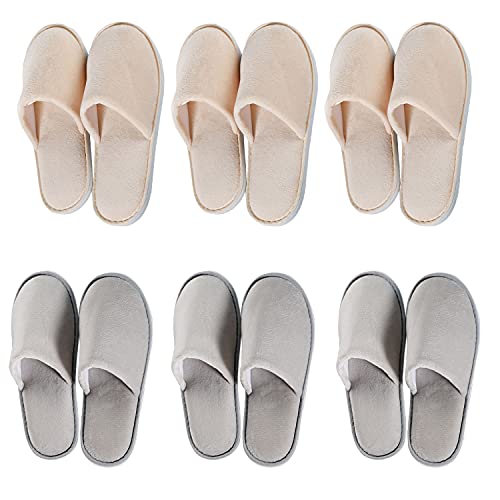
Spa Guest Slippers 6 Pairs Washable — Best Guest Set of Six
A six-pair pack changes the question from which slipper to what system. These spa-style pairs are sold for guests across home, hotel, bathroom and bedroom duty, reusable and washable per the listing, which makes them less a personal slipper than a household policy: nobody crosses your winter floors in wet socks, and nobody inherits a stranger’s pair, because six in rotation means a laundered pair is always waiting by the door.
Expect hospitality engineering rather than personal luxury. A guest pair must open wide, forgive a range of feet, enter without instruction and survive frequent washing, and those virtues trade against the moulded cushioning and exact sizing of a personal pair. The listing does not pin a single size in its title, so check the page’s own sizing before ordering for a household of known feet, and plan the laundry rhythm honestly: wash after each guest household, dry fully, and store the clean pairs where the offer actually happens, at the threshold.
- Pack quantity: six pairs, per listing
- Use: guests, home, hotel, spa settings
- Care: washable and reusable, per listing
- Sole: non-slip, per the listing
- Audience: women and men, per listing
- Size: confirm on the listing page
Strengths
- Six pairs make a real guest system
- Washable rotation keeps hospitality hygienic
- Non-slip soles suit unfamiliar bathrooms
Trade-offs
- Guest fit forgives rather than fits exactly
- Cushioning is hospitality grade, not personal
- Rotation demands cupboard and laundry discipline
Treat the six-pack as linen, not footwear, in your household systems: a shelf, a rotation, a laundry rhythm. The households that succeed with guest slippers are the ones that stop thinking of them as shoes and start thinking of them as towels with soles.
Best for: hosts who want a laundered guest pair always ready at the door
Not suited for: a single wearer seeking one perfectly fitted personal pair

HomeTop Fuzzy Loafer Slippers — Best Fuzzy Washable Loafer
HomeTop wraps the washable brief in curly fur, a grey loafer in 7-8 US whose texture does the visual work while the listing’s machine-washable claim does the practical work. The pairing matters because fuzzy uppers are the first to show a household’s life, dust at the toe, a kitchen splash at the vamp, and a pair that can be washed rather than merely brushed has a much longer social career ahead of it.
The loafer shape keeps the pair presentable through the day, and the non-slip sole extends its territory across indoor floors with brief dry outdoor excursions. Wash on the label’s terms, gently and cool, because curly pile can mat under heat and enthusiasm, and dry the pair open so the lining finishes as fresh as the upper. At the band’s upper edge the fit will begin close; the pile settles within a fortnight and the true size of the pair reveals itself, so judge it then rather than at the door.
- Stated size band: 7-8 US, grey
- Upper: fuzzy curly fur texture
- Shape: loafer for indoor outdoor wear
- Care: machine-washable, per the listing
- Sole: non-slip underfoot
- Brief: warm bedroom and home wear
Strengths
- Washable pile keeps fuzzy looks alive
- Loafer shape stays presentable all day
- Grey forgives between-wash dust
Trade-offs
- Curly pile mats if washed hot
- Band’s upper size starts close
- Pile traps lint and pet hair
Curly pile dries best shaken, not smoothed. A firm shake at the line restores the curl’s separation before drying begins, and the pair returns to the foot looking washed rather than flattened, a distinction guests of your hallway will register without knowing why.
Best for: size 7-8 wearers wanting fuzzy warmth they can actually launder
Not suited for: anyone who washes hot and expects pile to survive unchanged

EverFoams Fuzzy Slippers Cream — Best Cream Gift Pair
Cream white is a brave colour for a slipper, and EverFoams can only offer it in 9-10 US with a straight face because the listing also promises machine-washable care. The colour and the claim belong together: cream shows every hallway’s evidence within a week, and a washable pair turns that evidence into a laundry event rather than a slow surrender to beige. Buyers who love the look should buy the routine with it, a gentle wash whenever the cream dulls, full air drying, and a doorstep rule in wet weather.
The listing adds breathable and lightweight to its description, a cloud-soft positioning aimed at long indoor days, and the anti-slip sole keeps the softness honest on hard floors. Size is a band, so the 9 wears easy and the 10 wears close until the fuzzy lining settles. Nothing about a cream pair forgives neglect, yet few pairs reward care as visibly, which is precisely why it remains the gift colourway: it announces that the giver expected it to be looked after and believed the recipient would.
- Stated size band: 9-10 US, cream white
- Upper: fuzzy soft house shoe finish
- Claims: breathable, lightweight, cloud feel
- Care: machine-washable, per the listing
- Sole: non-slip and anti-slip wording
- Use: home and gift giving
Strengths
- Cream looks luxurious when freshly washed
- Washable claim makes the colour viable
- Lightweight build suits long indoor days
Trade-offs
- Cream shows dirt faster than any colour
- Needs washing more often than dark pairs
- Wet doorsteps will mark it instantly
Cream’s upkeep can be halved by a doorstep rule: this pair never crosses the threshold outward, and outdoor errands belong to a darker servant. Kept indoors, cream stays in the gentle-wash rhythm instead of the emergency-scrub rhythm that shortens its life.
Best for: size 9-10 gift buyers and cream devotees willing to wash often
Not suited for: households wanting a dark, forgiving, low-effort colourway

Snug Leaves Scuff Slippers — Best Washable Scuff
The scuff is the slipper reduced to its essence, a sole and a strap of plush, and Snug Leaves dresses it in cheetah brown faux fur for the 7-8 US band, with a TPR sole underneath and a machine-washable claim in the listing. A scuff’s openness is its maintenance advantage: no enclosed lining to trap a week’s moisture, air moving freely between wears, and a wash that dries faster than any closed shape in this guide can manage.
Pillow-soft cushioning in a scuff should be enjoyed as a surface kindness rather than a structure, because an open pair cannot hold a foot centred the way a loafer does, and hurried stairs remain a scuff’s forbidden territory. Within its true brief, bedside, bathroom, sofa, summer evenings when closed slippers feel like an overcommitment, it is superb, and the washable claim suits a shape that often serves as the household’s second, fresher pair. Cheetah brown, meanwhile, hides the dust of the weeks between washes with a pattern’s natural cunning.
- Stated size band: 7-8 US, cheetah brown
- Shape: open scuff, effortless slip-on
- Upper: plush faux fur finish
- Cushion: pillow-soft, per the listing
- Sole: anti-slip TPR construction
- Care: machine-washable, per the listing
Strengths
- Open shape airs and dries quickly
- Washable claim suits a fresh second pair
- Pattern hides dust between washes
Trade-offs
- Open back is unsafe for hurried stairs
- Cushion is surface softness, not structure
- Little warmth for midwinter ankles
An open scuff is the fastest pair in this list to move from wash to wear, which makes it the natural choice for the pair kept in a gym bag, a caravan or a hospital overnight case, where drying time is measured in hours and cupboard air is scarce.
Best for: size 7-8 wearers wanting an airy washable pair for bedside and bathroom
Not suited for: anyone needing a closed, warm, stair-secure winter slipper

RockDove Men’s Two-Tone Slipper — Best Men’s Washable Classic
RockDove’s men’s two-tone is the established citizen of this list, a memory foam slip-on in 11-12, dark grey and blue, whose listing stacks the practical claims without flourish: indoor and outdoor range, non-slip sole, machine washable, lightweight. It reads like a specification written by its owners’ feedback over years, and its two-tone panels divide exactly where wear shows first, a small design intelligence that keeps a working pair looking intentional between washes.
The washing routine for a pair this size is the standing one: gentle cycle, towel company, pressed dry of excess water, then a full day of air away from heat. The foam will take its impression and settle, as every foam in this guide does, and the pair’s defenders will tell you the settled version remains the one they reach for, because everything else, the sole’s grip, the upper’s washability, the shape’s ease, continues at full strength. Judge it as a system for keeping a large man’s daily pair clean, and it has few rivals here.
- Stated size band: 11-12, dark grey/blue
- Audience: men, original two-tone design
- Footbed: memory foam cushioning
- Care: machine washable, per the listing
- Sole: non-slip, indoor outdoor range
- Build: lightweight, skin-friendly brief
Strengths
- Complete practical specification for daily men
- Two-tone panels disguise working wear
- Washable system suits large daily pairs
Trade-offs
- Foam settles into a thinner familiarity
- Big pair dries slowly after washing
- Two-tone look will not please minimalists
When this classic eventually settles, keep it as the washing-day pair’s partner in the strictest sense: it covers the hours while its twin dries, and its own wash follows a day later, so the household’s rhythm never depends on a damp compromise.
Best for: men in the 11-12 band wanting a washable classic with outdoor manners
Not suited for: wearers who prioritise unchanging cushion loft above cleanliness
How Do the Six Compare at a Glance?
| Model | Form | Key trait | Signature strength |
|---|---|---|---|
| VeraCosy Men’s Two-Tone Washable | Men’s two-tone | Washable utility build | Resettable daily staple |
| Spa Guest Slippers 6 Pairs Washable | Guest pack | Six washable pairs | Hospitality as a system |
| HomeTop Fuzzy Loafer Slippers | Fuzzy loafer | Washable curly pile | Presentable washable warmth |
| EverFoams Fuzzy Slippers Cream | Fuzzy slipper | Cream washable finish | Giftable cloud softness |
| Snug Leaves Scuff Slippers | Scuff slipper | Open washable design | Airy plush convenience |
| RockDove Men’s Two-Tone Slipper | Men’s slip-on | Two-tone washable classic | Proven daily system |
What Does Washable Actually Promise, and What Does It Leave Out?
It promises that the maker has tested the pair through machine cycles without the sole delaminating, the upper shrinking into a smaller life, or the colours migrating into each other, provided the label’s temperature and cycle are respected. It does not promise that any wash, at any heat, with any drum companions, will end well. The distance between those two statements is where most washable slippers are ruined, usually in a single hot, hurried load.
It also leaves out the drying, which is half the process. A washed pair returned to feet while its footbed core is still damp will smell within days and compress faster for months. Treat washable as a two-part claim, a wash the label permits and a dry you perform patiently, and the pairs in this list will reward the reading. Treat it as invincibility and no maker’s testing will save the pair.
How Often Should Washable Slippers Go Through the Machine?
On evidence rather than on a calendar. The nose is the first instrument: a lining whose smell survives a night of upright airing is asking for a wash. Visible dullness at the toe and vamp is the second, especially on cream and pale pairs whose colour is their whole argument. Guest pairs run on a stricter rule, laundered after each visiting household regardless of appearances, because hospitality hygiene is about the next wearer rather than the last one.
Overwashing has its own cost, since every cycle spends a little of an upper’s texture and a sole’s adhesive patience. Most personal pairs settle into a rhythm of every few weeks in heavy season, less in summer, with spot cleaning and airing carrying the intervals. A household that rotates two pairs halves each pair’s wash frequency while doubling its drying grace, which is why rotation appears in every maintenance answer this guide gives.
Why Do Guest Slippers Deserve a System Rather Than a Spare Pair?
Because a spare pair fails socially in predictable ways. It is the wrong size for the brother-in-law, it lives in a cupboard nobody opens at the door, and it carries the unanswerable question of who wore it last. A set of washable pairs in rotation answers all three failures at once: several sizes or forgiving shapes by the threshold, a laundered pair always at the front, and a clean conscience offered along with the warmth.
The six-pair pack in this list is built for exactly that system, and its per-pair simplicity is the point. Guests need grip on an unfamiliar bathroom floor, easy entry without instruction, and warmth for an evening, not a moulded footbed fitted to somebody else’s arch. Hosts who adopt the system find the offer becomes automatic, and automatic hospitality is the kind guests actually remember.
How Should You Dry a Washed Slipper So It Keeps Its Shape?
Press, never wring, because twisting a slipper torques its sole bond and crushes foam cells unevenly, writing a lopsided impression before any foot returns. A towel rolled inside absorbs the first water and holds the upper’s shape while it does so. Then stand the pair upright, toes open, in moving room air, and give the process a full day for closed shapes and large men’s sizes, whose cores hold water longest.
Heat is the seductive error. A radiator promises speed and delivers warped soles, shrunken knit and foam aged a season in an afternoon. Sunshine through a window is gentler but can fade cream and pale colours unevenly, so choose shade with airflow over drama. A pair is dry when the footbed feels room-temperature and neutral all the way through a firm thumb press, not when its upper merely feels dry to a passing hand.
Which Washable Shape Suits Bare Feet Best Between Washes?
Open shapes forgive barefoot wear longest. A scuff exposes its footbed to air on every removal, so moisture escapes instead of accumulating in an enclosed lining, and the interval between necessary washes stretches. Closed loafers and fuzzy shoes worn barefoot deliver more warmth and more trapped moisture in the same hour, and their owners should expect a faster laundry rhythm as the honest price of the cosier arrangement.
Socks rewrite the arithmetic for every shape. A thin sock absorbs the day’s moisture into a layer that washes hotter and dries faster than any slipper, and households serious about freshness often find that sock-wearing doubles a closed pair’s comfortable interval. The choice is comfort philosophy rather than correctness: barefoot devotees should favour open or frequently washed pairs, and sock wearers can enjoy enclosed warmth with a clearer conscience.
What Should You Check on the Label of a Delivered Pair?
Four lines matter. The temperature ceiling, because fuzzy pile and curly textures mat permanently above it. The cycle instruction, since gentle is a structural requirement for glued soles, not a courtesy. The drying line, which separates air-dry pairs from the rare tumble-tolerant ones. And the size and origin panel, worth comparing against the listing while returns are still simple, because a mislabelled band discovered in week one is a refund and discovered in month two is a grievance.
Photograph the label before the first wash. Ink on care tags fades across a winter of cycles, and the household that keeps a picture keeps the instructions. This small habit, applied to every washable pick in this guide, prevents the most common and most avoidable failure in the whole category: a good pair ruined by a well-meaning wash that its maker never approved.
How Do Washable Slippers Change a Household With Pets?
They become the only sustainable kind. Pet households feed slippers a diet of hair, garden dust and the occasional muddy greeting at the door, and an unwashable pair absorbs that diet until it becomes part of the problem it was bought to solve. A washable pair sheds the week in the machine, and its sole can be wiped at the threshold, so the slipper stops ferrying the garden across the kitchen it was meant to keep clean.
Choose colours like a pet owner rather than a stylist. Greys, two-tones and patterns carry the intervals between washes with dignity, while cream becomes a part-time job. Keep the pet household’s pair by the door it actually uses, wash on the label’s rhythm rather than the calendar’s, and let a second rotating pair cover drying days. The animals will not notice the system, which is the highest praise a household system can earn.
When Does Washing Stop Reviving a Pair?
When the sole or the structure, rather than the smell, has become the problem. Washing resets hygiene and appearance; it cannot restore tread polished smooth at the heel, foam compressed into a hard map, or an upper whose seams have begun to grin. A pair that emerges clean from its wash and still feels thin, slippery or shapeless has told you its retirement date in the clearest language available.
Demote before you discard. A retired washable pair with dry-ground grip remaining can serve the garden door or the basement, washed less tenderly and worked without sentiment. What it should not do is remain the bathroom pair, because wet tile is where a polished sole collects its debt. Cleanliness kept a pair pleasant; only structure ever kept it safe.
How Do You Build a Laundry Rhythm a Household Will Actually Keep?
Attach it to a rhythm that already exists. Slippers washed with the weekly towel load inherit a schedule nobody has to remember, provided colours and labels allow the company, and a pair that joins the bedding wash gets the same free discipline. Standalone special loads for footwear are the first casualty of a busy month, and a washable pair whose wash never happens is an ordinary pair with a promising label.
Keep the infrastructure embarrassingly simple: a basket where the waiting pair lives, a shelf where the clean pair waits, and a rule that the swap happens on the same day each week. Systems survive on geography more than on willpower. When the clean pair is closer than the dirty one, the household chooses clean without ever making a decision about hygiene.
What Temperatures and Cycles Do Washable Slippers Actually Prefer?
The label’s, stated without romance, but the pattern across washable footwear is consistent enough to describe: cool to warm water rather than hot, a gentle cycle rather than a workwear battering, mild detergent in modest quantity, and company in the drum so no single item takes the machine’s whole argument. Heat is the recurring villain, matting pile, shrinking knit and stressing the bonds that hold a sole to its upper.
Drying belongs to the same paragraph because it is the same decision. Air, shade, moving room, time. Every shortcut through heat spends the pair’s structure to buy back hours, and the exchange rate worsens with every repetition. A household that plans its washing a day ahead of need never has to make that bad trade, which is the entire practical argument for owning two pairs.
Why Do Hotels and Spas Choose This Kind of Slipper?
Because their problem is throughput with hygiene, the same problem a hospitable household has at a smaller scale. A spa pair must fit a stranger in seconds, grip a wet-adjacent floor without instruction, survive industrial laundering rhythms, and present as fresh to a guest who will judge the whole establishment by it. Nothing personal, moulded or delicate survives those requirements, which is why the type converges on simple, washable, forgiving shapes everywhere in the world.
Copy the professionals’ logistics rather than their luxury. Multiple pairs, a strict wash between users, storage at the point of offer, and disposal without sentiment when structure fades. A home that runs its guest slippers like a small, kind hotel finds the system costs less attention than the apologetic spare-pair cupboard it replaces.
How Should Washable Slippers Be Handled After Illness in the House?
With a prompt wash on the label’s warmest permitted setting, a complete dry, and no sharing until both are done. Slippers live closer to floors and bathrooms than any other garment, and a household recovering its health should treat its washable pairs as part of the linen reset, alongside towels and bedding, rather than as footwear exempt from the general amnesty.
This is a housekeeping practice, described as such, and it is one of the strongest practical arguments for the washable category itself. A pair that cannot be laundered after a sick week simply carries the week forward. The washable pairs in this list, laundered on their labels’ terms and dried with unusual thoroughness, close the chapter cleanly, which is what a home recovering its rhythm most wants from its objects.
What Is the Environmental Honest Case For and Against Washable Pairs?
For: a washable pair is a longer-lived pair, and longevity is the largest environmental variable in footwear, outweighing most material debates. A slipper washed and worn for three winters displaces two replacements, and a guest system of reusable pairs displaces the disposable alternative entirely. Against: every wash spends water and energy, and synthetic piles shed fibres, so the rhythm should be evidence-led rather than compulsive, washing when the pair needs it instead of on a fixed guilt schedule.
The balanced household washes in full loads it was running anyway, dries in air it already has, rotates to halve frequency, and retires pairs for structure rather than for fashion. That routine makes the washable claim an environmental asset in practice, which is the only place environmental claims about household objects are ever really decided.
How Do You Keep a Washable Pair’s Sole Grippy Across Many Washes?
The tread’s enemies are heat and residue. Hot washes and hotter drying soften and polish tread compounds a fraction at a time, while fabric conditioner, the laundry’s kindness to towels, coats a sole in a film that quietly deletes its grip. Wash slippers without conditioner, at the label’s temperature, and the sole that emerges is the sole that went in, minus the week’s evidence.
Inspect the tread when you hang the pair, the way you would glance at a tyre. A pattern still crisp at heel and ball means the safety system is intact; a pattern polished smooth means the next wash should be the pair’s last in bathroom service, however fresh it smells. Cleanliness can be restored indefinitely. Grip, once spent, is spent, and the distinction is the whole retirement doctrine of this guide.
How Do You Spot-Clean Between Washes Without Wasting the Rhythm?
A damp cloth, a drop of mild detergent and thirty seconds at the moment the mark happens will carry most pairs an extra week between machine washes. Kitchen splashes, garden dust at the vamp and the grey tide-mark of a hallway all surrender more easily fresh than baked, and a sole wiped at the threshold stops being a ferry for the outdoors. Spot care is not a substitute for washing; it is what makes the washing rhythm sustainable instead of frantic.
Keep the kit where the slippers live, a cloth and a small bottle by the door or the bed, because a spot-clean that requires a cupboard expedition will be postponed until it requires a machine. The households that keep washable pairs looking washed are not more virtuous; their equipment is simply closer to the evidence.
Why Does the First Wash Matter More Than Any Other?
Because it is the pair’s examination under your machine’s conditions. Colours prove their fastness or confess their ambitions, pile proves it can survive your drum’s company, and the sole’s bond proves the maker’s claim in the only laboratory that matters, yours. Wash a new pair early, gently and observed, rather than late and desperately, and any weakness declares itself while the returns conversation is still simple.
The first wash also sets the household’s habits. A pair whose first cycle is cool, gentle and air-dried teaches its owner the routine by success; a pair whose first cycle is a hot emergency teaches only regret. Treat the maiden wash as part of the purchase, scheduled in the first fortnight alongside the fit test, and the washable claim becomes a demonstrated property of your pair instead of a hope printed on its box.
How Should a Household With One Machine Share Washing Capacity Fairly?
By giving slippers a standing seat in loads that already run, rather than a solo performance. A pair in the towel load, a guest set in the bedding load, colours respected and labels obeyed, costs the household almost nothing in water or time, while a dedicated slipper cycle is the first thing a busy week deletes. Fairness here is mostly logistics: the dirtiest jobs, guest pairs after visitors, go first in the queue when illness or a full house has stretched the rhythm.
Write the rhythm where the machine lives, a small note of which load takes which pair, and the system survives the household’s memory. Washable slippers fail socially long before they fail mechanically, usually in the gap between a good intention and a Tuesday. A note on the wall closes that gap more reliably than any resolution.
How Do You Wash a Pair When Someone in the House Has Sensitive Skin?
With the detergent question moved to the front. Use the mildest detergent that cleans, in the smallest effective quantity, and give the pair an extra rinse where your machine allows one, because a slipper holds rinse water in its footbed longer than a shirt holds it in a sleeve, and residue left behind is worn against skin for hours. Dry with unusual completeness before the pair returns to feet, since damp plus residue is the combination that sensitive skin notices first.
Keep a sensitive household’s slippers on their own side of the laundry’s geography where possible, washed with the towels and bedding that already use the household’s trusted detergent rather than with workwear’s stronger chemistry. The washable claim makes this choreography possible; a pair that could not be laundered would simply accumulate everything its owner’s skin objected to, in the layer closest to the objection.
What Does a Washing Machine Do to a Sole Over Fifty Cycles?
It negotiates with the bond, a little each time. Water works at edges, agitation flexes the joint between sole and upper, and heat, where owners ignore labels, softens adhesives in small increments that no single wash reveals. Fifty gentle, cool cycles are a life the makers of these pairs have tested for; fifty hot, violent ones are a different experiment with a predictable result, conducted at the owner’s expense.
The owner’s part of the contract is inspection. A sole whose edge begins to lift should be retired from wet-floor duty even if the pair still washes beautifully, because the bond’s failure will complete itself on a bathroom floor rather than in the drum. Washing extends a pair’s hygienic life indefinitely; it extends its structural life only when the structure is watched, and the watching takes five seconds at the line.
How Should Guest Pairs Be Stored Between Visits to Stay Fresh?
Washed, fully dried, and stored open to the air in the place they will be offered from. A guest pair sealed damp into a plastic box in a spare-room cupboard will greet its next wearer with the smell of its storage, undoing the entire point of the system. A basket or an open shelf near the door, where the clean pairs stand in the household’s moving air, keeps them neutral for months and visible at the moment of need.
Refresh by rhythm rather than by emergency. A pair unused for a season deserves a wash before its next offering regardless of its apparent cleanliness, because storage writes its own quiet history into fibres. The system’s promise to a guest is not merely a clean pair but a pair whose freshness the host can state without crossing any fingers, and that promise is kept in the storage, not in the wash.
Why Is Drying Space the Hidden Cost of a Washable Household?
Because every wash creates a day of drying, and drying occupies the scarcest resource in most homes: horizontal space in moving air. A household that washes six guest pairs at once has committed a rack, a rail or a landing to the cause until tomorrow, and a household without that space will quietly stop washing, which is how washable systems die in practice. Plan the drying geography before the laundry geography, a rack that lives where air moves, a rail that is nobody’s obstacle.
Stagger the washes to fit the geography. Two pairs a day through a small rack beats six pairs in a fortnightly crisis that colonises a room. The households that sustain washable routines for years are the ones whose drying never becomes an event, and that, more than any detergent or temperature, is the infrastructure on which this entire category stands.
How Do You Handle a Pair That Comes Out of the Wash Still Holding a Smell?
Diagnose before repeating. If the pair was dried slowly in still air, the smell is probably a drying artefact, and a second wash followed by a fast, airy dry, outdoors in shade or before a fan, will clear what the first cycle loosened. If the pair dried quickly and still holds its history, the fibres themselves have absorbed all they can forgive, and further washing becomes a ritual without a result, performed for the owner’s conscience rather than the pair’s future.
Demote such a pair honestly, to the garden door or the garage, where its remaining structural life is still useful and its smell is among its peers. The washable system’s discipline includes knowing when washing has stopped being the answer, because a household that cannot retire a pair will eventually distrust the whole category for one pair’s refusal to be saved.
How Should Washable Slippers Travel?
In their own washable bag, which is the whole system in miniature. A pair in a suitcase corner touches everything it has walked on to everything it will be worn beside, and a simple cloth bag, itself laundered with the pair, keeps the geography separate. At the destination the pair works as it does at home, on cold rental floors and unfamiliar bathroom tile, with its non-slip sole earning its luggage space at the first midnight crossing.
On the return journey the bag earns its keep a second time, isolating a travelled pair until its wash. Households that travel with washable slippers develop a particular loyalty to the category, because the pair is the one piece of home that can be made genuinely fresh at both ends of a journey, and freshness, in a strange house, is most of what home means.
Why Do Some Washable Pairs Shrink and Others Never Do?
Because washable is a tested claim about a specific construction, not a property of slippers in general. A pair built for the machine uses materials and bonds chosen to survive its maker’s stated cycle; a pair that shrinks was either washed beyond its label’s terms or was never built for the treatment its owner assumed. The label’s temperature is the border between the two stories, and it is printed, small and complete, inside every pair in this list.
Fit insurance follows from that fact: wash a new pair early, inside its returns window and on its label’s exact terms, and any shrinkage declares itself while the remedy is an exchange rather than a grievance. The first wash is therefore part of the fitting, as real as the evening measurement, and households that treat it so almost never own a shrunken pair they cannot return.
How Do You Wash Slippers in a House Without a Machine of Its Own?
By hand, in a basin, with the same discipline the machine imposes automatically: lukewarm water, mild detergent, immersion without violence, and pressing rather than wringing when the water leaves. A soft brush takes the vamp and the sole’s tread where a basin’s soak cannot reach, and two rinses matter more than one soak, because detergent left in a footbed is worn against skin for days. Laundrette users should choose the gentlest machine, the coolest honest temperature, and a mesh bag as the pair’s passport through a public drum.
Drying is the hand-washer’s real work, since no spin cycle has done the first half of it. Roll the pair in a towel and stand on the roll, gently, to press out the basin’s water, then give the pair the full day of moving air its core demands. A hand-washed pair dried completely is every bit as fresh as a machine-washed one; the method differs, the standard does not, and the standard is dryness, not machinery.
Why Does a Washable Pair Belong in Every Hospital and Care Bag?
Because institutional floors are cold, unfamiliar and walked at the worst hours, and a known pair with a non-slip sole is a small piece of home that also happens to be safety equipment. The VIFUUR-style sock shoe and the open scuff in this list pack flat, weigh nothing and ask nothing of a tired wearer, which is why listings name hospital duty without embarrassment. A washable pair matters doubly in that setting, because it can be laundered on the return home and closed back into the household’s ordinary life without carrying the ward with it.
Pack the pair where a hand finds it first, with the socks and the wash things, and choose the pair whose entry needs no bending and no balance. Families who have packed one hospital bag well tend to keep a second, smaller version ready, a lesson learned in a corridor at 3 a.m. that no checklist teaches as well. The slipper is the smallest item in the bag and, hour for hour, very often the most used.
What Is the First Thing to Do When a Washable Pair Arrives?
Read its label against its listing before the first wearing, while the comparison costs nothing. Confirm the temperature, the cycle and the drying instruction match what the product page promised, photograph all three panels, label included, and then run the maiden wash inside the first fortnight on exactly those terms. A pair that survives its own label in your own machine has converted a marketing claim into a demonstrated property of your household, and every later wash is a repetition rather than an experiment.
Check the fit again after that first wash and dry, because the pair you will live with is the washed pair, settled and honest, not the showroom pair that arrived in tissue. If the band has tightened beyond the label’s reasonable behaviour, the exchange conversation is still simple. This small ceremony, fifteen minutes of reading and one planned wash, is the difference between owning a washable system and owning a hope with a care tag.
What Mistakes Do Buyers Make Most Often?
Washing hot against the label is the fastest way to ruin a washable pair, matting pile and shrinking uppers in a single cycle. Second comes tumble or radiator drying, which warps soles while promising speed. Third, washing a guest pair only when it looks dirty, which misunderstands hygiene entirely.
Fourth, returning a pair to feet while its core is still damp, then blaming the foam for the smell. Fifth, expecting washing to restore tread or cushioning it cannot touch. Finally, buying a cream pair without buying its laundry rhythm, then resenting the colour for telling the truth about your hallways.
Final Recommendation
Build the system around the Spa Guest Slippers 6 Pairs Washable at the door, the VeraCosy Men’s Two-Tone Washable for large daily feet, and the HomeTop Fuzzy Loafer Slippers where fuzzy warmth must survive its own laundry, washing each on its label’s terms and drying each without heat.
A clean pair by the door changes how a house receives people, starting with the people who live there.
Frequently Asked Questions
Can I wash these slippers with my regular laundry?
Yes, with conditions: a gentle cycle at the label’s temperature, mild detergent, and towels in the drum to cushion the load. Avoid washing with anything bearing hooks or rough Velcro that can tear pile and knit. Remove the pair promptly and begin air drying at once.
How do I stop washed slippers smelling again within days?
Dry them completely before wearing, since residual core damp is the usual culprit, and air them upright between wears. If the smell persists through a proper wash and a full dry, the lining’s fibres have likely absorbed all they can forgive and the pair is nearing demotion.
Are the guest slippers one-size, and will they fit everyone?
The listing presents them for women and men without pinning one size in its title, so confirm the page’s sizing before ordering. Guest shapes forgive a range rather than fitting anyone exactly, which is the right bargain for hospitality, paired with non-slip soles for unfamiliar floors.
Will machine washing damage memory foam inside a slipper?
Only when the label’s terms are ignored. Where a maker claims machine washable, gentle cold cycles are the tested route; heat, wringing and fast spins are what injure foam and sole bonds. Press water out with a towel and air dry away from radiators.
How many washable pairs should one person own?
Two is the honest minimum for a daily wearer, so one can dry fully while the other works. Rotation halves each pair’s wash frequency, doubles drying grace, and keeps a clean pair available on the morning after wash day rather than a damp compromise.
Related Guides
A washable hallway leads naturally toward the labels and care questions in our other home guides. Start with Best Dearfoams Slippers for Women, continue to Best Bathtubs and Surrounds, and finish with Best Meat Thermometers With Folding Probe.


