What's inside
- Key Takeaways
- Quick Picks
- How We Chose These Picks
- Which of the Best Dearfoams Slippers for Women Fits Your Routine?
- How Do the Six Compare at a Glance?
- How Do You Tell Dearfoams Sisters Apart When the Names Blur?
- What Does a Gift-List Honour Actually Tell a Buyer?
- Why Does Terry Deserve More Respect Than It Gets?
- Closed Back or Clog: Which Dearfoams Architecture Fits Your House?
- How Should Wide Widths Change the Way You Choose?
- What Care Does Genuine Shearling Ask That Synthetics Do Not?
- Why Does Ankle Coverage Matter More Than Pile Depth in a Cold House?
- How Should You Gift a Dearfoams Pair Without Guessing Wrong?
- How Has Dearfoams Built a Range Out of Sisters Rather Than Sizes?
- What Should You Do When Your Size Sits Between a Band and a Medium?
- Why Do Wide Widths Matter More in Slippers Than in Shoes?
- How Do You Rotate Sisters Across a Week at Home?
- What Makes a Slipper Feel Like a Gift Rather Than a Purchase?
- How Long Should a Dearfoams Pair Serve Before Its Sister Replaces It?
- How Do You Read a Dearfoams Size Chart Without Guessing?
- Why Does the Same Brand Feel Different Across Its Own Range?
- How Should Sisters Be Handed Down or Passed On Inside a Family?
- How Do You Choose a Sister for a House With Both Stairs and a Bathroom Circuit?
- What Should You Expect From Chenille After a Season of Wear?
- How Does the Beth Boot Change a Morning in an Old House?
- Why Should a Gift Buyer Read the Care Label Before the Colour?
- How Does a Dearfoams Drawer Handle the Change of Seasons?
- Why Do Some Sisters Cost More, and What Does the Difference Buy?
- How Do You Match a Sister to a Particular Room of the House?
- Why Should You Photograph Your Favourite Pair Before It Wears Out?
- What Is the Last Comparison to Make Before Choosing a Sister?
- What Mistakes Do Buyers Make Most Often?
- Final Recommendation
- Frequently Asked Questions
- Related Guides
As an Amazon Associate I earn from qualifying purchases. This post may contain affiliate links at no extra cost to you.
cottageverdict.com is reader-supported. When you buy through links on our site, we may earn an affiliate commission.
Where to buy: the six Dearfoams pairs below are sold on Amazon, with links in the Quick Picks table, each review heading and the comparison table, where you can check price on Amazon and confirm sizes, widths and colours for the exact model. The best Dearfoams slippers for women are a family rather than a single product, six sisters sharing a surname and differing in material, architecture and temperament, and this guide’s first job is to keep them distinct.
Leslie is not Rebecca with a different colour, and the Hannah’s knit is not the Darcy’s velour. Every review below names its model’s defining material and shape before anything else, states its sizing as the listing states it, and records where a gift-list note appears in a listing without mistaking that note for a measurement of quality.
Key Takeaways
- Tell sisters apart by material: knit, terry, chenille, velour, boot, shearling.
- The Leslie is the washable terry clog; the Rebecca is the closed chenille shoe.
- Wide widths appear on the Leslie and Rebecca listings, a fit fact worth using.
- A gift-list note signals giftability, never a guarantee of fit or quality.
- Closed backs and the Beth boot seal warmth at the ankle where draughts enter.
- Shearling and suede ask for airing and brushing rather than routine washing.
Quick Picks
| Pick | Badge | Why it earns its place |
|---|---|---|
| Dearfoams Hannah Chenille Clog | Best Chenille Knit Clog | A latte chenille knit clog in 9-10, named in the listing among a well-known annual gift selection. |
| Fireside Dearfoams Sydney Shearling | Best Genuine Shearling Option | A chestnut shearling slip-on in size 8 with suede, memory foam and naturally water resistant wording. |
| Dearfoams Leslie Washable Clog | Best Washable Terry Clog Wide | A washable terry clog in iceberg, medium, with wide widths and memory foam in its listing. |
| Dearfoams Rebecca Closed Back | Best Closed-Back Chenille | A sleet chenille closed-back pair in 7-8 with wide widths and a lightweight cozy brief. |
| Dearfoams Darcy Velour Clog | Best Velour Quilted Cuff | A black microfiber velour clog in medium US with a quilted cuff, the smooth sister of the range. |
| Dearfoams Beth Foldover Boot | Best Foldover Boot Style | A grey frost boot slipper in medium with a foldover cuff, the ankle-covering sister of the six. |
How We Chose These Picks
All six picks had to be genuine Dearfoams women’s models, verified as such in their listings, and together they had to span the range’s real diversity rather than six colourways of one shoe. Materials were catalogued first: chenille knit, genuine shearling with suede, terry, chenille in a closed back, microfiber velour, and a foldover boot. Architectures came second: clogs, slip-ons and closed shapes each represented.
Sizing and widths were transcribed exactly as listed, including single sizes, bands, mediums and wide-width options, because within one brand those declarations still differ by model. Gift-list mentions were noted as listing context only. No model was allowed to borrow another’s defining claim, so the washable terry and the shearling’s water resistance stay with their rightful owners.
Which of the Best Dearfoams Slippers for Women Fits Your Routine?

Dearfoams Hannah Chenille Clog — Best Chenille Knit Clog
The Hannah is Dearfoams at its most knitted: a chenille knit clog in latte, sized 9-10, whose yarn upper gives it the softness of a favourite jumper translated into footwear. A clog shape means the entry is a single downward step, no heel to coax, and the knit stretches gently over the instep rather than presenting a structured throat. The listing notes a prominent annual gift-list honour, which we record as the listing’s own framing rather than as a quality measurement; the quality case rests on the knit, the colour and the shape’s ease.
Distinguish the Hannah from its same-brand sisters by material before anything else: this is the knit one, where the Leslie is terry, the Rebecca is chenille in a closed back, and the Darcy is velour with a quilted cuff. The Hannah’s knit will yield in width as it warms and will snag if it meets rough fastenings in a wash basket, so its care should be read on the delivered label and followed gently. In latte, it hides household dust more kindly than cream while keeping the pale, giftable look that made it a list-maker’s favourite.
- Stated size band: 9-10, latte
- Upper: chenille knit construction
- Shape: open clog, step-in entry
- Brand line: Dearfoams women’s range
- Listing note: named a 2024 gift favourite
- Care: follow the delivered label
Strengths
- Knit softness flatters end-of-day feet
- Clog entry needs no hands at all
- Latte hides dust between cleanings
Trade-offs
- Knit snags on rough wash companions
- Open back is insecure on hurried stairs
- Gift fame is not a fit guarantee
Keep the Hannah’s knit out of the towel wash’s rough company and it will repay you in texture. A gentle cycle among soft things preserves the chenille’s close surface, and the latte colour emerges looking chosen rather than survived.
Best for: size 9-10 wearers who want a knitted clog with a soft, pale finish
Not suited for: anyone needing a closed heel for stairs or long standing

Fireside Dearfoams Sydney Shearling — Best Genuine Shearling Option
The Sydney belongs to the Fireside line, Dearfoams’ step toward real materials: genuine shearling, a suede outer in chestnut, a stated size 8, and memory foam beneath. Shearling behaves unlike any synthetic pile in this guide, because the wool is still attached to its hide, regulating temperature in both directions and wearing a season’s use into a personal fit rather than into tiredness. The listing calls the suede naturally water resistant, which should be read precisely: it shrugs light splashes and damp grass, and it is not a waterproofing promise for wet pavements.
Durable outsoles extend this pair’s territory further outdoors than most of its sisters, within the dry-ground discipline every slipper obeys. The size is a single stated 8, so this is a pair for that foot exactly, bought with the knowledge that shearling compresses and moulds rather than stretches sideways. The listing also notes a 2024 gift-list appearance, recorded here as context. Among six Dearfoams, the Sydney is the one to choose when material authenticity, rather than washability or price of care, leads the decision.
- Stated size: 8, chestnut
- Upper: suede with genuine shearling
- Water note: naturally resistant, per listing
- Footbed: memory foam cushioning
- Outsole: durable, indoor outdoor brief
- Line: Fireside by Dearfoams
Strengths
- Real shearling regulates warmth both ways
- Suede ages into a personal fit
- Durable outsole extends dry territory
Trade-offs
- Single size 8 excludes other feet
- Shearling needs gentler care than synthetics
- Water resistant is not waterproof
The Sydney rewards a brush and a windowsill more than any product. Air it after long evenings, brush the suede’s nap in one direction, and let the shearling breathe back to neutrality; a pair treated so will smell of wool and leather, pleasantly, for years.
Best for: a size 8 buyer who values genuine shearling and suede above washability
Not suited for: anyone wanting a machine-easy synthetic pair or wet-weather range

Dearfoams Leslie Washable Clog — Best Washable Terry Clog Wide
The Leslie is the practical sister: a terry clog, iceberg in colour, medium in its stated sizing with wide widths offered in the listing, and washable in its very name. Terry cloth is the towelling of hotel robes, absorbent, unpretentious and built to be laundered, which makes the Leslie the Dearfoams for bathrooms, post-shower circuits and households that wash first and ask questions later. Its clog shape keeps entry instant, and the wide-width option answers the foot shape that standard bands most often disappoint.
Tell the Leslie apart from the Rebecca, with which it shares a first-name familiarity in the range: the Leslie is the open terry clog built around washing, while the Rebecca is a closed-back chenille shoe built around enclosure. Memory foam sits under the terry, performing its standard arc, and because a clog is so easily slipped off, its foam often enjoys a lighter daily load than a closed pair’s. Wash on the label’s terms, dry fully, and the terry will keep its looped freshness through far more cycles than a pile upper tolerates.
- Sizing: medium, wide widths in listing
- Upper: terry cloth, washable brief
- Colour: iceberg in this listing
- Shape: open clog, step-in entry
- Footbed: memory foam cushioning
- Territory: bathroom and home circuits
Strengths
- Terry is built for repeated laundering
- Wide widths serve overlooked feet
- Clog entry suits post-shower routines
Trade-offs
- Terry absorbs spills as readily as water
- Open back limits stair confidence
- Foam settles as all foam does
Wash the Leslie with the bathroom’s own rhythm, after the week’s showers have taken their toll, and hang it where the bathroom’s air moves. Terry dries with a looped freshness that makes the next wearing feel like a hotel’s small luxury at home.
Best for: wide-footed wearers wanting a washable clog for bathroom and home
Not suited for: anyone needing closed-heel security or deep winter enclosure

Dearfoams Rebecca Closed Back — Best Closed-Back Chenille
The Rebecca closes the back, and that single architectural decision separates it from half its family. In sleet chenille, sized 7-8 with wide widths in the listing, it wraps the heel the Hannah and Leslie leave open, so the foot stays centred through stairs, hurried crossings and long standing spells. Chenille gives it a soft, woven hand distinct from the Darcy’s smooth velour and the Leslie’s looped terry, a texture that reads as upholstery for the foot in the best sense.
Lightweight and cozy is the listing’s own summary, and the closed back makes the coziness structural rather than merely thermal, because a heel held is a foot that does not work to keep its shoe. Memory foam beneath follows the family pattern of early generosity and gradual settling. Wide widths in a closed back deserve emphasis, since wide feet in open clogs often spill sideways, while the Rebecca’s enclosure gives width a boundary to rest against. For buyers torn between the sisters, the Rebecca is the answer when security and softness must arrive together.
- Stated size band: 7-8, sleet chenille
- Widths: wide widths in the listing
- Back: fully closed heel enclosure
- Upper: chenille woven texture
- Footbed: memory foam cushioning
- Build note: lightweight cozy brief
Strengths
- Closed heel stays centred on stairs
- Wide widths gain a real boundary
- Chenille softness with secure structure
Trade-offs
- Less airy than open sisters in summer
- Foam impression deepens with use
- Band’s upper size begins close
The Rebecca’s closed back keeps its shape best stored upright rather than crushed in a basket’s bottom. A shoe horn’s gentleness is unnecessary, but a moment’s care at the heel, guiding rather than trampling it down, preserves the enclosure that is this pair’s whole argument.
Best for: size 7-8 and wide-footed wearers wanting softness with a secure heel
Not suited for: anyone who prizes hands-free open entry above security
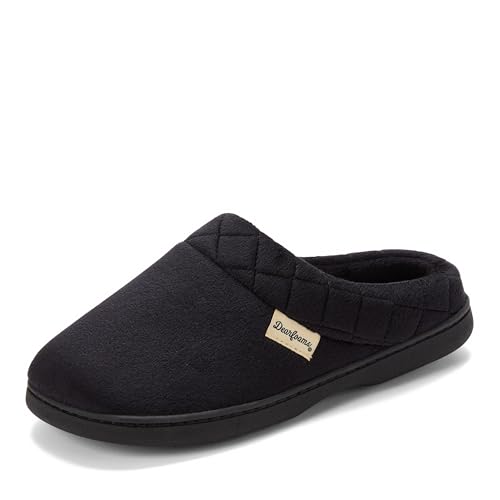
Dearfoams Darcy Velour Clog — Best Velour Quilted Cuff
The Darcy is the smooth one: microfiber velour in black, medium US in its stated sizing, finished with a quilted cuff that gives the clog a dressed edge its terry and knit sisters do not attempt. Velour’s short, dense pile catches light rather than dust, which makes black in velour look deeper than black in fleece, and the quilted cuff frames the ankle with a detail borrowed from jackets. As a clog it keeps the family’s step-in ease, admitting the foot without hands or bending.
Distinguish it by touch in your mind’s hand: velour slides, terry loops, chenille weaves, shearling breathes. The Darcy suits the wearer who wants a slipper that can answer the door looking intentional, and its black colourway carries evenings and visitors with the least explanation. The listing does not headline washability for this model the way the Leslie’s name does, so treat its care label as the authority and expect gentler handling than the terry pair. Medium sizing should be matched against the maker’s chart rather than assumed from a shoe size.
- Sizing: medium US, black
- Upper: microfiber velour finish
- Detail: quilted cuff at the ankle
- Shape: open clog, step-in entry
- Brand line: Dearfoams women’s range
- Care: follow the delivered label closely
Strengths
- Velour looks dressed for answering doors
- Quilted cuff adds a finished detail
- Black carries evenings without explanation
Trade-offs
- Care is gentler than the terry sister
- Open back limits hurried movement
- Medium sizing needs chart confirmation
Velour shows fingerprints of dust more honestly than pile, so the Darcy benefits from a lint roller’s weekly pass, ten seconds that keep black looking deep. Store it away from the knit pairs whose fibres migrate toward its smooth surface.
Best for: wearers wanting a smooth, dressed clog in black for home evenings
Not suited for: anyone needing a headline washable pair like the terry Leslie

Dearfoams Beth Foldover Boot — Best Foldover Boot Style
The Beth rises where its sisters stop. A boot slipper in grey frost, medium in stated sizing, with a foldover cuff that can stand tall around the ankle or fold down into a collar, it is the Dearfoams for houses where the cold arrives at ankle height, through draughty doors and uninsulated floors. That extra coverage changes the warmth equation more than any pile depth can, because ankles are where most slippers surrender their heat to the room.
The foldover design is two silhouettes in one purchase: boot for the morning’s cold circuit, collar for the milder evening, and the adjustment takes a second with cold fingers, which is when such features are actually used. Grey frost is the diplomatic colour, pale enough to feel wintry and deep enough to survive a hallway. Sizing stated as medium should be checked against the maker’s own chart, and the boot’s enclosure means a thick sock must be included in that calculation from the start rather than negotiated with later.
- Sizing: medium, grey frost
- Shape: boot slipper, ankle coverage
- Cuff: foldover, tall or folded
- Brand line: Dearfoams women’s range
- Territory: cold floors and draughty halls
- Care: follow the delivered label
Strengths
- Ankle coverage seals the draught gap
- Foldover cuff offers two silhouettes
- Boot enclosure holds the foot securely
Trade-offs
- Too warm for mild rooms and summer
- Medium sizing requires chart checking
- Taller upper dries slower after cleaning
The Beth’s cuff should be dried in the position you wear it, folded or tall, because a boot upper takes a set as it dries. Choose the tall dry after washing and the cuff will stand to its work on the coldest morning without persuasion.
Best for: cold-ankled wearers in draughty houses wanting boot coverage at home
Not suited for: anyone in a warm flat who overheats in enclosed footwear
How Do the Six Compare at a Glance?
| Model | Form | Key trait | Signature strength |
|---|---|---|---|
| Dearfoams Hannah Chenille Clog | Knit clog | Chenille knit upper | Soft giftable ease |
| Fireside Dearfoams Sydney Shearling | Shearling slip-on | Suede and real shearling | Material authenticity first |
| Dearfoams Leslie Washable Clog | Terry clog | Washable wide fit | Bathroom-ready practicality |
| Dearfoams Rebecca Closed Back | Closed-back slipper | Sleet chenille enclosure | Secure soft structure |
| Dearfoams Darcy Velour Clog | Velour clog | Quilted cuff detail | Dressed door-answering ease |
| Dearfoams Beth Foldover Boot | Boot slipper | Foldover ankle cuff | Draught-sealing coverage |
How Do You Tell Dearfoams Sisters Apart When the Names Blur?
By material and architecture, never by name alone, because the range reuses friendly first names across different constructions. The Hannah is a chenille knit clog, soft and yarn-like. The Leslie is a terry clog, looped like towelling and built around washing. The Rebecca is chenille again but closed at the back, a woven shoe rather than a clog. The Darcy is smooth microfiber velour with a quilted cuff. The Beth is a boot with a foldover cuff. The Sydney leaves the synthetic family entirely for suede and genuine shearling.
Hold those six definitions and the range becomes legible: choose the material your skin and laundry prefer, then choose the architecture your stairs and habits require. Buyers who shop by name similarity end up with a washable expectation attached to a gentle-care pair, or an open clog delivered to a household that needed a closed heel. The name is the label on the drawer; the material is what is inside it.
What Does a Gift-List Honour Actually Tell a Buyer?
That editors found the product giftable, which is a real but narrow verdict. A gift-list slipper is usually soft, photogenic, forgiving in its sizing band and priced within the etiquette of giving, and the Hannah and Sydney in this list carry such a note in their listings. What the honour cannot tell you is whether the size band fits your recipient, whether the material suits their laundry habits, or whether a clog’s open back suits their staircase.
Use the honour as a tiebreaker between two pairs that already fit the facts, not as a substitute for the facts. The most successful slipper gifts in this range are arguably the wide-width Leslie and Rebecca, whose fit generosity matters more to a recipient than any list maker’s blessing. Fame opens the drawer; fit decides whether the pair stays in it.
Why Does Terry Deserve More Respect Than It Gets?
Because terry is engineered humility. Its loops exist to absorb water and survive laundering, two unglamorous competences that matter more in a bathroom slipper’s actual life than any pile’s first-week luxury. A terry clog worn after showers, washed without ceremony and dried without fear will still be serving honestly in the season when a delicate knit has been retired for its own protection.
Terry also tells the truth about its condition. It does not hide a spill inside deep pile or disguise a tired lining under fluff; what you see is what the pair has left. Households that value that legibility, and feet that run wide and are served by the Leslie’s widths, often find terry the most trustworthy material in the whole Dearfoams drawer.
Closed Back or Clog: Which Dearfoams Architecture Fits Your House?
Count your stairs and your errands. A house lived on one level, with slippers working between bed, bathroom and sofa, flatters the clog’s instant entry, and the wearer gains seconds at every single transition of the day. A house with stairs in constant use, children to carry and doors to answer at pace argues for the closed back, whose heel keeps the shoe a partner in movement rather than a passenger that might stay behind on a step.
Warmth follows the same division. An open clog ventilates, suiting warm flats and summer evenings, while a closed back or the Beth’s boot holds heat around the ankle where draughts hunt. Many households end with one of each, a clog by the bed and a closed pair by the door, and the range’s pricing across sisters makes that two-pair answer more reasonable than forcing one architecture to serve two houses’ worth of duties.
How Should Wide Widths Change the Way You Choose?
They should move fit from a hope to a specification. A wide foot in a standard banded slipper does not merely feel snug; it spills over the footbed’s edge, misaligning the cushion and wearing the upper’s seam with every step. The Leslie and Rebecca in this list state wide widths in their listings, which means the volume was designed rather than stretched, and that difference is felt most at the end of a long day when feet are at their widest.
Buy the width your evening foot needs, not the width your morning shoe claims. Measure or judge after a day on your feet, include your usual sock, and remember that a clog’s openness forgives width at the heel while punishing it at the vamp, where the strap must contain the forefoot. A closed wide shoe like the Rebecca gives width a boundary all the way around, which many wide-footed wearers experience as relief rather than restriction.
What Care Does Genuine Shearling Ask That Synthetics Do Not?
Patience and restraint. Shearling and suede, the Sydney’s materials, prefer airing to washing, a soft brush to a soak, and shade to the radiator’s aggressive drying. They repay that gentleness with a longevity and a personal moulding that synthetics rarely match, because the material is a hide and a fleece in their original partnership rather than a simulation of one. The listing’s naturally water resistant wording buys tolerance for splashes, not permission for puddles.
Households should choose with their laundry temperament in view. A home that washes everything weekly will find the Sydney’s restraint a friction, and the terry Leslie exists precisely for that home. A home that airs, brushes and rotates will watch the Sydney improve for seasons. Neither temperament is wrong; matching the material to it is the whole decision.
Why Does Ankle Coverage Matter More Than Pile Depth in a Cold House?
Because heat escapes at openings faster than it conducts through insulation. A deep-piled slipper with an open ankle is a well-insulated cup with no lid, losing warmth to every draught that crosses the floor, and old houses specialise in exactly that floor-level weather. The Beth’s boot and foldover cuff close the opening, and the Rebecca’s closed heel seals the second-largest gap, which is why wearers often report a modest boot feeling warmer than a luxurious open clog in the same room.
Test your own house before choosing. Sit in your usual evening chair and notice where the cold touches first; for most people in draughty rooms it is the ankle and the top of the foot, not the sole. Buy coverage for the place the cold actually enters, and pile depth becomes a pleasant secondary decision instead of an expensive answer to the wrong question.
How Should You Gift a Dearfoams Pair Without Guessing Wrong?
Choose forgiveness in every dimension the range offers. A banded size over a single size, a wide option where feet are unknown, a washable material where laundry habits are unknown, and a colour that survives a real hallway. By those rules the Leslie and the grey-toned Rebecca are the safest gifts in this six, while the single-size shearling Sydney is the finest gift only when the size is known with certainty, ideally from a shoe you have seen the recipient wear.
Include the household’s truth with the present: permission to exchange the size without offence, stated cheerfully and in advance. A slipper is intimate apparel for the floor, and even a beloved brand cannot make a wrong band comfortable. The gift that survives is the one whose giver treated fit as part of the kindness rather than as an administrative detail.
How Has Dearfoams Built a Range Out of Sisters Rather Than Sizes?
By treating material as identity. Most slipper ranges vary colour and call it choice; this one varies the substance against the skin, knit, terry, chenille, velour, wool-rich shearling, and then varies the architecture, clog, closed shoe, boot, so that two wearers with the same shoe size can need entirely different Dearfoams. It is a wardrobe logic applied to the floor, and it explains both the range’s loyalty and its confusion, since names alone cannot carry that much difference.
The practical consequence is that brand loyalty should be to the system, not to a model. A household can trust the sizing charts’ honesty, the widths where offered and the care labels’ specificity, while still needing to choose freshly between sisters every time the duty changes. The terry clog that serves the bathroom owes nothing to the shearling that serves the study, except a surname and a standard of labelling.
What Should You Do When Your Size Sits Between a Band and a Medium?
Trust the model’s own chart over any conversion you invent, because a medium in one sister is not promised to equal a band in another. Measure the foot in the evening, add your sock, and compare against the chart for the exact model in your basket. Where two designations both claim you, choose by architecture: a clog forgives a fraction of extra room, while a closed back punishes a fraction of shortage at the heel with every step.
Order with the returns window in mind and test indoors on clean floors through a real evening. Dearfoams’ breadth means the right sister in the right designation almost certainly exists; the buyer’s task is detective work, not endurance. A pair that needs breaking in beyond a fortnight’s settling was the wrong designation wearing a hopeful disguise.
Why Do Wide Widths Matter More in Slippers Than in Shoes?
Because slippers are worn at the day’s end, when feet are at their widest, and because their soft uppers offer none of the structured negotiation a leather shoe performs across a morning. A wide foot in a standard slipper does not break the slipper in; it breaks it down, spilling over the footbed, stressing seams and misaligning the cushion whose comfort justified the purchase. The discomfort arrives disguised as tiredness, and owners often blame their feet for what their width was never offered.
The range’s wide options on the Leslie and Rebecca therefore deserve to be read as headline features, not footnotes. A designed width gives the forefoot a floor of its own and the upper a boundary it can hold, and the difference is largest exactly when slippers work hardest, in the evening’s long domestic shift. Measure width as seriously as length, in the evening, and the whole category becomes more comfortable.
How Do You Rotate Sisters Across a Week at Home?
By duty rather than by day. The terry clog owns the bathroom and the post-shower hour. The closed chenille owns the stairs and the working day. The knit or velour clog owns the evening’s soft circuit, and the boot owns the cold morning in a draughty house. Shearling owns the study, the reading chair and the long, still hours where its regulation matters most. A household that assigns duties stops asking one pair to be five, and each pair lasts longer for being asked less.
Rotation also rests every foam in the drawer, since even sisters share the family’s footbed material. A Dearfoams drawer run on duty rotation will outlast a single premium pair worn for everything, and it costs its owner nothing but the small pleasure of choosing the right sister at the right doorway.
What Makes a Slipper Feel Like a Gift Rather Than a Purchase?
Softness at first touch, a colour chosen for the recipient rather than for the giver’s hallway, and a fit that does not require the recipient to perform gratitude through discomfort. The listings in this guide that carry gift-list notes earned them on the first two counts; the third is the giver’s responsibility, discharged by choosing banded sizes, wide options and washable materials wherever the recipient’s facts are uncertain.
Presentation finishes the work. A pair given with its exchange path stated cheerfully, and with the household’s one piece of wisdom attached, wash it on its label and dry it in air, arrives as care rather than as merchandise. Slippers are intimate gifts, worn against skin in the house’s most private hours, and the ones remembered are the ones whose giver thought about the wearing, not the wrapping.
How Long Should a Dearfoams Pair Serve Before Its Sister Replaces It?
Judge by the family’s shared witnesses: the footbed’s recovery under a thumb, the sole’s tread at the heel, and the upper’s ability to hold its architecture, a clog’s throat, a closed back’s enclosure, a boot’s cuff. Materials retire at different speeds, terry outlasting knit in rough service, shearling outlasting both when its gentler care is actually given, so the calendar matters less than the model’s own evidence.
Demotion is the range’s graceful exit. A retired bathroom pair becomes the garden-door pair; a settled foam becomes the guest basket’s forgiving spare, washed between households. What a retired pair should never remain is the stair pair, because every sister in this drawer, whatever her material, owes her wearer an honest grip on the steps she climbs half-asleep.
How Do You Read a Dearfoams Size Chart Without Guessing?
Start with the foot, not the shoe collection. Trace it on paper in the evening, in the sock you will wear, and measure the longest line in the units the chart prefers. Then find that line inside the model’s own designations, remembering that a band, a medium and a single number are three different languages spoken by three different sisters. Where your line falls at a boundary, let architecture arbitrate: upward for a closed back that must contain the heel, downward only for an open clog with room to spare.
Keep the tracing. It outlives the purchase and turns every future sister into a thirty-second decision instead of a fresh investigation, and it settles the household’s arguments about who wears what size with evidence instead of memory. The chart is the brand speaking precisely; the tracing is you answering precisely, and fit lives in the conversation between the two.
Why Does the Same Brand Feel Different Across Its Own Range?
Because the range varies the two things a foot actually notices: what touches the skin and what holds the heel. A terry loop, a chenille weave, a velour nap and a shearling fleece are four different climates against the same foot, and a clog, a closed back and a boot are three different promises about movement. A wearer loyal to one sister may genuinely dislike another, not because quality changed but because climate and promise did, and both were the real product all along.
This is why the reviews in this guide lead with material and architecture before any other virtue. A Dearfoams purchase is two decisions wearing one name, and the buyers who make both decisions deliberately are the ones who describe the brand as reliable. The brand’s consistency lives in its labelling, its widths and its care instructions; the comfort lives in the match, and the match is yours to make.
How Should Sisters Be Handed Down or Passed On Inside a Family?
With a wash, a sole inspection and an honest description of the foam’s age. A settled pair still has real service in it for a lighter wearer or a less demanding duty, and families waste money retiring slippers whose only fault is that their first owner’s diary is written into the footbed. The recipient should know the pair is settled rather than new, because expectations calibrated honestly are what make a hand-me-down feel like generosity instead of leftovers.
What should never be handed on is a pair whose tread has polished or whose heel enclosure has collapsed, because safety does not transfer as a discount. Pass on warmth, pass on softness, pass on the guest-basket role with its wash between households, and retire without sentiment the pair whose grip has gone. A family’s slipper drawer, like its tool drawer, should be honest about which items are still instruments and which are now souvenirs.
How Do You Choose a Sister for a House With Both Stairs and a Bathroom Circuit?
By refusing to choose, in the range’s own spirit. The bathroom circuit wants terry, washability and a clog’s instant entry at the shower’s edge; the stairs want a closed heel and a sole that stays with the foot at pace. One pair asked to be both will be a compromise at the two moments a house is least forgiving, the wet threshold and the dark staircase, and the range’s breadth exists precisely so that no wearer has to accept that bargain.
Put the Leslie by the bathroom door and the Rebecca by the bed, and let each own its territory completely. The combined cost is less than the cost of the fall or the ruined pair that the compromise eventually arranges, and the daily experience is better in both rooms. Sisterhood, in this drawer, is a division of labour, and households that divide the labour get the brand’s whole argument instead of half of it twice.
What Should You Expect From Chenille After a Season of Wear?
A softening of its hand and a settling of its weave, in the places the foot works hardest. Chenille’s woven pile flattens a little at the vamp where the foot bends, and its colour evens out across the pair as light and wear distribute themselves. None of this is failure; it is the material becoming upholstery that has been sat in, familiar rather than showroom. A chenille pair judged at its first week is being judged as a photograph, and judged at its first season as a possession.
Care can slow the settling without pretending to stop it. Keep chenille out of rough wash company, let it dry in air rather than heat, and store the Rebecca upright so its closed back keeps the line the maker lasted. The pair that emerges from a season with its architecture intact and its weave merely settled has done everything its material ever promised, and it will do it again next winter.
How Does the Beth Boot Change a Morning in an Old House?
An old house keeps its cold at ankle height, in the draught that travels under doors and along skirting from room to room like a low weather system. Ordinary slippers, however deep their pile, leave the ankle standing in that weather, and the wearer feels the house’s age at every crossing. The boot’s cuff closes the border where the weather enters, and the morning changes character: the kitchen is reached warm, the bathroom is not an expedition, and the house feels smaller because none of its rooms are being avoided.
That is why boot slippers punch above their price in period homes and feel like overkill in modern flats, where the draught system does not exist. Buy architecture for your building’s actual climate, not for the climate in the product photograph, and the Beth becomes either the most important pair in this guide or an honourable irrelevance, depending entirely on the age of your doors.
Why Should a Gift Buyer Read the Care Label Before the Colour?
Because the recipient will live with the label weekly and the colour only visually. A washable terry pair given to a household that launders everything will be loved in the machine’s rhythm; the same household given a gentle-care shearling will either ruin it with kindness or resent it with restraint, and both outcomes are the giver’s fault for shopping by palette. The label is the pair’s maintenance personality, and matching it to the recipient’s laundry personality is the gift’s real thoughtfulness.
Read in this order: care first, width second, size third, colour last. It feels backwards in the shop and obvious by February, when the well-matched pair is still in daily service and the beautiful mismatch is in a cupboard. Dearfoams prints its labels clearly and its sisters’ differences honestly, so the information is all available at the moment of purchase; the discipline of reading it in the right order is the only part the brand cannot supply.
How Does a Dearfoams Drawer Handle the Change of Seasons?
By promotion and demotion rather than by storage. Spring asks the boot to step back and the clog to step forward; the terry pair moves from the bathroom’s winter duty to the garden door’s summer mornings, washed more often and worn more lightly; the shearling rests, aired and brushed, in the coolest cupboard rather than the warmest. A drawer that rotates its sisters with the year keeps every material in the conditions it prefers, and no pair spends a season being the wrong answer.
Resist sealing any pair away in plastic for a season. Materials that breathe, wool, terry, chenille, want air in their rest as much as in their work, and a pair stored sealed can emerge with a smell that takes a wash and a week to forgive. Open shelves, a cool room and an occasional airing are the whole storage technology this range asks for, and they are cheaper than the boxes they replace.
Why Do Some Sisters Cost More, and What Does the Difference Buy?
Mostly material honesty. Genuine shearling with suede is a hide and a fleece in their original partnership, cut and lasted like footwear, and it prices like the material it is. Synthetics price by their engineering instead: a terry built to be laundered weekly, a chenille woven to a consistent hand, a velour finished to hold its nap. Within the range, money buys either a rarer material or a more demanding specification, and both are legitimate purchases when they match the duty the pair will actually serve.
What money does not buy inside one brand is a different size truth. The chart’s honesty, the widths where offered and the labels’ specificity are the same across the drawer’s prices, which is why this guide keeps returning to fit and care as the real decisions. A modest terry clog that fits, washes and grips will outserve a premium shearling in the wrong size on the wrong stairs, every night of the winter, and the price difference will not console a single one of those nights.
How Do You Match a Sister to a Particular Room of the House?
Room by room, the range resolves itself. The bathroom votes for terry and a clog, because its floor is wet-adjacent, its hours are short and its laundry is constant. The study votes for shearling or a closed chenille, because its wearer sits still for hours and its cold arrives slowly. The kitchen votes for a closed back and a sole with manners, because its floor is hard, its spills are real and its wearer is standing, turning and carrying. The bedroom votes for whichever pair the sleeper’s midnight geography prefers, and its vote outranks all the others because it is cast half-asleep.
A household that lets rooms choose stops arguing about which sister is best in the abstract, a question this guide has refused to answer for six reviews because it has no answer. Best is a room, a duty and a foot arriving at an agreement, and the range’s whole design, its materials and architectures in parallel, exists to let that agreement be reached six different ways inside one trusted brand.
Why Should You Photograph Your Favourite Pair Before It Wears Out?
Because memory is a poor catalogue. When a beloved pair finally retires, its replacement hunt begins from a feeling rather than from facts, and feelings misremember sizes, materials and even brands with complete confidence. One photograph of the pair, one of its label and one of its size panel, taken in its prime, turns the replacement into a search instead of an investigation, and in a range of sisters with similar names it can be the difference between reordering the Rebecca and accidentally adopting the Leslie.
Keep the photographs with the household’s other quiet archives, the paint colours, the filter sizes, the boiler’s birthday. A house runs on such numbers, and a slipper’s are among the cheapest to record and the most annoying to reconstruct from a worn label in a dark cupboard. The pair that served you best deserves to be findable again, and thirty seconds of photography is the whole price of that loyalty.
What Is the Last Comparison to Make Before Choosing a Sister?
Stand in the room where the pair will work most and read the six definitions against that room’s evidence: its floor, its draughts, its stairs, its laundry. The bathroom will keep choosing terry, the study will keep choosing shearling or chenille, the stairs will keep choosing the closed back, and the cold morning will keep choosing the boot, no matter how the colours argue. A room does not care about a product photograph, and its verdict, reached honestly, is the one the winter will confirm.
Then check the two unglamorous panels one final time, the size chart for that exact model and the care label’s terms against your household’s real habits. A sister chosen by her room, her chart and her label has nothing left to surprise you with except comfort, and in a range built on sisters who share a surname and nothing else, that absence of surprise is the whole prize.
What Mistakes Do Buyers Make Most Often?
Buying a sister by name similarity is the signature Dearfoams mistake: expecting the Darcy’s gentle care to behave like the Leslie’s washable terry, or the open Hannah’s ease to hold a heel like the Rebecca. Second comes treating a gift-list honour as a fit promise and skipping the size chart. Third, washing shearling and suede with synthetic enthusiasm.
Fourth, choosing a clog for a house ruled by stairs, or a boot for a warm flat. Fifth, ignoring the wide widths the range actually offers and forcing an evening foot into a morning width. Finally, gifting a single-size model on a guessed size, when the banded, wide and washable sisters were designed to forgive exactly that uncertainty.
Final Recommendation
Choose the Dearfoams Leslie Washable Clog for washable terry practicality and wide feet, the Dearfoams Rebecca Closed Back when a secure heel must meet chenille softness, and the Fireside Dearfoams Sydney Shearling in its exact size 8 when genuine materials lead, keeping the knit Hannah for soft clog evenings.
Within one surname there is a whole household of temperaments, and the right sister is the one whose material matches your laundry and whose shape matches your stairs.
Frequently Asked Questions
What is the difference between the Leslie and the Rebecca?
Material and architecture together. The Leslie is an open clog in washable terry, offered with wide widths and built for bathroom and laundry-friendly duty. The Rebecca is a closed-back shoe in sleet chenille, also with wide widths in its listing, built for enclosure and security on stairs.
Are any of these Dearfoams machine washable?
The Leslie carries washable in its model name and listing, reflecting its terry construction. Other sisters should be cared for strictly by their delivered labels, and the shearling Sydney in particular prefers airing and brushing to any machine routine.
What does medium sizing mean in these listings?
It is the maker’s own size designation for those models rather than a shoe number, so it must be matched against Dearfoams’ chart for that model, with your usual sock included. Do not translate it from another brand’s medium or from a favourite trainer.
Which Dearfoams pair is warmest for a draughty house?
The Beth boot, because its foldover cuff covers the ankle where floor-level draughts enter, sealing the opening that open clogs leave exposed. The closed-back Rebecca is the next warmest architecture, while deep pile in an open clog loses heat at its opening.
Is the shearling in the Sydney genuine?
The listing describes the Fireside Sydney as shearling with suede and memory foam, and we report it on those terms. Its naturally water resistant wording means tolerance of light splashes, not waterproofing, and its care should stay gentle, with airing preferred over washing.
Related Guides
A single-brand drawer connects to the filtration and care decisions elsewhere in the house. Start with Best HEPA Bagged Canister Vacuums, continue to Best Apartment Size Freezers, and finish with Best Nespresso Machines for Lattes.



[…] hallway leads naturally toward the labels and care questions in our other home guides. Start with Best Dearfoams Slippers for Women, continue to Best Bathtubs and Surrounds, and finish with Best Meat Thermometers With Folding […]