What's inside
- Key Takeaways
- Quick Picks
- How Did We Choose These 48-Inch Vanities?
- How Do the Six Compare?
- Why Is 48 Inches the Standard Alcove Sweet Spot?
- How Do You Fit a 48-Inch Vanity Into a Standard Alcove?
- Which Top Materials Appear at This Width, and How Do They Behave?
- What Mistakes Do 48-Inch Buyers Make?
- How Does Living With 48 Inches Actually Feel?
- How Should You Choose Among Three Finishes From One Maker?
- What Does Installation Day Look Like at This Width?
- How Do Mirrors and Storage Companions Complete a 48?
- What Happens When the Household Changes Around a 48?
- How Do You Judge Drawer and Door Quality in the Showroom?
- Why Does This Width Suit Resale Without Being Boring?
- How Do You Care for Each Finish Family?
- What If Your Alcove Is Almost, but Not Quite, Standard?
- How Does a 48 Handle Two People Without Two Basins?
- What Should You Photograph Before Ordering?
- How Do You Keep a Standard Width From Looking Standard?
- What Is the Maintenance Calendar for a 48-Inch Vanity?
- How Should a First-Time Renovator Use This Guide?
- What Role Does the Faucet Play at This Width?
- How Do You Decide the Vanity Is the Right Height?
- What Is the Quiet Case for Buying Once, Properly?
- How Do Guests Experience a Well-Chosen 48?
- Final Recommendation
- Frequently Asked Questions
- Related Guides
As an Amazon Associate I earn from qualifying purchases. This post may contain affiliate links at no extra cost to you.
cottageverdict.com is reader-supported. When you buy through links on our site, we may earn an affiliate commission.
Where to buy: all six vanities are sold through Amazon, and each linked name opens its listing, where you can check price on Amazon and confirm the top, basin and finish details against the alcove you have measured at home.
The best 48-inch bathroom vanities occupy the sweet spot of bathroom design, and it is worth pausing on why forty-eight inches keeps winning. Thirty-six feels like a compromise in a family bathroom, sixty demands a wall many homes do not have, but forty-eight delivers a full-size basin, genuine counter aprons on both sides, and storage with real depth, all inside the standard alcove that builders have been framing for generations. If your bathroom was designed on a plan, it was very likely designed around this width.
Six vanities compete for that alcove here, and they disagree about almost everything except the measurement: three come from one furniture maker’s family in onyx, walnut and sage; one is a drawer system wearing a quartz top; one arrives fully assembled with its mirror included; and one wraps the whole combination in light walnut. The guide’s job is to match those personalities to rooms and households, because at a standard width, character is the real variable.
Key Takeaways
- Forty-eight inches fits the standard alcove while keeping real counter space.
- James Martin supplies three finishes here: onyx, walnut and sage green.
- The sage Brittany includes a Silestone quartz top, backsplash and basin.
- The Hepburn counters with nine dovetail drawers around one basin.
- The Benton arrives fully assembled with mirror and marble top included.
- Light walnut from DELUXE LIVING suits bright, wood-warmed schemes.
Quick Picks
| Pick | Badge | Why it earns its place |
|---|---|---|
| James Martin Brittany 48 Inch Vanity Black Onyx | Best Dark Statement | Black onyx cabinetry with quartz backsplash, the dramatic furniture piece. |
| James Martin Amberly 48 Inch Vanity | Best Warm Walnut Tone | Mid-century walnut warmth with a rectangular basin, calm and crafted. |
| James Martin Brittany 48 Inch Vanity Sage Green | Best Colour With Quartz Top | Sage green with a white Silestone quartz top, backsplash and sink included. |
| ARIEL Hepburn 48 Inch Vanity | Best Drawer System | Nine dovetail drawers and Carrara-toned quartz, the organiser’s choice. |
| Benton Collection 48 Inch Vanity | Best Arrives Assembled | Cream marble top, mirror included, fully assembled in cherry brown tradition. |
| DELUXE LIVING 48 Inch Vanity Light Walnut | Best Light Wood Combo | Light walnut combo with ceramic basin, three drawers and soft-close doors. |
How Did We Choose These 48-Inch Vanities?
Every candidate first had to honour the width: a basin scaled to an adult’s real routine, counter aprons that accept a tray and a tumbler without negotiation, and storage that uses the cabinet’s depth instead of decorating its front. Vanities that spent their forty-eight inches on styling while shrinking the basin were dismissed, because the sweet spot is a functional idea before it is a dimension.
We then weighted completeness and construction. Tops and backsplashes included, mirrors bundled where they are, solid frames and dovetail joinery, soft-close hardware: these are the signals of a vanity built for a decade of mornings. Finally we insisted on range, because a standard width serves period cottages and new-build ensuites alike, and a guide offering six white boxes would have failed the size it celebrates.

James Martin Brittany 48 Inch Vanity Black Onyx — Best Dark Statement
In black onyx, the Brittany stops being bathroom equipment and becomes the room’s portrait: panelled cabinetry with a lacquer-deep darkness, set off by a quartz backsplash and a rectangular basin. James Martin builds at furniture grade, and it shows in the proportions, which borrow from washstand history rather than from kitchen cabinetry. In a pale room the effect is deliberate and gallery-like; towels, chrome and greenery all arrange themselves around it.
The dark finish is a practical actor as well as a dramatic one. It forgives the scuffs and splashes of daily service that white cabinets confess instantly, while asking, in fair exchange, for a dusting rhythm, because dust writes pale on black. The quartz elements at the wet zones keep the maintenance story sensible, so the owner’s care goes into the cabinetry’s appearance rather than into stain anxiety.
This is the forty-eight for a household renovating once and meaning it: a primary ensuite in a period home, a guest bathroom intended to be remembered. Buyers who need maximum drawer filing should cross-examine the Hepburn below; buyers who need a room to have a centre of gravity have found it.
- Width: 48 inches
- Finish: black onyx
- Package: quartz backsplash, rectangular basin
- Maker: James Martin Vanities
- Style: traditional furniture grade
Strengths
- Instant centre of gravity for pale rooms
- Dark finish forgives scuffs and splashes
- Furniture-grade panelled construction
Trade-offs
- Dust shows pale between cleans
- Fewer drawers than system rivals
- Statement colour commits the scheme
Best for: period homes and guest ensuites wanting a memorable piece
Not suited for: renovators choosing character at the standard width

James Martin Amberly 48 Inch Vanity — Best Warm Walnut Tone
The Amberly speaks in a warmer accent: mid-century walnut, with the grain doing the decorating that paint does elsewhere. Its rectangular basin keeps the top’s geometry calm, and the whole piece suits bathrooms that lean toward timber floors, brass fittings and the softer modernism currently displacing clinical white. Where the onyx Brittany commands a room, the Amberly converses with it.
Walnut’s gift is temperature. A north-facing bathroom in white can feel like a clinic at dawn; the same room around walnut feels like a cabin’s civilised cousin, especially under warm lighting. The finish also mediates gracefully between the pale top elements and darker floors, a translator’s role that makes decorating around it unusually easy. Households torn between traditional and modern often discover walnut is the treaty both sides sign.
As with its siblings, the construction is the quiet argument: a maker’s line built as furniture, intended to be kept. Pair it with simple mirrors and unpatterned textiles and let the grain carry the room’s pattern budget alone, because walnut, given competition, merely looks busy, while given space, it looks expensive.
- Width: 48 inches
- Finish: mid-century walnut
- Basin: rectangular sink
- Maker: James Martin Vanities
- Style: warm transitional
Strengths
- Walnut warms cold-feeling bathrooms
- Grain replaces pattern elegantly
- Transitional style suits many schemes
Trade-offs
- Wood tone wants harmonious fittings
- Grain competes with busy textiles
- Premium furniture positioning
Best for: north-facing and wood-leaning bathrooms
Not suited for: households bridging traditional and modern tastes

James Martin Brittany 48 Inch Vanity Sage Green — Best Colour With Quartz Top
The sage Brittany may be the most complete single listing in this guide: the Brittany cabinet in a soft sage green, delivered with a three-centimetre White Zeus Silestone quartz top, its backsplash and a rectangular basin. Sage is the colour of the current cottage revival for good reason, green enough to be a decision, grey enough to live with, and it flatters both chrome and brass while making white towels look freshly laundered by association.
Silestone quartz brings the engineered virtues, consistency, stain resistance, no sealing calendar, in a bright white that sets the green cabinetry off like a frame. The package completeness matters practically: top, splash and basin resolved by the maker means the installation is a fitting exercise rather than a composition exam, and the colour story arrives guaranteed to harmonise because it was chosen at the factory.
Choose sage when the bathroom wants colour with an exit strategy. Green cabinetry can be repainted in a future scheme more gracefully than most statement finishes, and meanwhile it delivers the calm, botanical register that makes small bathrooms feel like garden rooms. Of the three James Martin entries, this is the one guests will photograph and the one most likely to start conversations about paint charts.
- Width: 48 inches
- Finish: sage green
- Top: White Zeus Silestone quartz, 3cm class
- Included: backsplash and rectangular basin
- Maker: James Martin Vanities
Strengths
- Complete top package included
- Sage flatters chrome and brass alike
- Quartz top needs no sealing
Trade-offs
- Colour is a commitment for now
- White top shows daily debris
- Botanical tone suits some schemes only
Best for: cottage-revival bathrooms wanting gentle colour
Not suited for: buyers wanting top, splash and basin resolved

ARIEL Hepburn 48 Inch Vanity — Best Drawer System
The Hepburn at forty-eight inches is the engineer’s answer to the James Martin poetry: solid wood, a Carrara-toned quartz top with backsplash, a single rectangular porcelain basin, and nine dovetail drawers working with two soft-close doors to file an entire household. Where the Brittany pieces ask how a vanity should look, the Hepburn asks how it should behave at six forty-five on a wet Tuesday, and its answer is: drawers, opened with one finger, revealing everything.
Nine drawers at this width is a small marvel of planning, possible because a single trap leaves the cabinet’s other flank free for a full drawer bank. The quartz top removes stone care from the household’s calendar, and the white finish keeps the composition bright against coloured walls. In family service, this is the vanity whose specification reads like a checklist written by the people who clean the bathroom.
It lacks the furniture romance of the onyx and walnut pieces, and its engineered veining will not fool a stone lover at close range. But households run on organisation more than on romance, and for them the Hepburn is the sweet spot’s sweet spot: standard width, maximum system.
- Width: 48 inches, single basin
- Top: Carrara white quartz with backsplash
- Storage: nine dovetail drawers, two doors
- Cabinet: solid wood, white
- Basin: rectangular porcelain
Strengths
- Drawer system files a whole household
- Quartz top, zero sealing duties
- Soft-close everything, quiet mornings
Trade-offs
- Engineered veining, not real marble
- White finish needs regular wiping
- Less furniture character than rivals
Best for: families whose bathroom runs on organisation
Not suited for: households wanting quartz ease at standard width

Benton Collection 48 Inch Vanity — Best Arrives Assembled
The Benton competes on a promise the others do not make: it arrives fully assembled, in a traditional freestanding cherry brown frame, with a cream marble top, undermount basin and its mirror included. For households whose renovation energy is finite, a vanity that skips the flat-pack weekend entirely and completes its own picture, mirror and all, is not a compromise; it is the entire appeal, honestly stated.
Cream marble is the gentle face of real stone, warmer than Carrara’s grey veining and kinder to schemes built on creams and wood. It carries marble’s terms, sealing and prompt wiping, in exchange for a genuine quarried surface. The traditional styling, raised panels, cherry warmth, suits period bathrooms and cottages where the James Martin pieces might feel a degree too polished.
Fully assembled also means fully formed for delivery: measure the journey as carefully as the alcove, because this piece will not fold itself around a stair turn. Households with easy access gain a vanity with the least installation friction in the guide; households with difficult stairs should weigh the assembled convenience against the carry, honestly and in advance.
- Width: 48 inches, single sink
- Top: cream marble
- Included: mirror, fully assembled
- Finish: cherry brown, traditional
- Basin: undermount
Strengths
- No assembly weekend required
- Mirror included, picture complete
- Real marble in warm cream tones
Trade-offs
- Marble care terms apply
- Assembled size challenges tight stairs
- Traditional style is a firm direction
Best for: period bathrooms and cottages wanting instant completeness
Not suited for: renovators whose energy budget excludes flat-pack
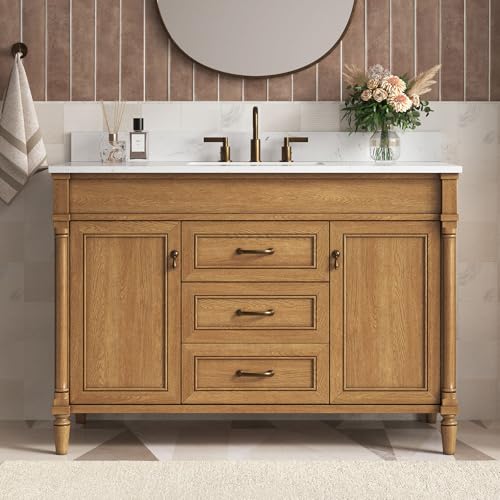
DELUXE LIVING 48 Inch Vanity Light Walnut — Best Light Wood Combo
The DELUXE LIVING entry wraps the combination in light walnut: a solid wood framed cabinet with countertop and backsplash, a ceramic basin, soft-closing doors and three dovetail drawers. Light walnut is the bright answer to the Amberly’s deeper grain, suited to Scandinavian and Japandi-leaning bathrooms where the palette runs pale and the wood is asked to warm without darkening.
Three drawers is the honest middle of this guide’s storage range, enough to file the daily categories while the doored section takes towels and bottles, and the soft-close hardware keeps the routine quiet. The ceramic basin keeps the wet zone simple and replaceable in character, a practical counterpoint to the stone and quartz elsewhere. As a combo, it is the most relaxed purchase here: nothing to compose, nothing to seal, nothing to assemble into a personality it does not already have.
Choose it when the room’s light is precious and its style leans calm. Darker vanities drink light; this one returns it, and in a small forty-eight-inch alcove that brightness is a functional feature, not merely an aesthetic one. Households wanting drama should look to the onyx; households wanting daylight should end their search here.
- Width: 48 inches, sink combo
- Finish: light walnut
- Frame: solid wood, soft-close doors
- Storage: three dovetail drawers plus cabinet
- Basin: ceramic sink with backsplash
Strengths
- Bright wood returns light to small rooms
- Balanced drawers and cupboard storage
- Combo arrives conceptually complete
Trade-offs
- Pale wood shows marks more than dark
- Three drawers, not nine
- Calm style will not supply drama
Best for: bright, pale bathrooms in Scandinavian spirit
Not suited for: households wanting an easy, complete combo
How Do the Six Compare?
| Pick | Form | Standout trait | Watch out for |
|---|---|---|---|
| James Martin Brittany 48 Inch Vanity Black Onyx | 48 inch, dark finish | Statement furniture presence | Dust visible on black |
| James Martin Amberly 48 Inch Vanity | 48 inch, walnut | Warm transitional grain | Needs harmonious fittings |
| James Martin Brittany 48 Inch Vanity Sage Green | 48 inch, sage | Complete Silestone package | Colour commitment |
| ARIEL Hepburn 48 Inch Vanity | 48 inch, white | Nine-drawer organisation | Engineered veining |
| Benton Collection 48 Inch Vanity | 48 inch, cherry | Assembled, mirror included | Stair access for delivery |
| DELUXE LIVING 48 Inch Vanity Light Walnut | 48 inch, light walnut | Bright complete combo | Pale wood marks readily |
Why Is 48 Inches the Standard Alcove Sweet Spot?
Building history made forty-eight the default: alcoves framed for a tub’s neighbour, plumbing roughed at a standard centre, and generations of vanities manufactured to the width keep its ecosystem rich, tops, mirrors and cabinets all readily available. Choosing the standard width is therefore also choosing the deepest market, the easiest replacements and the simplest future changes, an unglamorous advantage that compounds over a house’s life.
Function ratifies what history chose. At forty-eight, a single basin can be genuinely full-sized while the counter keeps aprons wide enough for the tray, the tumbler and the folded towel that smaller widths force into the basin’s orbit. Storage below reaches the volume where drawers become worthwhile and doors stop being caves. Shrink six inches and each of those virtues erodes; add twelve and the room, not the vanity, becomes the constraint.
The sweet spot also disciplines design. With width fixed and generous, makers compete on finish, joinery and storage intelligence, exactly the axes this guide has judged. A household shopping at forty-eight inches is shopping in the category’s most contested, best-developed territory, and the six here are what that competition produces at its best.
How Do You Fit a 48-Inch Vanity Into a Standard Alcove?
Measure the alcove at three heights, because walls lean and old plaster waves, and work from the smallest number. A vanity that fits at floor level may bind at counter height against an out-of-plumb wall, and the difference is discovered with the unit in the room unless the tape measure found it first. Leave a small tolerance and plan filler strips where the design allows, because a deliberate shadow gap looks fitted while a forced fit looks like an argument.
Confirm the plumbing centre against the vanity’s interior before ordering. Drawer banks, the Hepburn’s pride, must clear the trap, and the makers publish their interior layouts for exactly this check. Note the floor’s level across the alcove, since a four-foot span shows slope honestly at the top’s edge, and plan shimming rather than hoping. Finally, rehearse the journey from door to alcove with a tape and, for the assembled Benton, with particular humility.
Which Top Materials Appear at This Width, and How Do They Behave?
Quartz carries three of the six here, in Carrara tones on the Hepburn, in White Zeus Silestone on the sage Brittany, and as backsplash elements on the onyx, because at this family width its forgiveness suits the rooms forty-eight inches usually serves. It asks for no sealing, tolerates toothpaste and toner, and keeps its installation-day face for years, which is why busy households keep choosing it with their eyes open about its engineered origins.
Real marble appears once, in the Benton’s cream, offering the quarried alternative for households that prefer stone’s terms to quartz’s consistency. Ceramic, on the DELUXE LIVING combo’s basin, reminds readers that the basin and the top are separate decisions wearing one name. Judge each surface by the household that will wipe it, and the width will take care of itself.
What Mistakes Do 48-Inch Buyers Make?
The commonest error is measuring the alcove once, at its widest, and ordering to that number. The second is falling for a finish in showroom light that the bathroom’s north window will reinterpret unkindly, walnut going muddy, sage going grey, onyx going flat. The third is ignoring the interior layout until the drawers meet the plumbing in person, an introduction that should always happen on paper first.
Fourth, buyers assume assembled and flat-pack are interchangeable conveniences and discover the stair turn’s opinion too late. Fifth, they centre the mirror on the alcove rather than the basin. Sixth, they spend the whole budget on the vanity and improvise the faucet against a drilling pattern they never checked. This guide’s checks, alcove thrice-measured, light consulted, interiors compared to plumbing, exist to retire all six.
How Does Living With 48 Inches Actually Feel?
The first discovery is elbow honesty. At thirty-six inches, a morning routine is performed with elbows tucked and apologies ready; at forty-eight, the same routine unfolds at natural scale, with room to set down a brush mid-stroke and pick it up without a search. That difference sounds minor in a specification and enormous at six in the morning, repeated a thousand times a year. Width, in a bathroom, is not luxury; it is the absence of a thousand small negotiations.
The second discovery is that the counter aprons change what the bathroom can host. A visiting grandchild’s toothbrush, a guest’s washbag, a tray of first aid during a minor crisis: forty-eight inches absorbs these temporary citizens without evicting the permanent ones. Smaller vanities force a choice between the daily and the occasional; this width declines the choice, which is precisely why builders standardised on it before marketing departments learned to upsell.
The third discovery arrives at cleaning time, when the top wipes in three passes and the basin’s rim is reachable from a standing position without contortion. Forty-eight inches is also, not coincidentally, about the span a person can maintain comfortably, and rooms maintained comfortably stay maintained. The sweet spot is ergonomic as much as architectural, and its decades of dominance are the market admitting it.
How Should You Choose Among Three Finishes From One Maker?
The James Martin trio poses a useful problem: same furniture lineage, three temperatures. Solve it with the room’s fixed elements, the floor, the tile, the window’s direction, because those cannot change their minds. Onyx against pale tile and a bright window is composition; onyx in a windowless room with dark flooring is a cave with good joinery. Walnut against warm floors doubles the warmth, pleasantly in a cold room and excessively in a sun-baked one. Sage forgives the widest range of neighbours, which is why indecisive households so often land there and stay landed.
Solve it secondly with the household’s objects. Chrome-heavy households flatter sage and onyx; brass-heavy households flatter walnut and sage; black fittings argue for onyx or for the white Hepburn instead. A vanity finish is a treaty among the room’s metals, woods and light, and treaties signed after examining all parties tend to hold. Bring the actual tap, or its photograph in the room’s actual light, to the decision.
And solve it finally with the future. Paint-adjacent finishes, sage above all, can be refinished when schemes change, while grain and onyx commit more deeply. A household that redecorates on a five-year rhythm should weight that flexibility; a household renovating for the decade should weight the finish it loves most today. Both logics are respectable, and the trio’s existence means neither household must compromise on the furniture beneath the colour.
What Does Installation Day Look Like at This Width?
Forty-eight inches is the largest width that two people can usually carry without machinery and the smallest that feels unmistakably generous installed, a coincidence that makes its installation day the calmest in the vanity world. The unit levels on its alcove, shims take up the floor’s opinions, the top seats or is already seated, and the plumbing meets a cabinet whose interior the maker designed around a standard centre. Surprises are possible; they are merely less likely here than at any other width.
Use the day to verify the unglamorous list: drawers clear the trap with room to spare, doors swing without meeting the bath or the door, the backsplash joint seals in one continuous bead, and water runs for five minutes while a torch inspects every new connection. Photograph the plumbing before the cabinet’s back closes the view, because that photograph will serve every future plumber who kneels in that alcove.
Then load the vanity over a week rather than in an hour. The stock list plan meets reality, drawers negotiate their contents, and the counter constitution, tray here, plant there, nothing elsewhere, emerges from use instead of from a diagram. A vanity loaded gradually stays organised; a vanity loaded ceremonially is reorganised by its users within a fortnight, at dawn, audibly.
How Do Mirrors and Storage Companions Complete a 48?
A forty-eight-inch vanity wants a mirror that respects its span without aping it: a single mirror slightly narrower than the cabinet, or a pair over an imagined double that this width wisely refuses to be. Centre whichever you choose on the basin, light it from the sides at face height, and the alcove composes itself. Mirrors that stretch wall to wall belong to the sixty-inch theatre; at forty-eight, a framed margin of wall is the more elegant proportion.
Storage companions should be chosen after the vanity proves what it holds. Many households discover the Hepburn’s drawers or the Brittany cabinetry leave only towels homeless, answered by one tall cabinet or an over-toilet piece rather than by a second vanity’s worth of furniture. Let the vanity work for a season before buying its companions, because the sweet spot’s storage is deeper than it looks in the crate, and companions bought early tend to duplicate it.
Towel warming, hooks and a stool-height perch for dressing complete the alcove’s ecosystem without crowding it. The discipline at this width is addition by audition: one object at a time, each earning its place against the vanity’s calm. A forty-eight-inch alcove crowded with accessories has wasted the very quality, breathing room, that justified the width.
What Happens When the Household Changes Around a 48?
Babies turn the counter apron into a changing-adjacent station and the drawers into a ministry of small socks and smaller medicines, and the vanities here absorb the ministry because their storage divides. School years add hair equipment and the first cosmetics; the drawer systems re-argue their territories and survive. The width’s steadiness through these phases is its deepest selling point: the room’s centre never needs replacing as the household’s contents churn around it.
Later, the same vanity serves empty-nesters with suddenly excessive storage, a luxury problem solved by spreading out and by the guest kit moving in permanently. Later still, grab-friendly handles and knee-to-shoulder storage planning make the standard width the easiest to adapt for ageing in place, because its proportions were always human-scaled. A forty-eight-inch vanity bought at thirty can plausibly serve at seventy, which cannot be said of most bathroom decisions.
That longevity reframes the purchase entirely. This is not a product cycle; it is a fixture of the household’s biography, and it should be bought with the seriousness of furniture chosen for a lifetime, because that, at this width and this construction level, is what it is.
How Do You Judge Drawer and Door Quality in the Showroom?
Open everything, and open it the way a tired person does at dawn: one-handed, slightly careless, listening. A good drawer answers with a glide and a soft arrival; a poor one rattles its contents and announces its price. Doors should close flat without persuasion and sit in a line with their neighbours, because misaligned fronts at installation rarely improve with age. Hinges and runners are the vanity’s moving conscience, and they confess everything in the first thirty seconds of handling.
Look inside with the same suspicion. Drawer boxes in dovetail or solid construction, interiors finished rather than raw, shelves that adjust without tools borrowed from another room: these are the details that decide whether the vanity organises a household or merely contains one. Photographs never show them, which is why this guide names them in every entry, and why a showroom visit, hands on, remains the category’s best research method.
Finally, kneel. The view from knee height, where the plumbing lives and the cleaning happens, reveals the cabinet’s honest construction: the back’s finish, the floor’s sealing, the quality of what nobody stages. Makers who finish the invisible parts properly almost always finish the visible ones properly too, and the reverse inference is equally reliable.
Why Does This Width Suit Resale Without Being Boring?
Buyers touring a house read a forty-eight-inch vanity as the correct answer, because it is the size their own bathrooms most likely need, and correctness photographs as confidence. A dramatic width can date or intimidate; a standard width in a finish with character, sage, walnut, onyx, reads as a renovated room with taste rather than as a project with opinions. Renovators selling within five years should take the hint: character in the finish, conservatism in the dimension.
Landlords reach the same conclusion by a different road. Standard width means standard replacement parts, tops and mirrors forever, and a tenant-proof shortlist within this guide, quartz tops, soft-close hardware, finishes that hide the evidence. The Hepburn pattern in particular reads like it was specified by someone who has managed rentals and sworn never again about three separate features.
How Do You Care for Each Finish Family?
Painted finishes, the sage and the Hepburn’s white, want gentle cleaning and prompt attention to the splash zone at the base, where standing water tests any paint’s patience. Keep a touch-up path in mind from day one: note the finish name, keep the documentation, and small chips become maintenance rather than mysteries. Painted cabinetry rewards the household that wipes the base during the weekly clean with a decade of unmarked service.
Wood finishes, walnut in both its depths, want dusting that follows the grain and protection from the prolonged steam bath that a closed, unventilated room becomes. Run the extractor, crack the door after long showers, and the grain will deepen rather than dull across the years. Wood is the finish that improves with age when the air behaves, and deteriorates fastest when it does not, which makes ventilation a wood-owner’s first duty.
The onyx’s dark lacquer character asks for the softest cloths in the house, because dark gloss records micro-scratches the way marble records rings, and for the dusting rhythm already described. In exchange it will still be making guests ask questions when the paler finishes have been repainted twice. Every finish family in this guide charges its care in a different currency; the buyer’s task is only to choose a currency the household actually holds.
What If Your Alcove Is Almost, but Not Quite, Standard?
Alcoves that miss the standard by an inch or two are the rule in older houses, not the exception, and they are solved with honesty rather than force. A vanity a fraction narrower than the alcove, finished with filler strips stained or painted to the cabinet, reads as bespoke joinery. A vanity forced into a space a fraction too small reads as a mistake at every glance, and it also traps moisture in the unventilated seams it creates. Choose the smaller number and dress the gap; carpenters have done exactly this for centuries.
Where the alcove is wider than standard, the surplus can host the narrow storage from this site’s cabinet guides, a slim tower or a towel stand, turning a measuring disappointment into the bathroom’s most useful corner. Rooms are rarely the wrong size; they are merely awaiting the right division of their width, and forty-eight inches of vanity plus a slim companion often divides it better than a single oversized unit would.
How Does a 48 Handle Two People Without Two Basins?
Better than sceptics expect, because the choreography of a shared morning is mostly counter work punctuated by basin moments. One partner at the basin, the other at the mirror end with hair or makeup in progress, swapping in a rhythm that couples develop within a week and then never think about again. The forty-eight’s aprons are what make the rhythm possible; at thirty-six the same dance becomes a negotiation, and at sixty with two basins it becomes unnecessary only for the genuinely simultaneous.
Households should test the theory against their real alarm settings rather than against an imagined worst case. If the overlap is ten minutes, a single basin at this width with honest storage will serve for decades. If the overlap is forty minutes of true simultaneity every working day, no single vanity in this guide is the right purchase, and the doubles in the companion guides deserve the wall instead. The tape measure cannot answer that question; the household’s mornings can.
What Should You Photograph Before Ordering?
Photograph the alcove empty, the plumbing as it currently sits, the door swing caught mid-arc, and the route from the street to the bathroom with every turn included. Show those photographs to anyone advising you, because they contain the project’s real constraints in a form words flatten. Sellers of assembled furniture, delivery crews and plumbers all give better answers to photographs than to descriptions, and the set takes four minutes to gather.
Photograph the room’s light as well, at the hour of heaviest use, with the existing fittings in frame. Finish decisions made against that photograph survive installation; finish decisions made against a showroom’s lighting are renegotiated, expensively, in the first week. The camera is the cheapest consultant in the entire renovation, and at this width, where six strong candidates compete, its evidence often casts the deciding vote.
How Do You Keep a Standard Width From Looking Standard?
The fear that a standard size means a standard room is unfounded, because individuality at forty-eight inches lives in the layers the width does not dictate: the mirror’s frame, the faucet’s silhouette, the hardware swapped in an afternoon, the textiles rotated with the seasons. The vanity provides the room’s grammar; those layers provide its accent, and accents are cheaper to change than grammar. Choose the vanity for a decade and the accessories for a year, and the room will never look like a catalogue’s default setting.
Even the finishes here argue against anonymity: sage and onyx and walnut are not the choices of households seeking invisibility. Standard width, in other words, is a platform rather than a personality, and the six personalities on it in this guide span from garden-room calm to piano-black drama. The alcove may be standard; nothing installed in it needs to be.
What Is the Maintenance Calendar for a 48-Inch Vanity?
Weekly, the top and basin take the ordinary clean, the cabinet base gets its splash wipe, and the counter constitution is restored in the same pass. Monthly, drawer fronts and handles take a proper polish, the mirror earns its glass clean, and any drawer beginning to drift from its category is re-argued while the drift is small. None of this exceeds the cleaning the bathroom already receives; the vanity merely gives that cleaning a checklist with its name on it.
Twice a year, the deeper audit: joints and seals inspected, marble resealed where the bead test asks, hinges and runners checked for the first tiredness, the plumbing photographed again for comparison with the installation picture. Annually, the finish gets its honest appraisal in daylight, and the household decides whether the room’s next change is paint, textiles or nothing at all. A vanity maintained on this unglamorous calendar does not age; it matures, which is the entire difference between furniture and fittings.
How Should a First-Time Renovator Use This Guide?
Start at the mistakes section and read it as a checklist rather than as entertainment, because every error there was collected from real alcoves. Then measure, photograph, and only then fall in love, in that order, however backwards it feels. Falling in love first and measuring later is how vanities come to live in garages, and the garage is full of beautiful forty-eight-inch cautionary tales.
Shortlist two, never six, and let the household live with the two finalists on paper for a week, pinned to the bathroom mirror where the decision will be used. Decisions that survive a week of mornings usually survive a decade of them. When the week ends, order the survivor, arrange the old vanity’s next home, and prepare the room rather than refreshing the tracking page. The rest of this guide will be waiting, section by section, as each stage arrives.
What Role Does the Faucet Play at This Width?
At forty-eight inches the faucet is a jewel in a well-proportioned setting: large enough to deserve a good one, small enough that one good one is the whole budget line. Match its finish to the cabinet’s hardware family or set it deliberately apart in a room that needs a spark, and match its spout to the basin’s depth so water lands with a murmur rather than a drum solo. The drilling pattern, checked before ordering as this guide keeps insisting, decides the shortlist; the hand, testing the handle in a showroom, decides the winner.
Single-lever designs suit the width’s choreography, operable by an elbow or the back of a soapy hand, while widespread sets suit the traditional entries here, the Benton and the Brittanys, where separate handles are part of the furniture language. Neither is superior; each belongs to its vanity’s dialect, and mixing dialects is the one faucet error that photographs forever.
How Do You Decide the Vanity Is the Right Height?
Width gets the headlines, but height decides comfort, and forty-eight-inch vanities arrive in a small range of heights that suit different households. Taller adults and anyone who washes at the basin for long stretches, contact lenses, careful shaving, a child’s hair, should favour the higher profiles, because a basin that asks its user to stoop will be resented in the lower back long before it is resented in the eye. Households with small children may accept the stoop temporarily or provide the step that solves it more cheaply than a lower vanity solves adulthood.
Test height the way you test width: stand at a kitchen counter of similar height with a bowl on it and mime the routine. The body reports honestly within a minute. Height, like width, is a measurement the household makes with itself as the instrument, and the vanities here all sit within the comfortable modern band, so the check is a confirmation rather than a hunt.
What Is the Quiet Case for Buying Once, Properly?
Bathroom renovations are disruptive in a way kitchen refreshes are not, because the room cannot be taken out of service gracefully, and every vanity replacement reopens plumbing, walls and mornings. That disruption is the hidden price of buying twice, and it dwarfs the saving on a cheaper first vanity within a single replacement cycle. The six here are specified to be bought once: joinery that can be repaired, finishes that can be maintained, tops that can be renewed, at the width the house was built around.
Buying once also buys the household’s attention back. A vanity that simply works for fifteen years frees its owners to spend their renovation energy on rooms that reward novelty, while the bathroom, the house’s hardest-working room, gets on with its work in the background. That is the destination every section of this guide has been driving toward, and at forty-eight inches it is unusually reachable.
So take the final measurement standing in the alcove itself, tape in hand, household within earshot, and say the number out loud. Forty-eight inches, confirmed three ways, is the sound of a decision finishing. Everything after it, finishes, drawers, tops, mirrors, is the enjoyable part, and this guide has stocked it with six candidates that will not waste the width.
Keep the alcove photographs and the measurements with the project folder after installation, because the next person to renovate this room, possibly you in twenty years, will bless the archive. Standard widths reward documentation as reliably as they reward everything else.
And on the first evening, when the room is finished and the light is kind, notice how the vanity sits in its alcove as though the walls had been built in anticipation. In most houses, in the only sense that matters, they were.
How Do Guests Experience a Well-Chosen 48?
Guests never measure a vanity, yet they register its rightness instantly: a basin that fits their hands, a counter that accepts a washbag without a balancing act, a mirror lit kindly at the hour they meet it. A guest bathroom built around a good forty-eight feels like a small hotel that knows its job, and the finishes here, onyx for drama, sage for calm, walnut for warmth, let hosts choose the register of that welcome deliberately.
Stock the drawers for them, too: a spare brush, basic first aid, the small kindnesses that spare a guest the embarrassment of asking. A vanity with organised depth makes that hospitality easy, which is one more way the sweet spot earns its name in rooms the household itself rarely uses.
Hosts should test the guest theory once, by using the room themselves for a weekend while their own bathroom sits idle. The exercise reveals the missing hook, the dim corner, the drawer that should hold the spare towels, with a clarity no inspection matches. Then adjust, restock, and let the next guest inherit a room that has been rehearsed.
The same rehearsal works for the family bathroom before a renovation is declared finished. Live in the new arrangement for a fortnight, note every friction in a list kept inside a drawer, and fix the list in one session rather than in a dozen irritated improvisations. Friction recorded is friction halved; friction merely endured becomes the room’s permanent accent.
Keep that friction list afterwards, folded into the project folder. It becomes the brief for the room’s next small improvement, written by the only consultants who truly know the bathroom: the people who queue for it, half awake, every morning of the year.
When the list finally stays empty for a month, the renovation is done in the only sense that matters, and the alcove, the vanity and the household have reached the quiet agreement this guide has been describing from its first paragraph onward.
Celebrate that agreement plainly: a long bath, the good towels, and no further purchases for the room until something genuinely earns its place beside the vanity that started it all, in the alcove the house had ready and waiting since the day its walls were framed.
That readiness is the sweet spot’s last secret: the room was never the problem, and neither was the width. Only the match between them needed making, once, carefully, and with the tape measure held honestly at three separate heights, without fail.
Final Recommendation
Let the room choose its personality and the household choose its system. The onyx Brittany for drama, the Amberly for warmth, the sage Brittany for colour with a complete quartz package, the Hepburn for drawers and quartz calm, the Benton for assembled tradition with its mirror aboard, and the light walnut combo for brightness without fuss: six honest answers to the same forty-eight inches. Measure the alcove the way this guide insists, and the vanity you install will feel less like a purchase and more like the piece the room was framed for all along, which, at this width, it very nearly was.
Frequently Asked Questions
Is 48 inches big enough for a family bathroom?
For a single-basin family bathroom, yes: the basin is full-sized, the counters accept the morning’s equipment, and storage at this width can be genuinely organised, as the nine-drawer Hepburn proves. Families needing two basins in parallel should step up to a double at sixty inches. The deciding factor is synchrony, not family size, and most families stagger more than they collide.
Does a 48-inch vanity fit every standard alcove?
Most standard alcoves were framed around this width, but measure yours at three heights and work from the smallest figure, because older walls lean. Leave a small tolerance for shimming and filler strips. Also confirm the plumbing centre against the vanity’s interior layout, particularly with drawer-rich models, before ordering.
Which finish is easiest to live with?
White quartz-topped models such as the Hepburn hide dust best and need no sealing, while dark onyx hides scuffs but shows dust, walnut mediates between the two, and sage disguises daily life kindly while committing the room to colour. Easiest depends on whether your household produces more dust, more scuffs or more spills, and every household knows its own answer.
Is fully assembled better than flat-pack?
Assembled, like the Benton, removes the build weekend and guarantees factory-true joints, at the cost of a harder delivery journey. Flat-pack travels anywhere and assembles in place, at the cost of your Saturday and your precision. Neither is better absolutely; the right choice follows your access, your energy and your confidence with a screwdriver.
Can I put a 48-inch vanity in a small ensuite?
Yes, if the room’s swing and standing space allow it, and it will make the ensuite feel like a real bathroom rather than a cupboard with plumbing. Check that the door clears the vanity, that a user can stand at the basin without meeting the shower screen, and consider the light walnut or Hepburn finishes, which return light in compact rooms.
Related Guides
From the vanity, the natural companions are the bath mat guide for what lands beside it, plus the bedroom and air guides that finish the morning route: Best Lab-Tested Air Purifiers for Allergies Best Alarm Clocks for Kids Best Bath Mats by Color Best Air Purifiers for Mold Spores.


