What's inside
- Key Takeaways
- Quick Picks
- How Did We Choose These Après-Ski Pairs?
- The Six Après-Ski Slippers in Detail
- How Do the Six Après-Ski Pairs Compare?
- Why Do Feet Need Different Footwear After Skiing?
- How Should Après-Ski Booties Be Sized?
- What Mistakes Do Skiers Make Buying Après Footwear?
- How Do You Dry and Store Insulated Booties?
- Lodge, Hut, Tent, Chalet: Matching the Pair to the Trip
- The Drive Home: Après Footwear Behind the Wheel
- What About Children After Ski School?
- How Warm Is Warm Enough? Reading Insulation Claims
- The Boot Room Problem: Storage, Smell, and Shared Spaces
- Second Life: What Après Booties Do All Summer
- How Long Should a Pair Last?
- Après Without the Skiing: Who Else Lives in These?
- The Evening Timeline: When Each Pair Comes Into Its Own
- Wet Snow, Dry Snow, and the Walk Between
- Gifts for Skiers: The Bootie as the Safe Present
- What Rental-Skiers and First-Timers Should Know
- The Instructor’s and the Patroller’s Version of Après
- Packing the Pair: Boot Bag, Daypack, or Suitcase?
- A Short History of the Bootie, From Camp to Chalet
- The Spa and Sauna Detour: Après Beyond the Bar
- One Pair for the Whole Lodge: The Minimalist’s Après
- The Second Pair Strategy for Long Trips
- Final Recommendation
- Frequently Asked Questions
- Related Guides
As an Amazon Associate I earn from qualifying purchases. This post may contain affiliate links at no extra cost to you.
cottageverdict.com is reader-supported. When you buy through links on our site, we may earn an affiliate commission.
Where to buy: Amazon lists all six pairs under the names linked below — check price on Amazon there, and read the size notes on the listing, because insulated booties size differently from the slippers you wear in July.
The best apres ski slippers answer a very specific moment: the boots come off. Four, six, eight hours inside a rigid ski boot leaves feet compressed, cold at the edges, and quietly furious, and the footwear that receives them has to do three things at once — warm them without cooking them, cushion them without squeezing them, and survive the walk from the chalet door to the car across snow, slush, and a car park that has been salted into soup. An ordinary house slipper fails at least two of those, usually on the walk.
The category that has grown up around that moment divides into two families, and this guide keeps both in view. The first is the insulated bootie: a miniature mountaineering boot with a sole, built by outdoor brands for lodge floors and snowy thresholds. The second is the down bootie proper: a sleeping-bag for each foot, soleless or nearly so, made for tents, huts, and bunk rooms where the floor is cold but the weather stays outside. Confusing the two families is the classic buying error here, and the picks below are labelled by family as plainly as by name.
Two of the six picks are the same product line in women’s and men’s versions — THE NORTH FACE’s ThermoBall Trac Bootie — and this guide treats them as what they are: one design, two size runs, and the default answer for most skiers. The variety in this category lives in the other four picks, and in the honest differences between a lodge, a hut, and a tent.
Key Takeaways
- Decide your terrain first: soled booties for lodges and car parks, down booties for huts and tents — the families are not interchangeable.
- THE NORTH FACE ThermoBall line is the default recommendation for most skiers, in its women’s and men’s runs.
- Down booties pack to almost nothing and warm out of all proportion to their weight — inside a sleeping bag they are transformative.
- Fit after skiing runs generous: feet swell inside ski boots, and an après pair should be sized for the foot that comes out, not the one that went in.
- Water repellence matters more than waterproofing — the enemy is slush and lodge spills, not rivers.
- The LongBay bootie is the house answer: it skips the expedition features and wins on memory foam and price-position for chalet evenings.
Quick Picks
| Pick | Badge | Why it earns its place |
|---|---|---|
| THE NORTH FACE ThermoBall Bootie Women Black | The default, women’s | Insulated, water-repellent, grippy-soled bootie that handles lodge, snow, and car park in one design. |
| THE NORTH FACE ThermoBall Bootie Men Black | The default, men’s | The same ThermoBall design in the men’s size run — buy the run that fits, the bootie is identical in intent. |
| RANDDER Down Booties | Ultralight camp warmth | Down-filled booties that pack to a fist and turn a cold tent floor or sleeping bag into warm territory. |
| Naturehike Down Booties | The hut and bivouac pick | Another down bootie from a serious camping brand, for hut bunks and winter backpacking. |
| AEGISMAX Down Booties 650fp | Highest loft here | 650-fill-power duck down in a bootie aimed at serious cold inside tents and sleeping bags. |
| LongBay Mens Bootie Slippers | The chalet house bootie | Nylon uppers and memory foam in a bootie that stays indoors and wins on comfort per evening. |
How Did We Choose These Après-Ski Pairs?
The screening began with the moment itself: a pair qualifies only if it serves feet that have just left ski boots, in a place that is not quite indoors and not quite out. That single test eliminated most of the slipper catalogue — too flimsy for the car park, too soled for the sleeping bag, too sweaty for feet that need to warm gradually rather than be roasted. What survived fell naturally into the two families named above, and we took the strongest three of each rather than pretending one family could do the other’s work.
Within the soled family, the criteria were insulation that works when damp, a sole with real grip on wet stone and packed snow, and a collar that keeps slush and lodge grit out. Within the down family, the criteria inverted: loft, packability, and the quality of the shell fabric against a sleeping bag’s interior, with soles judged only on whether they survive a hut floor.
We also weighted the unglamorous question of drying. Après footwear lives damp — snowmelt, sweat, spills — and a pair that cannot dry overnight by a radiator or a hut stove becomes a cold, heavy pair by the third day of a trip. Every pick here dries at household speed, which is a specification no listing prints and every skier learns.
The Six Après-Ski Slippers in Detail
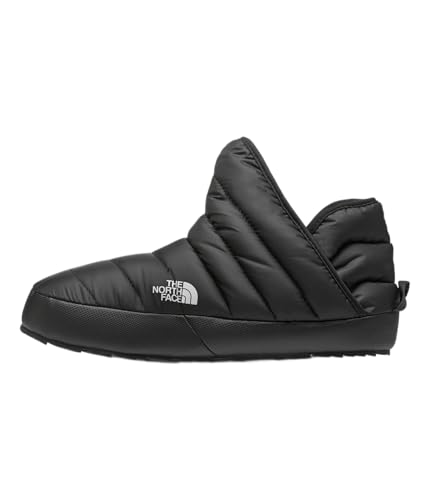
THE NORTH FACE ThermoBall Bootie Women Black — The default, women’s
This is the bootie the category is measured against, and its design reads like a checklist written by someone who has actually left a ski lodge at midnight. The insulation is the brand’s ThermoBall — a synthetic cluster fill that mimics down’s loft while keeping its warmth when damp, which in slush season is the whole argument — inside a water-repellent shell that shrugs off snowmelt and spilled glühwein with equal indifference. Underneath sits a proper rubber sole with grip, because the lodge’s wet stone steps are part of the product’s brief.
The fit is the other half of its success: a bootie’s volume that receives a swollen, socked, post-ski foot without a fight, and a collar that closes snugly enough to keep the snow out on the walk to the car. It is warm without being a sweat lodge, which matters — feet leaving ski boots need to warm gradually, and a bootie that roasts them produces the clammy chill an hour later that skiers blame on the weather.
- Insulation: ThermoBall synthetic clusters
- Shell: water repellent
- Sole: grippy rubber, outdoor-capable
- Fit: women’s size run, generous volume
- Setting: lodges, chalets, car parks, snowy thresholds
Strengths
- Warmth that survives damp conditions
- A sole that treats wet stone and snow as home
- Volume sized for post-ski feet, not showroom feet
Trade-offs
- Too much bootie for a warm apartment evening
- Synthetic fill packs larger than down
- The sporty look commits to the lodge aesthetic
Best for: women skiers whose après happens between lodge, snow, and car. Not suited for: tent campers counting grams or anyone wanting a house slipper.
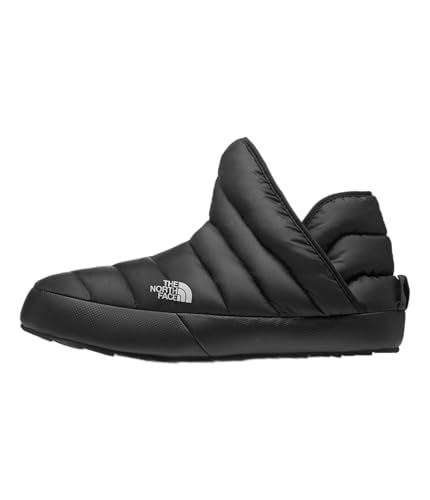
THE NORTH FACE ThermoBall Bootie Men Black — The default, men’s
Honesty first: this is the same ThermoBall Trac Bootie design in the men’s size run, and this guide lists it separately because skiers shop by the run that fits them, not because the bootie changes its character between the two. Everything said above — the damp-proof synthetic loft, the water-repellent shell, the grippy sole, the generous post-ski volume — applies here word for word, and a household with two skiers will often own both runs of the same bootie and think no more about it.
What deserves its own paragraph is the sizing behaviour across the runs: the men’s run is built on a broader last, and skiers between the runs — women with wide feet, men with narrow ones — should choose by fit rather than by label, because the insulation and sole do not care which run delivered them. In black with white detailing, both runs read as lodge equipment rather than footwear fashion, which is the correct register for the job.
- Insulation: ThermoBall synthetic clusters
- Shell: water repellent
- Sole: grippy rubber, outdoor-capable
- Fit: men’s size run, broader last
- Setting: lodges, chalets, car parks, snowy thresholds
Strengths
- The same proven design on a broader last
- Warmth that survives damp conditions
- Volume sized for post-ski feet
Trade-offs
- Identical intent to the women’s run — no new features
- Too much bootie for a warm apartment evening
- Synthetic fill packs larger than down
Best for: men skiers whose après happens between lodge, snow, and car. Not suited for: tent campers counting grams or anyone wanting a house slipper.

RANDDER Down Booties — Ultralight camp warmth
Cross into the second family and the priorities invert completely. The RANDDER booties are down-filled socks with ambitions: they pack into a fist, weigh almost nothing, and exist for the places a soled bootie cannot go — inside a sleeping bag, on a tent floor, in a hut bunk at altitude where the cold comes up through the mattress. Down’s warmth-to-weight is unmatched by any synthetic, and in the dry cold of a tent interior, its one weakness — damp — rarely gets a vote.
Their après-ski role is the hut trip and the ski tour: the evening in a mountain refuge where boots are banished to the boot room and the floors are cold stone or colder wood. A pair of these turns the bunk into warm territory and the sleeping bag into a system whose feet finally match its torso. What they will not do is the car park — there is no outdoor sole here worth the name — and the skier whose après is lodge-based should stay with the ThermoBall family and let the tourers have these.
- Insulation: down fill
- Character: ultralight, packs to a fist
- Sole: minimal — indoor and in-bag use
- Setting: tents, huts, sleeping bags, ski tours
- Carry: disappears into a pack’s corner
Strengths
- Warmth wildly disproportionate to weight
- Transforms sleeping-bag foot comfort
- Packs small enough to always come along
Trade-offs
- No outdoor sole — the car park is foreign territory
- Down sulks when wet; keep them dry
- Too warm for heated lodges and houses
Best for: hut-to-hut skiers, tourers, and winter campers. Not suited for: lodge skiers who need to walk outside in them.

Naturehike Down Booties — The hut and bivouac pick
Naturehike builds for people who carry their houses on their backs, and its down booties share the RANDDER’s philosophy with a backpacking brand’s execution: light, compressible, and warm in the static cold of camp. Where the two down picks differ is mostly in fit and shell feel — a matter of which one’s size run and cuff design suits an individual foot — and the honest guide admits that choosing between good down booties is a closer call than choosing the family itself.
For the ski context, these are the pair for the bivouac and the unheated refuge, and for the camper-van skier whose bed is a mattress in a cold vehicle. They also serve a quieter role at home that owners discover later: the coldest houses, the night-shift sleeper in a freezing spare room, the reader in an unheated study — anywhere a person is still and cold for hours, a down bootie is the most efficient warmth per penny in this guide.
- Insulation: down fill
- Character: ultralight camping build
- Sole: minimal — indoor and in-bag use
- Setting: huts, bivouacs, camper vans, cold rooms
- Carry: compresses into pack corners
Strengths
- Serious camp warmth at trivial weight
- Backpacking-brand construction and sizing
- Doubles as the cold-house evening pair at home
Trade-offs
- No outdoor sole worth the name
- Down must be kept dry to perform
- Overkill, and overheating, in heated spaces
Best for: winter campers, tourers, and van-based skiers. Not suited for: lodge floors with outdoor walks or warm houses.

AEGISMAX Down Booties 650fp — Highest loft here
AEGISMAX is the down specialist’s name in this guide — a brand known for sleeping bags — and its booties carry 650-fill-power duck down, the highest specified loft here. Fill power is the honest number in down: it measures how much space a given weight of down occupies, and more loft is more trapped air is more warmth, which in a bootie translates to the pair you reach for when the tent is at altitude and the night is serious.
The design brief is plainly the sleeping bag’s footbox: these are covers for feet at rest in extreme indoor cold, and their virtues — loft, lightness, packability — are a camper’s virtues. Skiers on expedition-style trips, winter mountaineers in high huts, and anyone whose après happens above the treeline will recognise the intent. Everyone else is buying more bootie than their lodge requires, and this guide says so with respect for both parties.
- Insulation: 650fp duck down
- Character: expedition-weight loft
- Sole: minimal — in-bag and indoor use
- Setting: high huts, winter tents, serious cold
- Brand ground: sleeping-bag specialist
Strengths
- The highest specified loft in the guide
- Warmth for genuinely cold nights under canvas
- Still packs to almost nothing
Trade-offs
- Serious overkill for heated lodges
- Down’s damp weakness applies in full
- No outdoor capability whatsoever
Best for: high huts, winter expeditions, and the coldest tents. Not suited for: resort skiers or any outdoor walking.

LongBay Mens Bootie Slippers — The chalet house bootie
The LongBay closes the guide by declining the expedition entirely: a bootie-shaped house slipper with tough nylon uppers, a non-slip rubber outsole, and adaptive memory foam, built for the chalet evening rather than the mountain night. Its après role is the rental apartment and the family chalet, where the floors are heated or carpeted, the walk outside is a balcony at most, and what feet leaving ski boots actually want is cushioning and ankle warmth without mountaineering cosplay.
Memory foam is the right technology for that brief — post-ski feet are tender, and a foam that adapts beats a loft that merely insulates — and the bootie height keeps the ankle, the ski boot’s other victim, inside the warmth. It is the least technical pick here and, for the majority of resort skiers whose après is a sofa and a fondue, very possibly the most appropriate one.
- Upper: tough nylon
- Footbed: adaptive memory foam
- Sole: non-slip rubber, indoor/light outdoor
- Fit: men’s, bootie height
- Setting: chalets, rental apartments, home
Strengths
- Cushioning that tender post-ski feet prefer
- Bootie warmth without expedition bulk
- Honest house pricing position
Trade-offs
- Not a snow-walking or car-park bootie
- Foam ages faster than down or ThermoBall
- Men’s run only in this listing
Best for: resort skiers whose après is a chalet sofa. Not suited for: hut trips, tents, or serious snow between door and car.
How Do the Six Après-Ski Pairs Compare?
| Pick | Family | Insulation | Outdoor sole | Best for |
|---|---|---|---|---|
| TNF ThermoBall Women | Soled bootie | ThermoBall synthetic | Yes — grippy rubber | Lodge skiers, women’s run |
| TNF ThermoBall Men | Soled bootie | ThermoBall synthetic | Yes — grippy rubber | Lodge skiers, men’s run |
| RANDDER Down | Down bootie | Down | No | Huts, tours, sleeping bags |
| Naturehike Down | Down bootie | Down | No | Camping, vans, bivouacs |
| AEGISMAX 650fp | Down bootie | 650fp duck down | No | Serious cold, high huts |
| LongBay Bootie | House bootie | Foam and nylon warmth | Light — doorstep only | Chalet evenings at home |
The comparison is really a map: find where your ski day ends — lodge bar, hut bunk, tent, or chalet sofa — and the family chooses itself. The most common buying error in the category is purchasing across the map, and it is made by skiers who buy the bootie that looks warmest rather than the one whose sole, or lack of one, matches their evening.
Why Do Feet Need Different Footwear After Skiing?
A ski boot is a cast with a hobby: it holds the foot in one position for hours, restricts circulation at the cuff, and compresses the soft tissues that a normal shoe never touches. Feet emerge swollen, temperature-confused, and tender in places that have no names in ordinary footwear. The après pair’s first job is therefore medical only in the loosest, comfort sense — room to expand, warmth without pressure, cushioning without squeeze — and its second job is everything the ski boot forbade: flexing, spreading, and walking like a person again.
That is why ordinary slippers disappoint after skiing even when they are warm: they are sized and shaped for morning feet, not for evening feet that have been in a vice. The volume in the ThermoBall booties and the give in the down pairs are not looseness; they are the specification.
How Should Après-Ski Booties Be Sized?
For the foot that comes out of the ski boot, in the thickest sock you actually ski in — that is the whole rule, and it routinely means a size more generous than the same person’s house slipper. Booties are forgiving garments, closer to mittens than to shoes, and a slightly roomy down bootie loses nothing while a tight one compresses its own insulation and defeats itself. The soled booties ask a little more precision, because they will be walked in: heel seated, toes unfurled, and room for the evening’s swelling to arrive without negotiation.
Between sizes, go up in this category without the hesitation you would bring to a climbing shoe. Warmth lives in loft and air, and both need volume the foot does not occupy.
What Mistakes Do Skiers Make Buying Après Footwear?
Buying across the families leads, as this guide has warned twice and now makes official: down booties for a lodge holiday, or soled booties for a tent, each excellent and each wrong. Second is sizing for the morning foot. Third is forgetting the drive home — the après pair often becomes the driving pair on winter roads, and a soleless down bootie on a clutch pedal is a poor end to a good trip, which is one more argument for the ThermoBall family’s ordinary competence.
The quiet mistake is buying for the photograph: the expedition bootie for a resort week, chosen because it looks like adventure. The LongBay exists in this guide as the corrective — most après-ski evenings in the world happen on heated floors, and there is no shame in the pair that admits it.
How Do You Dry and Store Insulated Booties?
Loose, open, and away from direct heat is the rule for both families: stuff the collar open, stand them where air moves, and let the radiator warm the room rather than cook the shell. Down in particular should be stored uncompressed — in a loose bag or hanging — because loft stored crushed for a summer returns slowly and sometimes incompletely; the synthetic ThermoBall forgives compression better, one of its genuine advantages for the casual owner.
On a trip, the overnight dry is a ritual worth building: booties opened by the hut stove or the chalet radiator the moment boots come off, so the pair is dry before it is needed rather than after. Damp insulation at altitude is not a discomfort; it is a failed system, and the ritual is the system.
Lodge, Hut, Tent, Chalet: Matching the Pair to the Trip
Resort weeks in hotels and lodges belong to the soled booties — the terrain is wet stone, carpet, snow, and car park in rotation, and only a real sole covers all four. Hut-to-hut tours belong to down, because every gram is carried and every evening is static cold. Mixed trips — a refuge night inside a resort week — argue for the ThermoBall as the compromise that walks outside and warms adequately in a bunk, accepting that it will be the second-best pair in the tent and the best pair everywhere else.
The self-catered chalet, the most common ski holiday of all, splits by its own geography: walk-to-lifts chalets behave like lodges, drive-to-lifts chalets behave like houses, and the LongBay’s honest domesticity wins the second kind outright. Read your own booking before your booties, and the category becomes simple.
The Drive Home: Après Footwear Behind the Wheel
An unglamorous truth of ski trips is that the après pair often becomes the driving pair, because nobody changes into shoes for a dark, cold car park if their feet are already warm. That reality argues for the soled family more strongly than any lodge consideration: a grippy rubber sole works a pedal predictably, a bootie’s volume stays clear of the neighbouring pedal in a way a ski boot never could, and the ThermoBall pair in particular has become the unofficial uniform of the Sunday-evening motorway run home from the mountains.
The down family must be honestly excused from this duty. A soleless bootie on a pedal is a slip hazard in the one place a slip matters, and the tourer who drives in down booties is borrowing risk against a warm foot. The discipline is simple: down for the hut, soles for the road, and a pair of driving shoes in the car for anyone whose trip mixes both worlds in one evening.
Long drives add a second consideration — circulation. Feet that sit swollen and still for three hours after skiing appreciate a pair with room and no cuff pressure, which is the generous bootie fit arguing for itself again. The après pair that fits the evening foot at the lodge will fit the motorway foot at midnight, and that consistency is a safety feature wearing a comfort costume.
What About Children After Ski School?
Children leave ski school with the same compressed, cold feet as adults and fewer words for the experience, and their après footwear follows the same logic at a smaller scale: roomy, warm, easy to pull on with cold fingers and no patience, and soled if the chalet has any outdoor threshold at all. The down booties in this guide are adult-sized in their listings, so the honest recommendation for children is the family logic rather than these specific pairs — a soled insulated bootie for the lodge child, and the warmest socks in the bag for the hut child.
The mistake to avoid is the adult one in miniature: tight fashion boots bought for the photograph, which a tired six-year-old will refuse by the second evening. Children’s après succeeds when it is treated as equipment rather than outfit, and the child who can dress their own feet after skiing is a child whose evenings run noticeably smoother for everyone in the chalet.
One more family consideration: children shed footwear in communal spaces with a talent that borders on performance art. A distinctive colour — anything but the black every adult in this guide is wearing — is a genuine feature in a boot room full of near-identical pairs.
How Warm Is Warm Enough? Reading Insulation Claims
Après footwear listings speak three insulation languages, and translating them prevents most disappointments. Down speaks in fill power and fill weight — the AEGISMAX’s 650fp is a real specification — and its warmth collapses when wet, which the listing will not emphasise. Synthetic fills like ThermoBall speak in brand names and gram weights, warm reliably when damp, and pack bulkier for the same warmth. Foam and fleece, the LongBay’s dialect, speak in neither: their warmth is modest, fixed, and entirely sufficient for the heated interiors they were designed in.
The translation rule is to match the language to the terrain rather than to rank the languages. A skier comparing a 650fp bootie with a ThermoBall bootie on warmth alone is comparing a tent answer with a car-park answer; each wins its own evening and loses the other’s. The listings in this guide were read that way — specification against setting — and the picks’ badges record the verdicts.
Beware the unnumbered claim: “extreme warmth” without a fill, a weight, or a material is a mood, not a measurement. Every pick here can name its insulation, which is the minimum entry fee for a category whose entire purpose is thermal.
The Boot Room Problem: Storage, Smell, and Shared Spaces
Every ski property has a boot room, and every boot room has a smell, and après footwear lives in that ecosystem whether it wants to or not. Pairs left sealed in a damp boot room for a week absorb the room’s biography; pairs dried in the bedroom and carried down each evening stay innocent. The ritual costs nothing and decides whether your booties greet you pleasantly on day five, which on a ski trip is a morale question as much as a hygiene one.
Shared chalets add the identification problem already met in the children’s section: a row of black booties by the door is a lottery. A loop of coloured tape, a distinctive lace, or simply the non-black colourway where one exists saves the nightly negotiation, and more than one friendship has been preserved by a bootie that could be told from its neighbours at midnight.
Drying space is the boot room’s scarcest resource, contested by gloves, helmets, and boots themselves. Down booties, needing only air, are the considerate guests; soled booties want a mat and a corner; and the skier who brings a small mesh bag to hang their pair from a hook has understood the politics of the room completely.
Second Life: What Après Booties Do All Summer
A fair question for any seasonal purchase is what it does in the off-season, and après booties answer better than most ski equipment. The down pairs become the camping kit’s standing members — summer tents at altitude have cold floors too, and a bootie that packs to a fist earns its corner of the rucksack in July as honestly as in January. The ThermoBall pair becomes the cold-house evening bootie, the festival wellington’s warm understudy, and the footwear of choice for anyone whose work or pleasure puts them standing in cold places after dark.
The LongBay never had another life to find; it was always a house bootie wearing ski colours, and summer changes nothing for it but the thermostat. The general lesson is that insulation bought for feet is insulation used wherever feet get cold, which in most climates is a nine-month season wearing a one-week costume in the marketing.
Storage across the summer follows the drying rules with one addition: down stored loose, synthetics stored as they come, and everything stored clean. A bootie put away with the season’s sweat still in it returns in December with a head start on the boot room’s smell, and no amount of December airing fully rewinds it.
How Long Should a Pair Last?
Ski weeks are short and après hours are shorter, so a good pair’s calendar life surprises people: the ThermoBall booties commonly serve five or more seasons before their soles polish or their fill tires, and down pairs, used a dozen nights a year and stored loose, can outlast the sleeping bags they were bought to accompany. The wear that does accumulate is honest — sole edges, cuff elastic, the heel’s interior — and it accumulates in proportion to walking, which is why the lodge pair ages faster than the tent pair despite the tent pair’s harder climate.
The LongBay’s foam sets its own shorter clock, as foam does, and its owners should expect the house-bootie lifespan of a few winters of evenings rather than a decade of trips. Judged per evening of service rather than per calendar, even that arithmetic is respectable — and judging per use, rather than per year, is the right ledger for everything in this guide.
Après Without the Skiing: Who Else Lives in These?
The category’s name undersells it, because the bootie answers any day that ends with cold feet and a cold floor: the ice fisherman’s hut, the winter photographer’s dawn, the market trader’s December stall, the dog owner’s last walk. Outdoor workers in cold climates adopted the soled bootie years ago as the vehicle-and-yard pair, and the down bootie has an equally committed second public among cold-water surfers changing in car parks and winter wild swimmers warming their feet on cold ground — contexts where the foot is wet, cold, and in a hurry, which is the après condition exactly.
This breadth matters to the buyer for a practical reason: it means the category is mature, its best designs are refined by several industries at once, and its prices are held honest by competition. The skier is not buying a novelty; they are buying into a solved problem, and the six picks here are what the solution currently looks like.
It also means the off-season second life discussed earlier is not a rationalisation. A pair that serves the ski week, the camping season, and the cold house’s evenings has a cost-per-wear that most footwear cannot approach, and the après bootie may be the most quietly economical purchase in the whole ski bag.
The Evening Timeline: When Each Pair Comes Into Its Own
A ski day has a footwear timeline, and placing each family on it clarifies every choice in this guide. Boots off at four: the soled bootie takes the walk to the room, the boot room, the bar, the car. Dinner in a hut at seven: the down bootie, carried up in a daypack, takes the bunk room and the cold floor. Bed at ten: the down bootie again, inside the bag, doing the job nothing else in this guide can do. And the chalet week scrambles the timeline into sofas and balconies, where the house bootie presides.
Skiers who buy one pair for a mixed trip are really choosing which hours of that timeline to serve best, and the ThermoBall’s dominance is simply the dominance of the four-o’clock hours in most people’s trips. The tourer’s day inverts the timeline — more bunk than bar — and their correct purchase inverts with it.
The timeline also exposes the false economy of the single cheap pair that serves no hour well: too soled for the bag, too thin for the car park, too sweaty for the sofa. Après is a category of specialists because the evening itself is specialised, hour by hour.
Wet Snow, Dry Snow, and the Walk Between
Not all snow treats a bootie alike, and the skier’s home mountain decides more purchases than the brochure does. Wet coastal snow — the maritime ranges’ specialty — soaks like rain and tests every water-repellent shell on the walk to the car; the ThermoBall’s damp-proof insulation was designed in exactly that school. Dry continental powder, by contrast, brushes off a shell like dust and barely challenges the down bootie’s minimal weather defences on the short dash between hut door and woodpile, which is why tourers in the high ranges carry down with a confidence that would be misplaced at sea level.
The walk between buildings is where these judgements become physical: thirty metres of slush will find the seam, the cuff gap, and the sole’s limit of any pair, and a bootie that treats that walk casually earns its price in a single evening. Judge your own mountain’s snow honestly — postcard powder in the brochure, ankle-deep soup in the car park — and buy for the soup.
Gifts for Skiers: The Bootie as the Safe Present
Ski equipment is a minefield for gift-givers — bindings, boots, and layers all demand expertise the giver rarely has — and the après bootie is the category’s safe ground: sized by the ordinary shoe size, forgiving of error, useful from the first evening, and priced like a present rather than a commitment. The ThermoBall pair is the default gift for a skier whose terrain you do not know, because it serves the widest map; the down booties are the connoisseur’s gift for the tourer whose trips you do know, and their packability makes them the rare present that earns its place in a carefully weighed rucksack.
The giving detail that matters is the sock pairing: a bootie given with one excellent pair of ski socks is a system, and systems read as thoughtfulness. Wrapped together, they also solve the giver’s sizing anxiety, since the sock absorbs the small errors the bootie forgives.
What Rental-Skiers and First-Timers Should Know
First ski trips are bought in a rush of borrowed kit and optimistic clothing, and footwear after the boots is usually an afterthought handled by trainers — which on a snowy threshold is a cold, wet mistake discovered exactly once. The first-timer’s après answer need not be expensive: the LongBay’s house bootie covers the apartment week, and any soled insulated pair covers the walk-about week, and either is a better use of money than the third pair of gloves most beginners over-buy.
Rental skiers have one extra consideration: their boots go back each evening, so the après pair is also the walk-to-the-rental-shop pair, on the coldest pavement of the day, often with a child in tow and a reservation expiring. For that walk, grip is not a feature; it is the product, and the soled family’s tread is the first-timer’s best insurance against ending the holiday on the first evening.
The Instructor’s and the Patroller’s Version of Après
The people who work a mountain wear après footwear as a uniform change, and their choices are the category’s stress test made visible. Instructors come off the hill with the most fatigued feet in the resort — a full day standing, demonstrating, and hauling children upright — and their boot rooms tell the story: soled insulated booties, almost without exception, because their evenings involve car parks, equipment sheds, and a second job’s worth of walking. The down bootie, for all its warmth, cannot do a working evening, and the professionals’ unanimity on the point is the strongest evidence this guide can offer the lodge skier.
Patrollers and hut keepers split the difference by altitude: soled pairs at the base station, down pairs at the high hut, each where its family belongs. The pattern is the guide’s map drawn by people with no money wasted on getting it wrong, and a leisure skier could do worse than simply copying the kit list of the person who rescues them.
Packing the Pair: Boot Bag, Daypack, or Suitcase?
Where the après pair travels decides a few arguments by itself. The soled booties ride best in the boot bag’s outer pocket or strapped to its side — they are bulky, unbothered by compression, and wanted the moment the boots come off, which is at the bag. The down pairs ride anywhere: a daypack’s lid for the tourer, a suitcase corner for the hotel skier, a stuff sack that doubles as the hut pillow’s neighbour. Their compressibility is a travel feature as much as a camp one, and owners find the pair migrating into every cold trip’s packing list regardless of whether skiing is involved.
The suitcase skier should note the one packing rule both families share: never pack them damp from the last evening into a closed bag for a long journey. A night open in the room before the travel day is the difference between a pair that arrives home neutral and one that announces the holiday every time the case is opened until spring.
A Short History of the Bootie, From Camp to Chalet
The down bootie was born in expedition camps, where mountaineers needed foot insulation that a sleeping bag’s footbox could not provide and a boot could not be worn to provide — a soft, packable answer that high-altitude porters and tent-bound climbers refined over decades before any resort skier heard of it. The soled bootie came later and from the other direction: as ski resorts grew into villages and the evening walk between lodge, restaurant, and car became a designed part of the holiday, footwear followed the terrain, growing a sole the way the resort grew pavements.
That dual ancestry explains the category’s present shape better than any marketing: two honest tools from two honest traditions, meeting in the modern ski bag. The brands in this guide divide by ancestry almost perfectly — the down specialists from the expedition world, THE NORTH FACE straddling both as only a large mountain brand can, and the house bootie descending from the slipper tradition that never left the building.
Knowing the ancestry helps a buyer resist the hybrid that betrays both: the fashion bootie with a decorative sole and ornamental loft, which camps badly and walks worse. The six picks here each keep faith with one tradition or the other, and the guide’s family labels are really ancestry labels — buy your tradition first, and the individual pair second.
The bootie’s next chapter is already visible in the boot rooms: insulation borrowed from sleeping bags, soles borrowed from approach shoes, and shells borrowed from ski jackets, converging on a garment that is less a slipper than a soft boot. The skier buying today is buying into that convergence at a good moment — the designs are mature, the families are clear, and the prices have not yet noticed how essential the category has quietly become.
The Spa and Sauna Detour: Après Beyond the Bar
Half the modern ski holiday’s evenings end not in a bar but in a spa, and the walk between room, sauna, and pool is its own small terrain — warm corridors, wet tiles, and a robe as the national dress. The soled bootie handles that terrain without comment, which is why the ThermoBall pair is as common in Alpine wellness hotels as in boot rooms; the down bootie, by contrast, should be excused from the pool deck, where its fill meets the one element it cannot abide, in quantity, at close range.
The spa detour also settles a packing question for the hotel skier: one pair, soled and water-repellent, covers bar, car, corridor, and pool deck, and the down pair stays home unless a tent is genuinely involved. Consolidation is a virtue in a ski bag, and the soled bootie’s ability to absorb the spa evening is a large part of its default status in this guide — it is not the warmest pair here, or the lightest, but it is the one that never has to be left behind for the next room.
One Pair for the Whole Lodge: The Minimalist’s Après
The minimalist skier, packing one bag for a week, asks the hardest question in the category: which single pair covers the most evenings with the fewest failures? The answer this guide keeps returning to is the soled insulated bootie, and the reasoning is failure-based rather than feature-based: its failures are mild (too warm for the sofa, too bulky for the rucksack’s last corner), while the down bootie’s failure — the wet car park — is total, and the house bootie’s failure — the snowy walk — is a soaked sock at the start of an evening. Choose the pair whose worst case you can live with, and for most trips that is the ThermoBall’s.
The minimalist’s second decision is colour, and it is not vanity: black hides a season of slush, salt, and boot-room floors in a way no pale colourway survives, and a single pair has nowhere to hide. Buy the dark pair, dry it nightly, and let it be the week’s quiet constant.
The Second Pair Strategy for Long Trips
Trips longer than a week reward a small luxury the short trip cannot justify: a second, lighter pair for the room itself, so the soled bootie can rest and dry fully between its outdoor duties while the feet are never bare on a cold floor. The down booties double beautifully in that role for tourers already carrying them, and the house bootie does it for chalet weeks. Rotation extends both pairs’ lives, guarantees a dry pair every evening, and costs one corner of a suitcase — the most experienced ski travellers in any boot room are, on inspection, almost always running two pairs.
Final Recommendation
Most skiers should buy the ThermoBall bootie in their size run and stop thinking: it warms damp-proof, walks on snow, and receives a post-ski foot like it was designed by the foot’s own union. Tourers and hut sleepers should take the down family — RANDDER or Naturehike for ordinary cold, the AEGISMAX when the cold is serious — and chalet-sofa skiers should take the LongBay and spend the difference on fondue. Whichever family is yours, size for the evening foot. After the slopes, the house’s own recovery footwear waits in Best Arch Support Bedroom Slippers.
Frequently Asked Questions
Can I walk outside in down booties?
Not meaningfully. Their soles are for hut floors and tent groundsheets; snow, gravel, and car parks will soak and shred them. The soled booties exist for any après that leaves the building.
Why are two picks the same product?
Because THE NORTH FACE sells the ThermoBall Trac Bootie in women’s and men’s size runs, and skiers shop by run. The design, insulation, and sole are the same; choose the run whose last fits your foot.
Are après-ski slippers worth it if I only ski one week a year?
Yes, if your week involves cold floors or any walk outside — the pair then serves for years of winter evenings at home too. Pure hotel weeks with heated floors are the honest exception, where a house bootie suffices.
How warm is 650 fill power in a bootie?
Fill power measures loft per weight, and 650 is a strong specification — the AEGISMAX lofts enough for serious tent and high-hut cold. In a heated lodge it is simply more warmth than the room will let you use.
Can down booties go inside a sleeping bag?
That is one of their main purposes: they warm the bag’s footbox, protect its lining from toenails and rough skin, and let campers wear their insulation where bags are often thinnest.
What socks should I wear with après booties?
The ski sock you already have on is the usual answer — changing socks is for the shower, not the boot swap. A dry spare pair for the evening doubles the comfort of any bootie here.
Do synthetic fills really work when wet?
Better than down does — that is ThermoBall’s reason to exist. It keeps much of its loft and warmth damp, where down clumps and chills, which is why the soled, slush-facing family is synthetic.
How do I stop my booties smelling by day three?
Dry them open every night without fail, rotate socks daily, and never pack them damp into a closed bag. Insulation forgives almost everything except being stored wet.
Related Guides
The rest of the cold-evening map: Best Bedroom Slippers covers the nightly pair these booties relieve, Best College Shower Slippers handles the shared-bathroom end of a ski trip’s dormitory nights, and Best 12-Volt Heated Blankets warms the camper van that half this guide sleeps in.



[…] by territory. For the cold end of the map, where warmth after skiing is the whole point, see Best Après-Ski Slippers; for sand and salt water, our guide to Best Beach Slippers and Flip-Flops takes over where the […]