What's inside
- Key Takeaways
- Quick Picks
- How Did We Choose These Arch-Support Pairs?
- The Six Arch Support Bedroom Slippers in Detail
- How Do the Six Arch-Support Pairs Compare?
- What Does “Arch Support” Actually Mean in a Slipper?
- How Should a Shaped Slipper Fit?
- The Adjustment Evenings: What to Expect
- What Mistakes Do Buyers of Support Slippers Make?
- Support Through the Seasons: Warm Uppers, Hard Floors
- Standing Evenings: The Kitchen Test
- Stairs, Tile, and the Night-Time Circuit
- Sharing a Household: One Pair or Several?
- What to Do With the Old Flat Pair
- Reading Reviews of Support Slippers Without Being Mislead
- Work-From-Home Feet: The All-Day Case
- Hard Floors by Material: Wood, Tile, Stone, Concrete
- Gifts for the Hard-Floor Household
- The Morning Foot Versus the Evening Foot
- When Support Slippers Are the Wrong Purchase
- How Long Before a Shaped Bed Needs Replacing?
- Socks With Shaped Beds: A Small Science
- The Quiet Design War: Support Versus Softness
- A Note on “Orthopedic” as a Word on a Listing
- Travelling With Support: Hotels, Hospitals, and Other People’s Floors
- The Two-Pair Treaty, Priced Honestly
- What a Month in a Shaped Pair Actually Changes
- The Last Word on Registers: Choosing Without a Shop Assistant
- A Note for the Household’s Other Feet
- Final Recommendation
- Frequently Asked Questions
- Related Guides
As an Amazon Associate I earn from qualifying purchases. This post may contain affiliate links at no extra cost to you.
cottageverdict.com is reader-supported. When you buy through links on our site, we may earn an affiliate commission.
Where to buy: Each of the six pairs is sold on Amazon under the name linked below — check price on Amazon there, and read the listing’s size guidance, because shaped footbeds fit differently from flat ones.
The best arch support bedroom slippers exist for a feeling most adults know precisely: the end of a long day, when the shoes come off and the feet — rather than relaxing — discover that the house’s hard floors have opinions of their own. A flat slipper offers warmth and nothing else. A shaped one offers a footbed with a raised arch profile, a defined heel cup, and cushioning placed where a standing, walking, kitchen-working foot actually loads. This guide is about comfort in that ordinary, daily sense: slippers that feel supportive across an evening at home. It makes no medical claims and treats no conditions — anyone with persistent foot pain belongs in a professional’s office, not on a shopping page — but it can match tired feet to the indoor footwear that treats them kindest.
The six picks divide by philosophy and by foot. The Litfun and COFACE serve women who want shaping inside a recognisably soft slipper; the ONCAI and KuaiLu serve men with contoured beds of different firmness; the VALSOLE and the V.Step are the structured, orthopedic-styled end of the shelf, unisex in spirit and definite in feel. Between them, every kind of bedroom-floor foot is provided for.
One expectation to set at the door: support you can feel is support that feels different, and a shaped footbed’s first evenings are an adjustment, not an error. The reviews below note which pairs are gentle introductions and which are the full architecture from the first step.
Key Takeaways
- Support means shape: a raised arch profile, a heel cup, and cushioning under load — not just a thicker sole.
- Start gentle if you are new to shaped footbeds; the Litfun and COFACE are the kindest introductions here.
- Firmer contoured pairs (KuaiLu, VALSOLE, V.Step) suit people who already know they like structure underfoot.
- Bedroom slippers still need house manners: quiet soles, easy on-off, and uppers suited to the season.
- Comfort framing only — persistent pain belongs to a clinician’s office, not a product page.
- Size for the shaped bed: heel seated in the cup, arch met by the rise, toes free.
Quick Picks
| Pick | Badge | Why it earns its place |
|---|---|---|
| Litfun Arch Support Slippers Women | The soft introduction | Shaped support inside a plush women’s slipper — architecture that does not feel clinical. |
| ONCAI Mens Arch Support Slippers | The men’s everyday contour | A contoured bed and a house-ready build in the men’s line, balanced for all-evening wear. |
| COFACE Womens Arch Support Slippers Pink | Shaped and cheerful | Women’s arch support in a soft pink slipper that remembers it is bedroom footwear. |
| KuaiLu Mens Orthopedic Slippers | The firm men’s structure | Orthopedic-styled contouring with a definite arch for men who like their support announced. |
| VALSOLE Orthopedic Slippers | The structured all-rounder | A shaped, supportive platform in a design aimed at long standings and hard floors. |
| V.Step Orthopedic House Slippers | The house-shoe conversion | Orthopedic styling in a house slipper that behaves like footwear and rests like a slipper. |
How Did We Choose These Arch-Support Pairs?
The screening test was the footbed itself, read the way a foot reads it: is there a genuine rise under the arch rather than a flat slab with marketing on it, does the heel land in a cup rather than on a plateau, and does the cushioning sit under the load points instead of distributing itself evenly and uselessly? Pairs that failed that reading — however plush, however popular — did not proceed, because a guide about arch support has one job.
Bedroom manners formed the second screen: the pair must be quiet on hard floors at night, easy to step into half-asleep, and shaped for the bedroom-to-bathroom-to-kitchen circuit rather than the street. Within those manners we kept a deliberate spread of intensity, from the Litfun’s gentle suggestion to the VALSOLE’s definite architecture, so that readers new to shaped footbeds and readers replacing a beloved structured pair are both served — and the reviews say plainly which is which.
Nothing here was evaluated as a medical device, because none of it is one. The language of this guide is the language of evenings: tired feet, hard floors, long standings at the stove, and the small mercy of a slipper that meets the foot’s shape instead of ignoring it.
The Six Arch Support Bedroom Slippers in Detail

Litfun Arch Support Slippers Women — The soft introduction
Litfun’s women’s pair solves the category’s presentational problem first: it looks and feels like a bedroom slipper — plush, warm, unthreatening — while hiding a shaped footbed underneath that a flat slipper simply does not have. The arch rise is present but polite, the heel is gathered rather than gripped, and the whole effect is of a slipper that has quietly been to finishing school. For the woman who has worn flat fuzzy pairs for years and suspects her evenings could feel better, this is the lowest-risk experiment in the guide.
The softness is also the honest limit: wearers who already know they want definite structure will find the Litfun’s architecture tasteful to a fault. It is the introduction, not the destination, and the guide keeps it at the front for exactly that reason — most readers of a bedroom-slipper page are beginning the shaped-footbed journey, not completing it.
- Footbed: shaped, gentle arch rise
- Upper: plush women’s slipper styling
- Heel: softly gathered cup
- Character: support as suggestion
- Best room: bedrooms and carpeted floors
Strengths
- Real shaping inside a genuinely cosy slipper
- The easiest first step into arch support
- Bedroom looks with nothing clinical about them
Trade-offs
- Too gentle for structure-seekers
- Plush warmth is a winter register
- Soft bed compresses sooner than firm rivals
Best for: women new to shaped footbeds. Not suited for: anyone wanting firm, definite architecture.

ONCAI Mens Arch Support Slippers — The men’s everyday contour
The ONCAI is the balanced men’s option: a contoured footbed with a clear arch profile and heel cup, inside a house slipper built for the whole evening rather than for a category photograph. Its support sits in the guide’s middle register — definite enough to feel, forgiving enough to wear from the first night — and that balance is why it will suit more men than either extreme on either side of it.
The build around the bed is workmanlike in the good sense: an upper that stays on without gripping, a sole with indoor manners and doorstep competence, and a general air of a product designed by people who wear slippers rather than merely sell them. Men replacing a dead-flat pair and wanting to know what the fuss is about should start here.
- Footbed: contoured, mid-register support
- Upper: stay-on house styling
- Sole: indoor with doorstep competence
- Character: the balanced men’s default
- Best room: whole-house evenings
Strengths
- Support balanced for all-evening wear
- No adjustment drama for most wearers
- Honest, durable house build
Trade-offs
- Middle register pleases neither extreme completely
- Styling is functional rather than handsome
- Firmness sits below the orthopedic-styled picks
Best for: most men moving from flat slippers. Not suited for: wearers who want the firmest structure available.

COFACE Womens Arch Support Slippers Pink — Shaped and cheerful
COFACE’s pink pair makes the same argument as the Litfun in a brighter accent: arch support does not have to dress like a clinic. The footbed carries a genuine shaped profile — COFACE builds its name on contoured soles across its range — inside a soft, warm, unmistakably bedroom slipper, and the combination suits the wearer who wants her evenings supported and her slippers cheerful in the same object.
Against the Litfun, the COFACE’s shaping reads a touch more deliberate, which splits the women’s introductory vote by temperament: the Litfun for the softest landing, the COFACE for the woman who wants to feel the architecture working from the first evening. Both are honest introductions; the difference is bedside manner.
- Footbed: shaped COFACE contour
- Upper: soft pink bedroom styling
- Character: cheerful, deliberate support
- Best room: bedrooms, bathrooms, kitchens
- Fit: women’s size run
Strengths
- Real contouring in a warm, soft slipper
- Support you can feel from the first evening
- Bedroom cheerfulness fully intact
Trade-offs
- Pink will not be every household’s register
- Mid-gentle: not the firm’s destination
- Warm upper for summer nights
Best for: women who want felt support in a soft slipper. Not suited for: anyone seeking maximum structure.

KuaiLu Mens Orthopedic Slippers — The firm men’s structure
KuaiLu builds the men’s firm option: an orthopedic-styled slipper whose contoured bed announces its arch from the first step and does not apologise for it. This is the pair for the man who has tried foam slippers, found them vague, and concluded that his feet prefer instructions to suggestions. The bed’s geography — rise, cup, and a forefoot that does not collapse — stays consistent across the evening and across the season, which is the structural advantage of building support into a firm last rather than into foam.
The adjustment contract is the honest price: give it several evenings, in socks, before judging, because a foot educated by decades of flatness reads any architecture as intrusion at first. Men who clear that week rarely go back, and the KuaiLu’s following has exactly that converted character.
- Footbed: firm orthopedic-styled contour
- Arch: pronounced, definite rise
- Character: support as structure
- Best room: hard floors, standing evenings
- Fit: men’s size run
Strengths
- Architecture that holds its shape all season
- Support that is unmistakably present
- Built for upright evenings, not just sitting
Trade-offs
- The firmest adjustment period for newcomers
- Too definite for wearers who prefer softness
- Shoe-like looks, minimal slipper cosiness
Best for: men who know they like structure underfoot. Not suited for: first-time shaped-footbed buyers wanting a gentle start.
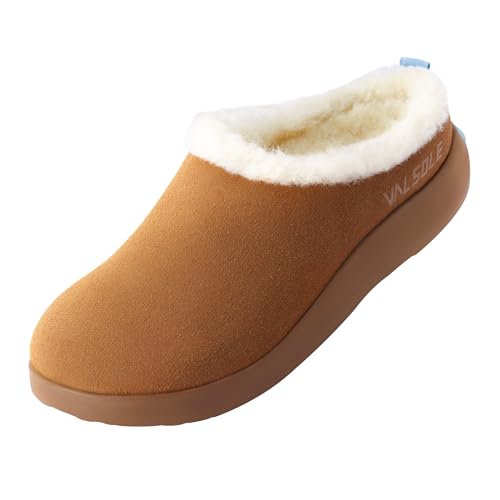
VALSOLE Orthopedic Slippers — The structured all-rounder
The VALSOLE occupies the guide’s structured centre: an orthopedic-styled slipper with a shaped platform that spreads support across the whole foot rather than concentrating it at the arch alone. Its design brief reads like the standing evening itself — kitchen hours, hard floors, a foot that loads heel and forefoot as much as arch — and the bed answers in kind, with a platform whose support feels architectural rather than localised.
That breadth makes it the pick for households rather than individuals: a pair bought for the house’s hardest floors and longest standings, worn by whoever’s evening runs longest. Its styling, like the KuaiLu’s, is equipment-honest, and its comfort is the comfort of a well-made tool — present, dependable, and uninterested in being mistaken for a cloud.
- Footbed: shaped supportive platform
- Support: spread across heel, arch, forefoot
- Character: structured all-rounder
- Best room: kitchens and hard floors
- Role: the household’s standing pair
Strengths
- Whole-foot support rather than arch alone
- Platform keeps its architecture over time
- Suits the longest standing evenings here
Trade-offs
- Firm feel needs the adjustment evenings
- Equipment styling over bedroom softness
- More shoe than slipper in the hand
Best for: hard floors and long standings. Not suited for: anyone whose priority is plush softness.

V.Step Orthopedic House Slippers — The house-shoe conversion
The V.Step closes the guide as the conversion candidate: an orthopedic-styled house slipper substantial enough to retire a pair of indoor shoes. Its contoured bed and structured build serve the wearer whose evenings are spent on their feet and whose current solution is keeping shoes on indoors — a solution with costs for floors, for comfort, and for the feeling of being home. The V.Step offers the shoe’s support with the slipper’s manners, and that trade is its whole argument.
Against the VALSOLE it reads a fraction more domestic; against the KuaiLu, a fraction less severe. It is the structured end of the shelf wearing its most house-trained face, and for the shoe-indoors household it may be the most life-improving pick in this guide despite sharing its badge class with two rivals.
- Footbed: contoured orthopedic styling
- Build: substantial, shoe-adjacent
- Character: support with house manners
- Best room: whole house, stairs, tile
- Role: retires the indoor shoe
Strengths
- Shoe-level support, slipper-level manners
- Structured build that lasts the season
- Steady on stairs and hard floors
Trade-offs
- The heaviest feel in the guide
- Adjustment evenings apply as with all firm beds
- Least suited to purely in-bed-adjacent wear
Best for: households currently wearing shoes indoors. Not suited for: anyone wanting a light, soft bedroom-only pair.
How Do the Six Arch-Support Pairs Compare?
| Pick | For | Support register | Upper feel | Best for |
|---|---|---|---|---|
| Litfun Women | Women | Gentle | Plush | First shaped pair |
| ONCAI Men | Men | Middle | House-standard | The balanced default |
| COFACE Pink | Women | Gentle-plus | Soft, warm | Felt support, soft slipper |
| KuaiLu Men | Men | Firm | Shoe-like | Structure-seekers |
| VALSOLE | Unisex-leaning | Structured | Equipment-honest | Standing evenings |
| V.Step | Unisex-leaning | Structured | House-shoe | Retiring indoor shoes |
The table’s real axis is temperament: how much architecture a foot wants to feel. Every pick here has a genuine shaped bed — the category’s entry fee — and the differences that matter are of degree and dress, not of kind. Choose your register honestly and the category rarely disappoints; choose by photograph alone and it often does.
What Does “Arch Support” Actually Mean in a Slipper?
In a slipper, the phrase describes geometry, not therapy: a footbed whose surface rises to meet the arch instead of leaving it spanning a flat gap, a heel that sits in a depression rather than skating on a slab, and materials firm enough to keep that geography under load. A flat foam slipper can be thick, soft, and kind, and still offer none of that geometry — which is why thickness is the category’s most misleading specification and shape is its only honest one.
The comfort logic is ordinary mechanics stated plainly: a foot whose arch is met and whose heel is seated spreads its load across more of the bed, and an evening of standing and walking on that bed feels different from an evening spent balancing on two points of a flat one. No cures are promised in that sentence, and none should be read into it. It is the difference between a chair that fits and a bench, applied to feet.
How Should a Shaped Slipper Fit?
Fit for a contoured bed is a three-point check, done standing, in the evening when feet are at their honest size. The heel should sit inside the cup rather than on its rim; the arch’s rise should meet the foot’s arch — present, not pressing — when weight is on it; and the toes should lie free, neither curled over the bed’s front edge nor swimming. A pair that passes all three in the evening will feel correct all day; a pair fitted in the morning to a rested foot often fails the first check by nine at night.
Between sizes, the shaped category argues for the larger one more often than flat slippers do, because a foot that overhangs a contour loses the contour entirely, while a foot with a few millimetres of grace keeps all of it. When a brand offers half-size or width guidance on its listing, that guidance outranks habit.
The Adjustment Evenings: What to Expect
A foot that has lived on flat surfaces reads a shaped bed as an event, and the first evenings can bring a awareness — sometimes an ache of unfamiliarity — that is the sensation of new geometry, not of error. The sensible protocol is graduated: an hour the first evening, two the second, building across a week, in socks, on your ordinary rounds. Most wearers cross to comfort inside that week and then find flat slippers strangely absent, the way a good chair makes a bench feel unfinished.
The honest stop-signals are equally plain: sharp pain, pain that grows rather than fades across the week, or any symptom that predates the slippers and persists — those belong to a professional’s assessment, not to a tougher adjustment. This guide’s comfort framing is a boundary as well as a description, and the boundary is deliberate.
What Mistakes Do Buyers of Support Slippers Make?
Buying thickness and calling it support leads the list — the plushest flat slipper in the shop has no arch geometry at all. Second is buying the firmest architecture first: the newcomer who starts at the KuaiLu end and quits on night two has not disproved support, only sequencing. Third is fitting in the morning and judging the pair by a rested foot’s opinion.
The quiet mistake is expecting a slipper to do a clinician’s work. These six pairs will make evenings on hard floors kinder; they will not diagnose, correct, or treat, and a buyer who needs those verbs needs a different door than this page. Within its honest brief — comfort, shape, and house manners — the category is excellent. Outside it, no slipper is.
Support Through the Seasons: Warm Uppers, Hard Floors
The shaped category skews warm, because its buyers skew evening and its uppers skew plush, and summer asks the question the listings dodge: can a supportive bedroom slipper breathe? The structured pairs answer best — their shoe-like uppers and firmer beds run cooler than the plush introductions — and a household with hot summers and hard floors may find its year splits naturally: VALSOLE or V.Step for the warm months, Litfun or COFACE when the cold returns and the bedroom wants softness with its shape.
Winter reverses the calculation and adds the sock: a shaped bed fitted barefoot in September meets the thick sock in January as a sizing event, and the pair bought with a few millimetres of grace in autumn is the pair that keeps its geometry all winter. Fit for the sock you will actually wear is the seasonal version of the evening rule, and it is the same rule: feet change size across every cycle that matters, and the shaped slipper must be bought for the foot at its largest honest hour.
Standing Evenings: The Kitchen Test
Every support slipper eventually faces the kitchen test: an hour upright on the hardest floor in the house, cooking, washing, and turning between stove and sink, on feet that have already done a day. It is the test the category exists for, and the six picks divide under it exactly as their registers predict — the structured three (KuaiLu, VALSOLE, V.Step) hold their geometry and their wearer to the end of the hour, the ONCAI manages it with more softness and slightly less authority, and the gentle pair ask to be judged by the sitting evening instead, where their kindness is the point.
The test also exposes the sole’s share of support: a shaped bed on a collapsing sole is architecture on sand, and the structured picks’ platforms earn their keep in the kitchen more than anywhere else in the house. A buyer whose evenings are upright should weight the kitchen test above every other section of this guide, because it is the one their feet will actually grade.
For the household cook who stands nightly, the recommendation sharpens to a point: buy the structured register, fit it in the evening, and let the gentle pairs serve the readers and the sitters. Support, like cookware, should be bought for the job it will actually do most.
Stairs, Tile, and the Night-Time Circuit
The bedroom slipper’s working route is a small circuit — bed to bathroom to kitchen and back — run at night, half-asleep, on floors that change character at every doorway. The circuit grades two things the showroom cannot: security on tile and stairs, and the ability to step in and out without hands, light, or thought. Shaped pairs pass the second test by design, since a bed the foot must find is a bed that teaches the foot where it lives, and the structured soles pass the first with their grip and their steadiness at the stair edge.
There is a night-time subtlety in the heel cup’s favour: a cupped heel stays located on a sleepy foot, where a flat slipper’s heel wanders and occasionally departs on the stairs — a small drama nobody needs at 3 a.m. The shaped category’s reputation is made in daylight language about arches, but a good share of its real value is this nocturnal reliability, and owners mention it unprompted more often than any specification.
Quietness completes the circuit’s grading: the rubber soles across these picks land softly on boards, and the household with a sleeping partner grades that silence as a feature of the first rank. Support that wakes the house is support with an asterisk, and none of the six carries it.
Sharing a Household: One Pair or Several?
Support slippers are personal equipment in a way flat slippers are not — the bed’s geometry meets an individual foot — and households discover quickly that a shared pair serves nobody: the arch rise that meets one foot presses another, and the cup sized for one heel swims on the next. The category therefore argues for a pair per person, bought to each foot’s register, which the spread of these six picks is designed to allow: the gentle introduction for one partner, the structured platform for the other, and no compromises negotiated at the bedroom door.
Guests are the exception that proves the design: keep a flat, forgiving spare for visitors, because a shaped bed offered to an unadjusted foot is hospitality with homework. The household’s own pairs can be as architectural as their owners like; the guest pair should be the Litfun end of the world or a flat classic, kind to a foot it will never meet again.
What to Do With the Old Flat Pair
Every support purchase orphans a flat pair, and the transition deserves a plan because the flat pair still has honest work in it: the garden dash, the guest duty described above, the summer week when any shaped bed feels like too much furniture. Rotating the flat pair into those roles also rests the shaped pair, and rotation — as every other footwear category in this batch has discovered — is the cheapest life-extender either pair will ever get.
What the flat pair should not become is the control group in a nightly comparison, swapped back in whenever the new bed feels unfamiliar during its adjustment week. That way lies a permanent verdict of “different, therefore wrong,” and the shaped pair never receives the graduated evenings it needs to become the pair the foot prefers. Commit for the week, in socks, and let the old pair wait in the hall like a retired but respected colleague.
Reading Reviews of Support Slippers Without Being Mislead
Reviews of this category divide so sharply that a naive reader concludes the products are random; the truth is that the reviewers’ feet are different, and the reviews are accurate reports from different geometry. A five-star “finally, support” and a one-star “hard lump under my foot” can describe the same bed on the same evening — the difference is the arch that met it and the expectations that foot carried in. The useful reading strategy is therefore to sort by self-description: find the reviewers whose feet sound like yours — flat-slipper loyalist, structure-seeker, standing cook — and weight their verdicts over the aggregate stars.
The other signal worth mining is time: reviews written after a month outweigh reviews written after a night, because the category’s whole story is adjustment and durability. A shaped bed’s first evening is its worst evening, and the review corpus, read with that in mind, becomes a much more honest document than its star average suggests.
Work-From-Home Feet: The All-Day Case
The work-from-home era quietly changed the bedroom slipper’s job description: the pair that once served two evening hours now serves ten, on feet that no longer get the commute’s variety of surfaces and movement. All-day wear regrades this category’s picks in instructive ways. The gentle foam-based pairs, delightful at nine in the evening, flatten by three in the afternoon and leave the foot negotiating with the floor; the structured beds, severe for a first evening, come into their own across a working day, holding their geometry from the first coffee to the last call.
The all-day wearer should also think like a shoe wearer about rotation: two pairs alternating days will each outlast two pairs worn in sequence, because shaped beds — foam or firm — recover between wears. The household that works from home in slippers is, footwear-wise, a household of full-time indoor workers, and it should budget and rotate like one.
The ONCAI’s middle register finds its largest public here: definite enough for the day, forgiving enough for the evening after it, and priced for the two-pair rotation the day quietly demands. The category’s best seller is rarely its most extreme member, and in this guide the balance point wears that logic openly.
Hard Floors by Material: Wood, Tile, Stone, Concrete
Not all hard floors are the same opponent, and the shaped slipper meets each differently. Wood gives a little and warms a little, and it is the floor the gentle pairs were born for. Tile gives nothing and chills everything, and on tile the structured beds earn their premium nightly. Stone and polished concrete — the modern kitchen’s pride — are the sternest examiners of all: unyielding, cold, and usually laid across the rooms where the household stands longest, and they are the floors that convert flat-slipper households to this category in a single winter.
Renters and renovators should note the direction of travel: homes are getting harder-floored, as carpet retreats to the bedroom and wood-effect surfaces colonise the rest. A support slipper bought for today’s mixed floors is bought for tomorrow’s harder ones too, which argues for choosing the register by the hardest floor you stand on rather than the average one — the kitchen’s stone, not the hallway’s boards, sets the specification.
The bedroom itself, last carpeted refuge, is where the gentle pairs keep their kingdom: on carpet, the shaped bed’s work is subtle and the plush introduction is all pleasure. The guide’s spread exists because houses are archipelagos of surfaces, and the right pair is the one matched to the island where its owner stands longest.
Gifts for the Hard-Floor Household
A support slipper is a more personal gift than a flat one, and the giving rules adjust accordingly: give the gentle end unless you know the recipient’s register, because an unrequested firm architecture can read as a comment, while the Litfun’s soft shaping reads as pure kindness with a secret. The ONCAI is the safe men’s gift for the same reason — balanced, inoffensive, and useful from the first evening without an adjustment saga the giver must then hear about.
Where the recipient’s register is known — the standing cook, the shoe-indoors holdout — the structured pairs become the thoughtful gift rather than the risky one, precisely because they are the pairs people hesitate to buy themselves. A gift that solves the hesitation is a gift with a thesis, and the VALSOLE given to the household’s longest-standing cook has a thesis anyone can read.
Include the adjustment week in the card, as with every shaped gift: a sentence of warning converts the first evenings from doubt into narrative, and the recipient crosses to comfort knowing the road was mapped. Gifts of footwear fail on surprises more than on fit, and this category’s one surprise is entirely disarmable in advance.
The Morning Foot Versus the Evening Foot
Feet are not a fixed size across a day: they arrive at the evening longer, wider, and lower in the arch than they woke, which is why every fitting rule in this guide insists on the evening as the honest hour. For support slippers the daily change matters twice over, because the shaped bed must meet an arch that has itself descended through the day — the rise that felt present at nine in the morning can feel absent at nine at night if the pair was fitted to the morning’s geometry. A bed that meets the evening arch is doing its real work; the morning fit is a rehearsal with a smaller foot.
This is also why the adjustment week should be run in the evenings even by all-day wearers: the evening foot is the largest, tiredest, most honest version, and a pair that wins it over has won the day entire. Morning-only trials flatter firm beds and deceive gentle ones, and several disappointed reviews in this category are, on inspection, morning verdicts on evening products.
When Support Slippers Are the Wrong Purchase
Honesty about the category’s edges serves the reader better than another badge. Support slippers are the wrong purchase for the foot that needs diagnosis — pain with a location, a history, or an agenda belongs to a clinician. They are the wrong purchase for the household whose floors are all deep carpet, where the shaping whispers when it could be silent and a flat pair gives the same evening for less. And they are the wrong purchase, at the firm end, for the wearer who has tried architecture before and simply dislikes it: preference is data, and the gentle end exists precisely for feet that vote soft.
They are also the wrong purchase as a first response to a new standing job or a new hard floor, if the budget forces a choice between one firm pair and the rotation the job actually demands — the all-day section’s arithmetic applies: two balanced pairs, alternated, will serve a standing worker better than one severe pair worn to exhaustion. The category rewards systems thinking at every scale, from the single evening to the working year.
How Long Before a Shaped Bed Needs Replacing?
A shaped bed’s retirement is announced by geometry, not by looks: the arch rise that once met the foot stops meeting it, the heel cup shallows into a saucer, and the evening’s kindness thins in a way the wearer notices before they can name it. Foam-based beds reach that announcement in months of heavy evenings; the firm structured beds postpone it across seasons, which is the durability argument that justifies their price and their adjustment week in a single ledger.
The test is comparative and costs nothing: stand in the pair at the end of a long day and ask whether the bed still has a geography — distinct places where the foot is met. When the answer blurs, the pair has become a flat slipper with a biography, and it should be retired to guest and garden duty before the foot starts paying for the demotion. Owners who run the test monthly replace on evidence rather than on the slow, deniable decline that ends in a sore evening blamed on the floor.
Socks With Shaped Beds: A Small Science
The sock is the shaped bed’s interface, and it deserves the thirty seconds this section gives it. A thick sock fills the cup and lifts the foot off the rise, muting the geometry the buyer paid for; a thin sock, or a bare foot in the washable pairs, lets the bed meet the arch as designed. The practical rule is to fit and judge the pair in the sock of the season you are buying for — and to expect the same pair to feel like a slightly different product in January’s wool than in July’s cotton, because it is one.
Grip socks earn a special mention for the hard-floor household: their tread compensates for any sole that runs smooth with age, and on polished tile they are the difference between a confident night circuit and a careful one. They also extend the structured pairs’ lives by taking the abrasion the sole would otherwise take indoors.
The Quiet Design War: Support Versus Softness
Underneath this whole category runs a design argument the buyer should know they are adjudicating. The softness school holds that a bedroom slipper’s duty is to disappear — to be warmth and nothing, an absence underfoot. The support school holds that an evening’s standing is work, and footwear for work should be built. The six picks in this guide are the support school’s current roster, but they were chosen by someone with sympathy for the opposition: the gentle end exists because the softness school is right about sitting, reading, and the last hour of the day, and the structured end exists because it is wrong about cooking.
Most households, honestly examined, need the treaty rather than a victor: a shaped pair for the upright hours and whatever softness they love for the horizontal ones. The buyer who understands the war buys peace — one pair from this guide, kept for the standings, and no guilt about the fuzzy flat pair waiting by the sofa for the hour when support’s work is done.
A Note on “Orthopedic” as a Word on a Listing
Several picks in this guide carry the word orthopedic in their names, and the reader deserves a plain account of what that word does there: it is a styling and intent signal — this footwear is shaped, structured, and aimed at comfort across long wear — not a certification, a prescription, or a promise about any condition. No slipper on this page has been evaluated as a medical device, and the word should be read the way “chef’s” is read on a knife: a claim about design philosophy, useful for sorting, meaningless as a guarantee.
That reading is not a dismissal. Design philosophy is exactly what a buyer is choosing among these six pairs, and the orthopedic-styled ones genuinely are built to a firmer, more architectural brief than the plush end of the shelf. Read the word as a register marker — structured lives here — and it will never mislead you; read it as medicine and it will, which is why this guide’s language stays on the comfort side of the line throughout.
Travelling With Support: Hotels, Hospitals, and Other People’s Floors
The shaped pair earns a suitcase corner in more itineraries than its owner first expects. Hotel floors are hard, cold, and of unknown biography, and the traveller who stands at a bathroom counter for a week learns the bedroom-slipper lesson in exile. Hospital stays and recovery periods at relatives’ houses make the same argument with higher stakes for comfort — with the standing caveat that any footwear need connected to a medical situation belongs in a conversation with the care team, whose advice outranks any guide, including this one.
Other people’s floors are the lightest version of the case: the guest who brings their own shaped pair is never at the mercy of a host’s carpet-or-tile lottery, and the pair’s presence in the bag reads as self-sufficiency rather than fussiness. Of the six picks, the ONCAI travels best — mid-register, uncomplaining, and shaped for floors it has never met — while the structured pairs travel like the equipment they are, worth their bulk exactly when the trip’s standings are longest.
The Two-Pair Treaty, Priced Honestly
Several sections of this guide have arrived at the same treaty — a shaped pair for the standings, a soft pair for the sittings, rotated — and the treaty deserves its arithmetic stated plainly. The shaped pair is the considered purchase, bought to a register and kept for seasons; the soft pair is the household’s existing fuzzy favourite, already owned, already loved, costing nothing new. The treaty’s total new spend is therefore one pair, and its return is that neither pair is asked to do the other’s job — the shaped bed is never flattened by sofa hours it was not built for, and the soft pair is never blamed for a kitchen hour it never claimed.
Households that sign the treaty report the same discovery in different words: the shaped pair lasts longer than expected, because its hours are the hours it was designed for, and the soft pair is enjoyed more, because it is no longer failing a test it never entered. Categories are usually sold as replacements; this one, honestly sold, is an addition — and the addition is why its buyers tend to stay bought.
What a Month in a Shaped Pair Actually Changes
Set the expectations for the far side of the adjustment week, because that is where this category is won or lost in a household’s memory. The change owners report is not dramatic and should not be sold as such: the end of the standing evening stops arriving with a announcement from the feet; the kitchen hour becomes unremarkable; the walk to bed is just a walk. Support, when it works, is the absence of an event — the dog that does not bark — and a buyer expecting a transformation will miss the quiet improvement entirely.
The second month adds the comparative discovery: a night in the old flat pair, at a hotel or a relative’s house, now feels like a missing stair. That backhanded evidence is the category’s real testimonial, repeated across households with suspicious consistency, and it is why the shaped pair’s owners replace like with like when the bed finally retires — the geometry has become the foot’s expectation, and expectations, once set by a month of evenings, do not unset.
None of that is medicine, and this guide ends the section where it began the article: it is comfort, accumulating quietly, on hard floors, in the hours when a house is stood in rather than sat in. For a great many feet, that is entirely enough to justify the shelf.
The Last Word on Registers: Choosing Without a Shop Assistant
If this guide’s central distinction — gentle, middle, structured — still feels abstract at the moment of purchase, there is a one-question test that resolves it for most buyers: think of the last time your feet ended an evening genuinely tired, and ask what you wished for in that moment. If the wish was softness, begin at the gentle end and let the Litfun or COFACE answer it. If the wish was for the floor to feel less present — for something between the foot and the boards with a shape to it — you are a structured buyer wearing a beginner’s hesitation, and the VALSOLE or V.Step will feel like recognition. The middle register, the ONCAI’s, is for the honest undecided, and there is no shame in the data point it will give you: a month in the middle tells a foot exactly which direction to go next, and that knowledge is worth a pair by itself.
A Note for the Household’s Other Feet
One pattern repeats across every household that adopts a shaped pair: within a season, the other adults start asking questions at the bedroom door, because the difference between a met foot and an unmet one is visible in how a person crosses a kitchen at midnight. The category spreads by demonstration rather than by advertising, and the second purchase in a household is nearly always the balanced middle register — the ONCAI’s territory — bought by a sceptic who has tested the first pair’s bed with one foot, standing on the bathroom tile, when they thought nobody was watching. If that is your household’s story in embryo, buy the second pair with the first and save the season of hints.
Final Recommendation
Begin where your temperament points: the Litfun or COFACE for a soft first step into shaping, the ONCAI for the balanced men’s default, and the KuaiLu, VALSOLE, or V.Step when you already know your feet like architecture and want it to last. Fit in the evening, adjust across a week, and keep the bargain honest — comfort is the promise, and these six keep it. For the shaped-footbed idea in its most architectural form, continue to Best Baby Slippers.
Frequently Asked Questions
Do arch support slippers help with foot pain?
This guide makes no medical claims: these are comfort products whose shaped beds many wearers find kinder across an evening. Persistent or sharp pain should be assessed by a professional, not treated by footwear shopping.
How long does it take to get used to a shaped footbed?
Most wearers adjust across roughly a week of graduated wear — an hour the first evening, building nightly. Awareness at first is normal; growing pain is a stop signal, not a stage.
Which pick is best for a first shaped pair?
The Litfun for the softest landing, the COFACE if you want to feel the shaping sooner, and the ONCAI for men who want the balanced middle register from the start.
Can I wear support slippers all day at home?
Yes — the structured picks (VALSOLE, V.Step, KuaiLu) are built for exactly that, and the gentler pairs suit evening wear best. Rotate or rest any pair occasionally, as with all footwear.
How do I know if the arch rise is in the right place?
Stand in the evening: heel seated in the cup, the rise meeting your arch with presence rather than pressure, toes lying free. If the rise presses the wrong spot or the heel rides the rim, the size or the model is wrong.
Are firmer slippers always more supportive?
No — support is geometry first. A firm flat bed supports nothing, and a softer shaped bed supports genuinely. Firmness decides how the support feels and how long the shape lasts, not whether it exists.
Do these work on carpet as well as hard floors?
Yes, though the difference they make is most noticeable on hard floors, where a flat slipper offers nothing between foot and board. On deep carpet the shaping is a subtler pleasure.
How long will the shaping last?
Firm structured beds hold their geometry for seasons; foam-based shaping softens gradually across months of evenings. The structured picks are the long-keepers, the gentle picks the softer, shorter-lived kindness.
Related Guides
Neighbouring comforts: Best Birkenstock Slippers takes the shaped footbed to its most architectural form, Best Cork Footbed Slippers covers the natural-bed branch of the shaped family, and Best Extra Firm King Pillows applies the same support-first thinking at the other end of the sleeper.


