What's inside
- Key Takeaways
- Quick Picks
- How Did We Choose These Gas Cooktops With Grills?
- How Do the Six Compare Side by Side?
- What Does a Centre Griddle Actually Cook Well?
- How Should You Read BTU Figures Without Being Misled?
- Which Is Better for Your Kitchen, 30 Inches or 36?
- How Does NG and LPG Conversion Actually Work?
- Why Does Thermocouple Protection Matter on a Gas Top?
- How Do You Season and Care for a Cast Iron Griddle Plate?
- What Extraction Does a High-Output Cooktop Need?
- How Should You Test a New Cooktop in Its First Week?
- What Clearances and Counter Checks Come Before Installation?
- How Do Continuous Grates Change Everyday Cooking?
- When Is a Separate Grill Still Worth Owning?
- How Should You Compare Warranties and Certifications?
- How Do You Cook a Full Breakfast on the Griddle Without Chaos?
- What Pan Sizes Suit Five Burners in Thirty Inches?
- How Do You Simmer Gently on a Powerful Burner Layout?
- What Should Renters and Renovators Each Prioritise?
- How Does Altitude and Bottled Gas Change the Picture?
- What Is the Sensible Order of Checks on Delivery Day?
- How Do You Keep Stainless and Black Finishes Looking Decent?
- Why Do Cooks Choose Gas Over Induction for This Job?
- How Should You Plan a Kitchen Around a 36-Inch Top?
- What Does the First Month of Ownership Usually Teach?
- How Do You Grill Vegetables on the Plate Without Steaming Them?
- How Do You Keep Children and Guests Safe Around an Open Flame Top?
- What Mistakes Do Buyers Make Most Often?
- Final Recommendation
- Frequently Asked Questions
- Related Guides
As an Amazon Associate I earn from qualifying purchases. This post may contain affiliate links at no extra cost to you.
cottageverdict.com is reader-supported. When you buy through links on our site, we may earn an affiliate commission.
Where to buy: the six cooktops below are sold through Amazon, and their names in the Quick Picks table, the detailed sections and the comparison table link to their listings so you can check price on Amazon, confirm cutout dimensions and verify fuel conversion details before ordering. The best gas cooktops with grills share one defining feature: a griddle or grill plate built into the cooking surface itself, usually over the centre burner, so flat-top cooking joins ordinary pan work without a separate appliance appearing from a cupboard.
That definition matters because the phrase gets abused. A grill pan in a bundle, a reversible plate stored in a drawer and a true resident centre griddle are three different ownership experiences. This guide favours cooktops where the plate belongs to the surface — flat on one side for eggs, pancakes and smash burgers, ribbed on the other for sear lines and draining fat — and each pick below was chosen because its listing describes exactly that arrangement.
The rest of the brief is classic cooktop judgement: burner spread and stated output, fuel flexibility between natural gas and propane, flame-failure protection, certifications, and the cutout your counter must actually accept. Sizes split between 30-inch models for standard slots and 36-inch models for renovated kitchens, and the guide keeps those lanes separate so you are never comparing a top that cannot fit your counter.
One warning runs through every section: stated BTU figures come from the listings themselves, and brands present them inconsistently — sometimes a total, sometimes a single burner. We quote them as the listings state them and flag where a careful read is needed. Heat you can use also depends on pan, grate and extraction, which the later sections cover in the order a real purchase decision usually unfolds.
Key Takeaways
- With grill means a plate on the cooktop itself — reversible cast iron, flat as a griddle and ribbed as a grill — not a bundled pan.
- The SNDOAS states the fiercest single burner here: a 22,000 BTU triple-ring wok burner within a 47,400 BTU total.
- The AMZCHEF claims the largest total, 48,300 BTU across five SABAF sealed burners, with ETL certification.
- Frigidaire’s Professional is the support-network pick, and its propane conversion kit is included rather than optional.
- Every model here converts from mains gas to bottled propane; confirm your supply before the fitter arrives.
- Cutout dimensions, not headline width, decide fit — the 36-inch reversible-griddle model lists 32.67 x 18.89 inches.
Quick Picks
| Pick | Badge | Why it earns its place |
|---|---|---|
| 36in Gas Cooktop with Reversible Griddle | Best reversible griddle layout | A 36-inch five-burner top whose centre cast iron plate flips between flat griddle and ribbed grill duty. |
| SNDOAS 30in Gas Cooktop SABAF | Strongest wok burner here | SABAF burners totalling 47,400 BTU per the listing, crowned by a 22,000 BTU triple-ring wok burner, plus a cast iron griddle. |
| VEVOR 30in Gas Cooktop | Best for RVs and small spaces | A 30-inch five-burner top the listing aims at camping, RVs and apartments, with thermocouple protection fitted. |
| Frigidaire Professional 36in Gas Cooktop Griddle | Best established-brand option | A 36-inch five-burner Professional-series top with griddle, from the most familiar appliance name in this lineup. |
| AMZCHEF 36 Inch Gas Cooktop with Griddle, 5 | Highest total BTU in the guide | Italy SABAF sealed burners with a maximum of 48,300 BTU per the listing, ETL certified, in a 36-inch 304 stainless panel. |
| GASLAND Gas Cooktop 30 Inch 5 Burners with G | Best black finish with grill plate | A black 30-inch five-burner top whose reversible cast iron plate works as both grill and griddle, CSA certified. |
How Did We Choose These Gas Cooktops With Grills?
We began with the plate. Any cooktop whose grill claim dissolved into an accessory pan was set aside, leaving models where a griddle or reversible grill plate genuinely belongs to the cooking surface. That single filter defines this category and shaped the six below.
Burner evidence came next, taken strictly from the listings: totals where stated, single-burner figures where highlighted, and the burner maker where named — SABAF components appear on two picks and carry weight with cooks who service their own appliances. Fuel conversion, flame-failure protection and recognised certification (ETL, CSA) were scored as ownership features, not fine print.
Finally we balanced the field across real kitchens: 30-inch and 36-inch widths, a small-space and RV brief, a black finish, an established brand, and two high-output options for households that cook hard. No pick duplicates another’s argument, so the shortlist reads as six answers to six slightly different questions.

36in Gas Cooktop with Reversible Griddle — Best reversible griddle layout
The phrase with grill in this category means one specific thing, and this model demonstrates it cleanly: a cast iron plate sitting over the centre burner that works flat-side-up as a griddle and ribbed-side-up as a grill. Pancakes and eggs take the flat face on Saturday; burgers, peppers and halloumi take the ribs on Sunday, picking up genuine sear lines and letting fat run into the channels instead of pooling around the food. No separate appliance comes out of a cupboard, and nothing extra needs washing beyond the plate itself.
Five burners spread across a 36-inch stainless top give the layout room to breathe. The listing gives a cutout of 32.67 by 18.89 inches, which is the number your cabinetmaker or fitter actually needs, and the top is convertible between natural gas and propane, with thermocouple protection that cuts the gas if a flame dies unexpectedly. That safety detail matters in draughty cottage kitchens where a window gust can take out a low simmer flame while a sauce is minding itself.
Judge this pick as a generalist with a party trick. The griddle plate will not replicate a dedicated outdoor grill’s smoke or ferocity, and cast iron asks for the usual respect — dry it after washing, keep it lightly seasoned, and lift it with both hands because it has real heft. What it delivers instead is everyday flexibility: a big, honest cooktop where the centre zone earns its keep at breakfast and barbecue-adjacent dinners alike, without surrendering a burner to a gimmick that only works twice a year.
- 36-inch built-in top, 304 stainless steel surface
- Five burners with a central zone under the griddle plate
- Reversible cast iron griddle: flat one side, ribbed grill the other
- Converts from natural gas to propane, per the listing
- Thermocouple flame-failure protection fitted
- Cutout listed at 32.67 x 18.89 inches
Strengths
- Griddle plate genuinely works at both breakfast and dinner
- Generous 36-inch layout keeps big pans from crowding
- Flame-failure protection suits draughty older kitchens
Trade-offs
- Cast iron plate is heavy to lift and needs seasoning care
- Ribbed side gives grill marks, not outdoor-grill smoke
- 36-inch size demands the counter space to match
Best for: families who would use a centre griddle weekly for breakfasts and seared dinners.
Not suited for: small kitchens where a 30-inch top is already a squeeze.
SNDOAS 30in Gas Cooktop SABAF — Strongest wok burner here
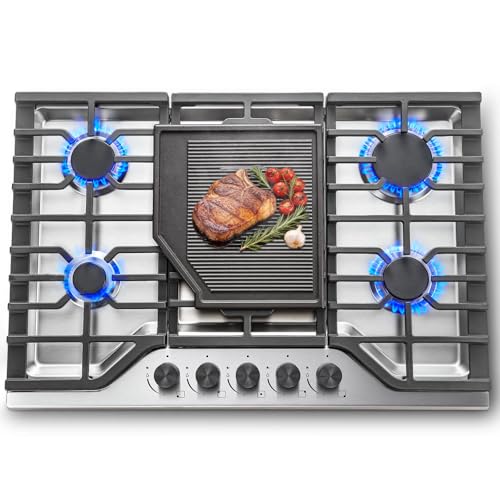
Serious heat is this cooktop’s argument, and the listing states it in numbers: five SABAF burners totalling 47,400 BTU, with a triple-ring wok burner rated at 22,000 BTU at the top of the range. SABAF is an Italian burner maker whose components appear in plenty of respected ranges, and a triple-ring design spreads fierce heat across a wide base — the difference between a stir-fry that sears and one that stews in its own juices while the cook pretends otherwise.
A cast iron griddle joins the package, so the with-grill brief is answered here too, spanning the centre for flat-top breakfasts and ribbed searing. The stainless top is NG/LPG convertible, knob control keeps the interface honest and glove-friendly, and the whole unit fits a 30-inch slot, which makes this the power pick for standard-width kitchens that refuse to accept standard-width performance. Wok households, in particular, should read the burner figure twice: it is the headline of this guide.
Balance the enthusiasm with the usual physics. A 22,000 BTU burner under a small milk pan is overkill that will scorch before you blink, and high-output cooking demands ventilation to match — an underpowered hood will leave the kitchen seasoned even when dinner is perfect. The griddle, as with its rivals, is cast iron with cast iron’s weight and care routine. Buy this one for the fire, use the griddle gladly, and respect both.
- 30-inch built-in gas cooktop, stainless steel top
- Five SABAF burners, 47,400 BTU total per the listing
- Triple-ring wok burner rated at 22,000 BTU
- Cast iron griddle included for the centre zone
- NG/LPG convertible with knob controls
Strengths
- Wok burner output leads this entire roundup
- SABAF components carry a solid reputation
- Full power arrives in a standard 30-inch footprint
Trade-offs
- Biggest burner will scorch small pans carelessly used
- Needs extraction strong enough for high-heat cooking
- Griddle care follows the usual cast iron routine
Best for: stir-fry households wanting real wok heat from a 30-inch top.
Not suited for: gentle cooks whose repertoire rarely passes a medium simmer.
VEVOR 30in Gas Cooktop — Best for RVs and small spaces
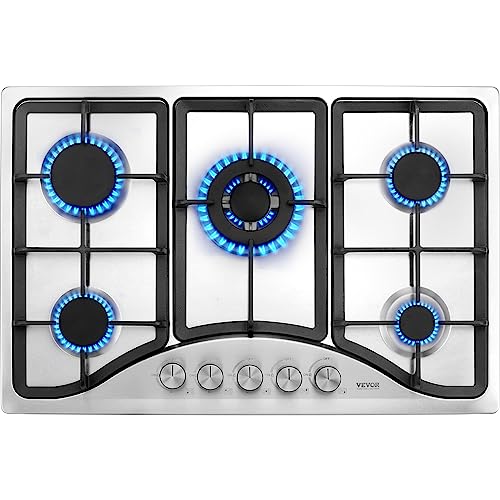
VEVOR sells this 30-inch five-burner cooktop into a different life from the others: the listing names camping, RVs and apartments among its intended homes, and that framing should guide how you judge it. In a motorhome galley or a compact flat, a built-in gas top with five burners is already a luxury; the expectations are reliability, safety and sane heat rather than wok theatrics, and this model is specified accordingly.
The listing states 12,250 BTU in its headline figure — read carefully on the product page whether that describes a single burner or a summary figure before comparing it against rivals’ totals, because brands present these numbers inconsistently. What is unambiguous is the thermocouple protection, which guards against gas flowing to an unlit or blown-out burner, and the NG/LPG convertibility that suits bottled-gas installations in vehicles and rural cottages alike. The stainless design keeps the surface wipeable in tight quarters where splashes have nowhere else to go.
Set expectations by the brief and this pick makes sense. It is not the searing station of the group, and cooks chasing char will look elsewhere in this guide. It is the pragmatic built-in for small spaces where gas cooking is wanted without drama, parts are sensibly specified, and the safety system watches the flame so the cook can watch the road-trip dinner instead.
- 30-inch built-in format aimed at RVs, camping and apartments
- Five burners, stainless steel design
- Headline figure of 12,250 BTU as stated in the listing
- NG/LPG convertible for mains or bottled gas
- Thermocouple protection against unlit gas flow
Strengths
- Small-space brief is honest and well matched
- Flame-failure protection suits vehicle installations
- Convertibility fits bottled gas in rural settings
Trade-offs
- Heat output is modest beside the power picks here
- Listing BTU presentation needs a careful read
- Fewer headline features than the family-size rivals
Best for: RV, camper and small-flat kitchens wanting built-in gas without excess.
Not suited for: cooks whose first priority is maximum searing power.

Frigidaire Professional 36in Gas Cooktop Griddle — Best established-brand option
Frigidaire’s Professional line is the conservative heart of this roundup: a 36-inch, five-burner stainless cooktop with a griddle, sold with a propane conversion kit in the box. For buyers who weigh service networks and parts availability alongside burner layouts — a reasonable stance for an appliance that should serve a decade or more — the established badge carries genuine weight that newer marketplace brands cannot match on paper.
The configuration follows the classic pro-style script. A centre zone hosts the griddle for the flat-top work this category promises, continuous cooking surfaces let heavy pans slide rather than lift, and the Professional styling — chunky knobs, restrained stainless — suits kitchens renovated around a serious cooking station. The included propane kit matters more than it looks: rural homes on bottled gas often discover conversion parts are an extra order and an extra week with lesser brands.
No specification heroics are claimed here, and that is the honest summary. The listing does not trumpet a record wok burner or a novel safety system; it offers a well-sorted 36-inch top from a maker with deep support. If your decision process starts with who will answer the phone in year seven, this pick starts the conversation, and its griddle ensures it still answers this guide’s particular question.
- 36-inch Professional-series gas cooktop, stainless steel
- Five burners with a griddle for centre-zone flat-top cooking
- Propane conversion kit included in the box
- Pro-style knob controls and continuous cooking surface
- Backed by an established national service network
Strengths
- Brand support and parts depth lead the group
- Conversion kit included rather than sold separately
- Timeless pro styling suits renovated kitchens
Trade-offs
- Listing leads on brand rather than standout figures
- Griddle performance is solid rather than class-leading
- 36-inch footprint excludes smaller kitchens
Best for: renovators who rank service networks and longevity first.
Not suited for: buyers chasing the highest stated burner output per burner.

AMZCHEF 36 Inch Gas Cooktop with Griddle, 5 — Highest total BTU in the guide
On stated numbers, this AMZCHEF tops the guide: five Italy SABAF sealed burners with a maximum total of 48,300 BTU, set into a 304 stainless steel panel, ETL certified and convertible between natural gas and propane. Sealed burners deserve their sentence — the burner bases are closed against spills, so the inevitable boil-over wipes up instead of migrating into the cooktop’s internals, a difference you appreciate on the first pasta night rather than in year three.
The griddle answers the category’s central promise across the middle burners, giving a 36-inch household the flat-top surface for batch breakfasts and a ribbed sear for evening proteins. With five burners and this much total output, simultaneous cooking is the real product: a stockpot can hold its simmer at the back while the griddle works and a sauce reduces at the front, without the musical-chairs pan rotation that smaller tops impose on anyone feeding six.
Certification is the quiet reassurance here. ETL listing means the design has been examined against North American safety standards, which is worth weighing alongside the headline BTU figure when comparing marketplace cooktops. As with the SNDOAS, extraction needs to keep pace with the firepower, and the griddle wants cast-iron manners. For a big household that cooks several things at once, though, this is the capacity pick.
- 36-inch built-in top, 304 stainless steel panel
- Five Italy SABAF sealed burners, max 48,300 BTU per listing
- Griddle included across the centre zone
- NG/LPG convertible, ETL certified
- Sealed burners simplify cleaning after boil-overs
Strengths
- Highest stated total output in this roundup
- Sealed burners keep spills out of the internals
- Certification adds buying confidence
Trade-offs
- Output demands equally serious ventilation
- Large top needs a large, well-planned cutout
- Griddle adds cast iron weight and care
Best for: large households cooking several pans at once on a 36-inch top.
Not suited for: compact kitchens or cooks who mostly prepare one-pan meals.

GASLAND Gas Cooktop 30 Inch 5 Burners with G — Best black finish with grill plate
Most cooktops in this guide wear stainless; the GASLAND wears black, and in a kitchen designed around dark cabinetry or a black range hood that is not a trivial difference. Beneath the finish sits a 30-inch, five-burner layout whose centrepiece answers this category precisely: a reversible cast iron plate that presents a ribbed grill face on one side and a flat griddle on the other, so the same burner zone handles both searing and breakfast without storing two accessories.
Specification details show a practical mind. The top runs on a 120V plug-in supply for its ignition, converts from mains gas to bottled propane, and carries CSA certification — the North American safety mark that insurers and inspectors like to see. Five burners in a 30-inch frame is a dense arrangement, and the centre plate gives that density a purpose: with the plate fitted, four corner burners remain for pots while the middle becomes a dedicated flat-top station.
Density is also the caveat. Five burners across thirty inches means large pans negotiate for elbow room, and two wide stockpots plus the griddle at once is an optimistic plan. Cook households of two to four, though, and the arrangement sings — especially for cooks who grill indoors weekly and want the ribbed plate living on the cooktop rather than in a cupboard across the room.
- 30-inch five-burner cooktop in a black finish
- Reversible cast iron grill and griddle plate included
- 120V plug-in ignition supply
- NG/LPG convertible, CSA certified
- Centre plate leaves four burners free for pans
Strengths
- Black finish suits dark kitchen schemes
- One plate covers both grill and griddle roles
- Certification supports insurance and inspection comfort
Trade-offs
- Five burners in thirty inches crowd oversized pans
- Plate storage needed when all five burners are wanted
- Black surfaces show dust and flour readily
Best for: smaller households wanting a resident grill plate and a black finish.
Not suited for: cooks who regularly run two very large stockpots side by side.
How Do the Six Compare Side by Side?
One line per cooktop, trait against caveat. The pattern to notice is that every strength in this category casts a small shadow — power wants extraction, plates want seasoning, density wants modest pans — and the sections exist to help you choose which shadow your kitchen tolerates best.
| Pick | Standout trait | Watch out for |
|---|---|---|
| 36in Gas Cooktop with Reversible Griddle | Resident reversible plate on a roomy 36-inch top | Iron plate needs seasoning and two-handed lifting |
| SNDOAS 30in Gas Cooktop SABAF | 22,000 BTU triple-ring wok burner per the listing | Extraction must match the firepower |
| VEVOR 30in Gas Cooktop | Small-space brief with flame-failure protection | Modest heat beside the power picks |
| Frigidaire Professional 36in Gas Cooktop Griddle | Established brand, conversion kit in the box | Specification is solid rather than spectacular |
| AMZCHEF 36 Inch Gas Cooktop with Griddle, 5 | 48,300 BTU stated total, sealed SABAF burners | Demands a large cutout and serious hood |
| GASLAND Gas Cooktop 30 Inch 5 Burners with G | Black finish with a reversible grill-griddle plate | Five burners crowd thirty inches |
What Does a Centre Griddle Actually Cook Well?
A flat cast iron plate over a centre burner is a short-order station in miniature. Its natural repertoire is anything that benefits from uninterrupted contact and room to move: pancakes without pan walls, eggs for four, bacon that renders evenly, grilled sandwiches pressed flat, onions softening in quantity for burgers, and smash burgers themselves, which need a ripping-hot flat surface and a confident press. The ribbed face handles peppers, courgette, halloumi and steaks when lines and drainage matter.
What it will not do is smoke. A ribbed plate gives marks and fat management, not the flavour of charcoal or a wood fire, and pretending otherwise sets buyers up for disappointment. Judge the plate as a superb indoor flat-top with a searing alter ego, keep the extractor honest, and it will earn its permanent place on the surface within the first month of breakfasts.
How Should You Read BTU Figures Without Being Misled?
Listings present heat three ways: a total across all burners, a headline figure for the largest burner, or — most confusingly — a number whose basis is unclear until the specification table. The SNDOAS in this guide states both its 47,400 BTU total and its 22,000 BTU wok burner, which is the transparent pattern. The VEVOR headline figure needs the careful read its section describes. Whenever you compare across brands, compare like with like: totals with totals, largest burners with largest burners.
Usable heat also depends on what sits above the flame. A wide, flat-based pan on a triple-ring burner receives the full argument; a small rounded wok on a flat domestic grate wastes much of it around the sides. Treat BTU as potential energy awaiting good cookware and decent extraction, and the figures in this guide will guide you honestly.
Which Is Better for Your Kitchen, 30 Inches or 36?
Thirty inches is the standard slot in most fitted kitchens, and five burners inside it — as several picks here manage — is a dense, capable arrangement provided your pans are ordinary sizes. Thirty-six inches buys elbow room: wider spacing, a longer griddle zone, and the ability to run two genuinely large vessels without negotiation. The cost is counter space and a bigger cutout, which is why 36-inch tops usually arrive during renovations rather than as casual swaps.
Measure the existing cutout before falling for any model, because headline width describes the glass or steel top, not the hole. One pick here lists its cutout at 32.67 by 18.89 inches; your cabinet’s opening must match its own model’s figure, not a neighbour’s. Fitters can sometimes enlarge an opening in stone or timber; they cannot shrink one, which argues for measuring twice and ordering once.
How Does NG and LPG Conversion Actually Work?
Every cooktop in this guide converts from mains gas to bottled propane, and the conversion is a jet-and-regulator job: different orifices meter the different gases, and the appliance’s regulator is set or swapped accordingly. Some brands include the conversion kit, as Frigidaire does here; others require ordering it. Either way, the work belongs to a qualified gas fitter in most jurisdictions, both for safety and for the paperwork your insurer may one day request.
Plan the conversion before delivery day. Confirm which gas the unit ships configured for, whether the kit is in the box, and whether your fitter wants to bench-convert before installation or adjust in place. Bottled-gas households in rural cottages should also confirm regulator compatibility at the tank end. None of this is difficult; all of it is miserable to discover with the old cooktop already on the driveway.
Why Does Thermocouple Protection Matter on a Gas Top?
A thermocouple is a small heat-sensing device beside the burner that holds the gas valve open only while a flame warms it. If a gust through an open window, a boil-over or a moment’s inattention kills the flame, the sensor cools and the valve closes, rather than the burner quietly filling the kitchen with unburned gas. Several picks here fit it, and the feature deserves more prominence than listings usually give it.
The protection is especially valuable on low simmers, where flames are smallest and most vulnerable, and in the draughty, door-open kitchens of older cottages and RVs. It does not replace attention — a cook still responds to a dead burner — but it converts a potential hazard into a mere relight. When two otherwise equal cooktops compete for your money, take the one watching the flame.
How Do You Season and Care for a Cast Iron Griddle Plate?
New cast iron improves with a simple ritual: wash, dry thoroughly on a warm burner, wipe the thinnest film of high-heat oil across the surface, and heat until it just smokes, then let it cool. Repeat twice and ordinary cooking maintains the layer from there. After use, scrape while warm, wash with hot water and a stiff brush, and always dry on the hob rather than in a rack — trapped moisture is how rust introduces itself.
Avoid the two classic errors. Do not soak the plate in the sink while dinner is eaten, and do not store it damp beneath other pans. A well-kept plate darkens, slickens and becomes the surface eggs slide on by month two; a neglected one stays sticky and grabby and gets blamed for crimes of housekeeping. The plate is the heart of this category, and ten minutes of manners keeps it beating.
What Extraction Does a High-Output Cooktop Need?
Heat, steam and aerosolised fat leave a cooktop at speed, and a high-output model used enthusiastically will overwhelm a decorative hood quickly. Match extraction to your cooking style rather than to the appliance’s maximum: a household that sears steaks and stir-fries weekly needs a hood that moves serious air and vents outside where possible, while gentle simmerers can live happily with less. Griddle cooking is the greasiest work in this guide, so place it in your calculations honestly.
Noise is the hidden variable. An extractor run at a bearable volume moves less air than its headline figure, so choose one whose middle setting you can tolerate through a whole dinner service. Position matters too: the hood should cover the front burners, not just the back wall zone. Good extraction protects cabinets, paintwork and the cook’s temper in equal measure.
How Should You Test a New Cooktop in Its First Week?
Boil a full kettle-equivalent pot on the largest burner and time it, then hold the gentlest possible simmer on the smallest without the flame dying or the sauce catching. Fry eggs on the griddle to map its hot spots — every plate has them, usually centred over the burner — and note where pancakes brown fastest, because that geography will guide your cooking for years.
Slide your heaviest pan across the grates, check knob feel with wet hands, and confirm ignition is instant rather than hesitant on every burner. Small annoyances discovered in week one are warranty conversations; the same annoyances discovered in month three are just your life now. A methodical first week turns a specification sheet into knowledge you actually cook with.
What Clearances and Counter Checks Come Before Installation?
Gas cooktops sit above ovens or cupboards and beside combustible surfaces, and every model carries its own clearance figures in its manual — distances to overhead cabinets, side walls and the hood. Read them against your kitchen as built, not as planned, because older renovations drift from their drawings. Confirm the counter material tolerates the cut edges and heat, and that the gas supply and electrical point for ignition land where the unit expects them.
The cutout deserves its own paragraph in every guide because it ruins more installations than any burner question. Measure the opening in your counter today, compare it with the figure in the listing of the exact model you are ordering, and photograph both for the fitter. Ten minutes with a tape measure is the cheapest insurance in the entire purchase.
How Do Continuous Grates Change Everyday Cooking?
Where grates run continuously across the surface, heavy pans slide from burner to burner instead of being lifted — a kindness to wrists and to sauces that slosh. The Frigidaire’s pro-style layout leans on this, and cooks with cast iron cookware feel the benefit daily. The trade is cleaning: larger grate pieces are heavier to lift to the sink and may not fit smaller basins, so check the grate design against your sink as honestly as against your pans.
Individual grates are lighter and easier to wash but interrupt pan movement and can rock under offset handles. Neither is a flaw; they are two philosophies of the same surface. Match the philosophy to the cookware you actually lift every day, because the cooktop will be cleaned and cooked on for years after the showroom impressions fade.
When Is a Separate Grill Still Worth Owning?
A cooktop plate covers weeknight grilling superbly, but it does not replace every outdoor fire. Cooking for twelve, smoking anything, or chasing charcoal flavour still belongs outside, and a household that entertains at that scale will keep both without redundancy. The plate’s gift is frequency: grilled peppers on a Tuesday, halloumi with lunch, burgers without weather negotiation — the small grill jobs that a separate appliance’s setup cost used to veto.
Think of the division as indoors for convenience, outdoors for occasion. Most households find the plate handles eighty percent of their grilling impulses, and the outdoor grill, relieved of weeknight duty, gets used with more pleasure and less obligation. That is a healthy arrangement, and it is the realistic promise behind this whole category.
How Should You Compare Warranties and Certifications?
Certification first: ETL and CSA marks, both present in this guide, tell you the design met North American safety standards under independent examination. For a gas appliance plumbed into your home, that is not bureaucratic decoration; it is the baseline your insurer assumes. Prefer a certified model whenever the choice is close, and keep the certificate details with your house documents.
Warranties divide into parts coverage and the network that honours it. An established brand’s longer parts list means little without local engineers, which is why the Frigidaire’s service depth features in its section. Marketplace brands compete on specification and price; weigh how you would actually obtain a replacement igniter in year four. The cheapest cooktop is the one that never needs an improvisation.
How Do You Cook a Full Breakfast on the Griddle Without Chaos?
Sequence is everything on a flat plate. Bacon goes down first, because its fat becomes the cooking medium for everything that follows and because it tolerates holding. Eggs come last and fastest, in the clearest patch of the plate, once the toast is already down and the coffee is poured. Between those bookends, mushrooms, tomatoes and sliced potatoes take the middle minutes, moved toward the plate’s cooler edges as they finish rather than being removed to cold plates.
Map the hot spots before the audience arrives. The zone directly over the centre burner runs fiercest, and the corners lag noticeably, which is a feature once you know it: sear in the middle, hold at the edges. Work with two spatulas, keep a tray beside the cooktop for finished items, and the griddle breakfast becomes a calm production line instead of the usual four-pan negotiation conducted at shouting distance.
What Pan Sizes Suit Five Burners in Thirty Inches?
Dense layouts reward honest cookware. On a 30-inch five-burner top, a 28-centimetre frying pan and a 24-centimetre saucepan coexist happily; two 30-centimetre stockpots do not, whatever the photograph in the listing suggests. Measure your two most-used vessels together, base to base with handles turned, and compare that span against the grate layout before ordering any dense model in this guide.
Handles are the hidden dimension. Long handles rotated outward steal the neighbour’s airspace and invite knocks, so angle them along the counter’s edge and keep the centre plate’s zone clear when it is working. Households that cook with genuinely oversized pans as a daily habit should step up to a 36-inch model and accept the cutout consequences, rather than blaming a 30-inch top for geometry it never promised to defeat.
How Do You Simmer Gently on a Powerful Burner Layout?
Low heat is where powerful cooktops are truly tested, because a burner designed for searing can bully a custard. Use the smallest burner for sauces and melting, keep a heavy-based pan between flame and food to smooth the pulses, and learn the quarter-turn of knob where your particular model holds a lazy bubble rather than a rolling one. That position differs by model and by gas type, and finding it in week one saves a year of scorched milk.
A simmer plate or diffuser earns its small cost on any high-output top, spreading a fierce burner’s output across a wider, gentler footprint. Delicate work — chocolate, butter sauces, rice finishing — becomes calm instead of vigilant. Judge a powerful cooktop by this end of its range as much as by its fireworks, because dinner is more often a simmer than a sear.
What Should Renters and Renovators Each Prioritise?
Renovators should buy for the decade: cutout flexibility while the counter is being made anyway, certification in order, conversion parts confirmed, and a service story they believe. The 36-inch models in this guide exist for that moment, when the kitchen is open and every dimension is negotiable for the last time in years.
Renters face the opposite geometry and should be honest about it. A built-in cooktop is rarely a renter’s purchase at all; where it is — a long lease with a cooperative landlord, say — the priorities become standard sizing, reversible installation and nothing that requires structural change. The 30-inch models here fit the commonest slots, and choosing one that matches the existing cutout exactly is worth more than any burner headline.
How Does Altitude and Bottled Gas Change the Picture?
Homes at altitude and homes on bottled propane both ask slightly different things of a gas cooktop. Propane burns with different characteristics from natural gas, which is precisely why conversion changes the jets rather than merely the supply hose, and why the fitter’s adjustment visit matters. Water also boils at lower temperatures higher up, lengthening some cooking in ways no burner figure can fix.
None of this changes which models belong in this guide — all six convert — but it changes the installation conversation. Tell your fitter the altitude and the supply type before the appointment, confirm the correct jet set is on hand, and the cooktop will be tuned to your actual kitchen rather than to a sea-level showroom it will never see.
What Is the Sensible Order of Checks on Delivery Day?
Inspect the surface before the packaging leaves: stainless for transit dents, the griddle plate for casting flaws, knobs present and seated. Photograph the model plate with its serial details for your records, and keep the manual’s clearance page open when the fitter positions the unit, because that page — not habit — governs the gaps to cabinets and walls.
Before the fitter leaves, light every burner, watch each flame’s colour and stability, run the griddle through its first seasoning heat, and confirm the conversion paperwork matches the gas in your line. Ten unhurried minutes at this moment are the difference between a cooktop that starts life correctly and one whose small mysteries get investigated, at callout prices, some time next spring.
How Do You Keep Stainless and Black Finishes Looking Decent?
Stainless rewards a wipe in the direction of the grain and punishes circular scrubbing with a permanent haze, while black finishes hide scorch marks gracefully but display every dusting of flour and salt. Both clean best warm rather than hot, with a soft cloth and a mild degreaser, before spills bake into the varnish-like layer that makes owners reach for abrasives they will regret.
Burner caps and grates want a soak in hot soapy water while the surface is wiped, and the griddle plate follows its own cast iron rules from the care section above. Ten minutes after a big cooking session keeps any of these tops presentable; a monthly heroic deep-clean is the sign the small habit slipped. Choose your finish by which evidence of cooking your household minds seeing daily.
Why Do Cooks Choose Gas Over Induction for This Job?
The honest answer is feel and compatibility. A flame shows its size, responds the instant a knob turns, works with every pan ever made including rounded woks, and keeps cooking through a power cut in homes where that matters. The griddle plates in this guide also behave predictably over gas, heating from a visible source a cook can read at a glance.
Induction counters with speed, efficiency and a cooler kitchen, and plenty of households choose it happily. This guide exists for the other household — the one that has cooked on flame for years, trusts its instincts over a touch panel, and wants the centre plate without changing religion. Neither camp needs converting; they need the right model within their own tradition.
How Should You Plan a Kitchen Around a 36-Inch Top?
Give the big top its supporting cast. Landing space on both sides for hot pans coming off the griddle, a hood sized to the full width rather than to the old 30-inch unit it replaces, and storage for the plate within one step — because a plate stored across the room is a plate that quietly stops being used. Drawers below suit utensils; the plate itself prefers a vertical slot or its resident place on the surface.
Lighting deserves a thought too, since a wide stainless top under downlights will show every splash in glorious detail. Warm task lighting angled from the front reveals the cooking without turning the surface into a mirror. Plan these details while the renovation drawings are still cheap to change, and the 36-inch top becomes the kitchen’s anchor rather than its diva.
What Does the First Month of Ownership Usually Teach?
Almost every owner reports the same curriculum. Week one is measurement regret or measurement pride, depending on whether the cutout advice was followed. Week two reveals the griddle’s true hot geography, usually one hand’s width hotter at the centre than expected. Week three is when the plate stops being an event and becomes the default place for anything flat, which is the moment the category justifies itself.
By the end of the month the knobs’ personalities are known — which burner lights shyly, which simmers sweetest, where the wok burner must be watched. That familiarity is the real product a cooktop sells, and it argues for choosing the model whose layout matches your habits rather than the one with the loudest single number. Specifications start the marriage; daily temperament decides it.
How Do You Grill Vegetables on the Plate Without Steaming Them?
Water is the enemy of the ribbed side. Peppers, courgettes and mushrooms arrive full of it, and a crowded plate drops in temperature until everything simmers in its own juice. Work in a single layer with space between pieces, let the plate recover its heat between batches, and salt after the sear rather than before, so moisture stays inside the vegetable until the marks are made.
Oil the food, not the plate: a light coating on the pieces themselves seasons evenly and smokes less than oil pooled in the ribs. Finish with the plate’s residual heat off the flame for delicate items like asparagus, which need ninety seconds of drama and no more. Treated with this discipline, the ribbed face produces vegetables with genuine char at the edges and bite in the middle, rather than the grey compromise indoor grilling is accused of.
How Do You Keep Children and Guests Safe Around an Open Flame Top?
Turn pan handles inward as a reflex, keep the griddle’s working zone treated as live even when its burner looks idle — cast iron holds heat long after the flame dies — and brief guests who offer to help, because visitors instinctively reach across cooktops they do not know. A kettle kept on a back burner gives small hands a landmark that the back is the safe direction.
None of this is unique to these six models, but a resident grill plate adds one specific lesson: the plate looks like a shelf and is not one. Teach the household that nothing — not a spoon, not a tea towel, not a phone — rests on it, ever, and the most common indoor-grill injury in any kitchen quietly disappears from your future.
One last habit separates contented owners from the rest: a thirty-second end-of-service routine. Grates get a glance for spills while they are still warm, the plate gets scraped before it cools, and knobs return to a definite off rather than a hopeful one. The cooktop that is left clean and confirmed safe at night is the one that greets the morning ready, and readiness, repeated daily, is what a great cooking surface actually feels like from the inside of a household.
What Mistakes Do Buyers Make Most Often?
- Ordering by headline width without measuring the existing cutout, then meeting a counter opening that fits nothing you bought.
- Comparing one brand’s total BTU against another’s single-burner figure and declaring a winner on mismatched numbers.
- Assuming the ribbed plate will deliver charcoal flavour, rather than sear marks and fat drainage as it actually does.
- Skipping the gas fitter for conversion work to save a fee, and inheriting both the risk and the insurance questions.
- Letting a cast iron griddle soak in the sink after dinner, then blaming the plate for rust that housekeeping caused.
- Fitting a high-output cooktop under a decorative hood, then seasoning the kitchen walls along with every steak.
Final Recommendation
Match the plate to your cooking first and the badge second. For the classic version of this category — a big stainless top whose centre plate flips between breakfast and searing — the 36in Gas Cooktop with Reversible Griddle is the guide’s centre of gravity, while the GASLAND Gas Cooktop 30 Inch 5 Burners with G shrinks the same idea into thirty inches and a black finish.
Heat hunters have two distinct doors. The SNDOAS 30in Gas Cooktop SABAF concentrates its argument in one fierce wok burner, and the AMZCHEF spreads the largest stated total across a 36-inch surface for many-pan households. The VEVOR serves small spaces honestly, and the Frigidaire serves the long decade, support network and all.
Whichever top lands in your counter, cook its first week deliberately: map the griddle’s hot spots, learn each burner’s temper, and season the iron before it has a chance to resent you. A cooktop chosen this way stops being a specification you bought and becomes the surface your kitchen’s habits quietly organise themselves around.
Frequently Asked Questions
Does the grill plate replace an outdoor grill?
For weeknight jobs, largely yes: it sears, marks and drains fat for burgers, peppers and halloumi. It does not produce smoke or charcoal flavour, and cooking for a crowd still belongs outside, so most households keep both and use each where it shines.
Are all six cooktops convertible between natural gas and propane?
Yes, every listing in this guide states NG/LPG convertibility. The Frigidaire includes its propane kit in the box; for others, confirm whether the kit is included or separate, and have a qualified fitter perform the conversion.
What does thermocouple protection do?
It senses the burner’s flame and closes the gas valve if that flame dies, preventing unburned gas from flowing into the room. It is fitted on several picks here and is especially valuable for low simmers and draughty kitchens.
How do I know whether a 36-inch model fits my counter?
Ignore the headline width and find the cutout figure in the listing — one model here lists 32.67 by 18.89 inches. Measure your existing opening and compare exact numbers before ordering, because counters can be enlarged but not shrunk.
Is a higher BTU total always better?
No. Totals and single-burner figures measure different things, and usable heat depends on pan base, grate design and extraction. A fierce wok burner transforms stir-fries; the same output under a milk pan is simply a scorching hazard.
How should I clean the cast iron griddle plate?
Scrape it warm, wash with hot water and a stiff brush, dry it on the hob and finish with the lightest film of oil while it is still warm. Never soak it or store it damp, and the seasoning will build rather than rust.
Related Guides
If the cooking surface is settled and you are furnishing the rest of the room, these guides pick up where the hob leaves off: Best Immersion Blenders Best Cotton Blankets Best Indoor Electric Grills


