What's inside
- Key Takeaways
- Quick Picks
- How We Chose These Picks
- How Do the Six Office Picks Compare at a Glance?
- How Quiet Is Quiet Enough for Video Calls?
- Where on the Desk Should the Purifier Live?
- What Does an Office Purifier Actually Do About Dust?
- How Do Printers, Pets and People Change the Calculation?
- Can Scent Belong in a Working Room?
- How Should You Run One Through a Working Week?
- What Maintenance Does an Office Machine Really Need?
- How Does an Office Purifier Behave in Winter, With the Heating On?
- What About the Afternoon Slump and Stuffy Air?
- Can One Purifier Serve an Office That Is Also a Workshop or Studio?
- How Do You Keep a Purifier From Becoming Desk Clutter?
- What Should You Check in the First Week With a New Machine?
- How Long Does an Office Filter Realistically Last?
- Do You Need a Second Machine for the Rest of the House?
- Which Mistakes Do Home Office Buyers Make Most Often?
- Final Recommendation
- Frequently Asked Questions
- Related Guides
As an Amazon Associate I earn from qualifying purchases. This post may contain affiliate links at no extra cost to you.
cottageverdict.com is reader-supported. When you buy through links on our site, we may earn an affiliate commission.
Where to buy: the six best air purifiers for a home office below are all sold through Amazon, and their names in the Quick Picks table, the review headings and the comparison table link straight to the matching listing, where you can check price on Amazon and confirm the filter type, speeds and dimensions before ordering. A home office has a peculiar and persistent air problem. It is the room where you sit still for the longest stretch of the day, breathing the same few cubic metres through calls, deadlines and the slow afternoon, while a printer warms up in the corner, a dog sleeps under the desk, and the door stays shut so the rest of the house does not hear your meeting.
Stillness changes what matters. Dust that would be stirred and diluted in a busy kitchen settles visibly on a monitor and a dark desk. Odours linger because nobody opens the door. And noise, which a living room forgives, becomes a genuine work issue: a fan drone under a video call reads as unprofessional, and a machine you mute during every meeting is a machine that spends half the day doing nothing. So this guide judges purifiers the way an office worker experiences them — by how quietly they run at the speed you will actually use, how little desk they steal, and whether they keep the air around your chair feeling fresh through a full working day.
One boundary before the picks, stated plainly so nothing later needs qualifying: these are comfort machines. They catch dust, hair and the particles that make a room feel stale, and they soften everyday smells. They are not medical devices and this guide makes no health claims for them. Where a listing states a coverage area, a decibel figure or a filter grade, we quote the listing. Where it does not, the spec box says the figure is not stated, because an honest gap beats an invented number every time.
Key Takeaways
- Office purifying is a noise discipline first: the winning machines are the ones quiet enough to stay on during calls, at 20dB stated figures on two picks here.
- Desk space is salary space; four of the six picks are small desktop units, and one, the Crane, doubles as the desk fan you may already own and rely on daily.
- The GermGuardian tower is the room-scale option, with a listing-stated reach of up to 743 sq. ft. and UV-C, for offices that are really converted bedrooms.
- Coverage claims vary wildly in method between brands, so compare the stated figures cautiously and comparatively: 880 sq. ft. (Purivortex), 1,086 ft² (FULMINARE and FreAire) and unstated on the Crane and AromaRoom.
- Aromatherapy features on the AromaRoom and FreAire are pleasant for solo workers and worth skipping in a shared or client-facing office.
- Filters are the only homework: none of these six asks for more than a periodic swap or a pre-filter rinse, but all of them punish neglect with noise and weak airflow, usually starting in the middle of your busiest week.
Quick Picks
| Pick | Badge | Why it earns its place |
|---|---|---|
| GermGuardian Tower HEPA Air Purifier | Best Room-Scale Tower | A slim 22-inch tower whose listing states up to 743 sq. ft., with UV-C and three quiet speeds for a full-size office. |
| Crane 2-in-1 Air Purifier and Desk Fan | Best Two-Jobs-One-Plug | It purifies and blows a personal breeze from the same small body, ideal where the desk has one spare socket. |
| AromaRoom True HEPA Air Purifier | Best for Scent and Sleep Modes | True HEPA filtration plus aromatherapy and a time mode, for the solo office that becomes a guest room at night. |
| Purivortex PX500 Air Purifier | Best Stated Coverage, Desktop Class | Its listing claims up to 880 sq. ft. from a compact black unit, and states plainly that it is ozone free. |
| FULMINARE H13 True HEPA Air Purifier | Best Night-Light Desktop | H13 true HEPA, a stated 20 dB quiet figure and up to 1,086 ft² claimed, with a night light for late sessions. |
| FreAire KN6391RGB Air Purifier | Best Ambient Style | 360° airflow, three ambient lights and an aroma pad wrap office filtration in a gadget that looks deliberate on a desk. |
How We Chose These Picks
We began with the working day as the test. A home office purifier must run for eight to ten hours without becoming the most noticeable sound in the room, so listings that publish a low decibel figure or emphasise quiet speeds rose to the top, and machines with no stated noise at all were treated as unknowns to be placed carefully rather than assumed silent. The second filter was footprint: a purifier that evicts your notebook, second monitor stand or coffee has failed before it has cleaned anything, so desktop designs dominate this list, with one slim tower included for people whose office is a whole spare bedroom.
Coverage claims were read with suspicion and reported as printed. Brands measure differently — some quote the room size for several air changes an hour, others for far fewer — so a bigger number is not automatically a stronger machine. We list each figure exactly as its listing states it and mark the gaps honestly. What we would not accept at any coverage number was vagueness about the filter itself: every pick here names its filtration in the listing, whether HEPA, true HEPA, H13 or HEPA-type language, so you know what is doing the work.
Finally, we thought about the second life of an office. Many home offices double as guest rooms, hobby rooms or the place the dog is banished to during calls. Sleep modes, night lights, timers and aroma options were scored as genuine flexibility rather than decoration, because a machine that also serves the room’s evening personality is a machine that stays plugged in all year.

GermGuardian Tower HEPA Air Purifier — Best Room-Scale Tower
The GermGuardian is the one pick here that thinks in rooms rather than desks. Guardian Technologies’ listing describes a 22-inch tower with HEPA filtration, three quiet speeds, UV-C and AHAM verification, sized for up to 743 sq. ft. That makes it the natural choice when your office is a converted bedroom with a sofa, a bookshelf wall and a door you close against the house. A tower in the corner conditions the whole space, including the air around the reading chair where you take calls, not just the bubble above your keyboard.
UV-C is the feature to hold with both hands. The listing includes it as part of the design, and we report it as such; what we will not do is turn a bulb in an air cleaner into a promise about your health. Treat it as an extra stage inside a machine whose real, everyday work is done by the HEPA filter catching dust, hair and the fine particles that film over a desk. The three speeds being described as quiet matters more in practice: a tower you can leave on its middle setting through a call is worth more than a stronger blast you reserve for lunch breaks.
The tower form cuts both ways. It needs floor, not desk — about a dinner plate’s worth, tucked beside a cabinet — and in a box room that floor may already belong to a printer stand or a filing box. Measure the corner before ordering. But if the floor exists, the GermGuardian is the pick that makes the whole office feel maintained rather than just the square metre where you sit.
- Format: 22-inch tower for floor placement in a corner
- Filtration: HEPA filter with UV-C stage, per the listing
- Coverage stated in the listing: up to 743 sq. ft., AHAM VERIFIDE
- Speeds: three, described in the listing as quiet speeds
- Noise figure in decibels: not stated in the listing
Strengths
- Only pick here sized and stated for a whole room rather than a desk zone
- Slim tower footprint suits the dead corner behind a door swing
- AHAM verification gives its coverage claim an outside reference point
Trade-offs
- Needs floor space, which the smallest offices simply do not have
- UV-C bulb is an additional part to replace in time, beyond the filter
- No decibel figure published, so call-time quiet is judged by its speed description
Best for: a spare-bedroom office where one machine should look after the entire room, sofa and all.
Not suited for: a desk-in-an-alcove setup where every centimetre of floor is already spoken for.

Crane 2-in-1 Air Purifier and Desk Fan — Best Two-Jobs-One-Plug
Crane looked at the average desk — already hosting a fan in summer, short of sockets all year — and merged the two appliances. The listing describes a 2-in-1 air purifier and desk fan with a small HEPA filter, aimed at office desks, nightstands, dorms and small bedrooms. As an office idea it is quietly brilliant. The breeze you want on a warm afternoon and the filtration you want all day arrive in one body, through one plug, occupying the footprint you had already surrendered to the fan.
Hold expectations at desk scale and the Crane delights. Its clean air is delivered exactly where its breeze goes: across your hands, face and keyboard. On a call, the fan side can keep you comfortable while the room’s heating argues otherwise, and the purifier side steadily trims the dust that would otherwise settle on the desk between you and the screen. What it will not do is condition a whole office the way the GermGuardian tower can; the listing positions it for personal space, and that positioning is honest.
The compromise inside any 2-in-1 is that neither half is the specialist. A dedicated fan moves air with more authority, and a dedicated purifier carries a larger filter. But desks are compromise machines themselves, and for the worker whose office is a corner of a bedroom, the Crane’s bargain — one device, two daily comforts, zero extra clutter — is the most practical offer in this guide.
- Format: compact 2-in-1 desk unit combining fan and purifier
- Filtration: small HEPA air purifier, per the listing
- Placement named in the listing: office desk, nightstand, dorm, small bedroom
- Room coverage figure: not stated in the listing
- Noise figure: not stated in the listing
Strengths
- Replaces a desk fan outright, freeing a socket and surface space
- Delivers filtered air as a personal breeze, right at the chair
- Small and light enough to move between desk and nightstand daily
Trade-offs
- Personal-scale cleaning; it will not condition a whole room
- Small filter means more frequent attention than larger units
- Fan and purifier share one body, so neither function is class-leading
Best for: a hot-desk worker in a small space who already keeps a fan on the desk from May to September.
Not suited for: anyone wanting room-wide filtration for a large office or studio.

AromaRoom True HEPA Air Purifier — Best for Scent and Sleep Modes
The AromaRoom’s listing is a study in dual-purpose design: true HEPA filtration for the working day, aromatherapy for the room’s other hours, and quiet sleep and time modes to bridge the two. It names its territory as bedroom, baby room, office and living room, and that spread tells the truth about its buyer — someone whose office is not a sealed professional pod but a room that changes costume between nine and nine.
True HEPA is the substantive part. Among the smaller picks here, a confirmed true HEPA filter is the strongest filtration wording a listing can offer, and for the office’s actual enemies — settled dust, pet hair drifting in from the landing, the fine grit that coats a printer — it is more than sufficient. The timer mode is the understated hero: set the machine to run through your working hours and rest overnight, and filtration becomes part of the room’s routine rather than another switch competing for your attention.
Aromatherapy needs the usual honest footnote. A scent pad makes the outgoing air pleasant; it does not clean anything, and in an office where a colleague or client occasionally sits across the desk, fragrance is a taste decision, not a default. Used solo, at low intensity, during the evening wind-down, it turns the office back into a room you might read in. That transformation, modest as it sounds, is why this pick exists.
- Format: portable small purifier for desk or side table
- Filtration: true HEPA, per the listing
- Modes named in the listing: quiet sleep mode and time mode
- Extras named in the listing: aromatherapy function
- Room coverage figure: not stated in the listing
Strengths
- True HEPA filtration confirmed in the listing at a small size
- Timer mode automates the working-day routine completely
- Sleep mode suits offices that become guest rooms after hours
Trade-offs
- No coverage figure published, so sizing rests on its small-room positioning
- Scent feature is wasted money if you dislike fragrance in workspaces
- No smart app control; everything happens at the unit
Best for: a solo worker whose office moonlights as a guest or reading room, and who likes a scent in the evening.
Not suited for: a shared office where fragrance would be imposed on other people.

Purivortex PX500 Air Purifier — Best Stated Coverage, Desktop Class
The PX500 makes the boldest claim among the desktop picks: its listing states coverage of up to 880 sq. ft. from a compact black unit with a HEPA filter, and adds a phrase we wish more brands printed — ozone free. Read the coverage the way all such figures deserve: as the maker’s own best-case room, not a promise for yours. Even discounted generously, though, the claim signals a machine built with a stronger motor than the nightstand class, and in an office that is also a workshop, a craft room or a home gym’s neighbour, that extra pull is the difference between a filter that keeps up and one that merely gestures.
The black finish is a deliberate office choice. White purifiers yellow the room’s palette and announce themselves in every video call background; a matte black box beside a monitor stand simply reads as equipment. For workers who record, stream or present, that camouflage is a real feature. The listing names its targets plainly — pollen, smoke, dust, pet dander, odour and hair — which is the office’s actual list, from the dog under the desk to the soldering or crafting smells some home offices generate.
Where the PX500 asks for faith is in the absence of a stated noise figure. A stronger motor in a small body can be a whisper or a whine, and the listing does not settle it. The pragmatic approach: place it a metre or two from the chair rather than at your elbow, where its pull still serves the desk zone and any fan character fades into the room. Bought with that placement in mind, it is the heavy lifter of the desktop group.
- Format: compact desktop unit in black
- Filtration: HEPA filter, per the listing; stated ozone free
- Coverage stated in the listing: up to 880 sq. ft.
- Targets named in the listing: pollen, smoke, dust, pet dander, odour, hair
- Noise figure: not stated in the listing
Strengths
- Largest stated coverage among the desktop-sized picks here
- Ozone-free design stated outright in the listing
- Black finish disappears into a monitor-and-desk background on calls
Trade-offs
- Coverage method is the maker’s own; treat the number as directional
- No published decibel figure, so keep it off the desk’s closest corner
- Fewer lifestyle extras — no light, scent or app mentioned in the listing
Best for: a larger or harder-working office — craft, workshop-adjacent or pet-shared — that needs more pull than a nightstand unit offers.
Not suited for: a silent-running purist who wants a published decibel figure before buying.
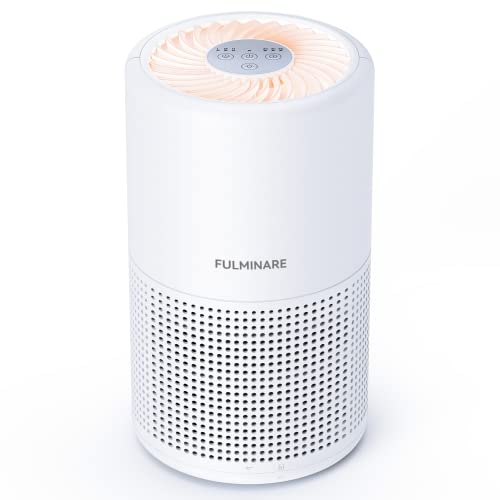
FULMINARE H13 True HEPA Air Purifier — Best Night-Light Desktop
FULMINARE’s listing stacks three numbers that office workers actually ask about: H13 true HEPA filtration, a 20 dB quiet figure, and coverage claimed up to 1,086 ft². Take them in order. H13 is a specific, high grade of HEPA — stronger wording than the generic “HEPA-type” language elsewhere in this market — and for a machine that will sit a metre from your face for years, that specificity is welcome. The 20 dB figure, as always, is the brand’s own measurement of its gentlest setting; even read sceptically, it marks a machine designed around quiet as a headline rather than an afterthought.
The coverage number deserves the standard caution, since the method behind it is not given in the listing. In a typical single office, what matters is that the machine is plainly not straining: a purifier loafing at its low speed in a small room is quieter and longer-lived than a mini unit screaming at maximum. That headroom is the real gift of an oversized claim, whatever its precise arithmetic.
The night light sounds like a bedroom feature until the first winter deadline. At 7 p.m. in January, an office lit only by a monitor is a cave, and a soft integrated light marks the machine’s corner without the glare of the main lamp. It can, of course, be ignored or switched off — the listing presents it as part of the package, not a condition. Workers who burn late hours will understand the appeal faster than anyone.
- Format: portable desktop purifier for home and office
- Filtration: H13 true HEPA filter, per the listing
- Noise figure stated in the listing: 20 dB on its quiet side
- Coverage claimed in the listing: 1,086 ft²
- Extras named in the listing: night light
Strengths
- Specific H13 grade rather than vague HEPA-style language
- Stated 20 dB quiet figure suits calls and deep-focus work
- Generous claimed coverage means easy, low-speed running in real offices
Trade-offs
- Coverage claim is the maker’s own and should be read as headroom, not a guarantee
- Night light will be pointless for nine-to-five-only workers
- No app or voice control named in the listing
Best for: a focus worker who runs late sessions and wants the strongest stated filtration grade in a quiet desktop body.
Not suited for: buyers who want independently verified coverage numbers before trusting a machine.

FreAire KN6391RGB Air Purifier — Best Ambient Style
FreAire’s KN6391RGB is the extrovert of the group: 360° airflow, a HEPA filter, a stated 20 dB sleep mode, three ambient lights and an aroma pad, with coverage claimed up to 1,086 ft². In a home office, looks are not vanity — the room is on camera. A purifier that resembles a deliberate piece of desk tech, with a soft light you control, sits more happily in a video-call background than a clinical white box, and the 360° intake means it does not need to be angled like a speaker to do its job.
The ambient lights deserve a fair hearing. Set low, they give the desk a defined pool of warmth in the evening, similar to a bias light behind a monitor, and they signal the machine’s state at a glance. Set bright or cycling through colours during a client call, they would be a distraction — but that is a settings choice, not a design flaw, and the worker who dislikes them entirely can treat them as off by default. The aroma pad follows the same logic: a personal, optional layer, best kept for solo hours.
Under the styling, the fundamentals are respectable for the class: HEPA filtration named in the listing, a sleep mode with a published quiet figure, and 360° airflow that forgives the messy reality of desk placement. If your office doubles as your streaming corner or simply the room you spend your life in, the FreAire argues that a purifier can be part of the room’s design rather than an apology in the corner.
- Format: desktop purifier with 360° airflow, black finish
- Filtration: HEPA filter, per the listing
- Noise figure stated in the listing: 20 dB sleep mode
- Coverage figure in the listing: 1,086 ft²
- Extras named in the listing: three ambient lights and an aroma pad
Strengths
- 360° intake forgives awkward placement between monitors and stacks
- Ambient lighting makes it a deliberate desk feature, not clutter
- Published sleep-mode figure matches the quietest claims in this guide
Trade-offs
- Styling features are wasted in a purely functional, off-camera office
- Aroma pad needs restraint if the office ever hosts clients
- Coverage figure is the maker’s own claim, as with its rivals
Best for: a camera-facing worker — streamer, presenter, perpetual video caller — who wants the purifier to look intentional.
Not suited for: a traditionalist who wants the plainest possible appliance and no lights at all.
How Do the Six Office Picks Compare at a Glance?
| Pick | Filtration (per listing) | Stated coverage | Standout trait |
|---|---|---|---|
| GermGuardian Tower HEPA Air Purifier | HEPA with UV-C | Up to 743 sq. ft. | Whole-room tower, AHAM verified |
| Crane 2-in-1 Air Purifier and Desk Fan | Small HEPA | Not stated | Fan and purifier in one body |
| AromaRoom True HEPA Air Purifier | True HEPA | Not stated | Aromatherapy plus timer and sleep modes |
| Purivortex PX500 Air Purifier | HEPA, ozone free | Up to 880 sq. ft. | Strongest desktop claim, black finish |
| FULMINARE H13 True HEPA Air Purifier | H13 true HEPA | Up to 1,086 ft² | 20 dB stated figure, night light |
| FreAire KN6391RGB Air Purifier | HEPA, 360° airflow | Up to 1,086 ft² | Ambient lights and aroma pad |
The table’s honest lesson is how differently brands report. Two listings state no coverage at all, three publish generous figures by their own methods, and one carries outside verification. Do not rank these machines by the coverage column. Rank them by where they will sit, how quietly they promise to run, and whether their extras match your room’s second life after working hours.
How Quiet Is Quiet Enough for Video Calls?
A microphone is a crueller judge than an ear. Modern call software suppresses steady background hum surprisingly well, but a purifier’s fan sits in exactly the frequency range of a voice’s lower body, and colleagues will hear it as a soft weather system behind your words. The practical test is the setting you can forget. Machines with a published figure around 20 dB on their gentlest speed — the FULMINARE and the FreAire here — are designed to live below conversation. Anything without a stated figure should be auditioned during its return window on a real call, not in a silent kitchen.
Placement is your second volume knob. A purifier at elbow height, half a metre from the microphone, is a co-presenter; the same machine on the floor across the room, or on a bookshelf behind you, becomes ambience. The GermGuardian tower earns a quiet advantage here simply by standing away from the desk while still conditioning the room. And remember the door: a closed office door traps both sound and air, so the machine inside works on a smaller, stiller volume — easier to clean, easier to hear.
Where on the Desk Should the Purifier Live?
Think in airflow, not in tidiness. The intake needs unblocked air on its approach side, and the outlet should not fire directly into a monitor, a curtain or your face for eight hours. The sweet spot for a desktop unit is a rear corner of the desk, behind or beside the screen, where cleaned air spills forward over the keyboard and the intake draws from the room rather than from the wall. The FreAire’s 360° intake is the most forgiving of the group if your desk corners are irregular battlefields of chargers and notebooks.
Keep the machine out of the dust motorways. Directly beside a printer is the worst seat in the office: every print job sheds a puff of paper dust and warm smell, and the purifier will gorge on it while the rest of the room waits. A metre of separation lets the room’s air mix before it reaches the filter, which is what you are paying to clean. The Crane is the exception to corner logic — as a fan, it belongs where its breeze lands on you, which usually means front and centre, and its filtration simply rides along.
What Does an Office Purifier Actually Do About Dust?
It slows the film. Anyone who works at a dark desk knows the grey bloom that appears on the surface within days of a clean, fastest near the window and the door. Airborne dust caught by a filter is dust that never completes that journey, so a purifier running daily stretches the interval between proper desk cleans and keeps the monitor screen clearer between wipes. The effect is real but modest, and it compounds: the second month is noticeably better than the first, because the room’s background load has been drawn down.
What it cannot do is vacuum. Dust already settled on shelves, books and the top of the tower case is beyond any filter’s reach until something disturbs it back into the air. The honest partnership is a weekly wipe with a damp cloth — which lifts dust instead of launching it — plus the purifier handling the airborne fraction in between. Workers expecting a self-cleaning office will be disappointed; workers expecting to dust half as often have understood the product.
How Do Printers, Pets and People Change the Calculation?
Each regular occupant adds a load. A laser printer contributes paper dust and a warm electronic smell during long runs. A dog under the desk contributes hair and dander continuously, and a cat that owns the spare chair contributes more. A second person working in the same room doubles the clothing lint and halves the air volume per person. None of this demands a bigger machine so much as a more honest duty cycle: the purifier in a pet-shared office should run all day at a comfortable speed, not in heroic bursts.
This is where stated coverage headroom stops being marketing and becomes practical. The Purivortex’s claim, or the FULMINARE and FreAire figures, suggest motors that can hold a middle speed against a heavier load without straining into noise. In a solo, pet-free office, the gentle desktop picks — AromaRoom, Crane — keep up easily, because the load they face is mostly your own clothes and the street dust that rides in on your shoes.
Can Scent Belong in a Working Room?
In a solo office, scent is a legitimate tool of mood: many people work better in a room that smells faintly of something they chose. The AromaRoom builds aromatherapy in, and the FreAire offers an aroma pad, and both are honest about it being an addition to filtration rather than a part of it. The rules of engagement are restraint and reversibility. A whisper of scent you could stop noticing is the right dose; anything a visitor comments on within a minute is too much, and anything that lingers in the filter after you stop adding oil has gone too far.
The moment the office is shared, or clients cross the threshold, the calculus flips. Fragrance preferences are personal, some workplaces ban scent outright, and a smell one person finds calming another finds distracting. The graceful compromise is scent for solo evening hours only, with the pads removed and the machine run plain through the working day. Both scented picks here filter perfectly well with their fragrance features idle.
How Should You Run One Through a Working Week?
Anchor it to the routine you already keep. On at the first coffee, on a middle or auto setting through the morning’s calls, a step up while you are out at lunch with the door shut — the empty room gets its deepest clean of the day — then back down for the afternoon. Timer users can hand the whole pattern to the machine; the AromaRoom’s time mode exists for exactly this. What matters is total hours at a tolerable speed, not the choreography’s precision.
Weekends deserve a decision too. A purifier left running in an empty office spends electricity polishing air nobody breathes; a purifier switched off from Friday to Monday returns to a room that has been quietly accumulating dust from the house’s air currents. The middle path — off over the weekend, on an hour before you sit down on Monday — suits most people, and smart-plug owners can automate even that without buying a smarter purifier.
What Maintenance Does an Office Machine Really Need?
Less than feared, more than never. The monthly task is external: vacuum the intake grille or wipe it, because office dust cakes there first, and check any pre-filter the design offers. The seasonal task is the main filter, judged by airflow and smell rather than by a calendar printed on a box; a filter that has gone faintly sour is announcing itself, and in a room where you sit all day you will notice before any indicator does. Keep the replacement’s model number in the same note as your other household consumables, and the errand stays a two-minute order instead of a research project.
Neglect announces itself rudely. A clogged office purifier gets louder as its motor strains, which means the machine you bought for quiet becomes the machine you switch off during calls — the exact failure this guide exists to prevent. Five minutes of attention per month is the whole price of avoiding it.
How Does an Office Purifier Behave in Winter, With the Heating On?
Heating season is the office purifier’s busiest quarter. Radiators and forced-air vents keep dust in circulation that would otherwise settle, windows stay shut for months, and the air dries until paper, skin and sinuses all complain. A purifier cannot add moisture — that is a humidifier’s job, and confusing the two is a common winter disappointment — but it works harder than ever on the particle side, catching the extra dust the heating keeps airborne before it lands on the desk.
Placement near a radiator deserves one caution. Heat rising off a radiator creates a current the purifier will happily drink, which sounds efficient until you realise the machine is filtering the radiator’s personal weather instead of the room’s. A metre or two of separation lets the room mix. And in winter the door stays shut even more than usual, which helps the purifier and hurts the stuffiness; crack the window for ten minutes at lunch and let the machine maintain the improvement afterwards.
What About the Afternoon Slump and Stuffy Air?
Every home worker knows the 3 p.m. heaviness: the room feels used up, concentration thins, and the window starts to look like a solution. Some of that is genuinely air — a small sealed room with a person, a computer’s heat and a shut door grows stale in a way a filter cannot fix, because filtration does not refresh oxygen or remove the warmth. Reaching for the purifier’s turbo button at that moment treats the wrong problem.
The honest routine is unglamorous: open the window or the door for five minutes, stretch, refill the water glass, and let the purifier deal with what it is actually good at — the dust and odour background — while ventilation resets the room. Workers who understand this division of labour stop blaming a good machine for failing at a job belonging to a window, and the purifier’s reputation in the house survives the winter.
Can One Purifier Serve an Office That Is Also a Workshop or Studio?
Hybrid rooms load a filter like nothing else in domestic life. Craft cutting sheds fibres, soldering and gluing add smells, a pottery or painting corner contributes its own dust, and a home gym in the same space adds chalk and clothing lint. A desktop purifier sized for a quiet desk will fall behind in such a room, not because it is badly made but because the source never sleeps. This is the scenario the stronger desktop claims were built for — the Purivortex’s stated 880 sq. ft., or the headroom in the FULMINARE and FreAire figures — run at honest middle speeds while you work.
Source control matters even more here. A lidded bin for offcuts, a mat that catches the worst of the craft debris, and ten minutes of tidying before the purifier’s evening shift will do more than any upgrade. And when the messy work is happening, accept the noise trade: a purifier working hard during a glue session can drop back to a whisper for the calls afterwards. Machines with several speeds, which is all six here, exist for rooms with more than one personality.
How Do You Keep a Purifier From Becoming Desk Clutter?
The difference between an appliance and clutter is a cable and a decision. Route the cord once, properly, behind the desk with the others, instead of letting it drape across the working surface where it will annoy you daily. Give the machine a permanent home rather than a rotation of temporary ones; a purifier that migrates gets unplugged during a tidy and forgotten. The FreAire’s lights and the AromaRoom’s scent both help here in an unexpected way — a machine with a small evening personality earns its place as furniture instead of apologising as equipment.
Resist stacking anything on top of it. The flat top of a desktop purifier tempts every office worker to rest a book, a phone or a mug there, and most designs draw or release air through surfaces that need to stay clear. The mug is the dangerous one: a spill into a running purifier is the fastest route to a dead machine and a sour filter. Treat the top as a roof, not a shelf, and the purifier will repay the discipline with years of unremarkable service.
What Should You Check in the First Week With a New Machine?
Run a deliberate audition. Day one, place it where you planned and work a normal day; note whether you reached to turn it down, and when. Take one real video call with it running at your chosen speed and ask a trusted colleague afterwards whether they heard anything — the answer is worth more than any decibel figure, including the stated ones in this guide. Then check the background of your own camera view: a machine that glows, flashes or looms in frame will distract you long after its noise stops registering.
By the end of the week, look at the intake. The dust pattern there is your room’s signature — heavy lint suggests a pet or a carpet is feeding it, fine grey dust suggests street and clothing sources — and it predicts how often your filter will need attention. Note the date somewhere durable. That small act turns filter maintenance from a surprise into a schedule, which is the entire difference between a purifier that serves for years and one that fades by spring.
How Long Does an Office Filter Realistically Last?
Forget the interval printed optimistically on packaging and read your own room instead. An office filter’s life is spent on whatever your room produces: a solo worker in a carpet-free room with a closed door might run a filter for the better part of a year, while the same filter in a pet-shared, printer-heavy office can be grey and tired in a few months. The signs arrive in a reliable order — airflow softens first, then the machine works a little louder at the same setting, and finally the outlet air carries a faint dusty note that no amount of running clears.
Budget-wise, treat the filter as the machine’s subscription. Before buying any purifier, glance at what its replacement filter is and how it is sold; a slightly dearer machine with an easy, sensibly priced filter can be the cheaper three-year ownership. This is also the argument for the big-brand designs in this guide — the GermGuardian’s long retail history and the Shark-free line-up of established names make future filters a routine order rather than an archaeological dig through discontinued part numbers.
Do You Need a Second Machine for the Rest of the House?
Success creates the question. A month of noticeably clearer air at the desk makes the bedroom feel dusty by comparison, and the temptation is to drag the office purifier around the house on a rota. Resist it for a week and observe: the office machine’s value comes precisely from its permanence, its routed cable and its settled routine. A purifier in transit is a purifier that is, at any given moment, in the wrong room, and moving it daily is the fastest way to return to no filtration anywhere.
If the budget stretches, a second, smaller unit for the bedroom is the honest answer, chosen by bedroom rules — quietest stated figure, no lights or lights that switch fully off, a sleep mode you trust — rather than by cloning the office pick. The two rooms ask different questions. The office wants a machine that disappears under a voice; the bedroom wants one that disappears under sleep. Several names in this guide, the AromaRoom and FULMINARE among them, were designed with a foot in both worlds, which is why their listings name bedrooms and offices in the same breath.
And if the budget does not stretch, the office keeps priority. You spend your longest, stillest hours there, breathing whatever the room offers at closest range. The bedroom at least gets a window opened at bedtime in most houses, most of the year. Spend the filtration where the hours are, and let the rest of the house wait its turn without guilt.
Which Mistakes Do Home Office Buyers Make Most Often?
The first is buying by coverage number alone, in a market where the numbers are not measured the same way; the table above shows two honest listings stating no figure at all, and they may suit a small office better than a rival claiming four figures of square feet. The second is placing the machine for the photograph instead of the airflow — wedged behind the monitor, intake against the wall, cleaning the same litre of air all day. The third is treating the purifier as a meeting-time appliance, switched on apologetically and off at the first comment, rather than as background infrastructure that runs all day at a modest speed.
Two more deserve naming. Workers buy scent features for a shared office and discover the politics too late. And workers forget that the office’s air is the house’s air: a purifier cannot outrun a door left open to a dusty renovation, a smoking balcony or a litter tray in the hall. Close the door, run the machine, and let it win the small war it was built for.
Final Recommendation
Choose by the shape of your working day. If your office is a real room, give it the GermGuardian Tower HEPA Air Purifier and let one tower hold the whole space. If your desk is tight and warm, the Crane 2-in-1 Air Purifier and Desk Fan earns its square inches twice over. For filtration purists at desktop scale, the FULMINARE H13 True HEPA Air Purifier pairs the strongest stated grade with the quietest stated figure, while the Purivortex suits heavier loads, the AromaRoom suits rooms with an evening life, and the FreAire suits anyone whose office is also their stage. Pick the one whose habits match yours, leave it running through the working day, and let your calls sound like you and nothing else.
Frequently Asked Questions
Will colleagues hear my purifier on a video call?
On a high setting at close range, possibly; on a low setting across the room, almost certainly not. Call software suppresses steady hum well, and the machines here with stated 20 dB sleep figures are built to sit below conversation. Test yours on a real call during the first week, and move it a metre further away before reaching for the off switch.
Is a bigger coverage number always a stronger purifier?
No. Brands state coverage by their own methods, and some listings here give no figure at all. A generous number mainly signals headroom — the machine can hold a quiet speed in a real office without straining. Judge by filter grade, stated noise and where the unit will sit, and treat coverage as a rough guide rather than a ranking.
Does UV-C in the GermGuardian replace the filter?
No. The filter does the everyday work of catching dust, hair and particles; the UV-C is an additional stage inside the design, as the listing presents it. Both parts have service lives, and the filter remains the component that decides how clean the air coming out actually is.
Can I use the aroma features if I share the office?
Only with your office-mate’s genuine agreement, and ideally only outside shared hours. Scent is a preference, not a neutral good, and both scented picks in this guide filter perfectly well with the feature left idle. In a client-facing room, plain filtered air is the professional default.
How often should an office purifier run?
Through the working day, at the fastest speed you can ignore. Total hours at a tolerable setting beat short bursts on high. A timer or a simple routine — on with the first coffee, off when you close the laptop — keeps the room’s background dust load falling week after week. If your machine offers an automatic or sensor-driven mode, the first fortnight is the time to learn whether you trust it: watch how it responds to a printer run, a dog settling in and a window opened at lunch, and if its judgement matches yours, hand it the routine entirely and stop thinking about fan speeds altogether.
Where should I put a tower if my office is small?
In the corner with the clearest air around it, away from the printer and out of the door’s swing. The GermGuardian’s slim 22-inch profile was designed for exactly that dead space. If no floor corner exists, that is the honest signal to choose a desktop pick instead of forcing a tower into a room that cannot host it. A tower half-blocking a doorway or wedged behind the chair will be bumped, resented and eventually unplugged, and a desktop unit on a shelf will out-clean it simply by being left alone to run.
Related Guides
For the rooms around the office: Best Air Purifiers for Large Living Rooms scales the same thinking up to family space, where coverage and seating take over from call etiquette, Best Two-Handle Kitchen Faucets covers the kitchen where your coffee actually comes from and where the working day’s breaks are really decided, and Best Quick-Dry Memory Foam Bath Mats handles the other room you cross a dozen times a day, usually in socks, usually in a hurry between meetings.



[…] the dorm room is sorted, the same small-space thinking applies at a desk job and beyond: see Best Air Purifiers for Home Offices for quiet machines that suit working hours, Best Solid Brass Kitchen Faucets when a first real […]