What's inside
- Key Takeaways
- Quick Picks
- How Did We Choose These Machines for Pet Households?
- How Do the Six Compare Side by Side?
- Why Does the Pre-Filter Matter More Than the Headline Filter?
- How Should You Size a Machine for a Home With Several Animals?
- What Mistakes Do Pet Owners Make When Buying a Purifier?
- How Does Pet Air Change With the Seasons?
- Where Should the Machine Stand in a Pet Home?
- What Grooming Habits Multiply a Purifier’s Effect?
- How Do Birds, Rabbits and Other Small Animals Change the Brief?
- What Does a Sensible Filter Budget Look Like Across a Year?
- How Should You Introduce a Purifier to a Nervous Animal?
- When Is One Machine Not Enough for a Pet Home?
- What Should You Check on the Listing Before Ordering?
- How Do Soft Furnishings Decide Whether the Machine Seems to Work?
- What Visiting Animals and Busy Weeks Teach You About Your Air?
- How Should the Machine Behave Overnight in an Animal Household?
- What Role Does the Machine Play When Someone in the Home Dislikes Animals?
- How Long Before a Pet Home Notices the Difference?
- Final Recommendation
- Frequently Asked Questions
- Related Guides
As an Amazon Associate I earn from qualifying purchases. This post may contain affiliate links at no extra cost to you.
cottageverdict.com is reader-supported. When you buy through links on our site, we may earn an affiliate commission.
Where to buy: the six machines in this guide are all listed on Amazon, and every pick name in the Quick Picks table, every review heading and every comparison row links to that model’s own page, where you can check price on Amazon and verify filter type, coverage claim and control options as they stand today. People searching for the best air purifiers for home with pets rarely mean one room; they mean the sofa that grows a fur coat, the hallway runner that never looks clean, and the faint animal warmth that settles into a house where creatures live indoors.
Pet air is really three separate burdens sharing one address. Loose hair floats, lands and resuspends every time someone sits down. Dander, the fine material shed from skin and coats, drifts much farther and stays airborne far longer. Odor gathers where animals sleep, eat and use their trays. A machine can be brilliant at the first burden and ordinary at the third, which is why this guide reads every listing for the unglamorous details that decide pet duty: what catches hair before it reaches the main filter, how much carbon is present for smell, and whether the controls survive paws, tails and curious noses.
The six picks divide along useful lines. Two lean into sensing, with the LEVOIT Vital Pet Pro watching for floating hair through dual sensors and the Dhyala reading its room across a claimed 3,620 square feet. Two make washable pre-filtration their promise, the FreAire HAP605 and the uahpet room model, which matters in homes where a pre-filter can look felted within a fortnight. The KNKA PetAir takes hair at floor level through a bottom intake, a small design decision with large consequences for shedding breeds. The AIRTOK AP2801 rounds out the set as a calmer, display-led machine for rooms up to a stated 2,240 square feet.
Comfort language governs everything that follows. Cleaner-feeling air, less visible hair in sunbeams, a living room that smells like its furniture rather than its occupants: those are the honest prizes here. This guide makes no medical promises for owners or animals, prints only the figures the listings themselves state, and marks every missing figure as the listing leaves unstated instead of filling the gap with a plausible invention.
One more expectation deserves setting before the reviews. No purifier grooms a dog, empties a tray or vacuums a rug. What the right machine does is shorten the distance between cleaning days, catching the share of hair and dust that would otherwise keep recirculating, so the home feels maintained rather than merely tidied in bursts. Households that understand that bargain tend to be delighted; households expecting a silent servant tend to be disappointed by machines that were never the problem.
Key Takeaways
- Hair management begins at the pre-filter, so washable or auto-cleaning pre-filtration is worth more in a shedding home than a headline coverage figure.
- The LEVOIT Vital Pet Pro is the sensing specialist, with dual sensors aimed at floating hair and a high-carbon filter for odor.
- Floor-level intake on the KNKA PetAir suits breeds whose hair travels along skirting boards before it ever floats.
- Claimed coverage ranges widely here, from the uahpet model’s 2,100 square feet to the Dhyala’s 3,620.
- Carbon quantity, not HEPA grade, decides how a machine handles the smell of a much-loved animal.
- Every machine in this list still depends on brushing, vacuuming and tray habits it cannot replace.
Quick Picks
| Pick | Badge | Why it earns its place |
|---|---|---|
| LEVOIT Vital Pet Pro | Best for Floating Hair | Dual sensors watch for airborne hair while an auto-clean pre-filter and high-carbon stage split the work. |
| FreAire HAP605 Air Purifier | Best Washable Filter Design | Stated reach of 2,600 square feet, a washable filter and a live PM2.5 readout for evidence-minded owners. |
| uahpet Pet Air Purifier | Best Balanced Pet All-Rounder | H13 HEPA, a washable pre-filter and an air quality monitor across a stated 2,100 square feet. |
| Dhyala Pet Air Purifier | Best for Very Large Rooms | The biggest coverage claim in the set, smart WiFi control and a pet lock for paw-proof settings. |
| KNKA PetAir APH2500P | Best Floor-Level Hair Intake | Pulls air in at the bottom where shed hair travels, with a U-shaped high-carbon filter behind it. |
| AIRTOK AP2801 Pet Air Purifier | Best Quiet Display-Led Option | AQI display, auto and sleep modes and a washable pre-filter for a stated 2,240 square feet in one hour. |
How Did We Choose These Machines for Pet Households?
Hair handling came first, ahead of every other virtue. A purifier in a home with a shedding dog can choke its main filter in weeks if loose hair reaches it directly, so designs that intercept hair early, through a washable screen, an auto-cleaning pre-filter or a low intake path, were favoured. Listings that said nothing about pre-filtration were read with suspicion, because silence on the subject usually means a plain mesh and a short honeymoon.
Odor equipment came second. Pet smell is a gas problem wearing a particle costume, and the listings that named carbon plainly, high-carbon in two cases here, earned more trust than those leaning entirely on HEPA language. HEPA still matters: dander and fine dust are particles, and a home can smell fresher simply because its air carries less of the material that holds scent against soft furnishings.
Controls were judged from the animal’s side of the room. A machine whose settings change when a cat walks across its top panel will live a chaotic life, so a pet lock is a real feature rather than a gimmick. App control earned credit where a household genuinely adjusts machines from another room, and plain physical controls earned equal credit where they do not. Noise figures were taken only from listings that print them, and several here do, which made the quieter claims easier to compare honestly.
Coverage claims were treated as ceilings rather than promises. A figure earned over one hour in ideal conditions describes a machine’s best behaviour, and a lounge full of sofas, curtains and animals is not ideal. The reviews therefore talk about which rooms each claim plausibly serves, instead of repeating the largest number on the page as though it were a guarantee.

LEVOIT Vital Pet Pro — Best for Floating Hair
Most purifiers react to dust; this one is described as watching for hair. The listing names dual sensors for floating pet hair alongside an auto-clean pre-filter, a pairing that shows a designer thinking about the actual sequence of a shedding event: the dog shakes by the door, a visible cloud lifts, and the machine notices before the cloud settles into the upholstery. Remote app control completes the picture for owners who would rather respond from the sofa than cross the room.
The high-carbon filter is the second half of its brief, aimed at dander-associated odor and the general smell of animal occupancy. Carbon weight is where pet machines separate into serious and decorative, and a listing that calls its carbon high at least claims the right priority. The main filtration handles the fine material, while the pre-filter’s auto-clean behaviour promises to slow the felted-mat problem that plagues pet homes by the end of the first month.
Daily life with a sensor-led machine has a rhythm of its own. It will surge when the household is active and animals are moving, then settle when the home sleeps, which is efficient and occasionally surprising the first time it happens during a film. Owners who prefer a machine that simply holds one setting forever can still run it manually; the sensing is an offer, not an obligation.
The listing does not print a square footage for this model, describing it for home pets and large rooms in general terms, and it gives no decibel figure either. That makes placement a judgment call: the room where animals spend their waking hours, with clearance around it, judged over a fortnight of normal shedding rather than by the drama of its first afternoon.
- Sensors named in the listing: dual sensors for floating pet hair
- Pre-filter behaviour: auto-clean
- Carbon described as: high-carbon filter
- Control: remote app control named
- Coverage area: not given in the listing
- Noise figure: not given in the listing
Strengths
- Sensing aimed at hair itself, not only at generic dust readings.
- Auto-clean pre-filtration suits owners who forget maintenance.
- Carbon emphasis matches the odor half of pet ownership.
Trade-offs
- No stated coverage figure to size it against a specific room.
- App-led control is wasted on households that never open such apps.
- Sensor surges may startle very sound-sensitive animals at first.
Best for: heavy-shedding dogs in the main living room, owned by people who like responsive machines. Not suited for: buyers who need a printed decibel rating, or small side rooms.

FreAire HAP605 Air Purifier — Best Washable Filter Design
The HAP605 builds its case on a washable filter and a number you can watch. Its listing claims large rooms up to 2,600 square feet, pairs a HEPA stage with a washable filter, shows real-time PM2.5 on a display, and quotes a sleep mode at 20 decibels with a turbo mode for the heavy moments. In a pet home, washable is a financial philosophy: the dirtiest layer of the machine, the one that meets the hair first, can be rinsed and returned instead of bought again.
Turbo mode deserves a pet-specific reading. Its natural moment is not a dinner party but the half hour after a wet dog comes home, or the grooming session that leaves the hallway looking snowed upon. A machine that can sprint briefly and then return to a murmur fits animal life better than one with a single dignified pace, provided the household remembers to let it sprint rather than leaving it idling at its gentlest.
The PM2.5 display, meanwhile, gives skeptical owners something to argue with. Watch it during a brushing session and during the night, and the machine’s behaviour becomes legible: you learn which activities load your air and how long recovery takes. That knowledge changes habits, encouraging grooming on hard floors near the machine, for instance, which is a benefit no filter specification can deliver.
Washable filters carry one honest caveat: they must dry fully before returning to the machine, and a damp filter in a warm cabinet helps nobody. Owners should treat washing day as a small ceremony, rinse, shake, dry completely, and only then refit. Households unwilling to perform even that modest ritual should look at the auto-clean approach of the LEVOIT above instead.
- Coverage stated in the listing: up to 2,600 ft²
- Filter note: washable filter with HEPA purification
- Sleep mode noise stated: 20 dB
- Display: real-time PM2.5
- Extra mode named: turbo, for pet hair, dust and smoke
Strengths
- Washable layer cuts the most frequent consumable cost in a hairy home.
- Live particle readout makes the machine’s work visible.
- Turbo headroom suits grooming days and wet-dog arrivals.
Trade-offs
- Washed filters must dry completely before refitting.
- Coverage is a ceiling claim, not a promise for furnished rooms.
- Turbo is audible by nature, so sprint sessions need timing.
Best for: owners of large shedding dogs who groom at home and like measurable feedback. Not suited for: anyone who knows a washing routine will quietly be abandoned.

uahpet Pet Air Purifier — Best Balanced Pet All-Rounder
Where its little litter plug-in sibling in another guide works at a tray, this uahpet is a full room machine: H13 HEPA filtration, a washable pre-filter, an air quality monitor and a stated reach of up to 2,100 square feet in a white and grey cabinet. Nothing in its brief is exotic, and that is its charm. It reads like a checklist written by someone who has cleaned up after animals: catch the hair before the expensive filter, tell the owner what the air is doing, and cover a proper room.
The washable pre-filter earns its emphasis again here because pet hair arrives in pulses. A new puppy, a seasonal coat change, a visiting second dog: each event loads the front of the machine in days rather than months. Being able to rinse that layer under a tap, dry it and carry on protects the HEPA stage behind it, which is where the replacement money lives.
An air quality monitor without app dependence suits households that want the machine to manage itself in the room it stands in. Glance at it while passing, learn the home’s rhythms, and otherwise leave it alone. The listing frames the machine for hair, dander, odors, dust and smoke together, a generalist’s promise that fits a generalist’s home: some of everything, in quantities that vary by week.
Sizing honesty matters with a 2,100 square foot claim. In an open ground floor that figure is a fair description of ambition; in a warren of small closed rooms, one machine treats the room it occupies and politely ignores the rest. Buyers in older, divided houses should plan on this being the living room’s machine and judge it there.
- Coverage stated in the listing: up to 2,100 ft²
- Filter stated: H13 HEPA
- Pre-filter: washable
- Monitor: air quality monitor included
- Finish named: white and grey
- Noise figure: not stated in the listing
Strengths
- Every pet-relevant box ticked without gimmickry.
- Washable front layer protects the costlier HEPA stage.
- Onboard monitoring needs no phone to be useful.
Trade-offs
- No printed noise rating for bedroom decisions.
- Generalist tuning means specialists beat it on single measures.
- Divided floor plans will limit its real territory to one room.
Best for: mixed pet homes wanting one sensible machine for the main room. Not suited for: buyers chasing the largest coverage claim or a certified quiet figure.

Dhyala Pet Air Purifier — Best for Very Large Rooms
The Dhyala makes the boldest spatial claim in this set: a large room up to 3,620 square feet, cleaned through an H13 True HEPA filter with air drawn in through a full 360 degrees. Around that headline sit the controls of a thoroughly connected machine: smart WiFi, an auto mode, a stated 22 decibels at its quiet end, and a pet lock, a small feature that reveals real experience of cats walking across control panels at dawn.
Pet lock deserves its paragraph. Any household where a cat treats a warm machine top as a seat will eventually find settings changed by paw: speeds altered, timers set, a machine switched off before a weekend away. A lock that freezes the panel converts the purifier from a toy back into an appliance, and owners of confident cats should weight it more heavily than a decibel or two either way.
The 360-degree intake changes placement manners. Machines that breathe from one face demand a wall to face away from; a machine breathing from all sides can stand more centrally, which in a large open room is often where the animals actually live. Central placement shortens the distance hair travels to reach the filter from any sofa, basket or rug in the room.
WiFi control will divide households cleanly. For some, adjusting the machine from upstairs or checking it while travelling is genuine peace of mind. For others it is an account, a password and an app for a box that blows air. The machine’s auto mode means the connected features can be ignored entirely after setup, which is the right way to buy it: value the filtration and the lock, and treat the smart layer as a bonus that costs nothing if unused.
- Coverage stated in the listing: up to 3,620 ft²
- Filter stated: H13 True HEPA
- Intake: 360 degrees
- Noise stated: 22 dB
- Controls named: smart WiFi, auto mode, pet lock
Strengths
- Largest stated reach in the set for open-plan homes.
- Pet lock ends paw-driven setting changes.
- All-round intake allows central placement among the furniture.
Trade-offs
- The biggest claim also deserves the most skeptical sizing.
- Smart features add setup some households will never use.
- A large-room machine is wasted on a small closed bedroom.
Best for: open-plan homes with several animals and a cat that sits on appliances. Not suited for: app-averse buyers or small single rooms.
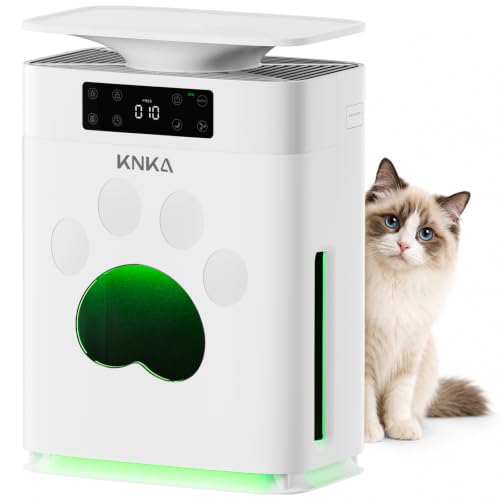
KNKA PetAir APH2500P — Best Floor-Level Hair Intake
Pet hair spends much of its life travelling low, along floors and skirting, gathering in drifts beneath furniture before any of it becomes airborne. The PetAir’s bottom intake is designed for exactly that geography, pulling air in where the hair actually moves, and its listing pairs that intake with a U-shaped and high-carbon filter arrangement, an AQI display and a HEPA sleep mode for the night hours.
The U-shaped, high-carbon description matters for the smell side of a pet home. More carbon in the air path means more capacity for the odor that clings to a house with a large dog or a pair of indoor cats, and capacity is the honest currency of odor control: it decides how many weeks pass before the machine’s freshness work quietly fades and a filter change restores it.
Bottom intake brings a housekeeping instruction with it. A machine breathing at floor level must not stand in a drift of the very hair it hunts, and its intake zone needs the same vacuuming attention as the corners where hair gathers. Owners who place it and then let a felted skirt of fur build around its base will strangle the design’s whole idea. A weekly pass with the vacuum nozzle keeps the geography working as intended.
The listing does not print a coverage figure for the PetAir, positioning it for home pets and large rooms without a number, and its sleep mode is described as HEPA sleep mode without a decibel value beside it. Judge it as a design-led pick: if low-travelling hair is visibly your home’s pattern, its intake logic speaks directly to your floors in a way the other five do not.
- Intake position: bottom, aimed at pet hair
- Filter described as: U-shaped and high-carbon, with HEPA filtration
- Display: AQI
- Mode named: pet mode and sleep mode
- Coverage area: not stated in the listing
- Noise figure: not stated in the listing
Strengths
- Intake geography matches how shed hair actually travels.
- High-carbon emphasis suits odor-heavy, multi-animal homes.
- AQI display keeps its working visible at a glance.
Trade-offs
- Floor-level intake needs disciplined vacuuming around its base.
- No coverage number in the listing for room sizing.
- Low intake is less special in homes where hair mostly floats.
Best for: homes with visible hair drifts along floors and skirting. Not suited for: buyers who want published sizing figures, or carpeted rooms rarely vacuumed.

AIRTOK AP2801 Pet Air Purifier — Best Quiet Display-Led Option
The AP2801 states its case in a single tidy line: a large room up to 2,240 square feet in one hour, HEPA filtration with a washable pre-filter, an AQI display, and both auto and sleep modes. It is the least theatrical machine in this set, and for a pet home whose main room doubles as a place to read, work and watch films in the evening, that calm competence may be exactly the point.
Auto mode plus a visible AQI readout is a partnership worth having. The display explains the machine: after the cat has used the tray or the dog has shaken off a walk, the reading moves and the fan answers, and the household learns to trust the pairing. Trust matters because a purifier’s real enemy is being switched off as a nuisance; a machine whose behaviour makes sense gets left running, and a machine left running is the only kind that works.
The washable pre-filter repeats a theme of this guide because pet ownership repeats it too. Hair arrives constantly, the first layer catches it, and the choice is between rinsing that layer and replacing it. AIRTOK sides with rinsing, which keeps the ongoing cost of the machine closer to its electricity than to a subscription of cartridges.
No decibel figure appears in this listing, so its sleep mode cannot be ranked against the printed numbers of the FreAire or the Dhyala. Light sleepers planning a bedroom role should treat that silence as a question to resolve on the listing or during a trial, while buyers for a living room can weigh the rest of its brief without that concern.
- Coverage stated in the listing: up to 2,240 ft² in 1 hr
- Filtration: HEPA with washable pre-filter
- Display: AQI
- Modes named: auto and sleep
- Noise figure: not stated in the listing
Strengths
- Clear, complete brief without gimmicks.
- Display and auto mode reinforce each other usefully.
- Washable front layer keeps running costs modest.
Trade-offs
- Unstated noise level leaves bedroom buyers guessing.
- No carbon emphasis is named for heavy odor homes.
- Specialists in this set outshine it on individual measures.
Best for: living rooms shared by animals and evening humans who value calm automation. Not suited for: odor-dominated homes needing named high-carbon capacity.
How Do the Six Compare Side by Side?
| Pick | Stated coverage | Hair strategy | Odor strategy |
|---|---|---|---|
| LEVOIT Vital Pet Pro | Not stated in the listing | Dual hair sensors, auto-clean pre-filter | High-carbon filter |
| FreAire HAP605 Air Purifier | Up to 2,600 ft² | Washable filter, turbo mode | HEPA stage |
| uahpet Pet Air Purifier | Up to 2,100 ft² | Washable pre-filter | H13 HEPA stage |
| Dhyala Pet Air Purifier | Up to 3,620 ft² | 360-degree intake | H13 True HEPA stage |
| KNKA PetAir APH2500P | Not stated in the listing | Bottom pet hair intake | U-shaped high-carbon filter |
| AIRTOK AP2801 Pet Air Purifier | Up to 2,240 ft² in 1 hr | Washable pre-filter | HEPA stage |
Why Does the Pre-Filter Matter More Than the Headline Filter?
Ask any pet owner who has opened a purifier after three months: the story is written on the first layer. Hair mats against the pre-filter in a grey felt, and everything behind it either enjoys protected air or slowly suffocates, depending on how that layer is treated. A superb HEPA element behind a neglected screen performs like a mediocre one, which is why this guide keeps returning to washable and auto-clean designs.
The maintenance rhythm is simple and unforgiving. Peek at the pre-filter monthly, rinse or brush it when it carries a visible coat, and never let a visiting-pet weekend pass without a check afterwards. Seasonal shedding doubles the pace. Owners who build that glance into the same round as watering plants rarely meet a choked machine; owners who wait for a warning light meet one every spring.
How Should You Size a Machine for a Home With Several Animals?
Begin with the room the animals actually inhabit, not the home’s total area. Purifiers treat the air of the space they stand in, and doors are near-total borders. A stated coverage figure should comfortably exceed that room’s area, because animals, furniture and soft furnishings all tax the ideal number, and a machine working at the top of its range must run harder and louder to hold its ground.
Then count animals as load, not as decoration. Two large dogs produce a different atmosphere from one elderly cat, even in identical rooms. Homes at the heavy end should favour the larger claims in this set, carbon emphasis and hair interception, while a single small animal in a modest flat is honestly served by the calmer mid-sized picks.
What Mistakes Do Pet Owners Make When Buying a Purifier?
Buying for the whole house and placing for one room is the commonest error, followed closely by hiding the machine behind a sofa where its intake starves. Ignoring the pre-filter until the main filter is ruined comes third, and fourth is expecting any machine to cancel the smell of a tray or a bedding pile that is itself overdue for washing. Pet bedding, in particular, should be laundered on a rhythm; the machine treats air, not fabric.
A subtler mistake is judging a purifier during the first weekend. New machines often coincide with a deep clean, open windows and unusual diligence, and almost anything shines in those conditions. The fair trial is the third ordinary week, when the home has returned to its true habits and the machine must hold its own against them.
How Does Pet Air Change With the Seasons?
Spring and autumn coat changes are the purifier’s busiest festivals. A dog blowing its winter coat can load a pre-filter in a week that would normally take a month, and the household that checks the machine only on a calendar rhythm will find it labouring behind a felted screen precisely when it is needed most. During a coat change, treat the pre-filter like the lint trap of a much-used dryer: glance at it whenever you pass with the vacuum in hand.
Summer brings open windows, which help and complicate in equal measure. Fresh air dilutes the indoor burden, yet pollen and dust ride in and give the machine new work, and animals shedding a summer-thin coat still shed. Many owners run the purifier less in high summer and forgive themselves; the honest compromise is to run it in the evening when windows close and the household settles with its animals indoors.
Winter is the machine’s season of consequence. Homes seal, heating dries the air, animals move fully indoors, and the recirculated atmosphere is entirely the household’s own. A purifier that seemed optional in July becomes the difference between a living room that feels lived-in and one that feels slept-in by February. Filters should enter winter fresh, which makes late autumn the sensible moment for the annual deep check.
Where Should the Machine Stand in a Pet Home?
Place it in the animals’ capital city, the room where they spend their waking hours, not in a hallway chosen for tidiness. Within that room, favour a spot near the main resting place but not inside the blast zone of a shaken coat or a kicked tray. A few feet from the favourite sofa or basket, with open air at the intake, beats a hidden corner behind furniture every time.
Height is a small decision with real consequences. Floor-standing machines breathe the layer where hair travels and dander eventually settles, which suits pet duty. Raising a compact unit onto furniture may please the eye, yet it moves the intake away from the busiest stratum of pet air and invites a cat to treat the machine as a perch, with all the panel-pressing chaos the Dhyala’s pet lock exists to prevent.
Bedrooms deserve a separate judgment. An animal that sleeps on the bed loads that room all night, and a quiet machine there can be the household’s favourite purchase, provided its night noise is honestly known. Where a listing prints no decibel figure, the bedroom is the room to trial first during a returns window, at pillow distance, on the setting it would actually use at two in the morning.
What Grooming Habits Multiply a Purifier’s Effect?
Brushing is air purification performed at the source. Hair removed by a brush on a hard floor near the machine never becomes airborne, never felts a pre-filter and never lands on a guest’s dark trousers. Ten unhurried minutes twice a week will do more for a shedding home’s air than an extra fan speed, and most animals, introduced kindly, come to treat the session as attention rather than administration.
Bathing rhythms matter for odor in a way machines cannot imitate. A dog washed on a sane schedule, bedding laundered weekly, and feeding bowls cleaned daily remove the sources that load the room’s air in the first place. The purifier then polishes an already decent atmosphere instead of fighting a losing war against a bedding pile that has not seen a washing machine since spring.
Vacuuming technique partners with all of it. Slow passes on soft furnishings, a nozzle along the skirting where hair drifts gather, and attention to the square metre around the machine’s own intake keep the whole system breathing. Owners often discover that owning a purifier quietly improves their vacuuming, because the display’s behaviour after a thorough clean is a small, satisfying reward.
How Do Birds, Rabbits and Other Small Animals Change the Brief?
Not every pet home is a dog home. Birds produce a fine, pale dander that travels astonishingly far from the cage and settles on high surfaces, and a machine placed near, but not blowing toward, the cage earns its keep there. Airflow direction matters: a purifier should never aim its output stream at a cage, an aquarium or a small mammal’s hutch, because constant draught is a stress small creatures cannot escape.
Rabbits and guinea pigs bring hay into the equation, and hay brings dust with every refill. The machine’s work in such a home concentrates near the hay store and the enclosure, and its pre-filter will gather a paler, finer load than dog hair. Rodent bedding changes follow the same rule as cat trays: the machine manages what escapes, while the enclosure’s own cleaning rhythm decides the room’s baseline.
Fish keepers, meanwhile, should think about humidity and splashes rather than hair, and place any machine well clear of tank maintenance zones. The principle across species is constant: know what your animal actually sheds into the air, and judge machines by that burden rather than by the dog in the advertisement.
What Does a Sensible Filter Budget Look Like Across a Year?
Plan the year rather than the purchase. Every machine here has a front layer that is either washable, auto-cleaning or cheap to treat as sacrificial, and a main element whose replacement is the real annual event. Households that note the main filter’s expected rhythm at purchase, and put a reminder in the calendar the day the machine arrives, never face the sad discovery that their purifier has been running on an exhausted element for a season.
Washable designs shift money from consumables to minutes. The trade suits some households perfectly and others not at all, and honesty about which household you run is worth more than any specification. A filter that will not be washed is more expensive than a filter that must be bought, whatever the listings say, because an unwashed washable filter performs like a clogged disposable one while costing the same electricity.
Carbon is the quiet line item. Odor capacity fades without drama, and a home can adapt to its own returning smell so gradually that nobody notices until a visitor’s face reports it. If a machine’s freshness work matters to you, treat its carbon stage as a subscription you manage yourself, refreshed on schedule rather than on evidence, because by the time the evidence is obvious the schedule is overdue.
How Should You Introduce a Purifier to a Nervous Animal?
New appliances arrive with new sounds, new smells of warm plastic and a new object in a familiar room, and animals read all three as news worth investigating or avoiding. Let the machine sit unplugged in its intended place for a day. Let it be sniffed, walked around and demoted from event to furniture. Then run it at its gentlest while you are in the room doing something boring and reassuring, with treats appearing for unrelated good behaviour.
Most animals complete their assessment within days and thereafter ignore the machine entirely, or adopt it: cats in particular may claim a warm top panel as a seat, which is where a pet lock stops being a curiosity. Dogs that startle at fan surges usually settle once the surging becomes predictable, and a machine run continuously at a modest pace startles less than one that leaps between silence and effort.
If an animal persistently avoids the room, believe it and move the machine rather than insisting. A purifier exiled to a neighbouring spot with the door open still contributes, while a machine that teaches a cat to avoid its own tray has created a worse problem than the one it was bought to solve.
When Is One Machine Not Enough for a Pet Home?
The honest signals are architectural. Animals living on two floors, a dog whose day room and night room differ, or a home where the cat’s tray sits in a utility room far from the dog’s lounge: each describes two air territories, and one machine can only govern one of them. The economical answer is rarely two large machines. It is usually one serious unit in the main territory and a smaller, calmer presence in the second.
Load can force the same conclusion in a single space. A multi-dog household with grooming done indoors, in a large open room, may simply produce hair faster than one intake can gather it, and the pre-filter’s condition will report this truth before any coverage figure does. When a washed screen felts again within days at the height of shedding season, the home is telling you its burden exceeds its machinery.
What Should You Check on the Listing Before Ordering?
Confirm the filter arrangement and what a replacement set contains, because pet ownership turns consumables from a footnote into a budget line. Check whether the pre-filter is genuinely washable or merely vacuumable, two words that look alike at midnight and behave very differently across a year. Verify the control lock if cats will share the room, and read the coverage claim’s wording for the hour attached to it, since a figure earned in one hour describes a sprint rather than a resting pace.
Then look at the unglamorous physical facts: the machine’s footprint against the floor space you truly have, the direction it breathes, and whether its top panel invites a sitting cat. Finally, decide the room first and the model second. A purifier bought for a named room, with its area measured and its animals counted, is almost never the purchase a household regrets.
How Do Soft Furnishings Decide Whether the Machine Seems to Work?
A room’s fabrics are its memory. Curtains, cushions, throws and the dog’s own bed absorb the airborne share of animal life all week and release it slowly, which is why a room can smell of pet within minutes of the purifier being switched off even when the air itself was well treated. Households that wash throws and bed covers on a rhythm give their machine a fighting chance; households that never launder the dog’s bed are asking moving air to out-argue a permanent source.
Hard floors are the purifier’s allies. Hair on wood or tile stays mobile, travelling toward intakes and vacuum nozzles instead of lodging in carpet pile, and a room that feels impossible to keep fresh in a carpeted house often becomes manageable after a flooring change made for entirely other reasons. Until then, slow vacuum passes with a proper head, rather than quick skims, are what keep the carpet from becoming the room’s dominant air feature.
What Visiting Animals and Busy Weeks Teach You About Your Air?
A visiting dog for a fortnight is a free stress test. The pre-filter loads faster, the odor background thickens, and the machine’s display, if it has one, narrates the whole experiment. Homes that cope gracefully during a visit own enough machinery for their ordinary life with headroom to spare. Homes that struggle learn exactly where their limit sits, which is valuable knowledge disguised as a slightly hairier month.
The same lesson arrives with puppies and kittens, whose accidents, training pads and general chaos load a room in ways adult animals do not. Expect to run a machine harder, wash its front layer oftener and forgive it for not performing miracles over a training pad. The phase passes; the habits of checking and rinsing that it teaches are the permanent gain.
Finally, notice what happens when the machine is away for repair or its filter is drying after a wash. The home’s air reverts to its untreated character within days, and that small regression is the most convincing evidence of what the machine had quietly been doing all along.
How Should the Machine Behave Overnight in an Animal Household?
Night is when pet air becomes personal, because the animal that spent the day downstairs often spends the night on the bed. A machine in the bedroom works at closest quarters, and its manners matter more than its muscle: a steady low murmur that the household stops hearing beats a clever auto mode that surges whenever the dog dreams, shakes and resettles. Where a model offers both, many owners run sensing by day and a fixed gentle setting by night, getting the benefits of each without the surprises.
Light is the forgotten night specification. Displays and status lamps that seem trivial in a showroom can glow impressively at three in the morning, and a machine destined for a bedroom should be judged with the lights off during its trial. Owners who tape over a lamp have bought the wrong machine for that room, however excellent its filtration, because sleep is the one household function that outranks air.
What Role Does the Machine Play When Someone in the Home Dislikes Animals?
Plenty of pet homes contain one person who chose the animal and one who merely consented to it, and the second person’s nose becomes the household’s strictest instrument. For that reader, the honest pitch of this entire category is diplomatic: a good machine, honestly maintained, narrows the gap between the animal’s presence and the home’s atmosphere until the consenting party stops keeping score. Carbon freshness, pre-filter discipline and bedding laundry are the three clauses of that peace treaty.
Guests deserve a sentence of their own. A home that smells neutral to its owners may still announce its animals to a visitor within seconds, because adaptation is merciless that way. Running the machine steadily in the day before guests arrive, rather than in a perfumed panic an hour beforehand, is the strategy that actually works, and it works precisely because it imitates the machine’s ordinary good week.
How Long Before a Pet Home Notices the Difference?
Give a new machine a week before forming any opinion and a month before forming a final one. The first days are distorted by the deep clean that usually accompanies a purchase, by filters at their absolute freshest and by owners paying unusual attention to everything. By the fourth ordinary week the home has tested the machine with muddy weather, a shedding surge and at least one forgotten bedding wash, and whatever freshness survives that curriculum is real.
The change, when it comes, announces itself indirectly. A guest asks whether the dog is out. A dark jacket comes off the sofa back wearable. The hallway stops greeting you with the day’s animal news. Collect those small reports rather than staring at the machine, because a purifier’s success is measured in moments that fail to happen.
Final Recommendation
Match the machine to your home’s dominant burden. Floating hair and a shedding dog in the living room point to the LEVOIT Vital Pet Pro and its hair-watching sensors. A very large open space with a panel-walking cat points to the Dhyala Pet Air Purifier, lock and all. Hair that travels along the floorboards argues for the KNKA PetAir APH2500P and its low intake.
Buy the machine whose maintenance you will genuinely perform, place it where the animals live, and let a month of ordinary Thursdays, muddy paws and unbothered evenings deliver the verdict no first weekend ever could.
A last word on expectations belongs to the animals themselves, who never asked for any of this machinery. The goal was never a home that hides its creatures; it is a home where the creatures are a pleasure to live alongside at close quarters, in every season, without the air keeping a tally. Every pick in this guide serves that modest, decent aim, and none of them pretends to serve any grander one.
Keep the receipt and the filter details together somewhere sensible, because the household that can find both in month nine is the household whose machine is still earning its electricity in year three.
Frequently Asked Questions
Will a purifier stop my sofa smelling of dog?
It will slow the process and freshen the room around the sofa, yet fabric that already holds odor needs washing or deep cleaning of its own. Think of the machine as preventing tomorrow’s buildup while you deal with yesterday’s directly; covers that can be laundered make the partnership far more effective.
How often will the pre-filter need attention in a shedding home?
Check it monthly as a floor, and fortnightly during a seasonal coat change or after a second animal visits for a week. Washable designs turn that check into a rinse rather than a purchase, which is why they dominate this guide’s recommendations for heavy shedders.
Is a bigger coverage number always better?
No. A claim describes a ceiling under favourable conditions, and a machine sized wildly beyond its room wastes money without improving a furnished room’s air. Comfortably above your room’s area is the target; multiples beyond that buy little beyond louder headroom.
Can one machine serve a whole floor of small rooms?
Not honestly. Air does not turn corners or pass closed doors in useful quantities, so a machine serves the space it stands in. Hallway placement is a compromise that serves every room slightly and none well; most multi-room homes eventually place a machine where the animals spend the day and accept the limit.
Do these machines help with litter smell specifically?
They help with the room-level share of it, particularly the carbon-led picks, while the sharpest tray-level odor is better handled by devices designed to sit at the box. Many cat homes run both layers, each doing the half it is built for.
Does a purifier replace bathing and bedding washes?
Never. It treats the air around sources it cannot clean, and a dog bed that has gone a month unwashed will defeat a good machine in its own corner of the room. Wash the sources on their rhythm, groom the animal on its rhythm, and let the purifier hold the space between those acts; that division of labour is the whole secret of a fresh-smelling pet home.
Where do I put the machine when the animals move between rooms all day?
Anchor it to the room with the longest occupancy, which for most animals is wherever the favourite sleeping spot and the humans’ evening chairs coincide. A machine cannot follow a cat’s itinerary, and chasing coverage across every room dilutes the budget into several weak presences. One strong territory, honestly served, changes the feel of a home more than three token machines blinking in doorways.
Related Guides
Readers refining the rest of a pet home’s air can continue with Best Air Purifiers for Kitchen Smells for the room where cooking and feeding collide, then Best Air Purifiers for Large Living Rooms for bigger shared spaces, and finally Best Two-Handle Kitchen Faucets for the sink where bowls and bottles get washed.



[…] working through the wider pet-air picture will find our companion coverage useful, starting with Best Air Purifiers for Homes With Pets for the whole-home view, continuing with Best Air Purifiers for Home Offices for the room where a […]