What's inside
- Key Takeaways
- Quick Picks
- How Did We Choose These Agitator Washers?
- Why Do Owners Still Swear by a Central Agitator?
- What Does Choosing Your Own Water Level Actually Buy?
- How Should You Load an Agitator Washer for the Best Wash?
- Agitator or Impeller — Which Wash Action Suits Your Clothes?
- How Do You Keep an Agitator Washer Running Well for Years?
- What Does the Weekly Rhythm of an Agitator Household Look Like?
- How Does an Agitator Washer Handle Bedding and Bulky Loads?
- What Should You Check on the Listing Before You Order?
- How Do the Six Agitator Washers Compare Side by Side?
- What Mistakes Do Agitator-Washer Buyers Make?
- Final Recommendation
- Frequently Asked Questions
- Related Guides
As an Amazon Associate I earn from qualifying purchases. This post may contain affiliate links at no extra cost to you.
cottageverdict.com is reader-supported. When you buy through links on our site, we may earn an affiliate commission.
Where to buy: the machines below are sold on Amazon under their listing names, and this is a category where you should read the control-panel description as carefully as the capacity figure, because the whole point of these washers is what your hands are allowed to decide; check price on Amazon once you have confirmed the wash action and the level control are the ones you grew up trusting.
The best top-load washers with agitators and water-level choice are a deliberate rejection of a trend. Over the past decade the industry pushed washers that sense a load, lock the lid and decide everything themselves, and a large group of owners discovered they missed being in charge: missed the tall central post that physically works clothes through water, missed choosing how full the tub should be, missed opening the lid mid-cycle to add the sock that escaped the basket. This guide is for those owners, and for first-time buyers who have done laundry at a parent’s or a laundromat and want that same direct, mechanical relationship with the machine.
Two features define the field, and both are about control returning to the user. The agitator — a central post with fins or a triple-action mechanism — moves the load by force rather than by tumbling or a wash plate’s gentle swish, which many owners find visibly more convincing on genuinely dirty clothes. Manual water-level choice means you, not a sensor, decide whether a small load swims in a full tub or a bedding load gets the deep water it needs. Where a listing states its level count outright, we say so; where it does not, we describe the machine honestly as part of the traditional agitator tradition and tell you what to verify on the console before buying.
The six picks divide into two families. Four are full-size top-loaders from Kenmore, BLACK+DECKER and KoolMore, built for plumbed laundry rooms and family throughput. Two are fully automatic portable machines from Auertech and Bonnlo whose listings print their five water levels in so many words, and which bring the same choose-it-yourself philosophy to apartments without hookups. Between them they cover nearly every household that wants an agitator’s wash action and a say in the water.
Key Takeaways
- A central agitator works clothes through water by force; it is the wash action generations of owners trust on real dirt.
- Only two listings here print an exact level count — the Auertech and Bonnlo portables, at five water levels each.
- The full-size picks follow the traditional agitator pattern; verify the exact level controls on the listing console before ordering.
- Triple Action agitation, named on both Kenmore picks, moves the load in more than one direction for tougher soil.
- Portable fully automatic models bring manual level choice to flats and dorms that full-size machines cannot serve.
- Deep water on demand is the practical prize: bedding and bulky loads wash better fully submerged.
Quick Picks
| Pick | Badge | Why it earns its place |
|---|---|---|
| Kenmore 4.1 Cu. Ft. Top Load Washer with Triple Action Agitator | The balanced family agitator | Triple Action agitation and a sensible 4.1 cu. ft. tub make this the straightforward traditional washer for most laundry rooms. |
| Kenmore 4.4 Cu. Ft. Top Load Washer with Triple Action Agitator | More tub for bigger households | The same Triple Action formula stretched to 4.4 cu. ft., for households whose loads regularly defeat a standard tub. |
| BLACK+DECKER 4.1 Cu. Ft. Top Load Washer with Agitator | Glass lid and stainless tub | A stated agitator, a stainless steel tub you can watch through a glass lid, ten wash cycles and an LED display — the traditional format with its working visible. |
| Auertech 28 lbs Portable Washer with 5 Water Levels | Five stated levels, fully automatic | The clearest water-level claim in this guide — five levels printed in the listing — inside a fully automatic portable with ten cycles and a drain pump. |
| Bonnlo 25 lbs Fully Automatic Washer with 5 Water Levels | Five levels in a lighter body | The Bonnlo matches the Auertech’s five stated water levels and ten programmes in a slightly smaller 25-pound machine with a drain pump. |
| KoolMore 4.0 Cu. Ft. Top Load Washer with Agitator | Narrow body, high-efficiency claim | A 25-inch-wide full-size agitator machine whose listing pairs traditional wash action with a high-efficiency description — built for tight laundry alcoves. |
How Did We Choose These Agitator Washers?
We began with the wash action, because it is the non-negotiable half of this brief. Every pick either names an agitator in its listing — a triple-action design on the Kenmores, a stated agitator on the BLACK+DECKER and KoolMore — or, in the case of the two portables, belongs to the fully automatic top-load tradition whose listings put user-selected water levels at the centre of their offer. Machines that quietly turned out to be impeller models wearing traditional styling were excluded; the wash plate has its own merits and its own guide elsewhere on this site, and mixing the two would betray the reader who came here for a post in the middle of the tub.
Water-level wording was audited line by line. The Auertech and Bonnlo listings state five water levels explicitly, so those two picks carry the claim in full. The full-size listings do not print a level count, so their reviews describe them as traditional agitator machines and direct you to the console photographs and specification tables on the listing itself — an honesty discipline we would rather keep than borrow a number from a sibling model. Capacity, tub material, cycle counts and voltage are likewise quoted only where the listing states them.
We also considered the second-hand wisdom of repairers, who consistently rank simple top-loaders among the machines they can keep alive longest with ordinary parts. That reputation is not a specification, so it appears in no spec box below, but it shaped our confidence in recommending traditional formats as long-term purchases. A washer bought for fifteen years should be judged partly on how the world will treat it in year ten, and the agitator’s world is full of people who know how to fix it.
Finally, we spread the picks across real households: a compact full-size option for smaller laundry rooms, a larger family Kenmore, a glass-lid model for owners who like to watch the wash, a narrow 25-inch machine for tight alcoves, and the two portables for renters. Laundry continues after the wash, of course, and readers pairing a new washer with gentler drying should look at Best Clothes Dryers That Don’t Shrink Clothes, where the emphasis falls on sensor control and lower heat rather than on brute tumbling.

Kenmore 4.1 Cu. Ft. Top Load Washer with Triple Action Agitator — The balanced family agitator
Kenmore’s 4.1 cu. ft. machine is the centre of gravity of this guide: a full-size top-loader in white whose listing leads with its Triple Action Agitator, a design that works the load with more than a simple back-and-forth twist. The point of a multi-direction agitator is coverage — clothes at the top of the load get drawn down and through the water rather than riding above it — and on the loads this category exists for, muddy sports kit, work clothes, towels stiff with a week’s use, that physical thoroughness is exactly what owners are paying for.
Around that wash action the listing adds the modern concessions that make a traditional machine easier to live with: touch controls instead of a purely mechanical dial, an Express Wash for small loads that cannot wait, and Accela Wash, the brand’s faster full-load treatment. None of that changes the machine’s character. It remains a washer you direct: you load it, you set it, and the agitator does visibly vigorous work. Buyers should confirm the water-level presentation on the listing’s console images, since the listing text itself does not enumerate levels, and traditional Kenmore consoles are where that choice has always lived.
In a family week, 4.1 cubic feet translates into a school-uniform rotation handled in one load, a double-bed sheet set with pillowcases washed together, or a towel accumulation that would take two trips through a compact machine. It is the size most laundry rooms were plumbed around, which matters for installation: standard width, standard hookups, no alcove surgery. For households replacing a deceased agitator washer and wanting the same life with better controls, this is the least dramatic, most satisfying swap in the guide.
Day to day, the machine’s virtue is predictability. The cycle you set is the cycle that runs, the water behaves as the console promises, and the agitator’s rhythm becomes a background sound the household reads unconsciously — experienced owners genuinely can hear the difference between a balanced load and a balling one from the next room. That legibility is what sensor machines traded away for their quiet cleverness, and it is why a washer like this inspires an odd loyalty: it never surprises you, and laundry is a chore where surprises are never welcome.
- Wash action from the listing: Triple Action Agitator
- Capacity from the listing: 4.1 cu. ft.
- Controls: touch controls
- Named cycles in the listing: Express Wash, Accela Wash
- Finish: white; full-size top-load format for plumbed laundry rooms
Strengths
- Triple Action agitation tackles genuinely dirty loads convincingly
- Express Wash rescues small urgent loads without a full cycle
- Standard full-size format drops into most existing laundry spaces
Trade-offs
- Listing does not enumerate water levels — verify the console before buying
- Agitator occupies tub centre, so bulky items wrap around it
- Touch controls will not suit buyers wanting purely mechanical dials
Best for: families replacing a traditional agitator washer with a like-for-like modern equivalent.
Not suited for: buyers who need a stated, counted set of water levels in writing before they commit.

Kenmore 4.4 Cu. Ft. Top Load Washer with Triple Action Agitator — More tub for bigger households
Everything said about the 4.1 applies here with the volume turned up: this is Kenmore’s Triple Action Agitator design in a 4.4 cu. ft. tub, and the extra space is the entire argument. Three-tenths of a cubic foot sounds trivial until the load is a king-size duvet cover with the sheets, a week of towels for five people, or the muddy output of a youth football team. Loads that must be split in a smaller machine — with the second load invariably forgotten in the basket until morning — go through in one confident fill here.
The supporting cast matches its sibling: touch controls, Express Wash for the small-and-urgent, Accela Wash for faster full loads, and stain-and-dirt intent stated plainly in the listing’s own words about tough dirt. The agitator’s presence in a bigger tub is worth a thought, too — a central post in a wide drum leaves generous room around it, so bulky items circulate rather than wedging, which is precisely where agitator machines sometimes struggle. As with the 4.1, the listing does not print a water-level count, so treat the console photographs as required reading.
Choose between the two Kenmores by load honesty rather than by optimism. Households of one or two who wash modest weekly loads gain nothing from the larger tub except partially filled washes; households of four or more, or anyone washing bedding frequently, will use the 4.4’s space every week. The larger machine also future-proofs against the way laundry grows — children, guests, a dog — in a way its sibling cannot. Both are traditional agitator washers in spirit; this one simply refuses fewer loads.
There is a water-wisdom point specific to big agitator tubs: a large tub run half-empty at a high level is the worst of both worlds, diluting detergent and wasting the machine’s force. The 4.4 rewards owners who batch their laundry into genuinely full loads — which, in a big household, is no discipline at all, since a full load assembles itself by Tuesday. Run that way, the big Kenmore is not the extravagant choice but the efficient one, clearing in three serious cycles what a smaller machine would take five apologetic ones to finish.
- Wash action from the listing: Triple Action Agitator
- Capacity from the listing: 4.4 cu. ft.
- Controls: touch controls
- Named cycles in the listing: Express Wash, Accela Wash
- Finish: white; full-size top-load format
Strengths
- Largest full-size tub among the agitator picks here
- Triple Action agitation with room around the post for bulky loads
- Express Wash still available for small loads despite the big tub
Trade-offs
- Oversized for one- or two-person households washing lightly
- Water-level count not stated in the listing text
- Bigger tub tempts overloading, which agitators punish with tangling
Best for: households of four or more and frequent bedding washers who split loads in their current machine.
Not suited for: small households, or buyers counting on a written level specification.

BLACK+DECKER 4.1 Cu. Ft. Top Load Washer with Agitator — Glass lid and stainless tub
The BLACK+DECKER’s listing is the most forthcoming of the full-size picks: it names its agitator, its stainless steel tub, its glass lid, its LED display and its ten wash cycles outright, and that transparency suits the machine’s character. The glass lid is more than styling. Agitator owners are supervisors by temperament — they like to see the load moving, check the water depth against their intention, and catch an unbalanced tangle early — and a glass lid turns that supervision into a glance rather than a lid-lift that pauses the cycle.
Stainless steel for the tub is the durability choice, resisting the chipping and rust that enamelled tubs can suffer over a long life, and it keeps the wash environment neutral for whites. Ten cycles is a generous count for a traditional machine, giving the LED-controlled console enough range to separate delicates from the heavy-duty loads the agitator exists for. The listing also states 120V, which readers should note simply as the machine’s stated electrical specification, printed in its title, rather than assuming the wiring of a full-size washer is uniform across brands.
As a household proposition, this is the agitator washer for the engaged owner: someone who adjusts, watches and intervenes, and who wants the machine to show its work. The 4.1 cu. ft. capacity matches the smaller Kenmore, so the choice between them is about temperament and materials — glass and stainless visibility here, Kenmore’s Triple Action branding there. Either washes traditionally; this one lets you enjoy the sight of it, and for a surprising number of laundry traditionalists, that settles the question.
The LED display deserves its small mention too, because on a traditional machine the display is not decoration: it tells you the cycle stage and remaining time plainly, which helps a supervisor plan the transfer to the dryer instead of discovering a finished, creasing load an hour later. Combined with the glass lid, the whole console encourages the engaged style of laundry this category is bought for. If your instinct is to set a machine and forget it for a day, these charms are wasted on you; if you run a laundry like a kitchen, they are daily pleasures.
- Wash action from the listing: agitator (model BTLW41MW)
- Capacity from the listing: 4.1 cu. ft.
- Tub: stainless steel, with glass lid
- Cycles and controls: 10 wash cycles, LED display
- Electrical stated in the listing: 120V
Strengths
- Glass lid lets you supervise water depth and load movement
- Stainless steel tub resists chipping and rust over time
- Ten cycles give a traditional machine unusual range
Trade-offs
- Level selection not enumerated in the listing — inspect the console details
- Glass lid invites fingerprints and needs a wipe to stay clear
- Capacity matches the smaller Kenmore, not the family 4.4
Best for: hands-on owners who like to watch the wash and value a stainless tub.
Not suited for: households needing maximum tub volume above all else.

Auertech 28 lbs Portable Washer with 5 Water Levels — Five stated levels, fully automatic
If the words water level are the heart of your search, this Auertech is the pick whose listing says the quiet part aloud: five water levels, stated in its title, alongside ten wash cycles and a 24-hour delay function. It is a fully automatic portable — fill it, choose the programme and level, and it washes and spin-dries in one tub — which makes it the bridge machine of this guide: the control philosophy of the traditional agitator washer, delivered in a body an apartment can host without plumbing work.
The five levels matter practically, not just rhetorically. Portable machines live on carried or metered water more often than plumbed ones, and matching water to load size is the difference between an economical smalls wash and a wasteful half-empty tub. A single pair of jeans at the lowest level, a full mixed load at the highest — that granularity is exactly what sensor-only machines deny you, and here it is a button press. The built-in drain pump completes the apartment case, emptying into a sink so the machine can live on a bathroom or kitchen floor.
Set expectations by format: at 28 pounds combined rating this is a portable, washing portable-sized loads, and its spin is a spin-dry within the same tub rather than a separate high-speed extraction. What it offers instead of full-size muscle is autonomy — no laundromat, no landlord negotiation, no hookup — with the manual level control this entire category celebrates. For renters who read this guide’s title and nodded, this is the most literal fulfilment of it available without a laundry room.
The 24-hour delay feature, easy to overlook, suits renter life specifically: set the machine to finish as you return from work, and clothes never sit damp in the tub through a shift. It also lets shared households stagger laundry around bathroom access without negotiations. Small courtesies like that accumulate in a portable, which lives closer to its owners than a plumbed machine in a separate room ever does. The Auertech understands its habitat, and its specification — levels, cycles, delay, pump — reads like a checklist written by someone who has actually done laundry in a studio flat.
- Water levels stated in the listing: 5
- Programmes: 10 wash cycles; 24-hour delay feature named
- Capacity from the listing: 28 lbs
- Drainage: drain pump; washer and spin-dryer combo in one tub
- Format: fully automatic portable top-loader
Strengths
- Five water levels explicitly stated — the guide’s clearest claim
- Fully automatic cycle: no manual transfer between tubs
- Drain pump suits sink drainage in flats and dorms
Trade-offs
- Portable capacity, not full-size family volume
- Single-tub spin-dry is gentler than a dedicated full-size spin
- Agitation is the portable top-load style, not a full-size post
Best for: renters and dorm residents who want stated manual water levels without plumbing.
Not suited for: families washing bedding and bulk loads every week.
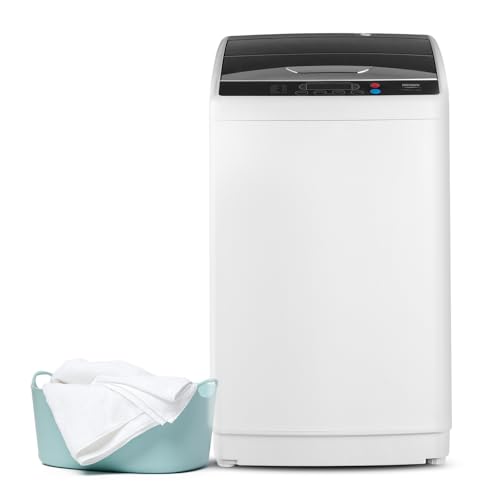
Bonnlo 25 lbs Fully Automatic Washer with 5 Water Levels — Five levels in a lighter body
The Bonnlo is the second listing in this guide entitled to the five-level claim, and it makes it in the same breath as its ten washing programmes: 25 pounds, fully automatic, top load, drain pump included. Having two portables state their level count in print matters for shoppers, because it proves the feature is a real, comparable specification in this class rather than a vague traditional aura — you can hold both listings side by side and choose on capacity, size and price positioning with the level question already answered.
At 25 pounds it sits a step below the Auertech, and that step is the honest difference between them. The Bonnlo suits one or two people’s laundry handled in regular, moderate batches: work clothes through the week, a towels-and-linen session at the weekend. Its fully automatic single tub means the load is washed and spin-dried without your hands touching wet clothes mid-cycle, and the pump again frees placement — home and apartment use are the listing’s own words, and the specification supports them.
Why choose it over its five-level sibling? Size and simplicity of decision. If your space is tighter, your household smaller, or your loads lighter, the Bonnlo’s slightly smaller body is the better fit, and nothing about the level control is diluted to pay for it. Why choose the Auertech instead? Volume per session and the delay feature. Between the two, the water-level promise — the reason this guide exists — is identical and equally explicit, which makes this the easiest head-to-head in the article.
Ownership rhythm in a small flat tends to be frequent and light: a midweek load of work clothes, a weekend load of towels and bed linen, smalls whenever the basket fills. The Bonnlo’s size matches that rhythm exactly, finishing each moderate batch without the tub ever feeling cavernous or the water bill for a half-empty wash stinging. Its ten programmes cover that repertoire with room to spare, and the five-level selector keeps each batch honest. It is the considered, right-sized version of the portable idea — not the biggest, not the flashiest, simply proportioned to the homes it names.
- Water levels stated in the listing: 5
- Programmes: 10 washing programmes
- Capacity from the listing: 25 lbs
- Drainage: drain pump; washer and spin-dryer combo
- Format: fully automatic portable top-loader for home and apartment
Strengths
- Five water levels stated in print, matching the class best
- Fully automatic — no mid-cycle handling of wet clothes
- Slightly smaller body suits tighter apartment corners
Trade-offs
- Less capacity than the Auertech for the same routine
- Portable spin-dry leaves clothes damper than full-size extraction
- Not a substitute for a plumbed family washer on bedding day
Best for: singles and couples in flats who want explicit level choice in a compact automatic.
Not suited for: larger households or anyone washing bulky items weekly.

KoolMore 4.0 Cu. Ft. Top Load Washer with Agitator — Narrow body, high-efficiency claim
The KoolMore’s defining number is not its 4.0 cu. ft. capacity but its 25-inch width, stated in the listing. Laundry alcoves, closet conversions and older homes often refuse standard-width machines by an inch or two, and a full-size agitator washer that fits those spaces without dropping to a portable is a genuinely useful thing. Inside that narrower body sits a stated agitator and a full 4.0 cubic feet of tub — barely below the Kenmore 4.1 — so the compromise is measured in fractions rather than in a whole class of laundry exiled to the laundromat.
The listing describes the machine as high-efficiency, which in an agitator context raises the water question this guide cares about. High-efficiency top-loaders traditionally use less water by default, so buyers seeking deep fills should study this listing’s console and cycle descriptions with particular care and confirm how much manual say the machine offers over its water. We flag that not as a defect but as the due diligence this category demands: the agitator is confirmed in print, the efficiency is claimed in print, and the level behaviour is yours to verify before the machine is plumbed in.
For the right home, though, the KoolMore solves a problem no other pick here addresses: a real agitator, in a real full-size tub, through a real narrow doorway. Townhouses with closet laundries, older cottages with converted pantry spaces, and rental units with undersized alcoves are its natural territory. Measure your space honestly, verify the level controls on the listing, and if both check out, this is the traditional washer that fits where tradition usually cannot.
Installation day is where this machine earns gratitude. A 25-inch body passes doorways and turns that defeat standard washers, and in older homes the difference between fitting and not fitting is often the difference between a laundry at home and a laundromat forever. Once placed, the ownership experience is conventional in the best sense: full-size loads, a proper agitator, a tub that takes a family weekend without complaint. The KoolMore asks for one homework task — confirming its water behaviour from the listing — and in exchange removes the most common reason traditional buyers give up on the category entirely.
- Width stated in the listing: 25 inches
- Capacity from the listing: 4.0 cu. ft.
- Wash action from the listing: agitator
- Description in the listing: high-efficiency top-load washer
- Finish: white; full-size format for home laundry
Strengths
- 25-inch width fits alcoves standard machines refuse
- Full-size 4.0 cu. ft. tub despite the narrow body
- Stated agitator keeps the traditional wash action
Trade-offs
- High-efficiency design — verify manual water control on the listing
- Slightly less capacity than the 4.1 cu. ft. rivals
- Level count not enumerated in the listing text
Best for: homes with narrow laundry alcoves that still want a full-size agitator machine.
Not suited for: buyers who want deep-fill behaviour guaranteed in the listing text.
Why Do Owners Still Swear by a Central Agitator?
The agitator’s case is mechanical and visible. A finned post twists the load through the water in both directions, forcing fabric against fabric and water through fabric, and on loads carrying actual soil — garden clothes, sports kit, a mechanic’s overalls — that forced circulation shifts dirt that gentler actions leave behind. Owners describe the difference in almost moral terms: the clothes look worked on. There is also a time argument, since agitator cycles traditionally run shorter than the long, careful programmes of high-efficiency machines, which suits households that process many loads on one day.
The honest costs are equally visible. A post occupies the centre of the tub, so a duvet must wrap around it; agitation is harder on delicate fabrics than a wash plate’s swish; and tangling happens when loads are unbalanced or overfilled. The agitator household accepts those costs as the price of cleaning power and control, mitigated by loading loosely, separating delicates into their own short cycle, and using the water level to give bulky items room to move. It is a considered preference, not nostalgia — though nostalgia, watching a load churn the way it did in a childhood kitchen, is allowed to help.
What Does Choosing Your Own Water Level Actually Buy?
Water is the medium of washing, and its depth decides three things at once: how freely clothes move, how diluted the detergent is, and how thoroughly soil can leave the fabric. Too little water in a bulky load and items rub dry patches against each other, emerging with detergent residue and unshifted dirt. Too much water under a tiny load and the agitator’s force dissipates — clothes drift instead of churning, and you have paid to heat and pump water that did no work. A manual level choice lets a thoughtful owner match the medium to the load, which is why traditionalists defend the feature so stubbornly.
There is a fabric argument as well, rarely made but real. Natural fibres release soil into water readily and rinse clean in generous fills; it is no accident that the agitator era coincided with wardrobes of cotton and linen that survived decades of washing. Modern synthetics ask less of water, which is one reason sensor machines suit them. A household whose wardrobe still leans natural — work shirts, cotton towels, linen bedding — will feel the benefit of chosen water depth in a way a polyester wardrobe never will, and should weight this feature accordingly when choosing between the machines in this guide and their high-efficiency cousins.
The practical repertoire is small and learnable. Small loads of light clothing want the low levels, where agitation stays concentrated. Everyday mixed loads sit in the middle. Bedding, towels and anything bulky want the highest fill you can select, because those items absorb water and still need room to circulate. Sensor machines attempt these judgements automatically and often make them well — but when they make them badly, the owner has no override. Every machine in this guide exists to put that override back in human hands, whether by a traditional console or, in the portables’ case, by a stated five-level selector.
How Should You Load an Agitator Washer for the Best Wash?
Loading an agitator machine is a small craft. Distribute clothes loosely around the post in a doughnut rather than dropping a compressed basket-load onto one side, alternate heavy and light items as you go, and stop at the point where the load sits below the top of the agitator with room to move. Add detergent to the water as the tub fills — or first, per the machine’s dispenser design — rather than onto dry fabric, where a concentrated dose can mark colours. Then set the level to match what you actually loaded, not what you meant to load.
During the cycle, the glass-lid and open-top habits of this category earn their keep: a quick look confirms the load is circulating rather than balling into a single rotating lump. If it balls, pause, redistribute, and resume — two minutes of supervision that rescues the whole wash. After the spin, shake items out as you transfer them to the dryer or line; agitator loads emerge more twisted than impeller loads, and a shake at this stage halves the ironing later. None of this is burdensome. It is the supervision this category’s owners actively enjoy, the laundry equivalent of stirring a pot.
Agitator or Impeller — Which Wash Action Suits Your Clothes?
The impeller — a low wash plate that swishes clothes with water currents — is gentler, leaves the whole tub open for duvets, and uses less water by design. The agitator is more forceful, more traditional, and more convincing on heavy soil, at the cost of the central post and a rougher manner with delicates. Neither is objectively correct; they are answers to different laundry. Households washing mostly modern casual clothing, gym synthetics and bedding often prefer the impeller’s open tub. Households washing workwear, cloth nappies, sports uniforms and genuinely dirty family laundry tend to return to the agitator, as this guide’s readers have.
Wardrobe honesty settles it. Count your loads for a fortnight: if the majority are lightly soiled and bulky, the plate will serve you; if the majority carry ground-in dirt and you have strong opinions about water depth, the post will. Many households in this category have owned both across a lifetime and can name the exact load that converted them back. Whichever you choose, drying deserves equal thought, and small-space readers in particular should see Best Compact Portable Dryers, which covers tumble dryers sized for apartments and dorms rather than family laundry rooms.
How Do You Keep an Agitator Washer Running Well for Years?
Agitator machines are mechanically straightforward, and their care matches. Leave the lid open between washes so the tub dries; wipe the top rim and the agitator’s base where lint and detergent collect; and run an empty hot cycle periodically if your water and habits encourage residue. The fins of the agitator deserve an occasional hand-check for roughness or trapped grit, because a snagged fin is rough on fabrics in a way owners misattribute to the wash action itself. Hoses on plumbed machines should be inspected yearly and replaced on schedule rather than on failure.
Load discipline is the other half of longevity. Chronically overfilled tubs strain the drive and the suspension, and chronically unbalanced spins shake fasteners loose across the whole machine. The traditional format rewards the traditional virtues: moderate loads, balanced distribution, prompt attention to new noises. In return it offers a machine any competent repairer understands, with parts and knowledge in wide circulation — one reason these washers are so often bought as twenty-year decisions rather than five-year ones. The same keep-it-simple philosophy extends to the laundry room’s other residents, as Best Accessories for Inflatable Hot Tubs shows for the bathing side of the house, where well-chosen extras protect a much larger investment.
What Does the Weekly Rhythm of an Agitator Household Look Like?
Traditional laundry has a cadence that sensor machines disrupted and agitator owners quietly keep. Loads are batched by type rather than by basket overflow: a darks load midweek, whites at the weekend, towels whenever the rail empties, bedding on a fixed day. Because cycles run comparatively briskly and the owner sets the terms, a whole family’s week can clear in one morning’s sequence of loads, each washed at its proper water depth. The machine’s predictability is what makes the cadence possible — you can plan around a washer whose behaviour never varies.
That rhythm also shapes buying. Households living this way value capacity honesty over programme count, which is why this guide weights tub size and stated controls so heavily and treats extra cycles as garnish. A machine that will run four loads every Saturday for fifteen years needs a sound tub, a repairable drive and controls that stay legible; the picks here were chosen with that Saturday in mind. If your laundry life is instead one small load whenever the basket looks at you, the portables at the end of the line-up fit the same philosophy at apartment scale.
How Does an Agitator Washer Handle Bedding and Bulky Loads?
Bedding is the agitator’s examination question, because a duvet cover, a fitted sheet and two pillowcases together test both capacity and circulation. The method that works: feed items in one at a time around the post rather than dropping the bundle in, choose the highest water you can select so the mass can actually move, and peek once mid-cycle to confirm the load is turning over rather than rotating as a single raft. In the 4.4 Kenmore this is a routine load; in the 4.1 machines it is a comfortable one; in the portables it should be split without embarrassment.
Towels are the friendlier bulk: dense, absorbent and hard to damage. A full towel load at a high level is where an agitator machine is happiest, churning a genuinely heavy mass with visible authority. The caution is detergent — towels arrive carrying soap residue from their working lives, so use less than habit suggests and give them water room. Owners who master bedding and towels in an agitator tub have mastered the format; everything else in the laundry basket is easier than those two loads.
What Should You Check on the Listing Before You Order?
Four checks, in order. First, the wash action in words: the listing should say agitator plainly, as all six here do, rather than leaving you to infer it from a photograph. Second, the water-level presentation: count the levels if the listing states them, as the two portables do, and otherwise study the console photographs and specification table until you can describe the control yourself. Third, capacity in cubic feet for full-size machines or pounds for portables, matched against your largest regular load rather than your average one. Fourth, the physical audit — width, hookup style and, for the KoolMore especially, the doorway and alcove measurements of your own home.
Do those four and the traditional washer you receive will be the one you thought you were buying. This category’s disappointments are almost never about washing performance; they are about a level control that turned out to be a sensor in disguise, a tub an inch too wide for the alcove, or a bedding load that needed splitting after all. The listings in this guide were chosen because they answer the first question honestly and give you the material to answer the rest — the rest is a tape measure and ten careful minutes.
How Do the Six Agitator Washers Compare Side by Side?
| Pick | Key specification from the listing | Best suited to |
|---|---|---|
| Kenmore 4.1 Cu. Ft. Top Load Washer with Triple Action Agitator | 4.1 cu. ft., Triple Action Agitator, touch controls | The default family agitator replacement |
| Kenmore 4.4 Cu. Ft. Top Load Washer with Triple Action Agitator | 4.4 cu. ft., Triple Action Agitator, touch controls | Big households and bedding-heavy laundry |
| BLACK+DECKER 4.1 Cu. Ft. Top Load Washer with Agitator | 4.1 cu. ft., agitator, stainless tub, glass lid, 10 cycles | Supervisors who want to see the wash working |
| Auertech 28 lbs Portable Washer with 5 Water Levels | 28 lbs portable, 5 water levels stated, 10 cycles, drain pump | Apartments wanting written level choice |
| Bonnlo 25 lbs Fully Automatic Washer with 5 Water Levels | 25 lbs portable, 5 water levels stated, 10 programmes, drain pump | Smaller flats wanting the same stated levels |
| KoolMore 4.0 Cu. Ft. Top Load Washer with Agitator | 4.0 cu. ft., agitator, 25-inch width, high-efficiency | Tight alcoves needing a true full-size washer |
What Mistakes Do Agitator-Washer Buyers Make?
The costliest mistake is assuming every traditional-looking top-loader has manual water-level control. Styling survives long after controls change, and some modern machines in classic dress sense their loads like any other. The defence is the discipline used throughout this guide: believe the listing’s words, count stated levels where they are stated, and interrogate the console photographs where they are not.
Second comes overloading, the agitator’s oldest enemy. A tub packed to the rim cannot circulate, so the load rotates as one tangled mass, emerging twisted, unevenly washed and hard on the machine. Load loosely to below the agitator’s top, split the heroic loads in two, and the wash quality you bought the machine for actually appears.
Third, buyers neglect the delicates question until a favourite jumper suffers. An agitator is a forceful tool; use the gentlest cycle, a mesh bag for fragile items, and keep true delicates in their own small, high-water load where movement is cushioned. Owners who build that one habit keep both the machine and the wardrobe for years.
Detergent habits imported from sensor machines cause quiet trouble too. High-efficiency machines sip detergent; a traditional agitator tub at a generous level wants a measure matched to its water, and owners who keep dosing for their old machine get grey, under-washed loads they blame on the agitator. Dose for the water you actually selected, and when in doubt run the load again with plain water — the rinse will show you whether soap or soil was the problem.
Finally, do not let the portable picks’ convenience blur their scale. The Auertech and Bonnlo bring genuine level choice to small homes, but they wash portable-sized loads, and expecting family bedding throughput from them repeats the classic category error of buying by feature list instead of by capacity. Match the tub to the household first; then enjoy the control.
Final Recommendation
For a plumbed laundry room, the decision tree is short. Most families should take the Kenmore 4.1 for its balance of Triple Action agitation, sane capacity and straightforward controls; larger households step up to the 4.4 and never split a load again. Owners who supervise their laundry will love the BLACK+DECKER’s glass lid and stainless tub, and anyone fighting a narrow alcove should measure for the KoolMore before conceding to a portable. For homes without hookups, the Auertech and Bonnlo state their five water levels in print and wash fully automatically — choose between them on capacity alone.
Our headline recommendation is the Kenmore 4.1, because it is the machine this category’s typical buyer actually pictures: a proper post, a proper tub, controls a person directs, and no feature standing between the owner and the wash. An agitator washer is bought to restore a feeling of command over a basic chore, and the Kenmore restores it with the least fuss and the fewest caveats of anything in this guide. It is, quite simply, the washer most readers came here hoping still existed.
Frequently Asked Questions
Is an agitator harder on clothes than an impeller?
It is more forceful, which is the point on dirty loads and a consideration on delicate ones. Everyday clothing — cotton, denim, towels, workwear — handles agitator washing for years without issue. Fine knits, lace and fragile synthetics deserve the gentle cycle, a mesh bag, or a separate small load with generous water to cushion the movement.
How many water levels do these washers have?
Two listings state the number outright: the Auertech and the Bonnlo portables each offer five water levels, printed in their titles. The full-size Kenmore, BLACK+DECKER and KoolMore listings do not enumerate levels in their text, so check the console photographs and specification details on each listing to see exactly how level selection is presented before you order.
Can an agitator washer handle a king-size duvet?
A duvet cover, yes, comfortably in the larger tubs. A thick duvet itself is a sterner test: it must wrap around the central post and still move, so load it alone with the highest water setting and check that it circulates rather than baling into a lump. If it cannot move, it cannot wash — that load belongs to a large impeller machine or a laundromat drum.
Why would I choose a portable instead of a full-size agitator washer?
Because your home decides before you do. The Auertech and Bonnlo need no plumbing, drain by pump into a sink, and still give you fully automatic cycles with stated manual water levels. They wash smaller loads than the full-size picks, but for a renter they convert laundry from a trip into a routine, which is the entire value of the category.
Do agitator washers use more water than high-efficiency models?
They can, especially at the highest levels with the tub full — that freedom is precisely what their owners are choosing. The same control also lets you run genuinely small loads at low levels instead of a sensor’s guess. Water use in this category is a decision the owner makes load by load, which traditionalists count as the feature, not the cost.
Are agitator washers louder than modern high-efficiency machines?
Generally, yes — a finned post driving a full tub of water makes a working sound, and the spin of a traditional machine is a forthright event. Owners in houses rarely mind; the noise is rhythmic and honest. In flats, run bulky loads at sociable hours and keep the machine level and balanced, which removes most of the spin drama. The portables are quieter in absolute terms simply because they move less water.
What size washer does a family of five need?
Start at the Kenmore 4.4 end of this guide. A family of five produces bedding, towels and clothing at a rate that makes split loads a daily tax in a smaller tub, and the 4.4 swallows the big mixed loads whole. Smaller households can step down to the 4.1 models without losing the agitator action that defines the category. What a family of five cannot step down from is the habit of full loads: the big tub pays for itself only when each wash is genuinely loaded, which in a busy house is the easiest discipline in the world to keep.
Related Guides
Textiles washed this thoroughly deserve the same care in specification, and our guide to Best Affordable Cotton Percale Sheet Sets (King) gathers the affordable king-size percale sets whose crisp weave stands up well to an agitator’s honest washing.


