What's inside
- Key Takeaways
- Quick Picks
- How Did We Choose These Small Smokers?
- How Do the Six Small Smokers Compare Side by Side?
- What Can a Small Smoker Actually Cook Well?
- How Do Balcony and Apartment Rules Affect Your Choice?
- How Do You Get Big-Smoker Results from a Small Chamber?
- How Do You Store a Small Smoker in a Small Home?
- How Do You Feed Guests from a Small Smoker?
- How Do the Fuels Compare on Running Cost and Convenience?
- How Do You Maintain a Small Smoker?
- Which Small Smoker Suits a Tailgate, Specifically?
- How Do You Choose Between Tabletop, Folding and Tower Formats?
- How Do Small Smokers Behave in Cold Weather?
- Which Accessories Earn Their Place with a Small Smoker?
- How Should a First Cook on a Small Smoker Go?
- Why Do Big-Smoker Owners Buy Small Smokers Too?
- How Strong Is the Smoke Flavour from Compact Machines?
- How Do You Transport a Small Smoker Without Wrecking It or the Car?
- What Mistakes Do Buyers Make with Small Smokers?
- Final Recommendation
- Frequently Asked Questions
- Related Guides
As an Amazon Associate I earn from qualifying purchases. This post may contain affiliate links at no extra cost to you.
cottageverdict.com is reader-supported. When you buy through links on our site, we may earn an affiliate commission.
Where to buy: all six machines below are sold through Amazon, and their names link to their listings in the Quick Picks table, the review headings, the comparison table and the check-price buttons, so you can confirm the exact model and configuration before ordering. This guide to the best small smokers grill options starts from a constraint most smoker guides ignore: space. Not everyone has a patio that swallows a 40-inch cabinet or a barrel offset on a frame, and not every smoking life happens in one place. Balconies, small gardens, campsites, RV trips, tailgates and apartment courtyards all want smoke flavour in a machine that fits the life around it — a smoker that stores in a cupboard, rides in a car boot, or sits on a table without apologising.
The six picks answer that constraint with four different fuels and philosophies. Two are electric: the Ninja Woodfire, a grill-smoker hybrid that burns real wood pellets for flavour while plugging in for heat, and the EAST OAK Pitmate, a tabletop electric cabinet with a probe and window. Two are pellet machines built to travel: the Traeger Tailgater with folding legs and the Z GRILLS 200A tabletop with a PID controller. Two burn charcoal: the Char-Griller AKORN Jr., a portable kamado, and the ROVSUN 18-inch, a multi-layer vertical charcoal tower. Stated cooking areas run from 155 to 544 square inches — small numbers next to the cabinets elsewhere in this batch, and exactly the point.
Small does not mean toy. Every machine here cooks real barbecue for real households; what changes is the load size, the fuel logistics and the storage footprint. The reviews judge each on its stated evidence, and the sections after them cover what small smokers do brilliantly, where their ceilings are, and how to cook food that tastes like it came off something much larger.
Key Takeaways
- The largest stated area is the EAST OAK Pitmate’s 544 square inches; the smallest is the AKORN Jr. kamado’s 155, and both are honest tools for different jobs.
- Two picks are pellet-fuelled travellers: the Traeger Tailgater (300 sq in, foldable legs) and the Z GRILLS 200A (202 sq in, PID controller, meat probes).
- The Ninja Woodfire is the hybrid: electric heat with real wood pellet smoke, sized by its title at six steaks or a 9-lb brisket.
- The Pitmate is the only tabletop electric cabinet here, with 1400W dual heating, a meat probe, a viewing window and a large side chip loader.
- Charcoal appears twice: the triple-wall insulated steel AKORN Jr. kamado and the multi-layer ROVSUN 18-inch vertical.
- Small smokers trade batch size for storage, portability and fuel economy; they suit couples, small families and travelling cooks.
Quick Picks
| Pick | Badge | Why it earns its place |
|---|---|---|
| Ninja Woodfire Outdoor Grill & Smoker OG301 | Best Grill-Smoker Hybrid | A 3-in-1 electric grill, smoker and roaster using real wood pellets, sized for six steaks or a 9-lb brisket. |
| EAST OAK Pitmate Tabletop 20-inch Electric Smoker | Best Tabletop Electric Cabinet | 544 square inches with 1400W dual heating, a probe, a window and a large side chip loader. |
| Traeger Tailgater Portable Pellet Grill | Best Portable Pellet Smoker | 300 square inches of wood-fired cooking with foldable legs and 6-in-1 versatility for travel. |
| Z GRILLS 200A Table Top Pellet Grill | Best for RVs and Apartments | A 202 square inch tabletop pellet smoker with a PID V3.0 controller and meat probes. |
| Char-Griller AKORN Jr. Portable Kamado | Best Portable Kamado | A triple-wall insulated steel kamado with cast iron grates and a locking lid over 155 square inches. |
| ROVSUN 18-inch Charcoal Smoker Grill | Best Charcoal Tower | A multi-layer 18-inch vertical charcoal smoker grill with a thermometer, for patios and parties. |
How Did We Choose These Small Smokers?
Smallness was defined by life rather than by a tape measure: a pick qualifies if it stores, travels or sits in a way a full-size smoker cannot. Tabletop machines qualify by footprint; the Tailgater qualifies by folding legs and a traveller’s design brief; the AKORN Jr. qualifies as the portable member of the kamado family; the ROVSUN qualifies as a slim vertical tower. Within that field we required genuine smoking ability — a machine that merely grills with a smoker box accessory would not carry this guide’s keyword honestly — and every pick here either smokes as a primary function or, like the Ninja, builds real wood smoke into its cooking system.
Fuel variety was a deliberate editorial choice, because small-space cooks face different fuel constraints. A balcony may forbid charcoal and pellets alike while allowing electric; a campsite reverses the permissions. By spanning electric, pellet and charcoal, the guide lets the reader’s circumstances do the first cut. Stated capacity was read in each maker’s own dialect: square inches where given, and in the Ninja’s case the vivid translation its title offers — six steaks, or a 9-lb brisket — which is honestly more useful to a shopper than an abstract area for a grill-shaped machine.
Finally, we favoured machines whose smallness is engineered rather than merely shrunk: a PID controller on the Z GRILLS, triple-wall insulation on the AKORN Jr., dual heating on the Pitmate. A small smoker that keeps a full-size machine’s control intelligence is a tool; one that simply omits everything is a compromise, and the reviews distinguish the two.

Ninja Woodfire Outdoor Grill & Smoker OG301 — Best Grill-Smoker Hybrid
The Ninja Woodfire OG301 refuses the premise that a small machine must choose between grilling and smoking. Its title describes a 3-in-1 outdoor grill and smoker — BBQ, bake and roast among its modes — that uses real wood pellets for flavour and electric power for heat. That combination solves the small-space dilemma elegantly: pellets deliver genuine wood smoke without a fire to manage, while the electric element delivers grill temperatures and control from an outlet. Capacity is stated in food rather than inches: six steaks on the grate, or a 9-lb brisket under the lid, which tells a couple or small family exactly what dinner looks like.
As a smoker, the Woodfire’s character is the quick, flavour-forward smoke rather than the twelve-hour vigil: ribs, chicken, salmon and sausages that take smoke beautifully in a few hours, plus the ability to finish and sear in the same machine — a trick no cabinet in this batch can perform. As a grill it is the week’s workhorse, and that dual life is the real argument for small-space households: one machine on the balcony or the patio table that covers Tuesday’s steaks and Saturday’s ribs, storing like an appliance rather than squatting like a monument.
The honest limits are size and style. A 9-lb brisket is the ceiling its own title sets, so packer-brisket cooks and party-scale loads belong to bigger machines; and pellet smoke in a compact electric grill is a lighter touch than a charcoal fire’s, which purists will note and most families will prefer. For the cook whose smoking is frequent, flavourful and dinner-scaled, the OG301 is the most versatile small machine in this guide.
- Format: electric outdoor grill and smoker, 3-in-1
- Smoke source: real wood pellets per the listing title
- Capacity: 6 steaks or a 9-lb brisket, as stated in the title
- Modes named: BBQ, bake and roast
- Model: OG301
- Cooking area in square inches: not stated in the listing
Strengths
- Grills, smokes, bakes and roasts in one compact appliance.
- Real pellet smoke without fire management or charcoal.
- Food-based capacity language is easy to shop by.
Trade-offs
- A 9-lb brisket ceiling excludes the largest cuts and party loads.
- Pellet smoke is milder than a charcoal fire’s character.
- Needs an electrical supply, so off-grid camping is out.
Best for: small households wanting one machine for weeknight grilling and weekend smoking. Not suited for: brisket specialists or cooks feeding crowds.
EAST OAK Pitmate Tabletop 20-inch Electric Smoker — Best Tabletop Electric Cabinet
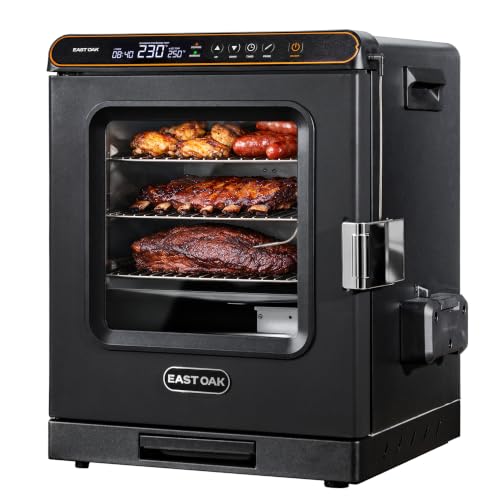
The Pitmate takes the vertical cabinet formula from our other guides and sets it on a table. Twenty inches of tabletop smoker with 544 square inches of cooking area — the largest figure in this guide — driven by 1400W dual heating that its title credits with up to 25% shorter cooking time. Around that core it arranges the equipment of a full-size cabinet: a meat probe, a viewing window and a large side chip loader. Nothing about the specification reads as a toy’s apology; it reads as a cabinet that happens to be small.
Dual heating is the engineering to notice. Small electric smokers can struggle to recover temperature after the door opens, because a modest element in a small box has little reserve; a 1400W dual arrangement is the maker’s answer, and the shorter-cooking-time claim follows from it. The window and probe repeat the EAST OAK philosophy from the larger models — see the food, read the food, keep the door shut — and in a tabletop machine they matter more, because a small cabinet’s climate is disturbed proportionally more by every opening than a big cabinet’s is.
Five hundred forty-four square inches in a tabletop footprint suits the balcony and the small patio precisely: stacked racks give vertical capacity while the base stays the size of a appliance. It will not cook for a reunion, and its title does not pretend otherwise. It will smoke a family’s ribs, a couple of chickens or a batch of wings on a Saturday, then go back on its shelf. For the electric-only household — the apartment with rules, the condo with a balcony — this is the guide’s most complete answer.
- Format: tabletop electric smoker, 20-inch
- Power: 1400W dual heating per the listing title
- Cooking area: 544 square inches
- Probe: meat probe included per the title
- Window: viewing window in the door
- Chip loading: large side chip loader
Strengths
- The largest stated capacity in the guide, in a tabletop footprint.
- Dual heating addresses small-box temperature recovery directly.
- Probe, window and side loader match full-size cabinet equipment.
Trade-offs
- Tabletop placement still needs a suitable outdoor surface and outlet.
- Capacity stops at family scale by design.
- The shorter-cooking claim is the maker’s figure, stated as such.
Best for: balcony, condo and small-patio households that must cook electric. Not suited for: event cooks or charcoal flavour seekers.

Traeger Tailgater Portable Pellet Grill — Best Portable Pellet Smoker
The Tailgater is Traeger’s answer to a specific question: what does a pellet grill become when it has to ride in the vehicle and set up on grass? Three hundred square inches of wood-fired cooking, foldable legs, and 6-in-1 versatility — the pellet platform’s usual range of grilling, smoking, baking, roasting and braising behaviours — in a package designed around tailgates, campsites and small patios. The folding legs are the thesis: the machine stands like a grill when cooking and folds like luggage when not, which is the difference between a portable grill and a small grill that is merely carryable.
Pellet cooking travels well because the fuel is tidy. A bag of pellets is clean, measurable and free of charcoal’s ash and a propane bottle’s bulk, and the grill’s automated feed gives the travelling cook the pellet platform’s signature ease — set the temperature and let the auger mind the fire — at a fishing camp as reliably as in a garden. Three hundred square inches is a real cooking surface for a travelling party: burgers for the tailgate crowd, ribs for the campsite, a pork shoulder for the cabin weekend.
The constraints are the platform’s own: pellets plus a power source for the auger and controller, which at remote sites means a battery pack, a generator or the vehicle’s support, and a hopper sized for trips rather than fortnights. Within those logistics, the Tailgater is the most credible travelling smoker in this guide, from the maker whose name is nearly synonymous with the fuel.
- Format: portable wood pellet grill and smoker
- Cooking area: 300 square inches
- Legs: foldable, per the listing title
- Versatility: 6-in-1 per the title
- Fuel: wood pellets
- Controller details: not given in the listing
Strengths
- Folding legs make it genuinely portable, not just small.
- Pellet automation travels: tidy fuel, set-and-hold temperatures.
- 300 square inches cooks for a travelling group, not just a couple.
Trade-offs
- Needs power for its auger and controller at remote sites.
- Hopper capacity suits trips rather than long unattended cooks.
- Larger than the tabletop picks when storage is a single cupboard.
Best for: tailgaters, campers and RVers who want real pellet barbecue on the road. Not suited for: balcony cooks whose buildings restrict pellet or smoke.

Z GRILLS 200A Table Top Pellet Grill — Best for RVs and Apartments
The Z GRILLS 200A is the pellet platform shrunk to a tabletop and aimed, by its own title, at RVs, road trips and apartments. Two hundred and two square inches is the second-smallest area in this guide, and the machine compensates for size with control: a PID V3.0 controller and meat probes are both named in the title. PID control is the pellet world’s precision instrument — a controller that reads the chamber constantly and meters pellets in small corrections rather than swinging between overshoot and undershoot — and finding it on a tabletop model signals that this small grill intends to cook like a serious one.
Meat probes, plural in the title, extend the same philosophy to the food: a small grill cooking a small load can still be cooking an expensive cut, and probe-monitored doneness is what separates a good result from a hopeful one. The tabletop format suits the RV life its title invokes — a grill that rides in a storage bay, sets up on a picnic table, and feeds two to four people with pellet flavour at every stop — and the apartment life too, where a balcony’s worth of space and a household’s worth of ambition meet.
Set expectations by the number: 202 square inches is a couple’s grill with room for guests’ burgers, not a party smoker, and its hopper and stature are scaled accordingly. What it offers in exchange is the fullest control specification of any pick here, in the smallest pellet package — the thinking cook’s travel grill.
- Format: tabletop wood pellet grill and smoker
- Cooking area: 202 square inches
- Controller: PID V3.0 per the listing title
- Probes: meat probes named in the title
- Audience: RVs, road trips and apartments per the title
- Legs or stand: not stated in the listing
Strengths
- PID control brings full-size pellet precision to a tabletop.
- Included meat probes suit careful cooking of smaller cuts.
- The most compact pellet option for RV storage bays.
Trade-offs
- 202 square inches caps loads at couple-plus-guests scale.
- Pellet power needs an outlet or inverter at campsites.
- No folding-leg or portability hardware is named in the title.
Best for: RV travellers and apartment cooks who value control over capacity. Not suited for: hosts cooking for groups or off-grid campers without power.

Char-Griller AKORN Jr. Portable Kamado — Best Portable Kamado
The AKORN Jr. compresses the kamado — barbecue’s most ancient shape, an egg of a cooker that grills, roasts and smokes by charcoal and airflow — into a portable steel form. Its title specifies the engineering: triple-wall insulated steel, cast iron grates, a locking lid, and 155 square inches of cooking area in grey. The triple-wall construction is the kamado idea translated from ceramic to metal: insulated walls that hold heat the way a ceramic egg does, in a body light and tough enough to travel, where a ceramic kamado of any size is a two-person lift and a permanent address.
Kamado cooking rewards the small format. The egg’s airflow control makes a modest charcoal load hold smoking temperatures for hours or climb to steak-searing heat, and the insulated steel walls sip fuel while doing it — a Jr. cooks a chicken, a rack of ribs or a small shoulder on a quantity of charcoal that would embarrass a barrel. Cast iron grates are the right surface for the grill half of its life, holding sear marks and heat with the material’s usual authority, and the locking lid is the travel detail: the whole cooker closes into a sealed unit that rides without shedding ash or parts.
One hundred fifty-five square inches is the smallest stage in this guide, and it defines the audience honestly: one to three people, a couple’s dinner, a small family’s chicken. Kamado technique also asks for a learning curve — vents in small movements, patience with the egg’s thermal momentum — but it is the most pleasurable curve in barbecue, and the Jr. is its most portable classroom.
- Format: portable kamado charcoal grill and smoker
- Construction: triple-wall insulated steel per the listing title
- Grates: cast iron
- Cooking area: 155 square inches
- Lid: locking lid for transport
- Colour: grey, per the title
Strengths
- Insulated steel walls give kamado heat retention in a portable body.
- Charcoal economy is exceptional; small loads cook for hours.
- Locking lid makes the cooker genuinely transportable.
Trade-offs
- 155 square inches is the smallest capacity in this guide.
- Kamado vent technique takes practice to master.
- Charcoal rules it out where open fire or charcoal is restricted.
Best for: couples and small families who want kamado cooking that can travel. Not suited for: group cooks or anyone needing a large flat grate.

ROVSUN 18-inch Charcoal Smoker Grill — Best Charcoal Tower
The ROVSUN takes the oldest inexpensive smoker shape — the vertical charcoal tower, a stacked cylinder in the bullet tradition — and states its case plainly: 18 inches across, multi-layer construction, heavy-duty round grill body, a thermometer, for outdoor cooking at patios and parties. The multi-layer design is the format’s genius: the tower separates into sections, so it can stand tall as a smoker with its stacked cooking levels or configure down toward grilling, and each layer lifts away for access to the fire and the food in a way a one-piece cabinet cannot imitate.
Charcoal in a tower is the apprenticeship format of generations: a fire at the base, water pan or heat management above it in the classic pattern, food on the stacked grates, and the cook learning vent and fuel discipline with the whole system visible and reachable. The fitted thermometer named in the title is the instrument the method needs, and the tower’s slim round footprint — an 18-inch circle — fits the corners and small patios that this guide exists for, while its layers give it more cooking levels than its footprint suggests.
The title publishes no total cooking area, and this guide leaves the figure to the listing rather than inventing one from the diameter. Judged on format and stated hardware, the ROVSUN is the traditionalist’s small smoker: charcoal, vertical, layered and inexpensive in spirit, for the cook who wants to learn fire in its classic classroom and feed a patio party from a footprint the size of a bar stool.
- Format: vertical multi-layer charcoal smoker grill, 18-inch
- Construction: described as heavy duty in the listing title
- Temperature reading: thermometer fitted per the title
- Cooking area: not given in the listing
- Layers: multi-layer, separable sections
- Water pan: not stated in the listing
Strengths
- Separable layers reconfigure the tower for smoking or grilling.
- An 18-inch round footprint fits the smallest patios.
- The classic bullet format is a proven charcoal classroom.
Trade-offs
- No total cooking area is published in the title.
- Charcoal fire management is required throughout the cook.
- Layered access means lifting sections to reach lower levels.
Best for: charcoal learners and small-patio cooks who want stacked capacity. Not suited for: cooks wanting digital control or electric convenience.
How Do the Six Small Smokers Compare Side by Side?
| Pick | Fuel | Stated capacity | Portability evidence |
|---|---|---|---|
| Ninja Woodfire Outdoor Grill & Smoker OG301 | Electric with pellets | 6 steaks or a 9-lb brisket | Compact appliance format |
| EAST OAK Pitmate Tabletop 20-inch Electric Smoker | Electric | 544 sq in | Tabletop cabinet |
| Traeger Tailgater Portable Pellet Grill | Pellets | 300 sq in | Foldable legs |
| Z GRILLS 200A Table Top Pellet Grill | Pellets | 202 sq in | Tabletop format |
| Char-Griller AKORN Jr. Portable Kamado | Charcoal | 155 sq in | Locking lid, portable kamado |
| ROVSUN 18-inch Charcoal Smoker Grill | Charcoal | Not stated | Slim 18-inch tower |
What Can a Small Smoker Actually Cook Well?
More than its dimensions suggest, because smoking rewards fit rather than volume. A small chamber cooks a whole chicken superbly, two racks of ribs with a rib rack’s help, a pork shoulder of modest size, salmon fillets, sausages, wings in party-starting quantity, cheese-adjacent projects at low settings, and vegetables that take smoke like a seasoning. What it cannot do is volume in a single load: the Thanksgiving turkey for fourteen, the four-brisket fundraiser. The small-smoker household adapts with rhythm instead of size — smoking in two batches across a weekend, choosing cuts that fit the chamber’s shape, and letting the smoker’s fuel economy make frequent small cooks cheaper than rare enormous ones. Many owners report the unexpected consequence: they smoke more often, because a machine that asks for a handful of charcoal or a cup of pellets and an hour of setup-free time gets used on whim, and whim is where weeknight barbecue lives.
How Do Balcony and Apartment Rules Affect Your Choice?
Rules cut this guide’s field before taste does. Many apartment buildings and condos restrict or forbid charcoal and open flame on balconies, some restrict pellets and smokers of any kind because of the smoke itself, and electric machines are commonly — not universally — the permitted option. The honest sequence is to read your building’s rules and your local fire code first, then shop within what survives. The Pitmate and the Ninja exist in this guide precisely for the electric-only household, and even they produce real smoke that drifts to neighbours, which is a matter of courtesy and sometimes of lease. Where no outdoor cooking is permitted at all, no smoker solves the problem, and this guide would rather say so than sell a machine that earns its owner a warning letter. For the permitted balcony, favour the compact electrics, mind the wind’s direction, and keep cooks neighbourly in size and hour.
How Do You Get Big-Smoker Results from a Small Chamber?
By respecting the physics that smallness sharpens. A compact chamber heats fast and loses heat fast, so preheat fully and open the lid with a plan. Its smoke concentration is a gift: a small volume flavours food quickly, which means shorter exposures and a lighter hand with chips or pellets than a big cabinet teaches. Use the vertical dimension wherever the machine offers it — the Pitmate’s stacked racks, the ROVSUN’s layers, a rib rack or a vertical chicken stand in the kamado — because small smokers are taller in spirit than their footprints. Manage the load’s geometry: food spaced for airflow cooks evenly, while a small grate paved solid steams its own dinner. And lean on probes; the Z GRILLS includes them and the Pitmate builds one in, because in a fast-responding small chamber, doneness arrives sooner than big-smoker instincts expect. Small is not a limitation to apologise for; cooked attentively, it is a style with its own excellences.
How Do You Store a Small Smoker in a Small Home?
Storage is where the format earns its rent. A tabletop machine like the Pitmate or the Z GRILLS lives on a shelf, in a deep cupboard or on a utility cart that rolls out for cooks and away after them — measure the cupboard before the machine, including the height its lid or hopper needs, because a smoker that almost fits is a smoker that lives on the floor. The Tailgater’s folded legs turn it into a flat package for a garage wall or an RV bay; the AKORN Jr. locks its lid and sits in a corner like a kettle with ambitions. Whatever the spot, store the machine clean and dry: ash out of the charcoal cookers, pellets out of the hopper for long storage in humid climates, cords coiled, probes in a drawer rather than in the weather. A cover sized to the machine keeps dust and garage life off it. The discipline is five minutes after each cook, and it is the difference between a small smoker that is always ready and one that needs a project before it can cook.
How Do You Feed Guests from a Small Smoker?
By cooking in sequence rather than in bulk, and by choosing a menu that respects the chamber. The strategy that works is the anchor-and-sides pattern: one smoked anchor — a pork shoulder cooked ahead and held, or ribs in two rotations — surrounded by sides that never needed the smoker at all. Shoulders are the small cook’s best friend because they finish when they finish and hold beautifully wrapped, freeing the chamber for a second act of wings or sausages as guests arrive. Sequence the day backwards: the long cook first, the quick smokes last, the grill-mode machines like the Ninja flipping to sear and finish at serving time. A rib rack or vertical stand multiplies a small grate’s rib capacity, and cutting a brisket’s point from its flat lets each fit the chamber on its own schedule. Guests fed this way eat in courses and rarely learn the smoker was small; the cook learns that hospitality is a scheduling art, and the small machine teaches it better than a cavernous one that hides poor planning.
How Do the Fuels Compare on Running Cost and Convenience?
At small scale, all three fuels are inexpensive per cook, so convenience decides more than cost. Electric is the simplest ledger: pennies of power, chips or pellets by the handful, no ash beyond the loader’s, and an off switch at the end. Pellets cost more per cook than chips and buy automation — the auger feeds the fire, the controller holds the number — with a hopper to keep dry and an appetite that grows with temperature. Charcoal is the cheapest fuel per hour and the dearest in attention: lighting, vent craft, ash disposal, and the irreplaceable flavour that its devotees correctly claim. The honest summary is that small smokers shrink every fuel’s bill to near-irrelevance and leave the real currencies exposed — your time, your building’s rules, your storage space and your taste. Choose by those, and the fuel question answers itself.
How Do You Maintain a Small Smoker?
Small machines forgive neglect less than big ones, because their margins are smaller: a thin layer of ash in a kamado’s base is a larger fraction of its airflow, a greasy film in a tabletop cabinet is closer to the element, a damp hopper stops a small auger as completely as a large one. The maintenance rhythm is correspondingly light but regular. After each cook: ash out once cold, grates brushed while warm, drip routes wiped. Monthly in season: check seals and hinges, empty and vacuum pellet paths where the maker allows, inspect cords and connections on the electrics. Seasonally: a deeper clean, a look at the finish, and an honest test cook before the first important event. None of this exceeds minutes at this scale, which is the point — a small smoker’s maintenance fits the same compact life as its storage, provided it is done in the small instalments the format prefers rather than in one annual excavation.
Which Small Smoker Suits a Tailgate, Specifically?
A tailgate is a cooking problem with a clock, a crowd and a car park, and it rewards machines that set up fast, cook forgivingly and pack without mess. The Tailgater was named for the venue: folding legs, pellet automation that frees the cook to watch the pregame, and 300 square inches that cover burgers and brats for a group with ribs as the headline. The AKORN Jr. is the charcoal romantic’s tailgate answer — locking lid for the ride, kamado efficiency for a long afternoon, and searing power for the main event — provided the venue permits charcoal. The Ninja travels as an appliance and grills like one, suiting the tailgate with power available. What all three share is the tailgate’s essential virtue: they cook food worth gathering around without requiring the cook to build a kitchen in a parking space, and they ride home in the vehicle they came in.
How Do You Choose Between Tabletop, Folding and Tower Formats?
The three shapes in this guide solve three different storage problems. The tabletop machines — Pitmate and Z GRILLS 200A — solve the shelf problem: they assume a surface exists wherever they cook, and in exchange they offer the most appliance-like experience, cabinets and controllers in miniature. The folding Tailgater solves the transport problem: it assumes no surface and brings its own legs, standing on grass, gravel or a tailgate with equal indifference. The tower and kamado — ROVSUN and AKORN Jr. — solve the floor problem: the smallest possible ground footprint, cooking upward instead of outward. Choose by walking your own routine. Where will the machine stand at 6 p.m. on a Saturday, where will it sleep on a Tuesday, and what journey separates those places? The format that makes that journey shortest is the format you will use weekly, and weekly use is the only metric by which any smoker in this guide should ultimately be judged.
How Do Small Smokers Behave in Cold Weather?
Honestly, and with more strain than their big relatives — a small chamber has less thermal mass and proportionally more surface to lose heat through. The exceptions prove the rule instructively: the AKORN Jr.’s triple-wall insulated steel is precisely the engineering that answers winter, holding its climate like the kamados are famous for, while a thin-walled small cabinet will work its element hard on a January night. Practical compensations help every machine here: shelter from wind above all, a full rather than nearly empty chamber, preheating longer than summer habits suggest, and choosing the day’s menu with the season — a chicken or ribs rather than the year’s longest brisket. Pellet machines should keep their fuel dry and their power supply warm where batteries are involved. None of this forbids winter smoking at small scale; it prices it, and the cook who pays the small price gets winter barbecue while the big cabinets’ owners are still considering the idea.
Which Accessories Earn Their Place with a Small Smoker?
Four, and no more to start. A rib rack, because ribs are the small chamber’s most requested food and a rack stands them on edge to multiply any grate. A good probe thermometer for the machines that lack one — the Ninja and the charcoal pair — since small chambers reach doneness faster than instinct predicts. A fitted cover, because small machines live in garages, cupboards and RV bays where dust and knocks accumulate. And a pair of heat gloves sized for lifting whole chickens and small shoulders from tight grates without drama. Everything else — specialty racks, injection kits, branded tool sets — should be bought against a named annoyance after the third cook, in the discipline this batch’s guides keep recommending, because accessories bought speculatively are just storage problems wearing the costume of solutions, and storage is the one resource a small-smoker household has already declared scarce.
How Should a First Cook on a Small Smoker Go?
Season the machine empty first, by its manual — a hot, smoky hour that burns off the factory and teaches you the controls with nothing at stake. Then choose the forgiving tutor in miniature: chicken thighs or a small rack of ribs, foods that announce doneness clearly and forgive an overshoot. Set up with everything within reach, because a small chamber’s speed punishes the cook who leaves to find tongs. Watch how quickly the temperature responds to your inputs — vents on the kamado and ROVSUN, dial on the electrics, controller on the pellets — and how quickly it recovers after the lid opens, because those two numbers are your machine’s personality. Take the food off by probe and by look, rest it, eat it, and write down three sentences about what the machine did. The second cook, which in a small machine can plausibly happen two days later because the fuel cost was trivial, is where the learning compounds. Small smokers reward iteration, and iteration is the whole of barbecue education.
Why Do Big-Smoker Owners Buy Small Smokers Too?
Because the big cabinet is a commitment and Tuesday is not. Owners of full-size smokers describe the same pattern: the large machine anchors weekends and events, while a small one accumulates the ordinary cooks — the weeknight chicken, the experimental sausage batch, the side dish of smoked beans that did not justify firing the cavern. Fuel and time economics drive it: a handful of pellets or a cup of chips against a cabinet’s full appetite, ten minutes of setup against an hour. There is also a teaching function; the small machine is the one lent to a curious friend or handed to a teenager learning the craft, because its stakes are dinner-sized. Far from cannibalising the big smoker, the small one protects it — the flagship stays an event, the workhorse stays busy, and the household smokes three times as often as it did with either alone. Readers with a large smoker already should read this guide not as a replacement catalogue but as a second-tool brief.
How Strong Is the Smoke Flavour from Compact Machines?
Stronger than their size suggests, for a simple physical reason: smoke concentration is flavour divided by volume, and a small chamber concentrates. The Ninja’s pellets and the Pitmate’s chips work in boxes a fraction of a cabinet’s size, so a modest fuel load perfumes the whole space quickly. This cuts both ways — the small-smoker cook learns to use less fuel than big-smoker recipes prescribe, because yesterday’s handful becomes today’s over-smoked chicken — but it means no machine in this guide produces apologetic barbecue. Charcoal keeps its depth advantage in the kamado and the ROVSUN, where the fuel is the fire itself, yet the honest verdict of blind tastings everywhere is that a well-run small electric or pellet smoker’s ribs stand proudly beside a barrel’s. Judge by your own table: cook the same cut on the small machine with a restrained fuel hand, and let the eating settle what the specifications cannot.
How Do You Transport a Small Smoker Without Wrecking It or the Car?
Cool, clean and closed is the whole doctrine. Let the machine cool completely — a kamado’s retained heat is a virtue at the campsite and a hazard in a boot — then empty ash and grease, because a transported smoker sheds whatever it holds at the first roundabout. Lock what locks: the AKORN Jr.’s lid exists for this journey, and other machines want their racks removed or secured, probes packed separately, and hoppers emptied or latched against spilling their pellets across the upholstery. Carry the machine upright and wedged, on a mat that forgives the drips no cleaning fully prevents, and drive the first mile gently to learn how your cargo rides. At the destination, the setup ritual is a level spot, clearances observed, and a test of the surface’s sturdiness before the machine’s weight commits to it. Treated this way, a small smoker becomes genuinely mobile equipment rather than a small smoker that once went on a trip — and the household’s map of possible barbecue places expands to every park, beach and relative’s garden within driving distance.
What Mistakes Do Buyers Make with Small Smokers?
The first is buying small for a large life: the household that entertains twelve monthly will resent a 202 square inch grate no matter how clever its controller is. The second is the opposite vanity — assuming small means lesser, and overlooking that the Pitmate’s equipment list and the Z GRILLS’ PID control out-spec larger machines. Third, travellers buy a “portable” smoker without checking its travel facts: folding legs, a locking lid and a weight their back approves of are the evidence, and the picks here state them to different degrees. Fourth, apartment buyers shop before reading their building’s rules, and meet the rules at the first cook. Fifth, new owners overload small chambers, paving the grate and steaming the food, when the format rewards spacing above all. Finally, buyers forget the fuel’s logistics — pellets need power for the auger, charcoal needs permission, electric needs an outlet — and discover at the campsite or the balcony that the machine and the location were never introduced.
Final Recommendation
For the single-machine household, the Ninja Woodfire Outdoor Grill & Smoker OG301 is this guide’s recommendation: it grills the week and smokes the weekend in one compact appliance. The electric-only balcony belongs to the EAST OAK Pitmate Tabletop 20-inch Electric Smoker, and the road belongs to the Traeger Tailgater Portable Pellet Grill. The Z GRILLS serves the control-minded traveller, the AKORN Jr. the kamado romantic, and the ROVSUN the charcoal traditionalist on a small patio. Measure your space and your typical dinner honestly, choose the fuel your life permits, and let the first small batch of ribs — smoked on a Tuesday because the machine made it easy — make the case for the format far better than any specification sheet in this guide possibly could on its own.
Frequently Asked Questions
Can a small smoker cook a brisket?
A small brisket or a brisket flat, yes — the Ninja’s own title sizes its ceiling at a 9-lb brisket. Full packer briskets belong to larger chambers where the cut lies flat without curling. Small-smoker cooks often choose the flat or a small whole brisket and gain tenderness from the chamber’s concentrated smoke. Trimming with the chamber in mind is the enabling habit: a brisket shaped to the grate before it is seasoned cooks evenly, while one forced in at an angle cooks like the compromise it is.
Which fuel is best for an apartment balcony?
Electric, where any smoker is allowed at all, because it involves no open flame or charcoal and is the format buildings most commonly permit. Confirm your own building’s rules and fire code first; the Pitmate and the Ninja Woodfire are this guide’s electric answers, and both still produce smoke that deserves neighbourly scheduling. A short conversation with the neighbours below the balcony, and a preference for daytime cooks, prevents most of the friction that gives balcony smoking its reputation.
Are pellet grills practical for camping?
Yes, with power planning. The Tailgater and the Z GRILLS 200A both target travel, and their augers and controllers need electricity — a campsite hookup, an inverter or a battery pack sized for the cook. The reward is set-and-hold pellet cooking anywhere; the duty is bringing the power with you. Plan the power for the longest cook on the itinerary rather than the average one, because a brisket’s schedule does not negotiate with a battery’s remaining charge, and keep the pellets in a sealed container against the damp that campsites specialise in.
How long does charcoal last in the AKORN Jr.?
Kamados are famously economical, and the Jr.’s triple-wall insulated steel follows the family’s pattern: a modest load of lump charcoal holds smoking temperatures for hours, because the insulated walls waste little heat. Exact duration depends on temperature, weather and load, but fuel economy is one of the strongest reasons to choose the format. The same insulation steadies the Jr. against wind that would bully a thin-walled cooker of its size, which is why experienced small-space cooks so often end their search at a kamado’s door.
Is a tabletop smoker stable and safe outdoors?
On a suitable, level, heat-safe surface with the maker’s clearances observed, yes. Tabletops belong on sturdy stands or tables rated for the weight and heat, away from railings and siding, and never on plastic surfaces. The Pitmate’s cabinet format keeps its heat contained, but placement discipline is the owner’s half of the design. A purpose-built stand or a metal-topped cart repays its small cost the first time the machine needs to move mid-cook, and it keeps the working height comfortable enough that the cook actually enjoys tending the food.
What is the best small smoker for a beginner?
The one whose fuel and controls match the beginner’s setting. Electric machines like the Pitmate minimise fire management while teaching smoke; the Ninja adds grilling versatility; the ROVSUN teaches charcoal craft in its classic form. Beginners learn fastest on the machine their home permits and their patience enjoys. Start with chicken, graduate to ribs, and let the machine’s size keep every lesson inexpensive.
Do small smokers make good gifts?
Unusually good ones, because they ask little of the recipient’s space. A tabletop pellet grill or the AKORN Jr. fits lives that a full-size smoker would burden, and the fuel to run them is a modest follow-up gift rather than a commitment. Match the machine to the recipient’s home rules — electric for the apartment dweller, charcoal for the garden traditionalist — and the gift cooks for years instead of occupying a garage. Include the first bag of pellets or load of lump charcoal, and the recipient’s first cook needs nothing but the food.
How many people can the smallest picks feed?
The AKORN Jr.’s 155 square inches and the Z GRILLS’ 202 square inches feed two to four people comfortably — a chicken, a rack of ribs with sides, burgers for a small group. Feeding more is a scheduling exercise rather than a capacity one: cook in sequence, hold the finished items warm, and let the menu arrive in courses. Children, it should be said, rarely audit the smoker’s dimensions; they audit whether the ribs are ready, and on that measure a small machine run well passes every time.
Can a small smoker replace my grill entirely?
For many small households, yes — and the hybrids make the case strongest. The Ninja grills, roasts and bakes as its main act, with smoking built in; the kamado sears as fiercely as it smokes; the pellet pair grill credibly at their high settings. What a small smoker-grill cannot replace is a large grill’s party surface, so the household that hosts big cookouts should keep both tools in their respective roles. For the household of two to four, though, one good small machine covers the calendar.
Related Guides
Small smokers meet their natural sequel in our guide to the Best Smokers for Cold Weather, where compact chambers face the season’s hardest test. The household theme continues indoors with the Best Bedside Alarm Clocks with Night Light, and for the bathroom shelf, our evidence-first approach shapes the roundup of the Best Tub Bath Mats.


