What's inside
- Key Takeaways
- Quick Picks
- How Did We Choose These Leather Slippers?
- The Six Pairs, Reviewed One by One
- How Do the Six Pairs Compare Side by Side?
- What Should You Look for When Buying Leather Slippers?
- How Do You Break In and Care for Leather Slippers?
- Which Leather Slipper Suits a Cold House, and Which Suits a Warm One?
- How Should Leather Slippers Fit Across a Whole Evening?
- What Is the Difference Between Cowhide, Nubuck and Shearling?
- When Does a Leather Slipper Stop Being Good Value?
- How Do Leather Slippers Behave on Carpet, Timber, Tile and Stone?
- What Mistakes Do Buyers Make with Leather Slippers?
- Final Recommendation
- Frequently Asked Questions
- Related Guides
As an Amazon Associate I earn from qualifying purchases. This post may contain affiliate links at no extra cost to you.
cottageverdict.com is reader-supported. When you buy through links on our site, we may earn an affiliate commission.
Where to buy: every pair in this guide is sold through Amazon, and the names in the Quick Picks table, the review headings and the comparison table all link to the matching listing, so you can check price on Amazon and confirm your size before ordering. The best leather slippers earn that label in two different ways, and it helps to know which one you are shopping for before you fall for a handsome product photo. Some pairs put leather on the upper, where it shows, scuffs, softens and slowly takes the shape of your foot. Others pair a leather upper with a shearling or fleece lining, so the material against your skin is wool while the leather does the structural work outside. Both are legitimate leather slippers, but they feel different on the first evening and age differently across a winter.
Leather also asks a little more of its owner than a polyester slipper does. It dislikes being soaked, it prefers to dry away from radiators, and it rewards an occasional wipe-down with years of service instead of a single season. In return you get an upper that does not pill, does not hold odours the way synthetics can, and looks better in year two than most fabric slippers look in month two. If your household treats slippers as disposable, leather is the wrong purchase no matter how good the pair is. If you wear the same pair every morning and evening, leather is usually where the value hides.
This guide stays strict about one thing: a pair only gets called genuine leather here when its listing says so. Cowhide, nubuck and leather uppers are described as exactly that. Where a listing is silent about a lining or a sole material, the review says the listing is silent rather than guessing, because the difference between a leather sole and a rubber outsole decides whether a pair belongs on a wet doorstep or only on bedroom carpet.
Five of the six pairs below are men’s styles and one is a women’s shearling design, which reflects where the genuine-leather listings actually cluster. Sizing notes are included wherever the listing gives them, because leather footwear sizes less forgivingly than stretchy knit slippers: a half size of squeeze in fabric becomes a pressure point in cowhide.
One more expectation is worth setting before the reviews. Leather slippers rarely feel luxurious in the first ten minutes the way a plush synthetic pair does, because hide starts firm and foam starts soft. The relationship reverses over a season: the plush pair thins and twists, while the leather pair softens into the shape of one particular foot and stays that way. Readers who judge slippers by the first impression in a shop doorway systematically underrate leather, and readers who judge by the hundredth evening systematically choose it. This guide is written for the hundredth evening.
Key Takeaways
- Every pick below has a listing that states leather, cowhide or nubuck outright; nothing here is a leather-look synthetic wearing a leather label.
- An open-back scuff, a flat bedroom slipper and a closed moccasin are three different tools, and the right choice depends on whether your feet run hot or cold.
- Shearling linings appear on three picks, so decide early whether you want wool against your foot or an unlined leather interior.
- Only some of these pairs carry soles suited to stepping outside; the flat cowhide pair is honest bedroom footwear and should stay indoors.
- Leather uppers mould to your feet over the first weeks, so a snug-but-not-pinching first fit is usually the correct one.
- Check the listing’s size run before ordering, because two picks are listed in whole sizes only.
Quick Picks
| Pick | Badge | Why it is here |
|---|---|---|
| UGG Men’s Scuff Slipper Black Leather | Best Classic Scuff | The open-back benchmark: a black leather upper in the slip-on shape men reach for beside the bed. |
| Men’s Genuine Cowhide Leather Slippers | Best Breathable Flat | Genuine cowhide with a soft, smooth sole, built as a flat bedroom shoe rather than an outdoor hybrid. |
| PROJECT CLOUD Genuine Leather Shearling Womens Slippers | Best Women’s Shearling | Genuine leather outside, genuine Australian shearling inside, and a water-resistant finish for damp mornings. |
| PROJECT CLOUD Mens Genuine Leather Moccasin Slippers | Best Cushioned Moccasin | A leather moccasin over a memory foam insole, for men who want padding under a traditional silhouette. |
| OluKai Moloa Men’s Nubuck Moccasin Slippers | Best Premium Nubuck | Nubuck upper, shearling lining and a collapsible heel that converts it from shoe to slide in one step. |
| JOOFAN Genuine Cowhide Leather Slippers for Men | Best Non-Slip Cowhide | Genuine cowhide house shoes with a non-slip brief, aimed at hard floors and evening kitchen traffic. |
How Did We Choose These Leather Slippers?
The first filter was honesty in the listing. A pair had to state its leather plainly — leather, genuine cowhide or nubuck — in its own title before it could be considered, and pairs whose leather claim dissolved into vague wording on closer reading were set aside. That single rule removes most of the confusion in this category, because the slipper shelves are full of uppers that photograph like hide and are nothing of the sort.
After that, the six were spread deliberately across the ways people actually wear leather slippers. There is an open-back scuff for warm feet and quick exits, a flat unlined cowhide pair for sleepers who overheat, two moccasins for men who want a shoe-like fit, a women’s shearling pair for cold floors, and a non-slip cowhide design for households with tile and timber. A guide with six near-identical moccasins would be easier to write and useless to read.
Soles were read as carefully as uppers. The listing for each pick was checked for what it claims underfoot: a soft smooth sole, a gum rubber outsole, a non-slip description, or silence. Silence is reported as silence in the reviews below. A leather upper on an indoor-only sole is a fine slipper, but it should never be sold to a reader as a doorstep pair.
Finally, sizing information was weighed, because leather does not forgive a wrong guess the way stretch fabric does. Picks whose listings publish a wide whole-size run earned credit for it, and picks listed in a single size or a narrow band are flagged in their sections so nobody orders hopefully and returns sadly.
The Six Pairs, Reviewed One by One

UGG Men’s Scuff Slipper Black Leather — Best Classic Scuff
The scuff is the oldest shape in this guide: a leather upper on an open back, nothing to pull on, nothing to tie, nothing between a cold floor and a warm foot except one step forward. UGG’s version in black leather is the pair men buy when they want the bedside ritual to take exactly one second. The listing is terse — it names the style, the colour and the leather, and gives a size — so this review treats it as what it plainly is: a branded leather scuff whose appeal is simplicity and the way a leather upper ages compared with the sheepskin-wool uppers the brand is better known for.
An open back means the heel breathes and the foot runs cooler than in any closed design here, which is why scuffs suit men whose feet overheat in lined moccasins by nine in the evening. The trade is security: a scuff stays on through a shuffle, not through a brisk walk to the letterbox, and it offers the heel no protection on stairs. Within those limits the shape is unbeatable, and a leather upper holds its structure over the toes far longer than a fabric scuff, which tends to collapse into a sad flap by midwinter.
Because the listing keeps its details close, the practical advice is to order your usual shoe size and expect the upper to ease across the forefoot during the first fortnight. Black leather also hides the scuffs that give this style its name, which matters in a pair destined to catch skirting boards and chair legs daily.
Consider who the scuff quietly serves best: the reader whose mornings are a relay between bedroom, bathroom and kettle, with no single stop long enough to justify lacing or pulling on a full shoe. A scuff lives at the exact point where the relay starts, which is why its owners replace like with like for decades. The leather version of that habit simply lasts longer between replacements, and black is the pragmatic colour for a pair that will meet dust, ash and pet hair on a daily route. If your evenings involve a garden, a workshop or a flight of stairs to a front door, read the scuff’s limits honestly and treat it as one half of a two-pair household rather than a failed all-rounder.
- Upper: leather, stated in the listing
- Colour and size listed: black, size 10
- Style: open-back scuff
- Lining material: not stated in the listing
- Sole construction: not given in the listing
Strengths
- One-step entry that no closed slipper in this guide can match for speed
- Leather upper keeps its shape over the toes instead of collapsing like fabric
- Open back keeps warm feet comfortable through a whole evening
Trade-offs
- Heel is unprotected and the fit loosens into a shuffle on stairs
- The listing gives little detail, so lining and sole questions go unanswered
- Black shows dust and pet hair more readily than tan or brown leather
Best for: men who want a durable bedside scuff and run warm in lined slippers.
Not suited for: anyone who wants heel coverage or plans to wear them beyond the front door.
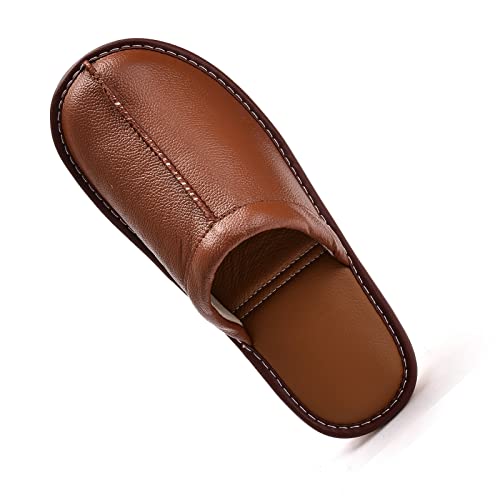
Men’s Genuine Cowhide Leather Slippers — Best Breathable Flat
This pair takes the opposite philosophy to the padded moccasins further down the page. The listing describes genuine cowhide, a breathable leather build, and a soft smooth sole, and it calls the result a bedroom flat shoe. That is a precise description of a traditional leather slipper: hide above, hide-feel below, minimal padding anywhere. For men who find memory foam slippers spongy and shearling slippers sweltering, this is the pair that feels like footwear used to feel.
Breathability is the genuine headline. An unlined or lightly finished cowhide upper lets moisture escape instead of trapping it against foam, so feet stay dry through a long evening in a heated house. The flat profile also keeps your gait honest: there is no rocker, no wedge, no thick stack changing how you stand at the kitchen counter. People who dislike the elevated, cushioned sensation of modern house shoes often settle happily into a flat like this within a day.
The soft smooth sole draws the boundary clearly. Smooth soles and wet tiles are poor companions, and the listing’s own bedroom framing should be believed — this is indoor footwear for dry floors, listed in light brown in a combined 11–12 size band. Treat it as a leather sock with structure, keep it off the doorstep, and it will repay you with the longest-wearing upper in this guide relative to its simplicity.
There is also a sensory argument for this pair that specifications miss. A flat leather sole transmits the floor: you feel the edge of a rug, the cool of a tile, the give of a board. People who spend their days in cushioned trainers often find that feedback restful in the evening, in the same way that barefoot feels restful, with the hide supplying protection and a finished look that bare feet do not. It is the closest thing in this guide to the leather slippers worn for generations before foam existed, and its buyers tend to be repeat buyers of exactly that idea. The combined 11–12 sizing band is the one practical caution: feet at the small end of the band should expect a roomier fit than feet at the top.
- Upper: genuine cowhide leather, stated in the listing
- Sole: soft and smooth, per the listing
- Colour and size listed: light brown, 11–12 band
- Intended setting, per listing: bedroom flat, indoor and outdoor wording notwithstanding, the sole argues indoors
- Cushioning system: none stated in the listing
Strengths
- Breathable cowhide suits men whose feet overheat in lined slippers
- Flat profile feels natural to anyone who dislikes thick foam soles
- Simple construction has very little in it that can fail or delaminate
Trade-offs
- Smooth sole offers limited grip on wet or polished floors
- No meaningful padding for long standing on hard kitchen tile
- Combined size band gives less precise fit than single sizes
Best for: warm-footed men who want honest, breathable leather and mostly carpeted or dry floors.
Not suited for: doorstep trips, wet tiles, or anyone who needs cushioning underfoot.

PROJECT CLOUD Genuine Leather Shearling Womens Slippers — Best Women’s Shearling
The only women’s pair in this guide earns its place on materials rather than novelty. The listing states 100% genuine leather and genuine Australian shearling, which means the warmth here comes from real sheepskin — leather on one side, wool grown on the other — rather than from a synthetic fleece glued into a leather shell. That distinction changes the wearing experience: genuine shearling breathes while it insulates, so feet warm up quickly on a cold floor and then level off instead of slowly stewing.
Shearling also compresses and moulds. The wool pile packs down under the heel and ball of the foot over the first weeks, leaving a footprint-shaped bed that fits one owner better than any new slipper can. The listing adds a water-resistant finish, which suits the reality of women’s slippers in most houses: they go from bedroom to bathroom to kitchen, across floors that are damp as often as they are dry. Water-resistant is not waterproof, and the pair should still be kept out of puddles and wet grass, but splashes at the sink are a non-event.
Styling leans fuzzy and cosy in the listing’s own words — fall shoes, house shoes — so expect a visible wool collar rather than a sleek moccasin line. Women who want a leather slipper that disappears under a trouser hem should look at the moccasins here instead; women who want the warmest honest construction in the guide should start with this pair and check the listing’s size options carefully before ordering.
One honest expectation to set: genuine shearling sheds a little loose wool in its first days and smells faintly of sheepskin when the box opens. Both fade quickly and both are, paradoxically, signs that the material is real. The warmth also changes how a room feels — owners of shearling slippers commonly turn the evening heating down a notch, because cold feet are usually what sends people to the thermostat. As a gift, this pair carries a risk and a reward: the risk is sizing, since women’s slipper sizes vary between brands, and the reward is that genuine materials are immediately obvious to the fingertips in a way a product photo cannot fake.
- Upper: 100% genuine leather, stated in the listing
- Lining: genuine Australian shearling, stated in the listing
- Finish: water-resistant, per the listing
- Audience: women’s sizing and styling
- Sole material: not stated in the listing
Strengths
- Real shearling insulates and breathes at the same time, unlike most faux piles
- Wool pile moulds into a personalised footbed over the first weeks
- Water-resistant finish shrugs off bathroom and kitchen splashes
Trade-offs
- Warmest pair here, and too warm for some sleepers in heated homes
- Shearling needs airing and gentle care rather than machine washing
- Listing leaves the sole undescribed, so outdoor grip is an open question
Best for: women with cold floors who want genuine materials and maximum lining warmth.
Not suited for: anyone who runs hot, or who needs a confirmed outdoor-rated sole.

PROJECT CLOUD Mens Genuine Leather Moccasin Slippers — Best Cushioned Moccasin
Where the cowhide flat above strips a leather slipper down to hide and sole, this PROJECT CLOUD moccasin rebuilds it around comfort technology: the listing pairs a 100% genuine leather moccasin upper with a memory foam insole, and describes the result as cushioned, casual and water resistant. It is the leather slipper for men who like the moccasin silhouette but have been quietly disappointed by how thin traditional moccasin soles feel on modern hard floors.
Memory foam changes the first impression most. The insole yields under the heel and forefoot, spreading pressure that a flat leather sole concentrates, and on tile or laminate that difference is obvious within one trip to the kettle. Foam does pack down over months of daily wear, so the tenth month will feel firmer than the first week; that is the honest lifecycle of every foam insole, and the leather upper here will comfortably outlast the padding beneath it.
The loafer styling matters too. A moccasin in genuine leather reads as a casual shoe rather than nightwear, so it survives the video call, the neighbour at the door and the school run’s first ten metres without embarrassment. The listing’s water-resistant note adds the same splash tolerance as its women’s sibling above. Men choosing between the two PROJECT CLOUD pairs should decide on lining: this men’s moccasin bets on foam underfoot, while the women’s pair bets on shearling around the foot.
The moccasin shape deserves a sentence of its own here, because it explains who keeps this pair longest. A moccasin wraps leather under and around the foot rather than sitting the foot on top of a flat board, so the upper and the foot move together with very little of the slap and slide of an open scuff. Add the foam insole and the result is a slipper that suits the man who paces — on calls, in the kitchen, between rooms — more than the man who mostly sits. If your evenings are armchair-shaped, the shearling pairs will please you more; if your evenings involve cooking, tidying and three trips to the garage, this is the leather pair built around that pattern.
- Upper: 100% genuine leather moccasin, stated in the listing
- Insole: memory foam, stated in the listing
- Finish: water resistant, per the listing
- Style: loafer-style moccasin for house and casual wear
- Outsole material: not given in the listing
Strengths
- Memory foam insole makes hard floors noticeably kinder than a flat leather sole
- Genuine leather loafer styling passes as a casual shoe at the door
- Water resistance handles the damp floors of real morning routines
Trade-offs
- Foam compresses over time while the upper still has years left
- No shearling lining, so it runs cooler than the warmest picks here
- Listing does not describe the outsole, limiting outdoor confidence
Best for: men who want a traditional leather moccasin with modern cushioning for hard floors.
Not suited for: purists who want an all-leather build with nothing synthetic underfoot.

OluKai Moloa Men’s Nubuck Moccasin Slippers — Best Premium Nubuck
The Moloa is the most fully specified pair in this guide, and its listing reads like a checklist of everything the others leave out. The upper is nubuck — leather sanded to a fine, velvety nap — in toffee with a dark wood sole tone. Inside sits a genuine shearling lining. Underneath is a non-marking gum rubber outsole, which is the detail that moves this pair from bedroom furniture to genuine indoor-outdoor footwear: gum rubber grips hard floors quietly and will not leave black streaks on pale timber or tile.
Two design ideas deserve plain description. The collapsible Drop-In Heel folds down so the moccasin converts into a slide, which is genuinely useful for the thirty-second trips — bins, letterbox, dog at the door — that make up half of slipper life. The listing also describes a high arch footbed; that is a product feature, a shaped insole with a raised arch profile, and it is described here as exactly that. Readers who like a pronounced shape under the arch will notice it immediately; readers who prefer flat insoles should consider the cowhide flat above instead.
Sizing is the friendliest in the guide: whole sizes from 7 to 16, per the listing, which covers feet that most slipper brands abandon. Nubuck asks for a suede brush rather than a polish and marks more visibly than smooth leather when it gets wet, so this pair rewards an owner who keeps it as a mostly-indoor shoe with outdoor privileges, not as a garden clog.
It is worth pausing on why the toffee nubuck and gum sole combination has become a quiet classic. The palette is borrowed from deck shoes and desert boots, which is why the Moloa escapes the slipper category visually: worn with chinos it reads as a relaxed house shoe rather than nightwear. That matters more than it should, because the pair you are slightly proud of is the pair you maintain, and maintained leather is leather that lasts. The shearling lining will compress into a personal mould just as the women’s PROJECT CLOUD pair does, and when it does, the fit of a size you chose correctly in whole sizes becomes noticeably bespoke. Buyers between whole sizes should read the listing’s guidance rather than guessing, since the lining’s initial loft makes the first fit feel fuller than the settled fit.
- Upper: nubuck leather, toffee colourway in the listing
- Lining: genuine shearling, stated in the listing
- Outsole: non-marking gum rubber, stated in the listing
- Heel: collapsible Drop-In Heel converts shoe to slide
- Sizes in listing: whole sizes 7 to 16
Strengths
- Gum rubber outsole gives real grip without marking hard floors
- Collapsible heel covers both the shoe and slide use cases in one pair
- Widest size run here, extending to a whole size 16
Trade-offs
- Nubuck shows water marks and needs a brush rather than a quick wipe
- Shaped, higher-arch footbed will not suit flat-insole loyalists
- Premium specification makes it the considered purchase of the six
Best for: men who want one leather pair that handles the house and short outdoor trips alike.
Not suited for: anyone who prefers a completely flat insole or a wipe-clean smooth upper.

JOOFAN Genuine Cowhide Leather Slippers for Men — Best Non-Slip Cowhide
JOOFAN’s listing leads with genuine cowhide and a non-slip promise, and positions the pair as gentlemen’s house shoes for the bedroom and the home generally. Read plainly, this is the cowhide answer to a specific household: one with hard, smooth floors where the flat leather pair earlier in this guide would be a liability. The non-slip brief is the reason to choose it over that simpler flat, and the cowhide upper is the reason to choose it over a synthetic non-slip slipper.
Cowhide behaves predictably and that is a compliment. It is tougher and less buttery than the leathers used in fashion loafers, it resists the stretching that turns sloppy slippers sloppier, and it wipes clean after kitchen duty. A cosy description in the listing suggests a comfort-focused interior, though the listing does not name a lining material, so this review does not invent one. What can be said is that the overall formula — structured cowhide above, grip-minded sole below — suits evening wear across mixed floor surfaces better than any other unlined pair here.
The styling is deliberately plain: a house shoe, not a fashion moccasin. Men who receive slippers as gifts and actually wear them tend to receive something like this, because it asks nothing of the owner — no collapsing heel to learn, no nubuck to brush, no shearling to air. Order your usual size, wear them everywhere indoors, and replace them when the sole eventually smooths out.
Think of this pair as the household workhorse and judge it by workhorse standards: does it stay on, does it grip, does it survive the kitchen, does it look acceptable at the door. On the evidence of its listing it is designed to answer yes four times, without the premium detailing of the Moloa or the lining story of the shearling pairs. Households with dogs will appreciate it disproportionately, because the evening routine in a dog household involves more standing, more door-opening and more floor traffic than any other, and a wipe-clean cowhide upper tolerates muddy welcomes that would mark nubuck permanently. It is the least romantic pair in this guide and, for a certain kind of busy house, very likely the most worn.
- Upper: genuine cowhide, stated in the listing
- Sole brief: non-slip, per the listing
- Positioning in listing: gentlemen’s house and bedroom shoes
- Lining material: none stated in the listing
- Closure: slip-on house shoe
Strengths
- Non-slip intent suits polished timber, tile and laminate households
- Cowhide upper resists stretching and wipes clean after kitchen wear
- Undemanding design needs no special care routine to stay presentable
Trade-offs
- Listing does not name the lining, so warmth is hard to judge before buying
- Plain styling will not satisfy anyone shopping for a handsome moccasin
- Cowhide starts firmer than softer leathers and needs breaking in
Best for: men in hard-floored homes who want genuine cowhide with grip as the priority.
Not suited for: gift buyers who need a luxurious look, or anyone wanting a named shearling lining.
How Do the Six Pairs Compare Side by Side?
| Pick | Leather | Lining | Sole note | Shape |
|---|---|---|---|---|
| UGG Men’s Scuff Slipper Black Leather | Leather upper | Not stated | Not described | Open-back scuff |
| Men’s Genuine Cowhide Leather Slippers | Genuine cowhide | Breathable leather build | Soft, smooth sole | Flat bedroom shoe |
| PROJECT CLOUD Genuine Leather Shearling Womens Slippers | 100% genuine leather | Genuine Australian shearling | Not described | Women’s fuzzy house shoe |
| PROJECT CLOUD Mens Genuine Leather Moccasin Slippers | 100% genuine leather | Memory foam insole | Water resistant build | Moccasin loafer |
| OluKai Moloa Men’s Nubuck Moccasin Slippers | Nubuck leather | Genuine shearling | Non-marking gum rubber | Moccasin with drop-in heel |
| JOOFAN Genuine Cowhide Leather Slippers for Men | Genuine cowhide | Not stated | Non-slip brief | House shoe |
What Should You Look for When Buying Leather Slippers?
Start by separating the three places leather can appear. The upper is where it matters most for durability and appearance. The lining determines warmth and next-to-skin feel, and plenty of honest leather slippers use fabric or foam there instead. The sole decides where the pair may walk. A listing that says “leather” once, vaguely, may mean a leather upper over synthetic everything else — acceptable at the right price, but you should know that is what you are buying, and every review above tells you which parts each listing actually names.
Next, match the shape to your evenings. Open-back scuffs are fastest and coolest, and the worst choice for stairs and heels that slip out. Moccasins hold the foot for walking around the house and read as shoes. Flats give a barefoot-adjacent feel with a layer of hide in between. Bootie and high-cut shapes, absent from this particular six, trade entry speed for ankle warmth. Most returns in this category are shape mistakes, not quality failures: the buyer wanted a shoe and ordered a scuff.
Gifting deserves its own word, because leather slippers are a classic present and a classic return. The safe gift in this guide is a shape with some adjustability in its fit and a colour that hides a season of wear — the scuff in black, or the JOOFAN for a hard-floored home. The risky gift is the precisely sized moccasin for a foot you have never measured. If you are buying for someone else, use their shoe size rather than their slipper size, keep the packaging until the pair has survived a weekend, and remember that a slightly generous scuff delights where a slightly tight moccasin merely disappoints.
Then read the sole before the colour. Smooth leather soles belong on carpet and dry boards. Rubber outsoles belong in houses with tile, stone and doorsteps. If a listing does not describe its sole at all, assume indoor duty until proven otherwise and budget your expectations accordingly. Finally, size leather like leather: your shoe size, snug across the forefoot, with the understanding that the upper will ease. Slippers that feel roomy on day one usually feel sloppy by day thirty.
How Do You Break In and Care for Leather Slippers?
Break-in is mostly patience. Wear a new leather pair for an hour or two at a time over the first several days rather than launching into a full evening, and let the upper learn your forefoot gradually. Thin socks during the first week reduce friction while the leather is still deciding its shape, and they keep skin oils off a shearling lining while it is fresh. If a specific spot rubs, that spot is information: the upper will soften there first, and a few shorter sessions will usually resolve what one long session would turn into a blister.
Day-to-day care is brief. Wipe smooth leather with a dry or barely damp cloth when it picks up kitchen splashes, brush nubuck with a suede brush in one direction to lift the nap, and let any wet pair dry at room temperature away from radiators, which crack hide by drying it too fast. Shearling linings appreciate a night of airing with the pair left open, and a shake outdoors now and then to evict the dust that wool collects. None of this takes five minutes a week, and it is the entire difference between leather slippers that last one winter and leather slippers that last five.
Storage matters in summer. Keep the pair somewhere ventilated rather than sealed in a plastic box, and push a rolled towel or shoe tree into moccasins you care about so the vamp keeps its line. Leather that rests in shape wears in shape.
Conditioning is the step owners argue about, so here is the measured version. Smooth cowhide benefits from a tiny amount of neutral leather conditioner once or twice a year if it starts to look dry at the creases; nubuck and shearling should never be conditioned, only brushed and aired. When in doubt, do less: more leather slippers are ruined by enthusiastic products and hot radiators than by neglect, and a pair worn daily indoors lives a gentler life than almost any other footwear you own.
Which Leather Slipper Suits a Cold House, and Which Suits a Warm One?
Temperature is the silent variable in almost every slipper disappointment, and leather makes it more important, not less, because a leather upper seals the foot in more completely than a knitted one. In a cold house — stone floors, draughty doors, heating that rests overnight — the shearling-lined pairs in this guide are the rational choice, and between them the women’s PROJECT CLOUD is the warmer construction while the Moloa adds the outdoor-capable sole. Wool lining manages the whole evening: quick warmth when you first step in, then breathability that prevents the clammy second hour that synthetic fleece often produces.
In a warm house the logic inverts. Underfloor heating, modern insulation and a household that keeps rooms at a steady comfort level turn a shearling slipper into an endurance test, and the unlined cowhide flat or the open-back scuff becomes the pair that actually gets worn. This is why so many households end up owning two pairs and rotating them seasonally, a pattern worth copying deliberately rather than discovering by accident: buy the warm pair in autumn if your floors demand it, buy the breathable pair when spring makes the first pair unbearable, and both will last longer for being rested half the year.
Between the extremes sit the foam-insole moccasin and the non-slip cowhide shoe, neither strongly lined nor fully open. They are the shoulder-season and mixed-climate choices, and for a household that can only justify one pair, one of these middle constructions is usually the safest single answer — provided the sole matches the floors, which remains the decision that outranks every other.
How Should Leather Slippers Fit Across a Whole Evening?
Feet are not a fixed size across a day. They swell gently from morning to evening, and a leather slipper bought and judged at nine in the morning will feel different at nine at night. Try a new pair on in the evening, when your feet are at their largest, wearing whatever you normally wear indoors — bare feet, socks, or one of each across a week. A fit that is merely snug in the evening will be comfortable in the morning; a fit that is perfect in the morning can become a pressure point by dinner.
Shearling complicates the judgement in a helpful direction. Fresh wool pile adds apparent tightness that is not really the upper’s doing, and as the pile compresses into a mould over the first fortnight, the same pair gains room exactly where your foot needs it. So a shearling pair that feels almost too full on day one is usually correctly sized, while a smooth-leather pair has no such reserve and should feel right, not hopeful, from the start. Judge length with your heel settled fully back: toes should nearly reach, never press, because no amount of breaking in adds length to a shoe.
What Is the Difference Between Cowhide, Nubuck and Shearling?
The vocabulary on leather listings confuses buyers because the words describe different things: some name the animal and the hide, some name a finish, and one names a construction. Cowhide is the hide itself, the default leather of durable footwear, valued for toughness and a grain that tolerates wiping, brushing and the occasional knock against furniture. When two picks in this guide say genuine cowhide, they are promising that workhorse material rather than a delicate fashion leather, and you should expect a firmer first week and a longer life in exchange.
Nubuck is not a different animal or a lesser hide; it is full leather whose outer face has been buffed into a fine nap, which is why the Moloa looks matte and feels velvety where a cowhide shoe looks smooth. The nap is also why nubuck shows water spots and asks for a brush. Suede, which appears elsewhere in this batch of guides, is made from the underside of the hide and is softer and more fragile than nubuck; the two are cousins, not synonyms, and nubuck is the hardier of the pair.
Shearling is a construction rather than a finish: a sheepskin worn with the wool still attached, so one material supplies both the leather and the lining. That is why the shearling picks in this guide can honestly claim leather and wool in a single layer, and why their linings do not peel or separate the way glued fleece eventually can. When a listing says “shearling-lined” about a synthetic upper, it is borrowing the word; here, each shearling mention sits on a listing that also states genuine leather or genuine shearling outright.
When Does a Leather Slipper Stop Being Good Value?
Leather asks more money up front than fabric, so the value question deserves a straight answer. A leather pair earns its premium when it is worn daily and kept for years, because the cost divides across thousands of evenings while a fabric pair is quietly replaced every season or two. The premium is wasted in three situations: a holiday-home pair worn ten nights a year, a growing teenager’s feet, and a household where slippers are routinely worn into wet gardens, which destroys hide faster than any amount of wear indoors.
There is also a middle path this guide illustrates well. The straightforward cowhide pairs — the flat and the JOOFAN — carry leather where it counts, on the upper, without paying for shearling linings or branded detailing. For a buyer who wants the durability argument without the premium argument, those two are the rational end of the table, and their simpler listings are a feature rather than a gap: fewer claims, each one checkable.
How Do Leather Slippers Behave on Carpet, Timber, Tile and Stone?
Floor type quietly decides which of these six pairs belongs in your house, so it is worth walking the surfaces one by one. On carpet, everything works and nothing matters much: grip is abundant, cushioning is supplied by the pile, and the choice reduces to warmth and shape. Carpet households should buy the lining they want and stop worrying, which is why the shearling pairs and the scuff make such easy recommendations for carpeted bedrooms.
Polished timber is the discriminating surface. It punishes smooth leather soles, rewards rubber, and reveals every squeak and scuff a sole can make. The Moloa’s non-marking gum rubber was practically designed for this floor, and the JOOFAN’s non-slip brief exists for it too. Timber households should also think about the upper: a structured cowhide or moccasin slides on and off without the heel-dragging that wears both the slipper and the floor’s finish near the bed.
Tile and stone add cold and water to the equation. Cold argues for lining — shearling first, foam second — while bathroom and kitchen water argues for an upper that wipes clean and a sole that grips when damp. That combination points to the cushioned PROJECT CLOUD moccasin for the kitchen end of the house and reserves the flat cowhide pair for the dry end. Stone floors in old houses are the coldest test of all, and they are where owners most often report that a lined leather pair changed how the whole house feels in winter, because feet stop avoiding the floor and start using the rooms again.
Laminate and vinyl sit between timber and tile: smooth enough to demand a grippy sole, warm enough that lining becomes a preference rather than a necessity. Most of this guide works on them, with the single exception of the smooth-soled flat on a freshly mopped surface — a combination to avoid in any house, on any floor, whatever the upper is made of.
What Mistakes Do Buyers Make with Leather Slippers?
The most common mistake is believing the word “leather” on a photograph rather than in a specification. Shoppers fall for a rich-looking product image, receive a synthetic upper, and conclude that leather slippers are overrated. The listings in this guide were chosen because their leather claims are written down; hold every pair you consider elsewhere to the same standard.
The second mistake is sizing up for comfort. Fabric slippers forgive that; leather slippers punish it, because an upper that starts loose stretches into a pair that slides at the heel and folds at the vamp. Buy your size, tolerate a snug first week, and let the material do the adjusting.
Third comes sole blindness: wearing smooth-soled bedroom flats onto wet doorsteps because the upper looked sturdy. Uppers do not provide grip; soles do. Keep one honest indoor pair and, if your life involves bins and doorsteps, choose a rubber-outsole pair like the Moloa for those trips instead of gambling with the flat.
Finally, many owners wash leather slippers like trainers. A machine cycle will wreck the hide, the shearling and the shape in a single afternoon. Spot-clean, air, brush — and let the pair’s materials do what they were chosen to do.
Final Recommendation
For most men, the OluKai Moloa Men’s Nubuck Moccasin Slippers is the pair to beat: it is the only pick here that specifies its leather, its genuine shearling lining and its non-marking gum rubber outsole all in one listing, and the collapsible heel quietly doubles its usefulness. Men who run warm and want the classic shape should take the UGG Men’s Scuff Slipper Black Leather and enjoy the one-second entry, while the warmest genuine-materials option for women is the PROJECT CLOUD Genuine Leather Shearling Womens Slippers. The cowhide flat suits minimalists, the cushioned PROJECT CLOUD moccasin suits hard floors, and the JOOFAN suits grip-first households. Choose by sole and lining rather than by photograph and you will land on the right pair. A leather slipper bought for the floors you actually walk on will still be earning its place by the door long after cheaper pairs have gone flat and forgotten.
Frequently Asked Questions
Are leather slippers warmer than fabric ones?
Leather itself is a mid-weight insulator; the lining decides the warmth. An unlined cowhide flat is one of the cooler options in this guide, while the shearling-lined pairs are the warmest things here. Judge warmth by what touches your foot, not by the upper material.
How long should a genuine leather pair last?
With the light care described above, a leather upper typically outlasts several fabric pairs, because hide resists the pilling, tearing and odour retention that retire synthetics. Soles and foam insoles wear first, so construction where the sole is rubber rather than fabric gives the upper the longest useful life.
Can leather slippers be worn outside?
Only the pairs whose listings describe a proper outsole should make that trip regularly. The Moloa’s gum rubber outsole is built for it. Smooth-soled bedroom flats should stay indoors, where their lack of grip and weather protection does not matter.
What is the difference between nubuck and smooth leather?
Nubuck is leather whose outer surface has been finely sanded to a short, velvety nap, giving the Moloa its matte, soft look. Smooth cowhide keeps its finished grain, wipes clean more easily and shows scratches differently. Both are genuine leather; the choice is about care habits and appearance.
Do leather slippers stretch over time?
Across the width, yes, modestly: the upper eases where your forefoot presses, which is why the correct new fit is snug rather than loose. Along the length, essentially no, because the sole fixes the dimensions. Shearling pairs appear to gain the most room, but most of that change is the wool pile compressing rather than the leather moving.
How do I stop leather slippers smelling?
Odour in leather footwear is usually a moisture problem before it is a material problem. Air the pair overnight somewhere ventilated, rotate with a second pair if you wear slippers all day, and keep shearling linings dry, since damp wool holds smells that dry wool releases. A pair rested for a day between wearings will outlast and out-smell a pair worn continuously.
Should leather slippers feel tight at first?
Snug, yes; painful, no. A new leather upper should hold the forefoot firmly without pressing the toes, because it will ease across the width during the first weeks of wear. Length does not change, so toes that touch the end on day one will still touch it on day ninety.
Related Guides
Leather is one route to a better house shoe; sole construction is another, and our companion guides cover the neighbouring questions. If grip and outdoor duty matter more than hide, start with Best Hard Sole Slippers for Women. Readers setting up the rest of a slow evening at home may also enjoy Best Propane Gas Smokers for the garden side of the ritual, and anyone rebuilding a bedside from scratch will find Best Alarm Clocks with USB a practical next stop.


