What's inside
- Where to Buy Small Front-Load Washers, and Why 24 Inches Changes Everything
- Key Takeaways
- Quick Picks
- How Did We Choose Compact Front-Loaders Worth Their Footprint?
- The Compact Field, Measured in Inches and Cycles
- How Is a Small Front-Loader Different From a Portable Twin-Tub?
- How Do You Install a Compact Washer in a Closet or Kitchen?
- What Laundry Rhythm Suits a 2.2 to 2.7 Cu. Ft. Drum?
- Living With a Compact Washer in a Shared Flat
- The Baby-Clothes Question in a Small Drum
- Moving House With a Compact Machine
- What the Neighbours Below Need You to Know About Spin
- The Second-Hand and Landlord Angles on Compact Machines
- Energy and Water in a Small Drum: The Quiet Arithmetic
- Wardrobe Strategy for a Small Drum
- The First Month: Calibrating Loads, Detergent, and Expectations
- When Small Is Not Small Enough — and When It Is Too Small
- Accessories That Earn Their Space Beside a Compact Washer
- A Studio Flat, a Hallway Closet, and a Kitchen Run: Three Fits Worked Through
- Winter, Humidity, and the Indoor Drying Season
- The Guest Test: When Visitors Meet the Small Drum
- A Note on Detergent Pods, Sheets, and Small Drums
- The Sound of a Small Machine in a Small Home
- Compact Washer Mistakes That End in Returns
- Final Recommendation
- Frequently Asked Questions
- Related Guides
As an Amazon Associate I earn from qualifying purchases. This post may contain affiliate links at no extra cost to you.
cottageverdict.com is reader-supported. When you buy through links on our site, we may earn an affiliate commission.
Where to Buy Small Front-Load Washers, and Why 24 Inches Changes Everything
The best small front-load washers exist to answer a tape measure. A standard washer wants a standard laundry room; these machines — most of them built around a 24-inch width — want a closet, a kitchen run, a bathroom alcove, or the corner of a studio flat, and they bring real front-load washing with them: a sealed door, a tumbling drum, a proper spin. That last point separates this guide from the portable twin-tub world. A twin-tub is a useful appliance, but it is not a front-load washer; it asks you to move clothes between tubs by hand and it does not seal, tumble, and spin as one automatic process. Every pick below is a genuine front-load machine in a compact body, and the distinction is the first thing to hold onto while you shop.
All six machines are sold through Amazon, and the linked names lead to their listings so you can check price on Amazon and confirm the exact dimensions and installation requirements before ordering. With compact machines, dimensions are not a detail: measure your space’s width, depth, and doorway, and compare them against the listing’s figures, because the difference between a machine that fits and a machine that almost fits is a return.
Capacities here run from 2.2 to 2.7 cu. ft. That is apartment arithmetic — a single person’s week, a couple’s rhythm, a small household washing little and often — and this guide will be honest about the ceiling: these are not family-of-six machines, and pretending otherwise would serve nobody.
Key Takeaways
- Most picks are built around a 24-inch width, the compact standard that fits closets, kitchens, and apartment laundry points.
- Capacities run from 2.2 to 2.7 cu. ft. — right for singles, couples, and small households washing in a steady rhythm.
- These are true front-load machines with sealed doors and automatic cycles, not portable twin-tubs wearing a front door costume.
- Several picks are stackable, letting a compact dryer claim the air above the washer instead of floor beside it.
- Steam appears on three picks, quick cycles on others, and one pick’s listing states an ENERGY STAR certification outright — check each claim where it is printed.
- Measure width, depth, door swing, and the delivery path before ordering; compact machines punish assumptions.
Quick Picks
| Pick | Badge | Why it earns its place |
|---|---|---|
| CONTOURE 24-Inch 2.7 Cu. Ft. Stackable Front-Load Washer | Best specified compact | A 24-inch stackable with a 1400 RPM spin, sixteen cycles, five temperatures, and a stainless drum, model named. |
| BLACK+DECKER 2.7 Cu. Ft. Compact Front-Load Washer | Best cycle-rich compact | A 2.7 cu. ft. drum with an LED display and sixteen cycles from a familiar name. |
| KoolMore 24-Inch 2.7 Cu. Ft. Front-Load Washer | Best quick-wash compact | A 20-minute quick wash, twelve cycles, and a quiet inverter motor in a 24-inch, 120V body. |
| Midea 24-Inch Compact Front-Load Washer with Steam Care | Best steam compact for families | Steam care and cold wash in a stackable 2.5 cu. ft. machine aimed at daily family use. |
| Kenmore 2.2 Cu. Ft. Compact Front-Load Washer | Best certified compact | The listing states ENERGY STAR certification, with steam treatment and express cycles in a 2.2 cu. ft. drum. |
| Avanti 2.2 Cu. Ft. Compact Front-Load Washer | Best flexible-placement compact | Freestanding or stackable, with fifteen cycles, steam wash, and a stainless tub in a 2.2 cu. ft. frame. |
How Did We Choose Compact Front-Loaders Worth Their Footprint?
Three filters did the work. First, authenticity: the machine had to be a true front-load washer — sealed door, tumbling drum, automatic cycle — which excluded the portable twin-tubs and countertop novelties that crowd this search. Second, compact honesty: the listing had to state its size story, whether a 24-inch width, a compact designation with a capacity, or a model number that lets you verify dimensions on the product page. Third, apartment usefulness: stackability, quick cycles for the little-and-often rhythm, steam where it genuinely helps small households sanitise and refresh, and spin speeds that leave clothes dry enough for indoor racks.
We also kept the claims discipline this batch demands. Only one listing here prints a certification in its title, and only that pick is described with it. Spin speed is quoted only where the listing states it. Everything else is described in the qualitative terms the listings themselves support. Households whose space problem is total — no room for even a compact pair — should look at Best Combo Washer Dryers, where one drum washes and dries in a single footprint.
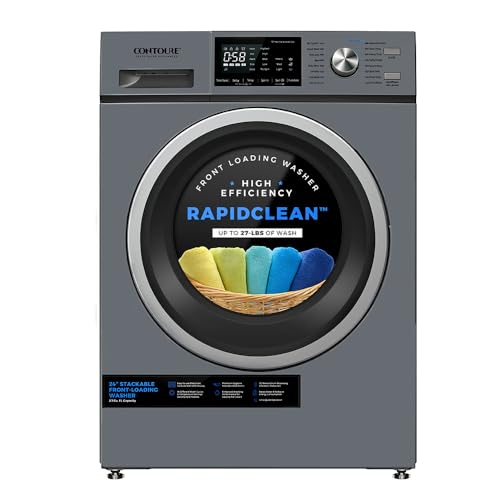
CONTOURE 24-Inch 2.7 Cu. Ft. Stackable Front-Load Washer — Best specified compact
The CONTOURE’s listing reads like a specification sheet, and in the compact category that is a compliment: a 24-inch stackable front-load washer of 2.7 cu. ft., spinning at 1400 RPM, with sixteen wash cycles, five temperature settings, LED touch controls, a stainless steel drum, a high-efficiency design, and the model WH-2700T named outright, in a titanium finish. A 1400 RPM spin is the headline for apartment life, because extraction is destiny indoors: clothes that leave the drum properly spun dry on a rack overnight, while clothes that leave it damp colonise the flat for two days.
Stackability completes the apartment argument. The washer claims its square of floor; the matching dryer claims the air above it; the household keeps the rest of the closet for living. Sixteen cycles and five temperatures give a small household the full grammar of laundry — delicates, cottons, synthetics, the hygiene wash — without a full-size cabinet. The titanium finish will divide taste, but in a machine that may live visibly in a kitchen or bathroom, a considered finish is a legitimate feature rather than a vanity.
- Width stated in the listing: 24 inches
- Capacity stated in the listing: 2.7 cu. ft.
- Spin stated in the listing: 1400 RPM
- Cycles and temperatures stated: 16 cycles, 5 temperature settings
- Model stated in the listing: WH-2700T
- Drum and controls stated: stainless steel drum, LED touch controls, stackable
Strengths
- The fastest stated spin here wrings clothes toward rack-dry in one cycle.
- A complete, printed specification makes measuring and comparing refreshingly direct.
- Stackable format and a full cycle menu bring full-size logic to a compact footprint.
Trade-offs
- Touch controls in a small, possibly steamy room demand dry hands and patience.
- A fast spin punishes unbalanced loads, so loading discipline matters more, not less.
- Titanium is a commitment if the machine will live in plain sight.
Best for: apartment households wanting the most fully specified compact washer in the guide. Not suited for: buyers who prefer physical knobs, or whose loads are mostly bulky bedding.

BLACK+DECKER 2.7 Cu. Ft. Compact Front-Load Washer — Best cycle-rich compact
BLACK+DECKER’s compact keeps its listing short — a front-load washer of 2.7 cu. ft. with an LED display and sixteen cycles — and lets the format argue for itself. Sixteen cycles in a compact drum is the point worth dwelling on: small households do not have small wardrobes’ worth of variety, they have full wardrobes washed in smaller batches, and a compact machine with a full menu treats a silk blouse and a gym kit with the same respect a full-size machine would. The LED display keeps the chosen programme unambiguous, which matters in machines that may live in shared flats where several people operate them.
The 2.7 cu. ft. capacity ties for the largest in this guide, which in compact terms is the difference between washing a set of bed linen in one load and washing it in two. Confirm the cabinet’s width and depth on the product page before ordering — the listing title does not print a width — and plan the same measuring ceremony every compact purchase deserves: space, doorway, and the swing of the machine’s own door, which in a tight alcove is the dimension everyone forgets.
- Capacity stated in the listing: 2.7 cu. ft.
- Cycles stated in the listing: 16
- Display stated in the listing: LED
- Format: compact front-load washer
- Width in the listing title: not stated in the listing title — confirm on the product page
- Price check: open the BLACK+DECKER 2.7 Cu. Ft. Compact Front-Load Washer listing on Amazon
Strengths
- A full sixteen-cycle menu refuses to treat compact owners as second-class laundry citizens.
- Top capacity for the category eases the bedding and towel arithmetic.
- A familiar appliance name simplifies manuals, support, and resale.
Trade-offs
- The title’s brevity leaves dimensions and spin speed to the product page.
- Sixteen cycles invite menu browsing that a five-cycle household may never need.
- Compact drums still cap the largest duvets; measure your bulkiest regular item.
Best for: couples and small households with varied wardrobes in a compact space. Not suited for: buyers who want every dimension confirmed without opening the product page.

KoolMore 24-Inch 2.7 Cu. Ft. Front-Load Washer — Best quick-wash compact
The KoolMore compact leads with time and quiet: a 24-inch front-load washer of 2.7 cu. ft. with a 20-minute quick wash, twelve washing cycles, a quiet inverter motor, standard 120V operation, and the model FLW-3CWH printed in the listing, in white. The quick wash is the feature apartment life actually runs on — the shirt needed tomorrow, the gym kit needed tonight — and twenty minutes respects the reality that compact households wash in the margins of the day. An inverter motor suits the same life: smooth, quiet running in a machine that may stand a wall away from a bed or a desk.
The stated 120V operation deserves emphasis, because compact machines sometimes assume European-style supply or a dedicated circuit. A machine that runs from a standard receptacle widens the map of possible laundry points in older flats considerably — though the circuit should still be checked, as with any washer, and water and drain points remain the true governors of placement. Twelve cycles cover the honest menu; the model number keeps the paperwork future simple.
- Width stated in the listing: 24 inches
- Capacity stated in the listing: 2.7 cu. ft.
- Quick cycle stated in the listing: 20-minute quick wash
- Motor stated in the listing: quiet inverter motor
- Model and power stated: FLW-3CWH, 120V
- Cycles stated in the listing: 12 washing cycles
Strengths
- A genuine 20-minute quick wash matches the little-and-often apartment rhythm.
- Quiet inverter running suits machines living near beds, desks, and neighbours.
- Standard-voltage operation and a printed model simplify installation and ownership.
Trade-offs
- Quick washes are for lightly soiled loads; ground-in dirt still needs a full programme.
- No steam feature, for households that use steam to refresh and sanitise.
- White-only finish, in a category where the machine often lives in view.
Best for: renters and small households whose laundry happens in short, frequent bursts. Not suited for: steam devotees, or anyone washing heavily soiled workwear as the main load.

Midea 24-Inch Compact Front-Load Washer with Steam Care — Best steam compact for families
Midea’s compact states its model, MLH25N7BWW, and its intentions together: a 24-inch, 2.5 cu. ft. front-load washer described as an energy and space-saving machine with steam care and cold wash, stackable, aimed at family daily use, in white. The family framing matters because it is honest about the rhythm required — a 2.5 cu. ft. drum serves a family only in a daily, little-and-often pattern — and steam care gives that pattern a hygiene tool: a steam phase to freshen and help sanitise the loads a family worries about, from baby clothes to the household’s shared towels.
Cold wash is the quiet partner feature. A machine designed to clean well in cold water cuts the largest energy item in washing — heating — out of the daily load entirely, and in a compact household running frequent small loads, that discipline compounds quickly. Stackability keeps the footprint at one square while a dryer takes the vertical. As ever in this guide, the certification question for this model belongs to its product page and the registry; the listing’s own words are energy and space-saving, and we leave them exactly that size.
- Width stated in the listing: 24 inches
- Capacity stated in the listing: 2.5 cu. ft.
- Model stated in the listing: MLH25N7BWW
- Features named in the listing: steam care, cold wash
- Format: stackable compact front-load
- Audience stated in the listing: family daily use
Strengths
- Steam care gives small households a freshening and hygiene tool usually found larger.
- Cold-wash design suits frequent small loads and keeps running costs disciplined.
- Stackable format and a printed model make it a well-documented apartment citizen.
Trade-offs
- At 2.5 cu. ft. it asks families to wash daily rather than in weekend mountains.
- Steam cycles use time and energy; they are a tool, not a default.
- Buyers wanting a stated spin speed will need the product page.
Best for: small families in compact homes who wash daily and value steam. Not suited for: households that save laundry for one giant weekly session.

Kenmore 2.2 Cu. Ft. Compact Front-Load Washer — Best certified compact
The Kenmore compact carries the distinction this batch’s efficiency guide could not offer: its listing states ENERGY STAR Certified in so many words. Around that claim sits a 2.2 cu. ft. compact front-load washer in white with a wrinkle-relaxing steam treatment, Express and Accela Wash cycles for reducing laundry time, and touch controls. For a buyer whose utility offers a rebate, or whose building’s energy rules matter, a certification printed by the listing itself is the shortest path through the verification ritual — though the wise buyer still matches the model on the registry, as a matter of habit rather than doubt.
The 2.2 cu. ft. drum is the smallest class in this guide, and it defines the household: one person, or two disciplined people, washing in a steady trickle. Within that life, the feature set is generous — steam to relax wrinkles out of shirts that will not meet an iron, express cycles for the daily smalls, and the water discipline front-load tumbling already provides. This is the pick for the studio flat, the in-law suite, the downtown pied-à-terre, where the alternative was a laundry bag and a lift ride to a shared basement.
- Capacity stated in the listing: 2.2 cu. ft.
- Certification stated in the listing: ENERGY STAR Certified
- Steam feature named: wrinkle relaxing steam treatment
- Cycles named in the listing: Express, Accela Wash
- Controls stated in the listing: touch controls
- Finish named in the listing: white
Strengths
- A certification stated by the listing simplifies rebates and energy compliance.
- Steam wrinkle care suits small wardrobes of work clothes that skip the iron.
- Express cycles match the solo household’s daily trickle of laundry.
Trade-offs
- The smallest drum class here caps loads firmly at small and often.
- Touch controls are the only interface, which knob loyalists should test in spirit first.
- Families will outgrow it; buy it for the household you have.
Best for: solo dwellers and couples in the smallest spaces who value certified efficiency. Not suited for: families, or anyone whose weekly wash includes bulky bedding in volume.

Avanti 2.2 Cu. Ft. Compact Front-Load Washer — Best flexible-placement compact
Avanti built its name on compact appliances for spaces other makers ignore, and this 2.2 cu. ft. front-load washer states the flexibility plainly: freestanding or stackable, with fifteen wash cycles, an LED display, steam wash, and a stainless steel tub, in white. The placement choice is the headline. A renter who cannot stack today can stand the machine alone; the same machine stacks tomorrow in a different home, which makes it the pick most likely to survive a change of address without being sold.
Fifteen cycles is a full menu at this size, and the stainless tub repeats the longevity argument made elsewhere in this batch: no enamel to chip, no rust spots to threaten light fabrics in year seven. Steam wash adds the freshening tool. Avanti’s compact specialisation also means the machine’s proportions were drawn for alcoves and closets from the first sketch, rather than shrunk from a full-size design as an afterthought — a distinction owners feel in door swings and control heights.
- Capacity stated in the listing: 2.2 cu. ft.
- Placement stated in the listing: freestanding or stackable
- Cycles stated in the listing: 15 wash cycles, LED display
- Features named in the listing: steam wash, stainless steel tub
- Format: compact front-load washer
- Finish named in the listing: white
Strengths
- Freestanding-or-stackable placement adapts to this home and the next one.
- A stainless tub and fifteen cycles give a small machine a long, capable life.
- A compact specialist’s proportions suit genuine alcoves, not just small rooms.
Trade-offs
- The 2.2 cu. ft. class ceiling applies: small loads, steadily, forever.
- Steam and cycle abundance reward users who will actually explore the menu.
- Stacking still needs the maker’s kit and a ceiling check, as with every compact.
Best for: renters and movers who need one machine to fit successive small homes. Not suited for: households whose laundry volume has already outgrown the compact class.
The Compact Field, Measured in Inches and Cycles
| Pick | Drum | Width story | Signature feature from the listing |
|---|---|---|---|
| CONTOURE 24-Inch 2.7 Cu. Ft. Stackable Front-Load Washer | 2.7 cu. ft. | 24-inch, stackable | 1400 RPM spin, 16 cycles, 5 temperatures |
| BLACK+DECKER 2.7 Cu. Ft. Compact Front-Load Washer | 2.7 cu. ft. | Compact; width confirmed on product page | 16 cycles, LED display |
| KoolMore 24-Inch 2.7 Cu. Ft. Front-Load Washer | 2.7 cu. ft. | 24-inch | 20-minute quick wash, quiet inverter motor |
| Midea 24-Inch Compact Front-Load Washer with Steam Care | 2.5 cu. ft. | 24-inch, stackable | Steam care and cold wash |
| Kenmore 2.2 Cu. Ft. Compact Front-Load Washer | 2.2 cu. ft. | Compact | ENERGY STAR Certified per the listing, steam treatment |
| Avanti 2.2 Cu. Ft. Compact Front-Load Washer | 2.2 cu. ft. | Compact, freestanding or stackable | 15 cycles, steam wash, stainless tub |
How Is a Small Front-Loader Different From a Portable Twin-Tub?
The confusion is understandable — both are small, both wash clothes, and marketplaces shelve them together — but the machines are different species. A front-load washer seals its door, fills, tumbles the load through water automatically, drains, rinses, and spins at speed, start to finish, while you do something else. A twin-tub asks you to be the automation: fill the wash tub, agitate, drain, move the clothes by hand to the spinner, spin, and manage rinsing as a separate act. Twin-tubs are cheaper, lighter, and often drain by gravity into a sink, which suits some RV and off-grid lives; what they are not is a small version of the machine in a normal laundry room.
The practical dividing line is the spin and the seal. A front-loader’s high-speed spin leaves clothes ready for a rack; a twin-tub’s spinner is effective but smaller and more manual. A front-loader can be plumbed in and forgotten; a twin-tub usually lives beside a sink it borrows. Choose the twin-tub knowingly, for its portability and price, or choose a machine from this guide for automatic, plumbed, apartment-grade washing — but do not let a listing’s photograph blur the two into one purchase. Households planning an entire small-space laundry corner sometimes extend the same rigour to event seating for guests, where Best Folding Chairs for Churches and Events rewards the same measure-first discipline.
How Do You Install a Compact Washer in a Closet or Kitchen?
Measure three times, in three places: the space itself, the narrowest doorway on the route, and the depth once the door’s swing and the hoses’ bend are accounted for — compact machines fail installations on hose clearance behind the cabinet more often than on width. Confirm the water supply and a drain the machine can reach without stretching, and a receptacle that suits the machine’s stated voltage. In a closet, plan ventilation: a front-loader’s door seal wants air between washes, and a louvered or ajar closet door is part of the appliance whether the brochure says so or not.
Levelling matters doubly in small spaces, because a compact machine on an upper floor announces its spin to the neighbours below. Level carefully, consider anti-vibration pads — the accessories reviewed in this batch’s balance guide fit compact feet too — and run the first empty cycle while watching every connection. In a kitchen installation, add a leak pan under the machine where local practice or a landlord requires one; the pan costs little and converts a potential flood into a mop’s worth of evidence that something needs attention.
What Laundry Rhythm Suits a 2.2 to 2.7 Cu. Ft. Drum?
Little and often is not a compromise here; it is the design’s native rhythm. A load every day or two keeps the drum in its sweet spot, dries on one rack’s worth of space, and never becomes the weekend mountain that makes laundry feel like a second job. Sort into two streams — the everyday load and the careful load — and let the quick cycles handle the first while the full programmes take the second. Bedding day is the exception to plan: a duvet cover alone, sheets in the next load, towels in a third, sequenced across a morning rather than forced into a single heroic cycle.
Drying is the rhythm’s second half, and in compact homes it is usually air. Spin speed is therefore a purchasing feature, not a statistic — the CONTOURE’s stated 1400 RPM exists for rack life. Hang with air on both sides, turn heavy items once, and keep a small fan’s worth of moving air in mind for humid flats. The household that masters this rhythm stops missing the big machine it could not fit, because the laundry simply never accumulates enough to miss it with.
Living With a Compact Washer in a Shared Flat
A compact machine in a shared home is a social appliance, and its success is negotiated as much as it is plumbed. Agree the house rhythm early: whose loads run when, how the end of a cycle is signalled so wet laundry never sits forgotten in the drum, and whose detergent lives beside the machine. The small drum actually helps the diplomacy — loads are personal-sized, so nobody’s week of laundry monopolises the machine for an evening, and the quick cycles turn over fast enough that a queue rarely forms. What does cause friction is the drying rack, which in a small flat is shared territory; a household that assigns rack space by load, and clears it promptly, will never have the argument that actually ends flatshares’ laundry peace.
Noise etiquette belongs in the same conversation. A compact machine’s spin, heard through a thin wall at midnight, is a diplomatic incident; the same spin at seven in the evening is housekeeping. Inverter-motor quietness, anti-vibration pads, and a house rule about late cycles together keep the machine a good neighbour. None of this appears on a specification sheet, and all of it decides whether the machine is still loved in month six.
The Baby-Clothes Question in a Small Drum
New parents in small flats ask a specific question of this category: can a compact machine serve the extraordinary laundry of a baby’s first year? The honest answer is that the rhythm fits beautifully and the volume needs planning. Baby laundry is small, frequent, and urgent — exactly the compact drum’s native pattern — and steam-equipped picks like the Midea and the Kenmore give parents a hygiene tool for the loads they worry about most. The planning lies in the parents’ own laundry, which must now share the drum’s calendar: a household wash rota that once ran twice a week becomes a daily smalls service with adult loads slotted deliberately around it.
Detergent choice matters more than machine choice in this chapter — a formula suited to infant skin, dosed exactly, with an extra rinse for the baby’s stream of laundry. And the drying rack becomes critical infrastructure: a second rack, bought before it is needed, is the cheapest sanity a compact-laundry nursery can purchase. Families who accept the rhythm find the small machine an ally; families who fight it with weekend mountains will blame the drum for an argument that was really with the calendar.
Moving House With a Compact Machine
Compact washers change address more often than their full-size cousins, because their owners are renters and renters move. Prepare the machine like the precision object it is: run a drain and spin so no water travels with it, fit the transit bolts if the maker supplied them — they protect the drum’s suspension in a van the way they did on its first journey — and photograph the hose connections before disconnecting anything, so the new installation is a reassembly rather than a puzzle. At the new home, repeat the levelling ceremony in full; a floor is never the same twice, and a machine levelled by memory is a machine preparing its first complaint.
The Avanti’s freestanding-or-stackable flexibility earns its keep precisely here, and so does every printed model number in this guide, because manuals for a machine bought years ago are findable in minutes when the model is known. Keep the transit bolts in a bag taped to the machine’s back — the traditional place, and the only one where they are ever found again.
What the Neighbours Below Need You to Know About Spin
In flats, a washer’s spin cycle is a broadcast, and the audience did not subscribe. Structure carries vibration faithfully: a machine standing mid-span on a timber floor will introduce itself to the ceiling below with every load. The mitigations are layered and mostly cheap. Site the machine over a supporting wall or joist line where the room allows it. Level it with genuine care. Fit anti-vibration pads, which compact feet accept as readily as full-size ones. Prefer the machine whose running character is quiet — the inverter-motor KoolMore makes its case here — and schedule the spin-heavy loads for sociable hours. A compact machine chosen and sited with its neighbours in mind is the difference between laundry as a private routine and laundry as a building-wide event, and in a small flat that difference is the whole purchase.
The Second-Hand and Landlord Angles on Compact Machines
Compact front-loaders circulate briskly in the second-hand market, because their owners move and upgrade, and a careful buyer can do well. Inspect as you would any front-loader — seal condition, drum play, a full test cycle including the spin — and add the compact-specific checks: the stacking kit’s presence if you intend to stack, the transit bolts if you intend to move it, and the exact dimensions against your space, since a bargain that does not fit is not a bargain. A printed model, which most picks here offer, turns the manual and parts search from archaeology into an errand.
Landlords furnishing small units should think in the Avanti and Kenmore direction: machines whose placement flexibility and stated credentials simplify both installation and the listing’s description of the flat. Tenants judge a small flat by whether its laundry works without a weekly expedition, and a compact machine that simply performs is an argument for renewing the lease. Fit a leak pan, leave the manual in the unit, and write the house’s cycle guidance inside a cupboard door — small kindnesses that return as careful tenants.
Energy and Water in a Small Drum: The Quiet Arithmetic
Front-load tumbling already sips water compared with filling a top-load tub, and a compact drum multiplies the discipline: smaller loads, smaller fills, and — on cold-wash designs like the Midea’s — a smaller heating bill attached to each. The household-level truth is that frequency cuts both ways. A compact machine run daily on half loads can spend more across a week than a full-size machine run twice on full ones, which is why this guide keeps returning to the rhythm: full-for-its-size loads, steadily, are what make the small drum’s arithmetic sing. The Kenmore’s stated certification gives one pick a documented figure to stand on; for the others, the honest method is the registry check by model, exactly as this batch’s efficiency guide taught.
There is also the building’s arithmetic to consider. In flats where water pressure sags at peak hours, a compact machine’s modest fills are a practical mercy, finishing cycles that a thirstier machine would stretch. In homes on septic systems, the small drum’s restraint is a genuine infrastructure kindness. Compact efficiency is not a slogan; it is the sum of a drum that fits the household, a rhythm that fills it, and water that was never heated, pumped, or drained without doing work on its way through.
Wardrobe Strategy for a Small Drum
A compact washer quietly edits its owner’s wardrobe, and the households that thrive with one make the edit deliberately. Fabrics that wash and dry quickly — modern synthetics, merino, linen in summer — rotate through a small drum gracefully, while a wardrobe of heavy denim and chunky cotton knits fights it weekly. Nobody should replace a wardrobe for a washing machine, but when buying clothes anyway, the compact household learns to glance at the care label with new respect: quick-drying, crease-resistant pieces are worth a premium to the person whose drying rack is also the hallway.
The same logic governs bedding and towels, the drum’s sternest examiners. Two lighter sets rotated frequently beat one luxurious, massive set that needs a launderette to wash. Guest linen can be the household’s one planned exception — washed before guests arrive in a sequenced morning of small loads, rather than in a panic the night before. Own the rhythm, and the small drum stops feeling like a compromise and starts feeling like a system that happens to fit in a closet.
The First Month: Calibrating Loads, Detergent, and Expectations
Every compact machine has a learning month, and households that treat it as calibration rather than verdict end it converted. Week one teaches load size: what a full-for-this-drum load actually looks like, which is less than instinct suggests — clothes should tumble freely, with visible space at the top of the drum when the door closes. Week two teaches detergent: front-loaders want measured, low-sudsing doses, and a compact drum overdosed by habit will prove it with residue and extra rinses until the hand learns the smaller measure. Week three teaches the cycle menu — which programmes the household genuinely lives on, usually three, with the rest in reserve. Week four teaches drying: which items dry overnight on the rack, which need the fan, and which should be scheduled for a breezy day.
Keep the manual open on top of the machine for that month, literally, and let everyone in the household run the calibration together. The machine that emerges from a shared learning month is a household appliance; the machine judged on its first load by one sceptical person is a return waiting for its paperwork. Small front-loaders reward patience out of all proportion to their size.
When Small Is Not Small Enough — and When It Is Too Small
Honesty about the category’s edges serves buyers better than enthusiasm. If your space cannot offer water, drainage, and a level floor, no compact washer will save it, and the honest alternatives are a laundry service, a shared facility, or the hand-washing world of this batch’s first guide. If your household is five people with a sports habit, a compact drum as the only machine will lose its argument with the calendar within a month, and the money belongs in a full-size machine and a room rearranged to fit it. Both edges are real, and naming them protects the large middle where these machines genuinely excel.
That middle is bigger than sceptics think: singles, couples, small families in rhythm, second laundry points for grime and delicates, in-law suites, staff flats, and the growing class of households that simply prefer laundry as a daily trickle to laundry as a weekly event. If you live in that middle, the only remaining question is which of the six above matches your space’s measurements and your wardrobe’s habits — and by now you have the tape measure, the rhythm, and the claims discipline to answer it.
Accessories That Earn Their Space Beside a Compact Washer
Small homes cannot afford passengers, so every accessory must justify itself. Three do. A collapsible laundry basket, which is furniture when needed and nothing when stored, solves the carry between drum and rack. A second, folding drying rack doubles the household’s drying capacity for bedding day and then vanishes behind a door. And a set of anti-vibration pads — borrowed from this batch’s balance coverage — protects both the floor and the neighbours’ ceiling for the price of a pizza. A leak pan earns its place in any above-ground-floor installation, and a simple mesh bag set protects delicates and corrals the socks that small drums otherwise distribute mysteriously around the household. Everything else marketed at compact owners should be asked a harder question than it is used to: the space it wants is the scarcest resource in the home it would serve.
A Studio Flat, a Hallway Closet, and a Kitchen Run: Three Fits Worked Through
The studio flat has one room and no illusions: the washer lives under the kitchen counter or in the bathroom, its cycles share air with its owner’s life, and quiet running plus a fast spin are the features that matter — the KoolMore’s pattern, or the CONTOURE’s extraction. The hallway closet is the classic conversion: width exactly the machine’s, depth consumed by hoses and door swing, ventilation solved by a louvered door, and stacking the only way a dryer joins the household — the CONTOURE, Midea, or Avanti pattern, with the kit bought alongside, not after. The kitchen run is the family compromise: the machine under a worktop, plumbed beside the dishwasher’s services, its door opening into the room’s traffic, where a considered finish and a display everyone can read — the BLACK+DECKER pattern — turn an appliance into a citizen of the room. Three rooms, three different right answers, one shared method: measure, match, and only then fall for a feature list.
Winter, Humidity, and the Indoor Drying Season
Compact laundry meets its sternest season when the weather closes in and every load must dry indoors. The households that cope best treat winter as a scheduling problem: wash earlier in the day so the rack gets the room’s warmest hours, spin at the machine’s best extraction, and rotate the rack’s contents once so the sheltered middle items get their turn in the airflow. A small dehumidifier in a closed room transforms the equation where damp is a building problem as well as a laundry one — it serves the walls, the windows, and the wardrobe at once. And the winter wardrobe itself can cooperate: this is the season when the quick-drying fabrics praised earlier stop being a preference and become the household’s peace treaty with its own closet-sized laundry.
The Guest Test: When Visitors Meet the Small Drum
Guests reveal a compact household’s true capacity. A visiting couple adds a second household’s rhythm to a drum calibrated for one, and the homes that handle it gracefully have usually planned the surge rather than improvising it: guests’ towels on a dedicated rotation, the hosts’ own laundry paused or pre-washed before arrival, and the launderette option stated cheerfully in advance for the duvet-scale items. None of this is hardship; it is the same little-and-often logic with a second metronome added. And there is a quiet satisfaction available here that full-size owners never taste — the guest who watches a complete laundry service emerge from a hallway closet tends to leave with their assumptions about small homes permanently rearranged.
A Note on Detergent Pods, Sheets, and Small Drums
Compact drums expose dosing formats honestly. A pod formulated for a full-size load can overdose a 2.2 cu. ft. drum washing half that weight, leaving residue that no rinse in a small machine can fully clear; sheets and liquids, which divide and measure gracefully, suit the compact rhythm better. Whatever the format, the rule is the drum’s, not the package’s: dose for the load in front of you, at the measure the machine’s manual blesses, and let the small drum’s whole philosophy — proportion — govern the chemistry as it governs everything else in this guide.
The Sound of a Small Machine in a Small Home
One quality-of-life thread runs through every section above and deserves its own paragraph before the verdicts: in a compact home, the washer is a roommate. Its fill, its tumble, and above all its spin share the air with work calls, naps, and neighbours. That is why this guide weighted quiet motors, honest levelling, and extraction that finishes the job in one confident spin rather than two complaining ones. Judge your finalist by imagining its worst moment — a full spin, a quiet evening, a thin wall — and buy the machine whose worst moment your household can live with happily, because in a small home you will hear that moment several times a week for years.
Compact Washer Mistakes That End in Returns
The returns desk knows this list by heart. Buying by capacity alone and never measuring the doorway. Forgetting that a front-load door swings toward the user and needs its arc. Stacking without the maker’s kit, or stacking under a ceiling that leaves no room to load the dryer. Ignoring the drain: a compact machine still produces a full machine’s worth of water and needs somewhere honest for it to go. And the quietest mistake — buying a 2.2 cu. ft. drum for a household of five and calling the machine disappointing, when the disappointment was arithmetic. Readers applying the same fit-first thinking to a work corner will find Best Ergonomic Saddle Chairs makes the analogous case for seating that matches the body and the desk.
Final Recommendation
Take the CONTOURE if you want the compact category’s fullest specification and fastest stated spin. Take the BLACK+DECKER for a full cycle menu at the category’s joint-largest capacity, the KoolMore for quick washes and quiet running on a standard receptacle, and the Midea when steam and cold-wash discipline serve a small family’s daily rhythm. Take the Kenmore when a stated certification matters to your rebate or your building, and the Avanti when your next home’s laundry corner is still unknown and the machine must adapt to it.
One last encouragement for the hesitant: the compact owners who write the warmest accounts of their machines are rarely the ones with the most features. They are the ones whose machine fits the alcove exactly, whose rhythm settled in the first month, and whose laundry stopped being an expedition. Fit and rhythm are available at every tier in this guide, which is why the right answer here is so often the honest size rather than the longest specification.
Whichever compact you choose, measure like a surveyor and wash like a metronome — little, often, and never forced — because a small front-loader rewards the household that treats its size as a rhythm to keep rather than a limit to fight.
Frequently Asked Questions
Can a 2.7 cu. ft. washer handle a queen duvet?
A duvet cover, usually yes; a thick duvet itself, cautiously and alone, if it fits without forcing the door — and forcing is the operative word, because a drum packed solid cannot tumble and will wash unevenly. Many compact households keep one launderette visit a season for the bulkiest items and let the home machine do everything else, which is a sensible division rather than a defeat.
Do compact front-loaders need special plumbing?
They need the same things any washer needs — a water supply, a drain, and a suitable receptacle — in smaller clearances. Most connect to standard fittings, and some, like the KoolMore here, state standard 120V operation. What they cannot forgive is a missing drain or a stretched hose run, so plan the services before the machine, not after it.
Is stacking a compact dryer on top safe?
Yes, with the manufacturer’s stacking kit for the specific models, a level floor, and ceiling clearance for loading the dryer comfortably. Never improvise the connection with generic brackets or straps. If the stack will stand on an upper floor, anti-vibration pads under the washer’s feet are a kindness to everyone below.
Why do compact washers cost as much as full-size ones?
Because the engineering is the same and the production runs are smaller. A sealed door, a suspension, a pump, and a control system cost what they cost at either size, and miniaturising them into a 24-inch cabinet is its own expense. You are paying for the space the machine does not take — which, in a city flat, is the most valuable feature on the list.
How do I keep a compact front-loader smelling fresh?
The front-load liturgy applies at every size: wipe the door seal’s fold after washes, leave the door ajar between loads, dose detergent by measure rather than enthusiasm, and run the machine’s cleaning cycle on schedule. Small drums forgive nothing about residue because there is less air and less water in their world, so the habits matter more, not less.
What clearance does a compact washer need around it?
Enough for hoses to bend without kinking behind the cabinet, for the door to swing fully, and for air to reach the seal between washes — in practice, a few centimetres behind and above, and a door arc kept clear in front. The exact figures belong to your model’s installation sheet, which is why this guide keeps sending you to it: in compact installations, the manual’s clearances are not bureaucracy, they are the difference between a machine that serves and one that chafes.
Can these machines go in an RV or a boat?
Some compact models serve RV and marine lives, but it depends on the specific machine’s installation requirements, the vehicle’s water and power systems, and securing the machine against motion — none of which should be assumed from this guide. Check the exact model’s documentation for any such approval, and treat a plumbed home installation as the default these picks were chosen for.
Related Guides
And keep the installation sheet after the fit is done. Compact machines get moved, re-stacked, and re-homed more than any other appliance in this batch, and the sheet with the clearances and the kit’s name is the document your future self — or the machine’s next owner — will be grateful you filed.
Before you order, do the guide’s closing ritual: stand in the space with a tape measure, read its three dimensions aloud, and say your household’s weekly rhythm aloud after them. If the two sentences sound compatible, they are — and the machine that fits both is already on this page, waiting for its closet.
For the wider field of compact machines built for apartment life, continue to Best Compact Clothes Washers for Apartments, which broadens the search beyond the front-load format.


[…] pick suits. Readers whose space, rather than budget, is the binding constraint should detour to Best Small Front-Load Washers, where the same cost-per-year logic is applied to compact 24-inch […]