What's inside
- Key Takeaways
- Quick Picks
- What Did “Simple” Have to Mean Before a Dryer Could Appear Here?
- Five Dryers, One Table: Capacity Against Character
- What Does a Gas Dryer Installation Actually Require?
- Gas or Electric: Which Fuel Suits a Simplicity Buyer?
- How Did Sensor Drying Become the Simple Choice?
- What Does a Week With a Gas Dryer Actually Look Like?
- What Washer Deserves to Stand Next to a Simple Gas Dryer?
- Which Gas Dryer Mistakes Cost Money or Worse?
- Final Recommendation
- Frequently Asked Questions
- Related Guides
As an Amazon Associate I earn from qualifying purchases. This post may contain affiliate links at no extra cost to you.
cottageverdict.com is reader-supported. When you buy through links on our site, we may earn an affiliate commission.
Where to buy: the five linked dryers below are sold on Amazon under their listing names, and the sixth pick is a prose-only route to the most basic gas dryers on the market, sold through appliance dealers rather than this pool; check price on Amazon for the linked five once you have confirmed the two things gas demands before any brand decision — a gas line where the dryer will stand, and a vent path out of the building.
The best simple gas dryers are bought by people who have looked at a modern dryer control panel — a glowing menu of steam refreshes, downloadable cycles and app notifications — and felt their blood pressure rise. They want a machine that dries clothes, offers a handful of sensible cycles, and can be operated by a visiting grandparent without a tutorial. This guide is for them, and it starts with an honesty the category avoids: a truly bare-bones gas dryer, all mechanical knobs and a timed dial, is now rare in new full-size machines. Even the simplest current models usually include sensor drying, because the sensor is cheap, saves energy, and prevents the cooked-clothes results that timed drying produces.
So “simple” in this guide means something precise: few smart features, no app, no Wi-Fi pairing ritual, direct controls, and a cycle list you can memorise. Four of the five linked machines state sensor drying in their titles, and we treat that as compatible with simplicity rather than a betrayal of it — a sensor is invisible in daily use, quietly ending the cycle when the load is dry instead of when a timer guesses. What these machines leave out is the connectivity layer and the twenty-cycle menu, and what they keep is the reason people choose gas in the first place: fast heat, gentle handling of big loads, and running costs that reward households who dry often.
Gas also carries the one serious paragraph in this guide, and it comes before any pick. A gas dryer must be connected to a gas supply by a licensed professional in most jurisdictions, it must be vented to the outside, and the room needs the clearances the manual specifies. This is not a DIY appliance swap in the way an electric dryer can be. Budget the installation into the purchase, use a permitted installer, and treat any listing copy that makes gas hookup sound casual as a reason to slow down. With that settled, the five machines below — plus the prose-only basic lines — are the straightforward end of the gas market, graded on how little they ask of you.
Key Takeaways
- “Simple” now means few connected features and direct controls — even basic new gas dryers usually include sensor drying, and that is a good thing.
- Gas installation is professional work: a licensed connection, a proper vent run, and manual-specified clearances come before brand choice.
- Every linked pick here is a front-load gas dryer between 6.7 and 7.5 cu. ft. — full family size, no compact compromises.
- Sensor dry appears in four of the five linked titles; the GE instead leads with Extended Tumble and an unusually long rated vent run.
- Wrinkle care features — Wrinkle Guard, Wrinkle Care, Extended Tumble — are the quiet heroes of simple dryers, rescuing loads you forget to unload.
- The most basic gas lines of all, from Amana and Roper, are covered prose-only: they are bought through dealers, and their appeal is a short feature list at the value end of the market.
- A gas dryer still runs its motor and controls on an ordinary household outlet — it is the gas line, not the electrics, that requires the licensed professional.
Quick Picks
| Dryer | Badge | Why it earns its place |
|---|---|---|
| Kenmore 7.0 Cu. Ft. Gas Dryer | The balanced household pick | Smart Sensor Drying with Wrinkle Guard on a 7.0 cu. ft. front-load frame — the modern basics, done without a connectivity layer. |
| Samsung 7.5 Cu. Ft. Gas Dryer with Sensor Dry | The big-drum straightforward choice | The largest drum among the linked five, a named Sensor Dry system, and a model-number listing that keeps the specification plain. |
| GE 7.2 Cu. Ft. Gas Dryer with Extended Tumble | The long-vent problem solver | Rated for venting up to 120 ft. with an Extended Tumble that keeps a finished load moving — built for awkward laundry-room geography. |
| Midea 6.7 Cu. Ft. Gas Dryer with Sensor Dry | The easy-panel value pick | Twelve cycles, sensor dry, Wrinkle Care and Air Fluff behind what the listing itself calls an easy-using control panel. |
| Samsung 7.4 Cu. Ft. Gas Dryer with Sensor Dry | The proven second Samsung | A 7.4 cu. ft. drum and Sensor Dry from the same family as the 7.5 — the alternative if the larger model’s fit or finish misses. |
| Basic Gas Dryer Lines from Amana and Roper (prose-only) | The truly bare-bones route | Dealer-sold entry lines whose entire pitch is a short cycle list and mechanical straightforwardness — described in words below, with no link, because no verified listing for them sits in this guide’s pool. |
What Did “Simple” Have to Mean Before a Dryer Could Appear Here?
We set three tests. First, the control experience had to be direct: select a cycle, select a temperature, press start — with touch controls acceptable and app control disqualifying. Second, the feature list had to be short enough to summarise in one breath; a dryer with a dozen cycles passes, a dryer with downloadable cycles does not. Third, the machine had to be a genuine full-size gas dryer, because the simplicity buyer is usually replacing a full-size machine and should not be quietly downsized. Homes whose laundry room cannot take gas at all are a different shopping trip entirely — the ventless route in Best Ventless Clothes Dryers covers the no-duct, no-gas corner of the market.
Within those tests we let the titles speak. Sensor drying appears in title after title, and we made peace with it for a practical reason: a moisture sensor is the one “smart” feature that reduces user decisions instead of adding them. It removes the guess-the-minutes ritual and the second cycle for the still-damp load. What we screened out was the layer above that — connectivity, cycle libraries, steam plumbing — none of which appears in any linked title below. Where a title does not state a feature, the review says so; gas dryer listings vary by production run, and the page in front of you at purchase time is the authority.
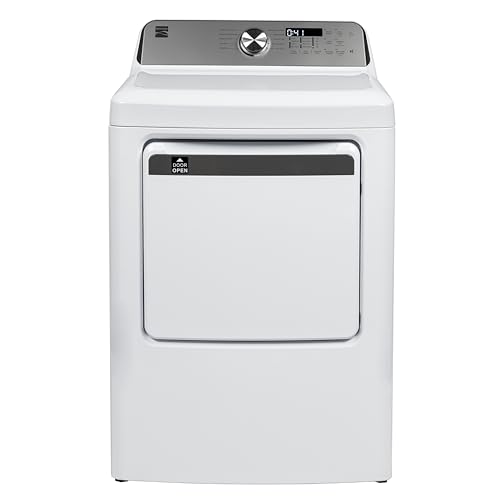
Kenmore 7.0 Cu. Ft. Gas Dryer — The balanced household pick
Kenmore’s 7.0 cu. ft. gas dryer is the machine in this guide that most plainly embodies the modern meaning of simple: the title offers exactly three ideas — Wrinkle Guard, Smart Sensor Drying, and touch controls — and each of them is a feature that reduces work rather than advertising range. Sensor drying ends cycles when the load is actually dry. Wrinkle Guard keeps the finished load tumbling intermittently so the shirts you forgot do not set into creases. Touch controls, on a machine with a short cycle list, are a flat panel you wipe clean, not a menu you study.
The 7.0 cu. ft. drum is the size a family actually needs: large enough for a week of towels or a set of bedding, small enough that a half-load does not rattle around wasting gas. Kenmore’s long history in laundry matters here in a specific way — this is a brand whose dryers are bought by people replacing a dryer, often a Kenmore, that ran for a very long time, and the design language of this model respects that buyer. Nothing in the title reaches for a lifestyle claim. It dries, it guards wrinkles, it senses moisture, and it stops.
There is a fitting argument for this size, too. A 7.0 cu. ft. drum pairs naturally with the 4.5–5 cu. ft. washers most households already own: the dryer should be at least as roomy as the washer feeding it, because wet clothes expand and need tumbling space, and 7.0 clears that bar for the mainstream washer sizes without spilling into the oversized cabinets that complicate tight laundry rooms. It is the pick in this guide that asks the fewest follow-up questions — about fit, about capacity, about features — and for a replacement purchase made under time pressure, that quietness is a specification in itself.
One honest note on the sensor: “Smart Sensor Drying” in a title tells you the machine measures the load rather than the clock, but the title does not enumerate cycles, temperatures or a venting specification, and those details live on the product page and in the manual. Read them there before ordering, particularly the venting requirements, because every gas dryer in this guide shares the same non-negotiable installation story — licensed gas connection, ducted vent, clearances respected.
- Drum: 7.0 cu. ft., front-load gas dryer, white
- Drying method per the title: Smart Sensor Drying
- End-of-cycle care: Wrinkle Guard, to reduce wrinkles and static
- Controls: touch controls, per the listing title
- Cycle count: not stated in the listing title — confirm on the product page
- Where to buy: the Kenmore 7.0 Cu. Ft. Gas Dryer listing on Amazon — check price on Amazon
Strengths
- The feature trio — sensor, wrinkle guard, touch panel — is exactly the modern basics with nothing ornamental.
- A 7.0 cu. ft. drum is the family-size sweet spot for bedding and towel loads.
- Static reduction in the Wrinkle Guard pitch suits synthetic-heavy wardrobes.
Trade-offs
- The title leaves cycle count and venting figures to the product page.
- Touch controls are wipe-clean but give no tactile dial for gloved or wet hands.
- No steam or refresh program is claimed, for buyers who rely on one.
Best for: households replacing a long-serving dryer with its modern equivalent and no learning curve. Not the right match for: buyers who want a published cycle menu in the listing itself, or who need steam refresh for a wardrobe of suits.

Samsung 7.5 Cu. Ft. Gas Dryer with Sensor Dry — The big-drum straightforward choice
At 7.5 cu. ft., this Samsung is the largest drum among the linked picks, and its listing is correspondingly plain: front-load gas dryer, Sensor Dry, white, model DVG45T6000W/A3. There is a kind of confidence in a title that leads with a model number. It says the machine is a known quantity in a known series, the sort of appliance a service technician has seen before and a parts catalogue stocks for — an underrated virtue in a category where a dryer is expected to serve for a decade or more.
Sensor Dry is Samsung’s name for its moisture-sensing system, and on a drum this size it earns its keep in a particular way: big drums invite big loads, and big loads are where timed drying fails most expensively, with a dry shell of clothes wrapped around a damp core. A sensor ends that guessing. The extra half cubic foot over the Kenmore also changes what fits — a king comforter that must be wrestled into a 7.0 drum tumbles freely in a 7.5, and free tumbling is drying quality, because airflow through the load is the whole mechanism.
Size also changes the economics of partial loads in a way worth planning around. A 7.5 cu. ft. drum run half-empty still heats the whole cabinet, so the household that buys this machine should let its laundry accumulate into fewer, fuller loads — which big-drum owners generally find easy, since the machine forgives a week’s towels in one pass. The household rhythm and the appliance genuinely fit each other here: volume in, volume out, and a sensor standing guard over the difference between dry and merely hot.
The counterweight is footprint discipline: a 7.5 cu. ft. cabinet needs its laundry room measured, door swing included, and the gas and vent connections planned behind it. The title states no wrinkle-care feature and no cycle count, so the page carries those answers; what the title promises is capacity plus sensing, and for the household whose laundry problem is volume rather than variety, that is the right promise.
- Drum: 7.5 cu. ft., front-load gas dryer, white
- Model: DVG45T6000W/A3, per the listing title
- Drying method named in the title: Sensor Dry
- Wrinkle-care program: none stated in the listing title
- Cycle count: the listing title does not state one
- Where to buy: the Samsung 7.5 Cu. Ft. Gas Dryer with Sensor Dry listing on Amazon — check price on Amazon
Strengths
- The biggest drum here makes bulky bedding a one-load job.
- Sensor Dry protects those big loads from the damp-core failure of timed cycles.
- A mainstream model number bodes well for parts and service familiarity.
Trade-offs
- No wrinkle-guard style feature is named in the title.
- The larger cabinet demands careful measurement of the laundry space.
- Buyers wanting an itemised cycle list must get it from the product page.
Best for: large households and bedding-heavy laundry, where drum volume is the simplicity that matters. Not the right match for: tight laundry closets, or anyone whose must-have list starts with an end-of-cycle wrinkle program.

GE 7.2 Cu. Ft. Gas Dryer with Extended Tumble — The long-vent problem solver
Every dryer guide buries the venting problem; this GE’s title leads with it. “Up to 120 ft. venting” is the most practically important phrase in this entire article for a specific and common household: the one whose laundry room sits in the middle of the house, or in a basement whose vent route bends around the architecture, so the duct run is long and the dryer at the end of it must still push moist air all the way out. A dryer not rated for the run dries slowly, lints its duct, and ages early. A dryer rated for 120 feet treats that house as normal.
Long vent runs deserve one more piece of arithmetic, because the rating is a ceiling and not a target. Every bend in a duct run costs effective length — the manual for any dryer will tell you how its maker counts an elbow — so a route that measures 90 feet on the tape with four bends may already be living at the edge of a 120 ft. rating. The practical responses are boring and effective: straighten the route where the house allows, keep the duct in smooth metal rather than crushed flex, and clean it on schedule. A dryer rated generously, vented carefully, dries like a dryer next to an exterior wall — which is the entire promise of this pick, kept by installation discipline rather than by the badge.
The second title feature, Extended Tumble, is GE’s answer to the forgotten load: after the cycle ends, the drum keeps turning the clothes at intervals without heat, so a load finished at breakfast is still presentable when someone remembers it at lunch. It is the same philosophy as Kenmore’s Wrinkle Guard expressed in plainer words, and for the simplicity buyer it may be the most-used feature on the machine, because it forgives the most common laundry sin there is.
Note what the title does not claim: no sensor system is named. That does not prove the machine lacks moisture sensing — titles are summaries, not manuals — but it means a buyer for whom sensor drying is a requirement should verify it on the product page rather than assume it. What is certain from the title is a 7.2 cu. ft. white gas dryer, model GTD48GASWWB, specified around venting reach and end-of-cycle care, and for the mid-house laundry room that specification is rarer and more valuable than another three cycles would be.
- Drum: 7.2 cu. ft. gas dryer, white
- Model: GTD48GASWWB, per the listing title
- Venting: rated up to 120 ft., per the listing title
- End-of-cycle care: Extended Tumble, per the listing title
- Sensor system: not named in the listing title — verify on the product page if it is a requirement
- Where to buy: the GE 7.2 Cu. Ft. Gas Dryer with Extended Tumble listing on Amazon — check price on Amazon
Strengths
- The 120 ft. venting rating solves the mid-house and long-basement duct run.
- Extended Tumble forgives forgotten loads without reheating them.
- A 7.2 cu. ft. drum sits comfortably in family-size territory.
Trade-offs
- Sensor drying is not stated in the title, so it must be confirmed before purchase.
- Long vent runs still need periodic duct cleaning to hold their performance.
- The feature story is installation-led; cycle variety is not its pitch.
Best for: homes with long or bent vent routes, and chronic load-forgetters. Not the right match for: buyers who want sensor drying confirmed in the listing headline, or whose vent run is short enough that the rating buys them nothing.

Midea 6.7 Cu. Ft. Gas Dryer with Sensor Dry — The easy-panel value pick
Midea’s listing uses a phrase the rest of the industry should steal: “Easy-Using Control Panel.” It is an unglamorous promise and exactly the one this category exists for. Around it, the 6.7 cu. ft. gas dryer (model MLTG37N1BWW) assembles a sensible dozen: 12 total cycles, auto sensor dry, Wrinkle Care, and Air Fluff. Twelve cycles sounds like a lot until you lay them out — they are the standard wardrobe map of normals, heavies, delicates, towels and timed options — and the panel’s job is to make that map legible at a glance, which the listing explicitly claims it does.
Air Fluff deserves its sentence, because it is the cycle simplicity buyers actually use weekly: a no-heat tumble that shakes dust and staleness out of pillows, throws, and clothes that sat in a drawer too long, without cooking anything. Wrinkle Care is the familiar end-of-cycle insurance. The drum, at 6.7 cu. ft., is the smallest of the linked five — still a full-size dryer by any honest measure, suited to couples and small families, and a touch easier to fit into older laundry spaces built when drums were smaller.
The smaller drum has one more everyday consequence that cuts in the buyer’s favour: it heats its working volume quickly and suits the cadence of smaller households, where a dryer that demands a mountain before it runs efficiently becomes a reason to postpone laundry. Couples who wash twice a week in moderate loads will find 6.7 cu. ft. unremarkable in the best sense — everything fits, nothing waits. It is only the bedding calendar that tests it, and even there, a queen set fits; it is the king comforter that should be measured against the drum before purchase day rather than argued with afterwards.
Midea’s position in the market is the value tier, and the honest reading of this pick is that it competes by completeness rather than by brand gravity: sensor, wrinkle care, air fluff and a dozen cycles in the group’s smallest drum. Buyers cross-shopping it against the Samsungs are trading a little capacity and a lot of badge for a panel designed to be understood in one look — a trade the simplicity buyer should recognise as being on their side of the argument.
- Drum: 6.7 cu. ft. gas dryer, white
- Model: MLTG37N1BWW, per the listing title
- Cycles: 12 total cycles, per the listing title
- Drying method named in the title: Auto Sensor Dry
- Named programs: Wrinkle Care, Air Fluff; control panel described in the title as easy-using
- Where to buy: the Midea 6.7 Cu. Ft. Gas Dryer with Sensor Dry listing on Amazon — check price on Amazon
Strengths
- The control panel is designed and described for immediate comprehension.
- Air Fluff adds a genuinely weekly no-heat cycle for pillows and stored clothes.
- Sensor dry and Wrinkle Care complete the modern-basics set at the value end.
Trade-offs
- At 6.7 cu. ft. it is the smallest drum among the linked picks.
- Twelve cycles is the longest list here, even if the panel organises it well.
- King bedding will be a snug, slower load than in the 7.5 cu. ft. Samsung.
Best for: couples and small families who want the full basic feature set behind the friendliest panel. Not the right match for: households whose laundry is defined by oversized bedding, or badge-first buyers.

Samsung 7.4 Cu. Ft. Gas Dryer with Sensor Dry — The proven second Samsung
Two Samsungs in a five-machine guide needs a word of justification, and here it is: they are not the same machine wearing two badges. This one — the DVG50R5200W, at 7.4 cu. ft. — sits a rung above the 7.5’s series in Samsung’s line, and its title is the shortest in the guide: capacity, Sensor Dry, colour, done. For the simplicity buyer, that brevity is information. This is a dryer whose pitch is that the essentials are handled, and whose listing trusts you to know what a gas dryer is for.
In practical terms the 7.4 and 7.5 are near-neighbours in capacity, and the choice between them comes down to the details the titles do not carry — cycle lists, drum materials, venting options, and the current page specification of each model. We include both because gas dryers are long-lived, room-specific purchases: when one model’s dimensions or vent exit position fights your laundry room, having a second, nearly equivalent machine from the same maker already vetted saves the whole search from restarting. Measure your space, read both pages, and let the room decide.
There is a resale-and-service angle to a mainstream model that rarely makes it into buying guides and matters over a ten-year horizon: dryers like this one populate the used market, the parts shelves and the mental libraries of local repair technicians in equal measure. When a belt or an igniter eventually wears — the honest wear items of any gas dryer — the fix is a known quantity at a known cost, and the machine returns to work instead of to a landfill. Simplicity, in the long run, is partly this: an appliance the world around it knows how to keep alive.
Sensor Dry carries the same argument here as on its sibling: on drums above seven cubic feet, sensing is what stands between a big load and the damp-core disappointment. The title names nothing else — no wrinkle program, no cycle count — and the review will not invent them. What can be said from the listing is that this is a full-size white gas dryer from the most mainstream of makers, specified around one drying idea executed properly.
- Drum: 7.4 cu. ft. gas dryer, white
- Model: DVG50R5200W, per the listing title
- Drying method named in the title: Sensor Dry
- Additional programs: none stated in the listing title
- Cycle count: the listing title does not state one
- Where to buy: the Samsung 7.4 Cu. Ft. Gas Dryer with Sensor Dry listing on Amazon — check price on Amazon
Strengths
- Near-flagship drum size with the shortest, plainest specification in the guide.
- Sensor Dry suits the big-load drying this capacity invites.
- A second Samsung option hedges fit and vent-position problems in real laundry rooms.
Trade-offs
- The title confirms nothing beyond capacity and sensing — the page must do the rest.
- No wrinkle-care feature is named for the load-forgetting household.
- Its overlap with the 7.5 model means the final choice rests on page-level details.
Best for: buyers who want a large, mainstream gas dryer with the least possible feature theatre. Not the right match for: shoppers who need every program enumerated before they will consider a machine.
Basic Gas Dryer Lines from Amana and Roper — The truly bare-bones route (prose-only)
There is one rung below everything above, and it is sold the old way. The entry gas dryers sold under the Amana name and the Roper name — Roper being the budget line long associated with rental properties and first apartments — are the closest thing the current market keeps to the classic simple gas dryer: a short list of timed and automatic cycles, a temperature selector, a start control, and a drum. Landlords buy them by the dozen for a reason: there is very little on them to confuse a tenant or to break in an interesting way.
For landlords the calculus has a second term: tenant-proofing. A dryer with a short panel cannot be misconfigured into strange modes, does not phone an app for permission, and presents the same face to the fiftieth user as to the first. When something does wear out, it wears out in ways the local appliance trade has seen for decades. That is why these lines persist in the market despite offering nothing new: they are not behind the times, they are aimed at a job — drying clothes for whoever lives there — that does not change with the times.
No verified listing for these lines sits in this guide’s pool, so there is no link and no model number here — instead, the practical guidance. Shop them through appliance dealers and big-box appliance departments by searching the brands plus “gas dryer” and comparing the entry model in each line. Expect the trade honestly: these machines lean harder on timed drying than the sensor-led picks above, so loads need a little more of your judgement, and end-of-cycle wrinkle programs may be basic or absent depending on the model. In exchange you get the shortest control panel in the category and a machine any local technician knows on sight. For a rental unit, a laundry room serving several households, or a buyer whose definition of simple is “a dial, a button, twenty years,” that exchange is the whole point.
- What they are: entry-level full-size gas dryers sold under the Amana and Roper names through appliance dealers
- Control style: short cycle lists with timed and automatic dry options; expect to supervise dryness more than with the sensor-led picks above
- How to shop: search each brand name with “gas dryer” at appliance retailers, and compare the entry model in each line against your vent run and space
- Installation: the same licensed gas connection and venting requirements as every machine in this guide — basic does not mean exempt
- Where to buy: appliance dealers and big-box appliance departments; no marketplace listing for these lines is part of this guide’s verified pool
Strengths
- The shortest control panels in the category — the genuine bare-bones experience.
- A long track record in rentals means technicians and parts are everywhere.
- The value end of the gas market, positioned by design rather than by discount.
Trade-offs
- Timed drying asks more of your judgement than the sensor machines above.
- Feature lists vary by model and year, so each unit must be read on its own page.
- Buying runs through dealers rather than the one-click route of the linked picks.
Best for: landlords, multi-household laundry rooms, and purists who want a dial and a button. Not the right match for: buyers who want sensor drying guaranteed, or who prefer to complete the whole purchase online in one sitting.
Five Dryers, One Table: Capacity Against Character
| Dryer | Drum | What the title promises | Who it fits |
|---|---|---|---|
| Kenmore 7.0 Cu. Ft. Gas Dryer | 7.0 cu. ft. | Smart Sensor Drying, Wrinkle Guard, touch controls | The all-round family replacement |
| Samsung 7.5 Cu. Ft. Gas Dryer | 7.5 cu. ft. | Sensor Dry in the largest drum here | Bedding and big-load households |
| GE 7.2 Cu. Ft. Gas Dryer | 7.2 cu. ft. | Venting up to 120 ft., Extended Tumble | Long vent runs; forgotten loads |
| Midea 6.7 Cu. Ft. Gas Dryer | 6.7 cu. ft. | 12 cycles, sensor dry, Wrinkle Care, Air Fluff | Small families; panel-shy users |
| Samsung 7.4 Cu. Ft. Gas Dryer | 7.4 cu. ft. | Sensor Dry, minimal title, minimal fuss | Mainstream buyers; fit-hedgers |
| Amana / Roper basic gas lines (prose-only) | Full-size class | Short cycle lists through dealers | Rentals and dial-and-button purists |
What Does a Gas Dryer Installation Actually Require?
Three systems meet at the back of a gas dryer, and each has its own professional standard. The gas line must be connected with the correct fittings and leak-tested — work for a licensed gas fitter or plumber in most jurisdictions, and the step that turns this from a delivery into an installation appointment. The vent must run from the dryer to the outside in rigid or semi-rigid metal ducting, as short and straight as the house allows, within the length the machine is rated for — which is why the GE’s 120 ft. rating matters and why every other pick’s venting specification should be read on its page against your actual duct route, bends counted as the manual counts them.
The third system is the room itself: clearances around the cabinet, a floor that keeps the machine level so the drum runs true, and combustion air as the manual specifies. None of this is exotic, but all of it is why gas dryers are quoted with installation as a line item rather than a favour. The same measure-first discipline governs any fixed installation in a home — the household that maps a vent route before ordering is the household that measures a patio before ordering a set from Best Metal Patio Swivel Chairs — and with gas, the measuring is not merely about fit. It is the safety case, made in advance, on paper.
One cost conversation belongs in this section, because it surprises buyers at the quote stage: installation of a gas dryer where a capped line already exists is usually a modest appointment, while extending a new gas line across a house is a project with its own permit and price. Neither fact argues against gas — households that dry daily recover installation thinking quickly in running costs and time — but the quote belongs in the budget before the dryer is chosen, not discovered after it is sitting in the hallway. Get the installer’s number from the same site visit that measures the vent run, and the whole purchase becomes one decision instead of three surprises.
After installation, the recurring duties are short. Keep the lint filter clean every load — on a gas dryer this is a safety habit as much as a performance one. Have the vent run inspected and cleaned on a regular cycle, more often for long runs. Know where the gas shutoff for the appliance is, and if you ever smell gas, the procedure is not troubleshooting: leave, and call the gas utility or emergency services from outside. A simple dryer should have a simple safety story, and it does — professional connection, clean venting, and no improvisation.
Gas or Electric: Which Fuel Suits a Simplicity Buyer?
The choice is usually made by the house before the buyer gets a vote: a laundry room with a gas line and no high-voltage dryer circuit points one way, and the reverse points the other. Where both exist, the honest comparison is this. Gas dryers heat up fast and their per-load running cost tends to favour households that dry constantly; electric dryers are simpler to install, easier to place in ventless forms, and ask nothing of a gas fitter. The drying experience itself — tumbling, sensing, wrinkle care — is now essentially identical across fuels at this level of machine, which is why this guide spends its words on controls and installation rather than on fuel ideology.
One more consideration belongs to the simplicity buyer specifically: service. Gas dryers reward a local technician who knows the model family, which quietly favours the mainstream badges in this guide and the dealer-sold basics. And if your home’s future points toward an all-electric conversion, that plan outranks any single appliance decision — buy for the house you are keeping. Readers outfitting a laundry corner as part of a wider settle-into-the-house project will recognise the same buy-once logic in our guide to Best Club Chairs: in both rooms, the right purchase is the one matched to the space and the habit, not the one with the longest feature list.
How Did Sensor Drying Become the Simple Choice?
It is worth understanding what the sensor replaced, because the older ritual explains the loyalty some buyers still feel for timed dials — and why that loyalty is now mostly nostalgia. A timed dryer asks you to predict, in minutes, the drying needs of a load whose weight, fabric mix and starting wetness you are estimating by eye. Predict short and the load comes out damp at the seams; predict long and you have paid gas money to overheat clothes that were dry twenty minutes ago, wearing the fabrics and setting wrinkles with heat. Experienced users got good at the prediction, and mistook that skill for a virtue of the system.
A moisture sensor moves the judgement into the drum. Strips or sensors in contact with the tumbling clothes read how much water the load still holds, and the cycle ends when the load reaches the dryness level you selected — dry, in other words, becomes a destination instead of a duration. For the simplicity buyer this is the rare technology that subtracts: one decision (“how dry?”) replaces a prediction, a timer check, and the second short cycle that timed loads so often needed. That is why it appears in title after title in this guide, including on machines whose entire pitch is having almost nothing on them.
The sensor has habits worth knowing. It reads the clothes that touch it, so a load of mixed weights — bath towels with pillowcases — can fool it toward the lighter items; sorting by weight keeps its judgement honest. Very small loads may not contact the sensor consistently, which is why a single special garment sometimes dries better in a modest mixed load or on a short timed cycle. None of this requires managing; it requires knowing, once, how the machine thinks — the definition of simple that this whole guide is built on.
What Does a Week With a Gas Dryer Actually Look Like?
The routine is undemanding, which is the point. Loads go in sorted by fabric weight, the lint filter gets its ten-second clean — every load, without exception, because on a gas appliance the filter is part of the safety system — and the panel asks its two questions: which cycle, how dry. The sensor machines then excuse you from the premises. Wrinkle care covers the gap between the cycle ending and you remembering it exists. The habits that matter are weekly rather than daily: keep the drum from becoming a storage shelf, leave the door ajar between laundry days so the interior stays fresh, and notice your dry times. A load that used to finish in one cycle and now needs attention is the dryer reporting a vent that wants cleaning, long before the situation becomes anything more than a maintenance call.
Seasonally, two checks keep a gas dryer honest. The vent termination outside should be clear and its flap moving freely — birds and lint both have opinions about vent caps — and the duct run itself should be cleaned on the schedule your run’s length dictates; the longer the run, the more seriously to take it. And once in a while, stand in the laundry room during a cycle and simply listen: a dryer you know well announces changes — a new rumble, a squeak — in time for them to be cheap repairs. Simplicity, maintained, is what makes these machines last the way their predecessors did.
Families develop dialects around these machines, and the simple ones learn the household’s language fastest: the towel setting that everyone trusts, the delicate cycle that handles the good shirts, the air fluff that revives the sofa throw before guests. A dryer with twelve well-chosen cycles accumulates this folklore in a month. A dryer with forty cycles and a companion app is still being negotiated with in year two — which is, in the end, the whole argument of this guide compressed into one laundry room observation.
What Washer Deserves to Stand Next to a Simple Gas Dryer?
The simplicity buyer usually owns, or is shopping for, a washer with the same philosophy — and the pairing has one technical rule worth stating: the dryer’s drum should be at least as large as the washer’s, and ideally a step larger, because clothes leave the washer compressed and expand as they tumble dry. Every dryer in this guide clears that bar for the mainstream top-load and front-load washers of the last two decades. Beyond capacity, match temperaments: a washer with a short, honest cycle list beside a dryer with a short, honest cycle list makes the whole laundry room legible to everyone in the house, including the teenager doing their first solo load and the parent visiting for a month.
There is also a choreography benefit nobody mentions until they live with it. When both machines are simple, a load’s journey is a single habit — same dials, same judgements, no mode where one appliance expects a phone and the other expects a coin. Households replacing one machine of a pair should resist the temptation to let the new one’s panel shame them into replacing the other; a mixed-temperament laundry room works fine, and the older machine’s remaining years are free.
Which Gas Dryer Mistakes Cost Money or Worse?
The expensive mistake is treating installation as an afterthought: ordering the dryer, then discovering the gas line is capped on the wrong wall, the vent route exceeds the machine’s rating, or the local rules require a permit nobody pulled. Every one of those is a pre-purchase measurement, and the GE’s title — the only one here that prints a venting figure — shows the standard the whole category should be read against. The dangerous mistake is improvising the gas connection or venting with foil duct and optimism; there is no version of saving on installation that is worth it on a combustion appliance.
The everyday mistakes are gentler. Overloading a sensor dryer defeats the sensor, because a packed drum shields its damp core from the airflow the sensor reads. Ignoring the lint filter stretches cycles and stresses the machine. Choosing by cycle count rather than by panel clarity buys a menu you will resent weekly. And forgetting the wrinkle question — will someone reliably unload this machine promptly? — leads buyers to skip the Wrinkle Guard and Extended Tumble class of features that exist precisely for real households, then blame the dryer for the creases their schedule created.
And a last word on the teenager test, which this guide quietly applied to every panel: if a machine can be run correctly by a first-time user reading only what is printed on its face, it passes the simplicity standard regardless of whether its controls are a dial or a touch surface. Several machines here pass it. The ones that would not — the app-mediated, menu-buried designs — are simply not in this guide, which is the most useful thing a guide to simple dryers can do.
Final Recommendation
Start with the room, not the brand: confirm the gas line, walk the vent route with a tape, and let those two facts rank this list for you. For most households the Kenmore 7.0 is the balanced answer — sensor drying and wrinkle care behind a clean touch panel. The Samsung 7.5 takes over when bedding volume rules, the GE when the vent run is long or the loads are forgetful, the Midea when panel clarity and value lead, and the second Samsung when fit makes the first one impossible. Below them all, the Amana and Roper basics wait for the purists. A simple gas dryer is not a lesser dryer; it is a dryer that has decided what it is for, and it will still be drying your towels, without a single software update, long after the connected models have been replaced twice.
Frequently Asked Questions
Are simple gas dryers without sensors still made?
Barely, in full-size form. As this guide’s titles show, sensor drying has reached even the straightforward end of the market — four of the five linked machines state it — because the sensor removes guesswork rather than adding features. The closest route to a sensor-free, dial-led machine is the dealer-sold basic lines covered prose-only above, and even there, expect the specification to vary by model and year, and read the exact unit’s page before assuming.
Can I install a gas dryer myself?
Treat the answer as no for the gas connection itself. In most jurisdictions the gas hookup must be done or certified by a licensed professional, and the venting must meet code and the manufacturer’s specification. Positioning the machine, levelling it and connecting the vent under professional guidance is one thing; improvising the gas line is another, and no saving justifies it. Book the installer when you book the delivery.
Does a gas dryer dry faster than an electric one?
Gas burners reach working temperature quickly, and owners generally experience gas drying as brisk, particularly on heavy cotton loads. In practice, load size, vent condition and sensor settings move drying time more than fuel does, which is why this guide ranks machines by controls, drum and venting rather than promising a fuel-based speed advantage for any specific model.
What does “venting up to 120 ft.” actually mean?
It is the maximum duct length the manufacturer rates the dryer to exhaust through, usually with deductions for each bend in the run. The GE in this guide prints that figure in its title; the other picks state their venting specifications on their product pages. Measure your intended route — including the bends, counted the way the manual counts them — and compare it against the rating of the exact model before ordering.
Do gas dryers need a special electrical supply as well?
A gas dryer still plugs in — the motor, controls and igniter run on ordinary household current, typically a standard outlet rather than the heavy circuit an all-electric dryer demands. That is one of gas’s quiet installation advantages in older homes whose panels cannot spare a large circuit, though it changes nothing about the gas connection itself, which remains licensed work.
How long should a simple gas dryer last?
Gas dryers are among the longest-lived appliances in a home, and the simple ones have a structural advantage: fewer electronic systems means fewer expensive failure modes, and the parts that do wear — belts, rollers, igniters — are familiar, stocked and repairable. Longevity in practice is decided less by the badge than by the installation and the vent’s cleanliness, which is why this guide keeps returning to those two unglamorous subjects.
Is a wrinkle guard feature worth having on a simple dryer?
For most households, yes — it is the feature that forgives the commonest laundry habit, which is not unloading the dryer when it stops. Wrinkle Guard on the Kenmore, Wrinkle Care on the Midea and Extended Tumble on the GE all keep a finished load moving intermittently so creases do not set. If your household unloads promptly every time, it matters less; almost no household does.
Related Guides
Simplicity in a gas dryer usually starts one decision earlier, with how the machine knows when a load is done. For the sensor-led end of the gas market in full, see Best Gas Dryers With Moisture Sensors, which takes the moisture-sensing question as its whole subject.


