What's inside
- Where to Buy a 33-Inch Bottom-Freezer Fridge, and Why Width Is the Whole Question
- Key Takeaways
- Quick Picks
- How Did We Assemble a 33-Inch Guide Without Inventing a Single Width?
- At a Glance: Four Linked Picks and Two Dealer Routes
- How Do You Measure a 33-Inch Opening Properly?
- Why Does the Bottom-Freezer Layout Suit Narrow Kitchens So Well?
- How Should You Verify a Width Claim Before Ordering?
- What About Entertaining From a Narrow Fridge?
- How Do You Settle a New Bottom-Freezer Into Its First Month?
- How Does a Bottom-Freezer Handle a Household’s Freezer Habits?
- What Should Renters and Landlords Each Look for in This Class?
- How Do You Choose Between the Stated-Width Three?
- How Does This Width Class Handle Height and Depth, the Forgotten Dimensions?
- What Mistakes Do 33-Inch Buyers Most Often Make?
- Final Recommendation
- Frequently Asked Questions
- Related Guides
As an Amazon Associate I earn from qualifying purchases. This post may contain affiliate links at no extra cost to you.
cottageverdict.com is reader-supported. When you buy through links on our site, we may earn an affiliate commission.
Where to Buy a 33-Inch Bottom-Freezer Fridge, and Why Width Is the Whole Question
The best 33-inch-wide bottom-freezer refrigerators exist because of a measurement. Thirty-three inches is the opening that older kitchens, narrow galleys and many apartment blocks actually offer, and it sits awkwardly below the 36-inch class the industry designs for first. This guide gathers the models that respect that measurement: three listings that print 33 inches in their own titles, one honest standard-depth bottom-freezer whose width you must verify on its product page before ordering, and two dealer-channel routes for buyers whose 33-inch opening comes with built-in ambitions. The bottom-freezer layout is the other half of the brief — fresh food at eye level, frozen food in a drawer or lower door below — because a narrow kitchen deserves modern ergonomics, not a shrunken version of the past.
Read the honesty notes in this guide carefully, because width claims are where refrigerator shopping goes wrong. Only the LG, the Commercial Cool and the Verona state 33 inches in their listing titles. The GE 21.0 in this guide is a standard-depth bottom-freezer whose listing title does not state a width at all, so its spec box deliberately omits width, and the sections below teach you to measure your opening and verify the exact figure on the product page. That discipline — measure, then verify, then order — is worth more than any single pick in this article.
Every linked model below is sold through Amazon, and each linked name leads to its own listing where you can check price on Amazon and read the manufacturer’s full dimensions. The two prose-only entries name no product and carry no link, because the built-in and panel-ready 33-inch world is sold through kitchen dealers rather than marketplace listings; they are described qualitatively, by channel and tier, so you know the route exists and what it asks of you.
Key Takeaways
- Only three linked picks — LG, Commercial Cool and Verona — print 33 inches in their listing titles; treat every other width as a figure to verify.
- The GE 21.0’s spec box in this guide omits width on purpose: its title states capacity and depth style, not width.
- Bottom-freezer layouts put the fresh section at eye level, which suits narrow kitchens where the fridge is used constantly.
- Capacities among the linked picks run from 18.9 to 26 cubic feet — the LG is a genuinely large fridge in a 33-inch frame.
- Two prose-only routes cover built-in and panel-ready 33-inch refrigeration, sold through dealers rather than Amazon listings.
- Measure the opening’s width, height and depth, and the delivery route, before falling for any model in this guide.
Quick Picks
| Pick | Badge | Why it stands out |
|---|---|---|
| LG 26 Cu. Ft. Bottom-Freezer Refrigerator, 33-Inch LRDCS2603S | Largest in the Width Class | Twenty-six cubic feet behind a stated 33-inch width, with Door Cooling and ThinQ in the listing. |
| Commercial Cool 18.9 Cu. Ft. French Door Refrigerator, 33-Inch CCRF1890KS | Two Freezer Drawers | A 33-inch French-door cabinet with two bottom freezer drawers, frost free with digital control. |
| Verona 33-Inch French Door Refrigerator VEFFD3316RISL | Stated-Width French Door | Verona’s 33-inch French-door entry in a stainless steel look finish. |
| GE 21.0 Cu. Ft. Bottom-Freezer Refrigerator | Standard-Depth Classic — Verify Width | A 21.0-cubic-foot bottom-freezer in fingerprint-resistant stainless; width must be confirmed on the product page. |
| Built-in 33-inch bottom-freezer columns (dealer channel) | Built-In Route | Premium-tier built-in refrigeration sized for 33-inch openings, sold and installed through kitchen dealers. |
| Panel-ready 33-inch refrigerators (dealer channel) | Panel-Ready Route | Cabinets that accept your cabinetry panels for a fully integrated look, ordered through dealer showrooms. |
How Did We Assemble a 33-Inch Guide Without Inventing a Single Width?
By treating the listing title as the only witness allowed to testify. Three manufacturers state 33 inches outright, and those three picks carry the width in their spec boxes below. GE’s listing for its 21.0-cubic-foot bottom-freezer states capacity, finish and standard depth — and no width — so this guide repeats exactly that and no more. It would have been easy, and wrong, to copy a width from a sibling model or a retailer’s summary; refrigerator families share names across different cabinet sizes, and the cost of the error lands on the buyer whose opening refuses the machine.
The two prose-only entries follow the same rule from the other direction. Built-in and panel-ready 33-inch refrigeration unquestionably exists, but it is sold through dealer showrooms with site surveys and installation services attached, not through marketplace listings we can link and verify. Rather than invent model numbers, this guide describes those channels honestly — what they offer, what they demand, and the premium tier they occupy — and leaves the specification conversation where it belongs, with the dealer who will measure your kitchen. Readers interested in how origin and branding claims deserve the same scrutiny will find a kindred exercise in our guide to Best American-Made Refrigerators, which applies this same evidence-first discipline to country-of-origin questions.
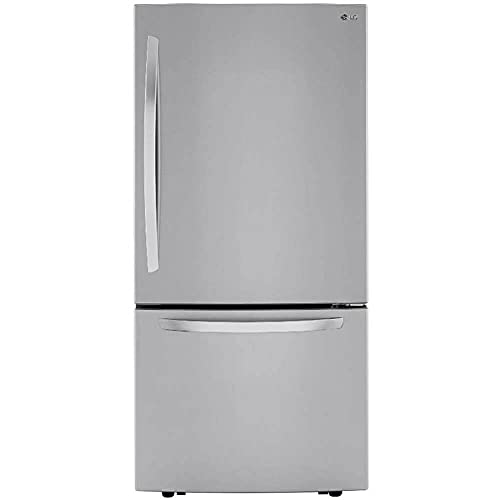
LG 26 Cu. Ft. Bottom-Freezer Refrigerator, 33-Inch LRDCS2603S — Largest in the Width Class
The LG LRDCS2603S is the headline act of this guide because it refuses the compromise the width class usually imposes. Twenty-six cubic feet is family-flagship capacity — the size households buy in the 36-inch class — delivered behind a stated 33-inch width with a bottom-mount freezer. If your kitchen offers 33 inches and your household shops like it has 36, this is the machine the whole article exists to point at.
The listing names Door Cooling and ThinQ among its features. Door Cooling addresses the bottom-freezer format’s small weakness — the door bins, furthest from the cabinet’s cold core, warming a little between openings — by directing cold air where the milk and juices actually live. ThinQ is LG’s connectivity platform, named here so that households who value alerts and remote temperature checks know the capability is on the table; households who do not can ignore it entirely, because the cabinet’s fundamentals do not depend on it.
Bottom-mount geometry at 26 cubic feet deserves a practical paragraph. The fresh section is wide and at eye level, which is where a household spends ninety percent of its fridge time; the freezer below takes the bulky, occasional traffic. In a narrow kitchen this division is doubly welcome, because the wide fresh door’s swing is the only big movement the cabinet asks for, and it happens at counter height where the cook already stands. The frozen drawer or door below opens into the room’s least contested floor space.
Who should hesitate? Households whose cooking depends on through-door ice and water should note that this listing names no dispenser, and plan accordingly. And every buyer should confirm the full dimension set — height and depth as well as the stated width — against their opening on the product page, because a 26-cubic-foot cabinet is a large object whose journey through the house deserves the same respect as its destination. Given those checks, the LG is the most complete answer this width class currently offers.
There is a longevity angle to choosing the class leader, too. A high-volume model from a major maker means shelves, bins and gaskets remain orderable deep into the machine’s life, and service knowledge is widespread. In a niche width class, that ecosystem is worth weighting heavily: the obscure cabinet that fits perfectly but cannot be repaired in year six fits perfectly in a landfill instead.
Consider the weekly shop staged through this cabinet. Fresh goods land at eye level where they will be seen and used in date order; the freezer below absorbs the frozen portion in one trip rather than in armfuls ferried to a separate chest. Households graduating from a small top-freezer will notice the change in posture first — a week of cooking without the stoop-and-reach routine — and in a narrow kitchen, where the cook cannot step back to make room for a low door’s swing, that posture change is worth as much as the capacity itself.
It is also the pick that best survives a growing household. Couples who buy the LG for its width today and find themselves feeding five in six years will not need to replace it; the capacity headroom is already there. In a width class where every purchase is constrained, buying the machine you will not outgrow is the closest thing to a free decision this guide offers.
- Capacity, from the listing title: 26 cu. ft. (listed as 26 CF)
- Width, from the listing title: 33 inches wide
- Format, from the listing title: bottom mount (bottom-freezer)
- Features, from the listing title: Door Cooling, ThinQ
- Model, from the listing title: LRDCS2603S
- Where to buy: the LG 26 Cu. Ft. Bottom-Freezer Refrigerator, 33-Inch LRDCS2603S listing on Amazon — check price on Amazon
Strengths
- Flagship-scale capacity inside a stated 33-inch width.
- Door Cooling targets the door bins where fresh items live.
- Major-brand ecosystem for parts and service over a long life.
Trade-offs
- No dispenser is named in the listing title.
- Large cabinet demands careful route and opening verification.
- Connectivity features will go unused by some households.
Best for: families with a 33-inch opening who refuse to downsize their fridge life. Not suited for: through-door dispenser households or openings smaller than the stated class.

Commercial Cool 18.9 Cu. Ft. French Door Refrigerator, 33-Inch CCRF1890KS — Two Freezer Drawers
The Commercial Cool CCRF1890KS takes the 33-inch brief and answers it with a French-door cabinet over two bottom-mount freezer drawers — a layout that squeezes surprising sophistication into the narrow frame. At 18.9 cubic feet it is sized for couples and small families, and its listing confirms the width in plain language: 33 inch wide. For the buyer whose opening is exactly the class this guide serves, that plain statement is the most valuable sentence in any of these listings.
Two freezer drawers, rather than one, change how a small household freezes. The upper drawer becomes the week’s working freezer — tonight’s proteins, the open bag of peas, ice — while the lower drawer holds the reserves. Because each drawer opens independently, the working drawer’s quick trips do not expose the reserves to warm kitchen air, and the reserves stop being excavated weekly by accident. It is the four-door zoning idea from our companion guides, folded into a 33-inch bottom-freezer.
The listing’s supporting details are the right ones for this tier: frost free operation, LED lighting and digital temperature control. Frost-free removes the manual defrost ritual that still haunts some compact freezers; LED lighting matters disproportionately in a narrow cabinet, where a single dim corner can hide a week’s leftovers; digital control gives a legible read on the cabinet’s state instead of a dial whose numbers mean whatever the last owner decided they meant.
Commercial Cool’s positioning is value-tier and proud of it, and this guide treats that as context rather than criticism. The CCRF1890KS’s proposition is that a narrow kitchen should not have to choose between its width and a modern layout. French doors over twin drawers, in stainless look, at a stated 33 inches — for the small household whose alcove is the constraint and whose standards are not, this is a genuinely well-aimed machine.
One caution belongs to the French-door format in narrow kitchens generally: check the swing. French doors need their lateral clearance, and a 33-inch alcove beside a wall or a tall unit can restrict one door’s travel. Measure the opening, then measure the swing against the room, and the CCRF1890KS will reward you with the most organised 18.9 cubic feet in this guide.
The twin-drawer freezer also suits a particular kind of cook: the market-driven one, whose freezer holds this week’s finds rather than a season’s stores. Small quantities, constantly rotating, file beautifully into two shallow drawers where nothing can hide for long. Food waste in such households usually comes from forgetting; a freezer that presents its whole contents in two pulls is a forgetting cure built into the cabinet.
For landlords furnishing a quality rental in an older building, the CCRF1890KS deserves a specific mention. It modernises the kitchen’s photograph — French doors, stainless look, digital control — inside an opening that has defeated previous attempts at upgrading, and it does so without plumbing or structural work. Tenants read a kitchen in seconds, and this machine changes what they read.
- Capacity, from the listing title: 18.9 cu. ft.
- Width, from the listing title: 33 inch wide
- Format, from the listing title: French door with 2 bottom-mount freezer drawers
- Features, from the listing title: frost free, LED lighting, digital temperature control
- Finish, from the listing title: stainless look
- Where to buy: the Commercial Cool 18.9 Cu. Ft. French Door Refrigerator, 33-Inch CCRF1890KS listing on Amazon — check price on Amazon
Strengths
- Twin freezer drawers separate working stock from reserves.
- Width stated plainly in the listing for a true 33-inch opening.
- Frost-free operation and digital control cover the modern essentials.
Trade-offs
- Capacity suits small households, not bulk shoppers.
- French doors need verified lateral swing clearance.
- The listing names neither an ice maker nor a water feature.
Best for: couples and small families in true 33-inch alcoves who want a modern drawer layout. A poor fit for: large families and high-volume ice users.

Verona 33-Inch French Door Refrigerator VEFFD3316RISL — Stated-Width French Door
Verona built its name on cooking appliances with an Italian design accent, and the VEFFD3316RISL brings that sensibility to the 33-inch refrigeration class: a French-door refrigerator, 33 inches by its own listing title, in a stainless steel look finish. The listing is terse — it states format, width class and finish, and little else — and this guide will mirror that terseness honestly rather than pad the entry with features borrowed from Verona’s ranges.
What can be said on the evidence is still meaningful. A French-door layout in this width puts the fresh section behind two narrow doors, each swinging through a modest arc — valuable in the galley kitchens where 33-inch openings concentrate. The bottom-freezer arrangement keeps fresh food at standing height. And Verona’s presence gives design-conscious buyers in this width class an option beyond the mainstream makers, from a brand whose kitchen aesthetic many of them already chose for the cooking side of the room.
The terseness of the listing cuts the other way as guidance: because the title names no capacity figure in cubic feet that this guide can quote with confidence beyond its format and width, buyers should go to the product page for the full specification — capacity, exact dimensions, and interior layout — and weigh those figures directly against the LG and Commercial Cool above. That is not a defect in the machine; it is the correct shopping behaviour for any listing that keeps its headline brief.
Choose the Verona when the kitchen’s design language matters and the household’s needs are moderate: fresh-focused cooking, a freezer used for the ordinary reserves, and an eye that wants the fridge to look like part of a considered room. In a Verona-equipped kitchen, this is the refrigerator that completes the sentence.
There is a broader point about brand coherence in small kitchens. In a compact room every appliance is visible all the time, and a fridge whose finish and proportions argue with the range beside it creates a low-grade visual friction that owners feel without naming. The Verona’s stainless-look French-door front was designed by a company that thinks about that sightline professionally. Buyers assembling a considered narrow kitchen from scratch should weigh that coherence as a real feature, even though no specification table has a column for it.
- Width, from the listing title: 33 inch
- Format, from the listing title: French door refrigerator (bottom-freezer layout of the class)
- Finish, from the listing title: stainless steel look
- Model, from the listing title: VEFFD3316RISL
- Full capacity and dimensions: verify on the product page, as the listing title does not state them
- Where to buy: the Verona 33-Inch French Door Refrigerator VEFFD3316RISL listing on Amazon — check price on Amazon
Strengths
- Stated 33-inch width from a design-led kitchen brand.
- French doors swing narrow in galley kitchens.
- Completes a Verona cooking suite visually.
Trade-offs
- Listing title is brief; capacity must be confirmed on the product page.
- No ice, water or smart feature is named in the listing.
- Smaller service footprint than the largest mainstream brands.
Best for: design-led kitchens in the 33-inch class, especially Verona range owners. Not the right match for: buyers who want every specification confirmed in the headline before clicking.

GE 21.0 Cu. Ft. Bottom-Freezer Refrigerator — Standard-Depth Classic, Verify Width
Here is this guide’s honesty exercise, presented as a pick — because it deserves to be one. GE’s 21.0-cubic-foot bottom-freezer in fingerprint-resistant stainless, standard depth, is a mainstream, sensibly sized refrigerator from one of the category’s defining makers. What its listing title does not do is state the cabinet’s width. So this guide includes it in a 33-inch article with the condition printed in its badge and repeated here: verify the width on the product page against your measured opening before you order. If the figure matches your 33-inch class opening, you have a strong candidate. If it does not, the three picks above are your guide.
Why include it at all? Because buyers searching this width class will meet this model constantly, and a guide that pretended it did not exist would serve them worse than a guide that presents it with its evidence labelled. Twenty-one cubic feet is a genuinely useful capacity — family-capable, short of cavernous — and standard depth gives the shelves and door bins a generosity that counter-depth cabinets trim away. The fingerprint-resistant finish suits the traffic of a family kitchen, where the fridge front collects the day’s evidence by lunchtime.
The bottom-freezer layout here is the classic form: fresh section at eye level, freezer below. GE’s long history with the format means the model sits inside a deep ecosystem of parts, documentation and service familiarity. For a buyer whose opening does verify, that ecosystem plus the capacity plus the finish is a coherent, mainstream proposition — the kind of appliance purchase that asks nothing exotic of its owner for a decade.
So the instruction bears repeating one final time, as the most useful sentence in this section: measure your opening’s width precisely, open the product page, find the manufacturer’s stated width for this exact model, and compare the two numbers with the clearance the maker specifies. Three minutes of that discipline converts this pick from a question mark into either a confident order or a clean elimination. Both outcomes are wins; the only loss is guessing.
Standard depth deserves its own defence while this pick is on the table. Counter-depth has dominated design coverage, but a standard-depth bottom-freezer’s shelves accept the deep casserole, the wide roasting tin cooling before portioning, and the door bins take gallon jugs without negotiation. Kitchens with the floor space to let a cabinet stand proud of the counter run get real, daily utility for the concession. If your 33-inch opening sits in a roomy kitchen — they exist, in farmhouses and converted barns especially — the GE’s depth may be the right trade, once its width verifies.
- Capacity, from the listing title: 21.0 cu. ft.
- Format, from the listing title: bottom freezer, standard depth
- Finish, from the listing title: fingerprint-resistant stainless steel
- Width: NOT stated in the listing title — deliberately omitted here; verify on the product page
- Where to buy: the GE 21.0 Cu. Ft. Bottom-Freezer Refrigerator listing on Amazon — check price on Amazon
Strengths
- Mainstream family capacity with standard-depth shelf generosity.
- Fingerprint-resistant finish suits busy family kitchens.
- GE’s parts and service ecosystem supports a long ownership.
Trade-offs
- Width is not stated in the listing and must be verified before ordering.
- Standard depth stands proud of counter-depth cabinet runs.
- No dispenser or smart feature is named in the listing.
Best for: buyers whose verified opening matches, wanting a mainstream standard-depth bottom-freezer. Poorly suited to: anyone unwilling to verify dimensions before ordering — choose a stated-width pick instead.
Built-In 33-Inch Bottom-Freezer Refrigeration (Dealer Channel) — Built-In Route
Beyond the freestanding market sits the built-in world, and in the 33-inch class it is a real, if rarefied, option. Built-in bottom-freezer models sized for narrower openings are sold through kitchen dealers and design studios, typically as part of a planned renovation: the cabinet integrates flush with surrounding joinery, often accepting the kitchen’s own door panels, and the purchase includes a site survey and specialist installation. This guide lists the route as prose-only because there is no marketplace listing to link, verify or price against — and inventing one would betray the evidence discipline this article runs on.
Position it qualitatively: this is the premium tier of the width class, chosen for the finished look and the renovation context rather than for capacity per money. The buyers it suits are already working with a kitchen designer, already budgeting joinery, and want the refrigerator to disappear into the room’s architecture. The buyers it does not suit are everyone replacing a fridge this month: dealer timelines, survey visits and installation scheduling belong to renovation calendars, not emergency ones.
If you explore this route, take this guide’s measuring discipline with you and apply it harder. Built-in installations forgive nothing: the opening, the floor level, the door swing against adjacent units and the ventilation path are all specified tightly by the manufacturer, and the dealer’s survey exists to catch what a tape measure alone would miss. Ask for the full dimension sheet for the exact model under discussion, and keep it with the renovation paperwork.
Budget conversations in this channel should be equally explicit. Ask what the quoted figure includes — delivery, installation, panel work, connection, removal of the old machine — and what it excludes, because built-in projects accumulate their surprises in exactly those gaps. A dealer who answers item by item is demonstrating the professionalism the tier charges for; one who waves at a single round number is telling you something worth hearing before any deposit changes hands.
- Channel: kitchen dealers and design studios — no Amazon listing, no link
- Tier positioning: premium, renovation-led
- Format: built-in bottom-freezer sized for narrower openings, often panel-accepting
- Specifications: obtain the manufacturer’s dimension sheet from the dealer for the exact model
- Where to buy: through a local kitchen dealer — qualitative guidance only
Strengths
- Flush, architectural integration no freestanding cabinet can match.
- Dealer survey and installation are part of the purchase.
- Panel options let the fridge vanish into the cabinetry.
Trade-offs
- Premium tier in cost and in renovation commitment.
- Timelines follow renovation schedules, not emergencies.
- Specifications must be gathered model by model from the dealer.
Best for: planned renovations with designer involvement and a flush-fit brief. Not suited for: urgent replacements or buyers shopping on a freestanding budget.
Panel-Ready 33-Inch Refrigerators (Dealer Channel) — Panel-Ready Route
The second dealer route overlaps the first but deserves its own entry, because some buyers want the integrated look without a fully built-in installation. Panel-ready refrigerators in narrower widths are freestanding or semi-integrated cabinets engineered to carry custom door panels that match the kitchen’s cabinetry. They are likewise sold through dealer showrooms rather than marketplace listings, which is why this entry is prose-only: no ASIN, no image, no invented specification.
The qualitative positioning sits between the freestanding picks above and the full built-in route: a mid-to-premium tier once the panels themselves and their fitting are counted. The hidden costs are the ones to interrogate at the showroom — who fabricates the panels, who fits them, how the handles are resolved, and what the total installed figure looks like against a stainless freestanding cabinet of similar capacity. Dealers answer these questions routinely; ask them before the design conversation becomes an order.
For the right kitchen — a period home whose cabinetry is the room’s glory, a narrow galley being renovated with care — a panel-ready 33-inch machine solves the problem no stainless box can: the refrigerator stops being an appliance parked in a fitted room and becomes part of the furniture. That is a legitimate ambition. It is simply one that must be pursued through the channel that actually sells it, with measurements verified at every step.
Panel-ready ownership has one more consideration the showroom may not volunteer: lead times compound. The cabinet, the panels and the fitter are three separate schedules, and a delay in any one idles the other two. Renovators should sequence the refrigerator order early, confirm panel dimensions from the manufacturer’s template rather than from the cabinet’s marketing dimensions, and keep the old fridge alive until the new installation is genuinely imminent. None of this is a reason to avoid the route; all of it is a reason to walk it with open eyes.
- Channel: dealer showrooms — no Amazon listing, no link
- Tier positioning: mid-to-premium once panels and fitting are included
- Format: panel-accepting cabinets in narrower widths
- Specifications: confirm exact dimensions and panel requirements with the dealer
- Where to buy: through a kitchen dealer — qualitative guidance only
Strengths
- Cabinetry-matched fronts for a fully integrated look.
- Less structural commitment than a full built-in installation.
- Solves the narrow-kitchen design problem elegantly.
Trade-offs
- Panel fabrication and fitting add to the true total.
- Dealer timelines apply, as with the built-in route.
- No marketplace listing exists to verify specifications against.
Best for: renovators whose cabinetry should visually swallow the refrigerator. A poor fit for: buyers who need a fridge delivered and running this week.
At a Glance: Four Linked Picks and Two Dealer Routes
| Entry | Stated width | Capacity | Channel |
|---|---|---|---|
| LG LRDCS2603S | 33 inches, in listing title | 26 cu. ft. | Amazon listing |
| Commercial Cool CCRF1890KS | 33 inches, in listing title | 18.9 cu. ft. | Amazon listing |
| Verona VEFFD3316RISL | 33 inches, in listing title | Verify on product page | Amazon listing |
| GE 21.0 Bottom-Freezer | Not stated — verify | 21.0 cu. ft. | Amazon listing |
| Built-in 33-inch route | Per dealer dimension sheet | Per model | Kitchen dealer |
| Panel-ready 33-inch route | Per dealer dimension sheet | Per model | Kitchen dealer |
How Do You Measure a 33-Inch Opening Properly?
Measure the width at three heights — floor, mid and top — because openings in older kitchens are rarely parallel, and the smallest figure is the one your refrigerator must pass. Measure the height under any overhead cabinet at its lowest point, and the depth from the wall to the counter’s front edge, noting skirting boards and any pipework that steals space at the back. Record all of it, with the date, in the notes you will shop with.
Then measure the swing, which is where narrow kitchens exact their toll. French doors, like the Commercial Cool’s and Verona’s, need lateral room; a single wide bottom-freezer door, like the LG’s fresh door, needs a clear arc in front. Stand in the opening and mime the week’s movements: the fridge door open, you passing with a tray, the dishwasher open below the counter opposite. If the mime involves contortion, the layout conversation matters as much as the width figure. Tall cooks will recognise the ergonomics instantly — the same reach-and-clearance thinking our guide to Best Chairs for Tall Men applies to seating applies here to door arcs and shelf heights.
Finally, walk the delivery route with the tape still out. A 33-inch-class cabinet still has a largest dimension — usually its depth with doors, or its height — and that dimension must survive the front door, the hallway turn and the kitchen entrance. Delivery crews can remove refrigerator doors to gain inches; they cannot remove your staircase’s corner. Five measured minutes now prevent the refused delivery that reschedules your kitchen for a fortnight.
Why Does the Bottom-Freezer Layout Suit Narrow Kitchens So Well?
Because it concentrates the cabinet’s daily traffic in its most accessible zone. In a narrow kitchen the cook stands close to the fridge, opens it often, and benefits from the fresh section presenting itself at eye and hand level without stooping or reaching. The freezer, visited less and usually with both hands free, takes the lower position where its drawer or door can open into the room’s floor space briefly and purposefully.
There is a thermal courtesy in the arrangement too. Cold air sinks; a freezer at the bottom works with that tendency rather than against it, and the fresh section above — opened ten times for every freezer trip — keeps its chill in a cabinet whose coldest zone is not being constantly disturbed. None of this makes top-freezers wrong; it makes the bottom-freezer the thoughtful default for a kitchen where the refrigerator is the hardest-working metre of the room.
How Should You Verify a Width Claim Before Ordering?
Follow the evidence chain this guide modelled. First, the listing title: a stated width there, as with the LG, Commercial Cool and Verona, is the manufacturer putting the class in the headline. Second, the product page’s specification section for the exact model — not a sibling, not a range overview — where the precise dimensions including clearances live. Third, the manufacturer’s own dimension sheet when a dealer is involved. If the three disagree, the dimension sheet for the exact model wins, and a call to the seller before ordering is worth more than a return afterwards.
Apply the same scepticism to photographs. Marketplace images show cabinets in idealised kitchens with no visible constraints, and wide-angle lenses flatter narrow machines into family flagships. The numbers are the product; the photographs are its portrait. Buy the numbers.
What About Entertaining From a Narrow Fridge?
Narrow cabinets host better than their reputation suggests, because hosting is a logistics problem more than a volume problem. Chill drinks in advance in the fresh section’s lowest, coldest zone; let the bottom freezer’s reserves move aside for the event’s ice and desserts; and accept one honest overflow — a cool box for the day itself. Households that entertain from the garden or patio will find the same plan-ahead spirit in our guide to Best Reclining Stadium Chairs — different furniture, same truth that comfort is arranged in advance or not at all.
The LG’s 26 cubic feet, it must be said, dissolves most of the problem outright: it is a full family cabinet wearing a narrow kitchen’s width. Buyers whose openings allow it and whose gatherings are frequent should weight that capacity heavily. The smaller picks ask for the cool-box compromise a few weekends a year, and return the favour in daily fit for the other fifty weeks.
How Do You Settle a New Bottom-Freezer Into Its First Month?
Installation discipline matters in this class because the cabinet is working in a tight opening where clearances are already spoken for. Level the machine so its doors close under their own weight, confirm the ventilation gaps the manufacturer specifies have survived the push into the alcove, and resist loading it fully on day one. Let temperatures stabilise overnight, verify them with a simple fridge thermometer in both sections, and only then stage the big shop into its new zones.
Use the first month as an audit. Note which shelf overflows and which drawer underfills, then move one shelf or reassign one drawer accordingly. Bottom-freezer cabinets reward this single iteration disproportionately, because their two zones are so distinct: fresh organisation and freezer organisation can each be tuned without disturbing the other. By the second month the cabinet should feel inevitable — everything where your hand expects it — and that feeling, not the delivery day’s novelty, is the true measure of a successful fit.
Keep the paperwork together from the start: the listing’s model identity, the verified dimensions you measured, and a photograph of the rating plate. In a niche width class, your future self — ordering a shelf in year five, or selling the house with the kitchen’s measurements in the particulars — will be grateful that the evidence was filed while it was fresh.
How Does a Bottom-Freezer Handle a Household’s Freezer Habits?
Most households freeze in three rhythms: the daily working stock, the weekly proteins, and the long reserves. A bottom-freezer serves the first two beautifully, because its drawer or lower door is opened briefly and its contents are the household’s current cooking. The long reserves — the glut of a garden, a whole animal share, a season of batch cooking — are where a single bottom-freezer reaches its limit, and households with serious preserving habits should plan a small supplementary chest freezer in a utility space rather than forcing the kitchen cabinet to be two appliances.
That division of labour is healthy for the kitchen machine. A bottom-freezer kept to working stock stays organised, seals well because it is never overfilled, and presents its contents honestly. The 33-inch picks in this guide are sized for exactly that role; asking them to also be the household’s warehouse is the one expectation this article declines to endorse.
What Should Renters and Landlords Each Look for in This Class?
The 33-inch opening is disproportionately a rental-market opening — older housing stock, conversions, apartment blocks — so this guide owes both sides of the tenancy a paragraph. Landlords should read the class for durability and neutrality: a stated-width stainless machine with no dispenser plumbing, like the Commercial Cool or the Verona, modernises the listing photograph, asks nothing of the building, and presents tenants with a layout they already understand. The LG, where the opening and budget allow, is the upgrade that lets a quality property advertise a genuinely large fridge in a small kitchen, a combination tenants remember at viewing.
Renters replacing a machine with a landlord’s consent should protect themselves with the same evidence chain: photograph the opening’s measurements, keep the listing’s stated width, and confirm in writing that the cabinet fits before it is ordered. A renter who can produce those three artefacts never has an argument about a refused delivery. And both sides should note the GE’s lesson — a famous name and a plausible size are not a measurement, in a tenancy or anywhere else.
How Do You Choose Between the Stated-Width Three?
With the width settled, the choice among the LG, Commercial Cool and Verona is an ordinary, pleasant one about household shape. Capacity decides first: families and bulk shoppers belong to the LG’s 26 cubic feet, full stop. Layout decides second: households that freeze in two rhythms — working stock and reserves — will feel the Commercial Cool’s twin drawers working for them every day, while fresh-focused cooks who freeze lightly may never open a second drawer with intent. Design decides third: the Verona earns its place where the kitchen’s look is a project in itself and the household’s volume is moderate.
Budget tier, stated qualitatively as this guide always states it, runs in the same order as ambition: the Commercial Cool is the value play of the three, the LG the mainstream flagship, the Verona the design-led alternative whose premium is paid for coherence with a cooking suite. None of the three requires plumbing, none demands renovation, and all three print the one number this entire article revolves around in their own titles. A buyer who has measured honestly cannot make a bad choice among them — only a better-fitting one.
How Does This Width Class Handle Height and Depth, the Forgotten Dimensions?
Width dominates this article because width defines the class, but a refrigerator must fit in three dimensions, and the other two eliminate candidates quietly. Height matters wherever an overhead cabinet, a bulkhead or a low ceiling crosses the alcove — and in the older kitchens where 33-inch openings live, overhead obstructions are common. Measure from the floor to the obstruction’s lowest point, and compare it against the exact model’s stated height on its product page, remembering that hinge caps can stand above the cabinet’s headline figure.
Depth decides the room’s feel. A standard-depth cabinet in a narrow kitchen projects into the walkway; a shallower one aligns with the counters and returns floor space to the cook. The picks in this guide include standard-depth honesty in the GE and narrower-kitchen thinking in the rest, but the listing titles do not all state depth, which is precisely why this guide keeps sending you to the product page: depth, like the GE’s width, is a number to verify rather than a vibe to assume. Walk the room with the tape at counter height and mark where each candidate’s front would land; live with each mark for a day before deciding, if the purchase allows the time.
Taken together, the three dimensions explain why this class rewards patience. The buyer who measures all three, verifies all three against the exact model, and only then falls in love with a finish will have a refrigerator that fits like joinery. The buyer who falls in love first will have a story. This guide was written so that its readers have the former.
What Mistakes Do 33-Inch Buyers Most Often Make?
The defining mistake is assuming a width from a model family’s reputation — the error this guide’s treatment of the GE exists to prevent. Second is measuring the opening once, at one height, in a kitchen whose walls lean with age. Third is forgetting door swing against a perpendicular wall, which can turn a French door’s outer shelf into a cave. Fourth is buying the class’s largest cabinet without walking its delivery route. Fifth is dismissing the dealer routes out of hand during a renovation, or pursuing them during an emergency; each channel has its season, and confusing the seasons is expensive in both directions.
Final Recommendation
Start with the tape measure, because in this class the tape measure is the review that matters most. If your opening verifies at 33 inches and your household is a family, the LG LRDCS2603S is the standout — flagship capacity with the width printed in its own title. Small households in the same opening should look hard at the Commercial Cool’s twin drawers, design-led kitchens at the Verona, and mainstream buyers at the GE on the strict condition that its width verifies on the product page before ordering. Renovators should keep the two dealer routes in view for what they genuinely offer. A 33-inch kitchen is not a failed 36-inch kitchen; fitted with the right cabinet, it is simply a kitchen whose refrigerator was chosen by measurement instead of by hope — and those are always the kitchens that work.
If a single sentence from this article deserves to survive the shopping trip, it is this: the width printed in a listing title is a promise, the width absent from one is a task. Three of the linked picks make the promise, one sets the task clearly and honestly, and the dealer routes exist for kitchens whose ambitions run beyond freestanding. Match the promise or complete the task, and the narrow opening that brought you to this guide becomes the best-fitted metre of your kitchen.
One last encouragement for the hesitant: a narrow kitchen fitted with a properly measured bottom-freezer stops feeling like a compromise within a month. The fresh section at eye level, the freezer filed below, the cabinet sitting honestly in its opening — the room starts to work the way its cook always wanted it to. The households that regret purchases in this class are never the ones who measured twice; they are the ones who guessed once. Be the first kind, and let this guide’s six entries compete for a space you know to the millimetre.
Frequently Asked Questions
Is 33 inches a standard refrigerator width?
It is a recognised width class, though less common than the 36-inch mainstream, which is exactly why stated-width models are worth seeking out. Many older kitchens and apartment blocks were framed for it, and the models in this guide exist to serve those openings properly.
Can I squeeze a 36-inch fridge into a 33-inch opening?
No. Refrigerators need their specified clearances for ventilation and door operation, and a cabinet wider than the opening simply does not fit. Choose a stated 33-inch model, or have the opening altered professionally as part of a renovation.
Why does this guide refuse to state the GE’s width?
Because its listing title does not state one, and this guide quotes specifications only from listing titles. The exact width for that model is published on its product page; verify it there against your measured opening before ordering, as the pick’s section explains.
Are bottom-freezer models harder to organise than top-freezers?
Most households find them easier for fresh food, which is the section they open constantly, since it sits at eye level. The freezer below rewards a simple filing habit — categories in labelled bags or boxes — especially in drawer models like the Commercial Cool’s twin-drawer layout.
Is a bottom-freezer a good choice for an older cook?
For fresh food, emphatically yes: the section used constantly sits at standing height, which removes the daily stooping a top-freezer imposes for milk, eggs and ingredients. The freezer below does ask for bending or kneeling on its less frequent visits, so households should file the freezer with the lightest, most-used items at its top or front, and keep a small step or a sturdy drawer habit in mind. Many older cooks judge the trade well worth it.
What if my opening measures slightly over 33 inches?
Then you have choices rather than problems: the stated 33-inch models will fit with clearance to spare, and some wider models may also verify — but verify them the same way, against the exact model’s stated dimensions and required clearances, never by eye. Extra clearance is a luxury; assumed clearance is a risk.
Do French doors work in a 33-inch alcove beside a wall?
They can, provided the wall side leaves the door its swing. A French door opens through roughly its own width; if a perpendicular wall or tall unit blocks that travel, the door’s outermost storage becomes hard to use. Measure the swing in the room, not just the opening, and if one side is blocked, a single-door bottom-freezer like the LG’s format may serve you better.
How much clearance does a refrigerator need around it?
Each manufacturer specifies clearances for ventilation and door operation, and they vary by model. Find the figures on the product page for the exact model you choose and treat them as part of the required opening size — an opening that fits the cabinet but not its clearances does not fit.
When does the dealer route make sense over a freestanding pick?
When a renovation is already under way, the budget includes joinery, and the brief is a flush or panelled finish. For a straightforward replacement in an existing kitchen, the linked freestanding picks in this guide are faster, simpler and far easier to verify.
Keep the measured numbers after the purchase, too. A note in the kitchen drawer — opening width at three heights, the chosen model’s verified dimensions, the delivery route’s pinch point — turns any future appliance conversation in this house from archaeology into administration. Narrow kitchens stay narrow; the households that thrive in them are the ones that wrote things down.
There is a final, quieter satisfaction reserved for the buyer who did all of this properly: the first weekly shop, staged into a cabinet that fits its opening to the millimetre, doors swinging clear, fresh food at eye level, the freezer filed below. Narrow kitchens ask more of their owners than wide ones do — more measurement, more discipline, more honesty about numbers. They repay it with a daily rightness that wider rooms, bought carelessly, often never achieve. The 33-inch class, chosen this way, is not a compromise at all. It is a craft.
Bring the same patience to the first month of ownership: one shelf moved, one drawer reassigned, one habit changed after the audit this guide recommended. A narrow cabinet tuned that way stops being the kitchen’s constraint and becomes its quiet advantage — measured, verified and entirely yours.
Related Guides
Narrow kitchens reward the same measure-first discipline in every appliance. Our live guide to Best Small Front-Load Washers applies it to laundry in compact spaces, with the same insistence that the manufacturer’s stated dimensions outrank any photograph.


