What's inside
- Key Takeaways
- Quick Picks
- How Did We Assemble a Guide Across Such Different Types?
- How Do the Six Compare at a Glance?
- Which Pool Sizes Map to Which Method?
- What Debris Does Your Pool Actually Produce?
- How Do the Tiers Stack Up over Five Summers?
- What Mistakes Do Buyers Make Across All Types?
- How Does Each Method Handle the Five Commonest Pool Days?
- What Maintenance Does Each Type Demand Across a Season?
- How Should Owners of Frame and Soft-Sided Pools Adjust These Recommendations?
- What Does a Complete Cleaning Kit Look Like at Each Tier?
- How Do You Choose Between the Three Linked Robots?
- What Should You Verify on Any Listing Before You Buy?
- How Does Vacuuming Interact with Water Chemistry?
- Can You Run a Pool Vacuum at Night or Early in the Morning?
- What Changes After a Year of Living with Your Choice?
- Final Recommendation
- Frequently Asked Questions
- Related Guides
As an Amazon Associate I earn from qualifying purchases. This post may contain affiliate links at no extra cost to you.
cottageverdict.com is reader-supported. When you buy through links on our site, we may earn an affiliate commission.
Where to buy: the three robotic models below are sold on Amazon with their names linked to the listings, where you can check price on Amazon; the three manual and powered alternatives are covered as types, since the right specimen depends on your pump, pole and local stock.
Shopping for the best above-ground vacuums goes wrong in a predictable place: the category is not one product but five different answers wearing a single label. A robotic cleaner, a suction-side wanderer, a hand vacuum on a pole and a battery handheld all promise a clean pool floor, yet they divide the work between machine, plumbing and owner in completely different proportions. Choosing well means deciding first how the cleaning should happen in your garden — who provides the power, who provides the patience, and what your pool actually drops on its floor each week.
Start with size, because size eliminates options fastest. A ten-foot ring pool holds a floor you can cross with a pole in four passes; sending a robot to patrol it is like hiring a bus for a trip to the corner shop. A thirty-foot oval is the opposite problem: manual cleaning becomes an expedition, and the methods that scale — robots chief among them — earn their keep with every metre. Between those poles sits the broad middle of family pools, where the honest contest happens and where this guide spends most of its attention.
Debris writes the second half of the brief. Pools under trees collect a heavy, visible load of leaves that fills baskets and chambers quickly. Open, sunny pools collect a lighter but more insidious load of dust and pollen that settles as silt and defeats coarse filtration. Sandy gardens and enthusiastic toddlers add grit that needs direct suction to lift. The six picks below — three robots we can link with confidence, and three alternative types discussed in prose — were assembled so that each common combination of pool size and debris type has a credible answer.
Money, finally, is discussed here the way it should be: in tiers and over seasons, never as a printed figure that expires. A method that looks thrifty at purchase can charge rent in filters, hoses and your own hours, while a premium robot can quietly repay itself in cleans that actually happen. Read the tier sections with your own diary in mind. The cheapest vacuum is the one matched to a pool it can genuinely keep clean. And keep one more variable in view as you read: who else will operate the thing. A method only its buyer understands is a method that stops during holidays, illnesses and busy months, while the pool’s debris observes no such calendar. The best system in this guide is the one a second member of the household can run without a briefing — because a pool cleaned by a system outlasts a pool cleaned by a person, however devoted that person is in June.
Key Takeaways
- Above-ground vacuums split into robots, suction-side cleaners, manual pole heads and battery handhelds — choose the type before the model.
- Pool size eliminates options fastest: handhelds for the smallest pools, robots for the largest floors, and honest argument for everything between.
- Debris type decides filtration needs; leaf pools want capacity, dusty pools want fine filtration layers, and gritty pools want suction delivered close.
- The WYBOT A1’s dual-layer filtration and 1,100-square-foot coverage make it the dusty large-pool answer here.
- Cost should be judged over seasons in tiers, counting filters, hoses, replacement batteries and your own hours alongside the purchase itself.
- Most households end with a pairing — one main method plus a spot tool — rather than a single device, and they usually arrive there within one season of experiments.
Quick Picks
| Pick | Badge | Why it made the list |
|---|---|---|
| AIPER Seagull SE Robotic Pool Vacuum | Mid-size pool favourite | Self-parking convenience and 100 minutes aimed squarely at pools up to 860 square feet. |
| Aiper Cordless Robotic Pool Cleaner for Above Ground Pools | Large-pool value route | Dual motors and two modes address pools up to 40 feet without flagship complexity. |
| WYBOT A1 Cordless Pool Vacuum | Dust and silt champion | Dual-layer filtration plus 130 minutes for big floors under trees or near paths. |
| Suction-Side Cleaners | Prose-only: pump-powered type | The filter pump does the work while the owner supervises hoses and baskets. |
| Manual Pole Vacuum Heads | Prose-only: owner-powered type | Total precision at the lowest tier, paid in weekly shoulder time. |
| Rechargeable Handheld Pool Vacuums | Prose-only: spot-cleaning type | Self-contained units for steps, spas and the smallest pools of all. |
How Did We Assemble a Guide Across Such Different Types?
We fixed the test every type had to pass: a family above-ground pool, cleaned across a whole season, judged on the floor’s average condition rather than its best day. That single standard exposes each type’s character honestly. Robots score through frequency, manual heads through precision, suction-side units through simplicity, and handhelds through responsiveness — and the same standard reveals where each one fails, because a season includes storms, holidays, lazy fortnights and the week the pump broke.
For the robots, only models whose listings speak directly to above-ground pools were eligible, and we recorded their stated runtimes and coverage pairings rather than their adjectives. The Seagull SE offers 100 minutes for pools up to 860 square feet with self-parking; the dual-mode Aiper offers 90 minutes for pools up to 40 feet; the WYBOT A1 offers 130 minutes, up to 1,100 square feet and dual-layer filtration. Those three sets of numbers, compared calmly, tell a buyer more than any amount of aquatic photography.
The prose-only types were assessed as classes because their specimens vary enormously by brand and region, and inventing a champion among them would be false precision. What can be said reliably about a class — its power source, its debris path, its maintenance rhythm, its tier — is said here in full. Where a class has a hard structural limit, such as a handheld’s chamber size, we state it as a property of the type rather than a defect of a model. Prices are handled the same way throughout: tiers and trajectories instead of figures, because a number printed in a guide like this would be a rumour by the time the season turned, while the relationship between the tiers — manual cheapest, suction-side close behind, handhelds between, robots at the top — has held for years and shows no sign of inverting.
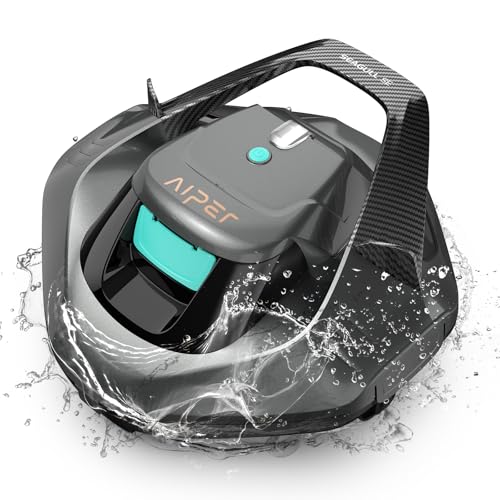
AIPER Seagull SE Robotic Pool Vacuum — Mid-size pool favourite
In an all-types guide, the Seagull SE’s role is to represent the sensible centre of the robot market: a cordless floor cleaner whose listing pairs 100 minutes of runtime with pools up to 860 square feet, quotes its suction as a flow of 1320GPH, and adds smart self-parking so the machine waits at the wall when the work ends. For the great middle band of above-ground ownership — rounds and ovals that host daily summer swimming — that combination covers the brief without asking the buyer to fund capacity the pool will never use.
Cost-tier thinking flatters it. Robots divide into those bought for convenience features and those bought for coverage, and the Seagull SE spends on the convenience that owners feel weekly: retrieval without fishing. A mid-size pool cleaned twice a week never tests the outer edge of its runtime, so the money not spent on extra minutes and modes stays unspent, while the self-parking pays its dividend every single session. That is the shape of value in this category — not the longest specification list, but the feature your routine touches most.
Its boundaries are the honest ones for its class. It cleans floors; the listing promises no wall climbing, and the flexible wall of an above-ground pool would resist climbing anyway. Pools larger than its stated coverage will see it finish part of the floor brilliantly and the rest on a second charge. Wrinkled liners slow it as they slow everything. Within its declared parish, though, it is the robot we would hand to a first-time owner who wants the chore to shrink without studying a manual the size of a novel.
- Type: cordless robotic floor cleaner
- Runtime and coverage: 100 minutes, pools up to 860 square feet
- Flow figure: 1320GPH per the listing
- Convenience: smart self-parking at the wall
- Tier position: the robot market’s sensible centre
Strengths
- Sizing matches the most common family pools without wasted capacity.
- Self-parking is the convenience owners actually feel every week.
- Simple brief makes it the easiest robot here to live with.
Trade-offs
- Larger pools outgrow its coverage and need split sessions.
- Walls and waterline stay outside its floor-only brief.
- Heavy leaf loads fill its basket mid-run in autumn.
Best for: small and mid-size pools wanting robot ease without flagship spend. Not suited for: the largest above-ground floors or wall-cleaning expectations.

Aiper Cordless Robotic Pool Cleaner for Above Ground Pools — Large-pool value route
Scale is this Aiper’s argument. Its listing addresses above-ground pools up to 40 feet — diameter language that reaches the largest installations families attempt — and backs the claim with dual motors and dual cleaning modes across a 90-minute runtime. In a guide organised by pool size, it occupies the ground where manual methods become expeditions and smaller robots become part-time: the big floor that needs a machine designed for distance.
The dual modes deserve a buyer’s-guide reading rather than a feature-list nod. A large pool’s dirt is unevenly distributed — deep-end drifts of leaves, a silt film everywhere, one corner where the tree overhangs — and a single fixed programme spends its battery democratically across clean and dirty water alike. Modes let the owner concentrate effort: the thorough pattern for the weekly reset, the lighter pattern for maintenance. Across a season, that choice is worth more than raw minutes, because it converts the same battery into better-placed work.
Tier-wise it asks an interesting question: how much robot does a big pool need? The flagship answer adds runtime and filtration layers; this Aiper answers with motors, modes and reach at a less demanding level of commitment. Owners of large pools with leaf-dominated debris — visible loads that any decent basket catches — may find that trade exactly right. Owners whose big pool also sits in dust and pollen should read the next pick before deciding, because filtration, not travel, will be their binding constraint.
- Type: cordless robotic cleaner, dual motors
- Runtime and coverage: 90 minutes, pools up to 40 feet
- Modes: dual-cleaning modes for reset and maintenance
- Finish: charcoal and teal
- Tier position: scale without flagship complexity
Strengths
- Reaches the largest above-ground pools in this guide’s terms.
- Mode choice places battery effort where dirt concentrates.
- Dual motors sustain pace across long floor crossings.
Trade-offs
- Ninety minutes is the briefest runtime among the three robots.
- Filtration is not its headline, so silt-heavy pools should compare carefully.
- Small pools pay for reach they will never use.
Best for: large above-ground pools with leaf-led debris loads. Not suited for: compact pools or silt-dominated water needing layered filtration.

WYBOT A1 Cordless Pool Vacuum — Dust and silt champion
Every pool guide needs a pick for the owners whose water looks clean from the deck and dirty from inside it. The WYBOT A1 is that pick here, because its listing pairs the stamina figures — 130 minutes, coverage up to 1,100 square feet, four cleaning modes — with the specification that decides dusty pools: dual-layer filtration. A coarse layer arrests leaves and insects; a finer layer arrests the silt and pollen dust that otherwise pass through, cloud the water on contact and resettle as tomorrow’s grey film.
Consider the debris diary of a pool near a gravel path in a breezy, open garden. Little arrives that a camera would notice. Yet the floor dulls within days, bare feet feel the grit, and a basic robot’s basket comes up nearly empty while the floor stays dirty — the classic signature of filtration mismatch. The A1 exists for that signature. Its four modes let the owner run shorter, more frequent passes in dust season, exporting fine particles before they compact into the liner’s texture, which is a strategy as much as a specification.
The tier consequence is plain: this is the most complete and therefore most committing robot of the three, and its value depends on the buyer’s debris. Leaf-only pools will not miss its fine layer; small pools will not use its coverage; owners who clean rarely will not exploit its modes. But for the large, dust-fed pool — the one whose owner has already watched a cheaper cleaner rearrange the problem — the A1 is the first specification in the category that reads like it was written about their garden.
- Type: cordless pool vacuum robot
- Runtime and coverage: 130 minutes, up to 1,100 square feet
- Modes: 4 cleaning modes per the listing
- Filtration: dual-layer, for coarse debris and fine silt
- Tier position: the most complete robot of the three
Strengths
- Fine filtration layer captures what other baskets recirculate.
- Longest runtime supports large floors and frequent passes.
- Mode range suits both dust season and post-storm recovery.
Trade-offs
- Capability is wasted on small or purely leaf-fed pools.
- Fine media demands regular rinsing to keep flow honest.
- Its completeness sits at the top of this trio’s commitment.
Best for: larger pools troubled by dust, pollen and silt films. Not suited for: tiny pools or owners wanting the simplest possible robot.
Suction-Side Cleaners — Prose-only: pump-powered type
Suction-side cleaners convert equipment you already own — the filter pump — into a cleaning service, and that economy defines their tier. A head on a hose draws its power from the skimmer’s suction and ambles across the floor, sending debris to the pump basket and main filter. As a generic type, the purchase sits near the bottom of the pool-cleaning market, there is no battery to manage, and the mechanism tolerates seasons of indifference that would retire more delicate machines.
The running costs hide in the plumbing. Every leaf the cleaner collects is a leaf your main filter must hold, so cartridge rinsing and backwashing arrive more often; the pump works harder for longer; and the cleaner’s wandering pattern, governed by hose length and water flow, covers a floor the way a grazing animal covers a field — thoroughly in the end, unpredictably in the middle. Modest above-ground pumps may also starve the cleaner into a lazy crawl. Owners of small pools with strong pumps and a relaxed attitude to pattern get a genuinely workable system for very little. Owners who want the floor finished, unattended and even, are shopping in the wrong aisle of this guide.
- Type: hose-fed cleaner powered by the filter pump
- Tier: near the market’s floor at purchase
- Hidden costs: main-filter loading and extra rinsing or backwashing
- Pattern: wandering, governed by hose length and flow
- Depends on: pump strength, which varies widely on above-ground setups
Strengths
- Uses the pump you already run, so cleaning piggybacks on filtration hours.
- Mechanically simple, with little that can wear out or drown.
- Purchase commitment stays low even for cautious budgets.
Trade-offs
- Main filter absorbs the whole debris load and its maintenance.
- Coverage wanders and corners can host the cleaner for hours.
- Weak pumps produce a slow, easily discouraged clean.
Best for: small pools with healthy pumps and patient owners. Not suited for: large floors or anyone wanting an unattended finish.
Manual Pole Vacuum Heads — Prose-only: owner-powered type
The manual head remains the reference point for two virtues no powered rival has matched: it costs the least of anything in this guide, and it cleans exactly where it is pointed, at the speed the owner chooses, with a thoroughness limited only by patience. For the smallest pools — the ring pool a pole crosses in minutes, the plunge pool beside the deck — it is not a compromise at all. It is simply the proportionate tool, and every grander method is an indulgence bought for comfort rather than cleanliness.
Its economics invert as pools grow. The purchase stays trivial while the labour compounds: twenty minutes for a small floor becomes an hour’s leaning and hauling around a large oval, performed weekly, in the heat, at a wall height that turns the work into a posture exercise. Technique taxes the result too — a head swept quickly raises silt clouds that resettle behind it — so the manual cleaner’s real specification is the owner’s temperament. Households that treat the session as a ritual keep beautiful floors for almost no money. Households that postpone it own, in effect, no vacuum at all for the weeks between intentions.
- Type: vacuum head on a telescopic pole, hose to skimmer
- Tier: the lowest purchase commitment in pool cleaning
- Precision: absolute, including seams, steps and ladder feet
- Labour: scales directly with pool size and debris load
- Technique: slow, overlapping passes keep silt from billowing
Strengths
- Precision in awkward zones exceeds every powered option here.
- No charging, programming, retrieval or winter battery care.
- Proportioned perfectly to the smallest pools and tightest budgets.
Trade-offs
- Labour grows punishingly with pool size and leaf load.
- Rushed passes stir the silt they were meant to remove.
- The method fails silently whenever the session gets postponed.
Best for: small pools, precise owners and minimal budgets. Not suited for: large pools, mobility limits or busy summer diaries.
Rechargeable Handheld Pool Vacuums — Prose-only: spot-cleaning type
Handheld pool vacuums are the type most often bought for the wrong job and loved for the right one. As a class they are self-contained battery units with modest debris chambers, sometimes mounted on short poles, that clean where the hand points them with no hose, no pump and no setup. Judged as whole-pool cleaners for anything beyond the smallest ring pool, their chambers fill and their batteries fade too soon. Judged as what they are — the pool’s spot-cleaner — they are close to perfect.
Their home ground is everything the big methods handle clumsily: steps and their corners, the shallow ledge, the spa, the patch behind the ladder, the drift of leaves that settled an hour before guests arrive. Deployment takes seconds, which changes behaviour; a tool that starts instantly gets used for five-minute rescues that a hose-priming session would never be summoned for. Tier-wise they sit between the manual head and the robots, and in the commonest final arrangement — a robot or suction unit for the floor, a handheld for the features — they are the second purchase that completes the system.
- Type: self-contained battery unit with onboard debris chamber
- Tier: the middle ground between manual heads and robots
- Home ground: steps, ledges, spas and ladder shadows
- Deployment: seconds, with no hose or pump involvement
- Chamber: sized for spots and small pools, not large floors
Strengths
- Instant response to visible dirt before swims and guests.
- Reaches features and furniture zones other methods skip.
- Serves spas and tiny pools that no robot can patrol.
Trade-offs
- Whole-floor duty on a large pool exhausts chamber and battery.
- Suction at the nozzle cannot match a pump-fed head on grit.
- One more battery enters the household’s charging rotation.
Best for: spot duty, steps, spas and the smallest pools. Not suited for: sole cleaning responsibility for a mid-size or large pool.
How Do the Six Compare at a Glance?
| Pick | Power source | Owner’s role | Pool sizes served |
|---|---|---|---|
| AIPER Seagull SE Robotic Pool Vacuum | Own battery | Deploy and retrieve | Small to mid, up to 860 square feet |
| Aiper Cordless Robotic Pool Cleaner for Above Ground Pools | Own battery, dual motors | Pick a mode, retrieve | Large, up to 40 feet across |
| WYBOT A1 Cordless Pool Vacuum | Own battery | Deploy, rinse fine filter | Mid to large, up to 1,100 square feet |
| Suction-Side Cleaners | The pool’s filter pump | Supervise, untangle, rinse filter | Small to mid with strong pumps |
| Manual Pole Vacuum Heads | The owner | Perform the entire clean | Smallest pools best; any size with patience |
| Rechargeable Handheld Pool Vacuums | Own small battery | Guide short sessions | Spots, steps, spas, tiny pools |
The columns tell the story in order: as the power source moves from owner to pump to battery, the owner’s role shrinks from performer to supervisor to spectator. Price tiers climb the same ladder, which is why the decision is really about how you value your summer hours — and about which member of the household those hours belong to, since a method understood by everyone survives holidays that a one-person system cannot.
Which Pool Sizes Map to Which Method?
Under roughly twelve feet of diameter, proportion rules. The floor is a few pole-lengths across, debris arrives in handfuls, and a manual head or a handheld clears it in minutes; a robot here spends its life turning in a space barely larger than its own turning circle. Owners of such pools who buy robots usually cite curiosity, and the machines work — but the money buys convenience measured in single minutes per week.
The middle band, from family rounds to modest ovals, is the contested ground where all six picks can argue their case. Robots win on frequency, suction-side units on thrift, manual heads on precision, handhelds on steps. The deciding evidence is the owner’s history: if last summer’s manual sessions happened weekly, keep the pole and save the money; if they happened monthly while the pool faded, the robot’s premium is buying the cleans that will actually occur.
Beyond that band, scale settles arguments. Large ovals and the biggest rounds multiply manual labour past most households’ tolerance and stretch suction-side wandering into all-afternoon supervision. Robots sized for the water — the dual-mode Aiper’s reach, the WYBOT A1’s coverage — stop being luxuries and become the only methods whose effort stays flat as the pool grows. At this size, also budget for the pairing: a handheld for the steps and ladder shadow completes what even the best floor robot leaves behind.
What Debris Does Your Pool Actually Produce?
Keep a week’s honest diary before buying. Leaves point to capacity: baskets, chambers and filters that swallow volume without choking, which favours the robots’ baskets over the handheld’s cup and warns the suction-side owner that the main filter becomes the leaf store. A pool beneath a shedding tree in autumn can fill any container quickly; the question is whose container is cheapest to empty — the robot’s basket at the wall, or your filter at the pump.
Dust and silt point to filtration fineness. This is the load that humiliates coarse baskets and rewards the WYBOT A1’s dual layers, and it is also the load where technique matters for manual owners, since every fast pole stroke returns silt to suspension. Grit and sand point to suction at the point of contact: pump-fed heads and robots both lift it well on a pass, while a small handheld may need several slow passes over the same patch. Algae film points away from vacuums entirely, toward brushing and water balance, with vacuuming cast in the supporting role of removing what the brush frees.
Mixed loads — most real pools — argue for the layered answer: a main method matched to the dominant debris, plus the cheap precision of a pole or handheld for the exceptions. Buying for the worst single day of the year distorts the choice; buying for the typical week, with a plan for storm days, is how pools stay clean and budgets stay sane.
How Do the Tiers Stack Up over Five Summers?
Year one flatters the cheap methods: the manual head costs almost nothing, the suction-side unit little more, and the robots’ premium looks steep against a single season. But ownership charges rent. Manual cleaning charges in hours — dozens across five summers, each hour priced at whatever a free Saturday is worth to you. Suction-side cleaning charges in filter media, pump wear and the occasional hose. Handhelds charge in a replacement battery somewhere around the middle of the story.
Robots charge in battery ageing too, and eventually in the machine’s replacement — but they pay a dividend the others cannot: cleans that happen twice weekly whether or not anyone felt like it. Spread over five summers, the robot’s cost per actual clean often undercuts the manual method’s cost per clean once the owner’s time is valued at anything above zero. That is the arithmetic behind the tier ladder in this guide, and it is why we keep returning to frequency as the true currency of pool cleanliness.
The pairing strategy softens every tier. A mid robot plus an ageing pole you already own covers floor and corners for less than a flagship robot alone. A suction-side unit plus a handheld covers a small pool completely at a combined commitment below any robot. Spend where your pool’s size and debris make machinery necessary; improvise where your own hands are genuinely enough.
What Mistakes Do Buyers Make Across All Types?
Buying the type before the diagnosis leads the list: a flagship robot for a ring pool, a handheld for a thirty-foot oval, a suction-side unit married to a feeble pump. Every one of those purchases was a fine product sent to the wrong pool. The second mistake is ignoring the wall question — expecting floor machines of any type to address walls and waterlines, then blaming them for the ring they never promised to touch. Brushes exist; budget the two minutes.
Third, owners under-maintain whatever they buy: filters left loaded, hoses left kinked, chambers left full, batteries left flat in cold sheds. Every type in this guide fails the same way when neglected, and succeeds unglamorously when rinsed, dried and stored with minimal respect. Fourth, shoppers compare purchase tiers while ignoring the season’s rhythm — a method that fits a quiet June may collapse in leaf-fall October, so judge your finalist against your pool’s worst month, not its best.
How Does Each Method Handle the Five Commonest Pool Days?
Picture the morning after a thunderstorm: leaves plastered across the floor, twigs in the corners, water the colour of weak tea. The robot owner deploys, empties a full basket, deploys again, and by afternoon the floor reads clean while the filter handles the cloudiness. The suction-side owner spends the same hours supervising a cleaner that keeps delivering leaves into a main filter that needs two rinses before lunch. The manual owner simply works, longest of all, and the handheld owner — if the handheld is the only tool — has chosen the wrong day to own only a handheld.
Now picture the ordinary Tuesday of high summer, when the pool was used for an hour and the floor carries a whisper of dust. Every method wins this day, including doing very little, which is precisely why Tuesday is a dishonest test. The differences that matter appear on the storm day, the leaf-fall day, the day before guests arrive with no warning, and the first day of the season — the days when effort, capacity and filtration stop being abstractions. Judge your shortlist against those four, and the Tuesday takes care of itself.
The guest day deserves its own sentence, because it is the day spot tools earn their existence. Ninety minutes before visitors arrive is not the moment for a full robot cycle or a hose-priming ceremony; it is the moment for a handheld across the steps, a net across the surface and a brush along the waterline. Households that plan for the guest day keep a handheld charged by the pool box all summer, whatever their main method is.
What Maintenance Does Each Type Demand Across a Season?
Robots ask for the least per week and the most at the boundaries. Weekly, the work is a rinsed basket and a charged battery. Seasonally, it becomes contacts cleaned, brushes inspected for wrapped hair and string, wheels checked for the grit that grinds quietly, and a battery stored indoors with a sensible charge. The fine filtration layer on a machine like the WYBOT A1 adds a rinsing discipline of its own — neglected, it throttles the flow that the whole design depends on.
Suction-side units spread their maintenance into the pool’s plumbing instead: baskets emptied more often, cartridges rinsed or media backwashed on a shorter cycle, hoses inspected for the pinhole leaks that bleed suction invisibly, and the cleaner’s own diaphragm or gears checked when its gait turns lazy. None of it is difficult; all of it is easy to forget, because the failing part is usually inside the pump shed rather than in your hands.
Manual heads ask almost nothing — a rinse, a check of the brush or wheels on the head, a pole stored out of the sun that embrittles its plastic. Handhelds ask for chamber rinsing and battery habits identical to the robots’. Across all types the pattern repeats: the maintenance is measured in minutes, and the failures are measured in neglected minutes. Choose the type whose small chores fit the places you already stand — by the tap, in the pump shed, beside the pool box — and the chores will actually happen.
How Should Owners of Frame and Soft-Sided Pools Adjust These Recommendations?
Soft pools change the floor before they change anything else. Their liners rest on ground that shifts, so the floor develops gentle hills, seam ridges and wrinkle valleys that no rigid pool has. Every method reads those features differently: robots lose a little composure and leave the valleys’ silt behind; suction heads can seal against a wrinkle and stick fast until the owner wiggles the pole; manual heads, guided by eyes, adapt best of all. The smaller the soft pool, the more the balance tips toward the guided methods.
The walls of a soft pool also forbid the leaning habits rigid pools tolerate. Retrieval of a robot should happen from a stable stance without hauling on the rim, and poles should be worked from outside with the wall’s flex in mind — a vacuum head pressed hard at the wall seam can worry a liner that a gentler pass would clean equally well. None of this disqualifies any pick in this guide; it simply prices in a delicacy that the listings, written for the whole above-ground market, leave the owner to supply.
One adjustment is pure gain: before the season’s first clean, walk the pool slowly and smooth the liner’s worst wrinkles toward the walls with your feet. Ten unglamorous minutes of this improves every subsequent clean by every method, all summer, more than any accessory you can buy. Soft-pool ownership rewards the owners who prepare the surface; the vacuum, whichever one, merely collects the reward.
What Does a Complete Cleaning Kit Look Like at Each Tier?
At the budget tier, completeness is a pole, a vacuum head, a leaf net and a soft wall brush — four simple tools that between them address floor, surface and walls, with the owner’s body supplying all locomotion. Add a handheld later and the kit gains its rapid-response member. This tier’s weakness is not coverage but endurance: everything depends on sessions happening, so the kit suits small pools and ritual-minded owners.
At the middle tier, a suction-side cleaner or the Seagull SE takes the floor, the net and brush remain, and a handheld covers steps and spots. The owner’s role shrinks to supervision and finishing, and the kit’s total commitment stays below a flagship robot’s while covering the same pool completely. This is the tier most family pools should honestly occupy, and the one where an extra hour spent comparing pump strength or robot coverage pays for itself all season.
At the premium tier, a long-runtime robot with serious filtration — the WYBOT A1 is this guide’s example — owns the floor outright, the handheld owns the features, and the pole retires to storm-day and spring-opening duty, where its precision still has no equal. The owner’s role becomes curatorial: choosing modes, rinsing media, brushing walls while standing in the water with a drink nearby. Premium money, spent correctly, does not buy a cleaner pool than the middle tier’s best day; it buys that standard on the ordinary days when nobody was trying.
How Do You Choose Between the Three Linked Robots?
Begin by eliminating on coverage, because it is the only ground where a robot can be simply wrong. A pool whose floor exceeds a model’s stated area, or whose diameter dwarfs its stated reach, will expose the mismatch weekly. The Seagull SE’s 860 square feet, the Aiper’s 40 feet and the WYBOT A1’s 1,100 square feet are not marketing garnish; they are the boundaries of each machine’s parish, and the wise buyer measures the pool before falling for any feature.
Next, interrogate your debris. Leaves alone forgive almost any filtration, so the leaf-pool owner can choose on runtime and retrieval alone. Dust and silt forgive nothing, and they push the decision toward the A1’s dual layers with an insistence that should override brand preference. Mixed debris in a very large pool sets the Aiper’s modes against the A1’s filtration, and the tiebreaker is frequency: owners who will run the machine often can let modes manage the load, while owners who will run it rarely need filtration that forgives a heavier accumulation.
Finally, weigh the ownership texture. Self-parking sounds minor until the twentieth retrieval in cooling September water; modes sound minor until the first storm week; fine filtration sounds minor until the first summer the floor stays grey under a cheaper machine. Each robot’s headline feature is a bet on which small friction will annoy you most. The listings state the features plainly — check price on Amazon for the configuration you settle on, and let your own history of annoyance cast the deciding vote.
What Should You Verify on Any Listing Before You Buy?
Verify the pairing of runtime and coverage, and be suspicious of any listing that trumpets one while hiding the other. Verify the pool types named — above-ground, in-ground or both — and the floor-only nature of the cleaning, so that wall expectations die before the order rather than after the first swim. Verify what the filter actually is: a single basket, a cartridge, or layered media, because that line of the specification predicts your August more accurately than the suction figure does.
Verify the retrieval story. A handle positioned for a wet lift, a self-parking behaviour, a weight you can raise one-handed over a pool wall while the unit drains — these unglamorous details govern weekly satisfaction. Verify charging practicalities too: where the charger lives, whether the battery is integral or replaceable, and what the maker advises for winter storage, since a pool robot’s lifespan is decided as much in the shed as in the water.
And verify the returns of honesty about your own pool. Measure it. Watch its debris for a week. Count the trees again. The listings in this guide were written to be checked against a real garden, and the buyers who check are the ones whose reviews, a summer later, read like the recommendation they followed — because the machine they bought was the machine their pool had been asking for all along.
How Does Vacuuming Interact with Water Chemistry?
Vacuuming removes matter; chemistry manages what is dissolved and alive. The two meet at the algae question, because a floor can be vacuumed spotless at noon and feel slippery again by the weekend if the water’s sanitiser has sagged — the vacuum exported the settled film while the water brewed its replacement. Owners who understand the division stop blaming their cleaner for chemistry’s homework, and stop expecting chlorine to lift leaves. Each system has a jurisdiction, and the pool stays clear where both jurisdictions are policed.
There is a genuine partnership available, though. Debris left on a floor consumes sanitiser as it decays, so a pool vacuumed frequently holds its chemistry with less effort and fewer corrections — the robot’s twice-weekly exports quietly stabilise the water it swims in. Brushing before a clean multiplies the effect: the brush breaks the film’s grip and suspends it, the vacuum and filter export it, and the sanitiser faces a smaller enemy. Sequenced that way — brush, vacuum, test, adjust — the weekly routine takes less total time than any of its parts performed in a panic.
One caution completes the picture: never vacuum immediately after shocking or heavy chemical dosing, both because the water is unkind to the machine’s seals and filters and because the debris you stir deserves a settled pool to be collected from. Let the chemistry do its work overnight, then send the vacuum in the morning calm. Order of operations is the cheapest expertise in pool care, and it costs nothing but a note on the shed door.
Can You Run a Pool Vacuum at Night or Early in the Morning?
Robots, practically speaking, are the only type suited to the quiet hours: they work unattended, their underwater operation is close to silent at the surface, and a run finished before breakfast greets swimmers with a clean floor. Suction-side units tie the clean to the pump’s schedule and its hum, which neighbours may have opinions about at dawn. Manual and handheld cleaning at antisocial hours is possible only for the truly committed, and we decline to recommend it as a lifestyle.
Morning runs carry a technical bonus beyond courtesy: overnight, suspended silt settles completely, so the first clean of the day collects the maximum load with the least stirring. Owners who adopt the dawn-robot habit often report the single largest improvement in their pool’s average clarity — not from a better machine, but from a better hour. It is the fitting final lesson of this guide: in pool cleaning, when and how often routinely defeat what and how powerful.
What Changes After a Year of Living with Your Choice?
The first change is behavioural, and every type produces its own version. Robot owners stop thinking of pool cleaning as an event and start treating it as weather — something that happens in the background while life proceeds. Manual owners either settle into a genuine ritual, often with surprising affection for the quiet half-hour, or quietly begin shopping this guide’s robot section by the second summer. Both outcomes are information: the method reveals the owner as reliably as the owner reveals the method.
The second change is diagnostic. A year of watching what your vacuum collects teaches you your garden’s true debris economy — which tree is responsible, which path contributes the grit, when the pollen peaks — and that knowledge feeds back into better planting, better covers and better timing than any purchase. Owners are often surprised to find the vacuum’s greatest value was the diary it kept of their pool, written in basket loads.
The third change is economic perspective. After a year, nobody remembers the purchase tier precisely, but everybody knows whether the cleans happened. The households that chose by size and debris, maintained the small chores and paired a spot tool with their main method report the same sentence in different words: the pool stopped being a project. That, in the end, is the standard this guide has applied to all six picks — not which is cleverest, but which combination returns the pool to being a pleasure that cleans up after itself as far as physics and honesty allow.
Final Recommendation
Decide by size first and debris second, and the shortlist writes itself. Small pools belong to the manual head or the handheld, with money saved and precision gained. Mid-size pools belong to the Seagull SE’s easy rhythm unless the pump is strong and the budget strict, in which case suction-side cleaning still earns its place. Large pools belong to robots sized with headroom — the dual-mode Aiper where leaves rule, the WYBOT A1 where dust and silt write the diary. Whatever you choose, add the cheap second tool for steps and corners, because a pool is only ever as clean as the patch its main method cannot reach, and that patch is reliably the one your guests step onto first.
Frequently Asked Questions
Is a robot worth it for a pool used only at weekends?
Often yes, because weekend-only pools are cleaned least by hand and benefit most from a machine that works on a weekday while nobody is home. The counter-case is the very small pool, where a five-minute pole session before swimming achieves the same result for a fraction of the commitment.
Can a suction-side cleaner work with an above-ground pool’s standard pump?
It depends on the pump’s strength, which varies widely in this market. Modest pumps may move the cleaner slowly and stall it in corners; if your pump already struggles with filtration alone, a robot’s independence from the plumbing is worth more than the suction unit’s thrift.
How do I vacuum a pool with a very wrinkled liner?
Slowly, and with expectations set. Smooth the worst folds first, favour methods you can guide — a manual head above all — and let robots make several passes rather than one. Deep wrinkles shelter silt from every type; a brush swept through the valleys before vacuuming transforms the result.
Do any of these methods clean the pool walls?
None of the six is sold here as a wall cleaner. Above-ground walls flex in ways that defeat climbing designs, so walls and waterlines belong to a soft brush in the owner’s hand — a brief job while standing in the water, ideally just before a floor clean so the robot or head collects what the brush releases.
What should a pool with steps and a ladder add?
A handheld, almost regardless of the main method. Steps, ladder feet and the shadow behind the rails are where floor patterns break down, and a self-contained spot cleaner covers them in the minutes before swimming without disturbing the main routine.
How often should an above-ground pool be vacuumed in summer?
Twice weekly keeps most pools ahead of their debris, with an extra session after storms, heavy leaf fall or a well-attended pool party. The right frequency is the one that prevents accumulation rather than rescuing it: silt and leaves removed while the load is light cost a fraction of the effort of the same material removed once it has compacted, decayed and begun feeding the water’s chemistry problems. Owners who vacuum little and often universally report the chore feeling smaller than owners who vacuum rarely and heroically.
Related Guides
For a deeper look at what suction figures and robot specifications really deliver indoors, see Best Robot Vacuums with Real Suction Performance. Home improvers can also browse Best Bathroom Double Vanities and Best 60 x 30 x 14 Bathtubs for the indoor half of a summer renovation, while our published guide to Best Air Purifiers for Dogs handles the pet hair that follows everyone in from the pool.


