What's inside
- Key Takeaways
- Quick Picks
- What Qualified as Stacked for This Guide?
- Towers and Stacks, Compared on Configuration and Fuel
- How Much Vertical Room Does a Tower Really Need?
- Gas or Electric: How Should a Tower Buyer Decide?
- How Do You Live With a Tower Day to Day?
- What Goes Wrong With Stacked Installs?
- How Does Service Work When One Half of a Tower Fails?
- What Should You Verify on the Product Page Before Ordering a Tower?
- Noise, Vibration and the Floor Under a Tower
- Who Should Not Buy a Tower at All?
- How Does a Tower Change Laundry Day for a Family?
- What Does the First Month With a Stacked Machine Teach?
- Reading the Titles: What This Category’s Listings Tell and Hide
- Final Recommendation
- Frequently Asked Questions
- Related Guides
As an Amazon Associate I earn from qualifying purchases. This post may contain affiliate links at no extra cost to you.
cottageverdict.com is reader-supported. When you buy through links on our site, we may earn an affiliate commission.
Where to buy: five of the six entries below are sold on Amazon as complete stacked machines or complete stacked sets, and the sixth is a class of machines discussed in prose because no single listing represents it fairly; for the five, the listing title carries the configuration facts that decide fit — washer size, dryer size, dryer fuel — so read it as a specification sheet and check price on Amazon once the fuel question, in particular, has an answer you can live with.
A stacked washer dryer makes one promise: family-size laundry on a closet-size footprint. The best stacked washer dryers take the washer and dryer you would otherwise place side by side — consuming a wall — and arrange them vertically, consuming a doorway’s width instead. Two architectures deliver that promise, and this guide keeps them distinct because they install differently, service differently and fail differently. The first is the laundry centre: a single factory-built tower, washer below and dryer above, sharing one cabinet and one control story. The second is the stacked set: two separate machines, joined on site by a stacking kit, which can be separated again when one half dies or the household moves.
Fuel is the specification this category hides in plain sight, so this guide prints it in every spec box. Two of the towers below dry with gas — the LG WashTower in this pool and the Electrolux laundry centre both state a gas dryer in their titles — which means a gas line, a vent and a different installation conversation than an electric tower. Neither is a defect; both are facts that must reach the buyer before the delivery truck does, because a gas tower delivered to an all-electric home is an expensive sculpture.
One more act of housekeeping before the picks. Searching this category surfaces a great deal of merchandise that is not a stacked washer dryer at all — most notably replacement control boards and other parts for laundry centres, listed under titles full of the right keywords. A control board is a component for repairing a tower, not a tower, and none appears below as a pick. Everything in this guide either washes and dries as a stacked unit, or — in the one prose entry — names the class of factory towers that the linked listings do not cover.
Key Takeaways
- Stacked laundry comes in two architectures: one-piece factory centres, and two machines joined by a stacking kit — service and replacement logic differ completely between them.
- Dryer fuel is stated in every spec box here: the LG and Electrolux towers in this pool dry with gas, the Samsung Hub’s dryer is gas as well, while the Equator set runs both halves on 110V electric.
- Washer capacities in the towers run 4.5 to 4.6 cu. ft. with dryers of 7.4 to 8.0 cu. ft. — full family sizes, on a single machine’s footprint.
- The Samsung Bespoke entry is a single-unit alternative to a tower, not a stack of two machines, and it is framed that way below.
- Control boards and parts surface constantly in searches for this category; they are repair components, never picks.
Quick Picks
| Stacked option | Badge | Why it earns its place |
|---|---|---|
| LG WashTower Stacked Smart Laundry Center | The centre-control tower | A 4.5 cu. ft. washer under a 7.4 cu. ft. gas dryer in black steel, built as one cabinet. |
| Electrolux Laundry Center 4.5 Washer 8.0 Gas Dryer | The big-drum gas centre | The largest dryer here — 8.0 cu. ft., gas — on a stated 27-inch width, with steam and predictive drying. |
| Equator Premium Stackable Washer and Vented Dryer Set 110V | The 110V stackable set | Two separate compact machines, both on 110V, that stack — the electric, separable answer. |
| Splendide Stacked Washer and Dryer Bundle with Vent Kit | The kit-complete bundle | Washer, dryer, vent kit and stacking kit in one freight-delivered package from an RV-bred maker. |
| Samsung Bespoke AI Laundry Hub Single Unit | The single-unit alternative | One integrated unit doing the tower’s job — 4.6 cu. ft. washer, 7.6 cu. ft. gas dryer — with nothing to stack. |
| The GE and Whirlpool laundry-centre class | The legacy tower class | The long-running factory-centre lines from two mainstream makers, discussed in prose below. |
What Qualified as Stacked for This Guide?
Three tests. First, the configuration had to be genuinely vertical and genuinely laundry-complete: a washer and a dryer arranged as a tower, sold either as one cabinet or as a set with its stacking hardware. A lone compact washer that could theoretically balance a dryer on top did not qualify; the stacking had to be the maker’s own design, with the kit named where a kit is needed. Second, every specification printed below had to come from the listing title — capacities, widths where stated, fuel where stated — because stacked machines are bought against fixed closet geometry, and an invented centimetre is a failed install.
Third, the fuel test: each entry had to be classifiable. The titles here state gas dryers for the LG tower, the Electrolux centre and the Samsung Hub, and 110V electric operation for the Equator set. The Splendide bundle’s title names its vent kit — evidence of a vented dryer — without naming fuel, so its spec box records the venting and sends the fuel question to the product page, where it belongs. The prose entry covers the laundry-centre class from GE and Whirlpool, whose towers have anchored utility closets for decades; no single Amazon listing in this guide’s pool represents that class, so it is discussed without a link and without model-level claims.
Physical scale sorted the rest. The towers here are full-size laundry appliances with family capacities, and the guide grades them as such; the Equator set is compact equipment that stacks, graded against the apartment brief it was built for. Comparing the two groups on capacity alone would be a category error, and the reviews keep the comparison honest by naming which brief each machine serves.

LG WashTower Stacked Smart Laundry Center — The centre-control tower
The WashTower’s idea is ergonomic before it is anything else. A conventional stack puts the dryer’s controls at the top of a tall cabinet, where shorter users read them on tiptoe; LG’s centre design gathers the controls for both machines in the middle of the tower, at the height where the washer’s top meets the dryer’s base. The specification around that idea is full-size: a 4.5 cu. ft. front-load washer, fully automatic, beneath a 7.4 cu. ft. dryer, with steam, in a black steel finish, model WKGX201HBA. And the fuel, stated in the title and repeated here because it decides the install: the dryer is gas.
Gas drying changes three things for a tower buyer. It requires a gas supply line to the laundry position and a vent to the outside, so the tower belongs in a home plumbed for it — typically a house replacing an existing gas dryer. It dries with the responsiveness gas heat is known for, heating and cooling faster than an electric element cycles. And it separates this tower absolutely from the 110V Equator set further down: they solve the same footprint problem for different houses, and choosing between them begins with a look at your utility wall, not at their feature lists.
The smart designation and the steam claim are the title’s other two assertions. Steam in a washer of this class is a refresh-and-sanitise tool — a way to treat a load that needs heat and moisture rather than a full detergent cycle — and in a tower serving a family, it earns its place on bedding and towels most of all. The black steel finish makes the tower the most furniture-like object in this guide; in a laundry room visible from living space, it will be looked at daily, and it is finished accordingly.
The centre-control layout has one more consequence that only appears in shared households: both machines are programmed from the same panel, so there is one interface to learn, one set of cycle names, one logic. A household member who can run the washer can run the dryer, which sounds trivial until you have watched a family negotiate two unrelated control philosophies across a side-by-side pair from different decades. The tower’s single panel quietly standardises the household’s laundry knowledge, and in homes where laundry duty rotates — teenagers, partners, a grandparent staying over — that standardisation is worth real money in un-shrunk sweaters.
One-piece construction carries the centre’s characteristic trade. The tower arrives as a single tall cabinet, which makes delivery a one-object problem — measure the route for a tall, heavy unit, including the turn at the top of any stairs — and makes any future separation of washer and dryer impossible. You are buying the marriage, not the couple.
- Configuration: one-piece stacked laundry centre
- Washer: 4.5 cu. ft., front load, fully automatic
- Dryer: 7.4 cu. ft., GAS — stated in the listing title
- Features named in title: steam, smart controls
- Model: WKGX201HBA; finish: black steel
- Where to buy: the LG WashTower Stacked Smart Laundry Center listing on Amazon — check price on Amazon
Strengths
- Centre-height controls solve the stacked category’s oldest ergonomic complaint.
- Full family capacities in both drums on one footprint.
- Gas heat for homes already plumbed for a gas dryer.
Trade-offs
- Gas dryer — unusable where no gas line reaches the laundry position.
- One-piece cabinet: the two halves can never be separated or individually replaced.
- Tall single-unit delivery needs a measured route and usually two people.
Best for: households with a gas laundry hookup who want full-size capacity in a closet-width footprint. A poor fit for: all-electric homes — look at the Equator set or the two-machine pairs in Best Compact Washers and Dryer Pairs instead.

Electrolux Laundry Center 4.5 Washer 8.0 Gas Dryer — The big-drum gas centre
Electrolux’s centre, model ELTG7600A, makes its argument in one number: 8.0 cu. ft. That is the largest dryer drum in this guide, stacked over a 4.5 cu. ft. washer in a cabinet whose width the title states outright — 27 inches. The width statement matters as much as the drum: 27 inches is the standard full-size laundry width, so this tower fits the footprint of a conventional machine while standing in a closet designed for a stack, and the title’s precision lets you verify that against your space without a trip to a specification PDF. The dryer, stated plainly in the title and repeated here: gas.
Two named technologies ride along. Perfect Steam is Electrolux’s steam system, applied here in a centre whose dryer can use steam to relax wrinkles from loads that sat too long — the tower owner’s characteristic sin, since the dryer sits above eye level and finished loads get forgotten. Predictive Dry is the sensor claim: the dryer estimates the load’s moisture and projects its finish rather than running a fixed timer into overdried territory. Both features address the lived reality of a tower — loads transferred upward, loads forgotten overhead — rather than adding novelty for its own sake.
The white finish and the mainstream maker matter for the long view. A laundry centre is a decade-scale appliance, and a centre from a maker with a national service network, in the category’s most standard colour, is the conservative purchase: parts pipelines, service familiarity and a finish that matches whatever washer-era appliance shares the room. Buyers who keep appliances until they die, rather than until they date, should weight that conservatism properly.
Gas, again, is the gate. This centre belongs in a home with a gas line at the laundry position and a vent path out. In that home, its combination of the biggest dryer here and a stated width is the strongest specification in the guide. Outside that home, it is not a contender at all — which is not a criticism of the machine but a property of the fuel, and the reason this guide prints fuel in the second line of every spec box rather than the last.
- Configuration: one-piece laundry centre
- Width: 27 inches, stated in the listing title
- Washer: 4.5 cu. ft.
- Dryer: 8.0 cu. ft., GAS — stated in the listing title
- Features named in title: Perfect Steam, Predictive Dry
- Model: ELTG7600A; finish: white
- Where to buy: the Electrolux Laundry Center 4.5 Washer 8.0 Gas Dryer listing on Amazon — check price on Amazon
Strengths
- The largest dryer drum in this guide — 8.0 cu. ft. over a family-size washer.
- Width stated in the title; a checkable fit for standard laundry spaces.
- Steam wrinkle care and sensor drying aimed at real tower habits.
Trade-offs
- Gas dryer — requires a gas line and venting at the install position.
- One-piece centre: no separating the halves later.
- The big dryer drum tempts overloading the washer to match it; the washer’s 4.5 cu. ft. remains the load limit.
Best for: gas-equipped homes that dry bulky loads and want the tower format’s footprint. Not the right match for: electric-only laundry rooms, or renters — a gas centre is a homeowner’s installation.

Equator Premium Stackable Washer and Vented Dryer Set 110V — The 110V stackable set
Every other machine in this guide is a tower. This one is a stack — two separate compact machines designed to be piled: a 15 lb washer of 1.62 cu. ft. and a vented digital dryer of 3.5 cu. ft., both running on 110V. The electrical fact is the headline. A stacked arrangement that asks only for standard household outlets can go where no laundry centre can: the apartment closet with no dryer circuit, the converted pantry, the utility corner of a small house whose panel has no room for new loads. The towers above assume a laundry position built for them; this set assumes a corner and an outlet.
Separability is the second headline, and it is the architectural opposite of the centres. When one half of this set eventually fails, that half — and only that half — is replaced. When the household moves, the set unstacks and travels as two manageable machines. When the room changes, the two can even live side by side or in different rooms for a season. The price of that flexibility is scale: 15 lbs of washing and 3.5 cu. ft. of drying is apartment capacity, and no honest review should let the word stackable blur the difference between this set’s drums and the towers’ 4.5 cu. ft. washers.
The dryer is vented, per the title, which in a 110V compact is a meaningful choice: venting exports the moisture rather than condensing it, keeping the dry cycle as brisk as low-voltage heat allows, at the cost of needing a vent path — often, at this scale, a window kit or an existing duct. Plan that path before ordering, because a vented dryer without a route for its air is a heater with ambitions.
Think through the stacking geometry once, because compact sets live or die by it. The dryer goes on top — it is the lighter machine and the one accessed with dry, light loads — and the washer, heavy with water in operation, stays on the floor where its weight and vibration belong. The set’s modest total height is its other geometric gift: ceilings, shelves and sloping under-stair voids that reject a full-size tower accept this stack without argument, which is why it keeps appearing in conversions where the laundry was an afterthought squeezed into architecture never meant for it.
White, compact, and unpretentious, the set is the renter-compatible face of stacked laundry. Nothing about its installation alters a building: no gas line, no new circuit, no permanent duct. For households whose laundry position is negotiated rather than owned, that reversibility is the feature the towers cannot copy at any price.
- Configuration: two separate machines, stackable set
- Washer: 15 lbs / 1.62 cu. ft., 110V
- Dryer: 3.5 cu. ft., vented, digital controls, 110V
- Fuel: electric, standard voltage — both machines
- Finish: white
- Where to buy: the Equator Premium Stackable Washer and Vented Dryer Set 110V listing on Amazon — check price on Amazon
Strengths
- Both halves on 110V — stacks where no dryer circuit exists.
- Separable machines: replace, move or rearrange one half at a time.
- Nothing permanent about the install; the renter-friendly tower alternative.
Trade-offs
- Compact capacities — a different league from the 4.5 cu. ft. towers.
- Vented dryer still needs an air path planned.
- Stacking two machines safely means using the maker’s intended arrangement, not improvisation.
Best for: apartments and small homes with a closet, an outlet and no dryer circuit. Poorly suited to: family laundry at tower scale — the drum sizes will make wash day a marathon.

Splendide Stacked Washer and Dryer Bundle with Vent Kit — The kit-complete bundle
Splendide built its reputation in the one environment harsher than any closet: the RV, where laundry machines endure vibration, tight bays and owners who measure reliability in seasons on the road. This bundle stacks that maker’s washer and dryer — the WFL2500X washer and DV1725X dryer, per the title, an updated pairing replacing the earlier WFL1300XD and DV6500X combination — and ships them with the two kits that stacked installs die without: the vent kit and the SK04 stack kit, plus starter laundry powder. Freight delivery is stated in the title, which is itself a piece of honesty: this bundle arrives as freight, on a schedule and by a process different from a parcel, and the title says so before you order.
The inclusion of the stack kit deserves emphasis, because it is where stacked-set purchases most often stumble. Two machines and no proper stacking hardware is not a stack; it is a hazard with a warranty problem. A bundle that names its stack kit and its vent kit in the title has pre-answered the two questions that otherwise become a second order and a week’s delay. Buyers comparing this bundle against assembling equivalents from separate listings should price those kits and their delivery into the comparison, or the comparison is fiction.
The title does not state the dryer’s fuel or either machine’s capacity, and this review will not invent them. What the RV lineage implies — compact dimensions, vented drying — is framed as implication; the figures themselves live on the product page, and a freight purchase above all others deserves page-level verification, because returning a freight item is a project nobody should begin by accident.
Who is this for, in a house? The buyer whose laundry position resembles an RV bay more than a laundry room: a tight vertical bay in a small home, a park model, a cabin, a boat-adjacent utility space — anywhere the stacked footprint is non-negotiable and the machines must tolerate being built into a confined, hard-working slot. Splendide’s whole catalogue is an answer to that brief.
- Configuration: two machines, stacked bundle
- Washer: WFL2500X, per the listing title
- Dryer: DV1725X, per the listing title
- Included, per the title: vent kit, SK04 stack kit, starter laundry powder
- Delivery: freight, stated in the title
- Capacities and dryer fuel: not stated in the title — verify both on the product page
- Where to buy: the Splendide Stacked Washer and Dryer Bundle with Vent Kit listing on Amazon — check price on Amazon
Strengths
- Stack kit and vent kit in the box — the two accessories stacked installs fail without.
- A maker whose entire reputation is compact laundry in confined bays.
- Freight delivery disclosed in the title, not discovered at checkout.
Trade-offs
- Key specifications are absent from the title and must be verified on the page.
- Freight delivery means scheduling, access and a longer returns path.
- Compact-class machines — not a substitute for the full-size towers on capacity.
Best for: confined vertical bays — small homes, cabins, park models — where a kit-complete stack is the whole requirement. A weak match for: buyers who want specifications settled at title level before any further reading.
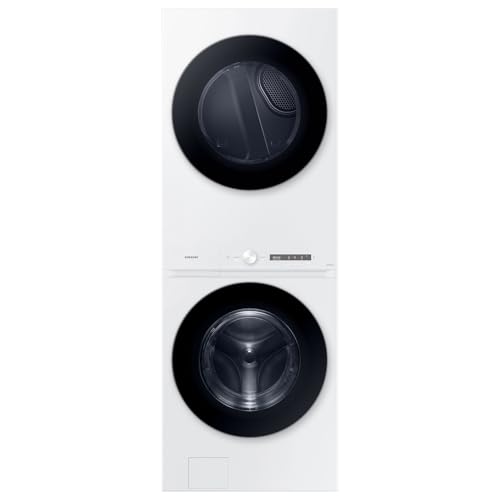
Samsung Bespoke AI Laundry Hub Single Unit — The single-unit alternative
This entry needs its framing stated before its features, because the framing is the honest part: the Samsung Bespoke AI Laundry Hub is not a stacked pair and not a laundry centre in the classic sense. It is a single integrated unit — the title says Single Unit outright — that performs the tower’s whole job from one appliance: a 4.6 cu. ft. washer with steam wash beneath a 7.6 cu. ft. dryer, in white, model WH46DBH100GWA3. It belongs in this guide as the alternative a tower shopper should consciously consider: if the appeal of stacked laundry is the footprint rather than the stacking itself, a purpose-built single unit delivers that footprint with no interface between two machines at all.
The dryer’s fuel, stated in the title: gas. Like the LG and Electrolux entries, this machine belongs in a home with a gas line at the laundry position, and its 7.6 cu. ft. dryer is the second-largest in the guide. The washer, at 4.6 cu. ft., is the largest here by a fraction — so on raw drum arithmetic, this single unit matches or beats both towers while asking the delivery route to accommodate one object with no stacking step at installation.
The Bespoke line’s design intent shows in the proposition: a laundry appliance meant to be seen, with the two functions presented as one designed object rather than as machinery in a cabinet. In the open-plan laundry spaces of newer homes — where the machines stand in a mudroom or off a kitchen, in daily view — that integration has a real aesthetic argument behind it, the same argument that makes households choose furniture-grade pieces elsewhere in the home. The AI branding in the title is the maker’s own; what it does cycle-by-cycle is a product-page question, and this review treats it as such rather than translating marketing into capability.
Weigh the single-unit logic honestly before choosing it. Integration removes the stacking interface and the matched-pair problem forever, and it also removes every future option to separate, replace or rearrange the halves. It is the tower’s trade — permanence for coherence — taken one step further, and it suits buyers who renovate a laundry space once and intend the result to stand for a decade.
- Configuration: single integrated unit — not two stacked machines
- Washer: 4.6 cu. ft., steam wash
- Dryer: 7.6 cu. ft., GAS — stated in the listing title
- Design line: Bespoke; finish: white
- Model: WH46DBH100GWA3
- Where to buy: the Samsung Bespoke AI Laundry Hub Single Unit listing on Amazon — check price on Amazon
Strengths
- The largest washer here and the second-largest dryer, in one footprint.
- No stacking interface, no matched-pair problem, one delivery object.
- Designed to be seen — suits open-plan laundry spaces.
Trade-offs
- Gas dryer — the fuel gate applies exactly as with the towers.
- Total integration: nothing can be separated or individually replaced, ever.
- Smart-feature value depends on claims the title does not enumerate.
Best for: renovators with a gas hookup building a laundry space in one decisive purchase. Not suited for: anyone who values the option to replace one half at a time — that option is the Equator set’s whole design.
The GE and Whirlpool Laundry-Centre Class — The Legacy Towers
Beyond the linked listings stands the class that invented this category: the factory laundry centres long sold by GE and Whirlpool, the tall one-piece towers that have stood in apartment closets, rental units and utility rooms for decades. They are discussed here without a link because this guide’s pool contains no listing that represents the class, and attaching one maker’s random marketplace offer to a class-wide discussion would mislead more than it helped. What can be said at class level is still worth knowing as you shop.
The class’s virtues are institutional. These towers are the machines property managers specify when a hundred rental units need identical laundry: proven configurations, parts available everywhere, and controls a new tenant understands without a manual. Their washers are typically more modest in capacity than the 4.5 cu. ft. towers linked above, their feature lists shorter, their finishes uniformly white and their design language unchanged across model years — a conservatism that reads as dullness in a showroom and as wisdom in a service van.
The class also teaches the category’s central caution. A one-piece centre concentrates risk: when an ageing tower’s washer half fails beyond repair, the working dryer half goes with it. Generations of owners have accepted that trade for the footprint, and the linked towers in this guide inherit it. If the trade troubles you, the answer is architectural, not brand-level — choose a separable stack like the Equator set, or two machines on a stacking kit, and accept the kit’s own small complexities instead.
Shop the class, if it appeals, through the makers’ own channels and major appliance retailers, verifying width, fuel and capacity per model as this guide has modelled throughout. What you are buying there is not a specification victory; it is the deepest service network in the category and a design that has been repaired a million times before yours.
- Configuration: one-piece factory laundry centres, class-level discussion
- Typical class traits: modest washer capacities, simple controls, white finishes
- Class strength: parts and service availability built over decades
- Class caution: one-piece construction retires both halves together
- Specifications vary by model — verify width, fuel and capacity for any specific unit
Strengths
- The most serviceable, best-understood towers in the category.
- Simple controls suit shared and rental households.
- A proven answer where a tower must simply work for years.
Trade-offs
- Capacities and features trail the linked flagship towers.
- One-piece risk concentration, as with all centres.
- No single verified listing anchors the class in this guide’s pool.
Best for: landlords, property managers and buyers who prize serviceability over specification. A poor fit for: households wanting the largest drums or steam features — the linked towers above carry those arguments.
Towers and Stacks, Compared on Configuration and Fuel
| Stacked option | Configuration | Washer | Dryer and fuel | Kit and delivery notes |
|---|---|---|---|---|
| LG WashTower Stacked Smart Laundry Center | One-piece centre | 4.5 cu. ft. | 7.4 cu. ft., gas | Single cabinet; centre controls |
| Electrolux Laundry Center 4.5 Washer 8.0 Gas Dryer | One-piece centre | 4.5 cu. ft. | 8.0 cu. ft., gas | Single cabinet; 27-inch width stated |
| Equator Premium Stackable Washer and Vented Dryer Set 110V | Two-machine stack | 1.62 cu. ft. / 15 lbs | 3.5 cu. ft., vented electric, 110V | Separable halves |
| Splendide Stacked Washer and Dryer Bundle with Vent Kit | Two-machine stack | Not stated in title | Not stated in title | Vent kit and SK04 stack kit included; freight delivery |
| Samsung Bespoke AI Laundry Hub Single Unit | Single integrated unit | 4.6 cu. ft. | 7.6 cu. ft., gas | Nothing to stack |
| The GE and Whirlpool laundry-centre class | One-piece centres | Modest, varies by model | Varies by model | Shop through maker and retailer channels |
How Much Vertical Room Does a Tower Really Need?
More than the cabinet’s height, and the difference is where installs fail. A tower needs its own height plus the room to tilt and level it during placement, plus clearance above for the dryer’s vent connection to be made and inspected, plus — in closets — the door’s header considered as part of the route rather than part of the room. Measure the closet’s ceiling, then measure the doorway the tower must pass standing or tilted, then check for the silent thieves of vertical space: a shelf, a water heater’s top, a sprinkler line, a sloping ceiling in an under-stair closet. The towers in this guide are full-height appliances; the Equator set, being two compact machines, forgives low ceilings that a one-piece centre cannot negotiate at all.
Depth deserves the same scepticism. A stacked unit’s stated depth is the cabinet’s; the installed depth includes the vent hose’s bend behind the dryer and the water hoses’ loop behind the washer, and closets are routinely shallower than the sum. Push any tower’s stated depth out by the space its connections need before you promise it a closet, and confirm the door still closes on the result.
Gas or Electric: How Should a Tower Buyer Decide?
By what the house already has — this is the least philosophical decision in the guide. If a gas line and a vent already serve your laundry position, the gas towers here are legitimate, efficient contenders with the largest dryers in the roundup. If the position is electric-only, adding gas is a building project whose cost and approvals belong in a renovation budget, not an appliance purchase, and the honest shortlist shrinks to the 110V Equator set among the stacks — or leaves the stacked category entirely for the compact pairs and combos covered elsewhere on this site. Buyers furnishing small rooms generally learn to love this kind of constraint-led shortlist: it is the same discipline that makes a chair work in a child’s room, where scale and safety filter the field before style speaks — a filter applied thoroughly in Best Kids’ Reading Chairs.
One asymmetry is worth knowing. Converting an electric position to gas is a project; converting your habits to a 110V set is a purchase. Households that expect to move within a few years should weigh that asymmetry, because the separable electric set leaves with you and the installed gas tower largely stays with the house.
How Do You Live With a Tower Day to Day?
The transfer is the ritual: wet laundry moves upward, from a washer at knee height to a dryer at chest height, and a laundry basket staged on a stool or the washer’s own top becomes part of the choreography. Households adapt within a week, and many come to prefer the arrangement — the dryer’s door at standing height is genuinely kinder than a floor-level one. The habits that matter are small ones. Clear the dryer’s lint screen every load, because a tower’s vent run is usually longer than a side-by-side’s. Leave the washer door ajar between washes, as with any front-loader. And learn your tower’s sounds in the first month, when a new rattle is a coin or a levelling foot, not yet a bearing.
Children and shorter adults deserve a thought in tower households. The washer is reachable by everyone; the dryer’s controls on a classic centre may not be, which is precisely the problem LG’s centre-control design answers. If several household members share laundry duty, control height is a household feature, not a personal one — weigh it the way you would weigh a desk chair’s fit for the person who actually sits in it, a fit-first argument made in detail in Best Compact Desk Chairs.
What Goes Wrong With Stacked Installs?
The classics are geometric. A tower ordered against a width measured at the closet’s widest point, delivered to a doorway narrower than the cabinet. A gas centre ordered for an electric home — the failure this guide’s fuel printing exists to prevent. A two-machine stack assembled without its proper kit, or with the kit of a different model, standing as a wobble with a warranty voided. A vent crushed flat behind a pushed-back dryer, halving the machine’s drying ability while its owner blames the drum. Every one of these is a measurement or a reading failure, not a machine failure, and every one is preventable in the hour before ordering rather than the week after delivery.
How Does Service Work When One Half of a Tower Fails?
The answer divides cleanly by architecture, and it is worth understanding before the purchase rather than during the breakdown. With a two-machine stack — the Equator set, the Splendide bundle — a technician services the failed machine, and if the failure is terminal, that machine alone is replaced; the survivor keeps working, and laundry continues in degraded form rather than stopping. With a one-piece centre, the service visit addresses the whole cabinet: many repairs are still component-level, a pump or a belt or a board, but a catastrophic failure in one half raises the question of retiring a cabinet whose other half works perfectly, and that question has no comfortable answer at year nine.
Parts availability softens the dilemma unevenly. The legacy class discussed in the prose entry enjoys the deepest parts pipeline in the category, which is a large part of why those towers remain in service for decades. The flagship towers from LG, Electrolux and Samsung sit inside national service networks of their own. The compact sets draw on smaller networks, balanced by the fact that their failed half can be swapped by the owner without a technician’s visit at all. None of this argues for one architecture absolutely; it argues for pricing the service story into the purchase, the way you would price a warranty, because on a ten-year appliance the service story is not a footnote — it is a chapter.
What Should You Verify on the Product Page Before Ordering a Tower?
Five things, in order. The exact external dimensions — height above all, since towers fail on height more than on any other axis — taken from the model’s specification rather than from a category average. The fuel and electrical requirements, confirmed against your laundry position’s actual supply, including whether a gas model needs a standard electrical outlet as well for its controls and drum motor, as gas dryers generally do. The vent position: a dryer that vents from the back needs depth behind it, and some closets only forgive a side-venting arrangement. The door swing of both machines, because a tower in a closet whose doors cannot fully open is a tower you load through a gap. And the delivery terms — a one-piece centre is a tall, heavy freight-like object even when it ships by standard delivery, and the Splendide bundle states freight outright; know which service is bringing your machine, what access it needs, and whether placement and packaging removal are included or are yours to arrange.
Verification has a second, quieter layer: the stacking question for sets. If you are assembling a stack from a set, confirm that the stacking arrangement is the maker’s own — the kit named for those models, the configuration shown in the maker’s documentation — and not a marketplace improvisation. The bundle in this guide that includes its SK04 kit in the title is the pattern to demand from any set you consider.
Noise, Vibration and the Floor Under a Tower
A tower concentrates a washer’s spin forces at the base of a tall cabinet, and tall cabinets amplify what floors forgive in shorter machines. The rules are the usual ones, applied with less margin for error. The floor must be level and, ideally, rigid; a tower on a sprung timber floor will announce every spin cycle to the room below, and levelling feet adjusted once at installation and checked after the first dozen cycles are the difference between a tower that hums and one that travels. Loads matter as much as floors: a single heavy item spun alone unbalances any front-load drum, and in a tower the resulting vibration has a lever arm to work with. Balanced loads are not a courtesy to the machine; they are the machine’s operating conditions.
No title in this guide states a noise figure, so treat any quietness claim you meet on a product page as a prompt to ask what was measured and how. What you control — floor, level, load balance, closet door — accounts for more of the lived noise than the differences between these makers’ motors, and it is all addressable on installation day for the price of attention.
Who Should Not Buy a Tower at All?
Households whose laundry includes regular oversize items that need a washer’s full opening without a dryer overhead dictating the room’s layout. Anyone whose laundry position lacks the ceiling height, measured honestly, tilting included. Renters in all-electric units, for whom the gas towers are irrelevant and the one-piece centres are an installation their lease rarely welcomes — the separable 110V set is the exception that fits rental life. And households where several members of very different heights share laundry duty and the chosen tower’s controls sit beyond someone’s reach; an appliance one person cannot operate is a chore permanently reassigned, and households feel that assignment for years. The stacked category is a brilliant answer to a specific geometry. Where the geometry is absent, a side-by-side pair or a combo serves better, and this site’s neighbouring guides exist for exactly those rooms.
How Does a Tower Change Laundry Day for a Family?
The change is mostly choreography. A side-by-side pair lets two people work the transfer together, one unloading the washer while the other loads the dryer; a tower serialises the ritual around one standing position, which suits the single-operator laundry that most households actually run. The dryer’s elevation, initially strange, becomes the arrangement’s quiet pleasure: folding straight from a chest-height drum onto a nearby surface, with no crouching, is kinder across a week of loads than any feature on a specification sheet. The washer’s lower door asks the one crouch of the cycle, and a small stool or a laundry basket at the right height answers it.
Capacity discipline tightens slightly in a tower household, for a subtle reason: the dryer’s drum overhead is so large — 7.4 to 8.0 cu. ft. in the flagship towers — that the washer’s 4.5 cu. ft. can feel like the bottleneck it is. Families learn to run the washer at its comfortable fill and let the dryer loaf, rather than stuffing the washer to feed the bigger drum. That discipline, learned in the first month, is the difference between a tower that serves a family of five and one that is always somehow behind.
What Does the First Month With a Stacked Machine Teach?
It teaches the vent’s importance, usually by demonstration. Towers are pushed into closets, and a vent hose bent too sharply behind the dryer announces itself as drying times that stretch week by week as lint colonises the restriction. Pull the machine forward once in the first month, inspect the hose’s run, and shorten or reroute it if it kinks; the machine you set up carefully in week three is the machine that dries properly in year three. The first month also teaches the household’s true load size, which is rarely the size imagined at purchase — most families discover their genuine load is smaller than feared, and that the tower’s capacity anxiety was a purchase-day ghost.
Finally, the first month is when the documentation habit pays. Photograph the installed tower, the hose connections and the data plates of both halves — or of the cabinet — and keep the images with the manuals. Every future service conversation, warranty claim or parts order starts from those plates, and a tower in a closet is an awkward object to re-photograph under breakdown conditions.
Reading the Titles: What This Category’s Listings Tell and Hide
A final skill, because you will shop beyond this guide: learn what a stacked listing’s title is doing. The good titles in this roundup — the Electrolux centre’s, above all — state configuration, width, both capacities and fuel in one breath, and a title that complete is a seller confident the facts favour the machine. Titles that lead with a model number and stop, or that bury the fuel in a feature list, are asking you to finish the specification yourself; sometimes, as with the Splendide bundle, the reason is a marketplace character limit rather than evasion, but the buyer’s duty is identical either way. And titles naming a single component — a board, a belt, a stacking kit sold alone — are parts listings wearing the category’s keywords; the kit alone is a legitimate purchase for a set you already own, but it is not laundry equipment, and the moment a search results page blurs that line is the moment to slow down and read every title as if it were a contract, which, in the ways that matter, it is.
The same reading skill protects you on capacity. A tower’s headline number, where only one is printed, is usually the dryer’s — the larger drum — because larger numbers sell. This guide has printed both numbers wherever the titles gave both, and flagged every case where they did not. Carry that habit to any listing you open: find the washer’s figure first, since the washer meets the dirty laundry first, and let the dryer’s figure be the pleasant surplus it is designed to be.
Final Recommendation
Choose by fuel first and architecture second. In a gas-equipped home, the Electrolux centre is the specification leader — the largest dryer in the guide on a stated width — while the LG WashTower is the ergonomic leader, and the Samsung Hub is the choice for a renovated space where the appliance is part of the room’s design. In an electric-only small space, the Equator set is the honest stack: modest drums, total separability, no building work. The Splendide bundle owns the confined-bay brief, kits included. And the legacy centres remain the serviceability benchmark against which all of them should be judged. A tower bought with its fuel confirmed, its route measured and its architecture chosen deliberately will stand in its closet doing family laundry for years — which is, in the end, the only verdict a stacked machine is ever really asked to earn.
Frequently Asked Questions
Is a laundry centre the same thing as a stacked washer and dryer?
Related, not identical. A laundry centre is one factory-built cabinet containing both machines. A stacked set is two separate machines joined by a stacking kit. Centres install as one object and retire as one object; sets can be separated, moved and replaced half at a time.
Why are so many of the towers in this guide gas?
Because this pool’s full-size towers happen to be gas models — the LG, Electrolux and Samsung entries all state gas dryers in their titles. Gas towers suit homes already plumbed for them. Electric-only homes should look at the 110V Equator set here, or at compact electric pairs, rather than treating gas as a surmountable detail.
Can I stack any washer and dryer I already own?
Only with the maker’s stacking kit for those exact models, a level floor and the dryer on top. Improvised stacking is unsafe and voids warranties. The Splendide bundle in this guide shows the correct pattern: the kit is a named, included component, not an afterthought.
What is a control board doing in search results for stacked washer dryers?
It is a replacement part for repairing a laundry centre, surfaced because its listing title names the machines it fits. It is not a washer dryer, and this guide excludes parts from its picks as a matter of policy.
Does the Samsung Laundry Hub count as a stacked washer dryer?
It performs the same job on the same footprint, but it is a single integrated unit rather than two stacked machines — its title says so. This guide includes it as the alternative to consider, framed exactly that way, rather than pretending it is a stack.
How tall a closet do I need for a full-size tower?
Taller than the cabinet: allow for tilting during placement, the vent connection above or behind the dryer, and any shelf or line crossing the space. Measure the doorway route as carefully as the closet itself, and compare against the specific model’s stated dimensions on its product page.
Related Guides
Stacked laundry is the vertical answer to a floor-plan problem; the horizontal small-space answer lives in the compact washer guides. If your space is tight but your machines need not tower, start with Best Front-Load Washers in Compact Sizes and build the pair that your room, rather than your ceiling, suggests — measuring the floor space with the same care this guide asked you to give the vertical, because a compact pair still needs its doors, its hoses and its owner accounted for.



[…] in a laundry-equipped cottage will recognise the same measure-twice thinking behind our guide to Best Stacked Washer Dryers, where vertical space gets the same honest […]