What's inside
- Key Takeaways
- Quick Picks
- How Did We Choose These Media Room Chairs?
- The Six Seats, Compared on What the Titles Actually Claim
- What Room Measurements Decide a Theater Seat Purchase?
- How Should Seats Be Arranged for Screen, Sound and Aisles?
- How Should Genuine Leather Theater Seating Be Cared For?
- Why Does Hide Outperform Synthetics in a Dark Room Specifically?
- How Do Tray Tables, Lighting and Charging Actually Get Used?
- Which Mistakes Do Media Room Buyers Make Most Often?
- Final Recommendation
- Frequently Asked Questions
- Related Guides
As an Amazon Associate I earn from qualifying purchases. This post may contain affiliate links at no extra cost to you.
cottageverdict.com is reader-supported. When you buy through links on our site, we may earn an affiliate commission.
Where to buy: each theater seat below links to its Amazon listing, where you can check price on Amazon and confirm the row configuration — a single seat or a row of two — plus the current finish options before ordering. Configuration is the very first fact to verify in this class, because two of the makers here sell both singles and pairs under near-identical names that differ by only a few words.
The best genuine leather media room chairs sit at the opposite end of the honesty spectrum from the classes where “leather” is a rumour. Here, the word is the entry ticket: every pick below carries genuine leather or top-grain leather wording in its own listing title, and this guide holds each one to exactly what its title claims — no more, and importantly no less. Top-grain is the upper layer of the hide, corrected and finished for consistency; genuine leather is the broader honest term for real hide. Both are the actual material, and in a media room — where a seat is used in the dark, for hours, for years — hide’s durability and the way it warms to the sitter are functional virtues, not luxuries.
One pick requires its wording explained rather than merely repeated. The Lexicon seat is described by its maker as “top grain leather match”: genuine top-grain leather on the surfaces your body touches, with a matched synthetic material on the outer sides and back where a viewer never makes contact. That is a legitimate, long-established construction in theater seating, priced below full-hide chairs — provided it is bought knowingly, which is why this guide explains it in the introduction instead of letting the word “match” slip past in a specification list. Bought knowingly, it is a sensible allocation of money; bought carelessly, it is the one disappointment this class can still produce.
It is worth pausing on why this class sustains genuine material at all, when its neighbouring classes have gone synthetic almost entirely. A media room seat is bought the way a mattress is bought — as infrastructure for a daily ritual, expected to serve for a decade, and judged every single evening. Purchases with that profile tolerate a premium for the material that ages best, because the cost is divided by thousands of sittings. The accent chair bought for a corner’s appearance divides its cost by glances; the theater seat divides by hours. That arithmetic, more than any romance about hide, is what keeps genuine leather alive in this one category — and it is why this guide can recommend these seats without the apologetic tone the synthetic classes require.
The other honesty this guide owes you concerns what dominates search results for this phrase. Rows of faux-leather theater seating vastly outnumber the genuine listings, and they are not linked here — not because they are contemptible, but because this article’s promise is genuine leather, and a guide that quietly fills its ranks with synthetics has broken the only promise that brought you to it. The faux rows are named at class level as the budget contrast: if their price is what your room can carry, shop them as what they are, with the care expectations synthetics carry. The six below are the verified hide end of the market: two makers of rows and singles, a dual-motor flagship, a lay-flat design with arm storage, a zero-gravity single, and the leather-match wall hugger.
Key Takeaways
- Every pick carries genuine or top-grain leather wording in its own title — the material claim here is verified, not assumed.
- The Lexicon is leather match: real top-grain on contact surfaces, matched material elsewhere, explained openly and priced accordingly.
- Configuration is a real decision — PBRO sells a row of 2 and a 1-seat under similar names; check which you are ordering.
- Power features recur across the class: power headrests, USB charging, tray tables, cup holders and ambient lighting.
- The comfiroom is the only dual-motor pick, separating back and footrest movement for precise positioning.
Quick Picks
| Pick | Badge | Why it earns its place |
|---|---|---|
| PBRO Genuine Leather Home Theater Seating Row of 2 | Row for Two | A genuine leather loveseat row with power headrest, tray tables and ambient lighting for the couple’s cinema. |
| comfiroom Top-Grain Leather Home Theater Seating | Dual-Motor Flagship | Top-grain, dual-motor, zero gravity, USB-C — the most mechanically complete single seat here. |
| PBRO Top Grain Leather Theater Recliner 1-Seat | Single Zero-Gravity | PBRO’s top-grain single with power headrest and ambient lighting for a one-seat theater corner. |
| Watson & Whitely Genuine Leather Power Recliner | Lay-Flat With Storage | Genuine leather, lay-flat recline, arm storage and cup holders — the feature-hoarder’s single seat. |
| Weilianda Top Grain Leather Home Theater Seat Black | Tray Table Single | Top-grain single with zero gravity, power headrest and tray table in classic black. |
| Lexicon Top Grain Leather Match Power Recliner | Wall Hugger Value | Leather-match construction and a wall-hugger mechanism for smaller rooms, in dark brown. |
How Did We Choose These Media Room Chairs?
The filter was the title itself. We kept only listings whose titles state genuine leather or top-grain leather — the two honest hide wordings — plus the single leather-match listing, included deliberately and labelled relentlessly, because its construction is legitimate and its price point serves rooms the full-hide chairs cannot. Everything else in the search results, however handsome its photographs, was set aside: a genuine-leather guide built from faux listings would be a fraud with good typography. Within the verified set, we spread the picks across configurations — a row of two, four full-hide singles with different mechanical emphases, and the wall hugger — because media rooms differ more in shape than in taste.
Feature claims were taken only as titles state them: power headrests, dual motors, zero-gravity positioning, tray tables, USB charging in its several forms, ambient lighting, arm storage. Where a title mentions massage and heat — one pick does — this guide treats those strictly as comfort features, the way it treats every such mention across this site, with no medical implication attached. Readers comparing the powered end of this class against swivel seating that turns toward conversation as readily as toward the screen will find that contrast drawn in Best Swivel Reclining Chairs.
We also weighted maker coherence. PBRO appears twice because its row-of-two and its single are genuinely different purchases, and a buyer comparing them needs both in one place with the naming trap — similar titles, different configurations — flagged in the open. The rest of the list is one seat per maker, chosen where the title’s specification was most complete, because in a class at this price level, a listing that cannot describe its own motors and materials has told you something important.
One further note on method, since this class invites it: we did not treat price as evidence of material. Faux theater rows are sold at prices that overlap the genuine singles, and hide seats are discounted into faux territory often enough that the number on the listing proves nothing in either direction. The title’s material line is the only witness this guide cross-examined, and readers should adopt the same habit permanently — in this category, and in every leather-adjacent category on the site, the wording is the product, and everything else is staging.

PBRO Genuine Leather Home Theater Seating Row of 2 — Row for Two
A media room built for two people who watch everything together should begin here: a genuine leather home theater loveseat row, power reclining, with a power headrest, USB charging ports, tray tables, cup holders and ambient lighting, in black. The row-of-two format is a commitment to a particular social geometry — two seats, joined, sharing the room’s centre — and genuine leather is the right upholstery for it, because a loveseat row concentrates wear on the same two cushions every night, and hide is the surface that absorbs that concentration gracefully for years.
The feature set is the full theater grammar. Tray tables turn the row into a dining-capable cinema for the households that eat in front of films; cup holders keep drinks out of the upholstery’s story; ambient lighting gives the row the cinema glow that sells the room to guests; the power headrest solves the reclined viewer’s oldest problem, the screen watched over the tops of one’s own feet with a cricked neck. USB charging at the seat ends the trailing-cable era. None of these is exotic anymore, but their combination in genuine leather, in a two-seat row, at a single purchase, is the complete package this class promises.
The cautions are configurational. A row of two cannot be split later into singles when the room changes, and its width must be measured against the room and the doorway with the seriousness a sofa deserves. Households of three or four viewers should not stretch this format; they should build rows from the singles below, where the count can grow. For the two-person cinema — the couple’s room, the dedicated den — this is the guide’s most complete single purchase.
The loveseat format also changes the viewing itself in a way rows of singles cannot. Two people sharing a continuous seat share the evening’s small negotiations — the shared tray, the passed bowl, the blanket that covers both — and theater rooms built around couples consistently choose the joined row for that reason, even when singles would be more flexible. Genuine leather serves the format’s longevity, too: a loveseat cannot hide wear by rotating chairs, since both seats age in place, in the light, together. Hide’s capacity to age as a deepening rather than a deterioration is worth its premium precisely here, where the same two cushions will host a decade of Friday nights in exactly the same spots.
- Material: genuine leather, black
- Format: row of 2 loveseat theater seating
- Power: power recline and power headrest
- Features: USB charging, tray table, cup holder, ambient lighting
- Where to buy: the PBRO Genuine Leather Home Theater Seating Row of 2 listing on Amazon — check price on Amazon
Strengths
- The only genuine leather two-seat row here — one purchase, whole cinema centre.
- Full theater feature grammar: trays, cups, light, charge, power headrest.
- Hide upholstery suits the concentrated wear of a shared nightly seat.
Trade-offs
- A joined row cannot be reconfigured into singles later.
- Two seats only — larger households must build from singles.
- Sofa-scale delivery and doorway measurements apply.
Best for: two-person media rooms wanting one complete, genuine leather row. Not suited for: growing households, whose seat count will change — build from the singles instead.
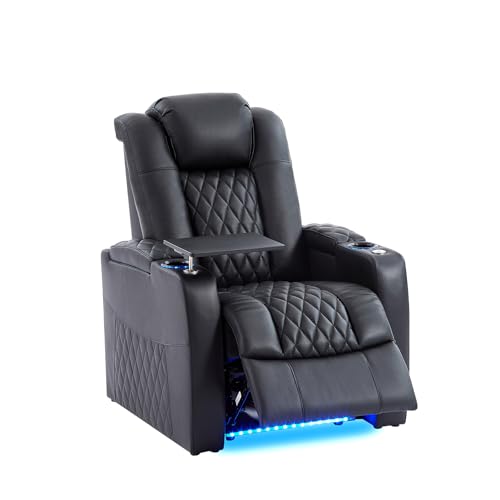
comfiroom Top-Grain Leather Home Theater Seating — Dual-Motor Flagship
The comfiroom is the engineer’s pick: top-grain leather, a dual-motor power recliner mechanism, zero-gravity positioning, motorized theater format in a row of one, with USB-C charging, an adjustable headrest and a tray table. Dual-motor deserves its explanation, because it is the specification that separates flagship theater seats from ordinary ones. A single motor moves back and footrest together along a fixed relationship; two motors let the viewer set the footrest and the back independently, so the seat can be feet-up-and-upright for a thriller’s tense half, or fully laid back for the credits, without compromise at either end.
Zero gravity, in theater-seat language, names the reclined posture that raises the knees toward heart level and spreads the sitter’s weight along the back — a comfort position, described here as the listings describe it, valued because long films punish any single posture and this one is the class’s favourite answer. USB-C rather than the older USB-A acknowledges the current generation of phones and tablets, a small specification that dates a design’s seriousness. The adjustable headrest completes the ergonomic set: recline angle, leg angle and head angle all independent, which is as close as a chair comes to fitting its viewer rather than the reverse.
As a row of one, this is a building block: buy one for a single-seat den, or line up multiples for a full theater row, with the confidence that each viewer’s position is their own — the dual-motor argument actually strengthens in rows, where no two viewers agree on an angle. The price of the flagship mechanics is the flagship’s usual one, and buyers whose viewing is mostly upright may be paying for independence they rarely use; the simpler power singles below exist for them. For the viewer who adjusts constantly and notices everything, this is the seat the rest of the list is measured against.
There is a subtler dividend to dual motors that only appears over a whole evening: posture rotation. A viewer who can change the relationship between back and legs every twenty minutes without standing ends a three-hour film in a different state from a viewer locked into one motor’s fixed curve, however comfortable that curve was at minute ten. Theater seating is sat in longer, more continuously, than almost any other furniture in the house — longer than dining chairs, longer than most sofas between breaks — and mechanisms that permit micro-variety are the class’s real ergonomic frontier. The comfiroom’s specification reads like it was written by someone who had sat through the long film and taken notes, which is the highest compliment a specification can earn.
- Material: top-grain leather, black
- Format: row of 1 theater seat
- Mechanism: dual-motor power recline, zero gravity
- Features: USB-C charging, adjustable headrest, tray table
- Where to buy: the comfiroom Top-Grain Leather Home Theater Seating listing on Amazon — check price on Amazon
Strengths
- Dual motors give independent back and footrest control — the flagship trait.
- Top-grain leather over the whole seat.
- USB-C charging matches current devices.
Trade-offs
- Flagship mechanics carry the flagship end of the class’s pricing.
- Mostly-upright viewers may underuse the independent adjustment.
- Singles must be multiplied for rows, at per-seat cost.
Best for: discerning single-seat buyers and rows where every viewer sets their own position. A poor fit for: casual viewers content with one-motor simplicity.

PBRO Top Grain Leather Theater Recliner 1-Seat — Single Zero-Gravity
PBRO’s second entry is its top-grain single: a zero-gravity theater recliner with power headrest, USB charging and ambient lighting, in black, sized for one. Read against the row of two above, this seat is the same maker’s answer to a different room — the den with one devoted viewer, the living room corner being converted to a screening spot, or the first unit of a row that will grow seat by seat as budget allows. The top-grain wording matters here: where the row claims genuine leather broadly, this single specifies the top-grain grade outright.
Zero gravity plus a power headrest is the essential theater pairing, and this seat keeps the combination while dropping the row’s dining apparatus — no tray table is claimed in this title — which suits viewers whose cinema ritual is a drink in the holder and nothing more. Ambient lighting in a single sounds indulgent until the first film night, when the soft glow under the seat turns a chair in a living room into a place with its own atmosphere; atmosphere, in media rooms, is half the product. USB charging at the seat remains the quiet daily convenience that owners mention most after a month.
Choose between the PBRO siblings by configuration, not by quality anxiety: the row is a loveseat commitment, this single is a flexible unit, and mixing the maker’s singles builds a row with an armrest between every viewer — which some households prefer to the loveseat’s shared middle. Measure for recline clearance behind the seat as carefully as for width; zero-gravity positions spend floor space backward as well as forward, and a seat placed by its upright footprint alone will introduce itself to the wall behind it on the first evening.
The growth path deserves one practical note: if you intend to add seats later, buy the second sooner rather than later, and store nothing against the first in the meantime. Hide is a natural material with batch character; a single bought this year and its partner bought in three years may differ in grain and sheen by enough to notice in a dark room’s low light — not a defect, but a fact worth planning around. The same advice applies to the Weilianda below. Makers’ models also revise over time, and a discontinued variant cannot be matched at all. A row assembled within one season is a row that will look assembled forever; a row assembled across years will tell its own history, which some owners love and others should avoid by timing.
- Material: top grain leather, black
- Format: 1-seat theater recliner
- Mechanism: zero gravity power recline, power headrest
- Features: USB charging, ambient lighting
- Where to buy: the PBRO Top Grain Leather Theater Recliner 1-Seat listing on Amazon — check price on Amazon
Strengths
- Top-grain specified outright, in a flexible single format.
- Zero gravity and power headrest — the essential theater pairing.
- Builds into rows seat by seat as a room grows.
Trade-offs
- No tray table claimed, unlike the row and the comfiroom.
- Recline clearance must be planned behind the seat.
- Per-seat pricing makes full rows a considered purchase.
Best for: single-seat dens and growing rows built one chair at a time. Not the right match for: couples wanting the joined loveseat format in one purchase.

Watson & Whitely Genuine Leather Power Recliner — Lay-Flat With Storage
The Watson & Whitely is the maximalist single: genuine leather, LED lighting, a lay-flat recline, a power headrest, arm storage and cup holders, pitched at home theater and living room alike. Lay-flat is its headline difference — where theater seats recline deeply, a lay-flat mechanism approaches the horizontal, turning the chair into a legitimate nap surface and the media room into a guest-overflow bedroom of last resort. Arm storage is the feature owners underestimate at purchase and praise at month three: remotes, glasses and the charging cable live in the chair, and the room’s surfaces stay clear.
Its title also carries massage and heat wording, and this guide handles that the way it handles every such mention: as comfort features, plain and simple — warmth and vibration for a pleasant evening’s viewing, with no medical promise made or implied. Within a theater seat, heat’s honest role is cinematic: a warm seat in a cool, dark room is a pleasure, and that is the whole claim. Buyers choosing this chair should choose it for the lay-flat mechanism, the storage and the hide, with the comfort features as a bonus rather than the reason.
The living-room pitch in its title is worth believing. Among these six, this is the seat that survives being the room’s main recliner rather than a dedicated theater unit — storage arms and lay-flat serve daily life as well as film night, and genuine leather in black converses with ordinary sofas without demanding a cinema around it. The trade is focus: dedicated theater builders may prefer the comfiroom’s dual motors or the PBRO row’s trays. For a room that is a living room by day and a cinema by night, this is the most fluent bilingual seat here.
Arm storage, praised briefly above, deserves its fuller case because it changes a room’s tidiness economy. Every media setup generates the same diaspora of small objects — two remotes, glasses, a phone, a cable, the streaming stick’s tiny controller that vanishes weekly. A chair that swallows them at arm’s reach ends the nightly excavation of sofa cushions and the slow migration of remotes toward the kitchen. In a dual-purpose living room, where the cinema must disappear by morning, that storage is the difference between a room that converts in one minute and a room that converts in fifteen. Features in this class are often ranked by spectacle — lighting first, motors second — but the owners’ long-term gratitude reliably belongs to the unglamorous ones, and storage is this pick’s quiet claim on it.
- Material: genuine leather, black
- Format: single power recliner
- Mechanism: lay-flat recline, power headrest
- Features: LED light, arm storage, cup holders; massage and heat as comfort features
- Where to buy: the Watson & Whitely Genuine Leather Power Recliner listing on Amazon — check price on Amazon
Strengths
- Lay-flat recline doubles the seat as a nap and guest surface.
- Arm storage quietly solves the media room’s remote problem.
- Genuine leather format works in living rooms, not only theaters.
Trade-offs
- Lay-flat needs the most rear clearance of any pick here.
- Single-motor class mechanics, unlike the dual-motor flagship.
- Feature breadth means some owners will never use every function.
Best for: living rooms that become cinemas nightly, and nappers between films. Poorly suited to: tight rooms where a lay-flat mechanism cannot fully open.

Weilianda Top Grain Leather Home Theater Seat Black — Tray Table Single
The Weilianda is the traditionalist’s single: top grain leather, black, row of one, zero gravity, power headrest, tray table, electric recline. Its specification reads like the class’s founding document — every core theater feature present, nothing exotic claimed — and that completeness is its argument. Where the comfiroom competes on mechanism and the Watson & Whitely on breadth, the Weilianda competes on being the canonical theater seat in top-grain hide, the chair a buyer pictures when they type this search phrase.
The tray table deserves its sentence, because it divides theater households into two durable tribes: those who eat in front of films and those who consider the idea barbaric. For the first tribe, a tray table at every seat is not optional, and this single — like the PBRO row — provides it, while the PBRO single and the Lexicon do not claim one. Zero gravity and a power headrest handle the posture; the tray handles the popcorn, the laptop during a streamed meeting, the notebook during a documentary. A seat that serves dinner, work and cinema in one footprint earns its floor in smaller homes.
Nothing in its title reaches for novelty, which also means nothing dates it. Black top-grain with this feature set will look correct in a media room for as long as the hide lasts, and hide, cared for with even minimal attention, is the longest-lived upholstery in this entire batch of guides. Buyers who want the theater seat as the class defined it — no experiments, no omissions — have found their pick; buyers who want a mechanism to admire should sit in the comfiroom’s section a while longer.
Canonical has a second meaning worth noting: repairability and resale of the imagination. A theater seat with the standard feature grammar — power recline, power headrest, tray, zero gravity — is understood by every future buyer, installer and houseguest instantly; nobody needs its manual explained at a party. Exotic mechanisms impress at purchase and puzzle forever after. In a room that will host years of guests, the seat whose every lever is obvious has a hospitality value that flagship specifications cannot match. The Weilianda’s restraint is therefore not an absence of ambition but a different ambition: to be the seat that never needs introducing, in the hide that never needs excusing.
- Material: top grain leather, black
- Format: row of 1 home theater seat
- Mechanism: zero gravity electric recline, power headrest
- Features: tray table
- Where to buy: the Weilianda Top Grain Leather Home Theater Seat Black listing on Amazon — check price on Amazon
Strengths
- The canonical specification — every core theater feature present.
- Top grain leather in a timeless black single.
- Tray table serves the eat-while-watching household fully.
Trade-offs
- No ambient lighting or USB charging is claimed in its title.
- Conventional design offers no novelty for novelty’s sake.
- Row building is per-seat, with per-seat cost.
Best for: traditional theater rooms wanting the complete, classic single seat. A weak match for: buyers who want charging and lighting built into every chair.

Lexicon Top Grain Leather Match Power Recliner — Wall Hugger Value
The Lexicon closes the list with the two qualifications this guide has promised to keep in plain sight. First, its material: top grain leather match, meaning genuine top-grain hide on the seat, back and arms where the body makes contact, with a matched material on the outer frame and rear. Every surface you touch while watching is real leather; the surfaces that face the wall are not, and the price reflects the difference. Second, its mechanism: a wall hugger, engineered to recline while sliding forward, so the seat needs only a few inches of clearance behind it instead of the foot-plus a conventional recliner demands.
That mechanism makes this the small media room’s pick — the spare bedroom conversion, the apartment’s cinema corner, the den where the screen wall and the seating wall are not far apart. Dark brown rather than black also suits those rooms, warming a space that black theater seats can make feel like a cave. USB charging is included, assembly is described as easy in the title, and the stitching detail gives the seat a finished face. As a living-room or bedroom recliner — the listing names both — it is the most domestically flexible design here.
Judge it fairly: against the full-hide singles, the Lexicon trades complete hide coverage for price and placement freedom, and for many rooms that trade is simply correct. The dishonesty would be in hiding the trade, which neither the maker — who prints “match” in the title — nor this guide has done. Buyers who want every panel hide should return to the five picks above with this guide’s blessing; buyers whose room is small and whose budget is finite have, in the Lexicon, the honest version of affordable leather theater seating. Households furnishing a child’s media corner alongside the main room may also glance at Best Hanging Chairs for Kids for the family’s other screen-adjacent seating, in a very different spirit.
Dark brown also deserves defence as a deliberate choice rather than a compromise colour. Black theater seats disappear in a dark room, which is the cinema ideal; brown seats remain furniture when the lights come up, which is the spare-room and bedroom ideal. A dual-purpose room spends most of its hours lit, and a seat that looks like a handsome recliner by day and performs as a theater chair by night is correctly coloured for its actual life. The stitching detail supports that daytime reading, giving the eye a crafted line to follow. Buyers converting a guest room — the commonest media-room project — should weight this pick above its specification rank, because it is the one designed for exactly that room’s double life.
- Material: top grain leather match — genuine hide on contact surfaces, matched material elsewhere
- Format: single wall hugger recliner, dark brown
- Mechanism: wall-hugger power recline, minimal rear clearance
- Features: USB charging port, stitching detail, easy assembly claimed
- Where to buy: the Lexicon Top Grain Leather Match Power Recliner listing on Amazon — check price on Amazon
Strengths
- Real top-grain leather everywhere the body touches, at a match price.
- Wall-hugger mechanism fits small rooms the others cannot.
- Dark brown warms apartment and spare-room cinemas.
Trade-offs
- Outer panels are matched material, not hide — bought knowingly or not at all.
- No tray table or ambient lighting is claimed.
- Single format; rows must be built seat by seat.
Best for: small media rooms and bedrooms needing leather contact surfaces on a finite budget. Not suited for: purists who want hide on every panel regardless of cost or clearance.
The Six Seats, Compared on What the Titles Actually Claim
| Seat | Leather wording | Configuration | Mechanical headline |
|---|---|---|---|
| PBRO Row of 2 | Genuine leather | Row of 2 | Power recline, power headrest |
| comfiroom | Top-grain leather | Row of 1 | Dual-motor, zero gravity |
| PBRO 1-Seat | Top grain leather | 1 seat | Zero gravity, power headrest |
| Watson & Whitely | Genuine leather | Single | Lay-flat, power headrest |
| Weilianda | Top grain leather | Row of 1 | Zero gravity, tray table |
| Lexicon | Top grain leather match | Single | Wall hugger |
Read the leather column as the guide in miniature: five seats of full hide wording, one of match wording, zero of silence. The faux-leather rows that dominate this market’s search results would fill a seventh row of that table with a different word entirely, and they are absent on purpose. Viewers whose evenings mix films with long heated reclines in the living room will find the comfort-feature end of seating surveyed in Best Recliner Massage Chairs With Heat, where the heat and massage wording is handled with the same comfort-only discipline applied to the Watson & Whitely above.
What Room Measurements Decide a Theater Seat Purchase?
Three numbers govern this class: the seat’s width, the room’s width, and the clearance behind the seat at full recline. Rows multiply the first number, and a row that fits the wall on paper may still fail the doorway, the stair turn or the lift — measure the route, not just the destination, and remember that theater seats travel as large, rigid objects. Rear clearance is the measurement buyers most often guess: a conventional power recliner at full stretch can need well over a foot behind its upright footprint, a lay-flat more, and the wall hugger almost none, which is why the Lexicon exists.
Viewing geometry is the second discipline. Screen size and seating distance decide how many seats fit the good viewing cone; a row squeezed wider than the cone gives its end seats a worse evening than a smaller row centred properly. Headrest power, present across this list, forgives some geometry sins by letting each viewer aim their own head, but no headrest fixes a seat placed outside the screen’s honest width. Measure the room, place the screen, then count seats — in that order, and this class stops producing returns.
Seat height and entry deserve a final mention, because theater seats are deep and low by design, and households that host older viewers should think about the exit as carefully as the recline. A seat that lowers a guest gracefully and then strands them at the bottom of a deep cushion has failed its hospitality at the last moment. Power recline helps here — the mechanism returns the sitter upright rather than asking them to climb — and it is one more reason the powered format has become this class’s standard rather than its upgrade. When you test a seat on delivery day, test the full journey: sit, recline, return, stand. The chair that handles all four acts smoothly is the chair that will host gracefully for years.
How Should Seats Be Arranged for Screen, Sound and Aisles?
A media room’s seats serve three masters: the screen, the speakers and the people walking between them. Centre the row on the screen first — an off-centre row is a nightly annoyance no recline angle forgives — then check the row against the room’s sound, since seats hard against the rear wall sit in the worst audio position in most rectangular rooms; even a modest gap behind the row, where clearance allows, improves both sound and the recline geometry. The wall hugger exists for rooms where that gap is impossible, and choosing it knowingly beats discovering the compromise after delivery.
Aisles are the third master and the most neglected. A row that fills the wall leaves its end viewers climbing past knees in the dark; leaving a genuine walkway at one end — ideally the end nearest the door — makes the room hospitable rather than merely equipped. Ambient lighting, present on the PBRO seats, earns its keep exactly here, marking the row’s edge without breaking the film’s darkness. Plan the room from the viewer’s journey — door, aisle, seat, screen — and the furniture decisions, including how many seats honestly fit, mostly make themselves.
How Should Genuine Leather Theater Seating Be Cared For?
Hide in a dark room lives an easier life than hide in a sunlit lounge — no ultraviolet siege — but it meets its own hazards: popcorn oils, drink rings, and the slow drying of heated, air-conditioned air. Wipe the contact surfaces with a soft, slightly damp cloth weekly, work a hide conditioner into the seat and back a few times a year, and keep cups in the holders the makers provided rather than on the arms. The leather-match Lexicon asks for split care: conditioner on the genuine contact surfaces, gentle soap-and-water on the matched panels, and never the reverse.
Mechanisms want a sentence too. Keep the recline path clear — blankets and charging cables migrate into footrest linkages — and run each seat through its full range occasionally if it sits unused, so the motion stays familiar rather than seized. Power headrests and motors are sealed consumer units; their maintenance is really protection from spills at the control panel. Treated this way, a hide theater seat is a decade-scale purchase, and its care routine, honestly totalled, is lighter than the weekly wiping a faux seat in a bright room demands.
Delivery day has its own small protocol in this class. Theater seats are heavy, powered and upholstered in the material you just paid a premium for, so clear the route before the boxes arrive, keep the packaging until each seat has run its full recline cycle under power, and test every function — headrest, USB port, lighting, tray — while the delivery is still a recent event rather than a memory. A motor that fails in month two began failing somewhere; a motor tested through twenty full cycles on day one has declared itself. Register the purchase details somewhere durable, and photograph the material line of the listing you bought from, because the wording you verified is the wording any future warranty conversation will be about.
Why Does Hide Outperform Synthetics in a Dark Room Specifically?
The media room is the one environment where leather’s classic virtues align perfectly with the use. Films are long, so the seat is occupied continuously for hours, and hide’s breathability — modest compared with fabric, real compared with sealed synthetics — tells across a double feature. The room is dark, so the ultraviolet ageing that punishes leather in bright lounges is absent, and the hide’s lifespan stretches accordingly. The viewing is habitual, the same seats nightly, so wear concentrates; hide responds to concentrated wear by polishing and deepening, while coated synthetics respond by eventually cracking at the flex points. Every one of the material’s weaknesses is minimised by this room, and every strength is amplified by it.
Temperature completes the argument. A media room is usually the coolest room in the house by design, and a synthetic seat in a cool room feels cold at first contact and clammy by the second hour. Hide meets the sitter closer to neutral and adjusts. None of this makes the faux rows irrational — their price buys a working cinema for rooms and budgets the hide seats cannot reach — but it explains why this class, alone among the batch’s chair classes, sustains a genuine-leather market at all: the room itself makes the case, nightly, to everyone who sits down in it.
How Do Tray Tables, Lighting and Charging Actually Get Used?
After the first month, owners’ feature rankings invert. Ambient lighting, bought as spectacle, becomes the night-light that lets a viewer cross the room mid-film without waking the picture’s mood — and gets used every single session. Tray tables, bought for dinners, become laptop desks, notebook stands and the household’s second office during streamed work calls. USB charging, bought as a bullet point, becomes the reason phones survive double features and the house’s most contested outlet moves into the armrest. The lesson for buyers is to weight the boring features at purchase: ask not which seat dazzles in the listing, but which seat’s conveniences will still be touched nightly in year three.
The corollary is that missing features should be forgiven where the core is right. The Weilianda claims no charging in its title; a small power strip behind the row cures that for the price of a pizza, while no accessory can retrofit a second motor into the comfiroom’s rivals or hide onto a faux seat. Buy the irreversible things — material, mechanism, configuration — with full attention, and let the reversible conveniences be solved with accessories. That ordering of priorities is the difference between a media room that ages well and one that is re-bought every few years at rising cost and falling patience.
Which Mistakes Do Media Room Buyers Make Most Often?
Ordering the wrong configuration under a familiar name is the first — PBRO’s row and single differ by one phrase in near-identical titles, and this guide has flagged it twice because it is the class’s most expensive misreading. The second is ignoring rear clearance, discovering at the first film that the seat reclines into the wall, the radiator or the walkway. The third is buying faux while believing genuine, the mirror image of the mistake this guide’s filter exists to prevent: in a market where synthetics dominate the listings, the material line must be read, not inferred from price or photographs.
Fourth, buyers over-seat the room, filling the wall with chairs and leaving the end viewers outside the screen’s good angles. Fifth, leather-match is bought unknowingly and judged as a fraud, when the construction is legitimate and the only failure was in the reading — the Lexicon prints its construction in its title, and this guide has explained it three times, because that is how much the distinction matters. Every one of these errors is a measurement or a reading skipped; none of them is a defect in any chair on this list.
A sixth error belongs to the room rather than the chair: forgetting power. Every seat in this guide is electric, and a row of three wants three outlets or a properly rated strip placed where reclining mechanisms will never pinch its cable. Rooms are routinely planned for screens and speakers and then discovered, on installation day, to have one socket in the wrong corner. Walk the room with the seats’ positions marked in tape, find the power, and route it before the furniture arrives — the least cinematic task in the entire project, and the one whose omission is visible at every single screening thereafter.
Final Recommendation
Build the room you actually have. Two devoted viewers: the PBRO row. One exacting viewer, or a row of them: the comfiroom’s dual motors. A growing theater: PBRO or Weilianda singles, added seat by seat. A living room that moonlights as a cinema: the Watson & Whitely, with its storage and lay-flat ease. A small room with a finite budget: the Lexicon, bought with its leather-match construction understood and its wall hugger valued. Every seat here is honest hide where it claims to be — and in this market, that verified sentence is the foundation the whole room is built on.
Before the order is placed, run the unglamorous checklist one final time: configuration named correctly — row or single, and which maker’s naming you are reading; material line re-read in the listing itself, because titles are revised and stock rotates; doorway, stair and room measurements compared against the reclined footprint, not the upright one; and a power outlet located where the seats will actually stand, since a row of power recliners at the end of an extension lead is a cinema with a trip hazard for a centrepiece. Ten minutes of this, and the purchase that arrives will be the purchase that was intended — which, at this class’s prices, is the only acceptable outcome.
Frequently Asked Questions
What is the difference between genuine leather and top-grain leather?
Top-grain is the top layer of the hide, lightly finished for a consistent surface — the grade most quality theater seating uses. Genuine leather is the broader term confirming real hide without specifying the layer. Both are actual leather; this guide repeats each listing’s own wording so you always know which claim a given seat makes.
What does leather match actually mean?
Genuine leather on the surfaces the body touches — seat, back, arms — with a matched synthetic material on the outer sides and back. The Lexicon in this guide is built that way, says so in its title, and costs less than full-hide seats because of it. It is a legitimate construction when bought knowingly.
How much space does a theater recliner need behind it?
A conventional power recliner needs substantial rear clearance at full recline, and a lay-flat design needs the most of all. A wall hugger, like the Lexicon, slides forward as it reclines and needs only a few inches. Check each listing’s dimensions against your room before ordering, and measure with the seat’s reclined footprint, not its upright one.
Are the faux-leather theater rows worth considering instead?
They are the budget end of this market and are sold in large numbers; as synthetics they ask for the wipe-clean, shade-aware care that material always does. They are not linked in this guide because its promise is genuine leather — but a buyer who chooses them knowingly, as faux, is making a legitimate budget decision rather than a mistake.
How long should genuine leather theater seating last?
With the light care described in this guide — weekly wiping, occasional conditioning, spills kept out of the controls — hide theater seating is a decade-scale purchase, and its mechanisms typically set the lifespan before its upholstery does. The dark, cool media room is the kindest environment leather furniture can live in, which is why this class justifies its pricing in a way bright-room leather sometimes cannot.
Can I mix singles from different makers in one row?
You can, but seat heights, arm widths and recline geometries will differ subtly, and a row is where subtle differences are felt nightly. Building within one maker’s line — the PBRO singles, or repeated comfiroom or Weilianda units — keeps the row coherent. If you do mix, place the odd seat at the row’s end, where its difference reads as a designated chair rather than an inconsistency.
Do I need a power headrest?
For reclined viewing, it is the feature that most changes the evening: without it, a deeply reclined viewer watches over their own chest with a strained neck. Five of the six picks here include one. If your viewing is mostly upright, it matters less; if you recline for whole films, treat it as essential rather than optional, and test it through a full feature before the packaging leaves the house, because headrest motors are the hardest-working small mechanism in the entire seat and the first place a lazy unit will confess.
Related Guides
For the room these seats are really built for, see Best Chairs for Home Movies, our wider survey of home-movie seating of every kind, where screen distance and room layout get the full treatment that this leather-focused guide could only summarise in passing here.



[…] the room beyond the desk, the media-room end of generous seating is covered in our guide to Best Genuine Leather Media Room Chairs, where wide powered recliners are judged as cinema […]