What's inside
- Key Takeaways
- Quick Picks
- How Did We Choose These Durable Beach Chairs?
- Side-by-Side: The Six Chairs at a Glance
- Which Features Actually Decide How Long a Beach Chair Lasts?
- How Should You Care for a Beach Chair Between Trips?
- How Does Sand Itself Wear a Chair Out?
- What Seat Height and Recline Range Suit Your Beach Routine?
- How Can You Test a New Beach Chair in Its First Week?
- Which of These Chairs Fits Which Kind of Beach Trip?
- Common Mistakes When Buying a Beach Chair for Durability
- Before You Order, Which Listing Fields Deserve a Slow Read?
- How Long Should a Good Beach Chair Reasonably Last?
- How Do You Set Up a Chair So the Sand Works for You?
- Final Recommendation
- Frequently Asked Questions
- Related Guides
As an Amazon Associate I earn from qualifying purchases. This post may contain affiliate links at no extra cost to you.
cottageverdict.com is reader-supported. When you buy through links on our site, we may earn an affiliate commission.
Where to buy: Amazon sells every chair in this guide through its own listing, linked from the Quick Picks table and again under each detailed review. Prices move with the season, so each listing asks you to check price on Amazon rather than trusting a number printed here.
Finding the best durable beach chairs is less about pretty fabric and more about what survives the third summer. Sand works into every hinge, salt air creeps along frame tubes, and a chair that felt solid in a showroom can start flexing at the rivets after one season of being dragged across a parking lot and folded wet into a trunk. Durability, for a beach chair, is a chain of small decisions: frame metal, fabric weave, how the armrests attach, whether the feet sink or spread, and how honestly the maker states the load the chair can carry.
This guide leans on stated numbers wherever a listing provides them. Four of the six picks publish a weight capacity in their titles, running from 300 lb up to 500 lb, and those figures are labeled pick by pick rather than smeared across the whole list. Frame materials are likewise taken from the titles themselves: aluminum where the listing says aluminum, steel where it says steel. One pick needs an honest framing note up front. The TIMBER RIDGE chair is a camping-quad form — the wide, high-backed folding chair you see at sidelines and tailgates — included here because plenty of beachgoers use exactly that shape on sand and because its stated 500 lb capacity is the highest in the group. It is not a low sand chair, and the review below treats it as what it is.
Seat height turns out to be the quiet durability issue nobody mentions. A chair you have to haul yourself out of gets grabbed by the armrests, torqued sideways, and stressed at exactly the joints that fail first. Two picks here sit noticeably higher than the classic low-slung beach profile — one at 13 inches, one at 17 inches — and that difference changes who should buy what more than any fabric claim does. If low-and-light is your priority instead, our companion guide to Best Low Beach Chairs With Lumbar Support covers the near-the-sand end of the market, where the trade-offs run the other way.
Key Takeaways
- Stated capacities in this group run 300 lb, 350 lb, 400 lb and 500 lb on the four picks whose listings publish a figure; the other two make no capacity claim and are judged on build instead.
- Aluminum frames resist salt-air corrosion better over multiple seasons, while the steel-frame rocker here trades some of that resistance for width and a stated 400 lb capacity.
- Higher seats — 13 inches on the Tommy Bahama Big Boy and 17 inches on the Homevative Cooler+ — are easier to get out of, which reduces the sideways wrenching that loosens armrest joints over time.
- Backpack straps appear on four of the six picks, and a chair that is easy to carry is a chair that does not get dragged, dropped or left behind in the rain.
- The TIMBER RIDGE pick is a camping-quad chair used at the beach, not a purpose-built sand chair; buy it for capacity and shade-free simplicity, not for a low profile.
Quick Picks
| Pick | Badge | Why it earns its place |
|---|---|---|
| Tommy Bahama Big Boy Beach Chair | Widest classic beach chair | An extra-wide seat on an aluminum frame with a 13-inch seat height that is kinder to knees than the usual low sling. |
| Yestomo Beach Chair Heavy Duty 350LBS | Stated 350 lb support | Publishes its 350 lb figure in the title and folds flat enough to lie down on, with a large cooler pouch behind the backrest. |
| GCI Outdoor Freestyle Rocker XL | The rocker | Spring-action rocking on a wide steel frame rated in its title at 400 lb, for people who fidget through a whole beach day. |
| CARIBBEAN JOE 300lb Capacity Beach Chair | Wooden-arm classic | A 300 lb stated capacity, four recline positions and wooden armrests wide enough to actually rest a forearm on. |
| TIMBER RIDGE Oversized Folding Camping Chair 500lbs | Highest stated capacity | A camping-quad form with a 500 lb title figure, cooler bag and side pocket, for beachgoers who prefer a tall, upright sit. |
| Homevative Cooler+ Tall Backpack Beach Chair | Tallest seat | A 17-inch seat height, five recline positions including lay-flat, plus a towel bar and cooler pouch in one backpack package. |
How Did We Choose These Durable Beach Chairs?
We started from verified listings and read titles the way a careful buyer should: as the only claims the seller is willing to put in writing at the top of the page. A capacity counted only when the title itself stated it. That rule immediately split the field. Plenty of chairs use words like heavy duty without a number anywhere near them, and those chairs were either passed over or, in two cases here, included with the absence of a figure stated openly in their reviews.
Frame material was the second filter. Aluminum and steel behave differently after a winter in a garage that also stores pool chemicals and road salt. Aluminum forms a dull oxide layer and mostly stops there. Painted steel holds up well until the paint chips at a fold point, after which rust starts at exactly the spot under the most stress. Neither material is automatically better; the question is whether the rest of the chair — width, seat height, carry method — matches how you actually use a beach.
Carry design mattered more than we expected. A chair with backpack straps gets carried. A chair without them gets dragged by one armrest across asphalt, bounced down boardwalk steps, and leaned wet against a wall. When we compared designs, the ones built to be carried tended also to be the ones built to be folded thousands of times: reinforced strap anchors, hinges that lock rather than merely rest, and pouches positioned so they do not chafe the wearer’s back.
Finally, we weighted repairable, understandable construction. A beach chair is a simple machine. The designs below expose their logic — you can see how the frame folds, where the fabric attaches, and what would wear first. Chairs that hide everything inside molded plastic shells may look sleek, but when something cracks there is nothing to tighten, patch or replace. Simple and visible is a durability feature in itself, and it shaped several of the judgments that follow.
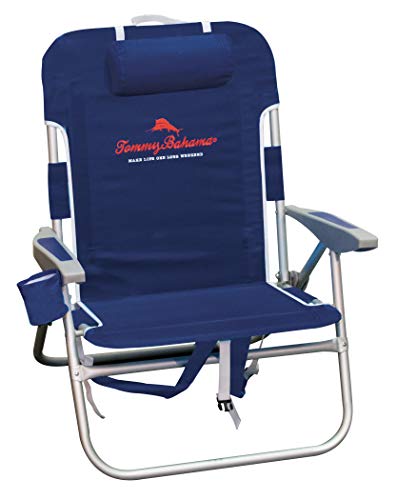
Tommy Bahama Big Boy Beach Chair — Widest classic beach chair
The Big Boy is the familiar Tommy Bahama silhouette scaled up for adults who find standard beach chairs pinchy at the hips. The title promises an extra-wide seat, and the proportions back that up: this is a chair you settle across rather than perch on. Its aluminum frame keeps the folded package manageable despite the size, and aluminum is the right call for a chair that will live near salt water, because the frame shrugs off the surface oxidation that makes steel frames look tired by August.
The 13-inch seat height deserves attention. Classic beach chairs often sit six or seven inches off the sand, which is lovely for dangling your legs and miserable for standing back up. Thirteen inches is a middle path — still low enough to feel like a beach chair rather than a patio chair, high enough that most adults can plant their feet and rise without rocking forward twice. That easier exit is also a longevity feature: the armrests stop being climbing equipment.
Four positions of recline cover the realistic range from upright reading to a flat-ish sunbathing tilt, and the included pillow supports the head at the steeper angles where a bare frame bar would otherwise press into your neck. Backpack straps, a cup holder and a storage pouch round out a package that has clearly been refined over many model years. Nothing here is experimental, and for a durability guide that conservatism counts as praise.
- Frame: aluminum, per the listing title
- Seat height: 13 in
- Recline: 4 positions
- Carry: backpack straps
- Extras: pillow, cup holder, storage pouch
- Where to buy: the Tommy Bahama Big Boy Beach Chair listing on Amazon — check price on Amazon
Strengths
- Extra-wide seat fits larger adults without squeezing at the frame edges.
- Aluminum frame resists the salt-air corrosion that ages steel chairs fastest.
- The 13-inch seat height makes standing up markedly easier than low sand chairs.
Trade-offs
- The listing title states no weight capacity, so heavier buyers should weigh the labeled picks below.
- Extra width means a wider folded package in a crowded trunk.
- The navy fabric shows sunscreen smears and sand dust readily between washes.
Best for: adults who want the classic backpack beach chair, only bigger and easier to rise from.
Not suited for: anyone who needs a published capacity figure before buying.

Yestomo Beach Chair Heavy Duty 350LBS — Stated 350 lb support
Yestomo puts its number right in the product name: support to 350 lb. That directness is refreshing in a category full of vague toughness language, and it lets a buyer match chair to body without decoding marketing adjectives. The chair folds to a lay-flat position, which matters for durability in an unexpected way — a chair that goes fully flat stores flat, stacks flat, and does not spend the off-season leaning at an angle that slowly bends a leg tube.
The large cooler pouch hangs behind the backrest, keeping drinks cold and, just as usefully, keeping their weight off the seat fabric. Condensation drips onto sand rather than soaking the sling. Backpack straps make the carry hands-free, and the striped blue-and-cyan fabric has a practical virtue beyond looks: stripes hide the fade gradient that solid fabrics develop where sun hits the top rail hardest, so the chair looks even-aged for longer.
Compactness is the other half of its pitch. The title calls it compact and portable, and the folded form is meant for car trunks that also hold a cooler, an umbrella and somebody’s optimistic collection of sand toys. If your beach routine involves a long walk from a parking lot, the combination of straps, flat fold and a real capacity figure is a coherent one — each feature reduces a different kind of wear, on the chair and on you.
- Stated support: 350 lb, per the listing title
- Positions: reclines to lay-flat
- Carry: backpack straps
- Extras: large cooler pouch
- Form: compact folding beach chair
- Where to buy: the Yestomo Beach Chair Heavy Duty 350LBS listing on Amazon — check price on Amazon
Strengths
- Publishes a 350 lb support figure in the title instead of hiding behind adjectives.
- Lay-flat folding stores neatly and doubles as a sunbathing position.
- The rear cooler pouch keeps drink weight and condensation off the seat.
Trade-offs
- A lay-flat beach chair sits low, so rising takes more effort than the tall picks.
- The bold stripe pattern is a love-it-or-leave-it look on a crowded beach.
- Cooler pouch capacity is snack-and-two-drinks scale, not family-picnic scale.
Best for: buyers up to the stated limit who want one chair for sitting, reclining and lying flat.
A poor fit for: beachgoers with stiff knees who struggle up from near ground level.

GCI Outdoor Freestyle Rocker XL — The rocker
Some people sit still at the beach. Others rock — through conversations, through chapters, through an entire afternoon of watching the water. The Freestyle Rocker XL is built for the second group. Its spring-action rocking mechanism is mounted on a wide steel frame, and the title states a 400 lb capacity, the second-highest figure in this guide. Steel is a sensible choice here because a rocking chair concentrates stress at the mechanism mounts with every cycle; the frame needs stiffness more than it needs corrosion immunity, though the paint deserves a rinse after salt-heavy days.
The mesh backrest is the comfort headline. On a still, humid afternoon a solid fabric back becomes a warm blanket glued to your shirt; mesh lets air move and dries quickly after a swimmer sits down wet. GCI’s Eazy-Fold design folds the chair with a handle-driven motion rather than the usual wrestling match, and a carry handle is built in. A phone holder and cup holder sit where your hands naturally fall.
On sand, rocking works differently than on a deck. The rockers press two lines into soft ground and can dig in on very loose sand, so this chair is happiest on packed sand near the waterline, on grass at a beach park, or on a rental-house deck. Judged in those settings, it offers something none of the sling chairs can: motion. For restless sitters, that motion is the difference between staying happily seated and wandering off after twenty minutes.
- Stated capacity: 400 lb, per the listing title
- Frame: steel, wide Eazy-Fold design
- Mechanism: spring-action rocking
- Backrest: mesh
- Extras: phone holder, cup holder, carry handle
- Where to buy: the GCI Outdoor Freestyle Rocker XL listing on Amazon — check price on Amazon
Strengths
- Rocking motion suits restless sitters through long beach days.
- A stated 400 lb capacity on a wide frame fits big and tall adults.
- Mesh back ventilates and dries fast after wet swimsuits.
Trade-offs
- Rockers dig into very soft, dry sand; packed ground suits it better.
- Steel needs a rinse and dry before storage to protect the finish.
- It folds flatter than it packs small — bulkier than the backpack chairs.
Best for: rockers, readers and game-watchers who set up on firm ground near the beach.
A poor fit for: soft-sand purists who sit right at the loose dune line.

CARIBBEAN JOE 300lb Capacity Beach Chair — Wooden-arm classic
Caribbean Joe’s chair leads with its figure too: 300 lb capacity, stated in the name. Below that headline sits a thoughtfully old-fashioned design. The armrests are wooden and genuinely wide, the kind of armrest that supports a forearm, a paperback and a pair of sunglasses at once. Wood also stays cooler to the touch than dark plastic under direct sun, a small mercy at noon.
The seat sits high for a beach chair, and the four recline positions adjust without the pinch-point levers that cheaper chairs use. A headrest supports upright reading, backpack carry straps handle the walk from the car, and the cup holder is placed on the arm rather than dangling from fabric, so a drink stays level when you shift your weight. The red fabric is easy to spot when you return from a swim and the beach has filled in around your spot — an underrated practical feature.
Durability here is about honest, inspectable construction. You can see the frame, see the armrest attachments, and see where the fabric bears load. Wooden armrests will eventually weather if the chair is stored damp, so a dry garage corner matters. But there are no hidden mechanisms to fail mysteriously, and for many buyers that transparency is exactly what durable means: a chair whose condition you can judge at a glance each spring.
- Stated capacity: 300 lb, per the listing title
- Recline: 4 positions
- Seat: high-seat design
- Armrests: wooden
- Extras: headrest, cup holder, backpack carry straps
- Where to buy: the CARIBBEAN JOE 300lb Capacity Beach Chair listing on Amazon — check price on Amazon
Strengths
- Wide wooden armrests stay comfortable and cool in direct sun.
- Published 300 lb capacity removes the guesswork for mid-size adults.
- High seat and headrest make upright reading genuinely comfortable.
Trade-offs
- Wooden arms need dry storage to avoid weathering over the years.
- The stated capacity is the lowest of the four labeled picks here.
- The upright profile catches wind more than a low sand chair.
Best for: readers and conversation-sitters who like a higher seat and real armrests.
Poorly suited to: anyone over the stated 300 lb figure — choose a labeled higher-capacity pick.

TIMBER RIDGE Oversized Folding Camping Chair 500lbs — Highest stated capacity
Let us be precise about what this chair is. The TIMBER RIDGE is an oversized folding camping chair — the quad-style form with a high back, a deep bucket seat and four feet that plant in a square. It is in a beach guide because a large share of beachgoers, especially those who set up on grass, packed sand or a boardwalk plaza, use exactly this form at the shore, and because its title states a 500 lb capacity that no purpose-built sand chair in this group matches.
That capacity figure is the reason to consider it. Adults who have watched a standard beach chair flex and groan will feel the difference in a frame built and rated for this load class. The high back supports the shoulders rather than ending at the shoulder blades, the cup holder and side pocket keep essentials off the sand, and the included cooler bag hangs within reach. The upright sitting position also suits people who dislike the hammock slump of low sling chairs.
The trade-offs are the flip side of the form. Quad chairs sit tall, so your feet rest on the ground rather than stretched out in front; on soft sand the four feet can sink unevenly where a wide sand chair spreads its load. It also folds into a long bundle rather than a flat pack, and it has no backpack straps in the classic beach-chair sense. Buy it as the heavy-duty chair that also goes to the beach, not as a beach chair that happens to be strong.
- Stated capacity: 500 lb, per the listing title
- Form: oversized camping-quad folding chair, used at the beach
- Back: high back
- Extras: cup holder, side pocket, cooler bag
- Seat style: upright, deep bucket
- Where to buy: the TIMBER RIDGE Oversized Folding Camping Chair 500lbs listing on Amazon — check price on Amazon
Strengths
- The 500 lb title figure is the highest stated capacity in this guide.
- High back and upright posture suit people who dislike low sling seats.
- Cooler bag, pocket and cup holder keep a full setup within arm’s reach.
Trade-offs
- It is a camping form, not a low beach chair; feet can sink in soft sand.
- Folds into a long bundle that is awkward beside flat-folding beach chairs.
- The tall profile is a sail on windy days at exposed beaches.
Best for: heavier adults who want the strongest stated rating and an upright sit.
A weak match for: minimalists walking a long way over soft sand to their spot.

Homevative Cooler+ Tall Backpack Beach Chair — Tallest seat
The Homevative Cooler+ makes its case with one number: a 17-inch seat height. That is patio-chair territory, and it transforms the beach routine for anyone whose knees, hips or back object to the deep crouch of a standard sand chair. You sit down the way you sit at a table, and you stand up the same way. For older beachgoers and anyone recovering from a cranky joint, that geometry matters more than any other specification in this guide.
Five recline positions run from upright to lay-flat, so the tall frame does not lock you into one posture. The towel bar across the back is a small stroke of genius — a wet towel draped there dries in the breeze instead of wadding into the sand, and it keeps damp fabric off the chair’s own backrest. A cooler pouch, cup holder and phone holder complete the storage story, and backpack straps carry the whole tall package hands-free.
The listing title states no weight capacity, and we flag that plainly rather than guessing. What can be judged from the design is structure: a tall chair works its frame harder than a low one because the legs are longer levers, so the sensible routine is to set it on reasonably level sand and avoid using the armrests as a step. Treated that way, it is the most accessible chair here — and accessibility, over years of beach trips, is its own kind of durability, because a chair people can use is a chair that keeps getting used. Readers shopping for an older parent may also want the wider seating discussion in Best Japanese Massage Chairs for Petite Frames, which covers compact fit from a different angle.
- Seat height: 17 in, per the listing title
- Recline: 5 positions, including lay-flat
- Carry: backpack straps
- Extras: cooler pouch, cup and phone holder, towel bar
- Color: High Tide Blue
- Where to buy: the Homevative Cooler+ Tall Backpack Beach Chair listing on Amazon — check price on Amazon
Strengths
- The 17-inch seat is the easiest in this guide to sit down into and rise from.
- Five positions including lay-flat cover sitting, lounging and sunbathing.
- Towel bar keeps wet towels drying in the breeze instead of in the sand.
Trade-offs
- No capacity figure is stated in the title, so heavier buyers should choose a labeled pick.
- Tall legs can wobble on uneven sand until you settle the feet properly.
- The full feature set makes it one of the bulkier backpack packages here.
Best for: anyone who wants a beach chair they can get out of gracefully.
Not suited for: buyers who require a published weight rating as a condition of purchase.
Side-by-Side: The Six Chairs at a Glance
| Chair | Stated capacity | Seat character | Carry style |
|---|---|---|---|
| Tommy Bahama Big Boy Beach Chair | Not stated in title | Extra-wide, 13 in seat height, 4 positions | Backpack straps |
| Yestomo Beach Chair Heavy Duty 350LBS | 350 lb | Low profile, reclines to lay-flat | Backpack straps |
| GCI Outdoor Freestyle Rocker XL | 400 lb | Wide steel-frame rocker, mesh back | Carry handle, Eazy-Fold |
| CARIBBEAN JOE 300lb Capacity Beach Chair | 300 lb | High seat, wooden armrests, 4 positions | Backpack straps |
| TIMBER RIDGE Oversized Folding Camping Chair 500lbs | 500 lb | Tall camping-quad form, high back | Folds to a long bundle |
| Homevative Cooler+ Tall Backpack Beach Chair | Not stated in title | 17 in seat height, 5 positions to lay-flat | Backpack straps |
Read the capacity column carefully: a blank there is not a failing grade, it is an absence of a published claim, and the two unrated chairs earn their places through frame material, seat geometry and carry design instead. Where a number exists, treat it as a ceiling for the regular user, not a target to test on the first afternoon.
Which Features Actually Decide How Long a Beach Chair Lasts?
Start with the frame joints, because chairs rarely die in the middle of a tube. They die where tubes meet: rivets loosen, plastic hinge blocks crack, and recline teeth wear until a position will not hold. When you shop, look for metal-on-metal pivots at the main fold points and a recline mechanism with positive stops you can feel click in. A chair that locks decisively when new will usually still lock decisively in year three.
Fabric is the second lifespan clock. The seat sling carries your full weight in tension all day, in ultraviolet light, often wet with salt water. Tight, dense weaves age better than loose decorative ones, and darker colors hide the sunscreen and rust-water stains that accumulate near frame contact points. If a listing mentions a cooler pouch or storage pocket, check where it hangs: weight carried behind the backrest or below the seat adds years, while weight hung off the seat fabric itself subtracts them.
Feet are the third quiet factor. Wide feet or bar-style bases spread load on sand and keep the frame from racking sideways as one leg sinks. Narrow point feet are fine on decks and packed ground. Matching the foot style to your usual beach surface prevents the slow twisting that loosens every joint in the chair at once. Event seating faces a similar logic at larger scale, which is why the chairs in Best Comfortable Stacking Office Chairs are judged on frame behavior under repeated setup and teardown rather than on looks.
How Should You Care for a Beach Chair Between Trips?
Rinse the frame and fabric with fresh water after beach days, paying attention to hinge points where sand grinds like lapping compound. Open the chair fully and let it dry in shade before folding it away; a chair folded wet on Sunday can smell of mildew by Saturday and the fabric weakens where it stayed damp. Once a season, work the recline mechanism through its positions and clear any grit from the teeth.
Storage matters as much as washing. Keep chairs out of standing water in garages and sheds, and avoid leaning heavy gear against a folded frame all winter, which can take a permanent set in one leg. Wooden armrests, like the Caribbean Joe’s, appreciate an occasional wipe-down and fully dry storage. Backpack straps should be checked at their anchor stitches each spring — restitching a strap in April is a small job; losing one on a boardwalk in July is a long carry home.
How Does Sand Itself Wear a Chair Out?
Sand is not a passive surface; it is an abrasive that gets everywhere. Grains work into recline teeth and hinge pivots, and each fold of the chair grinds them against the metal like a slow file. This is why two chairs of identical construction can age so differently: the one that gets shaken out and rinsed after each trip keeps its mechanisms crisp, while the one that lives sandy in a trunk develops sloppy hinges within a couple of seasons. When you inspect an older chair, work the recline through every position. Positions that no longer click positively are telling you the teeth have been sanded round, and no amount of tightening elsewhere will restore them.
Sand also changes how a chair should be set up. On loose dry sand, any chair settles until its feet find firmer ground, and if one foot sinks deeper the frame racks — twists slightly out of square. Sitting down hard on a racked frame multiplies the stress at every rivet. The gentle habit that prevents most of this damage is simply rocking the chair once, lightly, after you set it down, letting all four contact points find their level before anyone sits. It takes three seconds and it is the single kindest thing you can do for a folding frame.
Wet sand behaves differently again. Near the waterline the surface is firm and supportive, which is why the GCI rocker works so well there, but the sand is also saturated with salt water that wicks up fabric and frame alike. Chairs used at the waterline need the most disciplined rinsing of all, because they dry slowly and sit in their own salt film for hours on the drive home if they are folded wet into a hot trunk.
What Seat Height and Recline Range Suit Your Beach Routine?
Think about how a beach day actually divides. Most people sit upright for conversation and meals, recline for reading, and go nearly flat for sun or a nap. A chair with four or five honest positions covers that arc; a chair with two positions forces compromises that end with towels rolled under heads and backs aching by mid-afternoon. The Homevative’s five positions, including true lay-flat, make it the posture all-rounder here, while the four-position Tommy Bahama and Caribbean Joe cover the same arc minus the fully flat sunbathing pose.
Seat height interacts with recline in a way spec sheets never explain. The lower a chair sits, the more a reclined position stretches your legs out in front of you, which many people find deeply relaxing — it is the classic beach sprawl. The higher a chair sits, the more reclining feels like a porch chair: feet on the ground, book at a natural angle, easy to rise between swims. Neither is better. But they suit different bodies, and the mismatch — a tall person in a ground-level sling, a person with stiff knees in a chair they cannot exit — is what sends chairs back or leaves them in garages.
Armrest height belongs in the same calculation. On the Caribbean Joe, the wide wooden arms sit where forearms actually rest, which is why readers love it. On sling-style chairs the arms are often an afterthought at fabric height. If you read for hours, rest your forearms where the chair puts them during a ten-minute store test if you can, or at least picture a paperback in your hands and judge whether your shoulders would be hunched or level.
How Can You Test a New Beach Chair in Its First Week?
Set it up on a hard surface first, where any wobble is the chair’s fault rather than the sand’s. Sit, shift your weight side to side, and listen. Creaks at a joint on day one usually mean a rivet or bolt that will loosen further; a well-made frame is quiet or nearly so. Work the recline through every stop several times and check that each stop holds when you lean back firmly — a position that slips under load in the living room will slip on the beach at the worst moment.
Then fold and carry it the way you will at the beach. Hoist it by its backpack straps and walk around the block. Straps that dig or anchors that twist under the chair’s own weight will only get worse with a towel and a cooler pouch added. Fill the cooler pouch, hang a wet towel on it if it has a bar, and confirm nothing pulls the chair off balance when it stands folded. Finally, hose it down, shake it out, and time how long it takes to dry in shade. A chair that dries by dinner is a chair that will not mildew in your garage; a chair still damp the next morning needs a storage spot with moving air.
One more first-week check deserves its own mention: sit in the chair while wearing the swimsuit or shorts you actually beach in, on a warm day if the season allows. Bare legs on hot frame rails, fabric that sticks to skin, an armrest edge that presses a sunburned forearm — none of these show up in a clothed living-room test, and all of them decide whether a chair gets carried down to the sand or quietly left in the garage by week three. A durable chair that nobody wants to sit in is durable in the least useful sense.
Keep notes, even mental ones, during that first week, because the return window is when a mismatch costs nothing. The most common discovery is not a defect at all — it is that the seat height or recline style does not suit the buyer’s body or habits. That is a fit problem, and this guide’s range of heights, from the Yestomo’s low lay-flat profile to the Homevative’s 17-inch seat, exists precisely because fit is personal.
Which of These Chairs Fits Which Kind of Beach Trip?
For the walk-in beach reached by a path over the dunes, weight and carry rule the decision. The Tommy Bahama Big Boy and the Yestomo both ride on your back with your hands free for a cooler and an umbrella, and between them the choice is width and a 13-inch seat versus a published 350 lb figure and a fully flat fold. Either will outlast a chair you have to drag, because carrying is gentler than dragging on every stitch and rivet.
For the drive-up beach, the rental-house deck, or the grassy park above the sand, the calculus flips. Bulk matters less and comfort features matter more, which is where the GCI rocker’s motion and mesh back shine and where the TIMBER RIDGE’s tall, high-backed, stated-500 lb form makes sense despite its camping origins. These are also the settings where a chair gets used for evening concerts and outdoor movies, doubling its working hours across a summer.
For multi-generational groups — grandparents, parents, teenagers sharing a rotating pool of chairs — the Homevative’s tall seat quietly becomes the chair everyone negotiates for, because it is the one nobody struggles to leave. Buying two heights deliberately, one low lounger and one tall seat, covers a family better than buying four identical chairs, and it spreads wear across the set instead of concentrating it on the single chair that suits the oldest knees.
For anglers, shell collectors and other beachgoers who are up and down constantly, durability means something specific: a frame that tolerates being sat in forty times a day rather than four. Positive-locking recline stops, armrests that can take a steadying hand without flexing, and fabric that does not sag into a hammock by noon are the traits to prize, and they point toward the Big Boy or the Caribbean Joe, whose straightforward frames are built for repetition.
Common Mistakes When Buying a Beach Chair for Durability
The most common mistake is reading the words heavy duty as a specification. They are not. A stated capacity in the title is a specification; an adjective is a hope. The second mistake is buying the lowest chair on the beach and then using its armrests as a ladder every time you stand — that sideways load is what kills armrest joints, so match seat height to your knees honestly. Third, people store chairs wet and sandy, then blame the frame when the fabric gives out; the rinse-and-dry routine above prevents most early failures.
A subtler error is assuming a camping chair and a beach chair are interchangeable in both directions. The TIMBER RIDGE in this guide earns its place through a stated 500 lb capacity, but its four point feet still behave differently on soft sand than a beach chair’s wide stance. Know which surface you actually sit on, and buy for that surface rather than for the label on the box.
Before You Order, Which Listing Fields Deserve a Slow Read?
Read the title of any beach chair listing the way this guide did, because the title is where sellers commit to specifics. A capacity belongs in writing — 300 lb on the Caribbean Joe, 350 lb on the Yestomo, 400 lb on the GCI rocker, 500 lb on the TIMBER RIDGE — and its absence, as on the Big Boy and the Homevative, is information too: it does not mean the chair is weak, it means the maker has not published a figure, and your decision should rest on the design details instead. Frame material should be named, not implied. Seat height should be a number, not an adjective like tall or low, because your knees will experience the number, not the adjective.
Then look at the photographs for construction you can verify: how the armrests join the frame, whether the recline stops are visible metal teeth or hidden plastic, where the backpack straps anchor, and whether the cooler pouch hangs from the frame or from the seat fabric. Listings that show the folded chair honestly — its length, its straps, its profile against a person — are telling you the maker expects scrutiny. Listings that show only lifestyle scenes are asking you not to look closely, and with a product whose whole job is to hold you up over sand for years, looking closely is the entire game.
Finally, check what the chair includes against what your routine needs. A towel bar sounds minor until the first day a wet towel stops sanding up the car seats. A phone holder sounds like a gimmick until a phone overheats in direct sun on a towel. Storage pouches, cup holders and pillows are not decorations on a beach chair; they are the difference between a chair that organizes your patch of sand and a chair surrounded by a moat of loose belongings.
How Long Should a Good Beach Chair Reasonably Last?
With the rinse-and-dry habit in place, a well-built aluminum-frame beach chair used most weekends through a summer should give several seasons of service before the fabric, rather than the frame, becomes the limiting factor. Fabric fades and slowly loses its fight against ultraviolet light; that is honest aging, and a chair whose frame is still tight while its sling fades has done its job in the right order. Steel frames in this class last well too when their finish survives, which is why the rocker’s care routine matters: chips at the fold points are where attention belongs.
The chairs that disappoint early almost always fail at a joint or a strap anchor, and those failures trace back to the loads described earlier — armrests used as ladders, frames racked on uneven sand, straps asked to carry a chair loaded with wet towels and bottles. None of the six picks here is immune to misuse, but all six are built plainly enough that you can see wear coming: a strap fraying at its stitch line, a recline stop rounding off, a foot cap wearing through. A chair you can inspect is a chair you can retire on your own schedule instead of being surprised by a collapse in front of an audience of seagulls.
Budget expectations should follow that logic. Spending more buys better joints, denser fabric and published specifications; it does not buy immunity from salt and sand. The sweet spot for most households is a mid-priced chair with a stated capacity that fits the heaviest regular user, a frame material matched to your storage habits, and a carry system you will actually use — then two minutes of care per trip. That combination, repeated over summers, is what the word durable really describes.
How Do You Set Up a Chair So the Sand Works for You?
Choose your ground before you unfold anything. A few steps toward the waterline, the sand firms up and chairs sit level with far less settling; near the dunes, expect to re-level after the first sit. Press each foot or rail down with a slight twist, the way you would seat a beach umbrella, and then sit gently the first time rather than dropping. That first gentle sit is the frame’s chance to find its square; every later sit that day starts from a settled, unstressed position.
Angle matters too. A chair placed with its back to the breeze keeps wind off your face and stops a tall profile — the TIMBER RIDGE and the Homevative especially — from acting as a sail that creeps across the sand. If the wind is strong enough to move an empty chair, weight it with the cooler or fold it during swims; a chair that tumbles end over end across hard sand can bend a leg in a single gusty afternoon, and that kind of damage has nothing to do with how well it was built.
Shade discipline extends fabric life more than any treatment. Ultraviolet light is the slow enemy of every sling and strap in this guide, and a chair that spends its idle hours under an umbrella or a canopy ages at half the rate of one left baking while you swim and stroll. When the group heads for the water, a ten-second fold or a move into the umbrella’s shadow is worth weeks of accumulated sun. Durability, in the end, is a partnership between the maker’s rivets and the owner’s habits, and the owners who understand that are the ones still sitting in the same chair five summers later, watching newer chairs come and go around them.
Final Recommendation
For most buyers, the Tommy Bahama Big Boy is the balanced choice: aluminum frame, generous width, a humane 13-inch seat and the carry system people actually use. If a published rating guides your decision, the Yestomo at a stated 350 lb and the GCI Rocker XL at a stated 400 lb cover the middle, while the TIMBER RIDGE’s stated 500 lb stands alone at the top for those who accept its camping form. The Homevative Cooler+ is the pick when knees make the rules, thanks to that 17-inch seat. Whichever you choose, rinse it, dry it, and store it flat or hanging — because the best durable beach chairs are usually the ones whose owners spend two minutes on care after each trip, and this group’s strongest frames will repay that habit with season after season of uncomplaining service.
Frequently Asked Questions
Does a stated weight capacity guarantee a chair will last?
No. A capacity figure tells you the load the maker is willing to claim in the title; lifespan still depends on joints, fabric and care. Treat the number as a fit requirement — stay within it — and judge durability by frame material, hinge design and how the chair folds and stores.
Is aluminum or steel better for a beach chair frame?
Aluminum resists salt-air corrosion better and keeps weight down, which suits classic beach chairs that travel on your back. Steel offers stiffness for wide frames and mechanisms like the GCI rocker, but its finish needs rinsing and dry storage to stay ahead of rust at chips and fold points.
Why is seat height part of a durability guide?
Because of how people exit low chairs: by hauling on the armrests and twisting. A seat height matched to your legs — 13 inches on the Big Boy, 17 inches on the Homevative — removes that wrenching load from the joints most likely to fail first.
Can I use a camping chair at the beach instead?
Yes, with eyes open. The TIMBER RIDGE in this guide is exactly that: a camping-quad form with a stated 500 lb capacity. It sits upright and tall, and its four feet can sink unevenly in soft sand, so it suits packed sand, grass and decks better than loose dune sand.
Should I buy a matching pair or mix chair types?
Mixing usually serves a household better. Two different heights — say a low lay-flat Yestomo and a tall Homevative — cover more bodies and more moods than two identical chairs, and wear spreads across both. Matching pairs make sense when the chairs also serve as event seating, where a uniform look matters and every user is an average-size adult sitting for a defined program.
What is the first part most likely to wear out?
On most beach chairs it is a strap anchor or the seat fabric where it wraps the front rail, because both carry concentrated, repeated loads. Inspect stitch lines each spring, keep the fabric out of stored-damp conditions, and avoid standing on the seat to reach anything — a surprisingly common cause of sudden front-rail fabric failure.
How do I stop my beach chair smelling musty?
Rinse off salt and sand, open the chair fully, and let it dry completely in shade before folding. Mildew grows in fabric that stays damp inside a folded chair; a thorough dry after each trip prevents nearly all of it and extends fabric life at the same time.
Related Guides
If your beach setup leans lighter and lower than the chairs above, the site’s guide to Best Lightweight Backpack Beach Chairs covers the carry-first end of the same shoreline, with chairs chosen for the walk as much as the sit.



[…] a heavy-duty room more broadly will find the capacity-published end of seating surveyed in Best Durable Beach Chairs for the outdoor case, where stated limits are the norm rather than the […]