What's inside
- Key Takeaways
- Quick Picks
- What Guided the Shortlist for This Guide?
- Steam Ovens Compared: Format, Stated Size, and Signature Mode
- What Does Steam Actually Do to Everyday Food?
- How Do You Choose Between Countertop and Built-In?
- Which Modes Matter for Which Cooks?
- How Do You Keep a Steam Oven Clean and Fresh?
- What Goes Wrong for First-Time Steam Oven Buyers?
- What Does a Week of Cooking Look Like in a Steam Oven?
- How Does a Steam Oven Differ From a Microwave or an Air Fryer?
- Where Should a Countertop Steam Oven Live?
- What Do Preset Libraries Actually Do for You?
- Final Recommendation
- How Much Counter Space and Headroom Do the Countertop Picks Need?
- Is a Steam Oven Worth It for a Household That Mostly Reheats?
- Frequently Asked Questions
- How Do Steam Ovens Handle Frozen and Batch Cooking?
- What Should You Cook First in a New Steam Oven?
- Related Guides
As an Amazon Associate I earn from qualifying purchases. This post may contain affiliate links at no extra cost to you.
cottageverdict.com is reader-supported. When you buy through links on our site, we may earn an affiliate commission.
Where to buy: Each model below is sold through its Amazon listing — follow the links in the Quick Picks table or in each review to check price on Amazon, and confirm the exact configuration on the listing page before ordering.
The best home steam ovens share one idea with the professional baker’s deck: food cooks better when moisture is part of the recipe rather than an accident of the oven. A combi-steam oven adds controlled steam to convection heat, so vegetables keep their colour and bite, fish stays silky instead of chalky, bread crusts gloss and crackle, and yesterday’s roast reheats without turning into shoe leather. Five of the six verified picks in this guide are countertop machines you can carry to the bench and plug in; the sixth, the Garvee, is a 24-inch built-in that installs into cabinetry like a wall oven, and this guide keeps that split plainly in view because the two kinds of purchase could hardly be more different. One honest limit applies to every pick: none of the verified listing titles states how its water is supplied, so this guide makes no claim anywhere about tanks, reservoirs, or plumbed lines — check the listing for the model you choose if water handling is your deciding factor. A lighter neighbouring class also deserves a mention so nobody buys the wrong thing: steam-infusion air fryers add a puff of moisture to what is fundamentally an air fryer, and they are discussed here only as background, never as picks, because they do not offer the true steam modes the six below are built around.
Key Takeaways
- Five picks are countertop combi-steam ovens; the Garvee is a 24-inch built-in and belongs in a kitchen renovation conversation, not a countertop one.
- No listing title in this pool states a water-supply method, so no tank or plumbed claim is made for any pick.
- Capacity is stated three different ways across the pool — quarts, litres, and cubic feet — so compare the stated figure for each model rather than assuming one scale.
- Steam-bake and rapid-steam modes, named in the CIARRA title, are the features bread and pastry bakers should look for first.
- Ferment modes on the CIARRA and TOSHIBA turn the oven into a proofing box, which matters to dough bakers in cool kitchens.
- Preset counts vary widely — 36 menus on the TOSHIBA, 50 on the FOTILE, 108 smart recipes on the Garvee, 120 presets on the Nuwave — and are a convenience, not a quality score.
Quick Picks
| Steam oven | Badge | Why it earned its place |
|---|---|---|
| Nuwave Combi Steam Oven (16 Qt) | Precision Pick | Stainless multi-cooker with a stated 50-450°F range, 120 presets, moisture control, and sous vide among its named modes. |
| CIARRA Nosh Oven Pro Steam Oven (25.4 Qt) | Largest Countertop | The biggest countertop capacity here at 25.4QT, with rapid steam, steam bake, ferment, self-clean, and delay start in its title. |
| FOTILE ChefCubii 4-in-1 Combi-Steam Oven | Focused Four-Mode | A 1.1 cu. ft. combi-steam oven with steam-bake, air fry, convection, and dehydrator functions plus 50 preset menus. |
| TOSHIBA 6-in-1 Compact Steam Oven (20L) | Compact All-Rounder | Twenty litres with convection steam and bake, ferment, air fryer, slow cook, app control, and steam cleaning. |
| ROBAM R-Box Pro Countertop Steam Oven | Dual-Temp Specialist | A 1.2 Cu. Ft. countertop unit whose EXP mode dual-temp control and enamel interior set it apart for staged cooking. |
| Garvee 24-Inch Built-in Steam and Convection Oven | Built-In Option | The one installed pick: 24 inch, 2.5 Cu.ft, eight cooking functions, 108 smart recipes, and touch control. |
What Guided the Shortlist for This Guide?
We worked only from verified listings, matching each pick to its maker’s own title, and we required genuine steam cooking — a steam or combi-steam mode named in the title — rather than a marketing adjective. That rule is what keeps steam-infusion air fryers out of the pick list: they are fine machines for crisping, but their steam is an accessory, not a cooking medium. Next we mapped the field by installation type, because five countertop units and one built-in are not interchangeable recommendations, and a reader in a rental kitchen needs a different answer from a reader mid-renovation. Capacity came third, handled carefully: the pool states sizes in quarts for the Nuwave and CIARRA, litres for the TOSHIBA, and cubic feet for the FOTILE, ROBAM, and Garvee, and rather than converting and pretending the figures are directly comparable, this guide reports each as its maker states it and discusses what that size means in meals. Finally we noted the working features the titles actually name — ferment modes, self-clean or steam cleaning, app control, preset libraries, dual-temperature control — because those, not adjectives, are what you will touch every day. Readers comparing the wider oven landscape sometimes also look at Best Halogen Ovens, the older glass-bowl technology that steam combis have largely replaced on the countertop, and the contrast is instructive: radiant speed on one side, moisture control on the other.

Nuwave Combi Steam Oven (16 Qt) — Precision Pick
The Nuwave’s title reads like a control panel, and that is its appeal: a non-toxic stainless steel multi-cooker of 16 quarts that air fries, sous vides, toasts, and more, with a stated temperature span of 50-450°F, 120 presets, moisture control, and programmable operation. The low end of that range is the interesting part — temperatures down at the stated 50°F floor open the door to gentle work like proofing and low-temperature holding that most countertop ovens cannot attempt, while the 450°F ceiling covers the roasting and crisping end. Moisture control, named explicitly, is the feature that separates a combi from a merely steamy oven: being able to dial how much steam accompanies the heat is how you keep a chicken’s skin progressing toward crisp while the meat stays moist.
Sixteen quarts is the smallest stated capacity in this guide, which frames the Nuwave honestly as a precision instrument for one or two people rather than a family roaster. A household cooking for two, reheating single portions well, and experimenting with sous vide will find the size a virtue — faster to heat, easier to clean, less countertop surrendered. The stainless construction named in the title also suits cooks who prefer metal interiors over coated ones. The easy-to-clean claim in the title should be read as the maker’s framing, but a smaller cavity is objectively a quicker wipe-down than the cavernous alternatives.
Who should skip it? Anyone whose regular cook is a whole bird for six, or whose baking runs to full sheet trays. Who should linger? The methodical cook who cooks small, values a wide and controllable temperature range, and wants steam as a daily tool rather than a party trick. Among the six, this is the pick that treats steam cooking as a discipline.
One more scenario suits it particularly: the deliberate small kitchen of a keen cook. In a studio or a narrow galley, every appliance must justify its footprint weekly, and a sixteen-quart combi that steams, roasts, toasts, and holds low temperatures replaces several single-purpose boxes. Its programmability also fits cooks who prep in the morning and want a held, gentle finish rather than a cold wait. Small, in this design, is not a compromise — it is the concept.
- Format: countertop combi steam oven, 16 quarts, stainless steel multi-cooker
- Stated range: 50-450°F precision per the listing title
- Named modes: air fry, sous vide, toast and more; 120 presets; moisture control
- Water supply: not stated in the listing title — verify on the listing
- Where to buy: the Nuwave Combi Steam Oven (16 Qt) listing on Amazon — check price on Amazon
Strengths
- Widest stated temperature span here, reaching unusually low settings.
- Moisture control is named, not implied, in the title.
- Compact sixteen-quart footprint suits small kitchens.
Trade-offs
- Smallest capacity in the guide limits family-size cooks.
- Preset-heavy interface rewards cooks who like programmed cooking.
- Sous vide in an oven format will not replace a dedicated circulator for purists.
Best for: one- and two-person households that cook precisely and often. Not suited for: large families needing to steam and roast for a crowd at once.
CIARRA Nosh Oven Pro Steam Oven (25.4 Qt) — Largest Countertop
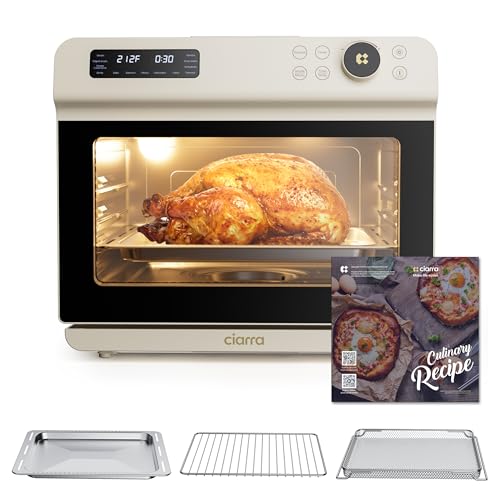
CIARRA’s Nosh Oven Pro is the big countertop statement in this pool: a 12-in-1 countertop steam oven with air fryer at 25.4QT, with convection cooking, rapid steam and steam bake named in the title, plus air fry, dehydrate, ferment, self-clean, and delay start. Start with the capacity — 25.4 quarts is family territory, the size that takes a whole chicken with vegetables around it, a decent batch of steamed dumplings in tiers of effort if not of trays, or a celebration fish without origami. Then notice the mode list, because two entries do heavy lifting: steam bake is the mode pastry and bread bakers actually need, marrying steam’s oven spring to dry heat’s colour, and ferment turns the cavity into a controlled proofing environment, which in a cold house is the difference between dough that rises on schedule and dough that sulks until midnight.
Self-clean and delay start, both named, speak to the unglamorous truth that a big countertop oven earns its place by being used on weeknights, not admired on weekends. Delay start lets a prepared dish begin cooking so it lands when the family does, and a self-clean cycle lowers the activation energy for the next use. The trade is physical: 25.4QT of oven is a large object, and in a small kitchen it will dominate a counter run and need clearance above and behind it. Measure your space, including the height under wall cabinets, before choosing the biggest box in any category.
For households that cook in volume and bake with steam ambitions, though, this is the countertop pick with the fewest capacity apologies. It is also the most direct answer in the guide to the cook who wants one machine to ferment the dough in the morning, steam-bake the loaf at noon, and air fry dinner in the same cavity at night.
The delay start deserves a practical footnote: it suits foods that wait well — grains, braises, sturdy vegetables, doughs on their ferment schedule — and should be used thoughtfully with anything highly perishable, following ordinary food-safety sense about how long raw ingredients sit before cooking. Used wisely, it turns the oven into a quiet member of the household staff, starting the rice as the commute begins. That, plus the sheer cavity, is why this model anchors the family end of the guide.
- Format: 12-in-1 countertop steam oven with air fryer, 25.4QT
- Named modes: rapid steam, steam bake, air fry, dehydrate, ferment
- Convenience: self-clean and delay start named in the title
- Water supply: not stated in the listing title — verify on the listing
- Where to buy: the CIARRA Nosh Oven Pro Steam Oven (25.4 Qt) listing on Amazon — check price on Amazon
Strengths
- Largest countertop capacity in this guide.
- Steam bake plus ferment covers the full bread workflow.
- Self-clean lowers the effort of keeping a big cavity pleasant.
Trade-offs
- Dominates counter space and needs clearance on all sides.
- Twelve functions means a learning curve before it feels automatic.
- Overkill for single-person reheating routines.
Best for: families who bake, ferment, and cook in volume. A poor fit for: tiny counters where it would crowd out prep space entirely.

FOTILE ChefCubii 4-in-1 Combi-Steam Oven — Focused Four-Mode
The ChefCubii makes a different argument from the twelve-function machines: four functions, chosen well. Its title describes a 1.1 cu. ft. 4-in-1 combi-steam oven with steam-bake, air fry, convection, and dehydrator functions, and 50 preset menus, in black. FOTILE is a kitchen-appliance maker by trade, and the ChefCubii reads like a distillation of what a steam oven is for — steam-bake for breads and roasts that need moisture then colour, straight convection for everyday roasting, air fry for the crisp finish, and a dehydrator for the preserving projects that otherwise demand a separate appliance. Fifty presets is a middle-sized library: enough to cover the common proteins and vegetables without turning the control panel into a phone book.
At 1.1 cubic feet, the cavity sits in the comfortable middle of the countertop class — family-capable for most dinners, not so large that heating it for a single portion feels wasteful. The black finish named in the title suits the many kitchens that have drifted toward dark appliances, though finish is a preference, not a performance point. What the ChefCubii does not claim is as telling as what it does: no ferment mode is named, no app control is named, so dough bakers and remote-control cooks should weigh the CIARRA or TOSHIBA more heavily.
This is the pick for the cook who distrusts feature inflation. If your cooking is steam-bake on Sunday, convection through the week, and air-fried finishes on Friday, the ChefCubii’s four modes map onto your life without surplus, and its preset library quietly handles the repetitive middle of the repertoire.
The dehydrator function is easy to overlook and, for the right household, quietly decisive. Gardeners with a tomato glut, hikers who dry their own fruit, and pet owners who make jerky treats otherwise buy a separate dehydrator that lives in a cupboard eleven months a year. Folding that job into an oven you already use weekly is the kind of consolidation that keeps a kitchen honest. If none of those projects sounds like you, the function costs you nothing; if one does, it may settle the choice.
- Format: countertop 4-in-1 combi-steam oven, 1.1 cu. ft., Black as listed
- Named functions: steam-bake, air fry, convection, dehydrator
- Presets: 50 preset menus per the listing title
- Water supply: not stated in the listing title — verify on the listing
- Where to buy: the FOTILE ChefCubii 4-in-1 Combi-Steam Oven listing on Amazon — check price on Amazon
Strengths
- Four well-chosen functions without menu sprawl.
- Dehydrator function replaces a separate appliance for preserving.
- Mid-size cavity balances family dinners and single portions.
Trade-offs
- No ferment mode named for dough proofing.
- No app control named for remote operation.
- Preset library is smaller than the Nuwave or Garvee libraries.
Best for: cooks who want the essential steam modes done cleanly. Not the right match for: bakers who need a proofing mode or cooks who run their oven from the sofa.

TOSHIBA 6-in-1 Compact Steam Oven (20L) — Compact All-Rounder
TOSHIBA’s entry calls itself compact and then lists a working day: a 6-in-1 compact steam oven, combi oven countertop with convection steam and bake, ferment, air fryer, slow cook, smart app control, 36 preset menus, and steam cleaning, at 20L. Twenty litres is the apartment-friendly size — big enough for a family chicken or a batch of steamed buns, small enough to live on a rental counter without evicting the kettle. The mode mix is unusually thoughtful for the size: ferment covers the dough bakers, slow cook covers the Sunday braise that steam ovens are secretly good at, and steam cleaning uses the machine’s own medium to loosen its own mess, which is the most elegant maintenance idea in this entire guide.
Smart app control, named in the title, changes the ergonomics of a countertop oven more than most features do. Preheating from the living room, checking a slow cook without opening the door and dumping the steam you are paying for, adjusting a ferment while you are elsewhere in the house — these are small mercies that compound across a year of cooking. Thirty-six presets is the smallest library here, and honestly sufficient; most households rotate through a dozen dishes and cook the rest manually.
The compact label deserves respect rather than apology. A 20L cavity heats quickly, steams efficiently, and cleans fast, and for the enormous number of households cooking for one to three people, the larger machines in this guide would spend their lives mostly empty. The TOSHIBA is the pick that fits the kitchen most people actually have.
The slow cook mode deserves its own sentence of respect, because steam-assisted slow cooking is a small revelation: the moist environment keeps long-cooked dishes from drying at the edges, and the sealed cavity holds a steadier gentle heat than many plug-in slow cookers manage. A household that retires a separate slow cooker, a separate proofer, and reheats properly in the bargain has consolidated three appliances into twenty litres. That is the compact argument at its strongest.
- Format: 6-in-1 compact countertop steam oven, 20L
- Named modes: convection steam and bake, ferment, air fryer, slow cook
- Control: smart APP control and 36 preset menus per the title
- Cleaning: steam cleaning named in the title
- Water supply: not stated in the listing title — verify on the listing
- Where to buy: the TOSHIBA 6-in-1 Compact Steam Oven (20L) listing on Amazon — check price on Amazon
Strengths
- App control suits set-and-monitor cooking styles.
- Ferment and slow cook broaden it beyond steaming alone.
- Steam cleaning uses the oven’s own steam for upkeep.
Trade-offs
- Twenty litres will not take the largest family roasts.
- Smallest preset library of the six.
- App-dependent features assume a household comfortable with connected appliances.
Best for: apartments and small households wanting full steam features in a compact body. Poorly suited to: cooks regularly feeding six or more from one cavity.

ROBAM R-Box Pro Countertop Steam Oven — Dual-Temp Specialist
The R-Box Pro’s distinguishing line in its title is EXP mode dual-temp control, and it points at the most sophisticated cooking idea in this pool: different zones or stages of the cook held at different temperatures, so a dish can start gentle and finish fierce, or cook two components at their own heats, without the cook shuttling pans between appliances. Around that headline, the title describes a countertop steam oven and air fryer of 1.2 Cu. Ft. in White, with convection cooking, 15+ modes and functions spanning steam fry and multi-stage cooking, and an easy-clean enamel interior. Multi-stage cooking is the quiet revolution here — programming a sequence, steam then roast then crisp, so the oven executes a technique rather than a single setting.
ROBAM is a serious kitchen brand, and the enamel interior is a telling detail: enamel wipes clean, resists staining from the turmeric-and-soy palette of steam cooking, and does not hold odours between a fish dinner and a morning pastry. The 1.2 cubic foot cavity edges the FOTILE’s as the roomiest of the countertop cubic-foot class. Fifteen-plus modes is a moderate count, but the emphasis is clearly on depth — dual temperatures and staged sequences — rather than breadth.
Choose the R-Box Pro if your cooking has a technical streak: layered dishes, staged finishes, recipes that read like timelines. Cooks who simply want to steam vegetables and reheat leftovers beautifully will find its talents partly surplus, though never in the way. It is the enthusiast’s countertop pick.
Think of multi-stage cooking with a concrete dish: a pork roast that steams gently to stay succulent, roasts to render, then crisps under a fierce finish — three techniques a single-mode oven makes you perform by hand, returning to the kitchen at each transition. Programmed once, the sequence becomes repeatable, and repeatability is how a special dish becomes a household standard rather than an annual event. That is the R-Box Pro’s real promise, and it explains why its mode count can be lower while its cooking ceiling is higher.
- Format: countertop steam oven and air fryer, 1.2 Cu. Ft., White as listed
- Signature: EXP mode dual-temp control per the listing title
- Named cooking: convection, steam fry, multi-stage; 15+ modes functions
- Interior: easy-clean enamel interior per the title
- Water supply: not stated in the listing title — verify on the listing
- Where to buy: the ROBAM R-Box Pro Countertop Steam Oven listing on Amazon — check price on Amazon
Strengths
- Dual-temp control enables staged, technical cooking.
- Multi-stage programs execute a technique hands-free.
- Enamel interior resists stains and odours between dishes.
Trade-offs
- Advanced modes reward study; casual cooks may underuse them.
- No ferment mode named in the title.
- No app control named in the title.
Best for: technically minded cooks who stage and sequence their dishes. A weak match for: anyone who wants one dial, one mode, and dinner.

Garvee 24-Inch Built-in Steam and Convection Oven — Built-In Option
Everything changes with the Garvee, because it does not sit on your counter — it becomes part of your kitchen. The title describes a 24 inch built-in steam and convection oven with 8 cooking functions, 108 smart recipes, a 2.5 Cu.ft stainless steel cavity with enamel interior, touch control, and stepless temperature adjustment. The 24-inch format is the standard compact wall-oven width, common in apartments, smaller homes, and as a second oven in larger kitchens, and 2.5 cubic feet is a genuinely useful cavity at that width — the largest stated volume in this guide. A built-in also reclaims the countertop entirely, which in a small kitchen can matter more than any cooking mode.
The trade-offs are the renovation kind, and they must be faced squarely: a built-in needs a correctly sized cabinet opening, an appropriate electrical supply, and installation you should not improvise. It cannot move house with a renter, and it cannot be returned to a shelf if your cooking changes. The 108 smart recipes and stepless temperature adjustment — fine-grained control rather than fixed steps — suit a permanent appliance that a household will learn deeply over years. Eight functions is a focused count for an installed unit, and the enamel cavity echoes the ROBAM’s easy-clean logic at wall-oven scale.
So the Garvee is not competing with the other five so much as answering a different question: not which steam oven should I buy, but should my kitchen have steam built into its bones. If you are renovating, remodelling, or fitting out a compact kitchen where a wall oven is already planned, it is the only pick here that belongs on your list, and its capacity and recipe library make it a strong one.
A built-in also changes entertaining geometry. With the steam oven in the wall handling vegetables, fish, and reheating at its own temperature, the main range is free for the roast and the stovetop work, and the cook stops playing cavity Tetris at the exact moment guests arrive. Kitchens designed around two complementary ovens feel calmer than kitchens with one large one, and the Garvee’s recipe library gives the second oven a repertoire of its own from the first week. Permanence, chosen well, is a feature.
- Format: 24 Inch built-in steam and convection oven
- Cavity: 2.5 Cu.ft stainless steel with enamel cavity per the title
- Functions: 8 cooking functions, 108 smart recipes, touch control
- Adjustment: stepless temperature adjustment per the title
- Water supply: not stated in the listing title — verify on the listing
- Where to buy: the Garvee 24-Inch Built-in Steam and Convection Oven listing on Amazon — check price on Amazon
Strengths
- Largest stated cavity volume in this guide.
- Frees the countertop completely once installed.
- Stepless adjustment gives unusually fine temperature control.
Trade-offs
- Requires cabinetry, correct electrical work, and installation.
- Not portable and not renter-friendly.
- A permanent decision compared with any countertop pick.
Best for: renovators and compact kitchens planning a wall oven. Not suited for: renters or anyone who wants steam cooking this week without installation.
Steam Ovens Compared: Format, Stated Size, and Signature Mode
| Model | Format | Stated size | Signature from its title |
|---|---|---|---|
| Nuwave Combi | Countertop | 16 quarts | 50-450°F range, moisture control |
| CIARRA Nosh Oven Pro | Countertop | 25.4QT | Rapid steam and steam bake |
| FOTILE ChefCubii | Countertop | 1.1 cu. ft. | Four functions, 50 preset menus |
| TOSHIBA 6-in-1 | Countertop | 20L | App control, steam cleaning |
| ROBAM R-Box Pro | Countertop | 1.2 Cu. Ft. | EXP mode dual-temp control |
| Garvee Built-in | Built-in, 24 inch | 2.5 Cu.ft | 108 smart recipes, stepless adjustment |
What Does Steam Actually Do to Everyday Food?
Start with vegetables, the daily case. Steam holds moisture at the surface while heat penetrates, so broccoli stays green and structured instead of olive and slumped, and carrots sweeten rather than shrivelling. Fish is the second revelation: a fillet cooked in moist heat emerges with its proteins set gently, flaking instead of drying at the edges. Reheating is the third, and for many households it becomes the headline — rice revives fluffy, roast chicken returns juicy, and bread rolls come back with their crust re-crisped if the oven finishes them with a dry phase, which is why combi machines pair steam with convection rather than offering steam alone. Bakers get the fourth benefit: steam in the first minutes keeps a loaf’s surface supple for expansion, the same principle the lidded iron bakers exploit. None of this requires exotic ingredients; it requires the cook to think of humidity as a setting, like temperature, and these six machines are how a home kitchen gains that dial. The underlying principle — keeping warmth and moisture where you put them instead of letting them escape — is one campers know well, which is why the insulation thinking in Best Lightweight Camping Quilts feels oddly familiar to steam cooks: different medium, same physics of trapping heat on purpose.
How Do You Choose Between Countertop and Built-In?
Ask three questions in order. First, tenure: if you might move within a couple of years, or you rent, the countertop five are your field, because they leave with you. Second, space geometry: a countertop oven consumes worktop permanently but needs no cabinet surgery, while the Garvee consumes a cabinet bay and gives the worktop back — in a tiny kitchen, that trade can be worth more than any feature list. Third, cooking volume: the built-in’s 2.5 cubic feet is the largest cavity here, and a household regularly cooking for gatherings may find even the CIARRA’s 25.4 quarts a squeeze. Answer those honestly and the format chooses itself; only then compare modes within the format, because comparing a ferment mode against an installation decision is comparing unlike things.
Which Modes Matter for Which Cooks?
Bread and pastry bakers should hunt for steam bake and ferment first — the CIARRA names both, the TOSHIBA names ferment, and the FOTILE names steam-bake — because those two modes cover proofing and baking in one cavity. Fish-and-vegetable households should value precise, gentle steam and moisture control, which is the Nuwave’s stated territory. Technical cooks who stage dishes should study the ROBAM’s dual-temp and multi-stage claims. Batch family cooks should weight capacity and self-cleaning, pointing to the CIARRA. App-driven households, the ones who already run lights and locks from a phone, will feel at home with the TOSHIBA’s smart control or the Garvee’s recipe library. The honest summary is that the mode list is a personality test: match it to the food you cooked last week, not the food in your aspirational cookbook.
How Do You Keep a Steam Oven Clean and Fresh?
Steam ovens clean differently from dry ovens because their working medium is water. Wipe the cavity while it is still slightly warm after cooking, before residues bake on through the next dry cycle. Use the built-in help where it exists: the CIARRA names a self-clean function and the TOSHIBA names steam cleaning, and both exist precisely because manufacturers know a neglected steam cavity develops odours. Enamel interiors, on the ROBAM and the Garvee, forgive more and stain less. Leave the door ajar after a heavy steam session so the cavity dries fully — a sealed, damp oven is the one reliable route to mustiness — and descale or service the water path exactly as the listing and manual for your model direct, since mineral build-up is the long-term enemy of every steam appliance. None of this is arduous; it is simply a different five minutes from the dry-oven routine.
What Goes Wrong for First-Time Steam Oven Buyers?
- Buying capacity by headline units. Quarts, litres, and cubic feet all appear in this pool; compare each model’s stated size to your largest dish, not to each other’s numbers at a glance.
- Assuming the water supply. No title here states tank or plumbed supply, so verify the arrangement on the listing before the oven arrives.
- Expecting air-fryer speed from a steam mode. Steam cooks gently and evenly; crisping is the dry phase’s job, and combi cooking is about sequencing the two.
- Ignoring clearance. Countertop steam ovens vent moisture; cramming one under a low cabinet invites condensation damage above it.
- Skipping the ferment test. Dough bakers who buy without a ferment mode often end up proofing in the oven anyway, with the light on, like everyone else — choose the mode if you bake weekly.
- Treating a built-in like a countertop return. The Garvee is an installation; measure the cabinet bay twice and confirm the electrical supply before ordering.
What Does a Week of Cooking Look Like in a Steam Oven?
Monday is reheating: Sunday’s roast and rice return for a short steam cycle and come back tasting cooked, not recycled, which quietly changes how a household feels about cooking extra on purpose. Tuesday is a fish night — fillets on a tray, greens beside them, one cavity, no pans to wash beyond the tray. Wednesday the ferment mode earns its keep if your model has one: dough mixed at breakfast proofs on schedule in a cold kitchen and is baked by lunch. Thursday is a dumpling or bao night, the food steam was invented for, where a dry oven simply cannot compete. Friday leans on the air fry or convection phase for the crisp things. Saturday is the experiment — a steam-baked loaf, a staged ROBAM program, a whole bird in the CIARRA — and Sunday is the batch cook that sets up next Monday’s reheating. Notice what happened across that week: the oven was used daily, for small jobs as much as large ones, and that frequency is the real test of any countertop appliance. A machine that only shines at celebrations is a cupboard tenant; a steam combi that reheats Monday’s lunch properly becomes infrastructure.
How Does a Steam Oven Differ From a Microwave or an Air Fryer?
Households often own all three and use them interchangeably out of habit, so the distinctions are worth stating. A microwave heats water molecules directly and quickly, which makes it unmatched for speed and genuinely poor at texture: crusts go leathery, edges overcook while centres lag, and nothing browns. An air fryer is a small, fierce convection oven — superb at crisping and roasting small batches, drying by design, which is why its leftovers reheat worse than they cooked. A steam combi is the texture specialist: it can cook gently in moisture, roast with convection, and sequence the two, at the price of being slower than a microwave and less ferociously crisp than a dedicated air fryer at tiny portions. The practical household pattern that emerges is division of labour — microwave for speed, air fryer for small crisp jobs, steam oven for everything where moisture decides quality. The steam-infusion air fryers mentioned in the introduction blur this map slightly by adding moisture to an air fryer’s dry heat, but their steam is a seasoning, not a cooking medium, which is why they remain background in this guide rather than picks.
Where Should a Countertop Steam Oven Live?
Placement is a steam-specific puzzle, because the machine exhales moisture every time it works. It needs clearance above and behind for venting, a surface that tolerates warmth and the occasional drip, and distance from anything that hates humidity — cookbooks, wooden utensil crocks, and the underside of low wall cabinets all qualify. Many owners settle on a spot near the sink, which shortens the water-handling trips whatever supply arrangement their model uses, and keeps the inevitable small spills over a forgiving zone. Under-cabinet mounting positions that suit a toaster oven can be wrong for steam, because the rising moisture condenses on the cabinet face directly above the door. If your only available slot is under cabinets, choose one of the more compact picks, leave generous headroom, and open the door slowly after heavy steam cycles so the cloud escapes into the room rather than into the woodwork. The built-in Garvee, of course, dissolves the whole question into the cabinet design, one more reason renovators find it attractive.
What Do Preset Libraries Actually Do for You?
The preset counts in this pool span a wide range — 36 menus on the TOSHIBA, 50 on the FOTILE, 108 smart recipes on the Garvee, 120 presets on the Nuwave — and the honest way to read them is as pre-programmed time, temperature, and steam combinations for named dishes. Their real value is not the count but the coverage of your personal repertoire: a library that includes your weekly fish, your rice, your reheated pizza, and your steamed greens saves genuine fiddling, while a library stuffed with dishes you never cook is decoration. Presets also encode the manufacturer’s own testing — the steam level they found right for a whole chicken in that cavity — which a new owner can treat as a trustworthy starting point before adjusting to taste. Over months, most cooks settle into a hybrid: presets for the staples, manual control for the experiments, and the ROBAM-style staged programs for the dishes that became family signatures. Judge libraries by whether they name your food, never by the headline number alone.
Final Recommendation
For most households, the decision narrows quickly. The CIARRA Nosh Oven Pro is the countertop default for families: the largest stated countertop capacity, steam bake and ferment for bakers, and self-clean for real life. The TOSHIBA is the smarter buy in small kitchens, where its 20L body, app control, and steam cleaning fit the space and the routine. The Nuwave suits the precise small-batch cook, the FOTILE suits the cook who wants four functions done properly, and the ROBAM suits the technician who will genuinely use dual temperatures and staged programs. The Garvee stands apart as the renovation answer, and a very good one where a 24-inch bay is waiting. Whichever you choose, cook one simple thing first — a tray of vegetables, a single fish — and learn how your oven’s steam behaves before you trust it with a celebration meal, because the first time you lift a fillet out of gentle steam and watch it flake at the touch of a fork, moist all the way through, you will stop thinking of steam as a specialty feature and start wondering how your old oven ever managed without it.
How Much Counter Space and Headroom Do the Countertop Picks Need?
Measure three numbers before any countertop purchase: the footprint of your largest candidate, the height from counter to the underside of your wall cabinets, and the depth from the wall to the counter’s front edge. Steam ovens sit deeper than toaster ovens because their cavities are squarer, and the largest model here, the CIARRA at 25.4 quarts, should be treated as a small appliance the size of a large microwave. Headroom matters doubly — the door swing or lift needs its arc, and the steam vent needs somewhere harmless to go. Households short on counter often solve the puzzle with a sturdy rolling cart parked in a corner, which also solves the venting question elegantly, since a cart can stand away from cabinets entirely. The compact TOSHIBA and the sixteen-quart Nuwave exist precisely for kitchens where that cart is a folding one. Never let the oven overhang the counter edge, and keep the cord’s route in the plan; a beautiful oven with a cord draped across the sink is a daily irritation in the making.
Is a Steam Oven Worth It for a Household That Mostly Reheats?
Surprisingly, yes — arguably the reheating household gains the most, because reheating is where dry ovens and microwaves do their worst work and where steam’s advantage is largest and most immediate. Pizza returns with a supple crust instead of a leathery one, fried foods recover a measure of their crispness when the oven finishes dry, rice and grains come back fluffy rather than gummy at the edges, and roasted meats reheat without the grey, dried ring that microwaves leave. A household that cooks twice a week and reheats five times is not buying a cooking appliance so much as a quality-of-leftovers appliance, and judged on that basis the mid-sized countertop picks justify themselves quickly. The caveat is honesty about volume: if your reheating is a single mug of soup, a steam oven is artillery for a sparrow. Match the cavity to the portions you actually warm, and the purchase will feel obvious within a fortnight.
Frequently Asked Questions
Do these ovens need a water line?
This guide cannot tell you, and that is deliberate: none of the six verified listing titles states a water-supply method. Check the listing for the exact model you are considering, and plan placement around what it says, rather than assuming either a tank or a plumbed connection.
Can a steam oven replace my regular oven?
For many households, the countertop combis cover the daily repertoire — roasting, baking, reheating, steaming — and the main oven becomes the holiday appliance. The limits are cavity size and simultaneous dishes: you cannot roast a bird and bake a separate tray at a different temperature in one cavity, which is where the ROBAM’s dual-temp idea and the built-in Garvee’s larger cavity start to matter.
Is steam cooking actually healthier?
This guide makes no health claims. What can be said on cooking grounds is that steam cooks vegetables and fish gently without needing them submerged or coated, and many cooks prefer the texture and colour that result. Judge it as a cooking method, not a medical one.
What is the difference between steam bake and regular steam?
Plain steam cooks with moisture alone, which is ideal for vegetables, fish, and dumplings but never browns anything. Steam bake, named in the CIARRA and FOTILE titles, combines steam with heated air so food can set and colour while staying moist inside — the mode bread, pastry, and roasts want.
Can I proof bread dough in one of these?
Where a ferment mode is named — the CIARRA and the TOSHIBA — yes, that mode is designed for controlled low-temperature work including proofing. The Nuwave’s stated range begins at 50°F, which also suggests gentle-temperature capability. For models without a named ferment mode, do not assume; check the listing. Warm kitchens create the opposite problem — dough that proofs too fast and ferments past its peak — and managing the room itself, rather than the dough, is the subject of Best Air Conditioners for Humid Climates.
A note on noise and heat, the two things spec sheets never mention: a countertop steam oven working hard will warm the kitchen corner it occupies and will sigh, hum, and occasionally gurgle as water moves and steam vents. None of the six is a silent appliance, and none should be — moving air and boiling water make sounds. Plan placement with that in mind if your kitchen doubles as a workspace, and take comfort that the same physics makes these ovens gentler on a room than a full-size range running at roast temperature for an hour.
How Do Steam Ovens Handle Frozen and Batch Cooking?
Frozen food is a quiet strength of the category. Steam thaws as it heats, so frozen vegetables, dumplings, and bao go from freezer to table without the rubbery edges a microwave leaves or the dried surfaces a dry oven produces; the moist environment forgives the unevenness that freezing introduces. Batch cooking benefits similarly: a cavity full of meal-prep chicken or grains cooks more evenly in steam than in dry heat, because the humidity buffers the difference between the tray’s centre and its corners. The countertop capacities decide how ambitious the batch can be — the CIARRA’s 25.4 quarts and the Garvee’s 2.5 cubic feet are the batch machines here, while the Nuwave and TOSHIBA serve smaller, more frequent rounds. For households whose Sundays are devoted to preparing the week’s lunches, that capacity question outranks every mode on the list, and it is worth answering with your actual containers in hand: stack the boxes you use inside the measurements of the cavity you are considering, at least on paper, before the oven arrives to do the experiment for real.
What Should You Cook First in a New Steam Oven?
Resist the celebration dish. The ideal first cook is something cheap, quick, and diagnostic: a tray of broccoli or green beans teaches you how your oven’s steam density treats vegetables; a single salmon fillet teaches timing and the gentleness of the set; a reheated portion of yesterday’s rice teaches the revival trick you will use weekly. Second cook: something with a dry finish — a steam-baked loaf or a roast chicken if your cavity allows — so you learn how your model transitions from moist to browning heat, which is where each oven’s personality lives. Take rough notes. By the third cook you will know whether your oven runs fierce or gentle, how its door behaves when opened mid-steam, and how long its cavity takes to dry afterwards. That small apprenticeship, costing almost nothing, is what separates owners who love these machines from owners who found them mysterious — the oven did not change between those groups, the first week did.
Related Guides
And if the household includes a sceptic who thinks steam is a gimmick, the broccoli test settles arguments faster than any review: two florets, one from the old oven and one from the steam cavity, side by side on the same plate.
Finally, a word about learning curves, because every owner has one: the first fortnight with any of these six involves over-steaming something, under-timing something else, and opening the door too often to look. That is not a defect of the machines; it is the tuition every new cooking medium charges. Keep the early experiments cheap, write down what worked, and by the third week the oven’s steam will feel as natural as the old one’s dry heat — except that dinner will be juicier, and you will know exactly why.
One closing note on expectations: steam cooking rewards cooks who taste and adjust, because moisture levels interact with the food’s own water content in ways no preset can fully predict. A watery vegetable steams faster than a dense one; a fatty fish forgives extra minutes that a lean fillet does not. The six machines here give you the control — the judgement, as with every good oven, remains deliciously yours to develop.
If a steam oven has you rethinking the whole cooking wall, our guide to Best 36-Inch Dual-Fuel Ranges covers the range format that pairs a gas cooktop with an electric oven, a common companion purchase in a steam-equipped kitchen.


