What's inside
- Key Takeaways
- Quick Picks
- How Did We Choose Vacuums That Survive Life With Animals?
- Which Affordable Vacuums Actually Beat Pet Hair?
- How Do the Six Divide a Pet Household’s Work?
- Where Does Pet Hair Actually Hide, and What Reaches It?
- How Do You Survive Shedding Season Without Losing the Plot?
- What Does Pet Ownership Do to a Vacuum Over Five Years?
- How Do You Clean the Places Pets Actually Live?
- What Should a Pet Household’s Cleaning Cupboard Contain?
- How Do Different Animals Change the Vacuum You Need?
- What Does ‘Pet Grade’ Mean When It Is Not Marketing?
- How Should You Introduce a New Vacuum to a Nervous Pet?
- What Mistakes Do Pet-Hair Shoppers Keep Making?
- Final Recommendation
- Frequently Asked Questions
- Related Guides
As an Amazon Associate I earn from qualifying purchases. This post may contain affiliate links at no extra cost to you.
cottageverdict.com is reader-supported. When you buy through links on our site, we may earn an affiliate commission.
Where to buy: each linked machine below is sold on Amazon, where you can check price on Amazon before ordering. Pet models are frequently bundled with different tool sets, so confirm the pet turbo brush or upholstery tool you care about appears in the contents list.
Pet hair is not dirt that happens to be hairy. It is a textile problem with a mind of its own: it weaves into carpet pile, felts itself under furniture, migrates into car footwells and sofa seams, and reappears on a clean floor with the timing of a comic actor. The best affordable vacuums for pet hair are therefore not simply strong vacuums with a paw on the box. They are machines whose brushrolls resist wrapping, whose tools reach the seams hair migrates to, and whose bins and filters tolerate a debris load that would embarrass an ordinary household’s weekly clean.
Affordable matters doubly here, because pet households vacuum more often than any other kind — in shedding season, daily is not unusual — and a machine used daily must be cheap to keep as well as cheap to buy. That means washable or long-lived filters, brushrolls that can be cleared without a workshop, and parts that pet owners can actually find when a belt meets its end mid-moult. Every linked pick below was chosen inside that logic: two Bissells with pet in their design brief, a Eureka with the cup and lightness a shedding house consumes, a Shark whose sealed system keeps dander where it belongs, and a Dirt Devil whose reach handles the stairs pets colonise first.
A sixth entry, in prose, covers the cheapest weapon in the whole war: the rubber broom and its lint-tool cousins, which pull hair out of carpet and upholstery by friction alone and cost less than a bag of the treats that caused the problem. They are the first line, not the whole army, and their entry explains where friction ends and suction must begin. Read the five machines against your animals — how many, how large, how seasonal the shedding — because pet hair is a volume business, and volume is what separates these picks.
A calibration on expectations before the picks: no affordable vacuum makes a shedding home hairless, and any guide promising that is selling a fantasy with a power cord. What the right machine does is change the ratio — hair removed per minute of effort, per week of rhythm — until the animals’ output and the household’s input reach a stable, livable balance. Judge every entry below by that ratio rather than by the dream of a permanently pristine sofa, and the choices become clear surprisingly quickly.
Buy, throughout, for the animals at their shedding peak rather than their tidiest: the machine must survive the spring moult with its temper intact, not merely photograph well against a clean rug in the calm of midwinter.
Key Takeaways
- Pet hair defeats vacuums at the brushroll first: tangle-free and easy-clear designs matter more than headline suction.
- The Bissell Pet Hair Eraser Turbo Plus is the specialist — tangle-free roller, allergen-sealing system and dedicated pet tools.
- Bissell’s CleanView Swivel Pet answers with steering and a triple-action brush for furnished, pet-run rooms.
- Eureka’s PowerSpeed NEU182B brings a 2.6-litre cup and five height settings at a budget tier and around ten pounds.
- The Shark NV360 seals dander in with HEPA filtration; the Dirt Devil Endura Reach covers the stairs pets colonise.
- Rubber brooms and lint tools, covered in prose, are the cheap first line that makes any vacuum’s job half done before it starts.
Quick Picks
| Pick | Badge | Why it made the list |
|---|---|---|
| Bissell Pet Hair Eraser Turbo Plus | The pet specialist | Tangle-free brushroll, SmartSeal allergen system and specialised pet tools in a lightweight frame. |
| Bissell CleanView Swivel Pet Upright 2252 | Steering for furnished pet rooms | Swivel steering, a triple-action brushroll and a large tank for rooms pets and furniture share. |
| Eureka PowerSpeed Bagless Upright NEU182B | Budget cup and settings | Five height settings, a 2.6-litre cup and pet-hair intent at around ten pounds and a budget tier. |
| Shark Navigator Lift-Away NV360 | Sealed-system all-rounder | Lift-Away pod, sealed HEPA filtration and brushroll shutoff — the dander-conscious pet pick. |
| Dirt Devil Endura Reach Upright | Budget reach for pet stairs | Endura sustained suction plus extended reach, aimed at the treads and furniture pets colonise. |
| Rubber Brooms and Lint Tools | Prose-only cheap first line | Friction-powered hair removal for carpet and upholstery — the first line that halves any vacuum’s job. |
How Did We Choose Vacuums That Survive Life With Animals?
Brushroll behaviour under hair load was the first and harshest test in our thinking. A roller that wraps becomes a felt cylinder within a month of shedding season, losing agitation exactly when the carpet needs it most, and its owner’s Saturdays acquire a recurring appointment with scissors. We favoured designs that resist wrapping outright — tangle-free geometries — and, where wrapping is merely managed, rollers that can be removed and cleared in minutes without tools. Any pick whose hair story depended on the owner never checking was read as a pick with an expiry date.
Tools came second, because pet hair’s favourite addresses are not open floor. They are sofa seams, stair treads, the car seat’s crease, the bed skirt’s hem. A pet vacuum without a credible upholstery tool and a crevice tool is a floor machine in a three-dimensional war, so included pet tools — turbo brushes that agitate upholstery, nozzles shaped for seams — were weighted as heavily as floor performance. Filtration followed: hair itself is coarse and easy to trap, but the dander and dust riding with it are not, and sealed or allergen-trapping systems keep a pet clean from perfuming the room it just left.
Capacity and cadence finished the sort. Shedding households empty bins the way other households water plants, so cup size and one-motion emptying are welfare features for the owner as much as specifications. And because these machines run more hours per year than any other vacuum category, we favoured platforms with findable belts, filters and rollers — the unglamorous infrastructure of a five-year pet war fought at an affordable tier.
We also excluded, on principle, the novelty end of the pet category: scented everything, gadget attachments shaped like animals, machines whose pet claim rests on a colour. Pet hair is a mechanical problem — wrap, weave, volume, dander — and it yields to mechanical answers. Every pick above can explain, in plain engineering terms, why it belongs here; that explainability was itself one of our criteria.
One more screen deserves recording: noise character. Pet machines run often and run near animals, so a steady, lower-drama note was quietly favoured over a marginally stronger machine with a frantic pitch. It never decided a pick alone, but between near-equals it broke ties, because a vacuum the household can run at breakfast without scattering its residents is a vacuum that gets run at breakfast — and breakfast, in a shedding home, is exactly when it is needed.
Which Affordable Vacuums Actually Beat Pet Hair?
Five linked machines from the specialist Bissell to the budget Dirt Devil, then the prose-only first line that costs almost nothing. Match them to your animals’ combined output; the entries are frank about which hair loads each one shrugs off and which ones slow it down.
Read the badges as workload labels rather than ranks: specialist, steering, capacity, sealing, reach. Your household has a workload shape of its own, and the entry whose label rhymes with it is your shortlist of one, whatever the order on the page suggests to anyone else.

Bissell Pet Hair Eraser Turbo Plus — The pet specialist
Some vacuums tolerate pets; the Pet Hair Eraser Turbo Plus was designed during an argument with them. Its headline is the tangle-free brushroll, which does the one thing shedding households actually need — it keeps spinning clean while hair passes through to the bin, instead of winding itself into a brake. Across a shedding season that single behaviour preserves the machine’s pickup in a way no suction figure can, because the brush that starts the month is the brush that ends it.
The SmartSeal allergen system addresses the invisible half of the pet problem. Hair is visible and merely annoying; dander is neither, and a system that traps it inside the machine rather than exhausting it back into the room is the difference between a clean floor and a clean house. The dirt tank empties with the one-button, bottom-drop manners that keep the owner out of the dust cloud — a detail pet owners, who empty more often than anyone, will appreciate weekly.
The specialised pet tools complete the brief: the attachments exist because Bissell knows where hair actually lives, in seams and on upholstery, and the machine’s light weight means the tool work does not feel like a second workout after the floors. It sits mid-band in this affordable company — check price on Amazon — and spends the position entirely on the pet problem, with nothing diverted to ornament.
If your household’s defining cleaning fact is animals, this is the guide’s centre of gravity: the pick the others are compared against. Single-pet homes on hard floors may find it more machine than they need, but for carpeted, multi-pet, shedding-season reality, the Turbo Plus is what ‘affordable pet vacuum’ means when the phrase is taken seriously.
One more Turbo Plus virtue deserves naming: its manners around the daily debris that accompanies hair — litter scatter by the tray, kibble around the bowl, the grit a dog imports on wet paws. A specialist that only did hair would be a part-time machine; this one treats the whole pet perimeter with the same composure, which is why it can serve as a household’s only vacuum rather than its pet accessory. Specialisation, done properly, turns out to mean understanding the whole territory of the problem, not just its most photogenic fraction.
Gift-givers and registry-makers, take note: for a household adopting its first large shedding dog, the Turbo Plus is the rare present that will be thanked in month six rather than week one. Its value compounds as the moult arrives and the roller simply declines to wrap, while lesser gifts are being quietly replaced. Practical presents lack glamour at the wrapping stage and acquire it steadily thereafter, which is more than can be said for most of what a new pet owner receives.
- Format: corded bagless upright, lightweight
- Brush: tangle-free brushroll
- Filtration: SmartSeal Allergen System
- Tools: specialised pet tools included
- Tier: mid within the affordable pet band
Strengths
- Roller resists the wrap that kills rivals
- Allergen sealing for dander-heavy homes
- Pet tools shaped for seams and upholstery
Trade-offs
- Specialist focus shows in fewer general extras
- Tank sized for rhythm, not estates
- Corded, like every serious pick here
Best for: multi-pet and carpeted homes in full shedding season.
Not suited for: pet-free homes paying for armour they will never use.
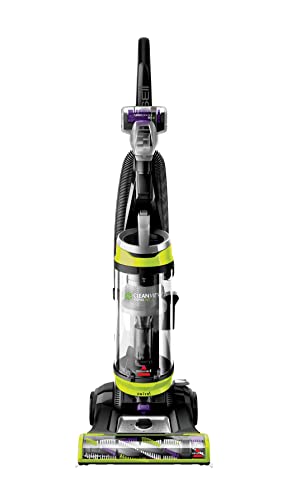
Bissell CleanView Swivel Pet Upright 2252 — Steering for furnished pet rooms
The CleanView Swivel Pet starts from a truth about pet homes: they are furnished homes, because animals colonise sofas, beds and the good chair, and the floor plan is a slalom of occupied furniture. Swivel steering is its answer — the head threads around chair legs, dog beds and the forest under a dining table without the shuffle-and-shunt of a fixed-neck upright, so the rooms pets actually live in get cleaned completely rather than approximately.
Its triple-action brushroll is built to loosen, lift and direct in one pass: bristles to open the pile and free woven hair, paddles to move it, suction to finish. On the mixed floors of a real pet home — carpet where the dog sleeps, boards where the bowls live — that combination keeps a brisk pace without the second pass that turns a chore into an event. The dirt tank is generously sized for hair’s volume, which is considerable and mostly air.
The tier is the friendly surprise: this is one of the more affordable entries in the guide relative to its appointment, so check price on Amazon and note what the position includes. Scatter-free hard-floor manners and pet tools round out a package aimed at the mainstream pet household — one or two animals, furnished rooms, weekly deep cleans with daily skirmishes between.
Against its Turbo Plus sibling, the choice is emphasis: the Swivel Pet is the manoeuvring generalist for furnished rooms, the Turbo Plus the sealed specialist for maximum hair war. Households whose enemy is hair in open carpet will lean one way; households whose enemy is hair everywhere furniture stands will lean the other, and both will be right.
The Swivel Pet also earns a word for the human-animal choreography it enables: quick, quiet-ish passes around a sleeping dog, a swivel around the cat’s chosen chair without moving its occupant, a clean that accommodates the household’s true rulers instead of exiling them. Vacuums that require the animals to be shut away get used less, by owners who dislike the shutting. A machine that can work around the residents, at their nap schedule, quietly accumulates more cleans per month — and accumulated cleans, as this guide keeps insisting, are the whole game.
Open-plan homes are the Swivel Pet’s natural stage: kitchen, dining and living areas flowing together, furniture arranged in islands, a dog bed in every sunbeam. The swivel head treats that landscape as one continuous clean rather than a series of rooms, and the tank’s volume matches the acreage. If your home’s ground floor is a single furnished expanse with animals roaming it like a savanna, this Bissell’s combination of steering and capacity was drawn on a plan of your house.
- Format: corded bagless upright with swivel steering
- Brush: triple-action brushroll
- Tank: large-capacity dirt tank
- Surfaces: carpet and hard floors, scatter-aware
- Tier: friendly end of the affordable pet band
Strengths
- Steering built for furnished rooms
- Brush action suited to woven-in hair
- Tank volume matches hair’s bulk
Trade-offs
- No tangle-free headline roller
- Filtration a step below the Turbo Plus
- Swivel takes a clean or two to master
Best for: furnished family rooms where pets and furniture share the floor.
Not suited for: maximum-shedding carpets needing the specialist’s sealed system.
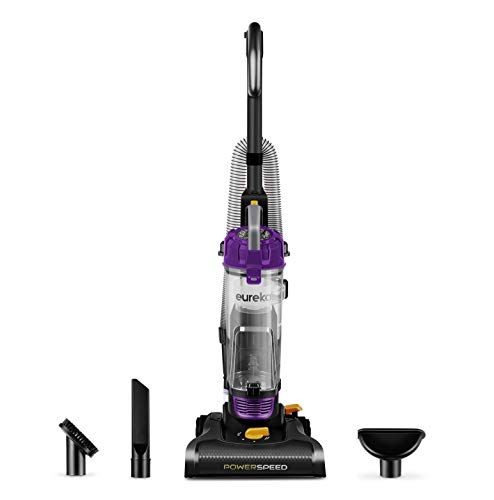
Eureka PowerSpeed Bagless Upright NEU182B — Budget cup and settings
The NEU182B is the budget pick that refuses to behave like a compromise, and its weapon is arithmetic: a 2.6-litre cup in a machine of around ten pounds, at the affordable end of this guide’s band. Pet hair is bulky — a single shedding dog can fill a small cup with what looks like a second, smaller dog — and the Eureka simply out-cups the problem, finishing rooms that send lesser bins to the pedal bin mid-pass.
Five height settings give its brushroll genuine range across the pet home’s surfaces, from the low mat by the door where grit and hair arrive together, to the bedroom carpet where both settle. Height adjustment at this tier is not guaranteed — many budget uprights fix the head and hope — and its presence here is the difference between a pet vacuum that adapts and one that merely attends.
The purple finish will divide opinion and clean nothing either way; what matters is the package’s honesty. Check price on Amazon: the tier is budget, the plastics are plain, and the engineering money visibly went into cup, brush and settings rather than trim. For a first pet, a first home, or a second machine stationed where the animals actually live, that allocation is exactly right.
It also travels between floors without negotiation, which in a house with a dog upstairs and a cat downstairs is not a detail. Pet hair’s geography is the whole house; a vacuum light enough to follow it everywhere, with a cup big enough to finish the job when it arrives, covers the map the way heavier specialists sometimes do not.
Students and first-time pet owners — a large and underserved nation — should read the NEU182B’s entry twice. A first dog or cat arrives with expenses in every direction, and the vacuum is usually bought in a hurry after the first sofa incident. This Eureka is the hurry-proof choice: capacity for the reality, settings for the rental’s unknown carpets, weight for the stairs of a shared house, and a tier that leaves room in the budget for the animal itself. It will not be the last vacuum a pet owner buys, but it is very hard to regret as the first.
The NEU182B also suits the fostering household — the saints who take in animals in rotation, whose hair load varies by the month and whose vacuum cannot be a specialist in any single coat. Capacity, settings and lightness generalise across guests: the long-haired resident, the short-haired visitor, the kitten season. Foster homes run their machines like small businesses, and this Eureka’s blend of low tier and high tolerance reads, in that context, less like a budget pick and more like equipment.
- Format: corded bagless upright, around 10 lbs
- Cup: 2.6-litre capacity
- Brush: 5-height adjustable brushroll
- Intent: pet hair, carpet and hard floor
- Tier: budget end of the affordable pet band
Strengths
- Cup volume swallows shedding loads
- Height range rare at this tier
- Light enough for whole-house duty
Trade-offs
- Plain finish and fittings
- No sealed allergen system headline
- Roller care is manual
Best for: budget-minded pet homes needing capacity and adaptability.
Not suited for: severe dander sensitivity needing sealed allergen systems.

Shark Navigator Lift-Away NV360 — Sealed-system all-rounder
The NV360 enters a pet guide on the strength of the half of pet mess you cannot see. Its sealed system with HEPA filtration means the dander and fine dust that ride along with hair complete their journey into the cup rather than leaking at the seams — the failure that makes some pet cleans smell, faintly, like warm dog and old carpet. For households where a family member’s breathing is part of the cleaning brief, that sealing is not a luxury line; it is the point of the machine.
The Lift-Away pod is the second pet argument: hair’s strongholds are stairs, car interiors and the upholstered heights, and a canister that lifts free with hose and tools turns those from expeditions into errands. Brushroll shutoff gives hard floors a suction-only pass that collects litter scatter and kibble without flicking them across the kitchen — a small mercy anyone who has chased the same kibble around a room will recognise.
It is the proven, mature option here: years in production, parts everywhere, behaviour known. Its cup is the modest one in this company, so the heaviest shedding estates will empty it often; but for the one-or-two-pet home with mixed floors and a dander concern, the balance of sealing, reach and manners is the most complete in the guide at its tier. Check price on Amazon — it anchors the affordable end of Shark’s own ladder.
Choose it when the pet problem in your home is as much air as hair, and when stairs and cars are part of the weekly map. The Bissells out-specialise it on the roller; the Shark out-seals and out-reaches them, and in many real households that trade resolves in the Shark’s favour by the second month.
The NV360’s pet case strengthens further in the car, a territory most vacuum guides forget and every pet owner knows intimately. Hair embeds in car upholstery with a tenacity that suggests intent, and the pod-plus-tools arrangement, run from a driveway socket, is the affordable household’s realistic answer — no dedicated car vacuum, no valet bill. If your animals travel, and whose do not, the lift-away pod is quietly doing double duty as the family’s automotive detailer, a role the floor-bound specialists cannot audition for.
Allergy-adjacent households — the ones where a visitor’s eyes water by dessert — will find the NV360’s sealed system changes the social arithmetic of pet ownership. A clean performed with a leaking machine redistributes the very particles the sensitive guest reacts to; a sealed clean removes them from circulation. No vacuum makes a pet home hypoallergenic, and this guide will not pretend otherwise, but the Shark narrows the gap between ‘we have a dog’ and ‘you can visit comfortably’ more honestly than anything else at its tier.
- Format: bagless upright with Lift-Away pod
- Filtration: sealed system with HEPA filter
- Brush: brushroll shutoff for hard floors
- Tools: upholstery and crevice tools
- Tier: value end of the affordable pet band
Strengths
- Sealed filtration for dander control
- Pod reach for stairs, cars, upholstery
- Hard-floor shutoff tames litter scatter
Trade-offs
- Smallest cup in this guide
- Roller is not a tangle-free design
- Pet tools less specialised than Bissell’s
Best for: dander-conscious pet homes with stairs and mixed floors.
Not suited for: maximum-volume shedding needing the biggest cups.

Dirt Devil Endura Reach Upright — Budget reach for pet stairs
Pets colonise vertically. The dog owns the third stair, the cat owns the landing and the armchair, and their hair concentrates exactly where a floor head cannot go. The Endura Reach is the budget answer to that geography: Dirt Devil’s Endura core — suction engineered to persist as the bin fills — plus the hose reach and tools to work treads, upholstery and the carpeted corners where hair drifts and settles.
The Endura discipline matters more in pet homes than anywhere, because hair loads a bin faster than any other debris and a machine whose suction fades as it fills will fade mid-dog. The Reach holds its temper across a session, and its light body makes the stair routine a one-handed-tool, one-handed-rail affair rather than a balancing act. At the friendliest tier in this guide — check price on Amazon — that combination of reach and persistence is the budget pet argument in its purest form.
It asks the usual Dirt Devil tolerances: plain finish, a tool set that is functional rather than plush, a brushroll the owner clears by hand. Pet owners already live a life of small maintenances; one more, monthly, on the roller is a fair exchange for a machine that covers floors, stairs and the dog’s chair at this tier.
Consider it the pick for the pet household whose home is more vertical than vast — stairs, landings, upholstered favourites — and whose budget is a hard fact rather than a preference. The specialists above out-clean it on open carpet in heavy moult; nothing at its tier out-reaches it, and reach is where its homes keep their hair.
There is also a kindness argument for the Reach in pet homes with older or smaller owners: the person who loves the animals may not be the person built for hauling a heavy upright up the stairs the animals have colonised. A light machine with long reach respects that reality, keeping the whole home within one person’s comfortable capability. Affordable cleaning is partly economics and partly ergonomics, and the Reach is the rare budget pick that understands both halves of its household.
Holiday lets and second homes with a dogs-welcome policy are the Reach’s other natural posting: hair loads arrive in concentrated weekend form, the stairs and sofas take the worst of it, and the turnaround clean must be fast, complete and performed by whoever is nearest. A light, reaching, inexpensive upright that lives on site beats a premium machine that lives elsewhere, every single changeover. Property owners running pet-friendly rentals on a budget will find this Dirt Devil’s arithmetic immediately familiar.
- Format: corded bagless upright with extended reach
- Filtration: Endura system for sustained suction
- Reach: hose and tools for stairs and upholstery
- Surfaces: carpet and hard floor
- Tier: friendliest in the affordable pet band
Strengths
- Reach covers pet-colonised stairs and furniture
- Suction persists as hair loads the bin
- Light body for vertical homes
Trade-offs
- Manual roller clearing
- Plainest finish in the guide
- Open-carpet authority below the specialists
Best for: vertical pet homes — stairs, landings, favourite chairs — on a budget.
Not suited for: vast open carpets in maximum moult.
Rubber Brooms and Lint Tools — Prose-only cheap first line
Before suction, friction. A rubber broom dragged across carpet rakes hair out of the pile by static and grip, gathering it into ropes and clumps that a vacuum — or a hand — then removes in seconds. On upholstery and car seats, the smaller lint tools of the same family work the same trick at hand scale. None of this is new technology; it is older than the vacuum itself, and in pet homes it remains undefeated at its price, which is to say almost no price at all.
Their role in an honest guide is load management. A two-minute rubber-broom pass before vacuuming a shedding room removes the surface hair that would otherwise load the bin and wind the roller, so the vacuum spends its session on the embedded fraction only it can reach. Pet owners who adopt the sequence find their machines lasting longer, their rollers staying cleaner, and their weekly deep clean arriving half done. As a first line, nothing in this article returns more per coin.
The limits are equally clear: friction tools do not touch grit at the pile’s base, do not filter air, and will not rescue a carpet that has not seen suction in a month. They are a complement with a defined border, and households that respect the border — broom for the surface, vacuum for the depth, both on rhythm — get a standard of pet-hair control that households relying on either alone rarely reach.
A final practical note on the broom itself: technique is a short drag toward you, strokes overlapping, working the room toward a single collection point rather than chasing hair around it. On carpet the strokes should be unhurried enough for the rubber to grip and roll the hair into its ropes; on hard floors the same tool gathers without the scattering a bristle broom causes. Rinse the head when it loads, and store it where the vacuum lives — the pair are a system, and systems work when their parts share an address.
Keep a second lint tool in the car and a third by the door, and the broom’s philosophy completes itself: hair is easiest to remove at the moment and place it lands, not after it has travelled. A thirty-second pass over your own clothes and the dog’s blanket before they circulate through the house prevents more hair migration than an hour of weekend vacuuming recovers. The tools are cheap enough to multiply, and multiplication — one at every point of need — is how friction quietly wins its share of the war.
- Format: rubber brooms, lint brushes and rollers
- Power: friction and static, no electricity
- Role: surface hair before vacuuming
- Cost class: the cheapest tools in this guide
- Tier: negligible — an accessory, not a machine
Strengths
- Pulls hair from pile vacuums skate over
- Costs almost nothing, lasts for years
- Extends every vacuum’s roller and bin life
Trade-offs
- No suction, no filtration, no grit removal
- Manual effort on every use
- A complement, never a replacement
Best for: every pet household, as the two-minute pre-pass before vacuuming.
Not suited for: anyone expecting it to replace a vacuum outright.
How Do the Six Divide a Pet Household’s Work?
Four machines clean floors and furniture, one seals and reaches, and the manual tools prepare the ground for all of them. Shortlist by hair volume and by where the hair lives — open carpet, seams, stairs or air.
If the table leaves two machines tied, let the sofa arbitrate: whichever one’s tools better match your upholstery’s seams and fabric will win the territory where pet hair’s reputation is actually decided, week after week, guest after guest.
| Pick | Format | Stands out for | Keep in mind |
|---|---|---|---|
| Bissell Pet Hair Eraser Turbo Plus | Corded upright | Tangle-free roller and allergen seal | Specialist, not generalist |
| Bissell CleanView Swivel Pet Upright 2252 | Corded upright | Swivel steering and brush action | Roller needs periodic clearing |
| Eureka PowerSpeed Bagless Upright NEU182B | Corded upright | Cup and height settings per tier | Manual roller maintenance |
| Shark Navigator Lift-Away NV360 | Bagless upright, Lift-Away | Sealing and lift-away reach | Compact cup for heavy loads |
| Dirt Devil Endura Reach Upright | Corded upright | Reach and sustained suction | Budget finish throughout |
| Rubber Brooms and Lint Tools | Manual tools (generic) | Friction beats hair at near-zero cost | First line only |
Where Does Pet Hair Actually Hide, and What Reaches It?
Open floor is pet hair’s least favourite hiding place, because that is where vacuums are strongest. The reserves live elsewhere: woven at the carpet’s roots where only agitation frees it, packed into the seam where sofa cushions meet, drifted into stair-tread corners, and suspended as dander in the dust every room exhales. A complete pet setup answers each address — a brushroll that opens pile, tools shaped for seams, reach for treads, filtration for the air. That is why this guide’s picks differ less in floor suction than in which of hair’s addresses they were built to evict.
The practical audit takes two minutes: after your next ordinary clean, run a hand in a rubber glove across the sofa seam, the third stair and the carpet by the dog’s bed. Whatever comes away is your current machine’s blind spot, itemised. Choose the pick whose tools and roller address that handful, and the upgrade will be visible in a way a suction figure never promised.
How Do You Survive Shedding Season Without Losing the Plot?
Shedding season is a logistics problem wearing a biology costume. The winning rhythm is frequency over intensity: short passes on the animal’s main territories every day or two, before hair weaves itself into pile and upholstery, beat the heroic weekend session that arrives after the weaving is done. Keep the vacuum where the animals are rather than where vacuums are traditionally kept; a machine stationed by the dog’s door will be used at dog frequency. Empty the bin at the line without exception — hair expands, packs and strangles airflow faster than any other debris — and give the roller its glance weekly in season rather than monthly.
The rubber-broom pre-pass earns its keep most in these weeks, stripping the surface so the vacuum’s session is spent on depth. Households that adopt the seasonal rhythm usually report the same surprise: the total weekly effort falls, because hair removed while loose is a minute’s work and hair removed after felting is an afternoon’s. The animals, indifferent, will shed either way; the season belongs to whichever household plans for it.
What Does Pet Ownership Do to a Vacuum Over Five Years?
It runs it roughly twice as much, loads it with the most abrasive common debris, and exposes every weak latch and proprietary filter to a hard audit. That is why this guide keeps returning to platforms and parts: a pet vacuum is a five-year relationship with a consumables schedule, and the affordable choice is the one whose belts, filters and rollers are cheap, findable and replaceable by the owner’s own hands at a kitchen table. Machines that meet that standard — all five linked picks were screened against it — convert pet ownership from a vacuum-consumption hobby into a stable, boring, affordable routine, which is the highest state pet cleaning ever reaches.
How Do You Clean the Places Pets Actually Live?
The pet home has a geography the floor plan does not show: the bed’s warm side, the sofa’s left cushion, the stair the dog uses as an observation post, the patch of hall carpet where the cat performs her ablutions. Those coordinates hold eighty percent of the hair in twenty percent of the area, and a cleaning route drawn around them — tools out, seams and treads first, open floor last — outperforms any machine upgrade applied to a generic route. Spend a week noticing where your animals actually spend their hours; the map will embarrass your current routine and then improve it permanently.
Upholstery technique repays the same attention. Work with the fabric’s grain, use the turbo or upholstery tool in overlapping lanes, and finish with the lint tool for the fraction suction leaves polished into the weave. Car interiors follow the same order — mats out and beaten, seams creviced, seats tooled — ideally before the weekly house clean, so the car’s harvest does not migrate indoors on your own shoes.
What Should a Pet Household’s Cleaning Cupboard Contain?
Beyond the vacuum itself, a small, deliberate kit multiplies any pick in this guide: the rubber broom and lint tools of the prose entry; a spare belt and filter bought before they are needed, because pet machines choose their moments; a washable throw over each animal’s favourite furniture territory, laundered weekly, which converts upholstery crises into laundry; and a doormat system — outside and inside the door the animals use — that intercepts the grit and hair at the border. None of it is expensive, all of it compounds, and together it is the difference between a household that owns a pet vacuum and a household that runs a pet-cleaning system.
The system’s final component is a calendar note: roller glance monthly, filter rhythm monthly, deep upholstery session seasonally, and the honest annual question of whether the animals’ numbers have changed the machine’s adequacy. Households change; litters arrive, old friends depart, a second dog materialises. The vacuum that fit the household of two years ago deserves a review, not an assumption, and this guide will still be here when the arithmetic changes.
How Do Different Animals Change the Vacuum You Need?
A cat and a dog are different cleaning problems wearing the same label. Cat hair is fine, light and electrostatic — it floats, clings to upholstery and clothing, and colonises high places a dog’s hair never reaches, which rewards sealed filtration and above-floor tools. Dog hair is heavier, oilier and volume-driven, arriving with grit and outdoor debris in its coat, which rewards cup capacity, brush authority and a doormat. Homes with both need the union of the two lists, which is why the generalist picks in this guide — the sealed Shark, the capacious Eureka — hold their own against the specialists in mixed menageries.
Small animals write their own footnotes. Rabbit and guinea-pig households fight hay as much as hair — long, light strands that wrap rollers with agricultural enthusiasm and bins that fill with bedding. For them the tangle question outranks everything, and the broom pre-pass becomes close to mandatory. The principle generalises: name your actual debris — hair type, bedding, litter, grit — and the correct machine tends to introduce itself, because every pick above is a different answer to a differently-worded problem.
What Does ‘Pet Grade’ Mean When It Is Not Marketing?
Strip the paw prints off the boxes and a genuinely pet-grade machine reduces to five verifiable properties: a roller that survives hair, a bin that tolerates volume, tools shaped for upholstery and seams, filtration that keeps the fine fraction indoors, and parts the owner can replace. Any model claiming the label should be interrogated against those five, in that order, with the listing’s contents and the parts catalogue as evidence. Models that pass — as the five linked picks here were required to — earn the label mechanically rather than graphically.
The interrogation takes ten minutes and saves a purchase. It is also portable: apply it to any future pet vacuum, at any tier, in any year, and the marketing falls away leaving the machine. Teaching that habit is worth more than any single recommendation in this guide, because the animals will outlast the models, and the next choice is already on its way.
How Should You Introduce a New Vacuum to a Nervous Pet?
A practical word that no specification sheet covers: some animals fear vacuums, and a machine’s success in a pet home partly depends on the diplomacy of its introduction. Let the new vacuum sit unplugged in the room for a day, a piece of furniture rather than an event. Run it first in another room with the door between, at the household’s calmest hour, and pair the sound with whatever the animal values — food, play, the good blanket. Most animals file the noise under ‘household weather’ within a week, and the household gains a machine it can use at full frequency instead of in apologetic bursts.
The point is not sentimentality; it is cleaning mathematics. A vacuum the dog tolerates gets used daily, and daily use is the entire pet-hair strategy. When choosing between two otherwise equal picks, the one your particular animal can live alongside — often the one whose pitch and pattern are steadiest rather than loudest — is the better machine for your home, whatever the figures say.
The same diplomacy applies in reverse when a new animal joins a home with an established vacuum: short, calm, rewarded exposures beat a single dramatic Saturday deep-clean as an introduction. Households that manage both introductions well end up with the rarest asset in pet ownership — a cleaning routine nobody in the house, on two legs or four, organises their anxiety around.
What Mistakes Do Pet-Hair Shoppers Keep Making?
Buying suction and ignoring the roller is the founding error: hair is freed by the brush and merely transported by suction, so a mighty motor behind a wrapping roller loses to a modest motor behind a tangle-free one by the second week of moult. Second, forgetting the furniture — choosing a floor champion with no credible upholstery tool while the sofa holds half the household’s hair. Third, under-sizing the bin for a debris that is mostly volume. Fourth, skipping filtration because hair is visible, while the dander that actually troubles breathing rides out the exhaust. Fifth, vacuuming at human convenience rather than shedding rhythm, then concluding the machine cannot cope. Sixth, never adopting the two-minute broom pre-pass that would halve the machine’s burden. Every pick above was chosen against this list; the remaining variable is the household’s own honesty about its animals.
Seventh, and most human: buying the vacuum for the pet you wish you had. A single short-haired cat and two long-haired dogs are different cleaning nations, and a machine chosen for the former will drown in the latter’s spring moult. Count your animals, weigh their coats honestly, and buy for the household that actually sheds on your floors — the pets, unimpressed by aspiration, will continue as they are.
Keep the whole list in proportion, though: pet households forgive a vacuum almost anything except being without one during moult, so a good-enough machine bought today outperforms a perfect machine researched until the season has passed through your carpets unopposed.
Final Recommendation
Start where your hair lives. Open carpet in heavy moult points to the Bissell Turbo Plus; furnished rooms to its Swivel Pet sibling; budget capacity to the Eureka; dander and stairs to the Shark; vertical homes on the strictest tier to the Dirt Devil Reach. Add the rubber broom to any of them — it is the cheapest upgrade in the history of this category — and the system is complete at an affordable band.
One seasonal note to close the argument: buy and set up your pet system before the spring moult, not during it. A machine learned in calm weeks — its bin rhythm, its roller glance, its tool drawer — is a machine that performs when the hair storm arrives, while a machine unboxed mid-moult gets blamed for the weather. Preparation is the cheapest pet accessory of all, and it is entirely free.
Pet hair never ends, which is precisely why the right machine matters: the war is permanent, so the weapon must be sustainable. Choose the vacuum whose roller, bin and tools match your animals’ output, keep its small rhythms, and the hair becomes what it should always have been — a chore of minutes, in a home that smells like a home and not like the evidence.
Frequently Asked Questions
What makes a vacuum good for pet hair specifically?
Three things, in order: a brushroll that resists or easily sheds wrapping, tools that reach seams and upholstery where hair migrates, and filtration that traps the dander riding with the hair. Raw suction ranks fourth, because hair must be freed before it can be collected — which is why specialist models beat stronger generalists in real pet homes.
How often should I vacuum with shedding pets?
Little and often wins: brief passes over the animals’ territories every day or two in shedding season, a full clean weekly. Hair lifted while loose is minutes of work; hair left to weave into pile becomes an extraction project. Station the machine where the pets live and the rhythm keeps itself.
Are tangle-free brushrolls really different?
Yes — the geometry combs or channels hair toward the bin instead of winding it around the roller, so agitation survives the month instead of fading by the week. They still deserve a monthly glance, but the scissor ritual that defines ordinary pet-vacuum ownership is genuinely retired, as the Bissell Turbo Plus entry describes.
Can a vacuum help with pet dander in the air?
A sealed or allergen-trapping system keeps collected dander inside the machine instead of exhausting it back, which is the vacuum’s real contribution. It complements rather than replaces air purification — our air-purifier coverage handles the room side — but a leaky vacuum can actively undo a clean, which is why sealing features in the Shark and Bissell picks above.
Is a cordless stick enough for pet hair?
For daily surface skirmishes in small, hard-floored pet homes, a good stick earns its place, and our cordless coverage says so. For carpeted, multi-pet, shedding-season reality, corded uprights sustain the agitation and capacity the job demands without a battery negotiating. Many pet homes run both, stick for the week and upright for the weekend.
What is the cheapest real improvement I can make today?
The rubber broom in the prose entry: a two-minute friction pass before vacuuming strips surface hair, halves the bin’s load and keeps rollers cleaner for longer. It costs less than the treats that caused the problem and improves every vacuum ever made, including the five linked above.
Related Guides
For the same animals on the other surfaces of the house, the floor-wide view is in Best Affordable Vacuums for Floors. Households that prefer their pet debris sealed in a bag instead should read Best Lightweight Bagged Upright Vacuums. Not all household hair is indoors, and the outdoor water has its own machines, in Best Automatic Pool Vacuums. And for the dander that leaves the floor and takes to the air, the companion guide is Best Air Purifiers for Dogs. Hair, floors, bags and air are one pet system; those guides cover the corners this one cannot. Read together, they turn a single purchase into a household system, which is the only scale at which pet hair is ever truly beaten.


