What's inside
- Key Takeaways
- Quick Picks
- How Did We Narrow Down the Small Dishwashers Worth Your Cabinet Space?
- Side-by-Side: The Six Options at a Glance
- What Does “Small” Actually Buy You — and What Does It Cost?
- Which Interior Details Matter Most in a Narrow Tub?
- How Do You Install an 18-Inch Built-In Without Regrets?
- What Changes When the Kitchen Is a Boat, a Cabin or an ADU?
- How Do You Keep a Narrow Machine Smelling Like Nothing?
- Mistakes That Make a Small Dishwasher Feel Smaller
- How Do Six Programs on a Small Machine Map to Real Loads?
- Noise, Water and the Studio-Kitchen Reality
- How Should You Load a Narrow Tub So It Actually Cleans?
- What Does a Small Dishwasher Cost You Over a Decade?
- Which of These Suits a Rental, a Renovation, or an Accessible Kitchen?
- Final Recommendation
- What Should You Check Before the Old Cabinet Comes Out?
- Frequently Asked Questions
- Related Guides
As an Amazon Associate I earn from qualifying purchases. This post may contain affiliate links at no extra cost to you.
cottageverdict.com is reader-supported. When you buy through links on our site, we may earn an affiliate commission.
Where to buy: every built-in model reviewed below is sold through Amazon, and each pick section ends with the exact listing to look for, where you can check price on Amazon and confirm the cabinet dimensions against your own tape measure before ordering. With narrow machines, an eighth of an inch is the whole story, so measure the opening twice and fall in love once.
The best small dishwashers exist because of a stubborn architectural fact: a great many kitchens were framed before the 24-inch dishwasher became the default, and their cabinet runs simply have no full-width bay to give up. Galley kitchens in pre-war apartments, basement in-law suites, studio conversions, narrowboats of the housing world like ADUs and tiny homes — all of them share the same leftover slot, roughly eighteen inches wide, that used to hold a trash compactor or a stack of drawers nobody loved. An 18-inch built-in turns that orphan slot into a real dishwasher with a plumbed drain, a proper door seal and a tub you never have to haul to the sink.
This guide stays disciplined about what “small” means. The four linked picks are all 18-inch built-ins with eight place settings where the listing states it, because that is the size class that actually solves the narrow-cabinet problem. Around them we discuss two honest alternatives in prose: the countertop class, for kitchens where even an 18-inch bay does not exist, and 24-inch slim-profile built-ins, for renovators who can steal a few inches from a neighbouring cabinet. What we do not do is pad the list with full-size machines wearing a “compact” badge, or with the same model listed twice in a second colour. The Honeywell and Midea below, for instance, each also appear on Amazon in black; those are finish variants of the picks already here, not extra recommendations.
Key Takeaways
- All four linked picks are true 18-inch built-ins with stainless steel tubs where the listing says so, and eight place settings where the listing states a capacity — no full-size machine has been shrunk on paper to fill this list.
- An 18-inch tub swallows a day of dishes for one or two people comfortably; households of three or more should expect to run it daily rather than every other day.
- The Frigidaire is the only ADA-height pick here, which matters in accessible kitchens and in older homes with low counter runs.
- If your kitchen has no 18-inch bay at all, the countertop class discussed in prose is the honest fallback — it trades capacity and a permanent drain for zero carpentry.
- Heated drying is not universal at this size; the Midea states it outright, and for the others, cracking the door after the cycle is the veteran move.
Quick Picks
| Pick | Badge | Why it earns its place |
|---|---|---|
| Honeywell 18-Inch Built-In (White) | Six-program all-rounder | Six washing programs and a stainless steel tub in an 18-inch frame, with UL and Energy Star credentials stated in the listing. |
| Midea 18-Inch Built-In (White) | The heated-dry pick | The only pick here whose listing promises heated dry alongside a high-temp wash, aimed squarely at apartments and RVs. |
| EdgeStar BIDW1802SS 18-Inch Built-In Dishwasher | Stainless-front staple | A long-running 18-inch, eight-place-setting design in a stainless finish that suits visible, open-plan galleys. |
| Frigidaire 18-Inch ADA Compact Dishwasher | ADA-height choice | Compact ADA sizing, dual spray arms and a stated 52 dBA, with room-of-choice delivery softening the installation day. |
| The countertop class | No-cabinet route | For kitchens with no spare bay at all: tank or faucet-fed machines that sit on the worktop and ask for no carpentry. |
| 24-inch slim-profile built-ins | The step-up width | Full-width machines with shallow depth and lean interiors, worth considering when a remodel can free the extra inches. |
How Did We Narrow Down the Small Dishwashers Worth Your Cabinet Space?
We started from the constraint, not the catalogue. A small-dishwasher guide earns its keep only if every linked machine physically fits the slot the reader actually has, so the first filter was width as stated in the listing title: 18 inches, no exceptions, no “compact for its class” 24-inch machines smuggled in. The second filter was format — built-in only for the linked picks, because a plumbed, door-sealed machine is a different purchase from a countertop box, and mixing the two in one ranked list misleads both audiences. Countertop and slim-24 options are covered, but in clearly labelled prose where they belong.
After that we read each listing for what it actually commits to. Place settings, program counts, tub material and certifications were only carried into this guide where the manufacturer’s own title states them; where a title is silent — and the EdgeStar’s is admirably terse — we say less rather than inventing more. We also collapsed finish duplicates: the Honeywell and Midea each sell in black as well as the white versions listed here, and a colour change is not a second product. Finally, we weighted the unglamorous things that decide whether a narrow dishwasher is loved or cursed in year two: whether drying help is stated, whether the height suits an ADA brief, and whether the brand has a service footprint a small-kitchen owner can realistically reach.

Honeywell 18-Inch Built-In Dishwasher (White) — Six-program all-rounder
Honeywell’s entry into the narrow class reads like a refusal to treat 18 inches as an apology. The listing commits to eight place settings and six washing programs inside a stainless steel tub, which is the full-size checklist transplanted into a cabinet slot most brands abandon to their cheapest engineering. Six programs at this width is genuinely useful rather than decorative: small households run odd loads — a couple of pans and four plates after a weeknight stir-fry, a weekend’s worth of glasses and mugs — and program choice is what lets a small tub behave like a flexible one instead of a single blunt cycle.
The stainless tub matters more in a small machine than a big one. A narrow tub is run more often per place setting than a wide one, because the household’s dish output does not shrink just because the cabinet did; the tub sees near-daily hot cycles, and stainless shrugs off the staining and odour retention that plastic tubs accumulate under that workload. The listing also carries UL and Energy Star credentials, which at this size class is not a given — plenty of narrow imports skip one or both. In white, it disappears into the painted cabinetry of older kitchens, which is exactly where most 18-inch slots live.
- Width class: 18-inch built-in, as titled
- Capacity: 8 place settings, as titled
- Programs: 6 washing programs, as titled
- Tub: stainless steel, as titled
- Credentials: UL listed and Energy Star, as titled
- Finish: white (a black finish of the same model exists — not a separate pick)
- Where to buy: the Honeywell 18-Inch Built-In Dishwasher listing on Amazon — check price on Amazon
Strengths
- Six programs give a small tub real flexibility across soil levels.
- Stainless tub suits the near-daily cycling small households impose.
- Both UL and Energy Star are stated, which is rarer at this width than it should be.
Trade-offs
- The listing states no noise figure, so open-plan buyers are guessing.
- White only in this listing; matching a stainless suite means choosing the sibling finish carefully.
- No drying technology is named, so plastics may need a tea towel.
Best for: a one- or two-person household replacing a dead trash-compactor slot with a real, plumbed dishwasher.
Not suited for: families of four hoping to wash a full day plus party ware in a single run.

Midea 18-Inch Built-In Dishwasher (White) — The heated-dry pick
Midea’s 18-inch machine is the one pick in this guide whose listing uses the two words small-dishwasher owners learn to hunt for: heated dry. Drying is where narrow machines traditionally cut their corners, because a heating element and the controls to run it cost money in a price-sensitive class, and the result is the familiar small-dishwasher ritual of shaking water off tubs and leaving the door ajar overnight. A stated heated dry, paired with a stated high-temp wash, moves this machine from “washes adequately” to “finishes the job,” and for renters and apartment dwellers — the listing itself names apartments and RVs — that completeness matters because there is rarely counter space to park a draining rack of half-dry plastics.
There is a second, quieter reason the heated dry matters specifically at this width. Narrow machines are bought disproportionately by households without a second set of anything — four mugs, four bowls, a single set of lunchboxes that must be clean and dry by morning because there is no backup set in the cupboard. A machine that washes but leaves plastics beaded with water breaks that household’s morning; a machine that finishes the dry keeps it. That is the lived difference between the listings that name a drying system and those that leave the subject untouched, and it is why this pick, rather than the marginally broader Honeywell, is the one we would install in a studio or a rental where the dish inventory is counted in single digits.
The rest of the stated package mirrors the Honeywell’s shape: eight place settings, six washing cycles and a stainless steel tub, with Energy Star certification named in the title. The listing also describes the machine as slim and quiet, aimed at compact living; we note the positioning without inventing a decibel figure the title does not give. Where the Honeywell leans on program breadth, the Midea leans on the wash-and-dry pairing, and for most small kitchens we would take the drying help over a sixth program variant. It is the pick we would hand to someone whose current routine is hand-drying everything the machine was supposed to finish.
- Width class: 18-inch built-in, as titled
- Capacity: 8 place settings, as titled
- Cycles: 6 washing cycles, as titled
- Tub: stainless steel, as titled
- Drying: heated dry, stated in the listing title
- Wash boost: high-temp wash, stated in the listing title
- Certification: Energy Star Certified, as titled
- Where to buy: the Midea 18-Inch Built-In Dishwasher listing on Amazon — check price on Amazon
Strengths
- Heated dry is stated outright — the scarcest promise in this size class.
- High-temp wash helps with greasy pans and baby bottles alike.
- Positioned and sized for apartments and RVs, not just small houses.
Trade-offs
- No decibel number is published in the title despite the quiet positioning.
- White finish in this listing; the black sibling is the same machine, not an upgrade.
- Heated dry adds cycle time that the impatient will notice.
Ideal when: your small kitchen has no room for a draining rack and dishes must come out cupboard-ready.
A weak match when: you run the machine overnight in a studio and need a verified low-noise figure before buying.

EdgeStar BIDW1802SS 18-Inch Built-In Dishwasher — Stainless-front staple
The EdgeStar BIDW1802SS is the elder statesman of this list: a model designation that has circulated in the 18-inch niche for years, sold under a listing title so terse it borders on defiant — width, place settings, format, full stop. We include it precisely because of that longevity. In a class crowded with listings that appear and vanish between seasons, a model that installers, RV upfitters and small-kitchen renovators have been specifying for years accumulates something no new listing can fake: a track record of parts, manuals and installer familiarity.
There is also a practical dividend to a model that has been specified for years: the second-hand and installer knowledge around it is deep. Forums hold its error codes, its rack quirks, its door-seal behaviour at year five. A buyer stepping into a niche class is buying into an information ecosystem as much as a machine, and on that measure the EdgeStar’s ecosystem is the richest of the four linked picks — a soft advantage, but a real one for owners far from a service centre.
What the title commits to is the essential geometry — 18 inches wide, eight place settings, built-in — and the stainless front that the SS suffix and the product photography carry. Everything else, we deliberately leave unsaid rather than borrow specifications from sibling models or older revisions, because EdgeStar has sold variations under this family name and the honest guide repeats only what the current listing states. Judge it as the conservative choice: the machine for a visible galley in an open-plan space, where the stainless face earns its keep daily, and for buyers who value a model’s history over a longer feature list. In a rental duplex or a long-owned condo, that conservatism is often the wisest money in the room.
- Width class: 18 inches wide, as titled
- Capacity: 8 place settings, as titled
- Format: built-in, as titled
- Model: BIDW1802SS
- Finish: stainless front, per the model designation and listing
- Where to buy: the EdgeStar BIDW1802SS listing on Amazon — check price on Amazon
Strengths
- A long-running model with deep installer and owner familiarity.
- Stainless front suits kitchens where the machine is always on show.
- The specification is honest and minimal — what is stated is what defines it.
Trade-offs
- The listing title states no tub material, program count or certification.
- No noise figure is published in the title.
- Feature shoppers will find the Honeywell and Midea lists longer.
Choose it if: you are fitting a proven model into a visible galley and value parts-and-manuals longevity.
Pass on it if: your buying decision hinges on a stated heated dry or a certified efficiency label.
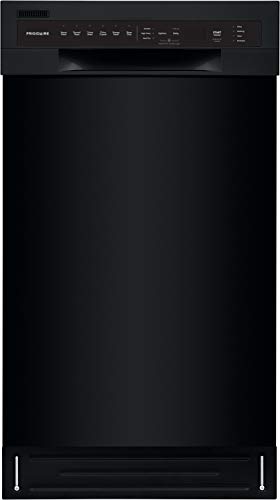
Frigidaire 18-Inch ADA Compact Dishwasher — ADA-height choice
Frigidaire’s compact entry solves a different dimension of small: not just narrow, but low. It is built to ADA compact dimensions, which makes it the pick that fits beneath the lowered counter runs of accessible kitchens and beneath the shallower counters of some older homes, where a standard-height 18-inch machine would foul the worktop. Accessibility is the headline, but plenty of buyers without an accessibility brief end up here because their 1930s kitchen simply has less vertical room than modern cabinetry assumes.
The listing states dual spray arms — meaningful in a narrow tub, where a single arm’s spray pattern has to work harder to reach the corners of a tightly packed load — and a noise figure of 52 dBA, the only decibel commitment among our four linked picks. That number will not trouble a separate kitchen; in a studio it is a background hum rather than silence, and we would not oversell it. It is also a front-control machine, so the cycle state is visible at a glance, which pairs naturally with its accessibility brief: controls you can see and reach beat controls hidden along a door’s top edge when seated operation is the point. The black finish and the room-of-choice delivery named in the listing round out a package clearly aimed at buyers who need the logistics made easy, not just the machine made small.
- Width class: 18-inch, ADA compact, as titled
- Controls: front control, as titled
- Spray: dual spray arms, as titled
- Noise: 52 dBA, as titled
- Finish: black, as titled
- Delivery: room-of-choice delivery included, as titled
- Where to buy: look for the Frigidaire 18-Inch ADA Compact Dishwasher listing on Amazon — check price on Amazon
Strengths
- ADA compact height fits low counters that exclude standard narrow machines.
- Dual spray arms address the corner-coverage problem of narrow tubs.
- It is the only linked pick here that publishes its decibel figure.
Trade-offs
- 52 dBA is respectable, not hushed, for open-plan sleeping-and-living spaces.
- The listing title does not state place settings or tub material.
- Black is the finish on offer in this listing.
The right kitchen: an accessible layout, a low counter run, or an older home whose cabinetry predates standard heights.
Look elsewhere when: you have full standard height available and want the longest stated feature list instead.
The Countertop Class — No-cabinet route
Some kitchens defeat even the 18-inch premise: the cabinet run is continuous, the landlord forbids carpentry, or the only free eighteen inches in the room are already the fridge. For those rooms the countertop class exists — compact machines that live on the worktop, feed from an internal tank or a faucet adapter, and drain into the sink. We cover them here at class level rather than as ranked picks, because they are a different appliance wearing the same noun: capacities are a fraction of a built-in’s eight place settings, a casserole dish is an event, and the machine itself consumes the counter space that small kitchens can least spare.
Judged on their own terms, though, they are the right answer for a defined set of lives: renters in studios, students in house-shares, anyone whose lease is shorter than a dishwasher’s payback period. If that is your situation, our countertop-focused guides on this site walk the class properly, model by model. Within this guide’s built-in brief, treat the countertop route as the honest fallback when the tape measure says no — chosen knowingly, it beats a built-in bought hopefully and returned angrily.
Strengths
- No cabinet surgery, no plumber, and usually no landlord negotiation.
- Moves with you at the end of a lease.
- Tank-fed versions need nothing but a nearby outlet and a jug.
Trade-offs
- Capacity is a few settings, not eight — big pans still meet the sink.
- The machine permanently occupies scarce worktop.
- Faucet-fed versions monopolise the tap while they run.
Worth it when: there is physically no bay to convert and the lease forbids creating one.
Frustrating when: you cook daily for three and expect built-in capacity from a countertop box.
24-Inch Slim-Profile Built-Ins — The step-up width
The final prose slot belongs to the machines that solve “small” along the depth axis instead of the width axis: full 24-inch built-ins with slim profiles — shallower tubs, lean racking, sometimes reduced height — designed for kitchens that have the width but not the depth, or for renovators who can free six extra inches by narrowing a neighbouring cabinet during a refit. As a class they wash meaningfully more per load than any 18-inch machine, and their racking takes the wide platters and tall stockpots that narrow tubs refuse.
We discuss them at class level because they answer a different question from this guide’s. If your remodel is already open — carcasses out, tape measures everywhere — price the slim 24 into the plan before defaulting to 18 inches out of habit. If, on the other hand, your cabinets are staying, this class is a daydream; the four linked picks above are your real shortlist. Readers weighing a ground-up small-kitchen refit may also want the panelled route, where the machine disappears behind cabinetry entirely — our companion guide to the Best Integrated Dishwashers covers that format in the depth it deserves.
Strengths
- Noticeably more capacity per load than the 18-inch class.
- Racking accepts wide and tall items that defeat narrow tubs.
- Depth-lean designs suit shallow European-style cabinet runs.
Trade-offs
- Requires the width — no help to a true 18-inch slot.
- Slim internals can mean shallower racks than standard 24-inch machines.
- Often priced like full-size machines, because mechanically they are.
Suits best: a remodel that can re-plan cabinet widths, or a kitchen short on depth rather than width.
Not suited for: a fixed, finished cabinet run with a single narrow vacancy.
One last piece of framing before the table. Notice what this guide has not done: it has not ranked these machines by a noise figure three of them do not publish, a program count two of them share, or a capacity stated identically across the class. At 18 inches, the differences that survive contact with real life are drying help, height, tub material and the maker’s staying power — and the table below is organised around exactly those stated facts, so you can compare what is known rather than what is marketed.
Side-by-Side: The Six Options at a Glance
| Option | Format | Stated capacity | What the listing commits to |
|---|---|---|---|
| Honeywell built-in, 18-inch (White) | 18-inch built-in | 8 place settings | 6 programs, stainless tub, UL and Energy Star |
| Midea built-in, 18-inch (White) | 18-inch built-in | 8 place settings | 6 cycles, stainless tub, heated dry, high-temp wash, Energy Star |
| EdgeStar BIDW1802SS | 18-inch built-in | 8 place settings | Width, capacity and format — a deliberately minimal spec |
| Frigidaire 18-Inch ADA Compact | 18-inch built-in, ADA height | Not stated in title | Dual spray arms, front control, 52 dBA |
| Countertop class | Worktop, tank or faucet fed | A few settings, class-wide | No installation; covered in prose |
| 24-inch slim-profile class | 24-inch built-in, lean depth | Varies by model | More capacity where width allows; covered in prose |
What Does “Small” Actually Buy You — and What Does It Cost?
The honest arithmetic of an 18-inch machine starts with place settings. Eight settings, the figure three of our four linked picks state, translates in a real kitchen to roughly this: a full day of dishes for two people who cook once, or a single generous meal for four with the pans stacked hopefully on top. It does not translate to a dinner party. Owners who thrive with narrow machines share a rhythm — run it every evening, half-full or not, and let the machine be a daily appliance rather than a twice-weekly event. Owners who fight with them are usually trying to batch three days of cooking into a tub designed for one.
What small buys you, beyond the obvious fit, is a kitchen that keeps its drawers. The alternative histories of an 18-inch slot are mostly bad: a trash compactor nobody empties, a wine fridge that becomes a warm cupboard, or a hand-washing regime that quietly eats twenty minutes a day. A plumbed dishwasher in that slot also beats the countertop compromise on every axis except portability — it drains itself, seals properly, and leaves the worktop free for the cooking that made the dishes. The cost, beyond capacity, is choice: the 18-inch class is a niche, so finishes, noise engineering and smart features arrive later and thinner than in the 24-inch mainstream. Buy the niche knowingly and it serves for a decade; buy it expecting mainstream variety and you will resent the catalogue, not the machine.
Which Interior Details Matter Most in a Narrow Tub?
Tub material leads the list, and it is why we kept repeating the listings’ own words. Two of the four linked picks state stainless steel tubs outright, and in a machine cycled daily, stainless resists the grey filming and lingering odours that plastic interiors develop. Readers who care about interior materials beyond the tub — rack coatings, spray-arm construction, the works — will find the material question taken apart properly in our guide to the Best Dishwashers With No Plastic Inside, which is honest about where polymers remain even in all-stainless machines. Inside this guide, the narrower point is simpler: in a small tub, everything is closer to the spray, the heat and the detergent, so interior quality is not a luxury tier — it is the machine.
Racking is the second detail, and the one photographs hide. Narrow racks punish tall glasses and reward stacking discipline; an adjustable upper rack, where a model offers one, is worth more than an extra program. Spray coverage follows: the Frigidaire’s stated dual spray arms exist precisely because a single arm in a narrow, densely loaded tub leaves shadowed corners. Finally, drying. In a wide machine, residual water is an annoyance spread thin; in a narrow machine loaded tight, it pools. A stated heated dry, like the Midea’s, or a disciplined door-crack habit, is the difference between unloading into cupboards and unloading into a drying rack you bought the machine to avoid.
How Do You Install an 18-Inch Built-In Without Regrets?
Begin a week before the machine arrives, with the opening itself. Measure width at the front and the back — old cabinet runs taper — and measure height from the finished floor, not the subfloor, especially if new flooring is part of the project; more narrow dishwashers have been defeated by a tile layer than by any mechanical fault. Confirm the slot has, or can be given, a hot-water feed, a drain path to the sink trap or disposal, and an electrical supply that meets your local code; an 18-inch machine needs the same three services as a 24-inch one, in less forgiving space.
On the day, slide the machine in on cardboard to protect the floor, level it front-to-back and side-to-side before any brackets go on — a narrow machine racks its door seal quickly if it stands twisted — and run the first cycle empty while you watch the connections with a torch and a dry paper towel. Then load it the way the manual’s diagram suggests for the first month, however fussy that feels. Narrow tubs teach their owners a loading grammar, and the owners who learn it in month one stop thinking about it; the ones who improvise from day one blame the machine for their own geometry. Keep the filter on a monthly rinse schedule, because a small filter serving daily cycles clogs on a small household’s timeline, not a big machine’s.
What Changes When the Kitchen Is a Boat, a Cabin or an ADU?
A meaningful slice of the 18-inch class never sees a conventional house. Accessory dwelling units, park-model cabins, houseboats and high-end RV conversions all converge on the same narrow slot, and the Midea’s listing nods at this world directly by naming RVs. The buying logic shifts in these settings. Water arrives from a tank or a modest supply, so per-cycle thrift outranks program glamour. Power may be a shore line or an inverter budget, which makes the eco cycle a planning tool rather than a virtue badge. And service access is a journey, which pushes the long-running, widely documented models up the list and the exotic listings down it.
Installation shifts too. Floors in these dwellings move — a boat flexes, a cabin settles — so levelling is not a one-time act but a seasonal check, and a machine that starts rocking its door seal in month three is usually standing on a floor that changed, not failing itself. Drainage into grey-water systems demands the low-residue detergent discipline that marine and off-grid owners already practise. None of the four linked picks is a marine appliance and we will not pretend otherwise; they are household machines that this world adopts because the geometry fits. Adopt them with the levelling checks and the drain planning done honestly, and they serve these small, beloved spaces as faithfully as they serve a city galley.
How Do You Keep a Narrow Machine Smelling Like Nothing?
Odour is the small dishwasher’s most reported ailment and its most preventable. The causes are mundane: a filter carrying a week of trapped starch, a door seal with a biofilm in its fold, a machine closed tight while still warm and wet. The cures match. Rinse the filter monthly under the tap — weekly if the household cooks a lot of rice and pasta, whose starches glue themselves to mesh. Wipe the seal’s fold with a cloth when you unload the morning after a heavy load. Leave the door cracked a finger’s width when the machine will sit empty for days, so the tub dries to neutrality instead of ripening in its own steam.
Monthly, run the hottest cycle empty with a dishwasher cleaner or a cup of white vinegar in a bowl on the top rack, whichever the maker’s manual blesses, and check the spray-arm nozzles for the grit that hard water leaves behind. In hard-water districts, keep the salt and rinse-aid reservoirs — where a model provides them — honestly filled, because scale narrows nozzles and clouds glassware in a small tub faster than in a large one. Do these few things and the machine greets you with the smell of warm nothing, which is the correct smell of every dishwasher ever made.
Mistakes That Make a Small Dishwasher Feel Smaller
The classic error is buying by the photograph of an empty tub. Empty narrow tubs look generous; loaded ones tell the truth. Shop instead by your largest regular item — the sheet pan, the stockpot, the tall blender jug — and accept that one or two oversize pieces per week will always be hand-washed, in any dishwasher class. The second error is skipping the rinse aid. In a tight tub, sheeting action matters more, not less, and most “my small dishwasher leaves everything spotty” complaints dissolve with a filled rinse-aid dispenser and the right dosage setting.
Third, owners overload the cutlery. Eight place settings of cutlery in a narrow basket nests spoons together and shadows forks; spreading cutlery handles-up and handles-down alternately is boring advice that works. Fourth, people forget that small machines are plumbed appliances with filters and seals that want the same maintenance as big ones — the monthly filter rinse and the occasional door-seal wipe are not optional extras at this size. And finally, the remodel mistake: ordering the machine before the cabinets are final. An 18-inch slot is a commitment made by the cabinet plan, and the time to choose Honeywell versus Frigidaire is when the plan is ink, not when the van is outside. Readers planning the wider kitchen around the machine — worktops, a microwave sized for a small household, the rest of the compact suite — may find our roundup of the Best 2.2 Cu Ft Microwaves a useful companion for the big-capacity end of small-kitchen thinking.
One more sizing trap deserves its own paragraph, because it catches careful people: height. Buyers measure width obsessively and height casually, yet the Frigidaire exists in this guide precisely because a meaningful number of small kitchens fail on the vertical. Countertop thickness, a raised floor layer, a sagging old cabinet run — each steals millimetres, and a standard-height machine under a low counter is a machine that does not fit, full stop. Measure the opening’s height at both front corners and take the smaller number as truth. The same discipline applies to depth once hoses and the water connection are counted: a narrow machine still needs its services behind it, and a slot measured to the wall is a slot measured wrong.
How Do Six Programs on a Small Machine Map to Real Loads?
Program counts invite scepticism — surely a dishwasher needs one good cycle and the rest is brochure. In a full-size machine that argument nearly holds, because a big tub buffers bad choices. In an 18-inch tub it collapses. Every load is a larger fraction of the machine’s capacity, loads vary wildly in character across a small household’s week, and the program dial is how a small machine pretends to be several machines. The six programs stated on the Honeywell and Midea listings typically span the territory that matters: an intensive cycle for pans and baked-on trays, a daily auto or normal cycle, an eco cycle that trades time for water and energy thrift, a rapid cycle for the lightly soiled aftermath of sandwiches and coffee, a glass or delicate setting, and a rinse or soak option. You will use three of them constantly and the others exactly when nothing else would do — which is the point of having them.
The mapping to real life runs like this. Weeknight cooking for two — two pans, four plates, glasses, cutlery — belongs on the daily cycle with a standard detergent dose. The Sunday roast, with its roasting tin and its gravy-skinned plates, belongs on intensive, loaded the moment the meal ends rather than after the film, because dried gravy is the narrow tub’s nemesis. Eco is the overnight cycle: it asks for hours and gives back thrift, and in a household running the machine daily anyway, eco’s patience costs nothing. Rapid exists for the morning after guests, when the glasses must turn around before lunch. Delicate is for the good glasses that a small household owns in fours rather than dozens. Owners who learn this mapping stop experiencing their small dishwasher as a compromise; the machine feels less like a shrunken appliance and more like a well-kept tool with the right setting for each job.
Noise, Water and the Studio-Kitchen Reality
Small dishwashers disproportionately live in small dwellings, and small dwellings collapse the distance between the kitchen and everywhere else. That is why the silence of three of our four listings on the noise question is genuinely unhelpful, and why the Frigidaire’s stated 52 dBA, modest as it is, earns respect: it lets a studio dweller plan. At that level the machine can run through a film without subtitles becoming a negotiation, though we would still not run it through the night in a room that is also the bedroom. If your home is a true one-room layout, treat any unrated machine as an unknown and lean on the daily-cycle-before-dinner strategy — run it while you are out or awake, never as a lullaby.
Water behaviour matters in the same dwellings for a different reason: old plumbing. Narrow machines are frequently installed in old buildings whose supply lines and traps were sized generously but aged ungenerously. A modern machine’s modest water appetite is kind to such plumbing, but the drain connection deserves a plumber’s eye in any pre-war building, because a slow trap that tolerated a compactor will not tolerate a pump-out cycle. None of this is a reason to avoid the class; it is a reason the installation paragraph earlier in this guide insists on watching the first empty cycle with a torch. Small kitchens forgive nothing, but they reward the careful with a decade of unremarkable, glorious service.
How Should You Load a Narrow Tub So It Actually Cleans?
Loading is where small dishwashers are won or lost, because a narrow tub has no spare volume to forgive bad geometry. Work from the spray outward: nothing tall belongs where it can block an arm’s rotation, and the first habit to build is the spin test — after loading, reach in and turn each spray arm by hand. If it completes a full circle untouched, the load is legal; if it clips a pan handle or a tall board, rearrange before the cycle, not after the disappointment. It takes five seconds and it is the single highest-value habit a narrow-machine owner can adopt.
Plates go in the lower rack facing the centre, largest at the back where the tub is tallest. Bowls ride the upper rack at an angle, never nested flat against each other, because nested bowls in a tight tub come out wearing each other’s soup. Glasses belong on the upper rack’s tines with space between them — in a narrow machine the temptation is to crowd, and crowding is how small loads emerge with one clean glass and one merely rinsed. Cutlery alternates handle-up and handle-down so spoons cannot nest, and knives ride blade-down for the person unloading. Plastics go on the top rack only, away from any heating element, and light lids get wedged between heavier items so the spray does not flip them into a puddle-holding position.
Soil strategy matters too. A narrow machine run daily carries light soil, and light soil forgives minimal detergent; the same machine asked to digest a three-day lasagne crust needs its hotter, longer program and a full detergent dose. Match the program to the worst item in the load, not the average one. And scrape, do not pre-rinse: modern detergents are formulated to cling to food soil, and a tub full of pre-rinsed plates can leave detergent under-activated and filming on glassware. Scrape the bones and chunks into the bin, trust the filter to catch the rest, and rinse that filter monthly so the trust stays earned.
What Does a Small Dishwasher Cost You Over a Decade?
Running costs at this size are dominated by behaviour, not engineering. A narrow machine run daily uses more water and energy across a month than a wide machine run every other day on the same household’s dishes — that is arithmetic, not inefficiency, and it is why the Energy Star credentials stated on the Honeywell and Midea listings are worth weighting: in a machine that cycles near-daily, per-cycle efficiency compounds. Heated dry, where fitted, is the hungriest phase of the cycle; owners who air-dry with the door cracked can skip it for everyday loads and reserve it for the loads of plastics and lunchboxes that truly need it.
The decade view also includes the unglamorous ledger: filters, door seals, rack wheels and the occasional inlet valve. Here the class’s niche nature cuts both ways. A long-running model like the EdgeStar accumulates parts availability simply by surviving; a newer listing from a smaller brand may lean harder on warranty support in year one and on generic parts thereafter. None of this should scare a buyer off the class — the machines are mechanically simpler than their feature-laden 24-inch cousins — but it should steer the choice toward listings from makers with a visible service footprint, and toward keeping the manual, the model number and the purchase record somewhere the future owner of the problem can find them.
Which of These Suits a Rental, a Renovation, or an Accessible Kitchen?
Rentals split into two worlds. Where the landlord owns the appliances and the slot already exists, the buying question is really the landlord’s, and the tenant’s job is the loading grammar and the filter schedule above. Where the tenant is furnishing an unfitted kitchen with permission to plumb, the Midea’s apartment-and-RV positioning and complete wash-and-dry package make it the least-regret choice, because it asks the least of a kitchen that offers the least. Where permission to plumb does not exist at all, stop shopping this list and take the countertop class seriously — it is the only honest answer a lease like that allows.
Renovations reward sequencing. Choose the machine when the cabinet plan is drawn, because the 18-inch decision is really a cabinet decision, and let the Frigidaire’s ADA height onto the table early if anyone in the household wheels, sits to cook, or simply has a low counter run in an old house — retrofitting accessibility is miserable, designing it in is a line on a plan. For the visible-galley renovation, the EdgeStar’s stainless front is the aesthetic pick, while the Honeywell in white disappears into painted cabinetry in the way Shaker kitchens reward. And for the forever-home narrow kitchen, buy the tub: stainless, stated, and run daily with pleasure — the Honeywell and Midea both put that sentence in their listings, and it is the sentence that will still matter in year nine.
Final Recommendation
For most narrow kitchens, start with the Midea if drying help tops your list, and the Honeywell if program choice and stated certifications matter more; both give you the stainless tub and eight place settings that define the class at its best. Choose the Frigidaire when height, not width, is your binding constraint, and the EdgeStar when a proven, stainless-faced staple matters more than a long feature list. If the tape measure kills every built-in, take the countertop class seriously rather than resentfully — and if a remodel can free the width, the slim 24-inch class is the upgrade that ends the compromise. A small kitchen does not need a smaller life; measured honestly and loaded with rhythm, an eighteen-inch machine quietly returns an hour a week to the people who cook in it.
What Should You Check Before the Old Cabinet Comes Out?
Demolition day is the wrong day to discover the slot’s secrets, so audit the vacancy first. Behind a compactor or a drawer stack you may find the water feed capped, the drain absent, the electrical run shared with a disposal, or — in the oldest kitchens — flooring that stops at the cabinet line and leaves the machine standing in a shallow pit. Each discovery is cheap a fortnight early and expensive on the morning the new machine is in the driveway. Photograph everything behind the old unit before it leaves, because the plumber and the electrician will both ask what is back there, and memory lies about pipework.
Check the neighbouring cabinets too. An 18-inch machine in a run of drawers changes how the kitchen works: the drawer stack it replaces held the cutlery, which must now live somewhere within a step of the machine, or unloading becomes a walking tour. Plan the cutlery drawer, the detergent spot under the sink, and a home for the racks’ worth of daily glasses before the machine arrives, and the new appliance slots into a system instead of disrupting one. Small kitchens are systems above all — that is the thought behind every section of this guide, and the reason a well-chosen narrow dishwasher punches so far above its width.
Frequently Asked Questions
Will an 18-inch dishwasher handle a household of three?
Yes, with rhythm rather than batching. Run it nightly and treat the occasional stockpot or sheet pan as a hand-wash item, and three people’s ordinary dishes fit the eight-place-setting rhythm comfortably. What it will not do is absorb a three-day backlog plus entertaining ware in one heroic load.
Is a stainless steel tub worth insisting on at this size?
We think so, because narrow machines cycle more often per setting than wide ones. Stainless resists staining and odour retention under that workload, and two of our four linked picks state stainless tubs in their listings, so insisting costs you nothing in choice.
How loud is 52 dBA in a real kitchen?
It is the Frigidaire’s stated figure, and in a separate kitchen it reads as a purposeful hum you stop noticing. In a studio flat where the bed is metres away, run it before bedtime rather than after lights-out; it is respectable, not silent.
Can I install an 18-inch built-in where a trash compactor used to be?
That is the classic conversion, and usually the slot width is right — but the compactor’s bay often lacks the water feed and drain path a dishwasher needs. Budget for a plumber to add both, confirm the electrical supply suits an appliance, and the swap becomes straightforward.
Does an 18-inch machine use more water than hand-washing?
For a full load, no — a modern machine’s measured appetite is a fraction of a running tap’s, and the near-daily rhythm this guide recommends still lands well under hand-washing the same dishes. The waste case is the opposite habit: running a near-empty machine three times a day out of impatience. Fill it to a sensible load, run it once, and the arithmetic stays firmly in the machine’s favour.
What detergent suits a narrow tub best?
Pods and tablets are dosed for full-size machines, so in an 18-inch tub a quality powder or gel you can dose down is often the smarter buy — less residue, no undissolved film on glassware. Whatever form you choose, keep the dose matched to the load’s soil rather than the tub’s hopes, and store it dry under the sink where the steam of the machine itself will not cake it.
Do countertop dishwashers make built-ins unnecessary?
Only where built-ins are impossible. A countertop machine trades away most of the capacity, the self-draining convenience and the free worktop, in exchange for zero installation. As a renter’s solution it is honourable; as a homeowner’s substitute for a plumbed machine it disappoints.
Related Guides
Small kitchens reward reading across the whole compact-appliance shelf. If your narrow machine will live in a van conversion or a very small dwelling rather than a house, our guide to the Best Dishwashers for RVs covers the neighbouring format and its own plumbing realities, and it pairs naturally with the apartment-and-RV thinking behind the Midea pick above.