What's inside
- Key Takeaways
- Quick Picks
- How Did We Sort Workshop Machines From Kitchen-Table Machines?
- What Is Actually Inside an Upholstery Seam?
- Piping, Zippers and Boxed Corners: The Three Operations That Decide Everything
- How Do You Choose Upholstery Fabric That Sewing and Sitting Both Approve Of?
- The Machine Is Only Half the Workshop: Tools Upholstery Actually Runs On
- A Sensible Ladder for Your First Three Projects
- Six Machines for Big Work, Compared
- How Do You Keep a Two-Metre Seam Straight When the Fabric Outweighs the Machine?
- Where Do Home Upholsterers Most Often Go Wrong?
- When Is a Piece Worth Re-Covering at All?
- Final Recommendation
- Frequently Asked Questions
- Related Guides
As an Amazon Associate I earn from qualifying purchases. This post may contain affiliate links at no extra cost to you.
cottageverdict.com is reader-supported. When you buy through links on our site, we may earn an affiliate commission.
To buy any pick here, click through from its name — in the quick-picks table or above its review — to that model’s own page on Amazon, check the price there, and read exactly what the set or bundle includes before ordering; two of these picks are industrial sets, and their listings carry the configuration details that matter most. The best sewing machines for upholstery are chosen for a kind of sewing that garment makers rarely meet: fabric that arrives by the bolt and leaves as furniture. Upholstery work is big. A sofa cushion cover is a three-dimensional box sewn from panels; a dining chair pad wraps foam; a curtain panel can carry more cloth in one seam than an entire dress. The machine’s job is to feed wide, layered, sometimes foam-backed assemblies in long straight lines, around piping cord, through zipper plies, without the work dragging itself crooked under its own considerable weight.
That sense of scale reorganises the buying question. Stitch libraries matter less than they do in dressmaking; what matters is the sandwich — face fabric, batting, sometimes a foam layer, sometimes a lining — and whether the machine keeps that sandwich honest over a two-metre seam. It matters whether the workspace around the needle can receive a cushion cover that is mostly air and attitude. And it matters, when the project is a matched pair of armchairs, whether the machine will sew the fortieth metre of seam with the same temper it brought to the first. The six picks below divide into two honest camps: two industrial sets for readers setting up a real upholstery capability, and four domestic heavy-duty machines for the much larger group whose upholstery life is cushion covers, chair pads, curtains and the rescue of beloved furniture, one piece at a time.
A note on neighbouring territory: re-covering a chair in fabric is a different discipline from the pattern-making and fitting world surveyed in Best Sewing Machines for Dressmaking, and different again from hide work. Upholstery fabric is woven, forgiving of unpicking, and usually sewn in long architectural lines rather than body-shaped curves — which is precisely why this category rewards workspace, feeding steadiness and seam stamina over decorative range.
Key Takeaways
- Upholstery sewing is defined by scale: wide panels, foam-and-fabric sandwiches and long seams that must stay true while the work’s own weight tries to steer it.
- Two picks are industrial lockstitch sets with 550W servo motors and tables — workshop installations for readers who mean to re-cover furniture regularly or for income.
- Four picks are domestic heavy-duty machines whose titles promise extra power for thick fabrics; they suit the cushion-cover, curtain and chair-pad rhythm of most homes.
- Piping, cushion zippers and boxed corners are the operations that decide success in this craft, and each is a feeding-and-control test more than a features test.
- One industrial listing’s title contradicts itself about whether its motor is included — this guide flags that openly rather than smoothing it over; verify before purchase.
- Support for the work — tables, extension surfaces, a second pair of hands — is half the craft; no machine in this guide can repeal gravity.
Quick Picks
| Machine | Badge | Why this one |
|---|---|---|
| VEVOR Industrial Lockstitch Sewing Machine (550W Servo) | The workshop installation | An industrial lockstitch set with a 550W servo motor, table stand, a stated 5,000 SPM ceiling and an automatic thread trimmer. |
| Industrial Upholstery Sewing Machine Set (550W) | Named for the trade | An industrial set whose title says upholstery outright and addresses tailors and drapery manufacturers — with one motor ambiguity to verify. |
| SINGER 4432 High Speed Heavy Duty Sewing Machine (Black) | Domestic workhorse | Thirty-two stitches, a power claim aimed at thick fabrics, and 1,100 stitches per minute for long furnishing seams. |
| SINGER Heavy Duty 4532 Next Evolution Sewing Machine | Smooth operator | The Next Evolution DC motor — credited with smoother sewing — over the same 32-stitch bench as its classic counterpart. |
| SINGER Heavy Duty 4511 Next Evolution Sewing Machine | The simple line | Eleven stitches and the DC motor: the minimal kit for cushion covers and curtains without decorative ambitions. |
| SINGER 4452 Heavy Duty Sewing Machine Holiday Bundle | Table included | An extension table and two extra presser feet bundled with the thick-fabric power claim — workspace in the box. |
How Did We Sort Workshop Machines From Kitchen-Table Machines?
Upholstery guides often blur the line between a domestic machine that can sew a cushion cover and an industrial set that can re-cover a suite, because the blur flatters every product at once. This guide drew the line in ink. The two industrial sets are presented as installations: they arrive with tables, they expect a permanent address, and their servo motors and lockstitch specialisation belong to the economics of repeated work — a decorator, a repair shop, a determined home upholsterer working through a house room by room. The four domestic machines are presented as appliances: they live in cupboards between projects, sew curtains in an afternoon, and go back to hemming trousers on Tuesday.
Within each camp, the screening questions were the craft’s own. Can the machine feed a layered sandwich evenly — face fabric over batting over lining — without the layers shearing apart along the seam? Does its title support thick-fabric work with a power claim, a serious motor, or both? Is there workspace — an extension table, a flat bed at table height — for panels that do not fold small? And for the domestics, does the stitch bench include the unglamorous essentials of furnishing work: a zipper-friendly setup, seam finishes for fabrics that fray like a dropped biscuit, and buttonholes for the cushion backs and curtain tabs that need them?
One more consideration separated the final six from a longer candidate list: ownership fit. Upholstery projects are measured in weekends, and a machine that is tiresome to thread, awkward to slow down, or mysterious to adjust will quietly end a reader’s re-covering ambitions more surely than any missing feature. Preference went to machines whose controls and documentation assume a working sewer rather than an engineer — or, at the industrial end, whose engineering is at least fully documented for the owner willing to meet it halfway.
Specification discipline applies here as everywhere on this site. Where a title states a number — a motor wattage, a speed ceiling, a stitch count — this guide uses it. Where a title is silent about something upholsterers want, such as presser-foot lift height or walking-foot provision, the spec boxes say so and point to the manufacturer documentation. Upholstery stacks vary so widely between projects that a printed number from the maker is worth more than any reviewer’s generalisation, including this one.
What Is Actually Inside an Upholstery Seam?
Take apart a bought cushion cover and read it like a layer cake. Outside: the face fabric, chosen for looks and rub resistance, often a weave with real body — a cotton duck, a linen blend, a woven polyester that shrugs off sunlight. Under it, frequently, a layer of batting or thin foam that gives the cover its soft shoulder and stops the inner foam core from printing its corners through the cloth. Inside: sometimes a lining, always the zipper or envelope closure, and around the edges very often a piping cord — a fabric-wrapped rope that gives the cushion its tailored outline and, not incidentally, adds two more layers plus a cord to every seam it decorates.
Now count what the needle crosses at a piped corner: face fabric twice (the piping’s bias wrap), the cord’s fabric casing, batting, and the second panel — a stack that changes thickness three times in as many centimetres as the corner turns. That is the upholstery test, and it is different from the denim test or the leather test. The materials are not individually extreme; woven furnishing fabrics pierce politely. The challenge is the assembly — its bulk, its sponginess, its tendency for layers to shear — sustained over seams measured in metres rather than centimetres, on workpieces too large to hold in your lap. Feeding steadiness and workspace are the upholstery virtues, and they are the virtues the picks below were graded on.
Fabric behaviour adds its own footnotes. Many furnishing weaves fray enthusiastically, so seam finishes are structural, not decorative. Patterns — stripes, checks, large florals — must match across cushion faces, which means the fabric cannot be allowed to creep mid-seam without the mismatch advertising itself forever. And furnishing fabric is expensive per metre in a way dress cotton rarely is, which raises the value of a test seam on offcuts from prudent to obligatory. The machine that sews upholstery well is the one whose behaviour you can predict completely before the good cloth goes under the foot.
Piping, Zippers and Boxed Corners: The Three Operations That Decide Everything
Piping first, because it is upholstery’s signature. A piped edge is made by wrapping a bias strip around a cord and stitching as close to the cord as the foot allows, then sewing that piped strip between the panels so the stitching disappears into the seam. The operation is a feeding ballet: the cord wants to roll, the bias wrap wants to stretch, and the seam must stay at a constant distance from the cord for metres at a time. A zipper foot or piping foot earns its place here, and steady low-speed control matters more than pace. When readers ask why their homemade cushions look homemade, nine times in ten the piping has wandered.
Zippers second. A cushion cover without a removable closure is a cushion cover that cannot be washed, and upholstery that cannot be washed ages in dog years. Sewing a zipper into a cushion’s back or base seam means stitching close to teeth through the full sandwich, turning corners at the zipper ends, and keeping the coil uncaught — a test of foot clearance and of the operator’s patience at the ends, where bar-tacks or dense zigzag anchor the closure against the daily violence of foam being stuffed back in. The domestic picks’ one-step and four-step buttonholes belong to the same family of closure skills, used on cushion backs with button closures and on curtain tabs.
Boxed corners third, because they convert flat panels into furniture-shaped objects. The corner is formed by folding and stitching across the seam allowance at a measured depth — simple geometry that concentrates every layer of the sandwich into one dense point, then asks the machine to sew through the concentration without flinching. Multiply by four corners per cushion and a suite’s worth of cushions, and corner behaviour becomes a machine’s reputation. Slow down, support the work, let the feed do its job: the liturgy of upholstery sewing is short, and corners are where it is recited.
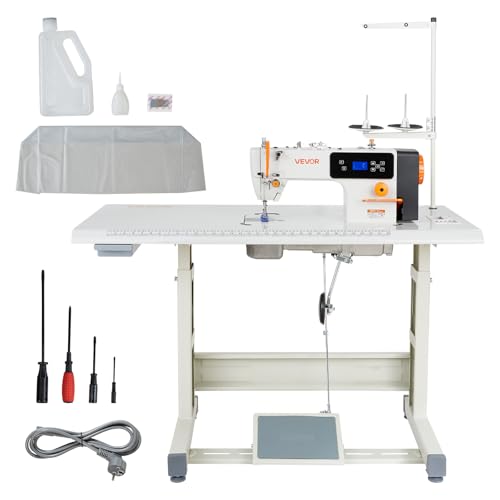
VEVOR Industrial Lockstitch Sewing Machine (550W Servo) — The workshop installation
The VEVOR set is the full industrial proposition, and its title itemises it: an industrial lockstitch sewing machine with a 550W servo motor, a commercial set with table stand, a stated 5,000 SPM high speed, an automatic thread trimmer, and a metal frame, with the title naming denim and cotton sewing among its uses. Read that as the specification of a workstation for someone who will sew furnishing fabric in quantity — a small upholstery business, a rental-property renovator, a home workshop graduating from favours to fees. The lockstitch specialisation is a feature, not a limitation, in this trade: upholstery seams are overwhelmingly straight structural seams, and a machine that does that one stitch at industrial pace and consistency is the machine professionals actually buy.
Two details deserve unpacking. The servo motor, at a stated 550W, brings the industrial virtues home: it turns only on demand, creeps controllably through a piped corner, and still has the ceiling — 5,000 stitches per minute as stated — for the long straight runs down a curtain panel or a sofa back, where pace converts directly into finished rooms. The automatic thread trimmer, easy to overlook, is a production feature: across hundreds of seams it removes a small manual act each time, and in a working week those acts compound into an hour. The title’s mention of denim and cotton tells you the machine’s cloth range is stated conservatively; upholstery-weight woven fabrics sit squarely in that family, but as ever, the manufacturer documentation is where a specific stack’s rating should be confirmed.
- Machine class: industrial lockstitch machine, commercial set with table stand, as stated in the listing title
- Motor: 550W servo motor, as the title states it
- Top speed: 5,000 SPM, in the listing’s own wording
- Thread trimmer: automatic, per the listing title
- Frame: metal frame, the title confirms
- Walking foot provision: the listing title does not specify a walking-foot mechanism — verify in the manufacturer documentation if your fabrics are slippery or heavily layered
- Where to buy: the VEVOR Industrial Lockstitch Sewing Machine (550W Servo) listing on Amazon — check price on Amazon
Strengths
- A complete industrial station — machine, servo, table — in one purchase.
- Servo control plus a high stated ceiling covers both piped corners and long panels.
- The automatic trimmer quietly multiplies productivity across a suite’s worth of seams.
Trade-offs
- Industrial permanence: this is furniture that sews, and it needs its own address.
- Lockstitch specialisation means no zigzag seam finishes from this machine.
- The title leaves the feed mechanism unspecified, which layered-fabric sewers should pin down.
Best for: readers building a genuine upholstery capability — regular re-covering, soft-furnishing work for others, room-by-room renovation. Not suited for: occasional cushion sewers, for whom the domestic picks below sew the same covers without claiming the spare room.

Industrial Upholstery Sewing Machine Set (550W) — Named for the trade
The second industrial pick wears its purpose in its name: a 550W industrial sewing machine set, an upholstery sewing machine, a commercial machine, described also as a long arm quilting machine for tailors and drapery manufacturers. That audience line — tailors and drapery manufacturers — is the most upholstery sentence in this entire guide. Drapery is upholstery’s closest cousin: wide panels, long seams, heavy cloth handled in quantity. A set marketed to the drapery trade is a set built for the scale this category is about, and the long-arm description promises the workspace around the needle that wide panels demand.
Now the honesty this guide owes you. The listing title contains a contradiction: it describes the set as an upholstery sewing machine “with Motor” and then closes with the parenthesis “(Excluding Motor)”. Both cannot be the final word, and this review will not pretend to know which phrase governs the package that arrives. The correct response is procedural, not dramatic: before purchase, establish from the listing’s full text and the manufacturer documentation whether a motor is included, and if it is, which motor. A 550W figure appears in the title as the set’s headline, which suggests the intended configuration, but “suggests” is not “states”, and on an industrial purchase the difference is worth an email. Buyers who do that homework get a purpose-named upholstery set; buyers who skip it are gambling on a parenthesis.
- Machine class: industrial sewing machine set, commercial, per the seller’s title
- Stated rating: 550W in the listing title
- Intended users: tailors and drapery manufacturers, listed in the title; upholstery named as the machine’s purpose
- Arm description: long arm, from the listing title
- Motor inclusion: the listing title contradicts itself (“with Motor” / “Excluding Motor”) — confirm the package contents before purchase
- Speed and stitch data: not printed in the listing title — consult the manufacturer documentation
- Where to buy: the Industrial Upholstery Sewing Machine Set (550W) listing on Amazon — check price on Amazon
Strengths
- The only pick whose very name is upholstery, aimed at the drapery-and-furnishing trades.
- Long-arm workspace suits the wide panels that define this category.
- A commercial set format for buyers furnishing a workshop in one order.
Trade-offs
- The motor contradiction in the title must be resolved before money moves.
- Key performance figures are absent from the title and live in the documentation.
- Like all industrial sets, it trades portability for permanence.
Choose it for: drapery and upholstery workshops that value purpose-built scale and will verify the package first. Pass if: you want every specification settled in the title itself — the VEVOR above is the more explicit document.

SINGER 4432 High Speed Heavy Duty Sewing Machine (Black) — Domestic workhorse
Crossing to the domestic camp, the 4432 in black is the classic heavy-duty proposition restated for furnishing work: thirty-two stitches delivering one hundred and ten applications, fifty percent more power aimed at thick fabrics, a top speed of 1,100 stitches per minute, and a one-step buttonhole. Translate those claims into upholstery. The power claim addresses the sandwich — the piped corner, the zipper ply, the folded hem of a curtain panel doubled over its lining. The pace addresses the metres: a pair of curtains is a marathon of straight seams, and a machine that cruises them briskly returns whole evenings to their owner. The thirty-two stitches cover the furnishing repertoire from construction seams to the zigzag that tames fraying edges and the decorative rows that edge a cushion flange.
The one-step buttonhole might look like a garment feature trespassing in a furniture guide, until you price cushion backs. Buttoned closures are the classic alternative to zippers on cushion covers, tab-top curtains hang by buttoned or sewn tabs, and a one-step mechanism makes those closures a production line rather than a penance. In black, the machine also survives the aesthetic test of living in a workroom rather than a sewing closet. For the household whose upholstery ambitions are real but episodic — the annual cushion refresh, the inherited armchair, the rental’s curtains — this is the guide’s centre of gravity: enough machine for the sandwich, no workshop required.
- Stitch count: 32 stitches, stated as 110 applications in the listing title
- Top speed: 1,100 stitches per minute, as printed in the title
- Power claim: 50% more power for thick fabrics, as the listing title has it
- Buttonhole: one-step style, in the seller’s title
- Extension table: not mentioned in the listing title — wide-panel sewers should check the manufacturer documentation for options
- Where to buy: the SINGER 4432 High Speed Heavy Duty Sewing Machine (Black) listing on Amazon — check price on Amazon
Strengths
- The thick-fabric power claim speaks directly to upholstery’s layered stacks.
- Pace for long seams plus a stitch bench that finishes fraying furnishing weaves.
- One-step buttonholes serve cushion closures and curtain tabs alike.
Trade-offs
- No extension table is promised in the title, so wide panels need a supporting surface arranged by you.
- Domestic scale sets a ceiling: daily commercial re-covering belongs to the industrial sets.
- Speed must be governed by foot control alone on the trickiest piped corners.
Right for: home upholsterers working piece by piece — cushions, chairs, curtains — on a machine that also serves the household. Wrong for: anyone whose upholstery is a business with deadlines measured in suites per week.

SINGER Heavy Duty 4532 Next Evolution Sewing Machine — Smooth operator
The 4532 takes the same thirty-two-stitch bench as the 4432 and rebuilds the experience around a different motor philosophy. Its title lists thirty-two built-in stitches, a metal frame, a one-step buttonhole, and a new DC motor credited with more power, more speed and smoother sewing. In upholstery, smoothness is not a luxury adjective. The craft’s hardest moments are its slowest — easing a piped corner around, stitching a zipper’s end, starting a seam on a stack that must not be shoved into misalignment by a lurching start. A motor whose manners are best at walking pace is a motor designed, whether it knows it or not, for furnishing work.
The comparison with its classic sibling is the interesting shopping decision in this guide’s domestic half. On paper the stitch benches match; in the chair they differ in temperament. The 4432’s proposition is pace and a proven mechanical formula; the 4532’s is refinement at the moments upholstery is actually decided. A sewer whose projects are mostly long curtain seams will feel little difference. A sewer whose projects are mostly cushions — corners, piping, closures, four dense intersections per cover — will feel it on every piece. Neither is the “better” machine in the abstract; they are tuned for different ends of the same craft, and this guide would rather say so than crown one.
- Stitch count: 32 built-in stitches, as the title states it
- Motor: new DC motor, described in the title as giving more power, speed and smoother sewing
- Chassis: built around a metal frame, per the listing
- Buttonhole: one-step style, the title confirms
- Top speed figure: not printed in the listing title — the manufacturer documentation carries the rated figure
- Where to buy: the SINGER Heavy Duty 4532 Next Evolution Sewing Machine listing on Amazon — check price on Amazon
Strengths
- DC-motor smoothness serves the slow, dense moments — corners, piping, zipper ends.
- The full 32-stitch bench finishes edges and closes cushions without a second machine.
- Metal-frame composure under the sandwich’s pushback.
Trade-offs
- The title withholds a numeric speed, leaving long-seam pace unquantified from the listing.
- It competes with its own sibling; buyers must choose a temperament, not just a specification.
- Workspace for the widest panels still has to be improvised around a domestic bed.
Suits: cushion-focused home upholsterers whose work is corners and closures more than marathons. Skip it if: your upholstery is mostly curtain yardage, where the classic model’s stated pace is the simpler bargain.

SINGER Heavy Duty 4511 Next Evolution Sewing Machine — The simple line
There is a furnishing sewer this guide keeps meeting: the one who sews cushion covers, simple curtains, chair pads and the occasional roman blind, who has no interest in decorative stitching, and who regards a sixty-stitch menu the way a carpenter regards a chocolate teapot. The 4511 Next Evolution is built for that reader. Its title lists eleven built-in stitches, a metal frame, a four-step buttonhole, and the same new DC motor as its 4532 sibling, with the same promise of more power, speed and smoother sewing. Eleven stitches sounds like a limitation until you inventory what upholstery actually uses: straight stitch in two lengths, a zigzag for edges and zipper anchoring, and a buttonhole method for closures. The 4511’s bench is not a reduced version of the craft’s needs; it is suspiciously close to an exact list of them.
The four-step buttonhole is the honest compromise in the package — cushion-back buttons will take a little more guidance than on the one-step models — and the smoothness inheritance from the DC motor is the compensating luxury, present where this machine’s owner will actually feel it, at the corners and closures. As with the VASPOW-class minimalism elsewhere on this site, the argument is about attention: fewer settings between the sewer and the seam means more of the sewer’s mind on the fabric, the piping and the pattern match, which is where upholstery quality is truly decided. Buy the 4532 if the wider bench calls to you; buy this if it doesn’t, and spend the difference on better fabric.
- Stitch count: 11 built-in stitches, per the seller’s title
- Motor: new DC motor, described in the title as giving more power, speed and smoother sewing
- Frame: metal frame, as printed in the title
- Buttonhole: four-step style, as the listing title has it
- Decorative stitch range: deliberately narrow — the listing title promises a working set, not a library
- Where to buy: the SINGER Heavy Duty 4511 Next Evolution Sewing Machine listing on Amazon — check price on Amazon
Strengths
- A stitch bench matched almost exactly to furnishing’s real operations.
- DC-motor smoothness at the corners, where this craft is judged.
- The simplest ownership proposition in the guide’s domestic half.
Trade-offs
- Four-step buttonholes slow down buttoned cushion closures.
- Decorative edging beyond the basics is outside the bench.
- Heavy daily workloads belong, as ever, to the industrial sets.
Best for: practical furnishing sewers — covers, curtains, pads — who want the craft’s essentials without ornament. Not suited for: sewers who trim cushions decoratively or want one-step closures for production buttoning.
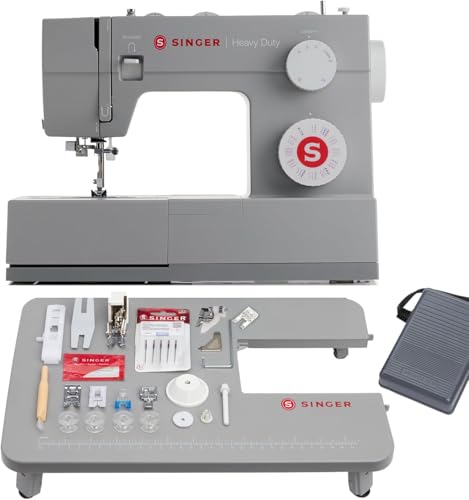
SINGER 4452 Heavy Duty Sewing Machine Holiday Bundle — Table included
The 4452 bundle understands the assignment in a way spec sheets rarely do: its title leads with an extension table and two presser feet included, wrapped around the familiar formula of thirty-two built-in stitches delivering one hundred and ten applications and fifty percent more power for thick fabrics. The extension table is the headline for upholstery, full stop. A cushion cover panel sliding off a small machine bed is a panel being steered by gravity; the same panel resting level on an extended surface is being steered by the feed dogs, which is the entire difference between seams that wander and seams that run true over distance. That the table arrives in the box, fitted to the machine, rather than as a later research project, is a genuine practical virtue.
The two extra presser feet extend the same logic — feet are how a general machine specialises, and in furnishing work the zipper and piping-adjacent feet are the ones that earn their drawer space, though the listing does not name the included pair, so confirm their identity on the product page if a specific foot is on your list. The “Holiday Bundle” framing is marketing seasonality; the contents are useful in every month. For a sewer setting up a first real upholstery corner — machine, surface, feet, one delivery — this bundle is the most complete domestic starting point in the guide, and its thick-fabric power claim matches the sandwich work it will be asked to do from the first cushion onward.
- Stitch count: 32 built-in stitches, stated as 110 applications in the listing title
- Power claim: 50% more power for thick fabrics, per the listing
- Included surface: extension table, per the title
- Included feet: two presser feet, listed in the title; their types are not named there — check the product details
- Buttonhole style: not specified in the listing title — verify in the manufacturer documentation if closures are central to your projects
- Where to buy: the SINGER 4452 Heavy Duty Sewing Machine Holiday Bundle listing on Amazon — check price on Amazon
Strengths
- The extension table answers upholstery’s workspace problem straight out of the box.
- Full 32-stitch bench with the thick-fabric power claim behind it.
- A one-delivery setup for a new furnishing corner.
Trade-offs
- The included feet are unnamed in the title, so a specific must-have foot may still be a separate purchase.
- Buttonhole details are likewise left to the documentation.
- The table adds storage bulk when the machine is packed away.
Choose it for: first-time upholstery setups where workspace, not features, is the binding constraint. Pass if: you already own a suitable table surface and would rather choose your feet individually.
How Do You Choose Upholstery Fabric That Sewing and Sitting Both Approve Of?
Furnishing fabric is sold by promises a garment sewer never has to evaluate. Durability is discussed in rub counts — laboratory abrasion cycles that sort a delicate occasional-chair silk from a family-sofa warrior — and while this guide quotes no figures for specific fabrics, the principle belongs in every purchase: the fabric on a hallway bench lives a harder life than the fabric on a bedroom chair, and its weave should be chosen accordingly. Tight weaves with short floats resist snagging and hold seam allowances better; loose, slubby weaves look artisanal and fray like they mean it, demanding the generous allowances and finished edges the mistakes section warns about.
Sewability has its own checklist. Hold a candidate fabric to the light: if you can read the weave’s openness easily, expect the sandwich to need a stabilising layer. Bend it: furnishing fabric should fold with authority, not collapse, or cushion covers will bag at the corners within a season. Check the reverse for coatings — some furnishing fabrics carry a backing that stiffens them pleasantly and feeds oddly, sliding differently under a foot than its face suggests, which is another argument for the test sandwich made from the real cloth. And run a thumbnail across the cut edge in the shop if the staff allow it; a fabric that sheds its edge at a touch will shed it at your seams, and no stitch in any of these machines’ benches can legislate against a fabric determined to unravel.
Sunlight deserves a vote too. Furnishing fabric fades at rates that vary enormously by fibre and dye, and the chair that lives in a south-facing bay will testify to the difference within a few summers. If your project piece has a sunny address, weigh fade resistance alongside rub resistance when you choose, rotate cushions as a household habit, and accept that the sewing — however well the machine does it — is only ever preserving a fabric that light is quietly editing. Choosing a slightly deeper tone than the room’s current fashion is the old upholsterer’s hedge, and it has saved many covers from looking tired before their seams are.
Colour and pattern deserve a cold eye as well. Large repeats are glorious and expensive in waste; stripes are honest tailors that show every wandering seam; plains hide a multitude of learning curves and are the wise first-project choice. The machine cannot rescue a fabric decision, and upholstery fabric is bought in quantities that make mistakes heavy — literally, by the kilo, in the remnant bin. Choose the cloth as carefully as the machine, and the two will get along for years.
The Machine Is Only Half the Workshop: Tools Upholstery Actually Runs On
New upholsterers are often surprised how much of the craft happens away from the needle. Removal comes first chronologically and teaches the most: a staple lifter and patience dismantle the old cover, which then becomes the pattern for the new one — label every panel as it comes off, photograph the order of assembly, and the chair itself will tutor you in its own construction. A long ruler, a tailor’s chalk that brushes out, and proper shears sized for furnishing weights turn cutting from a wrestling match into a measurement exercise. Foam, where it is replaced, is cut with an electric carving knife or a serrated blade in most home workshops, a sentence that sounds like a joke until you have tried scissors.
At the machine, the supporting cast is feet and fasteners. A zipper foot and a piping-friendly foot arrangement cover the category’s signature operations; clips replace pins wherever batting is involved, because pins vanish into foam sandwiches and reappear at the worst moments; a walking presser arrangement, where a domestic machine offers one, tames slippery linings. Beyond the machine sit the closure hardware — zippers by the metre with loose sliders, buttons and their covering kits — and the finishing tools: a staple gun for the underside work that almost every re-cover ends with, cambric dust cover for the base, and the mallet that persuades tacks and corners. Budget for this ecosystem when you budget for the machine, whichever camp you choose from the picks above; the industrial sets assume it, and the domestic machines deserve it.
A Sensible Ladder for Your First Three Projects
Ambition in upholstery should climb stairs, not leap. The first project that teaches the most per metre of fabric is a set of boxed cushion covers with piping and zippers — every signature operation in the craft, at a scale where mistakes are measured in centimetres and the fabric bill stays merciful. Sew them in a plain, forgiving weave, and let the set be your machine’s true audition: corners, closures and pattern-free panels will tell you more about your pick’s manners than any specification sheet.
The second stair is a set of dining chair pads or drop-in seats, where the sewing is simpler — mostly covers and ties — but repetition enters: six identical pieces expose any inconsistency in your measuring, cutting or feeding, and the set only looks like a set if the machine and its operator hold a line across all six. The third stair, taken when the first two feel calm, is a single armchair, ideally a structurally simple one, re-covered panel by panel from its own dismantled skin. Graduates of that chair own a skill that compounds for life: every subsequent piece of furniture in the house is evaluated not by its tired fabric but by its bones, and the machine that climbed the ladder with you has long since paid for its table space in rescued furniture alone.
Six Machines for Big Work, Compared
| Machine | Camp | Stated power or motor | Workspace story |
|---|---|---|---|
| VEVOR Industrial Lockstitch Set | Industrial | 550W servo; 5,000 SPM stated | Table stand included |
| Industrial Upholstery Set (550W) | Industrial | 550W headline; motor inclusion to verify | Long arm, per title |
| SINGER 4432 (Black) | Domestic | 50% more power for thick fabrics; 1,100/min | Standard bed |
| SINGER 4532 Next Evolution | Domestic | DC motor — power, speed, smoother sewing | Standard bed |
| SINGER 4511 Next Evolution | Domestic | DC motor — power, speed, smoother sewing | Standard bed |
| SINGER 4452 Holiday Bundle | Domestic | 50% more power for thick fabrics | Extension table included |
How Do You Keep a Two-Metre Seam Straight When the Fabric Outweighs the Machine?
Gravity is the unseen hand in every long upholstery seam. A curtain panel or sofa-back section weighs enough that its overhang pulls the work sideways and backward, and the sewer — feeling the seam drift — compensates by steering, which bends the seam the other way. The professional answer is embarrassingly unmechanical: arrange the room so the fabric never hangs. Sew at a table big enough to hold the whole panel, or extend the machine’s surface with the extension table, a stack of books planed level, or a second chairback of exactly the right height behind the machine so finished work accumulates instead of dangling. Feed from a supported pile, not from the floor.
Technique fills the remaining gap. Mark the seam line on wide panels rather than trusting the foot’s edge guide across two metres of stripe. Sew long seams in the same direction as the fabric’s pattern runs, so any residual creep moves the pattern uniformly instead of twisting it. Stop with the needle down every half metre to let the work settle and re-register the layers — an upholstery seam is a journey with waypoints, not a single gesture. And when pattern matching matters, baste or clip the critical checkpoints — the stripe junctions, the floral repeats — before the machine goes near them. The picks in this guide differ in pace and polish, but all of them sew straighter in a room arranged for the work than a theoretically better machine sews in a room arranged against it.
One more craft border worth marking while panels are on the table: the moment upholstery turns decorative — a monogrammed cushion front, a personalised chair back — the work crosses into embroidery’s territory, with hoops and stabilisers of its own. Readers planning personalised furnishing should browse Best Embroidery Machines for Hats and its neighbouring guides with a transferable lesson in mind: curved and three-dimensional items each demand dedicated workholding, in embroidery as in upholstery, and the accessory budget deserves planning alongside the machine budget in both crafts.
Where Do Home Upholsterers Most Often Go Wrong?
The first error is measuring once. Upholstery panels should be measured on the furniture, with the foam in place and compressed as it will sit, because a cushion cover sewn to the foam’s relaxed dimensions will strangle the core or wrinkle like a raisin depending on the direction of the mistake. The second is skipping the closure plan: a beautiful cover with no way to remove it is a future regret upholstered in your favourite fabric. Decide zipper, buttons or envelope before cutting, and buy the closure hardware with the fabric.
Third, sewers new to furnishing fabric underestimate fraying, sew tidy narrow seam allowances, and watch them dissolve in the first wash or the first year of sitting. Furnishing seams want generous allowances and finished edges. Fourth, pattern matching gets budgeted as an afterthought, and the fabric runs out one cushion before the set completes — buy for the match, not the metreage, and keep the offcuts for the test seams this guide keeps preaching. Fifth, the workspace error returns: sewing a suite’s worth of covers on a machine perched on a wobbly tray table, then blaming the machine for seams that wander. Support the work. Finally, a cleaning note that every upholsterer learns eventually: a freshly re-covered room deserves a deep clean beneath and behind the furniture before it all goes back, and the heavy-duty end of carpet care has its own dedicated survey in Best Heavy-Duty Carpet Cleaning Machines for readers mid-renovation.
When Is a Piece Worth Re-Covering at All?
Underneath every upholstery project sits an economic judgement the machine cannot make for you. Re-covering earns its fabric and hours when the piece’s bones are better than its skin: a hardwood frame that does not rock or creak, springs that still answer a palm with resistance, a shape that suits the room it will return to. Older furniture frequently passes this test with honours — frames from eras of solid timber and hand-tied springs outclass much of what is sold new at household prices — which is why the craft persists. A wobbly flat-pack frame in tired fabric fails the same test, and no machine in this guide can sew longevity into furniture that was not built with any.
Sentiment is a legitimate line in the ledger, provided it is entered honestly. A grandparent’s chair, a first-apartment sofa with a decade of evenings in it — these carry value that a spreadsheet misses, and re-covering them is partly an act of keeping. The practical counsel is to spend the sentiment budget on fabric you will love daily, since the labour is identical either way, and to let the machine decision follow the project list the sentiment creates: one beloved chair points to the domestic picks; a houseful of inherited bones points, over time, toward the industrial end of this guide. Either way, the first dismantled panel will tell you whether the bones deserved your faith, and it will tell you before the expensive fabric is cut — one more reason the old cover comes off slowly, with a camera nearby.
Final Recommendation
Sort yourself by rhythm. If upholstery is becoming a practice — regular pieces, other people’s furniture, a workshop taking shape — the industrial sets are the honest tools: the VEVOR for its explicit, complete specification, the upholstery-named set for its drapery-trade scale once its motor question is answered in writing. If upholstery is a beloved household skill exercised piece by piece, the domestic four divide by temperament: the 4432 for pace and a proven formula, the 4532 for slow-moment smoothness, the 4511 for the essentials without ornament, and the 4452 bundle for the workspace that makes wide work civilised from day one. Whichever camp you choose, spend your first session sewing test sandwiches from your actual fabric, arrange the room so gravity works for you, and let the first cushion be the plain one — the good fabric deserves the second attempt, and so does the furniture it will spend a decade on.
Frequently Asked Questions
Do I really need an industrial machine to re-cover a chair?
For one chair, almost certainly not. A domestic heavy-duty machine of the kind in this guide will sew the panels, piping and closures of a typical armchair, provided you work slowly at the dense corners, support the panels properly, and test your fabric sandwich first. Industrial machines repay their footprint when the work becomes plural — suites, regular commissions, a renovation business — or when your fabric choices run to the heaviest furnishing weights as a matter of routine.
What stitch should I use for upholstery seams?
A straight stitch of medium length does nearly all structural upholstery work; it is the stitch the industrial lockstitch picks are specialised for. Lengthen it slightly on thick sandwiches so the needle is not perforating the fabric into weakness, and use zigzag where its jobs appear: finishing fray-prone edges and anchoring zipper ends. Decorative topstitching, where a design calls for it, is the same straight stitch executed slowly with a guide, because on furniture the visible seam is part of the tailoring.
How do I sew piping without the cord twisting?
Cut the covering strip on the bias so it can ease around the cord and around corners, keep the cord untwisted as you feed the sandwich, and sew with the foot that lets you stitch closest to the cord — a zipper or piping foot. Work slowly and let the feed dogs set the pace; twisting usually enters when the operator pushes one layer faster than the other. Practise on a metre of scrap cord first: piping is a rhythm skill, and ten calm minutes of rehearsal will show in every cushion that follows.
What about outdoor furniture fabric?
Outdoor cushions use solution-dyed acrylics and olefins that are stiffer, more slippery and more UV-armoured than indoor weaves, and they sew well on the heavy-duty picks here with two adjustments: a fresh, sharp needle, because the coated fibres dull points quickly, and clips instead of pins, because the fabrics show punctures and resist pinning anyway. Work slowly at piped corners, where outdoor fabrics are at their most board-like, and store finished covers out of the sun they were built to endure — even the toughest weave appreciates the mercy.
Can these machines sew through foam?
Thin foam and batting as part of a fabric sandwich — the standard cushion construction — is normal work for the picks here, sewn slowly with the layers clipped together so nothing shears. Thick foam blocks are a different matter: upholstery foam is usually cut and glued, or sewn only at its fabric covering, rather than stitched through its full depth on a domestic machine. If a project design asks for deep foam sewing, check the specific construction against the manufacturer documentation for your machine before the foam is cut.
Why do my cushion corners come out rounded instead of sharp?
Usually a surplus problem: too much fabric and batting trapped in the corner seam, or the corner stitched with the layers slightly shifted so the point fills unevenly. Trim and grade the seam allowances at corners, keep the sandwich registered with clips right up to the corner stitch, turn the cover with a point turner rather than a sharp tool, and coax the corner out from inside. Sharp corners are made as much at the cutting table and the turning stage as at the machine.
Should I remove the old cover before or after buying the machine and fabric?
After — and photograph everything before a single staple moves. The old cover is your pattern, your assembly manual and your evidence of how the maker solved the corners; dismantling it before your machine, fabric and closures are on hand strands the chair in pieces while deliveries drift. Work in the other order: choose the machine for the project list, order fabric with the matching margin, assemble tools and hardware, then strip the piece panel by labelled panel in one session. The chair will be back together while your memory of its construction is still warm, which is worth more than any single tool in the workshop.
How much fabric should I buy for a first re-covering project?
More than the bare measurement, by a margin that covers pattern matching, a test seam allowance, and one honest mistake. Measure the piece with the old cover removed or over it, panel by panel, add seam allowances generously because furnishing weaves fray, and if the fabric has a repeat, buy to the repeat rather than the metre. Keep every offcut until the project is finished — they are your test sandwiches, your piping strips, and your insurance, all in one pile.
Related Guides
Re-covered furniture usually lands in a room that deserves furniture built to match its ambitions, and readers choosing the seating itself — rather than rescuing it — will find our survey of Best Heavy-Duty Recliner Chairs a fitting companion. The dressmaking and heavy-duty carpet guides linked in the body above complete the circle for readers whose project list spans garments, furnishings and the rooms they live in.


