What's inside
- Key Takeaways
- Quick Picks
- How Do You Tell a Genuine Bargain From a Cheap Mistake?
- Which Bargain Vacuums Are Worth Hunting Down First?
- How Should a Bargain Hunter Time and Check a Purchase?
- What Floors and Homes Suit the Bottom of the Market Best?
- How Do Refurbished Machines and Warehouse Deals Fit the Hunt?
- What Does a Bargain Cost to Run After the Till?
- What Are the Most Common Mistakes Down at This End of the Market?
- How Do the Bargain Shelves Break Down, and Where Should You Stand?
- Final Recommendation
- Frequently Asked Questions
- Related Guides
As an Amazon Associate I earn from qualifying purchases. This post may contain affiliate links at no extra cost to you.
cottageverdict.com is reader-supported. When you buy through links on our site, we may earn an affiliate commission.
Where to buy: the linked machines below all live on Amazon, the natural hunting ground for this tier, where the working habit is to check price on Amazon the day you shop and to look twice at the listing — bargain-tier stock rotates through bundle variants, prior-year colours and warehouse returns faster than any other shelf in the store.
There is a sport to buying the best bargain vacuums, and it is not the sport most people think. It is not about finding the lowest number ever printed beside a vacuum cleaner; that number, chased purely, leads to a machine that wheezes by spring. The real sport is hunting down at the market’s floor with your eyes open — knowing which corners a maker can cut safely, which cuts are fatal, and where the genuine bargains actually hide. They hide in prior-year models whose replacements differ by a colour. They hide in open-box returns from people who bought the wrong format for their floors. They hide in unfashionable formats — the canister nobody photographs, the bagged machine in a bagless decade — that clean superbly for a tier below their worth because fashion, not performance, set the price.
This guide is a field manual for that hunt. The five linked picks are the machines we would point a determined bargain hunter at today: an almost absurdly capable little canister, two featherweight uprights that anchor the bottom of their category, an upright with a cord rewind that feels like a pricing error, and a bagged canister from a serious maker sitting at an entry tier because the market currently prefers its debris in cups. The sixth entry is not a machine but the hunting ground itself — prior-year models, open-box stock and quiet clearance corners — discussed as a strategy, because knowing where bargains hide is worth more than any single bargain.
A distinction before we start, because the two ideas are confused constantly: this is a guide about entry price, not about lifetime value. Its sibling guide elsewhere on this site measures vacuums across five years of filters and belts; here, the question is narrower and more urgent — how little can you spend today, at the till, and still walk home with a machine that genuinely cleans? Sometimes the answer serves a student flat for one year. Sometimes it serves a household for five. Both are legitimate hunts, and the picks below say plainly which kind of service each machine offers.
It is worth saying who this guide is not for, because bargain hunting has a temperament and not everyone shares it. If you want the single best machine regardless of tier, with the newest engineering and a decade of flagship support, the market’s lower shelves will feel like a series of small renunciations, and you should shop higher with a clear conscience. But if your situation is a first flat, a rental, a second floor, a tight season, or simply the pleasure of paying a third of the expected sum for nine-tenths of the result, then you are the hunter this manual was written for, and the market’s bottom shelves are stocked, this year as every year, with machines that will make you feel quietly clever every time you open the cupboard.
Ground rules for the hunt, then. Never buy a format your floors cannot use, however deep the discount; a canister at a gift of a tier is still a loss if your home is wall-to-wall deep pile. Never buy a brand so obscure that its filter exists in exactly one listing on Earth. And never confuse a bargain with a gamble: a bargain is a good machine priced low for a knowable reason — fashion, a model change, a returned box. A gamble is a machine priced low for a reason the seller hopes you will discover later. Everything below is the first kind.
Key Takeaways
- Bargain hunting means buying good machines priced low for knowable reasons — model changes, open boxes, unfashionable formats — never unknown machines priced low for hidden ones.
- The Eureka Mighty Mite is the standout of this tier: a light, bagged canister with whole-home manners at an entry-level position.
- Featherweight uprights from Dirt Devil and Amazon Basics anchor the cheapest credible route to carpet cleaning.
- The Eureka PowerSpeed NEU202 adds a cord rewind and LED headlights, features that usually live a tier higher.
- The Kenmore 200 Series shows what happens when a serious bagged canister drifts down to bargain territory: HEPA filtration and a two-motor system included.
- Prior-year models and open-box stock are the hunter’s best ground — the final pick explains how to work them safely.
- Colour is the cheapest specification a vacuum owns: the unfashionable finish of a good machine is routinely its best-priced one, and a cupboard does not care what colour works inside it.
Quick Picks
| Pick | Badge | Why it made the list |
|---|---|---|
| Eureka Mighty Mite Canister 3670M | The bargain of bargains | A featherweight bagged canister that cleans floors, stairs and car interiors for an entry-tier outlay. |
| Dirt Devil Endura Lite Upright | Cheapest credible upright | The bottom rung of upright ownership that still deserves the name, light and simple throughout. |
| Amazon Basics Upright Bagless Vacuum | Staple at a staple price | A plain bagless upright with a washable filter and detachable handle, positioned at the floor of the market. |
| Eureka PowerSpeed NEU202 with Cord Rewind | Features below their tier | Cord rewind, LED headlights and pet tools in a machine priced like it has none of them. |
| Kenmore 200 Series Bagged Canister Vacuum | Serious machine, drifted down | A two-motor, HEPA-filtered bagged canister sitting in bargain territory because fashion moved on. |
| Where Bargains Hide | Prose-only strategy pick | Prior-year models, open-box returns and clearance corners, explained as hunting ground rather than product. |
How Do You Tell a Genuine Bargain From a Cheap Mistake?
We applied three tests to every candidate. The first is the reason test: can we name why this machine sits at this tier? A model superseded by a near-identical successor passes. A format the market has cooled on — bagged canisters in a bagless era — passes. A machine discounted because its maker is unknown, its parts are unlisted and its listing is its only footprint on the internet fails, because the reason for its price is probably inside the housing. Bargain hunters do not need a story for every discount, but they need the discount to be explainable without invoking defects.
The second test is the consumables test, applied with a hunter’s cynicism. A machine is only as cheap as its filter, bag and belt supply, so we checked that each pick’s consumables are standard, stocked and boring. The Mighty Mite’s bags are an industry staple. The uprights’ filters rinse rather than bill. The Kenmore takes bags you can find in a hardware store in a town you have never visited. A bargain whose filter costs like a fine dinner is a subscription disguised as a saving, and several tempting candidates were cut from this list on exactly that ground.
The third test is the exit test: if this purchase disappoints, what have you lost? At this tier, the honest answer should be “very little, and I learned my floors.” Machines were favoured whose failure would be an inconvenience rather than a financial event, whose roles could shrink gracefully — whole-home cleaner demoted to garage duty, upstairs machine, student-flat donation — rather than ending at the kerb. Bargain hunting is a portfolio of small, survivable bets placed on machines with explainable prices, and the picks below are the bets we would place ourselves.
A fourth, softer test deserves mention because experienced hunters swear by it: the community test. Machines that have sold in volume for years accumulate a visible wake — spare parts from multiple sellers, owners discussing belt changes, repair shops that know the model by sight. That wake is evidence no listing can fake, and it is why this guide’s picks are all established designs rather than this season’s debuts. A debut model may well be excellent, but at bargain tiers you are not paid to underwrite experiments; you are paid, in savings, to buy the machine whose story is already written. Let other shoppers fund the research and development. The hunter buys the results.
Which Bargain Vacuums Are Worth Hunting Down First?
Five machines, five different reasons for being cheap: unfashionable brilliance, featherweight simplicity, staple positioning, feature drift and fashion drift. Read for the reason that matches your situation, because at this tier the reason is the recommendation.

Eureka Mighty Mite Canister 3670M — The bargain of bargains
Every bargain hunter eventually meets the Mighty Mite, usually with disbelief. It is a small, bright, bagged canister — the listing even notes it arrives with a handful of bags — that weighs about as much as a large handbag, trails behind you on its cord like an obedient pet, and cleans hard floors, low carpet, stairs, upholstery and car interiors with an enthusiasm entirely out of proportion to its tier. It has been in production, in evolving forms, for longer than many of its rivals’ brands have existed, which in bargain terms is the whole story: the design is amortised, the parts are everywhere, and the price reflects a machine the maker finished paying to develop decades ago.
The format is the bargain’s engine. A canister separates the motor’s weight from your hand, so the wand feels light on stairs and the body bumps along behind. Bagged dirt collection keeps suction consistent as it fills and makes emptying a clean, sealed affair — lift the bag out, bin it, done — which matters in a machine this small, because a tiny bagless cup would need emptying mid-room. On hard floors it is genuinely excellent, the surface this design was born for, and on low-pile carpet and rugs it works hard and honestly. Deep shag will defeat it, and it will not pretend otherwise.
Picture the machine at work in the places uprights fear. It follows you up the stairs with its body bumping cheerfully behind the wand, noses along the skirting boards of a hallway, then rides out to the car to evict a winter of grit from the footwells, all in one outing and all on one bag that will last weeks more. Owners develop an unreasonable affection for these little canisters, and the affection is rational: it is the feeling of having beaten the market fairly, of owning the machine the insiders own. In a guide about bargains, that feeling is not a soft extra. It is the product.
Who should hunt it first? Renters in hard-floored flats, owners of older homes with mixed wood and runners, anyone needing one machine for home and car, and every household that has been quoted flagship money for the crime of having stairs. Its limitations are a short-ish cord by upright standards and a blower-port party trick — the exhaust can be redirected to blow leaves off a porch or inflate a paddling pool — that is more charming than essential. As a demonstration that these low shelves, hunted well, contain real machines, the Mighty Mite stands alone in this guide. Check price on Amazon; it sits at the entry tier and outperforms the position.
- Format: bagged canister, wand and floor tool
- Weight: featherweight class, easy on stairs
- Collection: disposable bags, several included
- Surfaces: hard floors and low-pile carpet
- Tier: entry — the lowest credible whole-home spend
Strengths
- Whole-home versatility from one small machine
- Bags are a cheap, universal staple
- Light enough for stairs, cars and small owners
Trade-offs
- Deep-pile carpet is beyond its brief
- Cord length is modest for large open floors
- Bagged running costs, though small, exist
Best for: hard-floored homes, renters, stairs and car interiors — anyone whose floors suit a canister’s strengths.
Not suited for: deep-pile carpet households, who should take an upright from this list instead.

Dirt Devil Endura Lite Upright — Cheapest credible upright
If the Mighty Mite is the bargain for canister people, the Endura Lite is the same argument translated for upright people, and translation matters: a bargain in a format you dislike is a bargain wasted. This is a light, corded, bagless upright for carpet and hard floors with a rinseable filter and a compact body, positioned at the very bottom of what an upright can cost while still being a real appliance from a real maker with real spares. That last clause is the recommendation. The floor of the upright market is crowded with anonymous machines; this one has a name, a parts trail and a design that has sold in volume, which is what separates the cheapest credible upright from the cheapest available one.
In use, its virtues are the virtues of lightness. It crosses a carpeted bedroom without rearranging your shoulders, climbs stairs in one hand while the other holds the rail, and stores in the sliver of cupboard that student flats and small houses actually possess. The rinseable filter means the machine’s appetite for money after purchase is close to nil — rinse, dry, refit — and the bagless cup keeps the whole proposition free of any consumable errands at all. For a first home, a spare machine for an upstairs floor, or a cleaning cupboard being equipped on a strict budget, that combination is the hunt completed.
Think of it as the household’s second vacuum that accidentally works as a first. Many owners buy the Endura Lite for an upstairs floor, a rental property or a teenager’s imminent departure to a first flat, and then find the main machine gathering dust because the little Dirt Devil is simply less bother to deploy. That pattern — the bargain becoming the favourite — is the surest sign the hunt succeeded, and it recurs in the stories owners tell about this class of machine far more often than about the flagships bought with greater ceremony.
The compromises are written in the same light materials. Deep-pile carpet makes it work for its living, the hose reach is everyday rather than ambitious, and the plastics ask to be treated as an appliance rather than a battering ram. None of this is hidden, and none of it disqualifies the machine from its role: the entry point to upright ownership that a hunter can recommend without crossing their fingers. Buy it for what it is — the bottom rung, honestly built — and it will not insult you by pretending to be the top one.
- Format: corded bagless upright, compact body
- Filtration: rinseable filter, no bags to buy
- Surfaces: carpet and hard floors
- Build: lightweight plastics throughout
- Tier: entry — the floor of credible uprights
Strengths
- Light enough for anyone to carry upstairs
- Running costs close to zero after purchase
- Backed by a major maker’s parts network
Trade-offs
- Deep pile demands real effort from it
- Modest hose and tool reach
- Finish is functional rather than refined
Best for: first homes, upstairs-spare duty and small carpeted flats on a strict budget.
Not suited for: large homes with deep carpets and heavy daily debris.

Amazon Basics Upright Bagless Vacuum — Staple at a staple price
The Amazon Basics upright is what the bottom of the market looks like when a giant retailer decides to occupy it properly. It is a bagless upright for carpet and hard floors with a washable filter, a dust cup in the 1.7-litre class, a cord in the twenty-five-foot class, crevice and upholstery tools in the box, and a handle that detaches so the machine can work above floor level without a wrestling match. Its bargain logic is distribution rather than design: a house brand with enormous buying power pricing a competent staple at the level where own-brand goods always undercut the badges, the way supermarket flour undercuts the miller’s label while baking the same bread.
That logic has a consequence hunters should weigh honestly. The machine itself is a known quantity — the design language is the industry’s standard upright dialect, and its consumables are a washable filter rather than a proprietary cartridge — but the badge carries no decades of vacuum heritage, so the long game depends on the retailer’s continued support rather than a maker’s reputation. At this tier, that trade is usually worth making: the saving is real, the machine is honest, and the risk window is the first year rather than the fifth, because staple designs either work out of the box or reveal themselves quickly.
There is a scenario where this machine is not merely a bargain but the only sensible answer: equipping a property you do not live in. A landlord furnishing a rental, a family stocking a holiday cottage, an adult child setting up a parent’s smaller new home — in each case the buyer needs competence without ceremony, delivery without drama, and a machine whose loss or failure would be a shrug rather than a claim. Staple products exist for exactly this emotional register, and the vacuum aisle’s version of the staple is this upright. Buying it is less like hunting and more like provisioning, and provisioning well is its own quiet form of the bargain art.
As a purchase, it suits the same hunters as the Endura Lite with one difference in temperament: where the Dirt Devil is the featherweight, the Amazon Basics machine is the slightly more settled all-rounder, with the detachable handle giving it the edge on stairs and upholstery for homes that need one machine to gesture at every job. Deep pile remains hard work, the steering is push-and-pull rather than balletic, and nobody will mistake its finish for a premium product. But as the answer to “what is the least I can spend on a proper upright this week,” it is the most straightforward sentence in this guide.
- Format: corded bagless upright, detachable handle
- Capacity: 1.7-litre class dust cup
- Cord: twenty-five-foot class
- Filtration: washable filter, bag-free running
- Tier: entry — house-brand staple positioning
Strengths
- Detachable handle covers stairs and sofas
- Washable filter keeps ownership nearly free
- Straightforward, widely understood design
Trade-offs
- House-brand support replaces maker heritage
- Deep-pile carpets are slow going
- No swivel steering for furniture mazes
Best for: budget-equipped flats, rentals and anyone wanting one plain upright that gestures at every job.
Not suited for: buyers who value a maker’s long vacuum pedigree and parts archive above the saving.
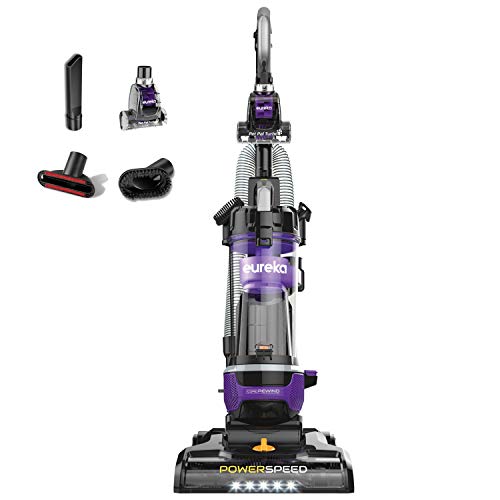
Eureka PowerSpeed NEU202 with Cord Rewind — Features below their tier
Some bargains happen because a machine’s features were priced by an optimistic spreadsheet and then quietly abandoned by the market. The PowerSpeed NEU202 is the clearest case in this guide: a lightweight upright with an automatic cord rewind, LED headlights on the floor head, and a pet brush among its tools — a specification that reads like the tier above — sitting at a bargain position because the PowerSpeed family sells in such volume, in so many variants, that this well-equipped one keeps drifting down to where the plain ones live. The hunter’s job is simply to notice, and to buy the variant with the rewind rather than the variant without it.
Each feature earns its keep in daily currency. The rewind deletes the cord-winding ritual that makes people postpone vacuuming, and a machine used more often is a machine worth more, whatever it cost. The headlights are a small theatre with a practical plot: dust and grit on hard floors, invisible in flat light, glow under a low beam, and the strip along the skirting board stops being a rumour. The pet brush extends the machine onto stairs and upholstery, and the PowerSpeed platform underneath — light body, bagless cup, carpet-and-hard-floor brief — is the same proven base as its plainer siblings, so the bargain carries no experimental risk.
A word about those headlights, because hunters rightly suspect gimmicks at this tier. On carpet they are decoration. On hard floors — the kitchen at dusk, the hallway where the dog shakes off the garden — they are genuinely informative, revealing the grit line along the skirting that flat ceiling light hides completely. Owners find themselves vacuuming in dimmer rooms than they used to, which is the lights quietly restructuring the job. A feature that changes behaviour for the better is not a gimmick; it is the rarest thing at this tier, a luxury that pays rent.
The cautions are the family’s usual ones. Lightweight construction rewards owners who do not throw their appliances around, the bagless filter wants its rinsing rhythm, and the rewind mechanism — like every convenience — is a moving part that grit and haste can jam, though a clean cord wiped before rewinding keeps it sweet for years. None of this dims the central fact: if your hunt is for the most equipment obtainable down at this end of the market from a maker with a real parts trail, the NEU202 is where the hunt ends. Check price on Amazon and compare its variant siblings carefully before choosing — the bargain lives in choosing the right one.
- Format: corded bagless upright, lightweight
- Cord: automatic rewind
- Head: LED headlights for hard-floor debris
- Tools: pet brush plus standard attachments
- Tier: entry price, feature set from a tier up
Strengths
- Rewind and headlights at a bargain position
- Pet tools included for stairs and upholstery
- Proven high-volume platform underneath
Trade-offs
- Variant confusion — check which PowerSpeed it is
- Light build dislikes rough handling
- Filter rinsing is part of the deal
Best for: pet-owning households that want maximum equipment for an entry-level outlay.
Not suited for: buyers who prefer the simplest possible machine with nothing extra to maintain.

Kenmore 200 Series Bagged Canister Vacuum — Serious machine, drifted down
The Kenmore 200 Series is the bargain that fashion created. It is a proper bagged canister in the old, serious mould: a two-motor system that lets the floor head drive its own brush, HEPA filtration, a retractable cord, and a set of cleaning tools riding onboard, wearing a pet-friendly brief and an orange coat. A decade ago this specification was the mainstream’s centre. Then the market fell for bagless cups and cordless sticks, and machines like this one — mechanically excellent, visually unfashionable — slid down the tiers until they arrived at positions their engineering never deserved. The hunter who is immune to fashion collects the difference.
What the engineering buys is composure. The powered head keeps the brush turning at its proper pace regardless of the suction path, so carpet cleaning feels deliberate rather than hopeful, while hard floors are handled by switching to suction and the appropriate tool. HEPA filtration inside a sealed bagged system means the dust you collect stays collected — the emptying ritual is a bag lifted out and binned, with no cup to shake over the garden and no filter to wash in the sink. For households with dust-sensitive members, that containment is not a luxury feature; it is the entire point, available here at a bargain position because the crowd moved on.
There is a further, quieter pleasure in this purchase: it embarrasses expensive machines. Guests who watch the Kenmore work a carpeted room assume a mid-market outlay; the hunter knows the truth and enjoys it privately every clean. More seriously, the machine demonstrates the guide’s thesis in its purest form — that the vacuum market’s pricing is a weather system of fashion passing over a landscape of engineering, and the two correlate far less than shoppers assume. A buyer who internalises that lesson at the Kenmore’s tier will never overpay for a vacuum again, which makes this pick educational as well as practical.
The costs of the choice are the format’s eternal ones: a canister trails behind you and must be driven around furniture legs like a small trailer, bags are a genuine if modest running expense, and the machine is a more substantial object to store than the featherweights above. But measure it as the hunters do — capability per unit of currency at the till — and the 200 Series may be the most underpriced serious cleaner in this entire guide. Buy it if your floors are mixed, your standards are high and your budget is not; that combination is rarer than it should be, and this machine exists precisely for it.
- Format: bagged canister with powered floor head
- Motors: two-motor system, brush driven separately
- Filtration: HEPA, sealed inside the bag system
- Cord: retractable, with onboard tool storage
- Tier: bargain position, mid-market engineering
Strengths
- Powered head cleans carpet with real composure
- Sealed bagged emptying suits dust-sensitive homes
- Engineering far above its current tier position
Trade-offs
- Bags are an ongoing, if small, expense
- Canister handling takes a room or two to learn
- More storage space than the lightweights need
Best for: mixed-floor homes wanting serious, sealed cleaning at an entry outlay.
Not suited for: anyone who knows a trailing canister will irritate them into not cleaning.
Where Bargains Hide — Prose-only strategy pick
The final pick is a map rather than a machine, because the hunters who consistently buy well are not lucky — they are looking in the right places. The richest ground is the prior-year model: when a maker refreshes a line, the outgoing version is frequently identical in motor, brush and bin, differing in colour, bundle or a badge digit, and it is cleared at tiers the current version will not touch for a year. The skill is verification — compare the two listings’ substance, not their adjectives, and confirm the older model’s filters and belts are the standard ones the new model also uses, so your bargain’s parts future is guaranteed by its successor’s popularity.
A note on colour, the humblest hunting ground of all. Makers release the same machine in several finishes, the finishes sell unevenly, and the unpopular one — the purple, the orange, the teal that photographed better than it sold — is cleared at tiers its grey sibling never reaches. A vacuum lives in a cupboard and works among dust; its colour is the least consequential specification it owns, and the market’s willingness to discount it is a small, reliable gift to buyers who agree. Two of this guide’s five machines wear exactly such unfashionable coats, which is not a coincidence. It is the thesis, wearing orange.
The second ground is open-box and warehouse-return stock, where machines come back because the first buyer’s floors, stairs or storage were wrong, not because the machine was. Hunt it with a checklist: all tools present, filter clean or replaceable cheaply, brush roll free of the previous home’s hair, and a returns path if the box’s story turns out to be fiction. The third ground is the quiet clearance corner — end-of-line colours, bundle variants missing a minor tool, the canister format in a stick season — where the discount’s reason is pure fashion and the machine underneath is untouched by it. Work all three grounds with the reason test from this guide’s opening, and the market’s floor becomes what it should be: not a risk, but a hunting reserve stocked by other people’s timing, taste and mistakes.
- Ground one: prior-year models cleared at refresh time
- Ground two: open-box returns with a full checklist
- Ground three: unfashionable colours, bundles, formats
- Rule everywhere: the discount needs a knowable reason
- Always: verify parts are standard before buying
Strengths
- Finds real machines below their honest tier
- Reasons are checkable before money moves
- Works in every season, not just sale weeks
Trade-offs
- Stock is unpredictable and cannot be scheduled
- Open-box buys demand inspection discipline
- The exact model wanted may never appear
Best for: patient buyers with flexible timing and a clear picture of their floors.
Not suited for: anyone who needs a specific machine this week, who should buy from the five picks above.
How Should a Bargain Hunter Time and Check a Purchase?
Timing at the bottom of the market is about stock rhythms rather than sale banners. Model refreshes cluster around the seasons when makers launch new lines, and the outgoing stock’s pricing softens in the weeks around those launches — the hunter who has already chosen two or three acceptable models can simply wait for one of them to drift. Clearance corners refill after the big retail events, when returns and overstock land together. And the open-box shelves are at their fullest in the month after the holiday season, when the nation’s wrong-format purchases come home to roost. None of this requires urgency; bargain hunting rewards the buyer who can say “not this week” without the house suffering for it, which is why equipping yourself with any serviceable machine now and upgrading opportunistically later beats waiting, vacuumless, for the perfect discount.
The pre-purchase check is a five-minute ritual. Confirm the format suits your floors. Confirm the consumables are standard and stocked. Confirm the listing’s variant is the variant you think it is — at this tier, one letter in a model code can mean the difference between a cord rewind and none. Confirm what is in the box, tool by tool. And confirm the returns path, because this tier is exactly where a no-faults return policy earns its keep. Five minutes, five confirmations, and the difference between a bargain and a gamble stops being luck and becomes procedure.
What Floors and Homes Suit the Bottom of the Market Best?
Hard floors are the bargain hunter’s home turf. Suction-only cleaning is mechanically simple, which is why a featherweight canister like the Mighty Mite can be simultaneously the cheapest credible machine in this guide and genuinely excellent at its job — there is no brush-roll engineering to skimp on, no pile to agitate, just airflow, a good floor tool and a sealed path. Homes with wood, tile, laminate and low rugs can therefore shop the very bottom of the market with confidence that the expensive machines’ advantages barely apply to them. Their money is better kept, or spent on the Kenmore’s filtration if dust sensitivity argues for it.
Carpet raises the floor of the market — literally. Pile needs a rotating brush, a motor that sustains it, and height adjustment to sit the brush correctly, and each of those is a place where a too-cheap machine cuts the corner that matters. Carpeted households should hunt at the upper edge of bargain territory: the PowerSpeed NEU202’s equipped platform, the Kenmore’s powered head, machines whose cheapness comes from fashion and volume rather than from a missing brush motor. Deep shag and bargain pricing remain natural enemies, and the honest hunter with shag carpet saves a little longer rather than buying the disappointment twice. Stairs, finally, argue for lightness above all specifications — the machine that gets carried is the machine that cleans them — which is why two of the five picks here weigh so little that the stairs stop being a separate cleaning problem altogether.
How Do Refurbished Machines and Warehouse Deals Fit the Hunt?
Between the open box and the brand-new shelf sits a third territory the patient hunter should understand: manufacturer-refurbished stock. These are machines returned under warranty or from retail displays, inspected, fitted with fresh consumables where needed, and resold through authorised channels at positions well below the new equivalent. The attraction is obvious — the machine has effectively been tested twice, once by its first owner and once by the refurbisher’s bench — and the risk profile differs from open-box in one important way: a refurbished unit’s story is documented by the programme that processed it, while an open-box unit’s story is a matter of your own inspection. Hunters who dislike ambiguity often find the refurbished shelf the most comfortable ground in the entire bargain landscape.
Warehouse deals — the scratch-and-dent, damaged-packaging and end-of-pallet listings that large retailers run alongside their main stores — reward a different skill: indifference to cosmetics. A vacuum is a tool that lives in a cupboard and works in dust; a scuffed housing or a crushed outer box has no bearing on the suction inside it, yet the market prices both as if they did. The checks remain the hunter’s liturgy — tools present, filter sound, brush free, returns path confirmed — but applied to warehouse stock they are applied to machines whose discounts were granted for the condition of their cardboard. Few trades in consumer life are more reliably in the buyer’s favour than paying less for a working tool because its packaging had a difficult journey.
One caution governs both territories: consumables and accessories are where returned and refurbished stock quietly sheds value. A missing crevice tool, a filter at the end of its life, a brush roll carrying a stranger’s hair — each is cheap to remedy and tedious to discover late. Photograph the box contents against the listing the day the machine arrives, remedy gaps immediately while the returns window is open, and the refurbished or warehouse route delivers exactly what it promises: a known machine, at an unknown-machine price, with the difference explained entirely by logistics rather than by anything inside the housing.
What Does a Bargain Cost to Run After the Till?
The hunt does not end at the checkout, because a bargain’s running costs decide whether it stays one. The good news is that this guide’s picks were chosen partly for tame appetites: the Mighty Mite’s bags are among the cheapest consumables in the entire vacuum world, the three bagless uprights ask for rinsed filters rather than purchased ones, and the Kenmore’s bags, while a real expense, are a standard size stocked everywhere bags are sold at all. A hunter comparing two candidate machines should perform the same trick as with the machines themselves — price a year of each one’s consumables, in the abstract, before choosing — because at bargain tiers the difference between two machines’ yearly appetites can quietly exceed the difference between their purchase positions within eighteen months.
There is also the matter of the hunter’s own labour, which honest accounting includes. A bagless cup wants emptying and its filter wants a rinse rhythm; a bagged machine wants a bag every month or two and nothing else. Neither is onerous, but they suit different temperaments, and a bargain that fights its owner’s temperament gets used less, cleaned with less, and replaced sooner — the most expensive outcome of all. The cheapest machine to run, in the end, is the one whose small demands you actually meet, which is why this guide describes each pick’s appetite as plainly as its abilities. Buy the appetite you will feed.
What Are the Most Common Mistakes Down at This End of the Market?
The first is buying the number instead of the machine: sorting by price, taking the top result, and discovering that these shelves conceal a substratum of anonymous products whose price is their only specification. The second is format blindness — the deep-discount canister bought for a deep-pile house, the upright bought for a home that is all stairs and hard floors — because a bargain in the wrong shape is a full-price mistake wearing a discount’s clothes. The third is ignoring the variant: at this tier, model families sprawl, and the listing with the rewind, the headlights or the pet brush sits one click away from the listing without them, at a confusingly similar position.
Fourth comes the consumables ambush, discovering in month two that the bargain’s filter is a proprietary shape sold by one store at a confident margin. Fifth is open-box carelessness — accepting a return-grade machine without checking the tools, the filter and the brush, when the whole discount rests on the previous owner’s story being benign. And sixth, subtlest of all, is buying a bargain as a placeholder with no intention of keeping it: a machine bought to be replaced is a machine whose entire price is waste, and the hunter’s discipline is to buy down here as if shopping at the top — researched, format-matched, parts-checked — because at these tiers, chosen properly, it very often serves like it.
How Do the Bargain Shelves Break Down, and Where Should You Stand?
It helps to see this end of the market as three shelves rather than one. The lowest shelf holds the anonymous machines — unbranded, unparted, reviewed by nobody you can verify — and this guide’s advice is simply to walk past it, however theatrical the discounts become. The middle shelf holds the credible floor: house staples and featherweight uprights from known makers, the Endura Lite and the Amazon Basics machine, where the saving is real and the risk is small. The top shelf of bargain territory is where the hunter’s prizes sit — the drifted-down Kenmore, the over-equipped NEU202, the amortised Mighty Mite — machines whose capability belongs a shelf or two higher and whose presence down here is an accident of fashion, volume or time. Most households should buy from that top shelf when their floors allow it, because the distance in capability between the middle and top shelves is large while the distance in outlay, on the right week, can be remarkably small.
Standing on the right shelf also simplifies the future. A machine from the credible shelves has filters you can find, a belt you can change and a maker who will still exist at the next model refresh, so the bargain compounds: cheap to buy, cheap to keep, and — when its years are done — respectable enough to pass to a student flat or a first home rather than a skip. The anonymous shelf offers none of that compounding. Its machines are cheap once, at the till, and expensive in every week that follows, which is the precise opposite of a bargain. Learn to see the three shelves and you have learned most of what this guide knows.
Final Recommendation
One last encouragement for the hesitant: every machine in this guide was chosen to be bought without regret at full bargain-tier position, on an ordinary week, by a buyer who never hunts again. The grounds, the timing and the colour tricks are bonuses layered on top of sound picks, not rescues for unsound ones. Start your hunt with the format, and the shortlist writes itself. Hard floors, stairs and mixed levels point to the Eureka Mighty Mite, the single most capable machine per unit of currency in this guide, with the Kenmore 200 Series as the serious, sealed, powered-head upgrade for households whose carpets and dust sensitivity justify it. Carpeted homes on a strict budget should take the Eureka PowerSpeed NEU202 for its out-of-tier equipment, while the Dirt Devil Endura Lite and the Amazon Basics upright divide the featherweight vote between maker heritage and staple simplicity. Then work the hunting grounds in the final pick before you pay full position for any of them — a prior-year variant or an honest open-box example may be waiting. The market’s bargain floor is not a compromise to be endured; hunted with a reason test, a parts check and a little patience, it is where the clever money in vacuums has always quietly gone.
Frequently Asked Questions
Are bargain vacuums just cheap vacuums with better marketing?
No — the distinction is the reason for the price. A bargain is a capable machine discounted because of fashion, a model refresh, a returned box or a house brand’s distribution power. A merely cheap vacuum is priced low because of what is missing inside it. This guide’s reason test exists to separate the two before money moves, and every pick here passed it.
Is an open-box vacuum a safe buy?
It can be the safest bargain of all, provided you inspect like a sceptic: every tool present, the filter clean or cheap to replace, the brush roll free of hair and damage, and a returns path confirmed before purchase. Most open-box machines were returned for fit — wrong format, wrong stairs, wrong storage — rather than faults, and the discount for other people’s misjudgements is the hunter’s favourite kind.
Why are bagged canisters so often bargains now?
Because fashion moved to bagless cups and cordless sticks, and pricing followed the crowd. The engineering did not get worse; the audience got smaller. A sealed bagged system with HEPA filtration, like the Kenmore in this guide, now sits at tiers that understate its capability — which is precisely the condition bargain hunters exist to exploit.
What is the first thing to check on a suspiciously cheap listing?
The consumables. Search for the machine’s filter, bag and belt as if you needed them tonight. If they are standard, stocked and sensibly priced, the machine has a supportable future and the discount may be genuine. If they are exotic, single-sourced or startlingly priced, the listing’s cheapness is being financed by your future self.
Can a bargain vacuum handle a whole family home?
Some can, and this guide separates them from the small-home machines. The Kenmore’s powered head and the PowerSpeed’s equipped platform are family-capable; the featherweights serve smaller homes and lighter debris better. Match the machine’s stamina to the household’s debris honestly — the wrong match is how bargains acquire their unfair reputation.
How much should I expect a bargain vacuum to last?
Expect the credible floor of the market — the machines in this guide — to serve for years rather than seasons when their filters are kept clean and their brush rolls kept free of hair. The anonymous substratum below them is where the one-year lifespans live. Lifespan at this tier is predicted less by the badge than by two questions you can answer before buying: are the parts standard, and is the design simple? Yes to both is the profile of every long-serving bargain ever bought.
Is it worth waiting for a sale event to buy at this tier?
Usually only if your need is not urgent. Sale events compress the whole market’s pricing, but bargain territory is already discounted by fashion and model cycles year-round, and the hunter’s grounds — prior-year stock, open boxes, warehouse deals — refill on their own schedule rather than the retail calendar’s. A household currently cleaning with a broom and good intentions gains more from buying a credible machine this week than from a marginally better position next quarter.
Related Guides
Keep hunting in good company, and remember that every guide below was written with the same suspicion of full price, the same parts check and the same patience that brought you, quite rightly, to this one in the first place. The same hunter’s eye applied outdoors lives in Best Battery-Operated Pool Vacuums, where the water changes every rule. Brand-focused shoppers can go deeper with Best Bissell Car Vacuums, and households whose floors are mostly carpet should compare against Best Canister Vacuums for Dog Hair — after starting, if you have not already, with the already-published Best Affordable Cordless Vacuums if a cordless is still on the table.


